OF THE RESEARCH PPPs
IN THE RECOVERY PLAN
Factories of the Future
Energy-efficient Buildings
European Green Cars Initiative
Research and Innovation
European Commission Office COV2 04/055 B-1049 Brussels Tel. (322) 299 17 57 Fax (322) 295 80 46
E-mail: [email protected] http://ec.europe.eu/research/industrial_technologies
Final assessment of the research PPPs
in the European Economic Recovery Plan
Factories of the Future
Energy-e
ffi
cient Buildings
European Green Cars Initiative
Europe Direct is a service to help you find answers to your questions about the European Union.
Freephone number (*):
00 800 6 7 8 9 10 11
(*) Certain mobile telephone operators do not allow access to 00 800 numbers or these calls may be billed.
LEGAL NOTICE
Neither the European Commission nor any person acting on behalf of the Commission is responsible for the use which might be made of the following information. The views expressed in this publication are the sole responsibility of the author and do not necessarily reflect the views of the European Commission.
More information on the European Union is available on the Internet (http://europa.eu).
Cataloguing data can be found at the end of this publication.
Luxembourg: Publications Office of the European Union, 2013 ISBN 978-92-79-31244-1
doi: 10.2777/30351
© European Union, 2013
Reproduction is authorised provided the source is acknowledged.
Cover photo: © artstudio_pro, #45246846, 2013. Source: Fotolia.com.
Executive summary ...7
1 Introduction ... 11
2 Brief description of the research PPPs ... 14
Aim and budget under the European Economic Recovery Plan ... 14
The role of industry ... 16
The Factories of the Future PPP ... 17
The Energy-efficient Buildings PPP ... 19
The Green Cars PPP ... 21
3 Assessment of the implementation of the research PPPs ... 24
Setting up the calls ... 24
Evaluation procedures ... 25
Analysis of results... 26
Impact achieved and foreseen ... 27
Other related activities ... 28
4 Achievement and progress towards the objectives ...30
General analysis of consultation ... 30
Effectiveness ... 32
Efficiency ...34
Quality... 37
Level of coverage of the roadmaps ... 38
Initiatives and impact of projects ... 39
Steps towards innovation ... 39
SME participation ...40
Contributions to the Europe 2020 strategy and the ERA...40
5 Research PPPs: the way forward ...42
Covering the innovation chain from research to market: strategy on research and innovation roadmaps ... 43
Research PPPs and the KET policy ...44
6 Findings ...46
7 Conclusions...48
Strengths and weaknesses ... 49
Progress towards objectives ...51
Impact and dissemination ... 52
8 Recommendations ...53
ANNEX A: Projects ...58
Annex A1: Factories of the Future ... 58
Annex A2: Energy-efficient Buildings ... 60
Annex A3: Green Cars ... 63
ANNEX B: Details of the group of experts ...65
Glossary
AIAG: Ad hoc Industrial Advisory Group
E2BA: Energy-efficient Buildings Association
EC: European Commission
ECTP: European Construction Technology Platform
EeB: Energy-efficient Buildings (research PPP)
EERP: European Economic Recovery Plan
EFFRA: European Factories of the Future Research Association
EGVIA: European Green Vehicles Initiative Association
EIB: European Investment Bank
EIT: European Institute of Innovation and Technology
EPoSS: European Technology Platform on Smart Systems Integration
Ertrac: European Road Transport Research Advisory Council
ETP: European Technology Platform
FoF: Factories of the Future (research PPP)
FP7: seventh framework programme (2007–13)
GC: Green Cars (research PPP)
H2020: Horizon 2020 EC framework programme for 2014–20
JTI: joint technology initiative
KET: key enabling technologies
KIC: knowledge and innovation community
LEIT: leadership in enabling and industrial technologies
NCP: national contact point
PPP: public–private partnership
Executive summary
This report details the results of an assessment on the three research public–private partner-ships (PPPs) that are running established under the European economic recovery programme. These research PPPs differ from previous PPPs in that, while the research needs of the pro-gramme are driven primarily by industry, the execution of the calls and propro-gramme manage-ment is undertaken by the Commission. The projects are then run under standard FP7 funding and operating rules, including those of openness and transparency. The three research PPPs cover the areas of Energy-efficient Buildings (EeB), Factories of the Future (FoF) and Green Cars (GC). This assessment builds upon a previous interim assessment carried out in 2011. The overall result of this assessment is very supportive of the research PPP model, although it is noted that few of the projects have yet been completed and so it is still somewhat early to be definitive about the magnitude of the effect in terms of achieved commercialisation. How-ever, the evidence suggests that the activities being pursued under the three research PPPs are more directly relevant to post-project commercialisation than is the case with standard FP7 Cooperation projects, which is a key objective of these research PPPs.
The data used in the assessment comes from a variety of sources but the primary data have been objective and statistical data relating to the relevant calls and call management informa-tion provided by the European Commission, interviews with key stakeholders both within and outside the PPPs and an online survey of more than 700 stakeholders, mainly participants in the PPP programmes. These data have been supplemented with information provided by the industrial research associations belonging to two of the three PPPs (Energy-efficient Buildings and Factories of the Future (1)), associated workshops and information from parallel assess-ment activities regarding the shape and content of Horizon 2020.
The three research PPPs target strategically important industries. Launched in Novem-ber 2008, the PPPs were set up as a response to the financial crisis with a view to supporting research, development and innovation in the manufacturing, construction and automobile industries, which had seen demand plummet. Although originally envisaged as a short-term measure, the ongoing crisis, linked with a better understanding of the need for a long-term perspective on the support for these strategic industries, has led to a call from industry for a long-term commitment to these economically important industrial sectors and to these PPPs. The industrial stakeholders have mentioned that the current timescale of the action and the level of funding are insufficient to make a significant impact in global terms with regard to European competitiveness and that therefore the combined public and private funds applied to this activity would need to be increased.
The three PPPs were set up with a fairly informal structure that allowed the initiatives to get underway quickly. At the same time the use of standard FP7 funding and operating rules meant that the process was transparent at the point of call issue and proposal assessment. Nevertheless, the informal nature of the roles of the industrial research associations and the ad hoc industrial advisory groups has led to some concern about the openness of the process and the influence of the key players on the whole process. The review found that such doubts as may exist are misplaced and that the evidence shows that the process is open and fair, and
that efforts have always been made to be as inclusive as possible. Despite this, a key finding of the review is that the current roles need to be formalised and published so that the whole PPP activity is as transparent and open as possible to all European organisations.
The review also found good evidence that the activities of the PPPs had resulted in more close-to-market relevant projects and activities than is typically achieved within standard FP7 cooperative projects. Much of this relevance arises from the development and application of the industrially driven multiannual roadmaps which give a long-term context for indus-trial participation. Indeed, indusindus-trial participation by both large companies and small and medium-sized enterprises (SMEs) is significantly higher than with standard FP7 programmes. However, several stakeholders in the process emphasised that, to have significant global impact, the commitment to the PPPs by the public and private sides, both in terms of timescale and resources, needs to be increased.
A significant finding of the review was that, although using standard FP7 rules, the efficiency of the calls was significantly improved, particularly with respect to success rates and shorter time to grant. Despite this, there was strong anecdotal evidence that the process was still burdensome for industrial companies, particularly SMEs and that this can be a hurdle for get-ting involved in the process.
The relevance of the current research PPPs activities is underpinned by the industry-driven multiannual roadmaps. Nevertheless, the range of activities that can be funded under FP7 instruments is limited. Except for the EIB loans scheme associated with the Green Cars PPP, all the other available funding instruments are well-tried pre-competitive schemes. Within this range the PPPs have attempted to create industrially relevant actions, such as with the demonstration-targeted projects. These, however, are still insufficient to address adequately the ‘valley of death’ issues that hinder the commercialisation of leading research ideas. In order to improve the rate of commercialisation, PPPs within Horizon 2020 need also to address higher technology readiness levels (TRLs) within projects, using, where appropriate, schemes such as pilot plants to address close-to-market, but still pre-competitive, innovation actions involving the whole of the industry value chain.
Finally, the review found that while awareness and dissemination efforts were being made by the various public and private bodies associated with the PPPs, these were insufficient to capitalise on the potential benefits arising from these industrially relevant initiatives. While it is clear that the centre of PPP activity is collocated with the industrially active areas, there is little evidence of active and widespread engagement of participants from the new Member States (figures are similar to those of FP7 Cooperation). SME participation in the research PPPs is better when compared with other FP7 calls. In any case, to maximise the impact of the PPPs there should be a more active dissemination to engage a much wider range of SMEs, particularly using multiplier organisations such as trade bodies.
The expert group has formulated five main recommendations, summarised below. Each rec-ommendation has an associated set of actions which are further detailed in the last section.
Recommendation 1: The governance model of the research PPPs should be under-pinned by a higher degree of formalisation, particularly with regard to the roles and duties of the private and public parties to the agreement. The valued contributions and commitments of the various actors involved would thereby be more appropri-ately recognised.
While the expert group recognises that the current governance arrangements have allowed the PPPs to be implemented with speed and are working to achieve the objectives of these PPPs, they nevertheless leave uncertainties regarding the process as a whole, the roles of the individu-als and, hence, the transparency of the whole process to external bodies and organisations. In particular, the role of the industrial research associations and their relationship with the Com-mission needs to be formalised, as does the role of the current ad hoc industrial advisory groups.
Recommendation 2: The research PPP model should be further used, developed and expanded in scope within Horizon 2020 and provided with sufficient funding to achieve a significant industrial effect.
There is good evidence that the research PPPs are capable of moving the research focus towards activities more relevant to exploitation. However, in order to make a significant step forward, there needs to be a long-term commitment from both the public and private sides to sustain support of the initiatives, and the combined level of public and private funding needs to be significantly increased in Horizon 2020 to stimulate sufficient leverage effect. Furthermore, future PPPs should be organised along European value chains to maximise the potential for European wealth creation.
Recommendation 3: The PPPs should work under the Horizon 2020 common rules, but its procedures need to be further streamlined and simplified to increase ease of entry into PPP projects for industry, especially SMEs, and to broaden the appeal to a wider subset of the relevant value chain.
The review identified strong benefits arising from the operation of the PPPs under common framework programme rules. However, while the expert group acknowledges that efforts have been made within the existing PPPs to simplify and streamline the procedures, more effort needs to be undertaken to speed up the entire process from application to grant, and also to streamline the up-front work, particularly for new entrants. While much of the simplification effort for Horizon 2020 has been focused on financial and reporting regulations, these are generally post-award activities. The major hurdle for a new entrant, particularly an SME, is the time and effort in getting to a grant award.
Recommendation 4: The research PPPs in Horizon 2020 need to focus on actions which strengthen innovation activities and the likelihood of European-based prod-ucts and services eventually reaching the markets.
The current PPPs have, within the limits of the instruments available, moved the project activi-ties closer to actions relevant to exploitation. However, PPP actions within Horizon 2020 need to widen the scope by also moving up the TRL scale, involving more innovation activities, and the assessment and review procedures need to focus further on the innovation aspects of the projects.
Recommendation 5: In order to maximise the benefits and widen participation in the research PPP activities and results, awareness about the research PPPs needs to be strengthened, particularly among the o#en hard-to-reach SMEs. SMEs are criti-cal to the industrial competitiveness of Europe and they increase the geographicriti-cal spread of organisations involved along the key value chains.
The current PPPs, while open, have still not achieved widespread awareness, particularly among industrial organisations in new Member States and SMEs. In order to maximise the impact of the programmes, more emphasis needs to be placed on raising awareness. In particular, the industrial research associations’ role as external ambassadors for their PPPs needs to be strengthened and formalised.
This report details the findings of the expert group assessing the three research PPPs launched in November 2008 as part of the European Economic Recovery Plan (2). The purpose of the report is twofold, namely to evaluate the contribution of the PPPs in their respective industrial areas and to make recommendations regarding the implementation of research PPPs within Horizon 2020. Even though this report builds upon the findings of the interim assessment carried out in 2011 (3), this is a new stand-alone assessment.
The research PPPs support research, development and innovation in manufacturing, construc-tion and the automobile industries, each of which had seen a dramatic fall in demand during the initial phases of the financial crisis and also faced significant challenges in the transition to the green economy. Total budgets (including both private and public investments) of the three parallel initiatives, as announced, were as follows.
bȩ In the manufacturing sector, a EUR 1.2 billion Factories of the Future (FoF) initiative to promote the competitiveness and sustainability of the European manufacturing industry.
bȩ In the construction sector, a European Energy-efficient Buildings (EeB) initiative, to promote green technologies and the development of energy-efficient systems and materials in new and renovated buildings with a view to reducing radically their energy consumption and CO2 emissions. The estimated envelope for this partnership was EUR 1 billion.
bȩ In the automotive sector, a EUR 5 billion Green Cars (GC) initiative to improve the sustainability of all European road transport and accelerate the move towards the electrification of road and urban transport (EUR 1 billion of research funding supplemented by EUR 4 billion of EIB loans).
2 EC COM(2008) 800.
3 Interim assessment of the research PPPs in the European economic recovery plan, Publications Office of the European Union, 2011 (ISBN 978-92-79-20425-8).
Introduction
1
The format of this assessment was to review the research PPPs with respect to their imple-mentation as well as their achievements and progress, particularly with respect to eff ective-ness, efficiency, quality and roadmap coverage.
The main information sources used in the assessment were:
bȩ objective and statistical data relating to the calls provided by the European Commission;
bȩ information provided by the industrial research associations and European technology platforms associated with the three areas relating to roadmaps, plans and outputs, as well as opinions regarding the effectiveness of the research PPPs;
bȩ interviews, including interviews with representatives from the industrial research associations and European technology platforms, and also with Members of the European Parliament;
bȩ an online survey of a wide range of research PPP stakeholders;
bȩ the results of impact workshops for both the EeB and FoF research PPPs;
bȩ parallel assessment activities being carried out with regard to the shape and content of Horizon 2020 programmes, in particular the Key Enabling Technologies High-Level Group recommendations.
The main task of the expert group was to analyse whether the research PPP structure is a suit-able model for engaging industry in relevant research and innovation activities and whether it increases the uptake of collaborative research results. The overall assessment has been structured around the following main requirements that a research PPP should maintain and reinforce for the future: (1) transparent processes; (2) efficiency; and (3) clear responsibilities. In order to undertake this assessment the following questions were developed by the expert group to focus the main activity of this assessment.
1. What is the best way of making an open and inclusive research programme while keeping a clear industrial focus and coherence?
2. Are the various parties to the research PPPs meeting these requirements? 3. Are the programme requirements fit for purpose?
4. What is the right approach regarding rules of participation for the research PPPs in Horizon 2020: common rules for all PPPs or tailor-made rules depending upon context?
5. Who should be responsible for the evaluation of proposals submitted to PPP calls and for the overall management of these initiatives in Horizon 2020?
In answering these questions the expert group explicitly acknowledged that, under Horizon 2020, research PPPs of the type of those in the research plan will evolve into contractual PPPs. This evolution to a contractual PPP (and the difference between these and institutional PPPs) is discussed in Section 5.
The expert group was appointed by the European Commission and then operated indepen-dently according to its terms of reference. The panel comprised a mix of experts coming from different fields and backgrounds, some with specific expertise in the technological content of the research PPPs and others with general expertise in research and innovation programmes, strategy and management. Details are given in Annex B.
Aim and budget under the European Economic
Recovery Plan
As a response to the financial and economic crisis, the European Commission launched, in November 2008, the European Economic Recovery Plan, with the aim of restoring consumer and business confidence, restarting lending, stimulating investment in the EU’s economies and creating jobs.
This plan was structured into two pillars. The first was meant to create a major injection of pur-chasing power into the economy, to boost demand and stimulate confidence. The second pillar defined the concept of ‘smart investment’, meaning investing in the right skills for future needs. Three sectors were identified as the most suitable to receive this investment in research (con-struction, automobile and manufacturing), and three major partnerships between the public and private sector were launched:
bȩ the European Green Cars Initiative,
bȩ Energy-efficient Buildings,
bȩ Factories of the Future.
The research plan was adopted by the European Commission on 26 November 2008 and endorsed by the European Council on 11–12 December 2008. A#er a meeting held in Brus-sels on 30 March 2009 between the Commissioner for Research, Innovation and Science and high-level representatives of industry to review progress and discuss priorities for the
Brief description
of the research PPPs
implementation of the research elements of the PPPs, a joint statement (4) was published establishing that the first PPP calls would be published in July 2009. Thus, in an unprecedent-edly short time, the PPPs were launched and the first calls were closed in November 2009, following FP7 rules and procedures.
The principles of relevance, simplification, transparency, continuity, process review and impact assessment were the basis (5) of the implementation process of these PPPs and have been maintained through the deployment period.
The PPP calls gathered topics launched in the work programmes by different FP7 themes and were managed by the Commission services, thereby creating a truly cross-thematic initiative, using common FP7 rules, unlike JTIs which have specific rules, and assuring accessibility to and fairness of the process with non-discriminatory principles.
The PPPs also differ from standard FP7 Cooperation calls in the direct involvement of industry in the dra#ing of the priorities to be tackled, since the research needs as seen by the private side were previously established in a multiannual roadmap discussed and approved by the industry. At the Competitiveness Council meeting on 26 May 2010 (6), it was concluded that research PPPs were crucial in addressing the grand European socio-economic challenges and had the potential to foster productivity and sustainability by focusing on a limited number of industrial sectors, selected on the basis of their potential contribution to European GDP and employment. Based on funding from the EC to be matched by the private sector, the overall indicative research budgets of the three research PPPs for the period 2010–13 amounted to EUR 3.2 bil-lion. The proposed EC contribution is detailed by theme in Table 1. Table 2 shows the final contributions of the different themes to the four annual PPP calls.
Table 1: Initially foreseen indicative funding distribution amongst the various FP7 Coopera-tion themes involved in the research PPPs
Budget
(million EUR) NMP ICT TRS ENE ENV FP7
FoF 400 200 600
EeB 250 100 125 25 500
GC 60 120 220 50 50 500
Total 710 420 220 175 75 1 600
4 http://ec.europa.eu/research/index.cfm?pg=newsalert&lg=en&year=2009&na=ppp-310309
5 Conference: The European RTD Framework Programmes: From Economic Recovery to Sustainability, Valencia, April 2010. 6 Council of the European Union, ‘Conclusions concerning various issues related to the development of the European Research Area’,
Table 2: Final funding distribution amongst the various FP7 Cooperation themes
Final
(million EUR) NMP ICT TRS ENE ENV FP7
FoF 416 245 661
EeB 261 105 160 21.5 547.5
GC 60 120 233.7 10 15.5 439.2
Total 737 470 233.7 170 37 1 647.7 For both Energy-efficient Buildings and Factories of the Future the final EC funding has been higher than originally envisaged. For Green Cars the research PPP funding was lower but the PPP action inspired DG Mobility and Transport to fund projects in the Green Cars area, such as the Green eMotion project.
The role of industry
The research PPPs were finally implemented as an element of the EERP, but the industry from the chosen sectors had already undertaken background work within their respective European technology platforms through the definition of their strategic research agendas. These docu-ments reflected the research needs of the sectors before the research plan was adopted and were used as the basis for the multiannual roadmaps of each PPP.
One of the differences between the calls of the PPPs and business as usual in FP7 was the creation of ad hoc industrial advisory groups (AIAGs), one for each PPP, which facilitated the strategic dialogue between the Commission and industry. The AIAGs were initially formed by an agreement between the industrial stakeholder groups and the EC lead service (at the invitation of the EC lead service) The lead service was the unit of the Commission with the biggest budget in each of the PPPs. The initial list of external members was proposed by the private partners and included both members of the industrial research associations and other key experts or representatives of key stakeholders, to be appointed by the EC, with the aim of achieving a broad representation of the stakeholders. These groups, co-chaired by the Commission and the private side, have had a balanced composition of representatives coming from different types of organisations (i.e. industry, RTO and academia), but always with strong technical and R & D expertise. One of the first tasks, once the AIAGs were created, was the preparation of the multiannual roadmaps in consultation with all the relevant stakeholders, the relevant ETPs and the Commission services.
Two of the three PPPs created, from the beginning, non-profit industrial research associa-tions to represent the private side in the partnership, under the umbrella of their respective technology platforms:
bȩ the Energy-efficient Buildings Association (E2BA) for the EeB PPP;
bȩ the European Factories of the Future Research Association (EFFRA) for the FoF PPP.
Green Cars chose to operate with an advisory group nominated through the three associated ETPs and only created an industrial research association a#er the last call of FP7, with the aim of preparing the continuation of the PPP in H2020.
It is important to keep in mind that, although the roadmaps contained the industrial research priorities to be addressed within the calls, the Commission has been responsible for the defi-nition of the work programmes. In all calls under FP7, the content of the research PPP calls had to be discussed and approved by the programme committees, where Member States and associated states are represented.
$ The EIB’s European Clean Transport Facility (ECTF), set up in November 2008, supported investments in the European transport industry, primarily in the automotive sector, targeting research, development and innovation in the areas of emission reduction and energy efficiency. The emphasis was on support for R & D and the market introduction of transport technologies. At EU level, the ECTF had been integrated as a pillar of the EC’s Green Cars Initiative, of which the Green Cars research PPP forms a part.
$ The EIB’s ECTF lending exceeded expectations: the EIB provided more than EUR 8 billion in lending as compared to the initially expected EUR 4 billion. This lending, as co-financing, helped catalyse an investment in the sector with a volume of more than EUR 20 billion. This investment helped primarily the private sector to retain its RDI programmes and therefore its competitiveness in a period of unprecedented weakness in demand.
It is worth emphasising that the research PPP funding comes from a number of different FP7 themes, as shown in Table 1. During the period 2010–13, the three research PPPs have used the current FP7 funding schemes and the calls were published under the respective themes’ work programmes, but with a specific Annex V inserted in the work programme to bring together all the PPP topics. Besides the EUR 1 billion for research activities for GC, EIB lending was expanded to more than EUR 8 billion (see text box).
The Factories of the Future PPP
The Factories of the Future PPP is a collaboration between the European Commission and industry to support the development of enabling technologies and to foster innovation in the EU manufacturing sector, with a particular emphasis on SMEs. Its focus is on restoring growth and achieving sustainability, which requires the boosting of competitiveness and a strategic shi# in Europe from cost-based competition to an approach based on the creation of higher added value.
Manufacturing plays a vital role in Europe’s economy, generating about 20 % of EU-27 added value and 18 % of EU-27 employment, providing more than 30 million jobs. It covers more than 25 different industrial sectors, largely dominated by SMEs. European manufacturing produces high-quality, state-of-the-art goods for domestic use and export, generating employment and wealth for Europe. Despite growing competition from emerging economies and established economies, Europe’s manufacturing industry is well placed to undertake actions to secure its long-term sustainability and competitiveness. Research and innovation, and especially the PPP Factories of the Future, with support from the NMP and ICT themes of FP7, is essential to the achievement of this objective.
Responding to an increasing demand for more customised and higher-quality products is important for European manufacturing. There is also a need to address the ‘green’ challenge of producing more while consuming less material, using less energy and creating less waste. Both research and demonstration activities are important in this context, as is adopting an approach based on eco-design concepts.
The European Factories of the Future Research Association (EFFRA) was created by the ManuFuture Technology Platform and leading European industry associations in response to the need for an association to work closely with the European Commission and develop the research agenda for the Factories of the Future PPP. EFFRA exists to provide a ‘one-stop shop’ for the European Commission and for any organisation (company, research organisation, industry association, trade union, etc.) interested in the Factories of the Future PPP.
The key activities of EFFRA include the development of the strategic research roadmap (which identifies the research priorities for the partnership), the creation and maintenance of close links with other related programmes/initiatives such as national or regional Factories of the Future initiatives, promotion and dissemination activities and the deployment of a database of all 150 existing Factories of the Future projects. This database not only promotes the result of the work and allows continuous evaluation of the efficiency of the measures taken, but also helps organisations to identify possible partners in a concentrated area of expertise. Promotion activities also include the annual publication of a free research projects brochure and full engagement with social media.
Thanks to the PPP approach, EU research today matches the actual needs of companies. The PPP approach has resulted in an industry-relevant roadmap based upon the input of the industrial research community. Within the PPP we have seen a continued increase in industrial participation (including by SMEs), in contributions to the roadmap definition, in responding to the EU calls for proposals and in the selected projects, most of which include demonstration activities.
The Factories of the Future PPP is one of the few cross-sectorial activities at European level. The PPP does not address one specific sector, one specific product group or technological challenge, but deliberately has a cross-sectorial character. One of the aims is to stimulate technology transfer from one application sector to another one.
The Factories of the Future community around EFFRA is working on the following plans for the coming years.
1. Facilitating take-up of project results. 2. Smart specialisation.
3. The launch of the EIT KIC on added-value manufacturing.
Also according to EFFRA, to facilitate take-up of results,the Factories of the Future PPP has re-engaged industry in EU research and has successfully introduced a new demo-targeted project scheme that has attracted an unprecedented level of industrial participation.
In terms of smart specialisation, the Factories of the Future community has a strong network that links together all EU Member States and regions. Beside the relatively small European
layer, the community consists of some 28 national ManuFuture platforms, national industry associations and research organisations, and national PPPs and programmes, which are all developing their specific ‘smart specialisation’ visions and roadmaps for advanced manu-facturing that are implemented at national and regional level. This community is involved in more than 40 national and regional research and innovation supporting programmes worth EUR 3.7 billion, covering complementary research activities and other stages of the innovation process, namely development, demonstration, pilot lines and market launch.
Finally, the European Union is planning to launch an EIT knowledge and innovation community (KIC) on added-value manufacturing. It is still unclear whether the launch will be part of the first wave of KICs in 2014 or in the second wave in 2017. EFFRA states that the Factories of the Future community is keen to support the implementation of the proposed KIC on added-value manufacturing in the first wave. Such a KIC would allow universities, enterprises and research organisations to use the KIC’s ‘knowledge triangle’ to better exploit research results, develop follow-up projects at the end of existing projects, and incorporate and expand skills for engi-neering graduates.
Two examples of the types of project undertaken within FoF (e-Custom and Femtoprint) are provided in Annex A1.
The Energy-e
ffi
cient Buildings PPP
The construction industry generates about 6.4 % of EU-27 added value and 7.2 % of EU-27 employment, corresponding to 16.4 million jobs. At present, buildings account for around 40 % of all the energy consumption in Europe and give rise to one third of the CO₂ emissions. The EeB PPP has used existing FP7 mechanisms whilst providing a mid-term approach to R & D activities. It brings together various directorates-general (DGs) — DG Research and Innovation (nanoscience, nanotechnologies, materials and new production technologies (NMP) and envi-ronment (ENV)), DG Energy and DG Communications Networks, Content and Technology — in close dialogue with industry.
The EeB PPP is a joint initiative of the EC and the Energy-efficient Building Association (E2BA) to promote and support research and innovation to reduce the energy consumption and CO₂
emissions related to new and retrofitted buildings and districts across Europe. It is the opinion of the E2BA that the EeB PPP is not just a funding instrument, but also an effective mecha-nism of dialogue between industry and the EC services, and it is being implemented in a true, positive partnership.
The E2BA was founded in November 2008 as a spin-off from the European Construction
Technology Platform (ECTP) and gathers together large companies, SMEs, RTOs, academic institutions and relevant stakeholders interested in RTD in energy-efficient buildings and dis-tricts. The E2BA has also been liaising with Member States and other related national initiatives through the national liaison points network.
In the framework of a broader multiannual ambition, built around a ‘wave action’, a 4-year roadmap was built up around three main challenges (renovation of the existing building stock,
positive-energy buildings and energy-efficient districts), for which relevant mid-term priorities were defined, as well as common transversal technical or organisational issues.
A lot of research is still needed, but most of the priorities defined in the multiannual roadmap for the 2010–14 period have been well covered by the four calls. This long-term programme set up by the industry also tackles the development of the enabling knowledge and technologies which are instrumental in order to achieve these targets, launching the required fundamental and applied research actions. This long-term approach effectively mobilised industry to reach over 50 % participation in the EeB PPP calls and raised SME involvement to around 30 %, figures which are well above business as usual in collaborative research projects under the framework programme.
The projects funded under the EeB PPP include research going well beyond the state of the art, covering several technology fields such as nanotechnology, advanced materials, processes and integration, energy systems and technologies, information and communication technologies, and environmental technologies, as well as non-technological activities such as user engage-ment, pre-normative research, dissemination and exploitation.
It is noteworthy that the participation of public entities in this PPP is much higher than in the other two PPPs (10 % EU contribution in EeB for public bodies vs 0.1 % in FoF and 4 % in GC). This is an asset particular to this industrial sector and the explanation is that many projects have demonstrators in buildings and neighbourhoods owned and managed by municipalities or other public bodies.
The construction and building sector has been able to respond strongly to the EeB PPP calls, showing a strong demand for collaboration along the value chain and attracting SMEs. This is a clear sign that the sector is moving, collaborating and more interested in investing in research and innovation than a few years ago.
The E2BA will also be engaged through several of its members within activities of the Euro-pean Innovation Partnership on Smart Cities and Communities (the stakeholder platform), and there are close links to the SET (strategic energy technology) plan and EERA (European Energy Research Alliance) activities as well. By providing these different initiatives with information on the R & I needs identified by industry and on promising forthcoming innovation from PPP projects, the E2BA is a catalyst of innovation and market uptake.
The vision of the E2BA by 2030, which is presented in its multiannual roadmap update, is to increase significantly research and innovation to transform the construction sector into a mature, innovative and high-tech building industry and to turn energy efficiency into a sus-tainable business.
A#er extensive stakeholder consultation, the new multiannual roadmap for the period 2014–20 provides the stakeholders’ research and innovation priorities for a potential contractual EeB PPP under Horizon 2020. The roadmap is focused on developing, integrating, demonstrating and validating technologies along three main research and demonstration lines:
bȩ building stock renovation through research on systemic, cost effective solutions;
bȩ development of novel solutions to guarantee performance of new and renovated buildings and districts.
Two examples of the types of project undertaken under the EeB PPP (BEEM-UP and FC-district) are provided in Annex A2.
The Green Cars PPP
The launch of the research plan in 2008 saw the European Commission collaborate with the European technology platforms ERTRAC, EPoSS and Smart Grids to involve public and private stakeholders in the area of cleaner and energy-saving road mobility. The automotive sector was targeted particularly, as sales in Europe declined to their lowest levels in decades, and because new ‘green, cleaner and energy-efficient technologies’ had reached such a techno-logical readiness level that the time was right to focus on electromobility. Around one in ten jobs in Europe depends directly or indirectly on the automotive sector and the industry is the largest investor in innovation and R & D (7).
The GC PPP was launched to improve the sustainability of all European road transport and accelerate the electrification of road and urban transport, a potential new market opportunity. Since European automobile producers must compete globally, the right technology choice at the right time is vital to industry success. Also unique among the three PPPs, the initiative included support from the European Investment Bank (EIB) under its European Clean Transport Facility (ECTF).
Based on the evidence gathered by the expert panel, prior to the existence of the GC PPP there had been little commitment by industry to invest into electromobility and sustainable transport solutions. Since the launch of the GC PPP, the growing commercial interest of the EU automotive sector in GC can be noted. This is driven by the high priority of the topic at EU policymaking level as well as by the eminent business need for EU companies to adapt to technological changes and consumer priorities. The numerous stakeholder participations in the GC PPP has positively influenced the preparedness of EU industries today to invest in green car technologies.
The GC PPP has accelerated technology development and take-up primarily through the inclu-sion of the broad value chain of car production and a large number of new players. This inclusion has meant that new perspectives are accommodated and new opportunities made available. Although SME participation in the GC PPP is lower than in other PPPs, there is still a significant increase from the thematic FP7 areas.
The first years of the GC PPP focused on electromobility, while other topics in the roadmap such as logistics and co-modality were addressed in both the PPP and other related FP7 thematic calls. Converging with the focus of the GC PPP, two JTIs (Artemis and ENIAC) also addressed the take-up of electromobility. The Commission directorates-general DG Mobility
and Transport and DG Communications Networks, Content and Technology published calls related to vehicle-to-grid, co-modality, logistics, smart city transportation and experimentation of electric vehicles in different regions.
Achievements on power electronics (8) and battery management systems are tangible exam-ples of the success of EU industry that were strengthened by the GC PPP. The high level of system integration is another aspect characterising EU industries which is reflected in several projects. In view of the positive experiences with demonstration projects in the GC PPP, it is emphasised for the future to put even more infrastructures in place to demonstrate the ease of electromobility and facilitate its uptake while discovering technology gaps.
According to the evidence gathered, the GC PPP roadmap, with its periodic revisions, can be considered as a success. The roadmap needs to be considered as a living document that should be revised and reoriented with some frequency. PPPs by their nature should be flexible in order to respond to technology and market evolutions. In a field as dynamic as green transport this should be at least a bi-yearly activity.
The efficiency of the GC PPP may be defined as ‘catalytic’, as its major achievement is the inclusion of the entire value chain and new players. The PPP offered chances for o#en disen-franchised organisations to make, with little money, significant developments that influenced organisations further up the chain. As such, the efficiency of the GC PPP may be described as causing supply chain push rather than large automotive industry pull.
The topics addressed in the GC calls have promoted the formation of well-structured consor-tia. Several projects involve SMEs, in cooperation with original equipment manufacturers and tier-one companies, that otherwise would not have participated in research activities or would not have actively joined proposals for calls with low success rates. This makes the transition from research to production less segmented and more fluid.
Unlike the other PPPs, there were multiple technology platform channels to include. An ad hoc advisory group was created in the same way as for the rest of the PPPs, but the indus-trial research association EVGIA was set up only in March 2013. This was done in view of the planned creation of contractual PPPs under Horizon 2020.
8 European semiconductors companies are by far the largest supplier of the electronics enabling electromobility used by Chinese original equipment manufacturers.
The existence of so much industry involvement in the projects leads to the preliminary conclu-sion that the research quality and focus would be on target. However, that cannot be taken for granted since most of the research projects are still ongoing There are some documented suc-cesses from early projects as detailed by the two examples provided in Annex A3. E-Vectoorc has demonstrated vehicle stability through multi-motor controls and the development of an efficient motor which avoids the use of expensive strategic magnets from a non-EU competitor. Opener combines a series of ICT technologies to improve control and efficiency in a multi-motor configuration.
The research achievements in the sector cannot only be attributed to the 113 projects of the GC PPP, since about 400 EU projects addressing the take-up of electromobility have been started in EU Member States since the launch of the PPP (9). It is felt that the initiative has also led to increased national support for research by leading the political commitment to stimulate research in the field (10).
9 Zubaryeva, A., Thiel, C., Paving the way to electrified road transport, JRC scientific and policy reports, 2013. Note: at the time this report was released the data from the fourth call of the GC PPP were not yet available. Also missing are Member State projects initiated in late 2012 or in 2013.
10 On top of the EUR 439 million spending from the GC PPP, the project spending on electromobility in Europe has been about EUR 1.5 billion. What was approved at the initial stage of the GC PPP has had a considerable funding leverage in most EU Mem-ber States. Strong impulse to the growth of the overall sector of electromobility can be attributed also to lending from the EIB.
Setting up the calls
As mentioned before, although the research priorities have been established in the context of the AIAGs by the multiannual roadmaps, the final translation of these roadmaps within the work programme content from the different FP7 themes must follow the usual procedures of the Commission. That is, the final approval must involve the responsible programme commit-tees where Member States and associated states are represented.
Similarly, the rest of the process, from the launching of the calls to the signing of the grant agreements, including evaluation, selection of proposals and negotiations, is under the respon-sibility of the Commission; the industrial research associations do not have a role to play there and are only informed through the AIAGs. This process has guaranteed the transparency, equality and fairness of the calls.
During the 4 years, PPP calls have contained topics from the work programmes in each of the thematic priorities involved, following the distribution showed in Table 3. In this distribution, the concept of topic might change between different themes (i.e. a topic in the ICT programme can use different funding schemes), and some topics might be funded by several themes. The 2009 calls were published in July and it was not possible to arrange a unique deadline for all calls, so Green Cars topics were open until January 2010 and the rest closed in Novem-ber 2009. For the rest of the calls, the same deadline was used for all PPPs and themes, approx-imately 5 months a#er the publication date, giving enough time to prepare quality proposals.
Assessment of the
implementation of the
research PPPs
3
Table 3: Number of topics published in the various FP7 Cooperation theme work programmes
PPP Call Theme
NMP ICT TRS ENE ENV FoF
2009 3 2
2010 6 3
2011 7 2
2012 11 2
EeB
2009 2 2 1 1
2010 4 2 1 2
2011 6 1 1 1
2012 6 1 1 1
GC
2009 1 1 10 1 1
2010 1 1 12 1 2
2011 2 1 11 - 1
2012 1 1 9 -
-Evaluation procedures
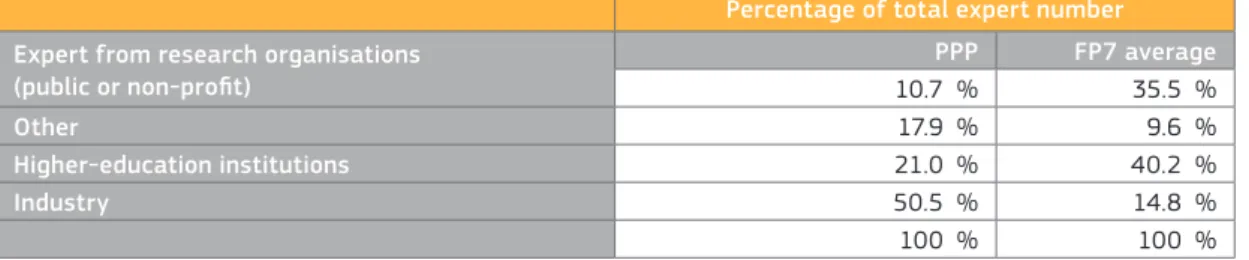
The evaluation process used for the PPP calls was the same as that used for the rest of the FP7 calls in their respective themes, the only difference being in the composition of the evalu-ators’ panel in terms of their profile
Table 4: Profile of evaluators in PPP calls and FP7 Cooperation
Percentage of total expert number Expert from research organisations
(public or non-profit)
PPP FP7 average
10.7 % 35.5 %
Other 17.9 % 9.6 %
Higher-education institutions 21.0 % 40.2 %
Industry 50.5 % 14.8 %
100 % 100 %
As the PPPs have the aim of funding projects with high industrial relevance, it was also an objective within the NMP theme to have at least 60 % of the evaluators from industry. The shi# from business as usual in FP7, where only around 15 % of the evaluators come from industry, was very important, and although the objective of 60 % was only implemented by NMP, the final overall figure of 50 % is indicative of very good progress.
The evaluation criteria for the PPP calls have been the same as in any FP7 call: scientific and technological quality, implementation and impact. Each criterion is assigned marks from 0 to 5, with the approval threshold at 3 and an overall threshold required of 10 points. However, the fact that there are more industrial evaluators increases the relevance of impact assess-ments as these assessors understand better the needs of industry and the relevance of impact objectives and actions in proposals.
For the sake of reducing the time to grant, it was decided to implement all PPP calls using a single-stage procedure, although some of the programmes involved have historically used two stages.
Analysis of results
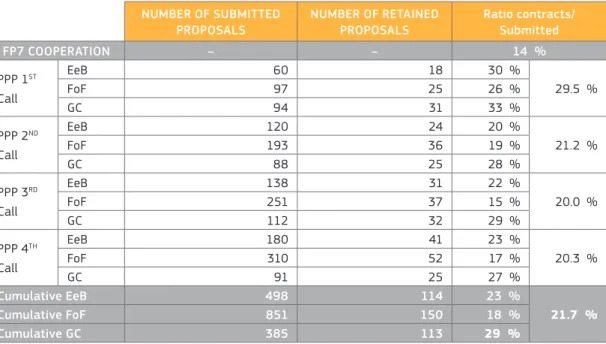
Overall, 1 734 proposals were submitted to the different PPP calls, and 377 of them were selected to be funded. It is necessary to point out that the data for the fourth call are based on preliminary information, since the grant negotiation process had not yet finished and the numbers shown as grants signed refer to proposals retained for negotiation.
With these figures, the rate of successful proposals in the PPPs reached 21.7 %, which compared to the 14 % average for all of FP7 means a substantial increase of around 50 %, although this figure of one in five may still seem low to industrial organisations faced with the substantial effort involved in putting together a competitive proposal. These figures suggest that the nature and format of the calls have created a good level of participant interest. This fact is also supported when comparing the success rate between calls, the first one being significantly high, when the PPPs were not yet widely known.
Table 5: Number of proposals submitted and retained for negotiation
NUMBER OF SUBMITTED
PROPOSALS NUMBER OF RETAINED PROPOSALS Ratio contracts/Submitted FP7 COOPERATION – – 14 %
PPP 1ST
Call
EeB 60 18 30 %
29.5 %
FoF 97 25 26 %
GC 94 31 33 %
PPP 2ND
Call
EeB 120 24 20 %
21.2 %
FoF 193 36 19 %
GC 88 25 28 %
PPP 3RD
Call
EeB 138 31 22 %
20.0 %
FoF 251 37 15 %
GC 112 32 29 %
PPP 4TH
Call
EeB 180 41 23 %
20.3 %
FoF 310 52 17 %
GC 91 25 27 %
Cumulative EeB 498 114 23 %
21.7 %
Cumulative FoF 851 150 18 % Cumulative GC 385 113 29 %
The participation of entities involved in the industrial research associations created for the PPPs (EFFRA in the Factories of the Future PPP and the E2BA in the Energy-efficient Buildings PPP) in projects funded in the PPP calls is shown in Table 6. In total, 30 % of the overall EC contribution to FoF projects was received by members of EFFRA, while 34 % of the EC funds
devoted to EeB projects were captured by entities involved in the E2B association. Therefore, participants that are not part of these two associations have received around 70 % of the overall budget. In terms of the number of participations the figures are even more positive regarding non-member participants, with 75 % of all project participations across FoF and EeB coming from non-association organisations.
A single-stage proposal process is more attractive to industry as it shortens the overall time between call announcement and contract award. At the same time, the increased focus of these calls (demand-driven rather than curiosity-driven) allows the oversubscription to be minimised by restricting the scope of more general proposals.
Moreover, despite the advisory influence of the AIAG on defining the topics, evidence shows there is no higher concentration of ‘frequent participants’ in the PPP projects than in the rest of FP7 Cooperation projects (see also Table 10 below). This finding was also supported by the questionnaire data, where the majority of respondents disagreed with the statement that ‘the PPP associations are closed organisations’.
On the other hand, this scenario shows that the industrial research associations have a good participation level, far from exclusive but enough to assure that they are representative and an important part of their respective sectors.
Table 6: Participation of industrial research association members
EC Contribution Participation EFFRA
non-member memberEFFRA non-memberEFFRA memberEFFRA Count Cumulative 70 % 30 % 78 % 22 % 1778
2010 63 % 37 % 71 % 29 % 275
2011 64 % 36 % 74 % 26 % 412
2012 72 % 28 % 80 % 20 % 407
2013 75 % 25 % 82 % 18 % 684
EC Contribution Participation E2BA
non-member memberE2BA non-memberE2BA memberE2BA Count Cumulative 66 % 34 % 71 % 29 % 1246
2010 64 % 36 % 71 % 29 % 223
2011 61 % 39 % 65 % 35 % 289
2012 70 % 30 % 74 % 26 % 380
2013 66 % 34 % 72 % 28 % 354
Impact achieved and foreseen
At this moment, it is hard to evaluate the impact of the projects funded within these initiatives. The proposals approved in the first call started in 2010 and are now in their third year. There-fore, some of them may have finished recently but the majority are still in the last phases, where dissemination of results and evaluation of possible impacts should be done. On the
other hand, the projects from the last call, the biggest in budget, have not started yet or are involved in the very first stages.
Therefore, an evaluation of the impact of the individual projects is not yet possible, but looking at the current projects, over 700 enterprises and organisations in numerous fields of activity across Europe have made links to each other and work together in different constellations. Compared to other funding programs, PPP activities are expected to have an increased impact at project level due to the increased involvement of industry.
The PPP initiative has been a kind of catalyst to bring, for the first time, all relevant players to the table and make them work together: RTOs, companies (along the value chains), industry associations and other actors (for example business-angel-type organisations). Many actors have had links with each other before and were organised into structures (RTO organisations, industry associations). However, the PPP has stimulated these actors to work with each other in a structured way and with a longer time horizon.
The projects that are running demonstrate the coverage of a wide range of innovative technol-ogies, methods and processes. The implementation of existing technologies into real demon-strators may also provide opportunities to explore issues and improve deployment techniques.
Other related activities
Several other activities have been carried out by the European Commission, the Member States, the European technology platforms and the industrial research associations.
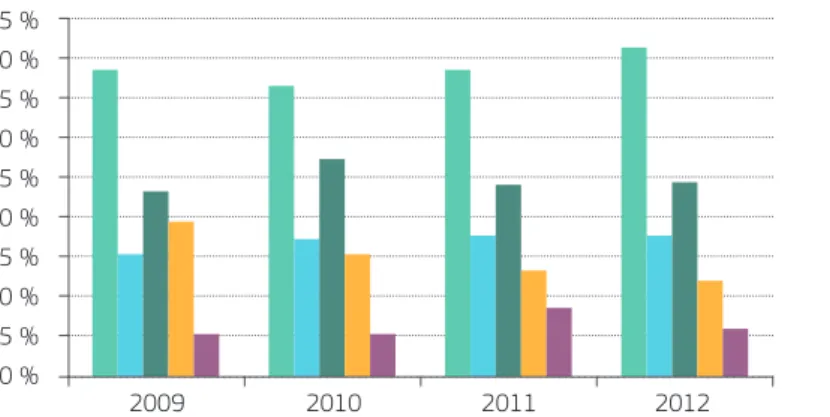
All the EC services involved in the PPPs participated in the organisation of annual information days in Brussels, to promote the participation in the PPP calls. Four took place every July from 2009 to 2012, gathering participants with different profiles. First-hand information on the top-ics was given, along with information on calls and the evaluation processes. The distribution of the participant profiles for each event is shown in Figure 1.
Figure 1: Profiles of the participants in the four information days 2009–12
0 % 5 % 10 % 15 % 20 % 25 % 30 % 35 % 40 %
45 % Industry
University/higher education Research organisations National/regional
authorities/regulatory agencies Other (including EU institutions)
The format of the events was similar throughout the years, built around a plenary session where a general overview of all the PPPs was given and with parallel sessions, one for each PPP, where more specific information was provided. In addition, brokerage sessions gave the opportunity for future participants to present project ideas with the aim of building appropri-ate consortia.
The four events were oversubscribed, with over 850 participants on average, but the presenta-tions from the Commission and the different speakers were made publicly available through the Internet (11).
Independently, the European technology platforms and industrial research associations organ-ised specific events for the promotion and dissemination of the research PPPs’ activities. Finally, for both Factories of the Future and Energy-efficient Buildings, impact workshops were held where the recipients of PPP grants presented their projects and activities, with discus-sions on early goals and the expected impacts of the projects. These workshops were held in November 2010, March 2012 and March 2013. The most recent workshops concluded that the two PPPs have managed to increase the industrial relevance of both the calls and the projects undertaken. Both PPPs are seen to be achieving their targets in terms of dissemination and exploitation. A significant recommendation arising from both of these PPPs is that, based on the perceived enhancement of exploitation and dissemination arising from cluster-based activi-ties, clustering activities should be pursued more vigorously by both the EC and the industrial research associations.
For Green Cars, assessments of technology advancements, industrial achievements, market reactions and R & D initiatives are reported in the annual brochures (12) released following the regular cluster meetings organised by DG Communications Networks, Content and Technology, DG Research and Innovation and DG Mobility and Transport and on the websites of the CSA projects ICT4FEV (13), Capire (14) and Smart EV-VC (15).
11 http://ec.europa.eu/research/industrial_technologies/ppp-in-research_en.html 12 http://cordis.europa.eu/fp7/ict/micro-nanosystems/ict-for-green-cars_en.html 13 http://www.ict4fev.eu
14 http://www.capire.eu 15 http://www.smartev-vc.eu
General analysis of consultation
The consultation questionnaire survey was completed by 409 respondents. In terms of the three PPP areas the number of respondents was:
EeB: ...149 FoF: ...162 GC: ...98
The number of respondents (16) in each category was: Coordinators: ...130
Participants: ...220 Industrial research associations: ...7 Programme committees/NCPs: ...47
In addition, the open (qualitative) questions were sent to four thematic programmes within the EC (DG Communications Networks, Content and Technology, DG Mobility and Transport, RTD ENV and RTD Transport).
The questionnaire consisted of a collection of 210 questions, of which 199 sought a quantita-tive agreement with statements rated on a scale from 1 to 5. Each group was guided to answer a different subset of the questions (with a maximum of 58), although many were common.
16 Five respondents did not give a specific stakeholder category but were classified as participants as far as the analysis was concerned.
Achievement and progress
towards the objectives
The results obtained were overwhelmingly positive towards the PPP initiatives. The table below shows the net positive percentage scores (i.e. the percentage of 4 and 5 scores minus the percentage of 1 and 2 scores).
Table 7: Questionnaire net percentage scores
EeB FoF GC
Coordinators 53.0 % 51.2 % 43.9 %
Participants 41.2 % 37.1 % 22.1 %
Industrial researchassociations 69.6 % 57.8 %
-PC/NCP 32.8 % 45.1 % 30.7 %
In terms of the issues attracting the strongest support, these can be summarised as:
bȩ research PPPs are being run efficiently;
bȩ research PPPs are both beneficial and appropriate;
bȩ research PPPs are an appropriate model for pursuing innovation actions in Horizon 2020;
bȩ programme committee delegates/national contact points consider research PPPs appropriate for demonstration instrument projects in FP7 and for larger demonstrations and pilot plants within Horizon 2020 (particularly with respect to Green Cars).
In terms of perceived negative aspects of the PPPs, the following aspects were notable:
bȩ research PPPs have not adequately contributed to standardisation activities;
bȩ there also appear to be some shared concerns, particularly among the
programme committee delegates and national contact points, that the PPPs may not be having a significant impact in terms of growth, job creation and leveraging industrial investment.
With regard to the general responses to the open (qualitative) questions, while there was a wide range of opinions expressed, there were also some common themes. These included:
bȩ a need for simplification with less bureaucracy and faster time to grants, including specific support for SMEs;
bȩ more awareness and dissemination activity;
bȩ increased funding and funding rates together with long-term and flexible funding arrangements;
bȩ a need for stronger and even more transparent governance rules covering both the private and public parties and greater involvement of all stakeholders;
bȩ a need for extended innovation actions including involvement of Structural Funds, regional bodies, end-users, etc.;
bȩ a perceived benefit of follow-up actions for successful projects as, for instance, demo-targeted projects or new instruments for supporting close-to-market activities;
bȩ the need for greater emphasis on IPR focus in proposals and projects, including specific support for SMEs.
E
ff
ectiveness
One of the aims of the research PPPs when they were set up was to achieve matched fund-ing from industry. As Table 8 below shows, this was not fully achieved as the average con-tribution of the EC was 65 %. However, this is largely due to the fact that the research PPPs were implemented using FP7 rules, and under these rules both RTOs and academic partners, but also, importantly, SMEs, received 75 % funding of their RTD activities. However, the EC percentage funding of PPPs is four percentage points lower than that of FP7 Cooperation as a whole, mainly due to increased large-industry participation and the increase in the funding of demonstration activities.
Table 8: Percentage of total costs funded by the EC
Contracts (cumulatively 2010–12) EC contribution as a percentage of total costs
EeB 65 %
FoF 67 %
GC 62 %
Total 65 %
FP7 Cooperation 69 %
Figure 2 shows the proportion of the funds spent on various activities within the PPP versus standard FP7 collaborative projects. As can be seen, the level of demonstration activities undertaken within research PPPs is significantly higher, by almost a factor of four. This has been achieved despite the lower funding rate available for this type of activity for SMEs, RTOs and universities, demonstrating that this type of activity has a real perceived benefit to the participants of the research PPPs.
Figure 2: Percentage of type of activities in PPP projects and FP7
0 % 10 % 20 % 30 % 40 % 50 % 60 % 70 % 80 % 90 %
Consortium Management
Demonstration Other RTD or Innovation
FP7 Cooperation PPPs
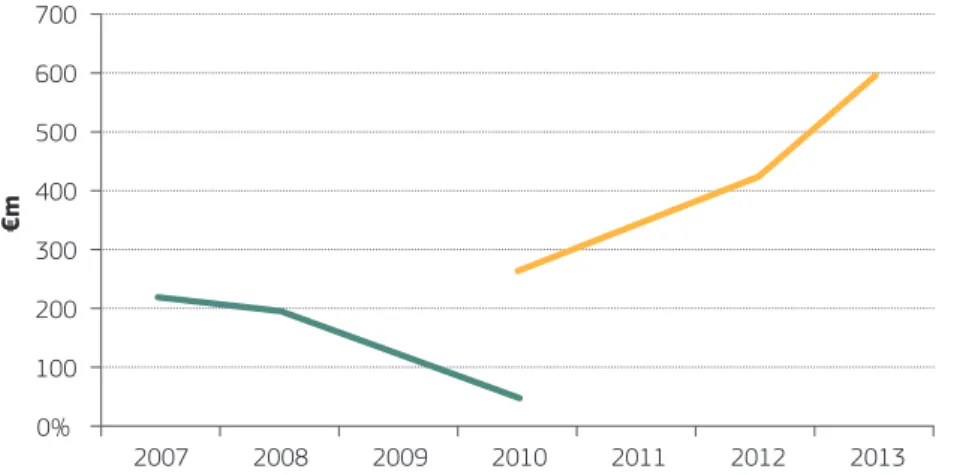
Figure 3 shows the funding that was allocated across the four research PPP calls and com-pares this with the funding that was made available for projects pursuing similar research topics prior to the set-up of the PPPs. Three features can be discerned from this graph: first, the funding for these industrial research areas was declining prior to the launch of the research PPPs; second, the PPPs achieved a step change in funding available to these topics, right from their inception; third, the financial support has increased significantly during the life of the research PPPs within FP7. This has allowed the expansion of relevant topics shown in Table 3 while keeping the focus of each topic, and therefore the oversubscription rate is significantly below general FP7 rates, as shown in Table 5 above.
Figure 3: Funding for PPP-relevant area projects
0% 100 200 300 400 500 600 700
2007 2008 2009 2010 2011 2012 2013
Pre-PPPs Combined PPPs
€
E
ffi
ciency
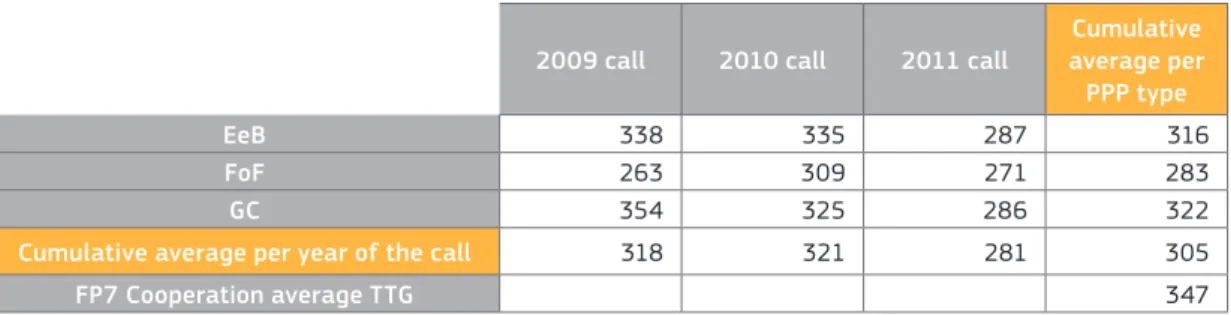
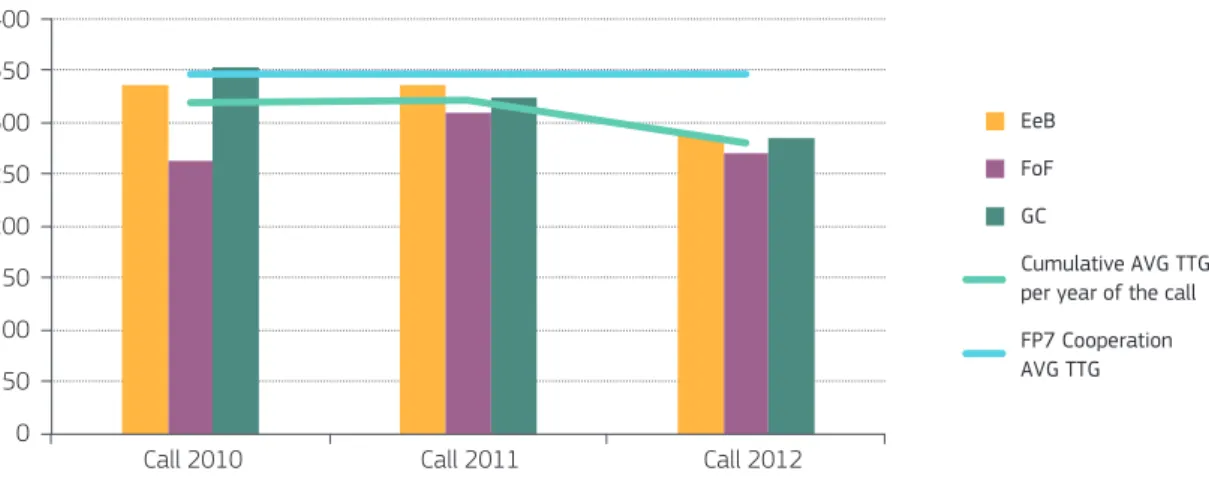
One of the key factors for industry (and particularly SMEs) affecting the relevance and per-ceived bureaucracy of a collaborative project call is the time to grant (TtG), or time between the proposal being submitted and the award of a grant. The longer the TtG, the longer before the product or service idea can be developed ready for market and the greater the chances are of the proposal ideas being overtaken by events or by the competition. This is reflected in the questionnaire responses, where TtG and overall bureaucracy were the two factors most o#en quoted as needing improvement under the general heading of simplification. As can be seen from Table 9, all three research PPPs made improvements in the average TtG (17) by the time of the third call (data for the final call were not available when this report was finalised as project negotiations were ongoing, but the first figures reflect the continuation of this improvement). By the time of the 2011 call, the cumulative average of the TtG for the three PPPs was 42 days faster than the average FP7 calls, with the best (FoF) being some 64 days faster. However, despite these welcome improvements in the average TtG and accepting the fact that these are still using standard evaluation and negotiation procedures, even the best times achieved fall short of the targets for H2020. Therefore this is one area where significant improvements would be expected for H2020.
It is understood that there were special circumstances regarding the 2010 call, in which fund-ing availability was partly delayed, which led to the relatively poor time achieved for this call. These figures are shown in graphic form in Figure 4.
Table 9: Time-to-grant averages
2009 call 2010 call 2011 call average per Cumulative PPP type EeB 338 335 287 316
FoF 263 309 271 283
GC 354 325 286 322
Cumulative average per year of the call 318 321 281 305
FP7 Cooperation average TTG 347
17 Time to grant is calculated only with the projects in the main list, since it is understood that projects from the reserve list are under special circumstances.
Figure 4: Time to grant in the PPPs and FP7
0 50 100 150 200 250 300 350 400
Call 2010 Call 2011 Call 2012
EeB FoF GC
Cumulative AVG TTG per year of the call FP7 Cooperation AVG TTG
Figure 5 shows the share of funding in the first three calls for all the PPPs by organisation type. As can be seen, the participation by large industry and by SMEs is significantly greater than for standard FP7 calls, with overall industrial participation in the PPPs being almost 50 %, compared with less than 35 % for FP7 overall. This demonstrates that industry views these programmes as being of high relevance.
Figure 5: Share of funding of PPPs vs FP7 Cooperation (18)
0 % 5 % 10 % 15 % 20 % 25 % 30 % 35 %
IND SME REC PUB HES OTH
Cumulative PPPs Cumulative FP7 COOPERATION
Figure 6 shows the distribution of funding by organisation type across the three research PPPs. The overall funding going to industry (by adding IND and SME) is 48 % for FoF, 49 % for EeB and 52 % for GC. The first point to note is the much higher percentage of large-industry fund-ing within the GC PPP, reflectfund-ing the structure of that sector. However, it is the FoF PPP that achieves the highest level of overall industrial participations when considering the combined
participations of both large industry and SMEs (59 % for FoF, 54 % for EeB, 56 % for GC). The second point to note is the relatively high participation of public bodies in the EeB PPP, which reflects their direct involvement in this area of activity.
Figure 6: Share of funding by PPP
0 % 5 % 10 % 15 % 20 % 25 % 30 % 35 % 40 %
IND SME REC PUB HES OTH
FoF EeB GC
When considering the geographic reach of the PPPs, it is useful to compare the make-up of participants by country. Figure 7 shows the distribution for overall FP7 Cooperation projects, while Figure 8 shows the distribution for projects originating in the research PPPs. As can be seen, the overall distribution between these two is similar, although, perhaps unsurprisingly given the relevance of the research PPPs to European industrial competitiveness, the involve-ment of non-EU partners is about one fi#h the level for overall FP7 Cooperation. Other than this, the involvement of participants from EU-15 countries is up slightly in the research PPPs (almost 4 %), with participants from EU-12 countries being almost the same and those from associated countries being down by around 15 %.
Figure 7: Geographic distribution for FP7
Cooperation Figure 8:
Geographic distribution for research PPPs
7.50 % 2.10 % 3.80 %
86.20 % ASOS
Non-EU EU 12
EU 15 EU 15 Non-EU EU 12 ASOS
6.2 % 0.4 % 3.7 %