Available online throug
ISSN 2229 – 5046
APPROXIMATE ANALYTICAL EXPRESSIONS OF CONCENTRATION
OF ACETIC ACID AND HYDROGEN PEROXIDE IN BATCH PHOTO-FENTON REACTION
J. FEMILA MERCY RANI
1#,, V. MEENA
2, S. GANESAN
3, L. RAJENDRAN
4*1
Department of Mathematics,
PSNA College of Engineering and Technology, Dindigul, Tamil Nadu, India.
2
Department of Mathematics,
Madurai Kamaraj University Constitutional College, Madurai, Tamil Nadu, India.
3
Department of Mathematics,
Syed Ammal Engineering College, Ramanaapuram, Tamil Nadu, India.
4
Department of Mathematics,
Sethu Inistitute of Technology, Kariapatti, Tamil Nadu, India.
#
Research and Development Centre,
Bharathiar University, Coimbatore, Tamil Nadu, India.
(Received On: 30-11-17; Revised & Accepted On: 30-12-17)
ABSTRACT
M
athematical model of the photo-Fenton oxidation process is discussed. This model involves a system of nonlinear equations containing a nonlinear term related to Eley-Rideal-type kinetics. Simple and closed- form of approximate analytical expressions of concentrations of acetic acid and hydrogen peroxide are reported. These analytical results are compared with available experimental and numerical (Matlab program) results. Satisfactory agreement is noted.Keywords: Mathematical modeling, photo- Fenton oxidation, hydrogen peroxide, acetic acid.
1. INTRODUCTION
Pesticides are commonly used worldwide to face the need for increasing and improving agricultural production [1, 2]. Organic pollution originates from domestic sewage, urban run-off, industrial effluents and agriculture wastewater [3]. Wastewater with organic pollutants contains large quantities of suspended solids which reduce the photosynthetic organisms. Organic pollutants include pesticides, fertilizers, hydrocarbons, phenols, plasticizers, biphenyls, detergents, oils, greases, pharmaceuticals, proteins and carbohydrates. Photochemical and photo catalytic processes have enormous potential for becoming viable alternatives to conventional chemical (AOP) for the treatment of polluted waters and effluents. Currently available photochemical technology permits the conversion of organic pollutants having a wide range of chemical structures into substances that are less toxic and/or more readily biodegradable [4, 5].
Abdul Aziz et al. [6] reported that adding H2O2 in a single batch leaves much of it available to attack by hydroxyl
radicals, whereas continuously feeding smaller quantities of the reagent to the system would allow the majority of radicals generated to target the organic contaminant. Various studies have been carried out on the heterogeneous photo-Fenton system; In particular, Fe over HY zeolite has been used for the degradation of polyvinyl alcohol [7]. The immobilization of Fe ions also on clays, bentonite and laponite for the oxidation of the azo-dye Orange II has been reported [8]. Similar works have been also described for the degradation of different azo-dyes over iron oxides such as goethite and hematite under non controlled pH conditions [9].
Corresponding Author: L. Rajendran
4*Nafion has been employed as organic support due to the presence of sulphonic groups allowing the effective anchoring of Fe ions [10]. Photo-Fenton oxidation of phenol was also performed using iron species incorporated over different silica supports [11]. Heterogeneous Fe (III) based photo-Fenton catalyst is often used as suspended particles in the liquid reaction medium [12]. Thus the biggest disadvantage lies in the fact that, after wastewater treatment, separation of catalyst from reaction solution is needed. To avoid this last operation the use of structured catalysts could be a valid solution. Recently, Sannino et al. [13, 14] developed a mathematical model of heterogeneous photo-Fenton oxidation of acetic acid on structured catalysts. Also Sannino et al. [13] proposed the experimental work for the above model. To the best of our knowledge, there is no simple analytical expression for steady-state concentrations of acetic acid and hydrogen peroxide for all values of the parameters is derived. The main purpose of this paper is to present the approximate analytical expression for the concentration of acetic acid and hydrogen peroxide for all values of parameters. The main advantage of this analytical method over numerical method is that we can accelerate the convergence rate, minimize iterative times, accordingly save the computation time and evaluate the efficiency. Also, we reported the sensitivity analysis of parameters on the concentration of acetic acid/hydrogen peroxide.
2. MATHEMATICAL MODEL
The mathematical model, closely similar to that described earlier [13] was used. Pictorial representation of the catalytic photo-Fenton oxidation is provided in Figure. 1 [14].
Figure-1: Laboratory apparatus for the catalytic photo-Fenton oxidation [14].
We assume that the reaction of catalytic oxidation of
CH
3COOH
(1) and the photolysis ofH
2O
2(2) in the homogeneous phase is:3
4
2 22
26
2CH COOH
+
H O
→
CO
+
H O
(1)2 2 2 2
1
2
H O
→
H O
+
O
(2) The corresponding one-dimensional mass balance equation of acetic acid and hydrogen peroxide, considering transport only by reaction are [13] given as follows:3
1 2 1 2
1
( )
( )
( )
1
( )
LaFeOdC t
K bC t C t
V
W
dt
= −
+
bC t
(3)3 2 2
2 2 1 2
1 2 1
( )
( )
( )
4
( )
1
( )
LaFeO H OdC t
K bC t C t
V
W
K C t V
Q
dt
= −
+
bC t
−
+
(4)The initial conditions are 1 1,0
at
0
C
=
C
t
=
(5)2 2,0
at
0
where
C
1and
C
2 are represents the concentration of acetic acid and hydrogen peroxide respectively. 2 1and
,
,
,
,
2 23
V
Q
K
K
W
b
LaFeo HO denotes the adsorption constant of acetic acid, amount of active phase, solution volume, molar flow rate ofH
2O
2entering the reactor kinetic constant for reaction R1 and R2 respectively.3. APPROXIMATE ANALYTICAL EXPRESSION OF CONCENTRATION OF ACETIC ACID AND
HYDROGEN PEROXIDE UNDER NON STEADY CONDITIONS
By solving the Eqns. (3) – (6) using an iterative method, we can obtain the approximate analytical expressions of concentration of acetic acid
C
1and hydrogen peroxideC
2 as follows:1
1
( )
1,0exp[
(1
)
]
K tC t
=
C
−
N
−
e
−−
L M t
(7)1
2
( ) (
2,0)
)
K t
C t
=
C
+
M e
−−
M
(8) Where3 2 2
2 1,0 2,0 2,0
1,0 2,0 1 1 1
4
(
)
,
and
(1
)
(
)
LaFeo H O
K bW
LC C
Q
L C
M
L
M
N
V
b C
L C
K
VK
K
−
−
+
=
=
+
=
+
+
(9)The Eqns. (7) and (8) satisfies the boundary conditions (5) and (6). These equations represent the new approximate analytical expression of the concentration of acetic acid and hydrogen peroxide for all possible values of the parameters
2 1
and
,
,
,
,
2 23
V
Q
K
K
W
b
LaFeo HO . Whent
→
∞
(steady state) and initial concentration of the hydrogen peroxideis zero
(
C
2,0=
0
)
, from the Eqns. (7) and (8) we obtain1 2 1 2 2
)
(
and
0
)
(
VK
Q
t
C
t
C
=
∞
=
=
∞
=
HO .4. DIFFERENTIAL SENSITIVITY ANALYSIS OF PARAMETERS
Differential sensitivity analysis is based on partial differentiation of the aggregated model [15]. We have found the partial derivative of concentration of acetic acid/hydrogen peroxide (dependent variable) with respect to the parameters
3 2 2 1 2
,
LaFeo,
,
H O,
and
b W
V Q
K
K
(independent variables). At some fixed experimental values(
b
=
0
.
021
mol
L
−1,
3 2 2
1 1 1 1
1
Figure-2: (a - e) Plot of concentration of acetic acid
C
1versus irradiation timet
using Eqn. (7) for various values of parametersV
,
K
1,Q
H2O2,
W
LaFeO3and
b
respectively.Figure-3: (a-c) Plot of concentration of hydrogen peroxide
C
2versus irradiation time t (h
) using Eqn. (8) for various values of2 2
and
,
,
1
V
Q
H OK
respectively.Figure-3: (d) sensitivity analysis of parameters. From this figure, it is inferred that the molar flow rate H2O2 entering
the reactor 2 2O H
5. VALIDATION OF ANALYTICAL RESULTS WITH EXPERIMENTAL AND SIMULATION RESULTS
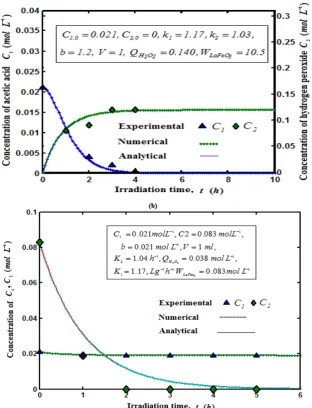
To show the efficiency, our approximate analytical results (Eqns. (7) – (8)) are compared with and simulation (Matlab) and experimental results [13] in Figure. (4).
(a)
Figure-4: Comparison of our analytical results (Eqns. (3) and (4)) with the experimental results [13], and numerical results for the concentration of acetic acid
C
1 and hydrogen peroxideC
2.
A satisfactory agreement is noted. The function pdepe, in Matlab software which is a function of solving the boundary value problems for nonlinear ordinary differential equations is used to solve this equation. The experimental values of the parameters used is given in Table 1. The Matlab program is also given in Appendix A.
6. DISCUSSION
Eqns. (3) - (6) are the new and simple approximate analytical expressions of concentrations of acetic acid and hydrogen peroxide for all possible values of the parameters.Figure. 4 (a- b) compares the analytical results with the numerical and experimental results with previous experimental data [13]. Figure. 2 represents the concentration of acetic acid
C
1 as a function of irradiation timet
. In Figure. 2 (a-e), the parameters solution volumeV
, kinetic constantK
1 andmolar flow rate
2 2
H O
Q increases the concentration of acetic acid. Also the concentration of acetic acid
C
1decreases slowly from its initial values of concentration and reaches the steady state value zero. Figure. 2 (f), it is observed that the molar flow rate2 2
H O
Q
has maximum influence on the concentration of acetic acidC
1, whereas the remaining parameters3 1
, LaFeo , ,
The concentration of hydrogen peroxide
C
2 versus timet
is shown in Figure. 3. From Figure. 3 (a-c), it is inferred that the concentration of hydrogen peroxideC
2 increases when kinetic constantK
1 and adsorption constant of acetic acidb
decreases whereas the concentration of hydrogen peroxideC
2increases when2 2O H
Q
increases. Here also the parameter2 2O
H
Q
has more influence than other parameters on the concentration of hydrogen peroxide. Also the time taken reaches a steady state value of acetic acidC
1 consumption is
+
+
+
+
−
=
− − 1 0 , 1 3 2 1 1 0 , 2 2 2 1 0 , 2 2 0 , 2 0 , 11
(
1
)
4
log
1
C
b
V
W
b
K
VK
C
Q
K
LC
C
LC
K
t
H O LaFeo . From the Eqn. (4), it is observed that theconcentration of hydrogen peroxide
C
2reaches the maximum value 12 2
VK
Q
H Owhen the initial concentration of
H
2O
2is zero. This result is also conformed from the Eqn. (4) for non steady state conditions.
7. CONCLUSIONS
A mathematical analysis of a heterogeneous photo-Fenton process using a LaFeO3 catalyst supported on a monolithic structure was discussed. The model was based on the happening of hydrogen peroxide photolysis and acetic acid oxidation in the heterogeneous phase, assumed first-order and Eley–Rideal-type kinetics, respectively. In this paper the analytical expression of concentrations of acetic acid and hydrogen peroxide are presented. A sensitivity analysis of the parameters from the concentration of acetic acid and hydrogen peroxide are suggested. Our analytical results agree with experimental and simulation data. These analytical results will be useful for the design and processes optimization.
Appendix-A: Scilab/Matlab program for the numerical solution of Eqn. (6).
function pdepe
options= odeset('RelTol',1e-6,'Stats','on'); %initial conditions
x0 = [0.021;0]; tspan = [0,10]; tic [t,x]= ode45(@TestFunction,tspan,x0,options); toc figure hold on plot(t, x(:,1)) plot(t, x(:,2)) legend('x1','x2') ylabel('x') xlabel('t') return
function [dx_dt]= TestFunction(t,x)
k1=1.17; k2=1.04;v=1;Q=0.140; b=1.2; W=10; dx_dt(1)=(-k2*b*W/v)*(x(1)*x(2))/(1+b*x(1));
dx_dt(2) =(-4*k2*b*W/v)*(x(1)*x(2))/(1+b*x(1))-(k1*x(2))+(Q/v); dx_dt = dx_dt';
Appendix-B : Nomenclature.
Symbols Definitions Numerical
Values [13] Units
b
adsorption constant of acetic acid 1.2L
mol
−1)
(
t
C
1 CH3COOH concentration -mol
L
−1)
(
t
C
2 H2O2 concentration -mol
L
−10 1
C
, CH3COOH initial Concentration 0.021mol
L
−10 2
C
, H2O2 initialConcentration 0mol
L
−11
r
CH3COOH consumption rate -mol
h
−1g
−12
r
H2O2 photolysis reaction rate -mol
L
−1h
−11
K
apparent kinetic constant for reactionR
1 1.17h
−12
K
apparent kinetic constant for reactionR
2±
1.03 0.01 1h
−2 2O H
Q
molar flow rate H2O2 entering the reactor (in the caseof continuous dosage ) 0.140
1
h
mol
−t
irradiation time -h
V
solution volume 1L
3 LaFeO
W
amount of active phase 10.5L
) 1
( 1,0
3 2 C b V W b K L LaFeo + − =
rate constant -12.66
h
−11 1 0 , 2 0 , 2 0 , 1 ) ( 4 VK Q K C L C LC M + +
= Parameter -0.11965
mol
L
−11 0 , 2 ) ( K M C L
N=− + dimensionless constant 1.2946 None
REFERENCES
1. Badawy, M.I., Ghaly, M.Y., and Gad-Allah T.A., (2006), Modeling Experimental Design for photo-Fenton Degradation of Methomyl, Desalination, Vol. 194, No. 1-3, pp. 166-175.
2. Ritter,W.F., Scarborough, R.W., and Chirnside, A.E.M., (1994), Modeling Experimental Design for photo- Fenton Degradation of Methomyl, Journal of Contaminant Hydrology, Vol. 15, No. 1-2, pp. 73-92.
3. Nageeb Rashed, M., (2013), Organic Pollutants – Monitoring, Risk and Treatment, Publisher: In tech, Chapters published January 30, pp. 238.
4. Amilcar Machulek, Jr., Frank, H.Q., Fabio, G., Volnir,O.S., Leidi, C.F., and Jose, E.F.M.,(2012), Fundamental mechanistic studies of the photo-fenton reaction for the degradation of organic pollutants , Hard cover, Publisher InTech edition February, pp. 472.
5. Alberici, R.M., Nogueira, R.P., Canela, M.C., Guimarães, J.R., Jardim, W.F.,(1998), Geation ambiental en el siglo XXI, Lima, APIS, pp.1- 10.
6. Diya’uddeen Basheer Hasan, Abdul Aziz Abdul Raman and Wan Mohd Ashri Wan Daud, (2014), Kinetic Modeling of a Heterogeneous Fenton Oxidative Treatment of Petroleum Refining Wastewater, Hindawi Publishing Corporation Scientific World Journal, Vol.2014, pp. 8 .
7. Bossmann, S.H., Oliveros, E., Gob, S., Kantor, M., Goppert, G.,You, L., Yue, P.L., Braun, A.M., (2001), Degradation of polyvinyl alcohol(PVA) by homogeneous and heterogeneous photocatalysis applied to the photochemically enhanced Fenton reaction , Water Sci. Technol., Vol. 44, pp.257-262.
8. Feng,J, Hu.X, Yue P.L,(2005),Discoloration and mineralization of Orange II by using a bentonite clay- based
Fe nanocomposite film as a heterogeneous photo-Fenton catalyst, 9. He, J., Tao, X., Zhao, W.Ma.J., (2002), Photooxidation of azo dye in aqueous dispersions of
H
2O
2/α-FeOOH ,
11. Martinez, F., Calleja, G., Melero, JA., Molina, R.,Iron species incorporated over different silica supports for the heterogeneous photo-Fenten oxidation of phenol,Applied Catalysis B: Environmental, Vol.70,1, pp. 452-460.
12. Bossmann, S., Oliveros, E., Gob, S., Siegwart, S., Dahlen, E., Payawan, L., Straub, M., Worner, M., Braun, A.,(1998), New Evidence against Hydroxyl Radicals as Reactive Intermediates in the Thermal and Photochemically Enhanced Fenten Reactions, J. Phys. Chem.,Vol.102, pp.5542- 5550.
13. Sannino, D., Ciambelli, P., Ricciardi, M., Isupova, L.A.,(2013), Mathematical modeling of the heterogeneous photo-fenton oxidation of acetic acid on structured catalysts, pp. 53-58.
14. Sannino, D., Ciambelli, P., Ricciardi, M., Isupova, L.A.,(2011), Structured catalysts for photo-Fenton oxidation of acetic acid,
15. Rasi, M., Rajendran, L., Subbiah, A., (2015), Analytical expression of transient current-potential for redox enzymatic homogenous system, Sensors & Actuators: B. Chemical, Vol. 208, pp. 128-136.
Source of support: Nil, Conflict of interest: None Declared.