Spiradiclis longanensis
, a new species
of Rubiaceae from China
Haizhen Wen1,2, Ruijiang Wang1, Shujun Deng1
1 Key Laboratory of Plant Resources Conservation and Sustainable Utilization, Guangdong Provincial Key Laboratory of Applied Botany, South China Botanical Garden, the Chinese Academy of Sciences, Guangzhou 510650, Guangdong, China 2 Medical College, Foshan University, Foshan 528000, Guangdong, China
Corresponding author:Ruijiang Wang ([email protected])
Academic editor:S. Razafimandimbison | Received 25 March 2015 | Accepted 2 July 2015 | Published 5 August 2015
Citation: Wen H, Wang R, Deng S (2015) Spiradiclis longanensis, a new species of Rubiaceae from China. PhytoKeys 55: 113–117. doi: 10.3897/phytokeys.55.4975
Abstract
A new species of Spiradiclis (Rubiaceae) was found during our field trip to Guangxi, China, and is de-scribed here as Spiradiclis longanensis R. J. Wang. This species is readily distinguishable from other pros-trate and decumbent species of the genus described previously by dense pubescence all over the plant, 5–20 small flowers per cymose, linear calyx lobes, and tubular corolla. The conservation status of VU was preliminarily assessed according to IUCN categories and criteria.
Keywords
China, Spiradiclis, Rubiaceae, taxonomy
Introduction
The genus Spiradiclis Blume belongs to the tribe Ophiorrhizeae in the subfamily Ru-bioideae (Bremekamp 1952, Bremer and Manen 2000), and comprises approximately 45 species (Wang et al. 2015). Its members are perennial herbs or subshrubs and usu-ally grow at the entrances of caves or mountain cliffs in the limestone area of Southern China and Northern Vietnam (Lo 1999, Wang 2002, Chen and Taylor 2011). They favor moist and shaded habitats, usually with ferns, Gesneriaceae, Begoniaceae, and Loganiaceae plants. Spiradiclis species are characterized by having usually 5-merous flowers and globose or ovoid capsules in a cymose or paniculiform inflorescence with dichasial or scorpioid axes (Deng et al. 2014).
http://phytokeys.pensoft.net
Copyright Haizhen Wen et al. This is an open access article distributed under the terms of the Creative Commons Attribution License (CC BY 4.0), which permits unrestricted use, distribution, and reproduction in any medium, provided the original author and source are credited.
Haizhen Wen et al. / PhytoKeys 55: 113–117 (2015) 114
During a field investigation in 2013, we found a semi-erect and hairy herb, which was similar to Spiradiclis danxiashanensis R. J. Wang in habit and leaf size. Unfortu-nately, the voucher (R. J. Wang & S. J. Deng 2324, IBSC) was only a vegetative indi-vidual at that time. The specimens with flowers and fruits were eventually collected after our subsequent collecting in different seasons. The 5-merous distylous flowers and ovoid to subglobose capsules in a cymose demonstrated that the plant was a true member of Spiradiclis. Our comprehensive examination showed that the flowered and fruited specimens represent a new and undescribed species of Spiradiclis.
Material and methods
All materials were collected by ourselves and deposited at the herbarium of South China Botanical Garden, the Chinese Academy of Sciences (IBSC). The leaf materi-als were carefully taken from the specimen R.J. Wang & Q. Liao 2592 (IBSC) and washed three times with 95% ethanol and then mounted on copper stubs. Samples were sputter-coated with gold particles for 15 min using a JEOL JFC-1600 AUTO FINE COATER. Scanning Electron Microscope (SEM) observation was carried out by JEOL JSM-T300. Digital images of the coated leaf surface were taken during the observation.
Taxonomy
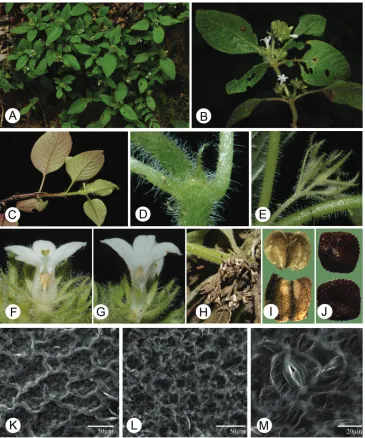
Spiradiclis longanensis R. J. Wang, sp. nov. urn:lsid:ipni.org:names:77148932-1
Fig. 1
Diagnosis. Spiradiclis longanensis is similar to S. danxiashanensis, from which it differs by its dense hairs in stems, leaves and inflorescences, (5–)7–10 secondary veins each side, a terminal or upper axillary cymose with 5–20 small flowers, linear calyx lobes, and tubular corolla.
Type. CHINA. Guangxi Zhuangzu Autonomous Region, Nanning City, Longan County, Pingshan Town, Tuanjie Village, 22°57’’N, 107°34’E, 219 m, 4 Jun 2014, long-styled flowers, R. J. Wang2682 (holotype: IBSC; isotypes: IBSC[6]).
Haizhen Wen et al. / PhytoKeys 55: 113–117 (2015) 116
5–12 mm long, to 3 cm while fruiting; bracts linear, 6–10 mm long. Flowers distylous, 5-merous; pedicels sparsely pubescent, 1–3 mm long, usually condensed. Hypanthium obconical, 1–2 mm long, sparsely pubescent; lobes 5, linear, 2.5–4 mm long, pubescent. Corollas tubular, white, sparsely hairy abaxially, tubes 2–3 mm long, ca. 1 mm wide; lobes subovate, ca. 1.5 × 1 mm; stamens 5; anthers oblong-linear, ca. 1 mm long; stig-mas bilobed; ovary 2-celled, ovules on the axile placentas. Long-styled flowers: a ring of pubescence in throat; stamens below the pubescent ring and included, filaments adnate to the base of corolla tube, ca. 1 mm long; styles exserted, ca. 3 mm long, stigma lobes capitate. Short-styled flowers: corolla tubes densely pubescent inside; stamens extend to the corolla throat but included, filaments adnate to the upper portion corolla tube, ca. 1 mm long; styles included, ca. 1 mm long, stigma lobes ovate. Fruits capsular, ovoid to subglobose, 3–4 mm, hairy, dehiscing loculicidally and then septicidally; valves 4, crusta-ceous, ca. 3.5 mm long; calyx lobes persistent, 1.8–2 mm long. Seeds ca. 30 per capsule, ca. 0.5 mm long, rectangular pyramid, brown, testa papillate.
Distribution. Known only from the type locality. The plants grow in the en-trances of limestone caves or moist cliffs of hill sides.
Ecology. Flowering in May–June and fruiting in June–August.
Conservation status. The number of S. longanensis was less than 500 individuals within an area of less than 5 km2; however we know that the present field investigation
is in a very low density and the evaluation we made here was based on all the available information up to now. We therefore assign a preliminary IUCN threat status of Vul-nerable (VU, B2ab(ii, iii, iv); D) to S. longanensis (IUCN 2001). The populations are probably prone to the effects of human activities or stochastic events in future, because the plants grow nearby the main traffic road or rice field.
Additional specimens examined (paratypes). CHINA.Guangxi Zhuangzu Au-tonomous Region. Longan County, Pingshan Town, Tuanjie village, 5 Apr 2013, R. J. Wang & S. J. Deng 2324 (IBSC); 6 Oct 2013, R. J. Wang & Q. Liao2592 (IBSC),
2595 (IBSC); 18 Feb 2014, R. J. Wang, S. J. Deng & Q. Liao2623 (IBSC); 4 Jun 2014, short-styled flowers, Ruijiang Wang2683 (IBSC), long-styled flowers, Ruijiang Wang2684 (IBSC).
Discussion. Similar to Spiradiclis longanensis in this genus, S. danxiashanensis,
S. guangdongensis, S. hainanensis and S. umbelliformis are all in prostrate or decum-bent habit, but their leaf laminas, inflorescences, calyx lobes, and flowers are different from S. longanensis and can easily be distinguished. The latter four species usually have rounded, orbicular, or ovate leaf laminas in 1–2.5 mm long and with 3–5 unobvious secondary veins each side, and their inflorescences often include 1–3 salverform and never condensed flowers, with ovate to lanceolate calyx lobes.
Acknowledgements
of Botany, Guangxi Zhuangzu Autonomous Region and Chinese Academy of Sciences for their kind help during our field investigation; Dr. Bine Xue and Miss Shuangsh-uang Zhu for helpful comments on the manuscript.
References
Bremekamp CEB (1952) The African species of Oldenlandia L. sensu Hiern et K. Schumann. Verhandelingen der Koninklijke Nederlandse Akademie van Wetenschappen, Afd. Natu-urkunde, Sectie 2, 48(2): 1–297.
Bremer B, Manen JF (2000) Phylogeny and classification of the subfamily Rubioideae (Rubiaceae). Plant Systematics and Evolution 225: 43–72. doi: 10.1007/BF00985458
Chen T, Taylor CM (2011) Spiradiclis. In: Wu ZY, Raven PH (Eds) Flora of China, vol. 19. Science Press, Beijing & Missouri Botanical Garden Press, St. Louis, 330–339.
Deng SJ, Wen HZ, Huang XX, Wang RJ (2014) Spiradiclis coriaceifolia and S. tonglingensis spp. nov. (Rubiaceae, Ophiorrhizeae) from Guangxi, China. Nordic Journal of Botany 32: 594–601. doi: 10.1111/njb.00461
IUCN (2001) IUCN Red List Categories and Criteria: Version 3.1. IUCN Species Survival Commission. IUCN, Gland, Switzerland and Cambridge, UK.
Lo HS (1999) Spiradiclis. Flora Reipublicae Popularis Sinicae, vol. 71, part 1. Science Press, Beijing, 86–110. [In Chinese]
Wang RJ (2002) Two new species of Spiradiclis (Rubiaceae) from China. Novon 12(3): 420–423. doi: 10.2307/3393092