Available online throug
ISSN 2229 – 5046
UNSTEADY MHD POISEUILLE FLOW BETWEEN TWO INFINITE PARALLEL PLATES
THROUGH POROUS MEDIUM IN AN INCLINED MAGNETIC FIELD
WITH HEAT AND MASS TRANSFER
U. S. RAJPUT
1, GAURAV KUMAR*
11
Department of Mathematics and Astronomy, University of Lucknow, Lucknow – (U.P,) India.
(Received On: 20-10-15; Revised & Accepted On: 16-11-15)
ABSTRACT
T
he motion of a two dimensional MHD Poiseuille Flow between two infinite parallel plates in porous media with heat and mass transfer under the influence of inclined magnetic field, is studied here. The flow is considered unsteady. The work is divided into two parts, one with both plates non porous while the other with lower plate porous. The governing equations of motion are solved by analytical method. The velocity profile is discussed with the help of graphs drawn for different MHD parameters, and the numerical values of skin-friction have been tabulated.Key Words: Magnetohydrodynamic flow, MHD, inclined magnetic field, porous plate.
INTRODUCTION
The study of MHD flow problems associated with heat and mass transfer play important roles in different areas of science and technology, like chemical engineering, mechanical engineering, biological science, petroleum engineering, biomechanics, irrigation engineering and aerospace technology. Such problems also frequently occur in petro-chemical industry, chemical vapour deposition on surfaces, cooling of nuclear reactors, heat exchanger design, forest fire dynamics and geophysics. The influence of magnetic field on viscous, incompressible and electrically conducting fluid is of great importance in many applications such as magnetic material processing, glass manufacturing control processes and purification of crude oil. The response of laminar skin friction and heat transfer to fluctuations in the stream velocity was studied by Lighthill [1]. Free convection effects on the oscillating flow past an infinite vertical porous plate with constant Suction, was studied by Soundalgekar [6] which was further improved by Vajravelu et al.
[7]. The work on radiation effects on MHD flow through porous media past an impulsively started vertical plate with
variable heat and mass transfer was done by Rajput and Kumar [4]. The same authors have also studied MHD flow past an impulsively started infinite vertical porous plate with heat transfer [3]. Further, Magnetohdrodynamic steady flow of liquid between two parallel plates was studied by Singh [5]. Hall effects on heat and mass transfer flow through porous medium was studied by Ram et al. [2]. In this paper we have considered unsteady MHD Poiseuille flow between two infinite plates through porous media and an inclined magnetic field with heat and mass transfer. The model has been solved analytically and the results are shown with the help of graphs.
MATHEMATICAL ANALYSIS
Consider the unsteady flow of a viscous, incompressible and electrically conducting fluid. The plates considered are parallel. The x axis has been considered along the flow and y normal to it. An inclined magnetic field B0 of uniform
strength is applied along to the plate at angle
α
from horizontal. The viscous dissipation and induced magnetic field have been neglected due to their small effects. Initially it has been considered that the plate as well as the fluid is at the same temperatureT
∞ and the concentration levelC
∞ everywhere in the fluid is same in stationary condition. The governing flow models for two cases are as under.Corresponding Author: Gaurav Kumar*
Case-1: Both plates are non porous:
,
.
2 2 0 2 2K
u
u
Sin
B
y
u
t
u
υ
ρ
α
σ
υ
+
−
−
∂
∂
=
∂
∂
(1),
2 2z
C
D
t
C
∂
∂
=
∂
∂
(2).
2 2z
T
k
t
T
C
p∂
∂
=
∂
∂
ρ
(3)Initial and boundary conditions are as under:
,
,
,
0
:
0
=
=
∞=
∞≤
u
T
T
C
C
t
for all y,w
w
C
C
T
T
u
t
>
0
:
=
1
,
=
,
=
at y=l. (4)
w
w
C
C
T
T
u
t
>
0
:
=
1
,
=
,
=
at y=-l.
Where u- is the velocity of the fluid, t- time, T- temperature of the fluid, l-distance between plates,
ν
- the kinematic viscosity, y- the coordinate axis normal to the plates,ρ
- the density,C
p- the specific heat at constant pressure,k - thermal conductivity of the fluid,
T
w-Temperature of fluid,C
w- Concentration of fluid, D - the mass diffusion coefficient,B
0- the magnetic field,σ
- electrically conductivity andK
- the permeability parameter.sing the following dimensionless quantities:
l
x
x
=
,l
y
y
=
,υ
ul
u
=
,2
l
K
K
=
,D
S
c=
υ
,µ
=
ρυ
,
υ
2
tl
t
=
0,
k
u
P
r=
µ
µ
σ
2 22
B
0l
Ha
=
,ρυ
2
pl
p
=
,∞ ∞
−
−
=
T
T
T
T
wθ
.
∞ ∞
−
−
=
C
C
C
C
C
w (5)
Here the symbols used are:
r
P
- the Prandtl number,S
c- the Schmidt number,t
- dimensionless time,θ
- the dimensionless temperature,C
- the dimensionless Concentration of fluid, Ha - the Hartmann number,µ
- the coefficient of viscosity,K
- the permeability parameter.Using non dimensional quantities (5), the equations (1), (2) and (3) reduce to
,
sin
2 2 2 2K
u
u
Ha
y
u
t
u
−
−
∂
∂
=
∂
∂
α
(6),
1
2 2y
C
S
t
C
c∂
∂
=
∂
∂
(7).
1
2 2y
P
t
r∂
∂
=
∂
∂
θ
θ
(8)
With the corresponding initial and boundary conditions:
,
0
,
0
,
0
:
0
=
=
=
≤
u
C
t
θ
for all y,
1
,
1
,
1
:
0
=
=
=
>
u
C
t
θ
at
y
=
1
,
(9)1
,
1
,
1
:
0
=
=
=
>
u
C
t
θ
at
y
=
−
1
.
Dropping the bars in above equations, we get
,
sin
2 2 2 2K
u
u
Ha
y
u
t
u
−
−
.
1
2 2y
P
t
r∂
∂
=
∂
∂
θ
θ
(12)
The corresponding boundary conditions become:
,
0
,
0
,
0
:
0
=
=
=
≤
u
C
t
θ
for all y,1
,
1
,
1
:
0
=
=
=
>
u
C
t
θ
at
y
=
1
,
(13)1
,
1
,
1
:
0
=
=
=
>
u
C
t
θ
at
y
=
−
1
.
Solving the above equations analytically, we obtain
−
−
=
− −− − +)
(
)
,
(
3 ) 2 ( 2 2 ζ ζ λ ζ ζ λe
e
e
e
e
e
t
y
u
y y t
+
=
−λ
λ
λ
λ
θ
λSin
y
Sin
Cos
y
Cos
e
t
y
t Pr2
)
,
(
) 1 ( 2
+
=
−λ
λ
λ
λ
λSin
y
Sin
Cos
y
Cos
e
t
y
C
t Sc2
)
,
(
) 1 ( 2 .Here
ζ
=
2sin
2+
1
−
λ
2K
u
Ha
,λ
is an assumed parameter in the solution.Case-2: Lower plate is porous:
Let
v
0 be the characteristic velocity of fluid moving perpendicular to the flow due to lower plate being porous.,
2 2 0 2 2 0K
u
Sin
B
y
u
y
u
v
t
u
α
υ
ρ
σ
µ
ρ
−
−
∂
∂
+
∂
∂
−
=
∂
∂
(14),
2 2y
C
D
t
C
∂
∂
=
∂
∂
(15).
2 2y
T
k
t
T
C
p∂
∂
=
∂
∂
ρ
(16)Initial and boundary conditions are as given in equation (4).Using non dimensional quantities (5), the equations (14), (15) and (16) reduce to
,
sin
2 2 2 2K
u
u
Ha
y
u
y
u
A
t
u
−
−
∂
∂
+
∂
∂
−
=
∂
∂
α
(17),
1
2 2y
C
S
t
C
c∂
∂
=
∂
∂
(18).
1
2 2y
P
t
r∂
∂
=
∂
∂
θ
θ
(19)
The initial and boundary conditions remain unchanged, i.e. (9).
Dropping the bars in equations, we get
,
sin
2 2 2 2K
u
u
Ha
y
u
y
u
A
t
u
−
−
,
1
2 2y
C
S
t
C
c∂
∂
=
∂
∂
(21),
1
2 2y
P
t
r∂
∂
=
∂
∂
θ
θ
(22)
with boundary conditions as given in equation (13).
Here
ρ
eR
A
=
.Solving the above equations analytically, we obtain
,
)
(
)
,
(
3 ' 2 2 ' 2 2 2
−
−
=
− − + − − η η λ η η η λe
e
e
e
e
e
t
y
u
A y y t y A,
'
'
'
'
2
)
,
(
) 1 ( '2
+
=
−λ
λ
λ
λ
θ
λSin
y
Sin
Cos
y
Cos
e
t
y
t Pr.
'
'
'
'
2
)
,
(
) 1 ( '2
+
=
−λ
λ
λ
λ
λSin
y
Sin
Cos
y
Cos
e
t
y
C
t ScHere 2 2 2
2
'
1
sin
4
α
λ
η
=
+
+
−
K
Ha
A
with
λ
′
as an assumed parameter.SKIN FRICTION
Case-1: Both plates are non-porous
=
∂
∂
=
=0 yy
u
τ
ⅇ𝜆𝜆2−𝑡𝑡𝜆𝜆2(−𝜁𝜁−ⅇ2𝜁𝜁𝜁𝜁)ⅇ−𝜁𝜁−ⅇ3𝜁𝜁 (23)
Case-2: Lower plate is porous
=
∂
∂
=
=0 yy
u
τ
ⅇ−𝐴𝐴2+𝜆𝜆′2−𝑡𝑡𝜆𝜆′2(𝐴𝐴(1−ⅇ2𝜂𝜂)−2(1+ⅇ2𝜂𝜂)𝜂𝜂)2(ⅇ−𝜂𝜂−ⅇ3𝜂𝜂) (24)
DISCUSSION AND RESULTS
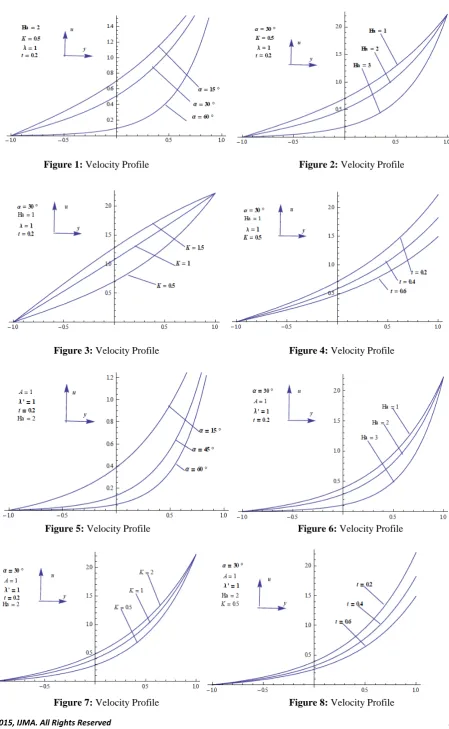
The velocity profiles for different parameters Ha, K,
α
and t are given by the figures1 to 8. Further the temperature and concentration profile are shown by Figures 9 and 10. The observations for both the cases: both plates non porous and lower plate porous are similar, which are as under.When the angle of inclination of applied magnetic field is increased, the velocity is decreased. It is shown by figure 1 and 5. Further it is deduced from figure 2 and 6 that velocity decreases when Hartmann number is increase. From figure 3, 4, 7 and 8 it is observed that velocity is increased when permeability and time are increased.
Figure 1: Velocity Profile Figure 2: Velocity Profile
Figure 3: Velocity Profile Figure 4: Velocity Profile
Figure 5: Velocity Profile Figure 6: Velocity Profile
Figure 9: temperature Profile Figure 10: concentration Profile
Table of skin friction for ordinary plates.
α
Ha Tλ
Kτ
15
1 0.2 1 0.5 0.946212
30
1 0.2 1 0.5 0.937676
45
1 0.2 1 0.5 0.910802
60
1 0.2 1 0.5 0.86831
30
1 0.2 1 0.5 0.937676
30
2 0.2 1 0.5 0.813251
30
3 0.2 1 0.5 0.470547
30
1 0.2 1 0.2 0.608504
30
1 0.2 1 0.5 0.9377676
30
1 0.2 1 1.0 1.10126
30
1 0.2 1 0.5 0.937676
30
1 0.4 1 0.5 0.77704
30
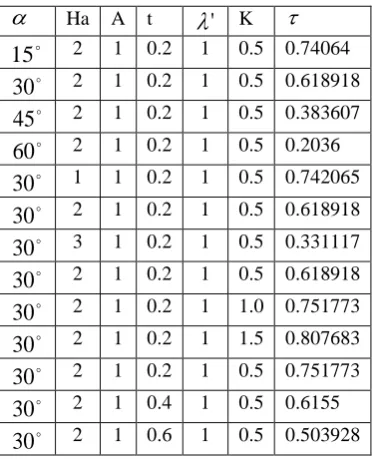
1 0.6 1 0.5 0.628543Table of Skin Friction for lower plate is porous.
α
Ha A tλ
'
Kτ
15
2 1 0.2 1 0.5 0.74064
30
2 1 0.2 1 0.5 0.618918
45
2 1 0.2 1 0.5 0.383607
60
2 1 0.2 1 0.5 0.2036
30
1 1 0.2 1 0.5 0.742065
30
2 1 0.2 1 0.5 0.618918
30
3 1 0.2 1 0.5 0.331117
30
2 1 0.2 1 0.5 0.618918
30
2 1 0.2 1 1.0 0.751773
30
2 1 0.2 1 1.5 0.807683
30
2 1 0.2 1 0.5 0.751773
30
2 1 0.4 1 0.5 0.6155
CONCLUSION
In this paper a theoretical analysis has been done for unsteady MHD poiseuille flow between two infinite parallel plates through porous media and an inclined magnetic field with heat and mass transfer. Solutions for the model have been solved analytically by an analytical method. The observations of the study are as below:
(i) Velocity increases with the increase in permeability parameter.
(ii) Velocity decreases with the increase in the angle of magnetic field, Hartmann number and time. (iii)Concentration increases with the increase in Schmidt number.
(iv)Temperature increases with increase in Prandtl number.
(v) Skin Friction increases with the increase in permeability parameter.
(vi)Skin Friction decreases with the increase in the angle of magnetic field, Hartmann number and time.
REFERENCES
1. Lighthill M J, “The response of laminar skin friction and heat transfer to fluctuations in the stream velocity”, Proc. R. Soc., A, 224 (1954), 1 - 23.
2. Ram P C, Singh C B and Singh U, “Hall effects on heat and mass transfer flow through porous medium”, Astrophysics Space Science, 100 (1984), 45-51.
3. Rajput U. S and Kumar Surendra, “MHD Flow Past an Impulsively Started Vertical Plate with Variable Temperature and Mass Diffusion,” Applied Mathematical Sciences, Vol. 5, 2011, no. 3, 149 – 157
4. Rajput U S and Kumar Surendra, “Radiation effects on MHD Flow through porous media Past an Impulsively Started Vertical Plate with Variable heat and mass transfer”, International Journal of Mathematical Archive-4(10), 2013, 106-114.
5. Singh C B, “Magnetohdrodynamic steady flow of liquid between two parallel plates”, In: Proc. of First Conference of Kenya Mathematical Society (1993), 24-26.
6. Soundalgekar V M, “Free convection effects on the oscillatory flow an infinite, vertical porous, plate with constant suction – I”, Proc. R. Soc., A, 333 (1973), 25 - 36.
7. Vajravelu K and Sastri K S, “Correction to `Free convection effects on the oscillatory flow an infinite, vertical porous, plate with constant suction - I”, Proc. R. Soc., A ,51 (1977), 31 - 40.
Source of support: Nil, Conflict of interest: None Declared