Address for correspondence Dr. Nighat Akbar,
Consultant Dermatologist, Dermatology Department, Military Hospital, Rawalpindi Email:[email protected]
Original Article
In vitro
susceptibility of
Sarcoptes scabiei
var.
hominis
to 1% topical ivermectin
Introduction
Scabies is an intensely itchy, common, parasitic infestation of the skin caused by the mite
Sarcoptes scabiei var. hominis. Overcrowding,
poor hygiene, poor nutritional status, homelessness, immigration, dementia and sexual contact favor it.1 The morbidity, treatment and control of scabies can be costly and challenging.2
Scabies is usually diagnosed on history and examination. Definitive diagnosis is made by microscopic identification of mites, eggs or fecal pellets extruded from lesions of scabies.
Usually, the number of female mites is thought to be limited to 12 on average.3 If diagnosis and treatment are delayed, the number of mites multiplies daily, resulting in progression of the infestation from a typical or classic form to a heavier or atypical infestation known as crusted scabies.4 Complications can also occur, especially after secondary bacterial infections such as post-streptococcal glomerulonephritis and systemic sepsis.5 Treatment should be started if scabies is suspected clinically, even if it is not confirmed by microscopy.
Methods
This quasi-experimental trial was carried out at Dermatology Department, Military Hospital, Rawalpindi from January 2013 to July 2013.Patients of scabies of all ages and both genders, in which diagnosis was made by
Nighat Akbar, Nadia Iftikhar
Department of Dermatology, Military Hospital, Rawalpindi
Abstract Objective The objective of this study was to measure the in-vitro susceptibility of Sarcoptes scabiei
var. hominis to 1% w/v ivermectin.
Methods This interventional (quasi-experimental) study was conducted in the OPD, Dermatology
Department, Military Hospital, Rawalpindi from January 2013 to July 2013. A total of 40 mites were taken for assay. Extruded mites from every patient were placed in 1% ivermectin w/v over a glass slide. Mites were inspected for leg movements at hourly intervals. Death was declared once all leg movements had ceased. All mites which died within 5 hours were declared susceptible. The mites having active leg movements even after 5 hours of drug application were considered resistant.
Results 100% (n=40) of mites died within 5 hours of application of 1% ivermectin, which was
significant.
Conclusion Topical 1% ivermectin is effective against Sarcoptes scabiei in terms of in vitro
susceptibility
Keywords
extruding live mites from the lesions of scabies and later on confirmed by light microscopy, were included in the study after taking informed consent.
Mites were explored and collected from the lesions manually with the help of a sterilized paper pin. 1% ivermectin was applied in a thin film over a glass slide. Live mites were then gently transferred to the glass slide with avoidance of any physical damage and maintained at room temperature. The vitality of mites was confirmed before assay. Mites were inspected for leg movements at an hourly interval. Death was declared once all leg movements had ceased. All mites which died within 5 hours were declared as susceptible to drugs, while mites having leg movements even after 5 hours of drug application were considered non-susceptible.6
Topical 1% ivermectin used was 1% w/v solution of ivermectin in propylene glycol. Since, topical ivermectin is not available commercially; to standardize the preparation it was prepared by a single chemist.
Results
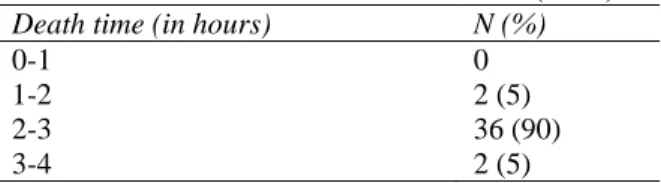
A total of 40 mites were exposed to 1% ivermectin solution and observed hourly for 5 hours. In vitro susceptibility of mites was 100% (Table 1). 36 (90%) mites died in 2-3 hours time period, 2 (5%) mites died in 3-4 hours and 2 (5%) mites died in 1-2 hours (Table 2). Mean survival time of mites when exposed to 1% ivermectin was 2-3 hours.
Table1 Frequency of in vitro susceptibility of mites to 1% ivermectin solution (n=40).
Susceptibility N (%)
Yes 40 (100)
No 0
Table 2 Time to death with 1% ivermectin (n=40). Death time (in hours) N (%)
0-1 0
1-2 2 (5)
2-3 36 (90)
3-4 2 (5)
Discussion
Scabies is a common health problem worldwide. Different therapies for scabies include anti-scabietics such as permethrin, benzyl benzoate, crotamiton, lindane, and ivermectin.
Most treatment modalities available are topical. Among them, 5% permethrin is the most effective scabicide with few side effects. But, the efficacy of this treatment has diminished, due to the emergence of permethrin resistance. This resistance has been linked to specific mutations in the neuronal voltage-sensitive sodium channel gene in the mite. The neuronal voltage-sensitive sodium channels are necessary for the generation of action potentials in excitable cells and are the target of permethrin.7
disrupting GABA-mediated central nervous system (CNS) neurosynaptic transmission. 8
Walton et al.5 described a simple in vitro analysis to evaluate the relative efficacy of various agents available in Australia for the treatment of scabies. Neem showed little acaricidal activity. 5% permethrin had the slowest killing time, with 35% of mites still alive after 3 hours, and 4% still alive after 18-22 hours of constant exposure. In contrast, no mites were alive after 3 hours exposure to 25% benzyl benzoate, 1% lindane, 5% tea tree oil and 100-8000ng/g of ivermectin.9
Similar in vitro resistance was demonstrated in a local study by Anwar et al.6 by comparing in
vitro efficacy of 5% permethrin with lindane.
93.3% (n=28) of mites in permethrin group died within 5 hours of drug application, but 6.7% (n=2) were still viable raising the possibility of resistance. However, the in vitro efficacy of permethrin was far better than lindane, 93.3% versus 55.3%. Mean survival time of permethrin was shorter than lindane, 2-3 hours and 4-5 hours, respectively.6 The in vitro resistance of permethrin has raised concerns about in vivo mite resistance.9,10
Various studies have been done on oral ivermectin. Study done by Rizvi et al.11 showed oral ivermectin to be more effective if given in two doses a week apart as compared to a single oral dose, with a cure rate of 56 % after a single dose and 78% after two doses.
Ranjkesh et al.12 compared the efficacy of permethrin 5% with oral ivermectin. Their study showed that two applications of permethrin with a one-week interval are more effective than a single dose of ivermectin. But two doses of ivermectin were as effective as a single application of permethrin.
A clinical trial comparing safety, efficacy and cost-effectiveness of benzyl benzoate, permethrin and ivermectin in scabies in a local population of Nagpur was done by Bachewar et al.13 First group received benzyl benzoate (BB) 25% lotion; second group received permethrin 5% cream, whereas third group received tablet ivermectin 200 microgram/kg as a single dose. The participants were recalled after one week for follow-up evaluation. If there were no signs of cure, the same intervention was repeated. The participants were followed up for two more weeks. Permethrin at the end of one week had significantly better cure rate than ivermectin. At the end of two weeks, cure rate in ivermectin group was 100%. The study concluded that benzyl benzoate and ivermectin each consecutively for two weeks were most cost-effective regimens giving complete cure in four weeks, while ivermectin was the fastest regimen giving the same results in two weeks.13
Few studies have been done using ivermectin topically, keeping in mind the well-documented effectiveness of oral ivermectin.
Goldust et al.14 compared topical 1% ivermectin at a dose of 400 microgram/kg with permethrin 2.5% cream. The study showed that two applications of ivermectin were as effective as two applications of permethrin at the 2-week follow-up, 63.1% versus 65.8%. After repeating the treatment, ivermectin was as effective as permethrin at the 4-week follow-up, 84.2% versus 89.5%, respectively.
micrograms/kg as single dose, and third group received ivermectin 1% lotion as single application. The patients were followed up at intervals of 1, 2, 3, and 4 weeks. If there were no signs of cure, the same intervention was repeated at each follow-up. Primary efficacy variable was clinical cure of lesions. At the end of first week, cure rate was 74.8% in permethrin group, 30% in oral ivermectin group, and 69.3% in topical ivermectin group. At the end of second week, cure rate was 99%, 63%, and 100%, respectively. At the end of third week, 100% cure rate was observed in permethrin and topical ivermectin group while 99% in oral ivermectin group. The study showed that permethrin and topical ivermectin were equally effective against scabies while oral ivermectin was significantly less effective at 2 weeks.15
There is no significant difference regarding safety of use between permethrin and oral ivermectin.16 It proved effective for the treatment as well as prophylaxis of scabies.17 Similarly topical ivermectin not only proved effective but also was well-tolerated.18
Considering all the available research on ivermectin done previously, we planned this in
vitro assay to explore this drug further. All mites
in our study died within 4 hours with a mean death time of 2-3 hours, which is significant. The presentation of scabies patients with recurrent infestations indicates the possibility of emerging drug resistance or poor compliance of patients to topical permethrin, which is the most commonly prescribed treatment for scabies. The application of topical permethrin is cumbersome and messy, and interferes with daily activities of patients.
Other treatment options should be studied, aiming for a better treatment modality. Our study suggests that topical ivermectin is a good alternative for the treatment of scabies. With a
shorter death time, it might need a shorter contact time and thus patients might comply better with it. Further in vitro and in vivo trials are needed with larger sample sizes to evaluate this treatment option in detail.
Conclusion
1% Ivermectin is effective against Sarcoptes
scabiei var. hominis in terms of in vitro
susceptibility. Further studies and trials should be done to study efficacy, safety and cost effectiveness of this novel treatment.
References
1. Hicks MI, Elston DM. Scabies. Dermatol Ther. 2009;22:79-92.
2. Le Cleach L, Chosidow O. Commentary on "Interventions for treating scabies". Evid Based Child Health. 2011;6:1865-6. 3. Wolf R, Davidovici B. Treatment of
scabies and pediculosis. Facts and controversies. Clin Dermatol. 2010; 28:511-18.
4. Christine KC, John R, Steven JS et al. Scabies surveillance, prevention and control. Ann Long Term Care. 2009;17:31-5.
5. Walton SF, Currie BJ. Problems in diagnosing scabies, global disease in human and animal populations. Clin Microbiol Rev. 2007;20:268-79.
6. Anwar IM, Rizvi SDA, Dilnawaz M et al. Comparison of in-vitro susceptibility of Sarcoptes scabiei var. hominis to 5% permethrin and 1% lindane. PAFMJ. In press 2014.
7. Pasay C, Arlian L, Morgan M et al. High-resolution melt analysis for the detection of a mutation associated with permethrin resistance in a population of scabies mites. Med Vet Entomol. 2008;22:82-8.
8. Dourmishev AL, Dourmishev LA, Schwartz RA. Ivermectin: pharmacology and application in dermatology. Int J Dermatol. 2005;44:981-8.
10. Mounsey KE, Holt DC, McCarthy J et al. Scabies: molecular perspectives and therapeutic implications in the face of emerging drug resistance. Future Microbiol. 2008;3:57-66.
11. Rizvi SDA, Iftikhar N, Batool F. Effectiveness of oral ivermectin for eradicating infesting mites in patients of scabies. J Pak Assoc Dermatol. 2011;21:87-92.
12. Ranjkesh MR, Naghili B, Goldust M, Rezaee E. The efficacy of permethrin 5% vs. oral ivermectin for the treatment of scabies. Ann Parasitol. 2013;59:189-94. 13. Bachewar NP, Thawani VR, Mali SN et al.
Comparison of safety, efficacy, and cost effectiveness of benzyl benzoate, permethrin, and ivermectin in patients of scabies. Indian J Pharmacol. 2009;41:9-14. 14. Goldust M, Rezaee E, Raghifar R, Hemayat S. Treatment of scabies: the
topical ivermectin vs. permethrin 2.5% cream. Ann Parasitol. 2013;59:79-84. 15. Chhaiya SB, Patel VJ, Dave JN et al.
Comparative efficacy and safety of topical permethrin, topical ivermectin, and oral ivermectin in patients of uncomplicated scabies. Indian J Dermatol Venereol Leprol. 2012;78:605-10.
16. Mushtaq A, Khurshid K, Pal SS. Comparison of efficacy and safety of oral ivermectin with topical permethrin in treatment of scabies. J Pak Assoc Dermatol. 2010;20:227-31.
17. Ribeiro Fde A, Taciro E, Guerra MR, Eckley CA. Oral ivermectin for the treatment and prophylaxis of scabies in prison. J Dermatolog Treat. 2005;16:138-41.