Address for correspondence Dr. Vishalakshi S. Pandit
#303, “C” Staff Quarters, KIMS Campus, Gangavati Road, Koppal-583231, Karnataka. Ph: +91-9844381033
Email: [email protected]
Original Article
A case-control study of frequency of occurrence of
cardiovascular risk factors in patients with psoriasis
Introduction
Psoriasis is a systemic, chronic inflammatory skin disease that affects approximately 2% of the population.1 Recently, psoriasis has been reported to be associated with metabolic disorders including obesity, dyslipidaemia and
diabetes mellitus, which are the cardiovascular co-morbidities.2 Psoriasis may represent a risk factor for major adverse cardiac outcomes independent of conventional cardiovascular risk factors.3 This study was conducted to assess the association of psoriasis with cardiovascular risk factors and metabolic syndrome.
Materials and Methods
This was a hospital-based case-control study involving a series of 50 psoriatic patients (cases) Vishalakshi S. Pandit, Aparna Palit*, Arun C. Inamadar*
Department of Dermatology, Venereology & Leprosy, Koppal Institute of Medical Sciences, Koppal, Karnataka.
* Department of Dermatology, Venereology & Leprosy, SBMP Medical College, Hospital and Research Centre, BLDE University, Vijayapur-586103, Karnataka.
Abstract
Objectives Psoriasis is a chronic, inflammatory skin disease. Nowadays, its association withmetabolic and vascular disorders is increasingly recognized. The study was conducted to know the association of psoriasis with metabolic syndrome (MS).
Methods A hospital-based case-control study was conducted. Fifty psoriatic patients and 48 controls were recruited. Data collected included disease duration, history of smoking/alcoholism, type and severity of psoriasis, body mass index (BMI), waist circumference, blood pressure and body surface area (BSA) involvement,. Fasting blood glucose and lipid profile were measured in all patients. MS was diagnosed in presence of ≥3 criteria of the ATP III criteria.
Results Patients had mild to severe psoriasis (PASI score 8.3-47). BSA affected ranged from 10% to 90%. The prevalence of MS was higher in psoriatic patients as compared to controls, but without statistical significance (12% vs. 6%, OR: 2.21, p: 0.48). MS components analyzed separately, showed a significantly higher prevalence of overweight/obesity (26% vs. 14.58% in controls), raised triglyceride levels (28% vs. 22.9%), arterial hypertension (24% vs. 12.5%), hyperglycemia (26% vs. 10.4%), hypercholesterolemia (8% vs. 2%), raised LDL levels (24% vs. 16.6%) and hypo HDLcholesterolemia (82% vs. 60.4%) in psoriatic patients than the controls. History of smoking (OR=4.91) and alcoholism (OR=2.75) was significantly higher in psoriasis patients.
Conclusion Our findings demonstrate a possible association between psoriasis and MS which can favor cardiovascular events. Dermatologists treating psoriasis patients should be aware of the development of these cardiovascular risk factors and advise patients to decrease additional risk factors such as smoking or obesity.
Key words
and 48 controls attending outpatient department of dermatology. Inclusion criteria for cases were age more than 18 years and clinically diagnosed of psoriasis. Patients receiving any systemic treatment for psoriasis including acitretin, ciclosporin, methotrexate, phototherapy or biologics for at least 1 month before enrolment were not included in the study. Controls were enrolled among patients referred for dermatological conditions other than psoriasis. A written consent was obtained from all the participants and an approval from ethical committee of the institution was received for this study.
BMI was calculated as weight (kg)/height (cm2) and obesity was defined as BMI> 30 kg/m2. Blood pressure was recorded in both sitting and lying down position. Severity of psoriasis was assessed according to Psoriasis Area and Severity Index (PASI) and body surface area (BSA) measurement. Fasting blood glucose levels, lipid profile were measured in all patients. All patients undergoing this analysis were instructed to fast for 8h before the withdrawal of blood. Metabolic syndrome was diagnosed in the presence of three or more criteria of the National Cholesterol Education Program Adult Treatment Panel III criteria.
Statistical analysis
Continuous data are expressed as the mean±SD, and categorical variables are expressed as percentages. Associations between the presence of psoriasis and various covariates were tested by using the Fisher’s exact test.
Results
The study included 50 cases and 48 controls. The mean age of the case patients was 43.88 years±15.44. The mean age of controls was 43.87 years±16.64. In the case group, there were
39 (78%) men and 11 (22%) women. In control group, there were 34 (70.8%) men and 14 (29.1%) women. Out of 50 cases, 43 (86%) were chronic plaque psoriasis, 3 (6%) were psoriasis vulgaris, 2 (4%) each in psoriatic erythroderma and guttate psoriasis. The mean duration of disease (in years) in psoriatic patients was 6.32±5.58. Patients had mild to severe psoriasis with a PASI score ranging from 8.3 to 47; 3(6%) patients had a PASI score < 10, whereas 47 (94%) had a PASI score ≥ 10. BSA affected ranged from 10% to 90%, with a median of 52.5. Prevalence of dermatological diagnoses in the control group was as follows: 7 (14.6%) autoimmune blistering diseases, 6 (12.5%) each in photodermatitis and acne group, 5 (10.4%) atopic dermatitis, 4 (8.33%) each in Hansen’s disease and drug reaction, 2 (4.16%) lichen planus and 14 (29.16%) others.
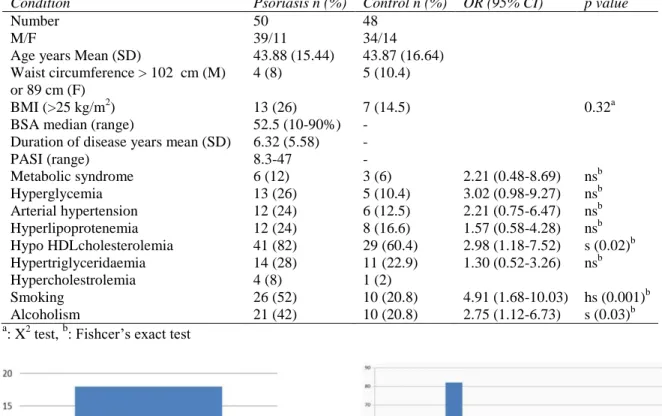
The prevalence of metabolic syndrome was higher in psoriatic patients than in control group, but without statistical difference (12% vs. 6%, OR: 2.21, P: 0.48) as shown in Figure 1. The association of metabolic syndrome, arterial hypertension, hyperlipidemia in both psoriatic and control groups is shown in the Table 1.
Table 1 Comparison of demographic, clinical and laboratory features of psoriasis and control groups Condition Psoriasis n (%) Control n (%) OR (95% CI) p value
Number 50 48
M/F 39/11 34/14
Age years Mean (SD) 43.88 (15.44) 43.87 (16.64) Waist circumference > 102 cm (M)
or 89 cm (F)
4 (8) 5 (10.4)
BMI (>25 kg/m2) 13 (26) 7 (14.5) 0.32a
BSA median (range) 52.5 (10-90%) -
Duration of disease years mean (SD) 6.32 (5.58) -
PASI (range) 8.3-47 -
Metabolic syndrome 6 (12) 3 (6) 2.21 (0.48-8.69) nsb
Hyperglycemia 13 (26) 5 (10.4) 3.02 (0.98-9.27) nsb
Arterial hypertension 12 (24) 6 (12.5) 2.21 (0.75-6.47) nsb
Hyperlipoprotenemia 12 (24) 8 (16.6) 1.57 (0.58-4.28) nsb
Hypo HDLcholesterolemia 41 (82) 29 (60.4) 2.98 (1.18-7.52) s (0.02)b Hypertriglyceridaemia 14 (28) 11 (22.9) 1.30 (0.52-3.26) nsb
Hypercholestrolemia 4 (8) 1 (2)
Smoking 26 (52) 10 (20.8) 4.91 (1.68-10.03) hs (0.001)b
Alcoholism 21 (42) 10 (20.8) 2.75 (1.12-6.73) s (0.03)b
a
: X2 test, b: Fishcer’s exact test
Figure 1 Percentage of metabolic syndrome among
cases and controls
Figure 2 Percentage of components of metabolic
syndrome among cases and controls
Similarly, alcoholism was significantly associated with psoriasis than in control group.
Discussion
Psoriasis is a chronic T cell-mediated disease of the skin and occasionally the joints (psoriatic arthritis). There is a significantly increased risk of cardiovascular risk factors and metabolic syndrome in patients with psoriasis. Systemic inflammation is associated with metabolic syndrome, with T helper type 1 pro-inflammatory cytokines such as tumor necrosis factor and nonspecific measures of inflammation such as C-reactive protein levels being elevated in patients with the syndrome compared with
those without it. These cytokines are also involved in the causation of psoriasis, thus may partly explain the association between these phenotypically distinct diseases.4 This proves that psoriasis is a disease which is just not restricted to the skin, but develops non-cutaneous disorders in a course of time.
It is not clear whether metabolic syndrome and its components are cause or consequence of psoriasis considering that patients with psoriasis change their lifestyle habits including nutrition and smoking.
patients than in controls.2,5,6 In our study, the prevalence of metabolic syndrome was higher in cases than in healthy controls but with no statistically significant difference (12% vs. 6%, odds ratio (OR): 2.21, CI: 0.48-8.69, P: 0.48). Similarly, in a Tunisian case-control study, an increased but not statistically significant prevalence of metabolic syndrome was observed in psoriatic patients in comparison with controls (35.5% vs.30.8%, odds ratio (OR): 1.39 CI: 0.88-2.18; P-0.095).7
In our study, there is increased prevalence of hypo HDLcholesterolemia in psoriasis group in comparison with the control group, and it is statistically significant. Similar observations have been made by many studies.7-9 This increased prevalence of hypo HDL cholesterolemia could be explained by a possibility that genetic alterations in the HDLc and⁄ or apo-lipoprotein (apo) A-I genes may be linked with psoriasis.
We have found that the prevalence of individual components of metabolic syndrome such as hyperglycemia, hypertriglyceridemia, arterial hypertension was high in our study. Similar results have been found in many studies.10,11 The prevalence of hyperlipoproteinemia, hypercholestrolemia and hypertriglyceridemia is higher (but without statistical significance) in this study which is comparable with result of study conducted by Bhat et al.12 Several mechanisms for the increased lipid levels in psoriasis have been suggested. Being a chronic inflammatory disease, psoriasis has increased immunological activity of type1 helper T cells and cytokines such as TNF-α and interleukin-6 which seem to play a central role. TNF may lead to insulin resistance by inhibiting insulin mediated tyrosine phosphorylation of the insulin receptor, as well as insulin receptor substrate-1. TNF-α has also been shown to be a potent activator of c-Jun amino terminal kinase, which
stimulates activator protein-1, a major regulator of pro-inflammatory activity.2,10,13
In our study, the association of smoking and alcoholism is higher with psoriatic group as compared to control group. These are the additional cardiovascular risk factors which make the establishment of association between psoriasis and metabolic syndrome difficult. Similar results were observed by many studies.2,5,6,9
Determination of BMI showed higher number of overweight and obesity in psoriatic group as compared to control group. But, the mean BMI in both the groups was almost same. As patients with psoriasis have decreased quality of life and increased rates of depression, a tendency for patient with psoriasis to compensate by smoking and excessive eating leading to obesity, which favor development of metabolic syndrome. It was shown that psoriasis and obesity share similar mediators of inflammation - such as TNF-α and IL-6 and that the engines of adipocytic and psoriatic inflammation, the adipocyte and macrophage, respectively - both derived from a common mesothelial origin. Obesity may potentiate some of the TNF-α and IL-6-driven inflammation seen in psoriasis, additionally leading to impaired glucose regulation, dyslipidaemia, endothelial dysfunction, hypertension and a heightening of the inherent cardiovascular risk of cutaneous psoriatic inflammation.14,15 So, psoriatic patients presenting early with or without metabolic syndrome need to be counseled properly so that behavioral modification along with appropriate management of the psoriasis may make the emergence of cardiovascular risk factors less likely.
Small group of cases and controls was the other limitation of this study.
Conclusion
To conclude, our study supports the previous reports of the association of psoriasis with metabolic syndrome. Further, large scale case-control studies are needed to establish this association. Dermatologists treating psoriasis patients should be aware of the development of these cardiovascular risk factors and investigate for the same. We should advise the patients to modify their life style to decrease these risk factors such as smoking or obesity.
References
1. van de Kerkhof PCM, Schalkwijk J: Psoriasis; in Bolognia JL, Jorizzo JL, Rapini RP (eds): Dermatology, ed 2. Philadelphia, Mosby Elsevier, 2008, p: 115–135.
2. Sommer DM, Jenisch S, Suchan M, Christophers E, Weichenthal M. Increased prevalence of the metabolic syndrome in patients with moderate to severe psoriasis. Arch Dermatol Res 2006; 298: 321-328. 3. Pearson KC, Armstrong AW. Psoriasis and
cardiovascular disease: epidemiology, mechanisms, and clinical implications. Psoriasis: Targets and Therapy 2012; 2:1– 11.
4. Langan SM, Seminara NM, Shin DB, Troxel AB, Kimmel SE, Mehta NN. Prevalence of Metabolic Syndrome in Patients with Psoriasis: A Population-Based Study in the United Kingdom. J Invest Dermatol 2012; 132: 556–562.
5. Gisondi P, Tessari G, Conti A, Piaserico S, Schianchi S, Peserico A et al. Prevalence of metabolic syndrome in patients with
psoriasis: a hospital-based case-control study. Br Jr Dermatol 2007; 157: p: 68–73. 6. Cohen AD, Gilutz H, Henkin Y, Zaheg D,
Shapiro J, Bonneh DY et al. Psoriasis and the Metabolic Syndrome. Acta Derm Venereol 2007; 87: 506-509.
7. Mebazaa A, Asmi ME, Zidi W, Zayani Y, Rouhou RC, Ounifi SE. Metabolic syndrome in Tunisian psoriatic patients: prevalence and determinants. J Eur Acad Dermatol Venereol 2011; 25: 705-709. 8. Mallbris L, Granath F, Hamsten A, Stahle
M. Psoriasis is associated with lipid abnormalities at the onset of skin disease. J Am Acad Dermatol 2006; 54: 614-621. 9. Dreiher J, Weitzman D, Davidovici B,
Shapiro J, Cohen AD. Psoriasis and Dyslipidaemia: A Population-based Study. Acta Derm Venereol 2008; 88: 561-565. 10. Neimann AL, Shin DB, Wang X, Margolis
DJ, Troxel AB, Gelfand JM. Prevalence of cardiovascular risk factors in patients with psoriasis. J Am Acad Dermatol 2006; 55: 829-35.
11. Cohen AD, Sherf M, Vidavsky L, Vardy DA, Shapiro J, Meyerovitch J. Association between psoriasis and the metabolic syndrome. Dermatol 2008; 216: 152-5. 12. Bhat RM, Pinto HP. Lipid profile in
psoriasis patients. In, Psoriasis: Targets and Therapy 2012:2 77–80.
13. Farshichian M, Zamanian A, Farshichian M, Monsef AR, Mahjub A, Serum lipid levels in Iranian patients with psoriasis. J Eur Assoc Deramatol Venereol 2007; 21: 802-805.
14. Krueger JG. The immunologic basis for the treatment of psoriasis with the new biologic agents. J Am Acad Dermatol 2002; 46: 1- 23.