Hegemonic masculinity predicts 2016 and 2020 voting
and candidate evaluations
Theresa K. Vescioa,1and Nathaniel E. C. Schermerhorna
aDepartment of Psychology, The Pennsylvania State University, University Park, PA 16802
Edited by Susan T. Fiske, Princeton University, Princeton, NJ, and approved November 15, 2020 (received for review October 6, 2020) This work examined whether the endorsement of the culturally
idealized form of masculinity—hegemonic masculinity (HM)— accounted for unique variance in men’s and women’s support for Donald Trump across seven studies (n=2,007). Consistent with our theoretical backdrop, in the days (Studies 1 and 2) and months (Studies 3 through 6) following the 2016 American presidential election, women’s and men’s endorsement of HM predicted voting for and evaluations of Trump, over and above political party affil-iation, gender, race, and education. These effects held when con-trolling for respondents’trust in the government, in contrast to a populist explanation of support for Trump. In addition, as concep-tualized, HM was associated with less trust in the government (Study 3), more sexism (Study 4), more racism (Study 5), and more xenophobia (Study 6) but continued to predict unique variance in evaluations of Trump when controlling for each of these factors. Whereas HM predicted evaluations of Trump, across studies, social and prejudiced attitudes predicted evaluations of his democratic challengers: Clinton in 2016 and Biden in 2020. We replicate the findings of Studies 1 through 6 using a nationally representative sample of the United States (Study 7) 50 days prior to the 2020 presidential election. The findings highlight the importance of psy-chological examinations of masculinity as a cultural ideology to understand how men’s and women’s endorsement of HM legiti-mizes patriarchal dominance and reinforces gender, race, and class-based hierarchies via candidate support.
masculinity
|
racism|
sexism|
hegmony|
political attitudesD
onald J. Trump’s history-making ascension from nonpoliti-cian to president of the United States has been explained in terms of an array of factors. Support for President Trump has been found to be associated with the antiestablishment, antielitist, and nativist populism of Trump voters (1), as well as voters’sexism (2–9), racism (10, 11), homophobia, and xenophobia (2). In addi-tion, many of the factors that predict support of President Trump are confounded with group membership. Men (versus women), White people (versus non-White people), those with relatively less (versus more) education, and Republicans (versus Democrats and Independents) are both 1) higher in racism, sexism, nationalism and 2) stronger supporters of President Trump (12). Status threat, or the increase in cultural diversity that threatens the status quo, is a broader factor that predicts support for Trump and may account for many of the aforementioned associations [specifically, those who supported Trump in the 2016 election were those who felt the hierarchy was being upended and those who perceived more dis-crimination against White than Black people, Christians than Muslims, and men than women (13)].As social theorists long have noted, the state and state-spon-sored institutions reflect the ideology of dominant groups (14), promoting the broad endorsement and acceptance of cultural ideologies that reinforce and maintain the status quo (15–17). Given that men have more physical, social, and economic power than do women (18), masculinity and manhood are valued and normalized, whereas femininity and womanhood are othered and in need of explanation (19). As de Beauvoir noted, the othering of women (or the gender binary) is at the heart of hierarchical sys-tems that oppress women (19); this includes women with various
intersecting identities (20), as well as men who belong to margin-alized ethnic, economic, religious, and sexual groups (21). As a result, the state institutionalizes a male point of view (22, 23), and masculinity long has been embedded in the political discourse of the United States (24), perpetuated by candidates who strategically symbolize masculine ideals while attempting to emasculate their opponents (25). In fact, since the 1980s, Republicans have defined their party as masculine by femininizing the Democratic Party and running campaigns based on strength and protection (26). There-fore, presidential elections were, up until 2016, conducted to decide which man was best able to protect the United States from various threats—real or constructed (27). In 2016, Trump epitomized ag-gressive masculine traits and waged masculinity competitions (28, 29) against his fellow Republican opponents via imputations of failed masculinity (26), accentuating Clinton’s gender [e.g., “she’s playing the woman card” (30)], and her implicit threat to the presidency given gender role incongruity (31).
Our theory and research examined whether United States citi-zens’ endorsement of culturally valued and idealized forms of masculinity account for unique variance in support of Trump, over and above the variance accounted for by the various other factors noted at the outset of the article. To elaborate our theoretical backdrop and elucidate our hypotheses, we discuss the two pri-mary ways in which masculinity has been conceptualized: mascu-linity as a precarious social identity and mascumascu-linity as hegemony. Within our consideration of each conceptualization, we discuss the relation of masculinity to status, power, and threat.
Significance
Donald J. Trump’s history-making ascension from nonpolitician to president of the United States has been attributed to the anti-establishment, antielitist, and nativist populism of Trump voters, as well as to sexism, racism, homophobia, and xenophobia. Based on the findings of seven studies involving 2,007 people, men’s and women’s endorsement of hegemonic masculinity predicted support for Trump over and beyond the aforementioned factors, even when controlling for political party affiliation. Results highlight the importance of looking beyond social identity–based conceptualizations of masculinity to fully consider how men’s and women’s endorsement of cultural ideologies about mascu-linity legitimate patriarchal forms of dominance and reify gender-, race-, and class-based hierarchies.
Author contributions: T.K.V. and N.E.C.S. designed research, performed research, ana-lyzed data, and wrote the paper.
The authors declare no competing interest. This article is a PNAS Direct Submission.
This open access article is distributed underCreative Commons Attribution-NonCommercial-NoDerivatives License 4.0 (CC BY-NC-ND).
1To whom correspondence may be addressed. Email: [email protected].
This article contains supporting information online athttps://www.pnas.org/lookup/suppl/ doi:10.1073/pnas.2020589118/-/DCSupplemental.
Published January 4, 2021.
PSYCHOL
OGICAL
AND
COGNITIVE
SCIENC
Precarious Masculine Identity
Psychologically speaking, masculinity typically and most frequently has been conceptualized as a precarious social identity (32–34). From this perspective, masculinity is earned and maintained through continual behavioral displays of manhood. As a result, momentary lapses in behavioral displays of masculinity have the potential to threaten masculinity, with important intra- and in-terpersonal consequences. Consistent with this notion, threats to masculinity have been produced experimentally by leading men to believe that they are like women in actions (e.g., braiding hair; 35), knowledge (36), personality (37), and/or cognitive perfor-mance (33, 38). Beyond documenting the causes of situational and chronic threats to masculinity (39), the precarious mascu-linity literature examines the consequences of threats to mas-culinity. For instance, findings show that the threat of being like women (versus men) inspires anger (40) and concerns about how one looks in the eyes of others (35, 36, 38) as well as compensatory dominance that reestablish one’s status as a good man. These compensatory acts include physical aggression (35), sexual domi-nance (38), intimate partner violence (41), the sexualization and harassment of women (34, 38), and interpersonal violence against lesbian, gay, bisexual, transgender, and queer people (42). Impor-tantly, most studies have found that gender threats inspire com-pensatory acts of dominance in men but not women (43), consistent with the notion that masculinity is a valued and precarious social identity for men in a way that femininity is not for women (33).
Although research on precarious masculine identity (PMI) has primarily examined content and relevance of masculine self-concepts (33, 35) in intra- and interpersonal contexts, threats to masculine social identities may have political implications. For instance, threatening men by leading them to believe that they were more like women (versus men) resulted in the greater justification of social inequality (37), less support of gender eq-uity (44), and more expression of sexism (38) and homophobia (45). Situational threats to masculinity have also been linked to support of aggressive policies—like support for the Iraq war (45) and gun enthusiasm (46).
Regardless of the potential political consequences (47), PMI cannot fully account for the political rise of Trump. As noted, women do not exhibit parallel threat responses upon receiving feedback that they are gender atypical. As a result, PMI findings can explain the political candidate support and voting patterns of some men but not women (13).
Theoretically and empirically, our work suggests that hege-monic masculinity (HM), more so than PMI, predicts support of Trump. In fact, a point often overlooked by psychological scholars is that conceptualizing masculinity in hegemonic terms implies, as discussed below, that culturally exalted forms of masculinity may be accepted and endorsed by most people—men, women, and gender nonbinary people—which has broader implications and offers a more parsimonious explanation of the linkages between masculinity, political thought, and candidate support.
HM
HM (48) refers to the form of masculinity that, within cultures, is exalted above all others. In the United States, idealized concep-tualizations of masculinity prescribe that men should be high in 1) power, or the potential to control outcomes and influence others in psychologically meaningful ways (49–51), and/or 2) status, or the ability to elicit admiration given one’s accomplishments and social standing (52). Ideally, men should also be mentally, physi-cally, and emotionally tough (52, 53), able to persist, unaffected, in the face of physical pain and/or emotional challenges. Given the gender binary and stereotypic prescriptions of men and women as opposites (54), to achieve this masculine ideal, one must repudiate and distance from all that is feminine, gay, or otherwise unmanly (53, 55, 56).
Whereas PMI is a social identity of relevance to individual men and the people with whom they interact, HM is a cultural ideology that is separable from male bodies (57). HM is an ideology that links success and power to men (not women) but is endorsed and accepted as personally beneficial by most members of a given culture—men and women (48). As a result, HM justifies and legitimizes the power of dominant men (i.e., White, straight, upwardly mobile, and able-bodied men) over women and margin-alized men (i.e., non-White, gay, disabled, and poor men). En-dorsement of HM elevates masculinity and male dominance by othering femininity and womanhood (19) and reinforcing the gen-der binary (54). Likewise, the endorsement of HM legitimizes and justifies notions of dominant group supremacy, which reinforces and maintains the othering and marginalization of racial minority, nonstraight, physically disabled, religious minority, elderly, and im-migrant men. Therefore, HM is related to but distinct from sexism and prejudice, allowing processes of hegemony to operate (15) by veiling sexism and prejudice and subtly contributing to the rein-forcement of male dominance and dominant group supremacy.
Interestingly, the psychological implications of HM have re-ceived little empirical attention. Theoretically, however, processes of hegemony have been hypothesized to be powerful tools in the reinforcement and maintenance of the status quo (15) given their influence on political thought and support of state-sponsored in-stitutions (14, 23).
HM and Support for President Trump
If HM is a cultural ideology, then its endorsement should be broad, consensual, and predictive of both men’s and women’s support for the status quo. In his 2016 presidential campaign, Trump embodied HM while waxing nostalgic for a racially homogenous past that maintained an unequal gender order. Trump performed HM by repeatedly referencing his status as a successful businessman (“ blue-collar businessman”) and alluding to how tough he would be as president (26). Further contributing to his enactment of HM, Trump was openly hostile toward gender-atypical women, sexualized gen-der-typical women, and attacked the masculinity of male peers and opponents. For instance, Trump consistently referred to the Obama administration as“weak,”proclaiming himself to be the masculine protector who could successfully restore America from its feminized state (26, 58). As a result, HM should predict support for Trump, operationalized as positive evaluations of and voting for Trump, over and above the factors that, as previously described, have been found to be associated with support of Trump (Studies 1 through 7).
Our theoretical conceptualization also positions populism as an effect of HM. As noted at the outset, Trump’s 2016 victory was initially explained in terms of a populist explanation: Trump was an antiestablishment, political outsider, who resonated with voters who felt that the government was no longer representing their interests (1). By contrast, as masculinity scholars have suggested, populists presumably have nostalgia for a racially homogenous, male-dominant past in which women and minorities were often blamed for taking jobs (that“should”belong to White men) and breaking apart the family (59). If populism is an effect of HM, then HM should predict voting for and evaluations of Trump over and above trust in government, as well as political party affiliation, gender, race, and education (Studies 3 and 7).
In sum, HM is a cultural ideology that legitimizes and reinforces idealized notions of masculinity and manhood as dominant over femininity and women and dominant over marginalized and sub-ordinated masculinities (48). HM is related to but distinct from sexism and prejudice toward marginalized groups, allowing pro-cesses of hegemony (15) to subtly reinforce male dominance and dominant group supremacy (48). From this perspective, HM is tied to negative attitudes and prejudice toward women and marginalized groups perceived as competing for resources to which dominant men have historically had unencumbered access (59). Consistent with this notion, masculinity has been found to be associated with
sexism (60), racism (61), xenophobia (62), homophobia (63), and racial and religious outgroups, more generally (59). However, HM should predict support for Trump over and above sexism (Studies 4 and 7) and prejudiced attitudes (Study 5 through 7), as well as other demographic variables.
Results
In seven studies (n =2,007), undergraduate or nonstudent men and women reported their past or intended voting, candidate evaluations, and demographic information, including gender, race, level of education, and political party affiliation. One’s own level of education was the predictor used in the three samples involving nonstudent men and women, (i.e., two Mechanical Turk [MTurk] samples and a nationally representative Prolific sample). How-ever, because there was no variance in one’s own level of educa-tion in the undergraduate student samples, parental educaeduca-tion was used as the predictor in the four student samples. Participants in each study indicated their endorsement of HM. Consistent with other research (64), we operationalized HM using the Male Role Norms Scale (MRN, 53). We chose the MRN as our measure of HM because MRN measures dominant and normative sociocul-tural masculine ideologies that can be endorsed and accepted by all, regardless of gender identification (53; see also 65–67), rather than descriptive traits of individual men that can be embodied and experienced by some (68, 69). We operationalized PMI using the Masculine Gender Role Stress Scale (69); it measures one’s stress as the thought of failures to embody masculine characteristics. The above-mentioned variables were measured in Study 1 and Study 2. We estimated two series of hierarchical regressions. The first set of regressions examined whether HM accounted for unique vari-ance in support for Trump, over and above political party, gender, race, and education. In these analyses, political party affiliation was entered in Step 1, the demographic variables of gender, race, and education were entered in Step 2, and the masculinity variables— HM and PMI—were then entered in Step 3. Finally, the interac-tions that involved the moderation of HM and/or PMI were then entered in Step 4. In the second set of hierarchical regressions, a step was added to the model to examine whether HM predicted support for Trump over and above populism, sexism, and prejudice toward marginalized groups, as well as demographic variables. In
these analyses, after political party affiliation and the demographic variables (i.e., gender, race, and education) were entered in Steps 1 and 2, respectively, social attitudes (i.e., trust in government, sexist attitudes, or prejudiced attitudes toward marginalized groups) were entered in Step 3. The masculinity variables were then entered in Step 4 and the interactions were entered in Step 5. Across analyses, we found no evidence of significant interactions that qualified the information presented below. Therefore, although we present sig-nificant interactions in the tables, interactions are not discussed in the main text; instead, interactions are presented and discussed in
theSI Appendix.
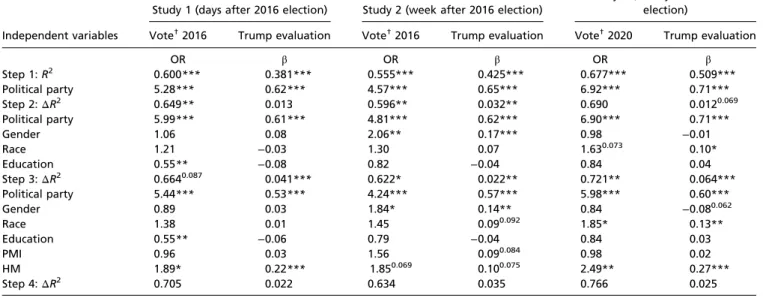
Consistent with our conceptualization, across variables and studies, HM predicted support for Trump, over and above the contributions of political party, gender, race, and education. In fact, the endorsement of HM predicted both voting for and evaluations of Trump in the days (Studies 1 and 2, Table 1) and months (Studies 3 through 6; seeSI Appendix, Table S1) following the 2016 election. Fifty days prior to the 2020 presidential election (Study 7, Table 1, right panel), in a nationally representative sample, HM also accounted for unique variance in intended 2020 voting and positive evaluations of Trump. Specifically, inclusion of the masculinity variables in Step 3 was associated with a consistent increase inΔR2(Table 1 andSI Appendix, Table S1), which was significant in six studies and marginally significant in the remaining study. Across studies, HM, but not PMI, predicted support for Trump in Step 3, and these effects were not qualified by any in-teractions in Step 4.
We additionally tested for PMI effects in two ways. First, in the hierarchical regressions, a PMI effect could be evidenced by a significant ΔR2 and a significant PMI × gender interaction associated with Step 4. The PMI X gender interaction emerged as significant in two cases (SI Appendix, Table S1) but exhibited contradictory patterns of findings (SI Appendix). Second, PMI effects might also be revealed if PMI predicted support of Trump for men but not women. We conducted analyses separately for men and women (SI Appendix, Table S2). These analyses failed to reveal evidence of precarious masculinity effects; HM, but not PMI, predicted support for Trump for both men and women. These analyses did, however, point to the possibility of stronger
Table 1. Results of hierarchical regression analyses for voting for (binary logistic) and evaluations of Trump (linear) for Study 1 (MTurk sample), Study 2 (undergraduate sample), and Study 3 (nationally representative sample)
Study 1 (days after 2016 election) Study 2 (week after 2016 election)
Study 7 (50 days before 2020 election)
Independent variables Vote†2016 Trump evaluation Vote†2016 Trump evaluation Vote†2020 Trump evaluation
OR β OR β OR β
Step 1:R2 0.600*** 0.381*** 0.555*** 0.425*** 0.677*** 0.509***
Political party 5.28*** 0.62*** 4.57*** 0.65*** 6.92*** 0.71***
Step 2:ΔR2 0.649** 0.013 0.596** 0.032** 0.690 0.0120.069
Political party 5.99*** 0.61*** 4.81*** 0.62*** 6.90*** 0.71***
Gender 1.06 0.08 2.06** 0.17*** 0.98 −0.01
Race 1.21 −0.03 1.30 0.07 1.630.073 0.10*
Education 0.55** −0.08 0.82 −0.04 0.84 0.04
Step 3:ΔR2 0.6640.087 0.041*** 0.622* 0.022** 0.721** 0.064***
Political party 5.44*** 0.53*** 4.24*** 0.57*** 5.98*** 0.60***
Gender 0.89 0.03 1.84* 0.14** 0.84 −0.080.062
Race 1.38 0.01 1.45 0.090.092 1.85* 0.13**
Education 0.55** −0.06 0.79 −0.04 0.84 0.03
PMI 0.96 0.03 1.56 0.090.084 0.98 0.02
HM 1.89* 0.22*** 1.850.069 0.100.075 2.49** 0.27***
Step 4:ΔR2 0.705 0.022 0.634 0.035 0.766 0.025
*P<0.05. **P<0.01. ***P<0.001.
†OR=odds ratio;R2values for binary logistic models refer to NagelkerkeR2associated with each step.
PSYCHOL
OGICAL
AND
COGNITIVE
SCIENC
HM effects in men than women, which could be related to PMI effects to which we return attention in the discussion.
Consistent with our conceptualizations of HM, and in contrast to populist explanations of Trump’s 2016 victory, HM also pre-dicted voting for Trump and support for Trump, over and above trust in government, political party affiliation, gender, race, and education (left panel of Table 2, Step 4). Study 3 was conducted following the 2016 election and results revealed that trust in government did not predict 2016 voting for or evaluations of Trump (Steps 3 and 4 in left panel of Table 2). Whereas trust in government and evaluations of Trump were negatively correlated prior to the 2016 election (r=−0.209,P<0.001), the direction of the relation reversed by the end of President Trump’s first term in office: 50 days prior to the 2020 election (Study 7), trust in the government was positively associated with evaluations of President Trump (r=0.183,P=0.002). Therefore, it is not surprising that the findings of Study 7 (right panel of Table 2) show that trust in the government predicted 2020 evaluations of Trump and mar-ginally predicted intended voting for Trump (Step 3). Consistent with our theoretical conceptualization, however, HM continued to account for unique variance in both voting for and evaluations of Trump, over and above the effects of trust in the government, political party affiliation, gender, race, and education (Step 4).
In the present data, HM was also strongly related to prejudice (i.e., sexism, racism, homophobia, xenophobia, and Islamophobia). We present meta-analytic summaries (70) of correlations between the variables measured in more than one study, as well as the zero-order correlations that emerged in instances where variables were measured in a single study (e.g., Islamophobia)(SI Appendix, Table S3). The top panel ofSI Appendix, Table S3presents correlations
between variables assessing demographics, masculinity, and support for Trump. Relations of those variables to measures of sexism, racism, homophobia, xenophobia, and Islamophobia are presented in the bottom half ofSI Appendix, Table S3. We found large cor-relations between HM and sexism. Endorsement of HM was asso-ciated with more 1) benevolent sexism, or stronger beliefs that gender-stereotypic women should be cherished and protected, and 2) hostile sexism, or antipathy toward gender-violating women (71). In addition, the correlations between HM and sexism were larger than the correlations between PMI and sexism. Similarly, HM was more strongly associated with racism than was PMI. The greater endorsement of HM was associated with less pro-Black attitudes, or positivity toward African Americans as victims of past injustices, and stronger anti-Black attitudes, or negativity toward African Ameri-cans who are viewed as pushing for unearned rewards (72). Greater endorsement of HM (compared to PMI) was also more associated with greater dislike of gay men (homophobia), people from other countries (xenophobia), and Muslims (Islamophobia). When cor-relations were estimated separately for men, similar patterns emerged, although correlations between PMI and prejudice (e.g., sexism, racism, and homophobia) were slightly stronger.
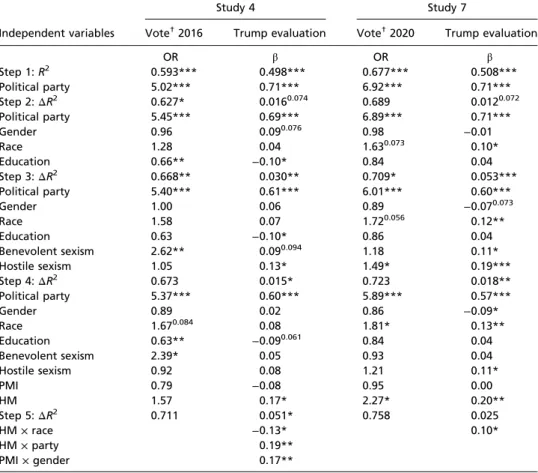
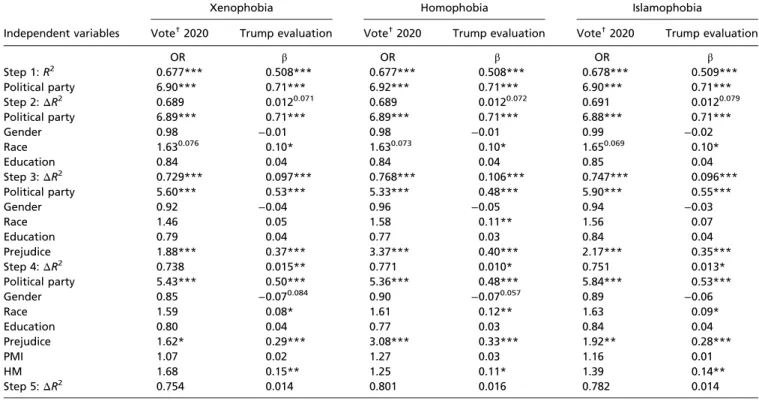
Consistent with our theoretical conceptualization, HM was also distinct from sexism, racism, and prejudice (i.e., homophobia, xe-nophobia, and Islamophobia). In fact, HM predicted evaluations of Trump across Studies 4 through 7, over and above prejudiced at-titudes. Inclusion of the masculinity variables in Step 4 was associ-ated with a significant ΔR2 in evaluations of Trump, and HM predicted evaluations of Trump, over and above sexism (Table 3), racism (Table 4), xenophobia, homophobia, and Islamophobia (Table 5), as well as the other demographic variables. Contrary to
Table 2. Results of hierarchical regressions for voting for Trump (binary logistic) and evaluations of Trump (linear), including trust in the government, for Studies 3 and 7
Study 3 Study 7
Independent variables Vote†2016 Trump evaluation Vote†2016 Trump evaluation
OR β OR β
Step 1:R2 0.605*** 0.463*** 0.677*** 0.509***
Political party 5.82*** 0.68*** 6.92*** 0.71***
Step 2:ΔR2 0.613 0.004 0.690 0.0120.069
Political party 5.79*** 0.67*** 6.90*** 0.71***
Gender 1.08 0.02 0.98 −0.01
Race 1.40 0.06 1.630.074 0.10*
Education 0.94 −0.03 0.84 0.04
Step 3:ΔR2 0.620 0.002 0.6990.080 0.024***
Political party 5.35*** 0.66*** 7.02*** 0.71***
Gender 1.08 0.02 0.93 −0.02
Race 1.39 0.06 1.660.072 0.10*
Education 0.96 −0.02 0.79 0.02
Trust in government 0.23 −0.05 9.530.077 0.16***
Step 4:ΔR2 0.639* 0.035*** 0.725* 0.054***
Political party 5.14*** 0.60*** 6.01*** 0.61***
Gender 0.99 −0.02 0.82 −0.08*
Race 1.480.091 0.070.078 1.86* 0.12**
Education 0.99 −0.01 0.81 0.02
Trust in government 0.41 −0.01 5.01 0.12**
PMI 1.22 −0.04 0.96 0.03
HM 1.64* 0.22*** 2.40* 0.25***
Step 5:ΔR2 0.678 0.034* 0.744 0.019
HM×race 0.30* 0.10*
HM×party 0.17** 0.10*
HM×PMI −0.14**
*P<0.05. **P<0.01. ***P<0.001. For discussion of interactions, please seeSI Appendix,Supplemental Materials.
predictions, however, prejudiced attitudes (i.e., sexism, racism, ho-mophobia, xenophobia, or Islamophobia) but not HM predicted voting for Trump. Specifically, on voting, Step 4 as not consistently associated with a significantΔR2and when it was, HM was only a marginally significant predictor of voting. These effects replicated in a nationally representative sample were gathered 50 days prior to the 2020 presidential election (right panel of Tables 3 and 4); as shown in Table 5 (see Step 4), HM, as well as political party affil-iation and prejudice (xenophobia, homophobia, or Islamophobia), predicted evaluations of Trump, whereas prejudice (xenophobia, homophobia, or Islamophobia) and political party affiliation pre-dicted intent to vote for Trump in the 2020 presidential election. We present the findings of Study 7 in Table 5 because Study 7 in-cluded measures of prejudice, HM, and PMI, whereas PMI was omitted from Study 6 (SI Appendix, Table S4).
Whereas HM consistently predicted evaluations of Trump in 2016 and 2020, evaluations of Trump’s democratic challengers— Clinton in 2016 and Biden in 2020—were more consistently and robustly predicted by prejudiced attitudes. As shown in Table 6 (Clinton) and Table 7 (Biden), the inclusion of trust in govern-ment and/or prejudiced attitudes (i.e., sexism, racism, xenophobia, homophobia, or Islamophobia) in Step 3 consistently predicted evaluations of both Clinton and Biden, as evidenced by a signifi-cantΔR2with one exception: racist attitudes (pro-Black or anti-Black) did not predict evaluations of Clinton in Study 5. Greater endorsement of pro-Black attitudes predicted more positive evaluations of Biden (but not Clinton), and greater endorsement of anti-Black attitudes predicted more negative evaluations of Biden (but not Clinton). In other words, prejudiced attitudes, but
not HM, predicted evaluations of both Clinton and Biden. In fact, there was only a single instance in which the inclusion of the mas-culinity variables (Step 4) accounted for additional variance in evaluations of the democratic candidate; HM accounted for unique variance in evaluations of Clinton in Study 3, over and above trust in government, political party affiliation, gender, race, and education. In addition, in the same Study, as evidenced by a significantΔR2in Step 3, trust in government predicted positive evaluations of Clin-ton, while HM and Republican Party affiliation predicted more negative evaluations. Interestingly, regardless of whether prejudiced attitudes were included in the model (Tables 6 and 7) or omitted from the model (SI Appendix, Table S5), HM did not consistently predict evaluations of Clinton.
Discussion
Consistent with our theoretical backdrop, findings across seven studies revealed that HM predicted voting for and evaluations of Trump, over and above the variance accounted for by political party affiliation, gender, race, and education. These findings were documented in the days following the 2016 American presidential election (Studies 1 and 2) and replicated in the months following the 2016 election (Studies 3 through 6), as well as the days ceding the 2020 presidential election (Study 7). In fact, HM pre-dicted voting for and evaluations of Trump equally well for women and men, White and non-White participants, Democrats and Republicans, and across levels of education. The same patterns emerged when controlling for trust in government (Study 2), as well as demographic variables, indicating that the HM effect could not be attributed to a populist perspective.
Table 3. Results of hierarchical regressions for voting for Trump (binary logistic) and evaluations of Trump (linear), including sexism, for Studies 4 and 7
Study 4 Study 7
Independent variables Vote†2016 Trump evaluation Vote†2020 Trump evaluation
OR β OR β
Step 1:R2 0.593*** 0.498*** 0.677*** 0.508***
Political party 5.02*** 0.71*** 6.92*** 0.71***
Step 2:ΔR2 0.627* 0.0160.074 0.689 0.0120.072
Political party 5.45*** 0.69*** 6.89*** 0.71***
Gender 0.96 0.090.076 0.98 −0.01
Race 1.28 0.04 1.630.073 0.10*
Education 0.66** −0.10* 0.84 0.04
Step 3:ΔR2 0.668** 0.030** 0.709* 0.053***
Political party 5.40*** 0.61*** 6.01*** 0.60***
Gender 1.00 0.06 0.89 −0.070.073
Race 1.58 0.07 1.720.056 0.12**
Education 0.63 −0.10* 0.86 0.04
Benevolent sexism 2.62** 0.090.094 1.18 0.11*
Hostile sexism 1.05 0.13* 1.49* 0.19***
Step 4:ΔR2 0.673 0.015* 0.723 0.018**
Political party 5.37*** 0.60*** 5.89*** 0.57***
Gender 0.89 0.02 0.86 −0.09*
Race 1.670.084 0.08 1.81* 0.13**
Education 0.63** −0.090.061 0.84 0.04
Benevolent sexism 2.39* 0.05 0.93 0.04
Hostile sexism 0.92 0.08 1.21 0.11*
PMI 0.79 −0.08 0.95 0.00
HM 1.57 0.17* 2.27* 0.20**
Step 5:ΔR2 0.711 0.051* 0.758 0.025
HM×race −0.13* 0.10*
HM×party 0.19**
PMI×gender 0.17**
*P<0.05. **P<0.01. ***P<0.001. For discussion of interactions, please seeSI Appendix. †OR=odds ratio;R2values for binary logistic models refer to NagelkerkeR2associated with each step.
PSYCHOL
OGICAL
AND
COGNITIVE
SCIENC
As conceptualized, HM was related to prejudiced attitudes to-ward women and marginalized groups in America. In the present data, HM was associated with more benevolent and hostile sexist attitudes (Studies 4 and 7), as well as the weaker endorsement of pro-Black attitudes and greater endorsement of anti-Black atti-tudes (Studies 5 and 7). HM was also related to more xenophobic attitudes (Studies 6 and 7), homophobic attitudes (Studies 6 and 7), and Islamophobic attitudes (Study 7). Although HM correlated with prejudiced attitudes toward women and marginalized groups, HM continued to predict positive evaluations of Trump when controlling for these prejudiced attitudes. Because gender- and race-based hierarchies are embedded within the culturally exalted form of masculinity (48), the endorsement of HM may mask the operation of dominant group supremacy. Analogous to how be-nevolent feelings of paternalism can mask open gender- and race-based inequities from the view of discriminators (73), the en-dorsement of culturally idealized forms of masculinity may mask the homophobic-, xenophobic-, and Islamophobic-based inequities from the view of actors. For example, one’s exaltation of good men may make it difficult for a given person to see one’s own race-and/or ethnicity-based antipathy toward and dehumanization of men who belong to marginalized and/or subordinated groups and are being judged to be bad men. The elevation of idealized forms of masculinity may, like the paternalistic desire to protect non-threatening women, contribute to one’s self-veiling and self-moti-vated lack of awareness of one’s own misogynistic acts of aggression toward gender and status-quo threatening women (71) and/or one’s dominant group supremacist acts of violence and dehumanization toward men who belong to marginalize and subordinated groups.
HM was also distinct from prejudiced attitudes in terms of the outcomes they predict. While HM consistently predicted positive evaluations of Trump, prejudiced attitudes–and not HM–more reliably predicted voting and evaluations of Trump’s Democratic opponent (Clinton in 2016 and Biden in 2020). In other words, while HM influenced support for Trump, prejudiced attitudes were more influential in evaluations of those who are question-ing the status quo (Clinton and Biden) than those who expressed open vitriol toward women and marginalized men (Trump). By predicting evaluations of different candidates in unique ways, processes of hegemony may operate more effectively to justify and legitimize hegemonic masculine dominance over women of intersecting identities and marginalized men. As noted, when included in the models and contrary to predictions, prejudiced attitudes were more consistent predictors of voting than HM. In hindsight, HM may be more directly related to support for Trump, given suggestions that some people in the 2016 and 2020 elections hid their support of Trump in light of awareness of Trump’s open misogyny, racism, and nationalism (74). By con-trast, perhaps HM is not needed to veil the role of prejudice in voting, as decisions for whom to vote are naturally veiled under candidates’differential stances on a host of issues if import be-yond prejudice. Additional research is needed to fully under-stand the outcomes predicted by HM versus open prejudice.
Our findings also point to the potential importance of context on the nature and consequences of prejudiced attitudes toward vari-ous groups in America. As noted above, in the United States of America, prejudice and civil rights movements have been defined almost exclusively in terms of racism toward Black Americans and Table 4. Results of hierarchical regressions for voting for Trump (binary logistic) and
evaluations of Trump (linear), including racism, for Studies 5 and 7
Study 5 Study 7
Independent variables Vote†2016 Trump evaluation Vote†2020 Trump evaluation
OR β OR β
Step 1:R2 0.639*** 0.475*** 0.677*** 0.509***
Political party 5.05*** 0.69*** 6.92*** 0.71***
Step 2:ΔR2 0.645 0.041* 0.690 0.0120.069
Political party 4.93*** 0.64*** 6.90*** 0.71***
Gender 0.90 0.19** 0.98 −0.01
Race 1.36 0.08 1.630.074 0.10*
Education 0.88 −0.05 0.84 0.04
Step 3:ΔR2 0.695* 0.062*** 0.769*** 0.122***
Political party 4.00*** 0.50*** 5.11*** 0.45***
Gender 0.88 0.15* 0.91 −0.03
Race 0.96 0.02 1.32 0.05
Education 0.97 −0.02 0.71 0.02
Pro-Black 0.42* −0.17* 0.50* −0.29***
Anti-Black 1.980.071 0.23** 2.02* 0.20***
Step 4:ΔR2 0.727* 0.042** 0.7820.094 0.022***
Political party 4.24*** 0.49*** 5.20*** 0.42***
Gender 0.61 0.08 0.79 −0.05
Race 1.17 0.02 1.30 0.070.066
Education 0.93 −0.05 0.710.094 0.014
Pro-Black 0.35* −0.16* 0.46** −0.30***
Anti-Black 1.68 0.14* 1.94* 0.12*
PMI 0.250.080 −0.03 2.12 0.070.078
HM 2.760.069 0.24*** 1.29 0.13**
Step 5:ΔR2 0.839* 0.059 0.796 0.023
PMI×Race 0.01*
HM×Party 0.20*
PMI×Gender 0.01*
*P<0.05. **P<0.01. ***P<0.001. For discussion of interactions, please seeSI Appendix. †OR=odds ratio;R2values for binary logistic models refer to NagelkerkeR2associated with each step.
sexism, which, until 2016, raised social desirability concerns about appearing to be prejudiced. For instance, contemporary theories of racial prejudice assume that White people have ambivalent
attitudes toward racial minorities, including sincerely positive at-titudes related to egalitarian principles and unacknowledged and negative attitudes of which they are often unaware (73, 75, 76); as Table 5. Results of hierarchical regressions for voting for Trump (binary logistic) and evaluations of Trump (linear), including xenophobia, homophobia, and Islamophobia, for Study 7
Xenophobia Homophobia Islamophobia
Independent variables Vote†2020 Trump evaluation Vote†2020 Trump evaluation Vote†2020 Trump evaluation
OR β OR β OR β
Step 1:R2 0.677*** 0.508*** 0.677*** 0.508*** 0.678*** 0.509***
Political party 6.90*** 0.71*** 6.92*** 0.71*** 6.90*** 0.71***
Step 2:ΔR2 0.689 0.0120.071 0.689 0.0120.072 0.691 0.0120.079
Political party 6.89*** 0.71*** 6.89*** 0.71*** 6.88*** 0.71***
Gender 0.98 −0.01 0.98 −0.01 0.99 −0.02
Race 1.630.076 0.10* 1.630.073 0.10* 1.650.069 0.10*
Education 0.84 0.04 0.84 0.04 0.85 0.04
Step 3:ΔR2 0.729*** 0.097*** 0.768*** 0.106*** 0.747*** 0.096***
Political party 5.60*** 0.53*** 5.33*** 0.48*** 5.90*** 0.55***
Gender 0.92 −0.04 0.96 −0.05 0.94 −0.03
Race 1.46 0.05 1.58 0.11** 1.56 0.07
Education 0.79 0.04 0.77 0.03 0.84 0.04
Prejudice 1.88*** 0.37*** 3.37*** 0.40*** 2.17*** 0.35***
Step 4:ΔR2 0.738 0.015** 0.771 0.010* 0.751 0.013*
Political party 5.43*** 0.50*** 5.36*** 0.48*** 5.84*** 0.53***
Gender 0.85 −0.070.084 0.90 −0.070.057 0.89 −0.06
Race 1.59 0.08* 1.61 0.12** 1.63 0.09*
Education 0.80 0.04 0.77 0.03 0.84 0.04
Prejudice 1.62* 0.29*** 3.08*** 0.33*** 1.92** 0.28***
PMI 1.07 0.02 1.27 0.03 1.16 0.01
HM 1.68 0.15** 1.25 0.11* 1.39 0.14**
Step 5:ΔR2 0.754 0.014 0.801 0.016 0.782 0.014
*P<0.05. **P<0.01. ***P<0.001. For discussion of interactions, please seeSI Appendix. †OR=odds ratio;R2values for binary logistic models refer to NagelkerkeR2associated with each step.
Table 6. Results of hierarchical regressions for evaluations of Clinton (Studies 3 through 6), including social prejudice
Independent variables Trust government Sexism Racism Xenophobia Homophobia
Step 1:R2 0.407*** 0.344*** 0.246*** 0.261*** 0.264***
Political party −0.64*** −0.59*** −0.50*** −0.51*** −0.51***
Step 2:ΔR2 0.019* 0.0230.052 0.024 0.040*** 0.039***
Political party −0.62*** −0.58*** −0.49*** −0.48*** −0.49***
Gender −0.12** −0.07 −0.11 −0.18*** −0.17***
Race 0.00 0.00 0.03 0.04 0.04
Education 0.080.093 0.14* 0.10 0.09* 0.090.064
Step 3:ΔR2 0.044*** 0.024* 0.027 0.013* 0.037***
Political party −0.55*** −0.51*** −0.41*** −0.42*** −0.36***
Gender −0.12** −0.05 −0.08 −0.16*** −0.090.075
Race 0.00 −0.03 0.06 0.05 0.01
Education 0.06 0.14* 0.08 0.09* 0.080.067
Attitude 1 0.23*** −0.04 0.08 −0.13* −0.25***
Attitude 2 — −0.15* −0.160.052 — —
Step 4:ΔR2 0.015* 0.009 0.022 0.004 0.000
Political party −0.51*** −0.50*** −0.42*** −0.41*** −0.36***
Gender −0.09* −0.02 −0.10 −0.13* −0.09
Race −0.01 −0.03 0.07 0.04 0.01
Education 0.06 0.12* 0.07 0.09* 0.080.068
Attitude 1 0.21*** −0.04 0.05 −0.110.059 −0.24***
Attitude 2 — −0.150.057 −0.170.060 — —
PMI 0.00 0.110.075 −0.150.054 — —
HM −0.13* −0.06 0.03 −0.08 −0.02
Step 5:ΔR2 0.010 0.026 0.110 0.010 0.008
*P<0.05. **P<0.01. ***P<0.001.
PSYCHOL
OGICAL
AND
COGNITIVE
SCIENC
a result, contemporary racism is theorized to be particularly in-fluential when race-based biases in judgment and behavior can be attributed to something other than racist attitudes, masking White people’s negative attitudes (75). Contemporary theories of sexism are also conceptualized in terms of ambivalent attitudes, with feelings of benevolent and paternalistic protections directed toward nonthreatening and gender-stereotypic women and feelings of hostility and aggression directed toward-threatening women who violate gender stereotypes (71); the adoration of stereotypic“good” women (e.g., wives, daughters, and service providers) masks the antipathy toward threatening“bad”women (e.g., well-performing colleagues and bosses). However, other prejudiced attitudes, like those toward immigrants, gay men, and transgender women (par-ticularly transgender women of color), are better characterized by antipathy and open hostility in the absence of any substantive positive attitudes. For example, in recent years, there has been an increased visibility and prevalence of immigrant detention practices, as well as increased incidences of hate crimes toward gay men and transgender women in the wake of lesbian, gay, bisexual, and transgender civil rights gains (77).
The present theory and research point to the need to articulate the relation between HM and prejudices toward various marginal-ized groups with different intersecting identities, different histories, and different contemporary stations. Future research examining the role of HM and prejudiced attitudes in politics outside of the United States would also add to our understanding of how context affects the present findings.
Comparing findings across studies highlights the importance of considering when and with what consequences HM and/or PMIs influence political thought and candidate evaluations. Presently, little attention is focused on PMI because we directed attention only to those effects that were replicated across studies and that included no PMI effects. It is important to note that we measured chronic PMI, or individual differences in the degree that people were concerned about masculine shortcomings. As noted, much of the work on PMI examines the consequences of situational threats
to masculinity, which were beyond the scope of the present work. Importantly, some PMI effects did emerge in the present data but in isolated instances. Because studies were also conducted across time, it is possible that PMI becomes pertinent to particular social contexts. A primary question raised by the present work is when and with what consequences do HM and/or precarious masculinity predict status quo maintaining consequences?
The present work also raises critical questions about whether the aggressive and violent acts that follow from threats to the PMIs of individual men reinforce and maintain HM and vice versa. More generally, theoretical perspectives on HM position the racialized gender binary at the core of systems of inequity (19, 62). HM is a legitimating ideology that justifies and reinforces gender and racial hierarchies. This is consistent with influential theories of system justification (16) and social dominance orientation (17), with the current findings pointing to another potentially critical legitimating ideology (or hierarchy enhancing ideology) that operates within the context of those theories: HM. However, the present theory and research also points to HM as an unique ideology that unifies 1) dominant men and marginalized men in their perceived superiority and rightful dominance over women, 2) dominant men and dom-inant women in their perceived superiority and dominance over marginalized people, and 3) dominant men, marginalized men, and women in their perceived superiority and rightful dominance over immigrant, foreign, and indigenous people who are dehumanized and seen as less human. This functionally ties groups of men and women of lower ranks to dominant men in different contexts, rein-forcing and justifying existing hierarchies—as the unions of some groups assure dominance over others. In addition, because the subordinate groups that align with dominant groups vary across contexts, HM may be a particularly effective ideology that func-tionally prevents the formation of alliances and collective action (78) across different groups of marginalized people.
Materials and Methods
All studies described were approved by the authors’Institutional Review Board. Across all seven studies, participants first read the consent statement Table 7. Results of hierarchical regressions for evaluations of Biden (Study 7), including social prejudice
Independent variables Trust government Sexism Racism Xenophobia Homophobia Islamophobia
Step 1:R2 0.356*** 0.358*** 0.356*** 0.356*** 0.358*** 0.356***
Political party −0.60*** −0.60*** −0.60*** −0.60*** −0.60*** −0.60***
Step 2:ΔR2 0.007 0.007 0.007 0.007 0.007 0.007
Political party −0.59*** −0.59*** −0.59*** −0.59*** −0.59*** −0.59***
Gender 0.05 0.05 0.05 0.05 0.05 0.05
Race −0.04 −0.04 −0.04 −0.04 −0.04 −0.05
Education 0.05 0.05 0.05 0.05 0.05 0.05
Step 3:ΔR2 0.036*** 0.019* 0.072*** 0.016** 0.035*** 0.023**
Political party −0.59*** −0.55*** −0.39*** −0.52*** −0.46*** −0.51***
Gender 0.04 0.05 0.05 0.06 0.07 0.06
Race −0.04 −0.03 0.00 −0.03 −0.05 −0.03
Education 0.03 0.05 0.06 0.05 0.05 0.04
Attitude 1 0.19*** 0.11* 0.27*** −0.15** −0.23*** −0.17**
Attitude 2 — −0.17** −0.10 — — —
Step 4:ΔR2 0.005 0.001 0.003 0.001 0.005 0.003
Political party −0.56*** −0.55*** −0.40*** −0.52*** −0.47*** −0.52***
Gender 0.05 0.05 0.04 0.06 0.06 0.05
Race −0.05 −0.03 0.01 −0.02 −0.04 −0.02
Education 0.03 0.04 0.06 0.04 0.05 0.04
Attitude 1 0.20*** 0.120.070 0.28*** −0.16* −0.28*** −0.20**
Attitude 2 — −0.17* −0.130.054 — — —
PMI 0.03 0.04 −0.02 0.03 0.02 0.04
HM −0.09 −0.04 0.08 0.01 0.08 0.04
Step 5:ΔR2 0.034 0.039 0.049 0.047† 0.042† 0.052†
*P<0.05. **P<0.01. ***P<0.001.
and, by continuing with the survey, implied their consent to participate. Par-ticipants were able to skip questions and/or withdraw their participation at any time. All of our data and syntax are available athttps://osf.io/u3g2n/(79).
Participants.We recruited 2,007 participants from both Amazon’s MTurk and
The Pennsylvania State University’s subject pool between November 10, 2016, and December 6, 2017, and from Prolific on September 14, 2020. Participants recruited from MTurk were compensated $0.50 for their participation; par-ticipants recruited from the subject pool were given partial course credit for their participation and participants recruited through Prolific were compen-sated an average of $9.66/h. TheSI Appendixincludes additional information about each sample.
Procedure.
Studies 1 and 2.After reading consent statements, participants indicated their endorsement of HM (53), their PMI (69), and political affiliation. They also indicated for whom they voted in the 2016 presidential election (or, if they did not vote, for whom they would have voted), evaluated Trump and Clinton, and provided demographic information. TheSI Appendixinclude a full description of each measure.
Studies 3 through 6.Similar to Studies 1 and 2, participants indicated their endorsement of HM and their PMI (participants did not complete the Male Gender Role Stress Scale in Study 6). Participants then reported either their trust in the government (Study 3), sexism (Study 4), racism (Study 5), or homophobia and xenophobia (Study 6). Participants indicated their political affiliation, their vote in the 2016 presidential election, and evaluated Trump and Clinton before providing demographic information. TheSI Appendix
includes a full description of each measure.
Study 7.Identical to the previous studies, participants indicated their en-dorsement of HM and their PMI. They then reported, in random order, their trust in the government, sexism (80), racism, homophobia, xenophobia, and Islamophobia (81) before indicating their political affiliation, their vote in the 2016 presidential election, and their anticipated vote in the 2020 pres-idential election. Finally, they evaluated Trump and Biden before providing demographic information. TheSI Appendixincludes a full description of each measure.
Data analysis.To test whether HM accounted for unique variance support for Trump over and above demographic variables known to have affected
political behavior in the 2016 election (82), we conducted two hierarchical regressions on each dependent variable: voting for and evaluations of Trump. Parallel analyses were also performed on evaluations of Democratic challengers: Clinton in 2016 and Biden in 2020.
Hierarchical binary logistic regression was used to analyze voting for Trump (vote for Trump=1, vote for another candidate=−1) and hierarchical linear regression was used to analyze evaluations of Trump, evaluations of Clinton, and evaluations of Biden. In the first set of hierarchical regression analyses, predictors were included in four steps. First, political party (higher numbers indicate stronger Republican affiliation) were entered in Step 1. Second, gender (1=male,−1=female), race (1=White,−1=non-White), and level of edu-cation (higher numbers indicate higher eduedu-cation) were included in Step 2. In Step 3, both HM and PMI were included. Finally, the two-way interactions of HM with each of the three demographic variables (i.e., HM×Gender, HM× Race, HM×Education), the two-way interactions of PMI with each of the three demographic variables (i.e., PMI×Gender, PMI×Race, and PMI×Education), the two-way interaction between HM and PMI, and the three-way interactions of HM, PMI, and the three demographic variables (i.e., HM×PMI×Gender, HM×PMI×Race, HM×PMI×Education, and HM×PMI×Party) were added in Step 4.
To examine whether hegemony was distinct from related social and prej-udiced attitudes, a second set of hierarchical regressions analyses were per-formed on each variable in Studies 3 through 7, in which social or prejudiced attitudes were measured. We conducted parallel hierarchical regressions (bi-nary logistic for voting for Trump and linear for candidate evaluations) to test the HM hypothesis alongside alternative explanations of the findings and/or the conceptualization of masculinity. Again, political party was entered in Step 1. Gender, race, and level of education were entered in Step 2. Social or prejudiced attitudes of interest—trust in the government, sexism, racism, xe-nophobia, homophobia, and Islamophobia—were entered in Step 3. HM and PMI were entered in Step 4. All two-way interactions that included HM and PMI were included in the final step.
Data Availability.Numeric/survey data have been deposited in Open Science
Foundation (https://osf.io/u3g2n/?view_only= a7d265959d8b462baf9edfc18d-04a507).
1. J. E. Oliver, W. M. Rahn, Rise of the trumpenvolk: Populism in the 2016 election.Ann. Am. Acad. Pol. Soc. Sci.667, 189–206 (2016).
2. K. L. Blair, Did secretary Clinton lose to a‘basket of deplorables’? An examination of Islamophobia, homophobia, sexism and conservative ideology in the 2016 US presi-dential election.Psychol. Sex.8, 334–355 (2017).
3. J. Bock, J. Byrd-Craven, M. Burkley, The role of sexism in voting in the 2016 presi-dential election.Pers. Individ. Dif.119, 189–193 (2017).
4. A. Bracic, M. Israel-Trummel, A. F. Shortle, Is sexism for white people? Gender ste-reotypes, race, and the 2016 presidential election.Polit. Behav.41, 281–307 (2019). 5. P. Glick, Gender, sexism, and the election: Did sexism help Trump more than it hurt
Clinton?Polit. Groups Identities, 1–11 (2019).
6. M. J. Monteith, L. K. Hildebrand, Sexism, perceived discrimination, and system justi-fication in the 2016 US presidential election context.Group Process. Intergroup Relat. 23, 163–178 (2020).
7. K. A. Ratliff, L. Redford, J. Conway, C. T. Smith, Engendering support: Hostile sexism predicts voting for Donald Trump over Hillary Clinton in the 2016 U.S. presidential election.Group Process. Intergroup Relat.22, 578–593 (2019).
8. V. Rothwell, G. Hodson, E. Prusaczyk, Why pillory hillary? Testing the endemic sexism hypothesis regarding the 2016 U.S. Election.Pers. Individ. Dif.138, 106–108 (2019). 9. M. Setzler, A. B. Yanus, Why did women vote for Donald Trump?PS Polit. Sci. Polit.51,
523–527 (2018).
10. L. D. Bobo, Racism in Trump’s America: reflections on culture, sociology, and the 2016 US presidential election.Br. J. Sociol.68(suppl. 1), S85–S104 (2017).
11. R. D. Swain, Negative black stereotypes, support for excessive use of force by police, and voter preference for Donald Trump during the 2016 presidential primary election cycle.J. Afr. Am. Stud.22, 109–124 (2018).
12. N. J. Shooket al., Sexism, racism, and nationalism: Factors associated with the 2016 U.S. presidential election results?PLoS One15, e0229432 (2020).
13. D. C. Mutz, Status threat, not economic hardship, explains the 2016 presidential vote. Proc. Natl. Acad. Sci. U.S.A.115, E4330–E4339 (2018).
14. K. Marx, F. Engels,The German Ideology(International Publishers, 1970). 15. A. Gramsci,Selections from the Prison Notebooks(International Publishers, 1970). 16. J. T. Jost, M. R. Banaji, The role of stereotyping in system‐justification and the
pro-duction of false consciousness.Br. J. Soc. Psychol.33, 1–27 (1994).
17. F. Pratto, J. Sidanius, L. M. Stallworth, B. F. Malle, Social dominance orientation: A personality variable predicting social and political attitudes.J. Pers. Soc. Psychol.67, 741 (1994).
18. F. Pratto, A. Walker,“The bases of gendered power”inThe Psychology of Gender, A. H. Eagly, A. E. Beall, R. J. Sternberg, Eds. (Guilford Press, 2004), pp. 242–268. 19. S. de Beauvoir,The Second Sex(Vintage Books, 1952/1989).
20. A. Y. Davis,Women, Race, & Class(Vintage, 1983).
21. G. Lerner,The Creation of Patriarchy(Oxford University Press, 1986).
22. D. Fernbach,The Spiral Path: A Gay Contribution to Human Survival(Gay Men’s Press, 1981).
23. C. A. MacKinnon, Feminism, Marxism, method, and the state: An agenda for theory. Signs7, 515–544 (1982).
24. S. Ducat,The Wimp Factor: Gender Gaps, Holy Wars, and the Politics of Anxious Masculinity(Beacon Press, 2004).
25. A. C. Fahey, French and feminine: Hegemonic masculinity and the emasculation of John Kerry in the 2004 presidential race.Crit. Stud. Media Commun.24, 132–150 (2007).
26. J. Katz,Man Enough? Donald Trump, Hillary Clinton, and the Politics of Presidential Masculinity(Interlink Books, 2016).
27. I. M. Young, The logic of masculinist protection: Reflections on the current security state.Signs29, 1–25 (2003).
28. J. L. Berdahl, M. Cooper, P. Glick, R. W. Livingston, J. C. Williams, Work as a masculinity contest.J. Soc. Issues74, 422–448 (2018).
29. S. L. Kuchynka, J. K. Bosson, J. A. Vandello, C. Puryear, Zero-sum thinking and the masculinity contest: Perceived intergroup competition and workplace gender bias. J. Soc. Issues74, 529–550 (2018).
30. A. Khalid, Is Donald Trump playing the "man card"?NPR, 10 May 2016. https://www. npr.org/2016/05/10/477423028/is-donald-trump-playing-the-man-card. Accessed 29 September 2020.
31. A. H. Eagly, S. J. Karau, Role congruity theory of prejudice toward female leaders. Psychol. Rev.109, 573–598 (2002).
32. J. H. Pleck,The Myth of Masculinity(MIT Press, 1981).
33. J. A. Vandello, J. K. Bosson, D. Cohen, R. M. Burnaford, J. R. Weaver, Precarious manhood.J. Pers. Soc. Psychol.95, 1325–1339 (2008).
34. A. Maass, M. Cadinu, G. Guarnieri, A. Grasselli, Sexual harassment under social identity threat: the computer harassment paradigm.J. Pers. Soc. Psychol.85, 853–870 (2003).
35. J. K. Bosson, J. A. Vandello, R. M. Burnaford, J. R. Weaver, S. Arzu Wasti, Precarious manhood and displays of physical aggression.Pers. Soc. Psychol. Bull.35, 623–634 (2009).
36. L. A. Rudman, K. Fairchild, Reactions to counterstereotypic behavior: the role of backlash in cultural stereotype maintenance.J. Pers. Soc. Psychol.87, 157–176 (2004). 37. K. S. Weaver, T. K. Vescio, The justification of social inequality in response to
mas-culinity threats.Sex Roles72, 521–535 (2015).
38. J. Dahl, T. K. Vescio, K. S. Weaver, How threats to masculinity sequentially cause public discomfort, anger, and ideological dominance over women.Soc. Psychol.46, 242–254 (2015).
PSYCHOL
OGICAL
AND
COGNITIVE
SCIENC
39. J. A. Vandello, J. K. Bosson, Hard won and easily lost: A review and synthesis of theory and research on precarious manhood.Psychol. Men Masc.14, 101–113 (2013). 40. M. Jakupcak, M. T. Tull, L. Roemer, Masculinity, shame, and fear of emotions as
predictors of men’s expressions of anger and hostility.Psychol. Men Masc.6, 275–284 (2005).
41. C. G. Lisco, R. M. Leone, K. E. Gallagher, D. J. Parrott,“Demonstrating masculinity”via intimate partner aggression: The moderating effect of heavy episodic drinking.Sex Roles73, 73–1 (2015).
42. R. L. Stotzer, M. Shih, The relationship between masculinity and sexual prejudice in factors associated with violence against gay men.Psychol. Men Masc.13, 136–142 (2012).
43. C. L. Munsch, R. Willer, The role of gender identity threat in perceptions of date rape and sexual coercion.Violence Against Women18, 1125–1146 (2012).
44. N. Kosakowska-Berezeckaet al., If my masculinity is threatened, I won’t support gender equality? The role of agentic self-stereotyping in restoration of manhood and perception of gender relations.Psychol. Men Masc.17, 274–284 (2016).
45. R. Willer, C. L. Rogalin, B. Conlon, M. T. Wojnowicz, Overdoing gender: A test of the masculine overcompensation thesis.Am. J. Sociol.118, 980–1022 (2013).
46. K. Matson, T. D. Russell, A. R. King, Gun enthusiasm, hypermasculinity, manhood honor, and lifetime aggression.J. Aggress. Maltreat. Trauma28, 369–383 (2019). 47. S. H. DiMuccio, E. D. Knowles, The political significance of fragile masculinity.Curr.
Opin. Behav. Sci.34, 25–28 (2020).
48. R. Connell,Masculinities(University of California Press, 1995).
49. S. T. Fiske, Controlling other people. The impact of power on stereotyping.Am. Psychol.48, 621–628 (1993).
50. J. R. French, B. Raven,“The bases of social power”inStudies in Social Power, D. Cartwright, Ed. (Institute for Social Research, 1959), pp. 150–167.
51. D. Keltner, D. H. Gruenfeld, C. Anderson, Power, approach, and inhibition.Psychol. Rev.110, 265–284 (2003).
52. R. Brannon,“The male sex role: Our culture’s blueprint of manhood, and what it’s done for us lately”inThe Forty-Nine Percent Majority: The Male Sex Role, D. David, R. Brannon, Eds. (Addison-Wesley, 1976), pp. 1–48.
53. E. H. Thompson, J. H. Pleck, The structure of male role norms.Am. Behav. Sci.29, 531–543 (1986).
54. K. Deaux, L. L. Lewis, Structure of gender stereotypes: Interrelationships among components and gender label.J. Pers. Soc. Psychol.46, 991 (1984).
55. J. K. Bosson, J. L. Prewitt-Freilino, J. N. Taylor, Role rigidity: a problem of identity misclassification?J. Pers. Soc. Psychol.89, 552–565 (2005).
56. C. J. Pascoe,Dude, You’re a Fag(University of California Press, 2007). 57. J. Halbertstam,Female Masculinity(Duke University Press, 1998).
58. J. Geraghty, Obama’s weakness fuels the demand for Trump’s strength.National Review, 6 October 2015. https://www.nationalreview.com/2015/10/obama-donald-trump-foreign-policy-weakness-strength/. Accessed 20 September 2020.
59. M. Kimmel,Angry White Me: American Masculinity at the End of an Era(Nation
Books, 2013).
60. M. Kimmel,Guyland: The Perilous World Where Boys Become Men(Harper, 2008).
61. J. C. Wade, C. Brittan-Powell, Men’s attitudes toward race and gender equity: The importance of masculinity ideology, gender-related traits, and reference group identity dependence.Psychol. Men Masc.2, 42–50 (2001).
62. R. W. Connell, Masculinities, change, and conflict in global society: Thinking about the future of men’s studies.J. Men’s Stud.11, 249–266 (2003).
63. M. G. McCusker, M. P. Galupo, The impact of men seeking help for depression on perceptions of masculine and feminine characteristics.Psychol. Men Masc.12, 275 (2011).
64. E. H. Thompson Jr, K. M. Bennett, Measurement of masculinity ideologies: A (critical) review.Psychol. Men Masc.16, 115–133 (2015).
65. J. H. Pleck,“The gender role strain paradigm: An Update”inA New Psychology Of Men, R. F. Levant, W. S. Pollack, Eds. (Basic Books, 1995), pp. 11–32.
66. E. H. Thompson Jr, J. H. Pleck,“Masculinity ideologies: A review of research instru-mentation on men and masculinities”inA New Psychology Of Men, R. F. Levant, W. S. Pollack, Eds. (Basic Books, 1995), pp. 129–163.
67. J. S. Sinn, The predictive and discriminant validity of masculinity ideology.J. Res. Pers. 31, 117–135 (1997).
68. S. L. Bem, Gender schema theory: A cognitive account of sex typing.Psychol. Rev.88, 354 (1981).
69. R. M. Eisler, J. R. Skidmore, Masculine gender role stress. Scale development and component factors in the appraisal of stressful situations.Behav. Modif.11, 123–136 (1987).
70. J. X. Goh, J. A. Hall, R. Rosenthal, Mini meta-analysis of your own studies: Some ar-guments on why and a primer on how.Soc. Personal. Psychol. Compass10, 535–579 (2016).
71. P. Glick, S. T. Fiske, The Ambivalent Sexism Inventory: Differentiating hostile and benevolent sexism.J. Personal. Soc. Psychol.70, 491–512 (1996).
72. I. Katz, R. G. Hass, Racial ambivalent and American value conflict: Correlational and priming studies of dual cognitive structures.J. Pers. Soc. Psychol.55, 893–905 (1988). 73. M. R. Jackman,The Velvet Glove: Paternalism and Conflict in Gender, Class, and Race
Relations(University of California Press, 1994).
74. Z. Stanton,“People are going to be shocked”: Return of the‘shy’Trump voter? Po-litico (Pavia)(2020).
75. S. L. Gaertner, J. F. Dovidio,“The aversive form of racism”inPrejudice, Discrimination, and Racism, J. F. Dovidio, S. L. Gaertner, Eds. (Academic Press, 1986), pp. 61–90. 76. I. Katz, R. G. Hass, Racial ambivalent and American value conflict: Correlational and
priming studies of dual cognitive structures.J. Pers. Soc. Psychol.55, 893–905 (1988). 77. New York City Anti Violence Project, A crisis of hate: A report on lesbian, gay, bi-sexual, transgender, and queer hate violence homicides in 2017. https://avp.org/wp-content/uploads/2018/01/a-crisis-of-hate-january-release.pdf. Accessed 16 June 2020. 78. R. Spears, R. Greenwood, S. de Lemus, J. Sweetman,“Legitimacy, social identity, and power”inThe Social Psychology Of Power, A. Guinote, T. K. Vescio, Eds. (Guilford Press, 2010), pp. 251–283.
79. T. K. Vescio, N. E. C. Schermerhorn, Hegemonic masculinity predicts 2016 and 2020 voting and candidate evaluations. Open Science Framework. https://osf.io/u3g2n/. Deposited 12 December 2020.
80. C. Rollero, P. Glick, S. Tartaglia, Psychometric properties of short versions of the am-bivalent sexism inventory and ambivalence toward men inventory.TPM21, 149–159 (2014).
81. S. A. Lee, J. A. Gibbons, J. M. Thompson, H. S. Timani, The Islamophobia scale: In-strument development and initial validation.Int. J. Psychol. Relig.19, 92–105 (2009). 82. Pew Research Center, An examination of the 2016 electorate, based on validated voters. https://www.people-press.org/2018/08/09/an-examination-of-the-2016-electorate-based-on-validated-voters/. Accessed 16 December 2020.