WEB TESTING: For the Expressive of Ability and Imminent
Tendencies
Modalavalasa Sateesh1, S Vishnumurthy2
#1. M.Tech (CSE) in Department of Computer Science Engineering, Aditya Institute of Technology and Management, Tekkali,
#2. Assosc.Prof, Department of Computer Science and Engineering, Aditya Institute of Technology and Management, Tekkali, Srikakulam, A.P, India.
Abstract—
Testing is an essential stride in planning and executing software in the distributed environment. Testing in the conveyed applications is troublesome, as well as an expensive strategy. This Research quickly talks about the execution testing in the disseminated software condition alongside various other testing techniques proposed in the writing that compare to circulated applications. Furthermore, we talk about the key testing challenges confronted amid the entire procedure of testing the circulated applications. A significant part of the concentrate of this paper is on smart operator based testing. Operator based testing is give better coordination component between various analyzers and apply greater controllability and observablility on fault detection. In this review we have basically investigated testing systems being polished in the disseminated condition. We have concentrated the benefits and confinements of these procedures proposed in the contemporary writing and have recognized the conceivable changes in those systems to make them more powerful.
Keywords: Web Application, Web applications testing, automated web application testing system.
I. Introduction
In these days, web is the most effective tool for giving administrations and data over the worldwide systems. To address the issues like practicality, testability, security, execution, rightness and unwavering quality of web applications, testing of web applications is done [2]. Because of the huge number of client communications, existing techniques for testing customary software are not adequate for testing web applications. With the improvement of the web, web server advancements,
II. Related Work
These days, numerous associations are contributing immense measure of cash to enhance the nature of their software and software advancement prepare; and are utilizing diverse quality confirmation procedures, techniques and practices to enhance the nature of their software. Code surveys, walkthroughs, norms and methodology are reliably checked through execution observing, item assessment, review, approval, confirmation, reviews and associated testing exercises. A. Circulated Testing with Agile Methodology Collins et al [1] join the qualities of two techniques: DSD (Distributed Software Development) and deft software advancement strategies. As indicated by the creators, the old works did not cover the situation where the testing exercises are appropriated among various groups which are topographically isolated. In light of that review, the creators advocate which the software improvement alongside their own particular testing coordinated effort will be troublesome if your colleagues more often than not are topographically isolated. And furthermore to comparative different components, e.g. work time, social contrasts, correspondence crevices and specialized contradictions and so forth these all elements may affect the achievement of the software extend. The principle commitment of this examination is to highlight the difficulties being confronted in the appropriated testing condition and worked out a procedure to direct circulated application testing utilizing spry software advancement system. Testing is for the most part led late in the improvement procedure. Testing mostly goes for identifying the imperfections. The creators highlight the significance of keeping the deformities. In this examination, the creators utilized coordinated improvement strategy in dispersed software testing. B. Testing Web-Based Application Di Lucca et al. [2] Performed examination of various testing strategy for web applications as for practical and nonfunctional necessities. For web application, the examination highlights that usefulness relies on upon taking after angles: testing levels, testing procedures, test cases, testing models and test forms. C. Versatile and Random Partition Software Testing Adaptive testing is an input based software testing system that has been more powerful than Random Testing (RT) and Partition Testing (PT). A noteworthy worry in the utilization of AT is its multifaceted nature and computational cost for experiment choice. Lv et al [8]. Propose crossover approach that utilizations AT
and Random Partition Testing (RPT) is a rotating way. The inspiration for this approach is that both techniques are utilized to such an extent that the basic computational unpredictability of Adaptive Testing is diminished by presenting Random Partition Testing (RPT) into the testing procedure without influencing the imperfection recognition viability. A contextual investigation with seven genuine subject projects is introduced in the review. D. A Temporal Agent Based Approach for Testing Distributed Systems Coordination and correspondence are more mind boggling elements of the disseminated testing segments. For such broad responses for mistakes, Time outs, recognizability, locks, controllability and synchronization issue are manufacture. Azzouzi et al. [10] concentrates on the transient properties that determine the time required for trading messages between the different parts of the dispersed test applications. The review acquaints new design with maintain a strategic distance from the synchronization issue between various analyzers. The point of the review is to propose better coordination component between different analyzers and apply greater controllability and observablility on blame discovery. Another goal is to check timing imperatives in appropriated testing effectively such that all analyzers and tickers ought to be synchronized. This advancement with the conveyed testing structure is a troublesome procedure where the testing framework must not just check if the yield occasions have been watched, and furthermore the time at whatever point the vast majority of these occasions have been happened. The venture displayed inside this examination expands come about because of testing in appropriated system to manage testing an execution under test with some testing requirement.
III. Challenges in Testing Web based Applications
♠ Large and diverse users of a website having multiple submit and send requests from the client and server model.
♠ Exposure to security threats like cross–site scripting (XSS), broken authentication, improper error handling [4].
♠ Illegal point of entry into databases and systems containing confidential information may open in web applications.
♠ Testing the performance of a website in terms of server response to the number of client requests.
♠ Reusing the test cases and the reusable components of a web application to develop a website that meet the new requirements of a client in the dynamic environment. Therefore, to ensure that a web application is working correctly, the factors mentioned above need to be accounted. Test cases covering the functional and non – functional requirements of a web application should be developed covering different aspects of a web application. As the technologies and methodologies to build the web applications and the load on the server changes continuously, the effort should be made to cover these factors so that the web application functions without any failure
IV. Performance Testing Web Applications
Internet-users commonly interact with websites, many of which are dynamic in nature. These sites generate content to suit user requests instead of only serving static web pages. Due to this functionality and interactivity provided by these dynamic websites they are more appropriately considered as Web Applications [5].
Fig. 1. Web Application Architecture
• Client tier (the Brower) – presents requested data.
• Presentation tier or Middle Tier or Application Server (the Web server) – handles all business logic and serves data to the client(s).
• Data storage tier (the database server) – maintains data used by the system, typically in a relational database.
The primary task of a web-application performance-testing tool is to generate load. Load is represented by number of users accessing the tested application simultaneously. Because the testing tool only simulates these users, they are called virtual users. Each virtual user represents one individual user working with the application [3].
V. Testing Tools
As the product business develops. It turns out to be more focused and progressed for organizations to deliver such great quality programming. With this unwavering quality and due dates ought to likewise met. Manual testing takes too long time and it can squander the parcel of time. With the guide of testing apparatuses this can build productivity and get the due dates met. Testing instrument is a type of mechanized testing. It is fundamentally program to do different testing assignments. Presently a-days testing is finished with the assistance of different testing instruments [7]. These are the some execution testing instruments of web applications [4].
A. Apache JMeter
It is a Java stage application. It was initially intended for testing Web Applications however has since extended to other test capacities. Apache JMeter might be utilized to test execution both on static and element assets (documents, Servlets, Perl scripts, Java Objects, Data Bases and Queries, FTP Servers and the sky is the limit from there). It can be utilized to reproduce a substantial load on a server, system or question test its quality or to dissect general execution under various load sorts.
B. NeoLoad
This is a device utilized for measuring and examining the execution of the site. This instrument examination the execution of the web application by expanding the activity to the site and the execution under overwhelming burden can be resolved.
This is a HP item which can be utilized as an execution testing device. It is particularly helpful in comprehension and deciding the execution and result of the framework when there is real load. One of the key appealing elements of this testing instrument is that, it can make and handle a large number of clients in the meantime.
D. LoadUI
LoadUI is yet another open source and load testing programming utilized for measuring the execution of the web applications. This apparatus works viably when it is coordinated with the useful testing instrument soapUI.
LoadUI is the most adaptable and intuitive testing instruments. The propelled investigation and report creating highlights permits you to inspect the real execution by pumping in new information even while the application is being tried.
E. WebLOAD
WebLOAD is one such instrument utilized for load testing and stress testing. This device is utilized as a part of the earth where there is an appeal for most extreme Load testing. This instrument gives the reasonable data on the usefulness and the real limit of the web applications.
F. WAPT
WAPT alludes to the Web Application Performance apparatus. These are scales or investigating devices for measuring the execution and yield of any web application or web related interfaces. WAPT gives point by point data about the virtual clients and its yield to its clients amid the heap testing.
G. Levelheaded Performance Tester
The Rational execution analyzer is a computerized execution testing instrument which can be utilized for a web application or a server based application where there is a procedure of information and yield is included.
H. Testing Anywhere
Testing Anywhere is a robotized testing device which can be utilized for testing the execution of any sites, web applications or some other items. Numerous designers and analyzers make utilize if this instrument to discover any bottlenecks in their web
effective apparatus which can test any application naturally.
I. QEngine (ManageEngine)
QEngine (ManageEngine) is a most normal and simple touse robotized testing apparatus helping in execution testing and load testing of your web applications. Numerous engineers observe it to be the most straightforward and simple device to use for discovering any spillage in their web administrations or sites. The key critical element of this testing device is its capacity to perform remote testing of web administrations from any topographical area.
VI. The Proposed Web Testing Approach
In the proposed Web testing approach, the hyperlinks of the site to be tried are naturally tailed one by one to recover all HTML writings of its pages beginning from the landing page. The HTML content of each experienced page is investigated to extricate the required data about it. At that point, the gathered data is utilized as a part of the blunder checking process. The calculation, appeared in Figure 1, delineates the means of the proposed approach.
Website Analysis Algorithm
Begin
Input the URL of the website to be tested.
Add this URL to URL_list and mark it as unvisited.
While URL_list contains unvisited links Do
Get first unvisited URL in the URL_list and mark it as visited.
Send an http request to the web server to request the web page that is associated with the given URL.
Download the HTML text for this web page
Analyze HTML Tags in the HTML text as follows:
(i) If the HTML Tag is a href tag, do one of the following actions according to the associated link:
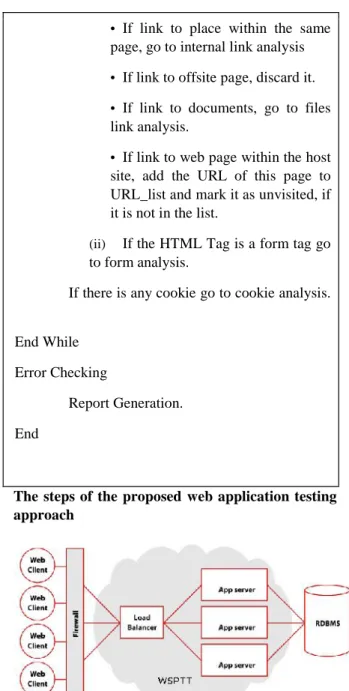
• If link to place within the same page, go to internal link analysis
• If link to offsite page, discard it.
• If link to documents, go to files link analysis.
• If link to web page within the host site, add the URL of this page to URL_list and mark it as unvisited, if it is not in the list.
(ii) If the HTML Tag is a form tag go to form analysis.
If there is any cookie go to cookie analysis.
End While
Error Checking
Report Generation.
End
The steps of the proposed web application testing approach
Fig. Proposed System Architecture
By following the steps of the proposed approach, each page and each hyperlink is visited once. This guaranties the satisfaction of two web application white-box testing criteria, namely page coverage criterion and hyperlink coverage criterion. These criteria are defined as follows [8]:
Page coverage criterion: every page in the site is visited at least once in some test case.
Hyperlink coverage criterion: every hyperlink from every page in the site is traversed at least once.
VII. Conclusion
The very large number of users characterizing Web applications and the strategic value of the services they over, make the verification of both non-functional and non-functional requirements of a Web application a critical issue. While new and specific approaches must be necessarily used for the verification of non-functional requirements (see the problems of security or accessibility testing that are specific for Web applications), most of the knowledge and expertise in the Weld of traditional application testing may be reused for testing the functional requirements of a Web application. In this paper, we have reported main differences and points of similarities between testing a Web application and testing a traditional software application. We considered testing of the functional requirements with respect to four main aspects, i.e., testing scopes, test models, test strategies, and testing tools. The main contributions on these topics presented in the literature have been taken into account to carry out this analysis. The main conclusion is that all the testing aspects that are directly dependent on the implementation technologies have to be deeply adapted to the heterogeneous and ‘dynamic’ nature of the Web applications, while other aspects may be reused with a reduced adaptation effort. This finding also remarks that further research efforts should be spent to define and assess the effectiveness of testing models, methods, techniques and tools that combine traditional testing approaches with new and specific ones. Moreover, as additional future trends, we expect that new relevant issues will arise in the Weld of Web services testing, as well as a new challenge will consist in the introduction of ‘agile’ methods in Web application testing processes for improving their effectiveness and efficiency.
References
[1] E. Collins, G. Macedo, N. Maia., and A. Dias-Neto,‖ A Industrial Experience on the Application of Distributed Testing in an Agile Software Development Environment‖, In Global Software Engineering (ICGSE) on IEEE Seventh International Conference, pp-190-194,2012.
[3] T. Clune, M. Rilee, and D. Rouson, ―Testing as an essential process for developing and maintaining scientific software‖.on In The 2nd Workshop on Sustainable Software for Science: Practices and Experiences, 2014.
[4] M. Chu, C. Murphy, and G. Kaiser, ―Distributed in vivo testing of software applications. In Software Testing Verification, and Validation”, on 1st International Conference on, pp. 509-512, 2008
[5] B. Li, M. Grechanik, and D. Poshyvanyk, ―Sanitizing and minimizing databases for software application test outsourcing. In Software Testing, Verification and Validation (ICST)” on IEEE Seventh International Conference on, pp. 233-242,2014.
[6] N. Sivakumar, and k. Vivekanandan, ―Agent Oriented Software Testing–Role Oriented approach‖ on International Journal of Advanced Computer Science and Applications, vol 3, 2012
[7] E. Uzuncoava, S.khurshid,, and D. Batory, ―Incremental test generation for software product lines‖ on Software Engineering, IEEE Transactions, vol 36, pp. 309-322,2010.
[8] Lv, J., Hu, H., Cai, K. Y., & Chen, T. Y. (2014). Adaptive and Random Partition Software Testing.
[9] T. Chen, F., Kuo, H., Liu and E. Wong,‖ Code coverage of adaptive random testing‖, on IEEE Transactions on Reliability, vol 62, pp. 226-237.2013.
[10] F.E, Eassa., L.J Osterweil, M. A, Fadel, S. Sandokji and A Ezz,‖ DTTAS: A Dynamic Testing Tool for Agent-based Systems‖on Pensee Journal, vol 76. 2014.
Authors
Modalavalasa Sateesh Holds a B.Tech certificate in Computer Science Engineering from Sri sivani institute of technology, Srikakulam, AP, India. He is presently Pursuing M.Tech (CSE) in the department of computer science engineering from Aitam, Tekkali, Srikakulam, AP, India.