Master’s Thesis
End-To-End Application Security Using Trusted Computing
Michiel Broekman
August 18, 2005
University of Oxford University of Nijmegen
Preface
This thesis is the result of my research project at the Software Engineering Programme of the Oxford University Computing Laboratory, from January till August 2005. This project has been done under the supervision of Dr. Andrew Martin from the University of Oxford and Dr. Jaap-Henk Hoepman from the University of Nijmegen. I would like to take the opportunity to thank Andrew Martin, Andrew Cooper, and Jaap-Henk for their help and support. Also, I would like to thank my family for supporting me throughout these years and for giving me the opportunity to fully develop myself.
Abstract
This thesis describes the implementation of Trusted Computing in end-to-end application security. It focuses on the services that are provided by application layer protocols in end-to-end communication. There are many security issues related to application layer protocols and some of these are explored. Application layer firewalls are often used to protect against these security issues. Unfortunately they are application specific, which means that only recognised protocols can be examined. It is practically impossible to distinguish between all possible application layer protocols. Therefore an abstraction to application layer protocols is proposed by providing a classification that tries to capture a large subset of the full spectrum of pro-tocols. The security issues involved are discussed and addressed by Trusted Computing. A more thorough investigation is performed by examining the
architecture of some distributed application components. Spam and
se-cure message store in SMTP are researched and discussed in the context of Trusted Computing. Access control in FTP is enhanced to enable policy enforcement of an object on both the server and client platform. Further-more, some ideas are proposed to enhance the privacy and security of web cookies. The research offers a new perspective on how Trusted Computing can improve end-to-end application security.
Contents
1 Introduction 11
1.1 Application Layer Protocols and End-To-End Security . . . . 11
1.2 End-To-End Argument . . . 12
1.3 Trusted Computing Platforms . . . 13
1.4 Research . . . 14
2 Trusted Platforms and TCG Technology 15 2.1 An Overview of Trusted Platform Technology . . . 15
2.1.1 The Reasons for Trusted Platforms . . . 16
2.1.2 Limitations of Existing Security Technology . . . 17
2.1.3 Definition of Trust . . . 18
2.1.4 Trusted Computing Group and the TCG Specification 19 2.1.5 Definition of a Trusted Platform . . . 19
2.1.6 Cryptographic Capabilities . . . 20
2.1.7 Digital Signatures . . . 21
2.1.8 Integrity Measurement and Report . . . 22
2.1.9 Creation of Trusted Identities . . . 22
2.1.10 Privacy . . . 23
2.1.11 Protected Storage . . . 23
2.2 Applications of TCG Technology . . . 24
2.2.1 Improvements Realized by Trusted Platforms . . . 25
2.2.2 Examples of Improved Conventional Services . . . 26
2.2.3 Virtual Machine-Based Platforms for Trusted Com-puting . . . 27
2.2.4 Example Applications . . . 28
2.3 Key Components of Trusted Computing . . . 29
2.3.1 Platform Configuration Registers . . . 29
2.3.2 Integrity Recording and Reporting . . . 30
2.3.3 Protected Storage . . . 33
3 End-To-End Application Properties 38 3.1 Introduction . . . 38
3.3 Transfer of Responsibility . . . 40
3.4 Identification . . . 41
3.5 Intermediaries . . . 42
3.6 Old Versus New Protocols . . . 43
3.7 Security Issues . . . 44
3.8 Classification of Application Layer Protocols . . . 45
4 Classification and Security Issues 48 4.1 Message Connection . . . 48
4.2 Shared Data Repository Connection . . . 51
4.2.1 Filestore Connection . . . 52
4.2.2 Web Connection . . . 53
4.2.3 Database Connection . . . 55
4.3 Conferencing Connection . . . 56
5 Trusted Computing Applied 58 5.1 Architecture for Access Control Using Trusted Computing . . 58
5.1.1 A Platform with Trusted Reference Monitor . . . 59
5.1.2 Architecture . . . 62
5.1.3 Policy . . . 64
5.1.4 Policies and User Attributes . . . 65
5.2 FTP and Access Control . . . 67
5.3 Whiteboarding and Trusted Computing . . . 70
5.4 SMTP and Trusted Computing . . . 73
5.4.1 Spam . . . 74
5.4.2 Securing Message Store . . . 75
5.5 Cookies and Trusted Computing . . . 78
6 Conclusion and Further Research 82
List of Figures
2.1 Questions addressed by TPs. . . 18
2.2 Trusted Computing Platform model. . . 20
2.3 The measurement process in a TP. . . 22
2.4 A storage hierarchy. . . 24
2.5 Integrity-checking. . . 26
2.6 Terra’s architecture. . . 28
2.7 Architecture for dynamic checking in a TrustedVM. . . 33
2.8 Hashes of bootstrap code stored in PCRs. . . 34
2.9 Sealing and unsealing. . . 37
3.1 Message interactions in SMTP. . . 39
3.2 Simple client-server architecture. . . 40
3.3 Architecture with interconnected servers. . . 40
3.4 Store-and-forward of email. . . 41
3.5 Dual Homed Gateway. . . 45
3.6 Publish/subscribe mechanism. . . 46
5.1 The platform architecture. . . 60
5.2 Architecture for client-side policy enforcement. . . 63
5.3 Policy enforcement in a client platform. . . 64
5.4 An example of a policy. . . 66
5.5 User identity migration. . . 67
5.6 Secure whiteboarding architecture. . . 71
5.7 Whiteboarding policy enforcement in a platform. . . 73
5.8 Preventing spam by rate limiting. . . 75
5.9 An SMIME message. . . 76
5.10 SMTP on a Trusted Platform. . . 77
Chapter 1
Introduction
This thesis describes the outcome of the research project that has been carried out at the Software Engineering Programme (SEP) of the Oxford University Computing Laboratory (OUCL). This chapter will first provide some introductory information on the problem definition. Then it will for-mulate the exact problem definition which will be the basis for the rest of this thesis. After the reader has gained a clear understanding of the motivations behind this project, chapter 2 will provide some information about Trusted Computing to show what trust mechanisms it can provide and how they are realized. Chapter 3 will give some background information on application layer protocols and present a classification of application layer protocols, which will make it easier to look at security issues from the perspective of end-to-end application security. Chapter 4 will discuss the security require-ments of the various classes and the application of Trusted Computing to these security requirements. In chapter 5, Trusted Computing will be used in the implementation of the architecture of some distributed application components. At the end, chapter 6 will summarize the performed research and give an answer to the problem definition stated in the beginning. It will conclude by proposing topics for future research.
1.1
Application Layer Protocols and End-To-End
Security
From the perspective of the Open Systems Interconnection (OSI) model application layer protocols are part of the top layer of the network stack. The OSI stack does not focus on how the various network protocols exactly accomplish their task. Instead, it describes different layers of which each layer performs services for the next higher layer, and makes request to the next lower layer. The OSI model is a hierarchical structure of layers which defines the requirements for communication between two computers. In this thesis the emphasis lies on the services that are provided by the application
layer protocols in end-to-end communication. This approach is completely in agreement with the objective of the OSI model.
There are many security issues related to application layer protocols. Var-ious web servers, mail servers and other internet service software contain bugs that let remote users do things that are harmful. For example remote users can gain control of the machine and can do whatever they want. The exposure to these kind of threats can be minimized by running only the necessary software and getting the latest patches, and using software that has a good reputation [RCR04]. However, there remain many security issues that cannot be easily dealt with. Firewalls are often used to cope with these kind of issues.
Application layer firewalls are hosts running proxy servers that do not permit direct traffic between networks and perform logging and auditing of traffic that is going through them. These proxy applications are software com-ponents that run on the firewall and are application specific, which means that only recognized protocols can be examined. However, it is difficult to distinguish between all possible application layer protocols. Therefore a higher level approach must be chosen to cover all protocols without having to deal with the protocols one by one. This can be achieved by looking at how information is shared and disseminated in end-to-end communica-tion between hosts. In the next seccommunica-tion a justificacommunica-tion is presented for this end-to-end approach.
1.2
End-To-End Argument
The end-to-end argument that was raised by Saltzer, Reed and Clark in 1984 [SRC84] has been one of the most influential in the area of communication protocol design. The paper discusses the placement of functions in a com-munication network. Certain functions can be placed in both the network and the end systems, like for example error control, security and routing. The end-to-end argument however, suggests that these functions should be implemented in the endpoints. The end-to-end argument states that:
“The function in question can completely and correctly be implemented only with the knowledge and help of the application standing at the end points of the communication system. Therefore, providing that questioned function as a feature of the communication system itself is not possible.”
As an example of the end-to-end argument the secure transmission of data is presented. Firstly, if the data transmission system encrypts and decrypts data, it has to be trusted to manage the required encryption keys in a
se-cure manner. Secondly, if the data is transferred to the target node and sent to the application, the data is not encrypted and vulnerable to attacks. Thirdly, the authenticity of the message has still to be checked by the appli-cation on the end system. However, if the appliappli-cation performs end-to-end encryption, then it can obtain the required authentication check and it can handle key management itself. Furthermore, the data is never exposed out-side the application.
So in order to meet the requirements of the application, the communication subsystem does not have to provide automatic encryption of all data. How-ever, automatic encryption of all the data by the communication subsystem may be used to ensure that a user or application does not deliberately trans-fer information that should not be exposed. However, neither mechanism can completely satisfy both requirements.
1.3
Trusted Computing Platforms
The ability to protect a computing platform by using only software has some inherent weaknesses [Pea03]. Security solutions based on software depend on the correct installation and execution, which can be easily affected by other software that has been executed on the same system. Even the most robust software does not have complete control over its own integrity. Malicious software can bypass the mechanisms of the OS and corrupt the behavior of the OS.
Experts in information security say that some security issues cannot be solved by software alone and therefore trusted hardware is required. For example, the increasing e-business activities on the internet demand more security than is given at this moment. This has led to the Trusted Com-puting Group (TCG, which was formerly called the Trusted ComCom-puting Platform Alliance) that designs the specifications for computing platforms that are supposed to create trust for software processes, based on some extra hardware within the platform.
Basically a Trusted Platform is a computing platform that makes use of a trusted component. This trusted component is in the form of built-in hard-ware and is the basis of trust for softhard-ware processes. The security functions of the security hardware in a Trusted Platform must be trusted. The hard-ware is a root of trust and is able to measure both the hardhard-ware and the software environment of a specific system. If the software is decided to be trustworthy for some purpose, then all other security functions and software can operate as normal processes. These roots of trust are the core TCG capabilities.
There are all kind of interesting applications that can be realized with TCG technology. One interesting application is that of distributed firewalls. On a Trusted Platform a distributed firewall is significantly more powerful. An-other application is rate limiting for the prevention of distributed denial of service attacks (DDoS). There are a few papers that describe possible OS architectures which support Trusted Computing. One of these architectures, called Terra, will be briefly discussed in the next chapter.
1.4
Research
The introductory information given in this chapter is meant to familiarize the reader with some basic concepts that will be further investigated and used in the following chapters. In this thesis the emphasis lies on the end-to-end communication between applications. The general problem definition can be formulated as follows:
What are the benefits and drawbacks of using Trusted Computing in the im-plementation of end-to-end application security?
From the information provided above, it can be concluded that Trusted Computing may significantly improve platform security and guarantee spe-cific properties of applications. Therefore it is very interesting to research the possibilities of enhancing end-to-end application security using Trusted Computing.
Chapter 2
Trusted Platforms and TCG
Technology
This chapter provides the reader with relevant information about Trusted Platforms and TCG technology in order to create a basis of understanding for the rest of the thesis. The first section is intended to give the reader a summary of Trusted Platforms and their context. In the second section some applications of Trusted Platforms (TPs) are brought together. The last section describes a few relevant properties of Trusted Platform technol-ogy in more detail. These properties are used further on in this research. Much of the information given in this chapter is gained from the book “Trusted Computing Platforms, TCPA Technology in Context” [Pea03]. This book presents an overview of the 1.0 specification which is a bit out of date, as the 1.2 specification was already released in February 2005. How-ever, the general ideas of Trusted Computing Platforms are still the same and version 1.0 of the TCG specifications provides the basic building blocks to design secure applications and services. For more comprehensive and up-to-date information about Trusted Computing Platforms the reader is
referred to the official web site of the Trusted Computing Group (TCG)1.
2.1
An Overview of Trusted Platform Technology
This section introduces the reader to the concept of Trusted Platform tech-nology. It describes the reasons for Trusted Platforms and what they can provide. Trust is an important notion in the development of Trusted Plat-forms and therefore a short discussion about its definition is given. After that, a summarization of the main features of Trusted Platforms is presented.
2.1.1 The Reasons for Trusted Platforms
A platform is a computing device like a PC, server or mobile phone that is ca-pable of computing and communicating electronically with other platforms. Nowadays computer platforms can be found everywhere and they are used for electronic business and commerce. This means that information pro-tection is becoming increasingly important, especially on client platforms. Secure operating systems have been developed for server platforms but no corresponding improvement has been realized for client platforms. The rea-son for this is the ad hoc manner in which client platforms are developed, the large number of them and the cost.
The flexibility and openness of PC platforms have created a remarkable busi-ness growth and efforts to counter this flexibility and openbusi-ness have proven to be unsuccessful. People have always preferred convenience to security and this makes confidence in client platforms (PCs in particular) even more difficult.
There is no single company responsible for the design of the architecture of all platforms. Most client platforms on the internet are PC-based and the variety of hardware and software continues to increase. As businesses increasingly rely on PCs and the internet in order to meet their objectives, the trustworthiness of platforms and PCs becomes an increasingly impor-tant issue. Furthermore, the same computer platforms are used for both personal use and business which means that users must be able to store and use sensitive data on their platforms.
Unfortunately a computing platform cannot be protected by using software alone because of its inherent weaknesses. The amount of confidence a user can get of the software largely depends on the correct installation and exe-cution of it, which can be influenced by other software that is running on the same platform. Malicious software can bypass the security mechanisms of an OS and corrupt its behavior without the OS noticing anything. In general it is not really difficult to find a particular change made to the software if it is clear what to look for. However, conventional computing platforms do not enable a remote user to check whether the platform is appropriate to store and process sensitive information. It is certainly possible to identify a re-mote user accessing a corporate network by using a Virtual Private Network (VPN) gateway, however nothing can be said about the trustworthiness of the remote machine.
Some security issues cannot be solved by software alone and therefore trusted hardware is required as a basis for security mechanisms.
2.1.2 Limitations of Existing Security Technology
In the previous section it was stated that software alone is not enough to protect a computing platform because of its inherent weaknesses. Although this may be true, a few other important and more specific limitations of existing security software should be discussed as well. Existing security infrastructure includes the following technologies:
• Firewalls provide boundary protection for computer networks, but when much traffic is going through them they can become a bottleneck [RCR04]. Moreover, to add new functionalities and services it has become normal to increase the number of ‘holes’ in firewalls through which dynamic content and programs can be pushed. So there is the choice to either prohibit the new traffic or to adapt the firewall to deal with the new situation.
• Software security programs are available to provide a spectrum of security functions. These programs may run in a cryptographic co-processor or on the main platform co-processor. Software that runs on the main platform processor assumes that it runs in a safe environment. So confidence can be gained only if the software is installed and executed properly. However, data that is stored can be exposed to malicious programs and is therefore not safe.
• Cryptographic accelerators/co-processorsare other types of se-curity products. They are very good at creating a trusted environ-ment. They may even be preferred over a Trusted Platform, because the co-processor can do bulk encryption in a physically protected en-vironment. However, the disadvantage is that this kind of specialized hardware is too expensive and therefore cannot be used in all plat-forms. Therefore it must be clear that ubiquitous platform security cannot be based on conventional cryptographic co-processors.
• Other specific technologies can be used to increase the levels of confidence in computing platforms. A large number of security proto-cols (like IPsec) can be implemented in either hardware or software. All these techniques are executed on the main CPU and therefore rely upon the correct operations of the host computing platform.
This does certainly not mean that Trusted Computing technology will re-place existing security technology. Both technologies can be combined to realize new applications and to provide a higher level of security. Examples of applications that use both existing security technology and Trusted Plat-form technology are described in for example [GRB03], where Trusted Com-puting technology is combined with SSL. A recently published book [Smi05] treats various application case studies in which existing security technology
is merged with Trusted Computing technology. More information about this will be presented later on in this thesis.
2.1.3 Definition of Trust
First if all it should be noticed that trust is a complex notion. With respect to trust one usually thinks in terms of entity A trusting entity B for some-thing. However due to a number of reasons it is a more complex notion than expected. For example, trust is dynamic which means there exist differing phases in a relationship such as building trust, ongoing trust and declining trust. Further, trust levels vary in the degree and scope of trust: entities trust (or do not trust) each other to fulfill specific tasks, rather than for everything. At the same time, trust in certain areas can transfer to trust more generally.
Trust can be categorized in terms of behavioral and social components. These two different approaches help to get a better understanding of how Trusted Platforms can improve trust.
• The behavioral definition of trust is about collecting evidence of
be-havior and providing evidence of bebe-havior. The obtained information is used to decide whether a platform can be trusted.
• The social definition of trust focuses on what it is to be trustable.
Social trust in a Trusted Platform is an expression of confidence in behavioral trust, because it is an assurance about the implementation and operation of the specific Trusted Platform.
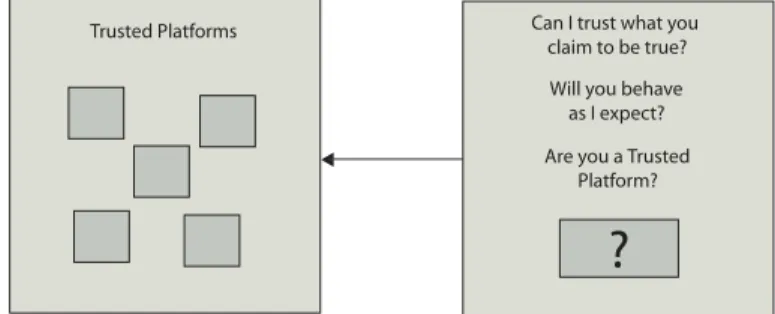
Trusted Platforms Can I trust what you claim to be true? Will you behave as I expect? Are you a Trusted
Platform?
?
Figure 2.1: Questions addressed by TPs.
Trusted Platforms use social trust to get confidence in the mechanisms that collect and provide evidence of behavior. They also use social trust to pro-vide confidence that certain values of epro-vidence represent a platform that is in a “good” state. It should be noted that a platform itself cannot decide
whether it can be trusted because trust is dependant on how the platform is to be used. So ultimately only a user can decide if the platform should be trusted for the intended purpose. The platform must report the necessary information to the user so that a decision can be made. Figure 2.1 shows what kind of questions play a central role in obtaining trust.
2.1.4 Trusted Computing Group and the TCG Specification
The security issues described above are addressed by the Trusted Computing Group (TCG), formerly known as the Trusted Computing Platform Alliance (TCPA). This group is responsible for the design of the specifications for computing platforms that can provide a basis of trust to software processes, based on some hardware within the platform. The TCG specification is independent of the type of platform. More information about the Trusted Computing Group can be found on their official web site.
2.1.5 Definition of a Trusted Platform
A Trusted Platform is a computing platform with a trusted component.
Cre-ating a Trusted Platform out of a conventional platform requires TCGroots
of trust to be embedded in the platform, so that local and remote users can
trust the platform. These TCG roots of trust are realized by cost-effective
security hardware. The security functions that are enabled by this hardware must be trusted as the hardware is the root of trust in the process that
mea-sures the platform’s hardware2 and software environment. The focus will be
on the software environment because knowing what the computing engine is doing is of most importance. If the software environment turns out to be trustworthy then all other security functions and software can operate
normally. Theseroots of trust are core TCG capabilities.
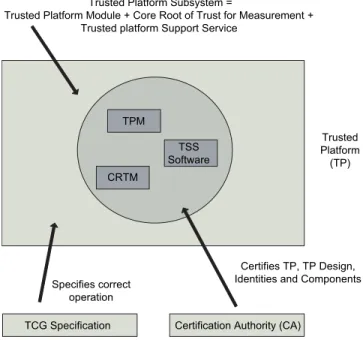
As can be observed in the figure 2.2, within each Trusted Platform there is a Trusted (Platform) Subsystem which contains a Trusted Platform Module (TPM), a Core Root of Trust for Measurement (CRTM), and support soft-ware (the Trusted platform Support Service, TSS). The TPM is a hardsoft-ware chip that is separate from the CPU(s). During the boot process the CRTM is the first piece of software that is allowed to run. The TSS is responsible for all kind of functions that are necessary for communication with the rest of the platform or other platforms. So called Certification Authorities (CAs)
2[HvD04] claims that TCG technology does not measure the hardware environment,
whereas [Pea03] claims that it can do both. This contradiction is the result of the fact that at this stage the CRTM is part of the BIOS. However, the BIOS can be altered so that the CRTM cannot be trusted anymore. Therefore future BIOS should have both a writable and a read-only part. Then the CRTM can remain unaltered in the read-only part of the BIOS.
are used to testify that the TP is genuine and are therefore very important in gaining trust.
Trusted Platform Subsystem =
Trusted Platform Module + Core Root of Trust for Measurement + Trusted platform Support Service
Trusted Platform (TP) CRTM TPM TSS Software
Certification Authority (CA)
Certifies TP, TP Design, Identities and Components
TCG Specification Specifies correct
operation
Figure 2.2: Trusted Computing Platform model.
In information security the Trusted Computing Base (TCB) is the set of functions that is responsible for the security properties of a platform. With respect to a Trusted Platform the TCB is the combination of a Trusted Subsystem (mainly dealing with secrets) and some additional functions that mainly deal with the use of those secrets, like bulk encryption. The Trusted Subsystem first shows that it can be trusted and then it shows that the rest of the TCB in the Trusted Platform can be trusted as well. Certifications from trusted entities are used to vouch for the platform in all kind of con-figurations.
Now that the Trusted Platform model has been described, some specific trust mechanisms of Trusted Platforms can be introduced. In the following subsections the characteristics of the most important ones are summarized.
2.1.6 Cryptographic Capabilities
Cryptography plays an important role in the realization of a Trusted Plat-form. Therefore the cryptographic capabilities that are provided by the TPM are listed below.
pro-duces a fixed-size output. The use of SHA-1 is explained later on in the thesis.
• Random number generation (RNG) is used for the security of many
cryptographic mechanisms. Examples are the primes in the RSA
en-cryption and digital signature schemes and thenonce (the concept of
anonce will be explained later on in the thesis). In all these cases the number that is generated must be of sufficient size and be random in the sense that an adversary cannot construct the generated number.
• Asymmetric key generation (RSA) is used to create asymmetric key
pairs for asymmetric encryption/decryption.
• Asymmetric encryption/decryption (RSA) is used to wrap and unwrap
secrets because this gives better functionality than would be provided by symmetric encryption/decryption. By using an asymmetric algo-rithm, public key operations can be performed outside the TPM on the CPU or at another platform, while the private keys are left inside the TPM. If a symmetric algorithm would be used then both encryp-tion and decrypencryp-tion must be performed in the TPM because the single symmetric key has to remain secret.
Besides asymmetric encryption/decryption the TCG specification also re-quires symmetric encryption/decryption (3DES) for purposes that are not further described here. At the moment AES, 3DES’s replacement, is not part of the TCG specifications, however in the future it may be required as well. For more information the reader is referred to [Pea03].
2.1.7 Digital Signatures
On a Trusted Platform digital signatures are created by encrypting data with the private key that is protected by the TPM. Digital signatures will become more important as their legal status is increasing. Trusted Platforms can support and enhance the use of digital signatures. The benefits that can be achieved are listed below.
• A Trusted Platform can protect signature keys by using the TPM. It
never releases these keys outside the TPM. The Trusted Platform uses these keys to digitally sign data that is submitted to the TPM.
• A Trusted Platform can improve the value of digital signatures by
adding integrity metrics that show the software state of the platform when the data is signed.
• Depending on the implementation of the TPM, a Trusted Platform
can further improve the value of signatures to guarantee that what is signed matches with what was seen by the signer.
2.1.8 Integrity Measurement and Report
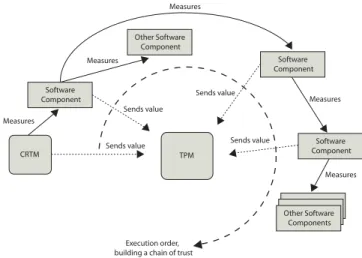
A Trusted Platform executes a series of measurements that record the sum-maries of software that has executed or is executing on the platform. This is illustrated in the figure 2.3. There is a boot-strapping process where Trusted Subsystem components measure each next component in the chain and save the value in the TPM. This procedure enables the measurement and record of a set of software instructions (binary code) before it is exe-cuted. This means that malicious software is recorded and therefore cannot hide. Cryptographic techniques are used to send the measurement to an interested party without enabling a malicious party to change it in transit
(in most literature this principle is known asremote attestation).
TPM CRTM Software Component Other Software Components Software Component Software Component Other Software Component Execution order, building a chain of trust Measures Sends value Measures Measures Measures Measures Sends value Sends value Sends value
Figure 2.3: The measurement process in a TP.
2.1.9 Creation of Trusted Identities
To prove that the measurements are reliable it is necessary to prove that a platform is a genuine Trusted Platform. This proof is realized by cryp-tographic attestation identities. Each identity is created on the individual Trusted Platform, with attestation from a PKI Certification Authority. A randomly generated asymmetric key and an arbitrary string that is used as an identifier for the pseudonym (which can be chosen by the owner of the platform) are part of each identity. In order to get an attestation from a CA, the platform’s owner sends the CA information that shows that the identity was created by a genuine Trusted Platform. This attestation process makes use of signed certificates from the manufacturer of the platform and uses a secret that is installed in the TPM. This secret is only known to the TPM
and is not released to other parties. Cryptographic attestation identities are used so that these secrets do not have to be made public to arbitrary third parties.
2.1.10 Privacy
Attestation identities provide a prove that they correspond to a Trusted Platform. A specific identity always identifies the same platform. The Cer-tification Authority (CA) is the only party that can track the origin of the specific identity, which assures privacy. So an appropriate selection of CAs enables the owner to control traceability from an attestation’s identity to the certificates that attest to a specific TPM and a specific platform. It is important to mention that identities can only be correlated with other identities by the CA that certifies these identities and that the owner has the choice of that CA. The owner is able to choose a CA that has the policy not to correlate identities or to correlate the identities. Different purposes can get different identities and separate identities are given to different users of the Trusted Platform. However, platform privacy can still be at stake be-cause of identification of platforms from for example MAC and IP addresses. In [Arb02] it is claimed that Trusted Computing does not provide a rea-sonable degree of privacy. According to this paper there are two major problems with the approach described above: (1) if a user requests several anonymous identities then the trusted third party can link all of the anony-mous credentials to the user because they have complete knowledge of the user’s identity and (2) if the trusted third party ever conspires with a true name CA then it becomes easy to relate the user’s real identity with their anonymous identities by matching public keys.
This claim should not be taken too seriously because there is no reason
to talk about Trusted Platforms if CAs cannot be trusted anymore. A
CA is an organization that vouches for an entity and verifies if a TP is genuine. Therefore CAs are centrally involved in the manufacture and usage of TPs. Furthermore the owner is able to choose a CA that does not correlate identities. Nonetheless, there is definitely some truth in this claim because preventing potential conspiracies between different parties is a serious issue that has to be taken care of.
2.1.11 Protected Storage
A TPM can be seen as a secure portal to protected storage, however the time to store and retrieve specific information can become large. The TPM is intended for keys that encrypt files and messages, keys that sign data and for authorization secrets. It is possible for a CPU to get a symmetric
TPM
Storage Root Key (Asymmetric Key) Protects (Stored internally)
Arbitrary data Asymmetric keys
TPM protected objects
Storage keys Protects (Using encryption)
Protects (using encryption)
Storage key
Protects (using encryption)
Symmetric key Secret Data
Signature Key Secret Data
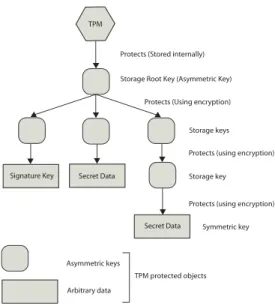
Figure 2.4: A storage hierarchy.
key from a TPM for bulk encryption or a CPU can send data to a TPM and ask the TPM to sign that data. The TPM acts as a series of separate operations on individual secrets. These operations together form a tree (hi-erarchy) of TPM protected objects, each of which contains a secret that is encrypted (wrapped) by the key above it in the hierarchy. It is important to mention that the TPM itself does not know anything about this hierarchy and only receives a series of commands from untrusted software that man-ages the hierarchy. An example of a possible hierarchy is shown in figure 2.4. An essential characteristic of Trusted Platforms is that an object that is protected by a TPM can be sealed to a particular software state in a plat-form. If the object is created the creator specifies the software state that has to exist when the secret is to be revealed. If a TPM decrypts the TPM protected object, the TPM first checks if the current software state equals the stated software state. If they match, the TPM grants access to the secret and if they do not match, the TPM denies access to the secret.
2.2
Applications of TCG Technology
Trusted Platform technology can provide the basic features that are required for current applications. The protection of data and digital signing can be achieved by using secrets that are protected by the TPM. In this section some basic enhancements that are enabled by Trusted Computing are given first. Then a brief description of Virtual Machine-Based Platforms for Trusted
Computing is presented. After that a few possible applications are shown where Trusted Platforms promise to have significant impact.
2.2.1 Improvements Realized by Trusted Platforms
By providing improved methods of storing secrets and signing data Trusted Platforms can attest that a specific secret is being used on a TP and they can report the state of a TP. The enhancements that are enabled by TPs are described below.
• Improved Protection of Secrets TCG technology provides a way of encrypting that enables the caller to define the software environ-ment that must be fulfilled in order to get the TPM decrypt a secret. A decrypting software environment is described by defining values of some or all so-called Platform Configuration Registers (PCRs) which are saved with the secret. So when a TPM tries to retrieve the se-cret, it first compares the saved PCR values with the current values of those PCRs. Only if the stored and current PCR values match then the TPM reveals the secret (in the case of data) or it uses the secret (in the case of a key). This TCG feature can be used quite easily, however the application should know how to use it.
• Improved Signatures TCG technology improves digital signatures by (1) using keys that can prove they belong to a genuine TPM and (2) incorporating the current value of some or all PCRs into the value of the signature. Only specific data structures generated by the TPM are signed directly by a TP identity key. Some structures that originate outside the TPM, but are constructed by the TPM and thus cannot be tampered with, are included as well. Examples of these kind of structures are messages concerned with identity creation, signatures that include PCR values and signatures that vouch for other keys. A TP does not directly use its identity keys to sign homogenous data. In fact, an identity key vouches for another TP key which then signs the homogenous data. This mechanism is important as it prevents a malicious party from signing data with the identity key. Otherwise it would be impossible to distinguish between data generated by the TPM and data that is generated outside the TPM.
• Improved Protection of Data on Remote ComputersThe afore-mentioned improvements increase the confidence for the owner of data that resides on a remote platform. So it is possible to store data on a remote platform and to define the conditions under which the data can be used.
2.2.2 Examples of Improved Conventional Services
Conventional services can be improved by using the storage and signature mechanisms that TPs provide. A few scenarios are described below.
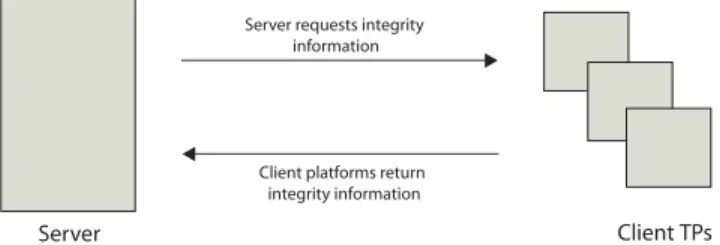
• Checking Client IntegrityA server can ask client TPs for integrity information and then use this information to check that unauthorized modification has not been made to the client platforms. Figure 2.5 visualizes this process.
Server requests integrity information
Client platforms return integrity information
Server Client TPs
Figure 2.5: Integrity-checking.
• Authorized Network Connection A corporate server allows ser-vices to be provided only to remote platforms that are TPs and that can provide trustworthy information about the software that is in-stalled on the platform. This makes it impossible that sensitive infor-mation is sent to computers that cannot be trusted.
• Remote AttestationTrusted Platforms can be used in a Virtual Pri-vate Network (VPN), so employees that are not at their home office can check if an unknown platform is trustworthy before using it. So employees can use an unknown TP at an arbitrary physical location to work on company information. The employees insert a smart card into the unknown platform. The smart card then asks the employer’s server to challenge the unknown platform and to decide whether it can be trustworthy. The server challenges the unknown platform af-ter which the unknown platform responds by digitally signing and sending its PCRs and other integrity information. The set of data that is sent should be enough to show that a TP will not reveal sen-sitive information to unapproved platforms. The server then checks the identity signature and determines whether the integrity metrics are acceptable. If the server decides that everything is well then the server gives the smart card the TPM identity and PCR values of the approved platform. So at the end the server sends sensitive informa-tion to the approved platform and the approved platform will not use the information in the wrong way.
For a comprehensive list of enhanced conventional services the reader is referred to [Pea03].
2.2.3 Virtual Machine-Based Platforms for Trusted
Com-puting
It is claimed that the vision of Trusted Platforms cannot be achieved with today’s operating systems because they offer poor assurance and implement a security model that contradicts the one that is required for trusted
com-puting [GRB03]. Therefore [GRB03] and [GPC+03] outline the design of
implementing a new OS architecture based on the idea of aTrusted Virtual
Machine Monitor (TVMM). In this model traditional applications and OSes
can run side-by-side on the same platform in either an open box or closed
box execution model.
A Trusted Virtual Machine Monitor is a high-assurance virtual machine monitor that splits up a single tamper-resistant, general-purpose platform into multiple isolated virtual machines. Existing applications can run in a standard virtual machine (open-box VM) which is quite similar to today’s open platforms. Applications can run in closed-box virtual machines as well so that the functionality of a dedicated closed platform is provided. The TVMM is responsible for protecting the privacy and integrity of the content of a closed-box VM. At the same time the TVMM can cryptographically authenticate the running software to remote parties by attestation.
Closed-box VMs are completely isolated from the rest of the platform. Be-cause of hardware memory protection and cryptographic protection of stor-age, the content is protected from observing and tampering by the platform owner or some malicious party.
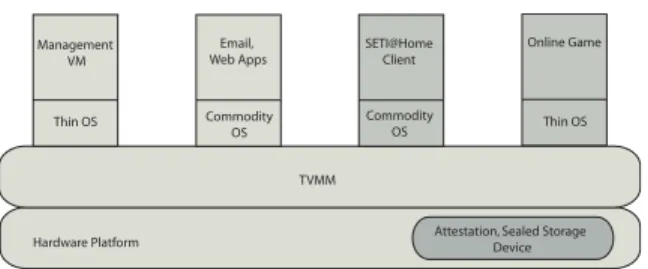
A good example of an OS architecture that enables these kind of features is Terra [GPC+03]. In figure 2.6 the TVMM isolates and protects the in-dependent VMs. The two closed-box VMs that are shown in dark gray are protected from eavesdropping and modification by anyone but the remote party that supplied the box. The SETI@Home client is put in a closed-box VM so that its server can verify that it has not been modified and claims that it has run checks that it actually has not. The online game is in a closed-box as well in order to deter cheating. The TVMM can identify the contents of the closed box to remote parties so that they can gain trust in the platform. In each VM another OS can be run. The management VM is responsible for the configuration of how much storage and memory is assigned to the VMs.
Attestation, Sealed Storage Device Hardware Platform TVMM Management VM Email, Web Apps SETI@Home Client Online Game Thin OS Commodity OS Thin OS Commodity OS
Figure 2.6: Terra’s architecture.
2.2.4 Example Applications
There are several areas in which Trusted Platforms can have a significant im-pact. The use of Trusted Platforms can have a big influence on the function-ality of today’s client side technology. There will be no focus on applications that are related to Digital Rights Management (DRM) of which the public policy consequences have been discussed quite thoroughly [And03]. Some interesting examples are presented in [GRB03] and are briefly described be-low.
• Regulated Endpoints and Distributed Firewalls Conventional firewalls assume that everyone on the inside of the network is trusted and that everyone on the outside is untrusted. However, due to the deployment of wireless access points, tunnels, VPNs and dial-ins the distinction between the inside and the outside becomes more vague. Because of increasingly dynamic network topologies, distributed fire-walls simplify the task of implementing network security policies a lot. By using a distributed firewall the security policy is defined centrally and enforced at every endpoint of the network. This enables a larger variety of policies and greater scalability than the conventional cen-tralized firewalls [IKBS00].
On a normal host, distributed firewalls can help protecting a host from others, but they are of little use for protecting others from the host: it is impossible to tell if the host does not tamper with or bypass the firewall. However, on a Trusted Platform a distributed firewall is a lot more powerful because it can prevent packets that violate the central security policy from ever reaching the network. A distributed firewall can for example prevent port scanning and IP spoofing as the packets will never reach the network. At the same time the distributed firewall can make sure that all VMs on the machine have implemented the connection rate limits properly. This means that distributed firewalls on Trusted Platforms enable well-regulated endpoints for a all kind of network types.
• Third-Party ComputingIt is increasingly common to borrow, lease or donate computing resources. A nice example of this is the use of donated cycles for massively parallel scientific and mathematical com-putations by SETI@home. Another example, which is quite popular at this moment in the United Kingdom, is the emerging field of grid computing which allows heavy users of scientific computing resources to pool and share their computing resources. The problem with this third-party computing is trusting the machines that are doing the com-putation to (1) produce the correct results and (2) keep the contents of the computation secret. Trusted Platforms offer a solution to these two problems by providing attestation. Using attestation, remote ma-chines can show and prove that they are running the right executable image. The results of the computation can be signed and encrypted so that privacy and authenticity is guaranteed.
• Civil Liberties ProtectionLaw enforcement increasingly needs the use of network surveillance devices that can potentially violate civil liberties. These kind of devices are certified not to exceed their legal boundaries by getting together a select group of experts to review their design. Unfortunately, there is no certainty that the system that is reviewed by the experts is the one used in the field. Attestation is the technique that makes it possible to verify if a system can be trusted.
2.3
Key Components of Trusted Computing
This section focuses on some of the key components that are part of Trusted Computing technology. They will be discussed in more detail as they will be used later on to address the security issues of some application layer protocols or to enhance specific security mechanisms. Each of the following
subsections scrutinizes a specific component. First, the concept ofplatform
configuration registers is explained, because they are a prerequisite for the functioning of the other key components.
2.3.1 Platform Configuration Registers
An important part of a Trusted Platform are the platform configuration
registers (PCRs). They are used in all kind of trust mechanisms. The in-tegrity metrics are stored in such a manner that misrepresentation of the presented values or the sequence in which they were presented is prevented. The PCRs are used to store summaries of integrity metrics. If values of in-tegrity metrics would be individually stored and updates of inin-tegrity metrics would have to be individually stored as well, then it is difficult to define an upper bound on the size of memory that is necessary to store them. There
is an unknown number of integrity metrics that have to be measured in a platform and an integrity measure can change at every moment so that a new value has to be stored. The authentication of the source of measure-ments of integrity metrics is practically impossible, and adding a new value of an integrity metric should not overwrite an existing value. If this would be possible then a malicious party can easily erase an existing value that represents a subversion and replace it with a value that looks harmless. The solution that is presented in the TCG specification is based on storing sequences of integrity metrics instead of individual integrity metrics. So values of integrity metrics are appended to a sequence of which the repre-sentation has a fixed size. At power-up the states of all the sequences in the TPM are set to a specific value. Then each new metric must change the value of the sequence. The value of a new integrity metric is concatenated with the existing value of the sequence. The digest of the concatenation will then be the new representation of the sequence. The digests are saved in the Platform Configuration Registers inside the TPM.
2.3.2 Integrity Recording and Reporting
Integrity measurement is one of the most important components of a Trusted Platform. The host platform uses integrity measurements to provide pro-tected storage: the disclose of secrets is only performed if the platform is in the correct state. Third parties use integrity measurements to verify if the target platform is in the correct state. A third party believes the measure-ments because the platform signs the measuremeasure-ments with the TPM identity which provides guarantee that the measurements are coming from a Trusted Platform.
Integrity challenge and integrity response are the TCG processes that are responsible for reporting the current hardware and software configuration of
a computing platform to local and remote challengers. Integrity verification
is the process of verifying that the configuration is the one that is desired. So if some computing platform wants to know the state of the computing environment inside a TP then there is a strong dependance on the values of the integrity metrics. Therefore the integrity metrics should be reported by a trusted mechanism which in this case is the TPM. The TPM creates a cer-tain amount of trustworthiness by signing data using one of its identity keys. A challenger, who wants to know the state of a target platform, creates a
nonce and sends anintegrity challenge to the target platform. The TP does
not have to respond to the challenger, which depends on the policy of the TP. If the TP decides to respond, the Trusted Platform Agent coordinates the integrity response. The TPA sends the nonce to the TPM so that the
TPM signs the nonce and the current PCR values, using a TPM identity. After that, the TPA gets the logs of the measured software from the Trusted Platform Measurement Store and gets certificates from the relevant reposi-tories. The TPA collects all this information and sends it to the challenger.
This is theintegrity response.
The challenger must verify the integrity response in order to decide if the target platform can be trusted. In practice, the challenger must investigate the following aspects:
• The certificate that is signed by the Privacy CA that attests to the
TPM identity (to know whether the TPM identity is a genuine TPM identity).
• The nonce signed by the TPM identity.
• The PCRs signed by the TPM identity.
• The PCR values and the certificate signed by the entities that vouch
for the platform (to determine whether the platform is in the expected state).
The challenger then makes a decision whether there is enough reason to trust the target platform and to interact with it. In most cases the challenger only wants to know if the target has the correct identity, if it is running the right OS with the latest security updates and if it has a virus checker that is using the latest virus definitions. If the challenger wants to communicate with the target platform then the platform should sign all information that it sends to the challenger for the rest of the session. If the data would not have been signed there is a chance of a man-in-the-middle attack. If a specific signing command, which includes PCR values, is issued then a TPM identity signs the information. Arbitrary data is signed by an ordinary signing key that is certified by a TPM identity, because TCG does not allow TPM identities to sign arbitrary data as there is a risk of forgery of special data structures that are generated by the TPM and signed by TPM identity keys. It is important to notice that there is a time interval between the beginning and the end of a trusted transaction. The TCG specification tries to overcome this problem by asking the integrity metrics both before and after the trans-action, although this approach clearly does not really offer a satisfactory solution.
Fine-Grained Remote Attestation In [SPvD05] an idea is proposed to address two important problems that are inherent to the attestation tech-nology described above:
• Due to the great diversity of software versions and configurations the verification of the hash is quite difficult.
• The time-of-use and time-of-attestation discrepancy is still to be
ad-dressed, because the code may be correct at the time of attestation, but it may be compromised by the time of use.
BIND, a fine-grained attestation service for secure distributed systems, promises to deal with these issues. It offers the following properties to realize its aims:
• BIND accomplishes fine-grained attestation, by only attesting to the
part of the memory that is relevant. So instead of attesting to the entire memory content. This makes verification a lot easier.
• BIND makes the gap between time-of-attestation and time-of-use a lot
smaller. It measures a piece of code directly before it is executed and uses a sand-boxing mechanism to protect the execution of the attested code.
• BIND ties the code attestation with the data that the code produces,
so that it can figure out what code has been run to generate that data. Further, the verification of input data integrity is incorporated into the attestation which enables a transitive integrity verification. So by using one signature it is possible to vouch for the entire chain of processes that performed transformations over a piece of data.
Semantic Remote Attestation In [HCF04] remote attestation is scru-tinized and a another approach is chosen. The kind of attestation that
is proposed is called semantic remote attestation. It is claimed that the
kind of remote attestation, which is described in the TCG specifications, is static, inexpressive and fundamentally incompatible with today’s heteroge-neous distributed computing environments. Current techniques of remote attestation do not really investigate program behavior as they only attest to a specific binary. However, it is possible that an attested binary has bugs and does not confirm to the security policy the server was expecting. At the same time it is quite difficult to keep pace with the continuing release of software patches and upgrades. Therefore a language-based virtual machine is proposed to enable remote attestation of complex, dynamic and high-level properties in a platform-independent way. This principle is known as seman-tic remote attestation.
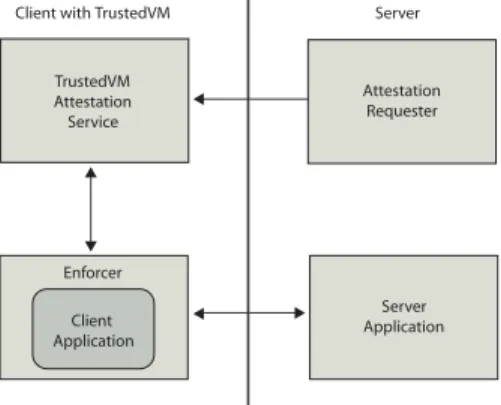
Semantic remote attestation uses a Java Virtual Machine to create a language-based virtual machine (for the sake of clarity, a VM is not the same as a VMM which was described earlier in this chapter) that executes platform-independent code. The requests for remote attestation are now made to
the TrustedVM which enforces or checks the specific security policies on the code that is run by the TrustedVM. See also figure 2.7 for an overview of the top-level architecture.
Client with TrustedVM
Client Application Enforcer Server Attestation Requester Server Application TrustedVM Attestation Service
Figure 2.7: Architecture for dynamic checking in a TrustedVM.
Secure Boot Integrity measurements can be used in secure boot which is
about checking that a boot process is proceeding as expected. Asecure boot
process checks if the values of the PCRs match with the expected values that are stored in the data integrity register (DIR) and activates an
exception-handling routine if the values do not match. So a platform boots in a
predefined way or not at all. However, [HvD04] states that secure bootstrap is not enough and that secure boot standards should verify the firmware of all devices in the computer as well, so not just only devices that are acces-sible by the host CPU. Therefore a simple extension to secure bootstrap is proposed which prevents attacks on firmware by adding some extra func-tionality to the devices so that they can prove their trustworthiness. Figure 2.8 shows that hashes of bootstrap code, operating system and applications are stored in the PCRs which can be queried. For a more detailed descrip-tion about PCRs and integrity measurement the reader is referred to [Pea03].
2.3.3 Protected Storage
Protected storage is a service to the platform in which the TPM is used as a portal to confidential data that can be stored on all kind of unprotected storage media. The service creates and uses TPM protected objects that exist outside the TPM. The objects can be either data protected by the TPM (TPM protected data objects) or TPM keys protected by the TPM (TPM protected key objects). The protected storage service needs help from the host platform software to manage those objects. The management
PCR[0] PCR[11] PCR[10] PCR[9] PCR[8] PCR[7] PCR[6] PCR[4] PCR[3] PCR[2] PCR[1] PCR[5] PCR[12] PCR[13] PCR[14] PCR[15] Operating System Specific: Device Drivers, Application, etc. BIOS Hardware Configuration Option ROMS Option ROM Configuration Boot Loader Configuration Boot Loader
Figure 2.8: Hashes of bootstrap code stored in PCRs.
process itself is not security sensitive and therefore the TCG specification does not include this. The protected storage service can work without using any integrity measurements, but complete functionality requires access to the data that is stored in the PCRs. The values of these PCRs have to be known in order to decide if the platform is in the right state and if access should be granted to the secrets. Important points of interest for users are:
• Protected storage makes it possible to store signature keys in such a
way that the TPM can use them without exposing them to the host platform.
• Bulk encryption keys or arbitrary authorization data can be stored in
such a way that cooperation of the TPM is needed to reveal them to the host platform.
• Protected data can be stored in such a way that either permits
duplica-tion of the data by TCG features (which is under control of the owner of the data) or prevents duplication of the data by TCG features.
• Protected data can be stored in such a way that prevents use of the
data if the platform is not in an expected state (this functionality requires access to the data stored in the PCRs).
Cryptographic Protection The TPM uses cryptographic functions to make sure that the TPM protected objects that are created by protected storage have the necessary properties of confidentiality and integrity. The focus here will not be on the cryptographic capabilities, for further informa-tion on this topic the reader is referred to [Pea03].
To provide confidentiality of TPM objects asymmetric cryptography is used instead of symmetric cryptography. One important reason for this is the fact
that some plain text originates outside the TPM and asymmetric cryptog-raphy permits encryption of that data outside the TPM without revealing the decryption secret. This can improve overall platform throughput as the TPM becomes less of a bottleneck. At the same time it permits encryption to be done at another platform. Unfortunately the drawback of using asym-metric cryptography, compared to symasym-metric cryptography, is that it takes a longer time to generate keys and perform encryption/decryption. Another drawback is that the size of data in the TPM protected object is limited by the size of the asymmetric key that is used to encrypt it. So the amount of data that can encrypted by the TPM and stored as a TPM protected object is limited. The Trusted Computing Group came with the idea to make all Protected Storage structures fit in a single block.
The integrity of data objects should be checked as well. Usually integrity checks are performed by checking the self-consistency of data. Protected storage already has a built-in consistency check for decrypted data in the
form of the authorization check. A TPM protected object includes the
encrypted authorization data so that a comparison can be made with the authorization data that is sent to the TPM to prove sufficient rights to use the TPM object. The probability that there is an authorization match after decryption of a corrupt TPM protected object is very small, because autho-rization data is the size of an SHA-1 digest. So no other explicit integrity check is required.
However, an explicit integrity check is certainly needed for every associated plain text data, because all TPM protected objects correspond with plain text data. At the same time all TPM protected key objects are associated with the public part of that key and other descriptive information, whereas all TPM protected data objects are associated with descriptive data. In order to enable an integrity test of the plain text data that corresponds with the TPM protected object, every TPM protected object contains a digest of the associated plain text data. So if the authorization for the TPM protected object is successful then the plain text integrity digest must be correct and can then be used to check the integrity of the plain text data.
Migratable and Non-MigratableMigratable TPM protected objects can be infinitely replicated by its owner and can be moved to another platform. Non-migratable TPM objects however, are locked to one particular TPM and never duplicated. As a result, migratable TPM key objects are allowed to be created outside the TPM and are only protected by the TPM, but they can also be created by the TPM itself. Non-migratable keys always have to be created by the TPM. More detailed information can be found in [Pea03].
Object hierarchyA TPM protected object that is stored outside a TPM will not be lost or corrupted. A TPM protected object includes all kinds of secret attributes of the key or data it is protecting, and it is associated to plain text attributes that are not secret. All TPM objects are encrypted by an encryption key. Such an encryption key is stored outside the TPM as another TPM protected key object. The consequence of this is that a set of TPM protected objects form a tree hierarchy, where each child TPM protected object is encrypted by the encryption key in the parent TPM protected object. The only encryption key that is stored in the TPM is the storage root key (SRK). It is generated inside the TPM and is non-migratable. The intermediate TPM object nodes in the tree are encryption keys (storage keys) and they are used to decrypt child nodes. It is not very wise to use the same key for both signing and encrypting, so a signature key will never be used as a storage key and vice versa. Therefore a storage key can exist anywhere in the tree, but a signature key will always be a leaf key. Further, a migratable storage key will never be the parent of a non-migratable TPM object, as this would result in a non-migratable ob-ject being migratable. Of course a non-migratable node can be the parent of a migratable node without any bad consequences. Figure 2.4, which was already shown before, gives an example of a storage hierarchy.
Arbitrary data will be contained in a leaf TPM object node as the TPM never uses arbitrary data as a key. The time that is required to access the contents of a particular TPM protected object node depends on its position in the tree. Only the SRK is always available as it is stored as plain text inside the TPM. In order to get the content of some TPM protected object, the management software outside the TPM has to look for a path from the SRK to the target TPM object. First the SRK is “loaded” and used to decrypt the child TPM key object which is next in the path to the target. Then the key from that child object is used to decrypt the child TPM key object that is the next in the path to the target. This process continues and at the end target object is decrypted by the TPM and can be immediately used. There are ways of decreasing the delay in accessing a node and this can be read in [Pea03].
Sealing and Unsealing Keys and Data If arbitrary data or a key are saved by protected storage it is possible to define the future software envi-ronment that has to be satisfied before a TPM will release the data or key. This adds some extra functionality to access control. The desired software state is defined by the values of platform configuration registers (PCRs). Sealing is the process of locking a secret to a certain software configuration. So a TPM will not unseal the secret unless the platform is in the approved software configuration. Both TPM data objects and TPM key objects can
be sealed to a specific software configuration. Two important advantages of sealing data and keys are listed below.
• By directly sealing arbitrary data the use of that data is prevented
unless the platform is in the right software state.
• By sealing TPM signature keys a signature will not be performed
un-less the platform is in the right software state.
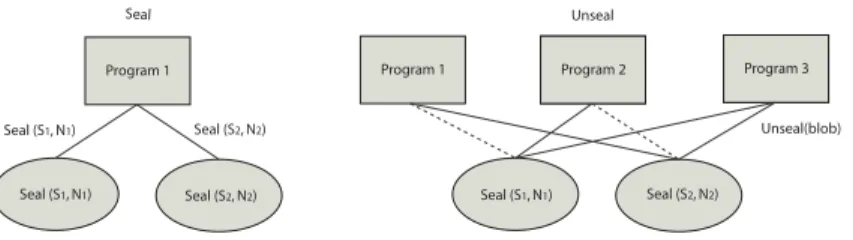
In figure 2.9 the sealing and unsealing is visualized [ELM+03a]. A secret S
is sealed and a program N is named that is allowed to access the secret. If a program calls unseal then the secret is revealed only if the identity of the requester is the same as the identity specified in the sealed data block. The successful unseal requests are represented by dashed lines.
Program 1 Program 1 Program 1Program 2 Program 1Program 3
Seal Unseal
Unseal(blob)
Seal (S1, N1) Seal (S2, N2) Seal (S1, N1) Seal (S2, N2) Seal (S1, N1) Seal (S2, N2)
Figure 2.9: Sealing and unsealing.
Authorization There are two authorization types related to objects in protected storage. One proves rights to use the contents of the object and the other proves rights to migrate the contents of the object. There are two values used, so a protected storage object can be created and an entity can get the right to use to object but it may not have the right to copy (migrate) the object, for example.
Chapter 3
End-To-End Application
Properties
This chapter gives an introduction to application layer protocols and de-scribes their fundamental properties from the perspective of end-to-end com-munication between applications. Some security issues are briefly addressed by Trusted Computing technology. Then an abstraction to application layer protocols is proposed by providing a classification that tries to capture the full spectrum of protocols. The obtained classification is of great importance as it it will be used in the next chapter to address the involved security issues.
3.1
Introduction
The term “application layer” refers to the top layer of the Open Systems
Interconnection (OSI) model1 which is a layered abstract description for
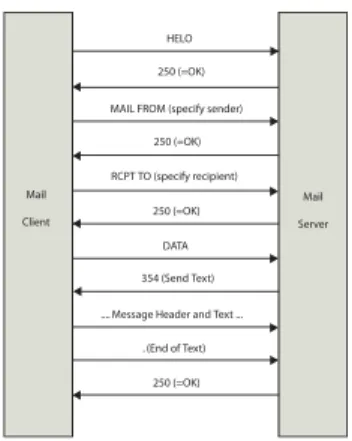
communications and computer network protocol design. This model divides the functions of protocols into seven layers of which each layer only uses the services of the layer below and exports functionality to the layer above. The lower layers are usually implemented in hardware and the higher ones in software. This separation of seven layers makes it easier to discuss the behavior of protocol stacks. The application layer interfaces directly to and performs common application services for the application processes. It also sends requests to the presentation layer. Furthermore, it is the application layer that contains the protocols used by applications to exchange data. In the beginning application layer protocols were quite simple. Basically, a program on one host that wants to connect to a program on another host is able to communicate by the transfer of simple textual commands. Figure 3.1 visualizes the messages that are required to send an e-mail message from
Mail Client Mail Server HELO 250 (=OK)
MAIL FROM (specify sender)
250 (=OK)
RCPT TO (specify recipient)
250 (=OK)
DATA
354 (Send Text)
.... Message Header and Text ...
. (End of Text) 250 (=OK)
Figure 3.1: Message interactions in SMTP.
a client to a server, using the SMTP protocol. An e-mail is transmitted by sending a few lines of text back and forward between the client and the server.
Some widely-known application layer protocols are those that are used for the exchange of user information like HTTP which is used to transfer files that form the web pages of the World Wide Web, FTP which is used for interactive file transfer, SMTP which is used for the transfer of mail messages and attachments, and Telnet which is used for logging on to network hosts remotely. There are other application layer protocols that help facilitate the use and management of TCP/IP networks like DNS which is used to resolve a host name to an IP address and RIP which is a routing protocol that routers use to exchange routing information on an IP internetwork.
3.2
Architecture
There can be several processes at different computers that communicate with each other. The term architecture refers to the way applications are organized into different modules and how these modules communicate. Fig-ure 3.2 shows a very simple architectFig-ure where a few clients communicate with one server. The server is usually responsible for a database. The pro-tocol is a client-server propro-tocol.
A more complex architecture that is used for example to transfer email and Usenet News can be observed in figure 3.3. There are two types of connec-tions to be distinguished: (1) connecconnec-tions between a user agent and a service agent and (2) connections between two service agents. Because of the na-ture of these connections the protocols are different. In the case of email the protocol used for sending email (from a user agent to a service agent)