Improving caching efficiency and quality of experience
with CF-Dash
Zied Aouini, Tourad Mamadou, Ali Gouta, Anne-Marie Kermarrec, Yannick
Lelouedec
To cite this version:
Zied Aouini, Tourad Mamadou, Ali Gouta, Anne-Marie Kermarrec, Yannick Lelouedec.
Im-proving caching efficiency and quality of experience with CF-Dash. NOSSDAV ’14 - 24th ACM
Workshop on Network and Operating Systems Support for Digital Audio and Video , Mar 2014,
Singapore, Singapore. ACM, pp.6, 2014,
<
10.1145/2578260.2578268
>
.
<
hal-01097325
>
HAL Id: hal-01097325
https://hal.archives-ouvertes.fr/hal-01097325
Submitted on 13 Jan 2015
HAL
is a multi-disciplinary open access
archive for the deposit and dissemination of
sci-entific research documents, whether they are
pub-lished or not.
The documents may come from
teaching and research institutions in France or
abroad, or from public or private research centers.
L’archive ouverte pluridisciplinaire
HAL
, est
destin´
ee au d´
epˆ
ot et `
a la diffusion de documents
scientifiques de niveau recherche, publi´
es ou non,
´
emanant des ´
etablissements d’enseignement et de
recherche fran¸
cais ou ´
etrangers, des laboratoires
publics ou priv´
es.
Improving caching efficiency and quality of experience
with CF-Dash
Zied Aouini
Orange Labs[email protected]
Mamadou Tourad
DIALLO
Orange Labs[email protected]
Ali Gouta
Orange Labs[email protected]
Anne-Marie Kermarrec
Inria[email protected]
Yannick Lelouedec
Orange Labs[email protected]
ABSTRACT
HTTP Adaptive Streaming (HAS) is gradually being adopted by Over The Top (OTT) content providers. In HAS, a wide range of video bitrates of the same video content are made available over the internet so that clients’ players pick the video bitrate that best fit their bandwidth. Yet, this affects the performance of some major components of the video de-livery chain, namely CDNs or transparent caches since sev-eral versions of the same content compete to be cached. In this context we investigate the benefits of a Cache Friendly HAS system (CF-DASH), which aims to improve the caching efficiency in mobile networks and to sustain the quality of ex-perience of mobile clients. Firstly, we motivate our work by presenting a set of observations we made on large number of clients requesting HAS contents. Secondly we introduce the CF-Dash system and our testbed implementation. Finally, we evaluate CF-dash based on trace-driven simulations and testbed experiments. Our validation results are promising. Simulations on real HAS traffic show that we achieve a sig-nificant gain in hit-ratio that ranges from 15% up to 50%..
Categories and Subject Descriptors
C.2 [COMPUTER-COMMUNICATION NETWORKS]: Network Architecture and Design
General Terms
Design, Performance
Keywords
HAS, Dash, MOS, GPAC, cache, hit-ratio
The research leading to these results has received funding from the European Union’s Seventh Framework Programme ([FP7/2007-2013]) under grant agreement n 318398, project eCOUSIN
Permission to make digital or hard copies of all or part of this work for personal or classroom use is granted without fee provided that copies are not made or distributed for profit or commercial advantage and that copies bear this notice and the full citation on the first page. Copyrights for components of this work owned by others than ACM must be honored. Abstracting with credit is permitted. To copy otherwise, or republish, to post on servers or to redistribute to lists, requires prior specific permission and/or a fee. Request permissions from [email protected].
NOSSDAV2014 Singapore, Singapore Copyright ACM ...$15.00
http://dx.doi.org/10.1145/2578260.2578268
1.
INTRODUCTION AND RELATED WORKS
Mobile video is expected to increase 16-fold between 2012 and 2017, accounting for over two-thirds of the world’s mo-bile data traffic by 2017 [11]. This growth in video is accom-panied by a key technology trend: the shift toward adaptive streaming over HTTP (HAS). In HAS, the client player dy-namically adjusts the video bitrate as a function of the net-work condition and CPU usage. While this may reduce the playback interruptions, it still adversely affects the user ex-perience with the rise of the number of switching between qualities during the video session [8]. This has also a straight impact on the performance of transparent caches or CDNs, since many bitrates of the same chunk from the same content compete to be cached [5].
Currently, MPEG is working towards a new edition of DASH. This second edition, introduced as SAND [1](Server and Network assisted DASH), aims at giving the network deliv-ery actors such as operators and CDN providers the ability to assist the client player to select the video quality that both clients’ players and content delivery actors find it con-venient to serve. MPEG has addressed various issues related to the actual HAS version [2], among them was the impact on the existing internet infrastructure such as servers, prox-ies, caches and CDNs. In this paper, we investigate this impact and propose a solution to tackle this issue. In [4], authors investigated the case of multiple bitrate-adaptive client players sharing a bottleneck link and competing for bandwidth. They focused on scenarios involving a limited number of clients on small scale network. This is because the bandwidth allocation becomes unfair when considering a relative small number of players sharing a LAN like link. Our work is complementary to these works. First, in case of mobile networks the bottleneck is likely to be shifted toward the nodeB or SGSN or GGSN gateways which are shared by tens of thousands of mobile clients. Second, our approach aims at optimizing the network delivery side which in return increases the user experience. In this context we investigate the benefits of a Cache Friendly HAS system (CF-DASH), which aims to improve the caching efficiency in mobile net-works by softly limiting access to the highest encoding bi-trates in the HAS client adaptation logic without compro-mising the user engagement and the ability of the HAS client to react adequately in case of adverse network conditions. The main contributions are the following:
• We carry out observations on clients requesting HAS contents in an operational network. Then we identify the profiles that are commonly requested by clients. Then we give insights regarding the user quality per-ception as a function of the encoding profile. This study aims to identify which profile should we privilege within the delivery infrastructure, we call this profile:
profile-limit.
• We promote theprofile-limitwithin the cache: By de-fault clients experiencing a high bandwidth do not sys-tematically move beyond the profile limit since we as-sume that the user-engagement is guaranteed at that profile. This makes the large majority of clients expe-riencing good network conditions to request the same profile (i.e. profile limit), hence this raises the proba-bility to this profile to persist longer in the cache.
• We carry out testbed experiments and trace-driven simulations to evaluate CF-Dash. Simulations show that we may achieve a gain in hit-ratio that ranges from 15% up to 50% if properly selecting the profile limit and the cache size.
• Clients still have the option to move beyond the profile-limit. They should manually select profiles higher than the profile limit.
The remainder of this paper is organized as follows. In Sec-tion 2 we present the observaSec-tions made on a large scale mobile network that motivate our work. In section 3, we introduce the CF-Dash system and we describe our testbed implementation. In section 4, we evaluate CF-Dash based on trace-driven simulations and testbed experiments and show that it achieves the goals that we have set. Finally, in sec-tion 5, we conclude the paper.
2.
MOTIVATION
Our motivation stems from the results of an empirical study that we describe below. This section reports on our main findings.
2.1
Empirical study
In [5] we analyzed a large dataset of HAS sessions collected over a period of 3 months over the French network of a major European mobile operator. The dataset includes 92.595.115 HTTP requests for HAS chunks from 246.913 unique ac-tive clients. Each request was logged along with the request timestamp, the size of the chunk, the length of the embedded video segment and the encoding bitrate. Our motivation for the present study is based on the following three observa-tions made in [5].
First, we showed that clients’ players often switch between the encoding bitrates. On average the number of transi-tions during a HAS session falls within the interval [1/6, 1/2] of the total requested chunks per session. In case where a caching system (e.g. CDN or transparent cache) is deployed on the Gi interface of the mobile network, our simulations show that this high switching behavior and video bitrate se-lection heterogeneity adversely affects the cache hit ratio by 15%.
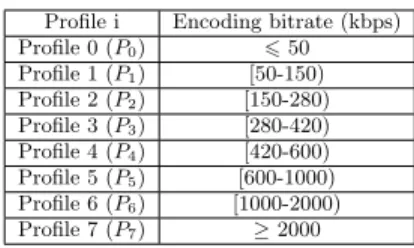
Profile i Encoding bitrate (kbps) Profile 0 (P0) 650 Profile 1 (P1) [50-150) Profile 2 (P2) [150-280) Profile 3 (P3) [280-420) Profile 4 (P4) [420-600) Profile 5 (P5) [600-1000) Profile 6 (P6) [1000-2000) Profile 7 (P7) ≥2000 Table 1: Profiles
Second, the analysis of the encoding bitrates in the collected data led us to classify them into a set of representative ranges, called Profiles (See Table 1): the vast majority of the videos had each of their encoding bitrates belonging to one of these profiles and they did not have two encoding bi-trates in the same Profile. Profile 5 was clearly the most fre-quently requested one over all HAS sessions, while the next most frequently ones were lower profiles; mostly requested at the beginning of the sessions (See Figure 1).
0 0.2 0.4 0.6 0.8 1 11 21 31 41 51 61 71 81 91 101 111 121 131 141 151 161 171 181 191 distribution of profile i
Chunkindex (for index=1, then we bin every 20 chunk)
profile 0 profile 1 profile 2 profile 3 profile 4 profile 5 profile 6 profile 7
Figure 1: Distribution of requested profiles with re-spect to the chunkindex for catch-up (VoD) contents Third, we used markov chains to characterize the switching between profiles. We estimated the probability to move from
Pi∈[0..7]to profilePj∈[0..7];j̸=i(c.f. transition matrixP). We observed that the probability to move fromPi=5toPj>5 is
22%, then when clients are inPi=6, they are more likely to
switch toPj=5with a probability equal to 60%. When being
inP7, clients move toP6andP5 with a probability of 92%.
All this suggests that when being in P5, we observe that a
significant proportion of transitions are limited within the highest profiles. When being inP4, around 45% of
transi-tions are made to the upper profiles, and that 48% are made from Pi=5 to Pj=4. This intermittently switching between
the highest profiles does not necessarily yield improvement of quality of experience. But instead, it adversely affects some network components such as caches.
P= 0 0.0997 0.2650 0.2685 0.1784 0.1358 0.0460 0.0066 0.0053 0 0.1533 0.3482 0.2683 0.1753 0.0464 0.0029 0.0036 0.0405 0 0.4237 0.28 0.2034 0.0456 0.0028 0.0021 0.0410 0.2496 0 0.4204 0.2486 0.0339 0.0041 0.0007 0.0192 0.1271 0.3867 0 0.4080 0.0500 0.0079 0.0009 0.0099 0.0817 0.2005 0.4790 0 0.2016 0.0260 0.001 0.0055 0.0303 0.0739 0.1617 0.6060 0 0.1213 0.0004 0.0018 0.0078 0.0160 0.0441 0.2266 0.7031 0
These three observations show that there is a potential op-portunity to improve the caching efficiency in the mobile network by favoring one specific profile in the HAS adapta-tion logic. without compromising the user engagement and the ability of HAS clients to react adequately in case of net-work congestion and adverse conditions on the server and client devices.
2.2
QoE evaluation
In this section we show results of a subjective quality per-ception tests made by the operator who provided the dataset we described in the previous section. Tests were conducted with five ranges of quality from bad 1 to excellent [4,5]. The purpose of the experiment was to correlate the encoding pro-files with the perceived quality. Type of videos used for the tests fits well the type of VoD contents analyzed in [5]: News, Animation and Film. The tests were conducted with 27 sub-jects. Subjects were invited to watch video contents twice: on smart phone, then on Tablet. The resolution description and results of the average Mean Opinion Score (MOS) of each profile are reported in Table 2.
Profile Video resolution User perception (MOS) Profile 1 (P1) 176 x 144 bad (1) Profile 2 (P2) 280 x 160 bad (1.2) Profile 3 (P3) 320 x 180 medium (2.2) Profile 4 (P4) 400 x 224 good (3.3) Profile 5 (P5) 480 x 270 good (3.8) Profile 6 (P6) 640 x 360 Excellent (4) Profile 7 (P7) 1024 x 576 Excellent (4.5) Table 2: MoS
In [10], authors suggests that a minimum guaranteed MOS equal to 3 is required to ensure an acceptable service quality for any connected user. This requirement is guaranteed with
P4andP5.
Based on these considerations, we observe that defining a wide range of encoding profiles (such the content providers do actually) would let clients’ players switch often between the highest profiles. Whereas we observe that the user en-gagement is guaranteed at a specific profile. Next, we present CF-Dash that leverages these observations to improve caching efficiency.
3.
CACHE FRIENDLY-DASH
In this part, we introduce CF-Dash adaptation logic and details our implementation and testbed setup.
3.1
Cache Friendly-Dash in a nutshell
In CF-Dash, we intentionally promote one specific profile within the cache. This is achieved by pushing clients’ play-ers to request one specific and commonly requested profile, we call itprofile-limit. By doing so, theprofile-limitwill be populated within the cache and clients will be more likely to be served from the cache. From the network standpoint (i.e. Core network), our approach reduces the aggregated number of switching between qualities experienced by all clients and hence ensures stability of clients’ players. In CF-Dash, even though clients experience a high bandwidth, by default clients’ players never ask for profiles above the
profile-limit. The profile-limit is chosen in such a way we guarantee a good user-engagement. Hence switching to the
highest profiles would be unnecessary and would not affect the user-engagement. Now, for clients who want to move be-yond theprofile-limit; they have to select manually profiles higher than theprofile-limit. The rationale behind this idea is to prevent clients to turn systematically to the highest profiles when they experience a high bandwidth.
3.2
PoC implementation
In our PoC, we chose GPAC [6] as an Open Source multi-media framework installed on end-terminals, since it incor-porates the major DASH standard components. We chose Squid as a proxy cache and Apache as HTTP server. We in-tegrated our proposed changes within the core of GPAC, and carried out testbed experiments to evaluate our approach and validate our implementation.
In CF-Dash, clients’ players and cache-servers share infor-mation so that the clients’ player learns about the profile-limit. In MPEG, contributors consider three options to make clients’ players and content delivery servers communicate: either by modifying the MPD at some network level (i.e.
CDN), or by adding new fields in the HTTP header, or by adding a new interface through which clients’ players and network components exchange messages. In our PoC, when a client starts a new video session. First, her HTTP-GET request gets forwarded to the proxy-cache server. Then, the proxy-cache is configured so that it does not cache the initialization segment 2 that points to theprofile-limit but
caches all the rest. Squid implements theX-CACHEheader. Therefore, if the init segment is not cached, the X-CACHE header will contain a miss. The HTTP-Response being sent to the client, the latter parses the header fields and maps the miss into theprofile-limitcandidate. Herein we consider 2 cases:
Leader.
This is the case when a new video is being added to the catalogue of VoDs, and a first user (we call it leader) requests that video. This first client in time scale would not be able to identify theprofile-limit, since none of the init seg-ments is being cached. Therefore, the leader will download all init segments from the origin server and admits that the latest downloaded init segment (highest profile) corresponds to the profile limit.Followers.
Followers refer to all users who will successfully identify theprofile-limitbased on the aforementioned mech-anism.3.2.1
Pseudo code
Algorithm 1 depicts the pseudo-code of CF-Dash rate-adaptation logic:
• In Require:AdaptationSetandRepresentationare dash standard words naming.Representation refers to the encoding profile.
2
During the connection setup, the clients’ player downloads all init segments defined within the Media Presentation De-scription. Each init segment is associated to one encoding profile. The init segment has the metadata needed by the player to decode the associated profile.
0 0.2 0.4 0.6 0.8 1 100 300 500 700 900 0 0.2 0.4 0.6 0.8 1
Average Hit-Ratio (AVR)
Gain in Hit-ratio
Γ: cache capacity AVR with Baseline AVR with CF-Dash, PL 4 AVR with CF-Dash, PL 5 gain in hit-ratio, PL4 gain in hit-ratio, PL5
(a) Average and Gain in hit ratio
0.1 1 10 100 1000 10000 1 10 100 1000 GH % chunkindex Γ=100 Γ=300 Γ=500 Γ=700 Γ=900
(b) Average Hit-Ratio per chunk index when setting profile limit to 4 1 10 100 1000 1 10 100 1000 GH % chunkindex Γ=100 Γ=300 Γ=500 Γ=700 Γ=900
(c) Average Hit-Ratio per chunk index when setting profile limit to 5
Figure 2: Metrics evaluation: Average hit-ratio,GH
• Line 1: disable switching becomes true when clients select manually profiles higher than the profile limit.
• Lines [6,8]: DL corresponds to the download speed of the last downloaded chunk. In these lines, we compare the last representation (last requested profile) with the new DL.
• Lines [13,28]: This loop parses all existing profiles and tend to identify the profile that fits the user bandwidth. Conditions 19 and 23, forces the clients’ player to not surpass the profile limit whatever the value of DL.
• Line 30: We save the actual representation, so that we can compare it with the next computed DL, when requesting the next chunk.
4.
EVALUATION
In this part, we demonstrate through simulations and testbed emulation that CF-Dash adaptation logic improves the cache efficiency on large scale.
4.1
Simulation evaluation
We achieved a trace-driven simulation to evaluate the im-pact of CF-Dash on caching efficiency. The trace considered in the simulation corresponds to HAS sessions collected over a period of 2 weeks from the dataset introduced in Section 2. Each record in the trace corresponds to one HAS session; it includes the timestamp of the connection setup, the refer-ence of the requested video, the number of requested chunks, and for each video bitrate switching the timestamp and the newly requested Profile. The caching system is deployed at the Gi interface on the mobile network. For the sake of sim-plicity, we assume that: All chunks are 10 second long. The encoded profiles are selected with respect to the following encoding profiles:
Piϵ[0..7]= [40,100,210,250,510,900,1500,3500]kbps. LRU is the content replacement algorithm of the caching system. We evaluate the performance of the cache for different val-ues of the capacity C such as: C = Γ∗S, where S repre-sents a video size of10 MB, typically a short video-clip of 5 minute long, and Γ represents the number of videos that the cache sustains. In Figure 2(a), we evaluate CF-Dash with the baseline (i.e. native trace) based on 3 key metrics:
Require: Client, AdaptationSet, Representation, Limit Profile,
1: if (disable switching = TRUE)then
2: return
3: end if
4: Go Up=FALSE
5: DL=compute download rate(Client)
6: if (Representation.bandwidth6DL)then
7: Go Up=TRUE
8: end if
9: if (DL6AdaptationSet.M in Representation Bitrate)then
10: DL=AdaptationSet.Min Representation Bitrate
11: end if
12: N=AdaptationSet.total representations
13: fork= 0→N do
14: SR=Get Representation(AdaptationSet,k)
15: if (DL≥Selected Representation.bandwidth)then
16: if(!New Representation)then
17: New Representation=SR
18: else if(Go Up)then
19: if(SR.bandwidth>
N ew Representation.bandwidth)and(k≤ AdaptationSet.Limit P rof ile)then
20: New Representation=SR
21: end if
22: else
23: if(SR.bandwidth>
N ew Representation.bandwidth)and(k≤ AdaptationSet.Limit P rof ile)then
24: New Representation=SR 25: end if 26: end if 27: end if 28: end for 29: if (disable switching=
F ALSE)and(N ew Representation)and(N ew Representation̸=
Representation)then
30: Representation = New Representation
31: end if
• Average hit-ratio
(H=requests served f rom the cacheall requests ): average ratio of re-quests successfully served from the cache.
• Gain on hit-ratio (GH=
HCF−Dash−Hbaseline
Hbasline ), to assess the gain we may achieve on hit-ratio with CF-Dash adaptation logic with regard to the baseline.
• GH perchunkindex.
We observe on Figure 2(a) a significant improvement in the hit-ratio when clients adopt CF-Dash adaptation logic. When theprofile-limitis set toP4, we reach more than 40%
ofGH. When theprofile-limit is set toP5, we still reach a
gain of 15%.
In [5], we observed that around 65% of HAS sessions are being aborted from the start when clients experience long delays during thejoining-phase. Figures 2(b) and 2(c) show that reducing the aggregated number of switching gives more chance to the earlierchunkindexto hold in the cache. This is because the earlier chunks compete less with the advanced chunk indexes for whom CF-Dash takes action (i.e. when experiencing a high bandwidth, clients’ players converge to request theprofile-limit). This is important for the joining-phasesince clients will be served from the cache rather than from the origin server, and since this is the most critical phase that impacts theuser-engagement.
4.2
Experiments evaluation
4.2.1
Test bed and scenario
The experimental testbed and setup is similar to that de-scribed in [7]. We install Gpac on both end-terminals. The configuration of each component of the testbed is as follows:
• The Apache HTTP server hosts a catalogue of 20 videos encoded with respect to profiles used in previous sim-ulations. Each video is hosted jointly with its MPD. Videos are segmented into 12 chunks, 10 second long each one. We skip profile 0, since it is rarely requested (c.f. figure 1).
• The cache proxy is placed between the clients and the origin server. Evaluation tests are carried by varying the cache size capacityC. We keep on the same pa-rameters used in the simulations: C= Γ∗S, where S represents a video size of12 MB, which is the average size of one video from our catalogue, and Γ represents the number of videos that the cache sustains. We set the profile limit to P5. We use Dummynet on both
clients to emulate the bandwidth variation. We use real world bandwidth variation traces [9] of clients be-ing covered by 3G/HSPA network in Norway. We pe-riodically reproduce network conditions when moving by train from Oslo to Vestby, and the way back (c.f. [3]).
Finally, we simulate 200 clients requesting videos from the catalogue. Content popularity is distributed according to Zipf law with parameter equal to 1.
4.2.2
Results and interpretation
We evaluate the following:
• Profiles distribution: We analyze the proportion of each profile per requested chunk. Our goal is to pro-mote theprofile-limit within the cache.
• Gain in hit-ratio (GH)(c.f. Section 4.1).
• Stability of clients’ players: We show how CF-Dash re-duces the aggregated number of switching during HAS sessions.
Profiles distribution.
Most HAS implementations (com-mercial and open source) agree that the first requested chunk from a video content should be preset in the MPD by the content provider. Usually, the content provider defines the startup profile as the lowest encoding profile, so that to guar-antee a smooth playback at the joining-phase. In figure 3, we observe that this holds for Gpac for chunk1. Then, clientsdecide to move to the profile that fits best their available bandwidth. We observe that theprofile-limit is largely re-quested by client-players. Profiles higher than the profile-limit (i.e. P6 andP7 in our case), are still being requested.
This is because leaders do not recognize theprofile-limit as do the followers, since all init segments are downloaded from the origin server.
0 0.2 0.4 0.6 0.8 1
DASHCF-DASHDASHCF-DASHDASHCF-DASHDASHCF-DASHDASHCF-DASHDASHCF-DASHDASHCF-DASHDASHCF-DASHDASHCF-DASHDASHCF-DASHDASHCF-DASHDASHCF-DASHDASHCF-DASH
Fraction of requested profiles
Chunks profile 1 profile 2 profile 3 profile 4 profile 5 profile 6 profile 7 12 11 10 9 2 8 7 6 5 4 3 2 1
Figure 3: Profiles distribution
Gain in hit-ratio.
Figure 4(a) confirms that the GH sig-nificantly increases. When Γ = 4.5, we observe that CF-Dash adaptation logic allows doubling the performance of the cache with regard to the dash adaptation logic. Then, al-though theGH decreases as the cache size increases, we still maintain a promising gain in hit-ratio that reaches around 38% when Γ = 17.5. Our evaluations demonstrate that CF-Dash significantly improves the hit-ratio.Stability of client-players.
Figure 4(b) shows that most HAS sessions upgrade their video quality when moving from the first to the second chunk of the stream. This is because the emulated bandwidth variation is most of the time higher than the preset profile. With CF-Dash, we decrease the aggregated number of switching over all HAS sessions by0 0.2 0.4 0.6 0.8 1 4.5 9 13.5 17.5 0 0.2 0.4 0.6 0.8 1
Average Hit-ratio Gain in Hit-ratio
Γ: cache capacity LRU LRU+CF-Dash gain in hit-ratio
(a) Average Hit ratio
0 0.2 0.4 0.6 0.8 1 2 4 6 8 10 12 Percentage Chunks CF-Dash Dash (b) Percentage of switch-ings perchunkindex Figure 4: Evaluation: Hit ratio and stability
20%. Hence, this promotes theprofile-limitwithin the cache and increases the opportunity to the followers to be served from the cache.
5.
CONCLUSION
In this paper, we investigated the effect of rate-adaptation in HAS on caching-efficiency. Having observed that the QoE is guaranteed from a specific encoding-bitrate, we designed CF-Dash system with the aim to have further control on the rate-adaptation and to promote one specific encoding profile within the cache. In our future work, we will further investigate the ideal profile to be cached and define incentive strategies to encourage clients requesting the same encoding profiles.
6.
REFERENCES
[1] https://datatracker.ietf.org/documents/ LIAISON/liaison-2013-11-04-...pdf. [2] http://cmm.khu.ac.kr/korean/download.php?id= 808&sid=6a267a6d7b2f771ab06f776dc67a21ba. [3] http://home.ifi.uio.no/paalh/dataset/ hsdpa-tcp-logs/.[4] S. Akhshabi, L. Anantakrishnan, C. Dovrolis, and A. C. Begen. Server-based traffic shaping for stabilizing oscillating adaptive streaming players. In
Proceeding of the 23rd ACM Workshop on Network and Operating Systems Support for Digital Audio and Video, pages 19–24. ACM, 2013.
[5] A. Gouta, D. Hong, A.-M. Kermarrec, Y. Lelouedec, et al. Http adaptive streaming in mobile networks: characteristics and caching opportunities.
MASCOTS2013, 2013.
[6] J. Le Feuvre, C. Concolato, and J.-C. Moissinac. Gpac: open source multimedia framework. In
Proceedings of the 15th international conference on Multimedia, pages 1009–1012. ACM, 2007.
[7] C. Mueller, S. Lederer, and C. Timmerer. A proxy effect analyis and fair adatpation algorithm for multiple competing dynamic adaptive streaming over http clients. InVisual Communications and Image Processing (VCIP), 2012 IEEE, pages 1–6. IEEE, 2012.
[8] P. Ni, R. Eg, A. Eichhorn, C. Griwodz, and
P. Halvorsen. Spatial flicker effect in video scaling. In
Quality of Multimedia Experience (QoMEX), 2011 Third International Workshop on, pages 55–60. IEEE, 2011.
[9] H. Riiser, P. Vigmostad, C. Griwodz, and
P. Halvorsen. Commute path bandwidth traces from 3g networks: analysis and applications. InProceedings of the 4th ACM Multimedia Systems Conference, pages 114–118. ACM, 2013.
[10] A. Saul. Wireless resource allocation with perceived quality fairness. InSignals, Systems and Computers, 2008 42nd Asilomar Conference on, pages 1557–1561. IEEE, 2008.
[11] S. I. ULC. Sandvine global Internet phenomena Report - 1h2012. Technical report, 2012.