North Carolina Health Care Safety Net: Overcoming Barriers to Serving the Uninsured Are Confidentiality Laws a Barrier to Forming Safety Net Collaborations to Provide Medical Care to the Uninsured?
by Sharice N. Rice
A Master's Paper submitted to the faculty of the University of North Carolina at Chapel Hill
In partial fulfillment of the requirements for the degree of Master of Public Health in
the Public Health Leadership Program.
Chapel Hill
Abstract
In the United States, the health care safety net plays an important role in
providing health care for uninsured individuals. Patient confidentiality is subject
to both state and federal law and compliance with these laws is important to
insure that safety net providers remain open and available to care for patients.
The North Carolina Institute of Medicine suggests that in order to be efficient and
provide quality care to patients, safety net providers must find ways to share
information with others and collaborate on developing an integrated system of
care.
Some North Carolina communities have managed to overcome barriers and
develop collaborative networks that successfully serve the uninsured. The
project described here was developed to understand how these successful
collaborative networks have overcome barriers to collaboration with special
attention to how they address the issues of sharing patient information and
confidentiality. It is a secondary part of a larger project conducted by the North
Carolina Institute of Medicine (NC 10M) Safety Net Advisory Council (SNAG).
Each of the four community collaboration projects approached patient
confidentiality in slightly different ways, though some common themes emerged.
The use of clinic-specific medical release of records forms and the use of legal
assistance were the most common responses to address patient information
sharing. Our findings seem to suggest that modalities for addressing
confidentiality will be the same regardless of the level of knowledge regarding
state confidentiality laws
The case studies presented here provide a list of many other barriers to
collaboration between safety net providers beyond those of patient
the only barriers that surfaced from multiple respondents and from multiple
collaboration sites. Other obstacles appear to be unique to the individual
collaborations. Our findings suggest that communities who are attempting to
develop any type of collaboration need to consider carefully the available
resources, physician I provider recruitment, and possible medication provisions in
addition to questions surrounding the sharing of patient information.
Future research should move beyond barriers to collaboration and should
address current and newly emerging barriers to serving communities so that the
Introduction
In the United States, the health care safety net plays an important role in
providing health care for uninsured individuals. These organizations deliver a
significant amount of health care to the uninsured, Medicaid or other vulnerable
populations and often have a mission to offer services to patients regardless of
their ability to pay. Some communities have successfully developed integrated
systems of health care, however, most communities retain a fragmented safety
net system of healthcare.1
In March/Apri12005, the North Carolina Institute of Medicine (NC 10M)
released the North Carolina Safety Net Task Force Report which contained
recommendations to help strengthen and expand the ability of safety net
providers to address the health care needs of the uninsured in their communities
and in the state. The 28 recommendations were organized into four broad
categories of concerns that safety net organizations should address. One of the
four primary matters is "Strengthening safety net integration and collaboration
efforts". The report suggested that safety net organizations need to work
together to maximize the use of limited resources to maintain and expand care to
the uninsured.2• 3
Unfortunately, strengthening integration and collaboration between safety net
organizations may pose many challenges. The NC 10M Safety Net Task Force
Report also identified several potential impediments to health care collaborative
networks. These include variables such as: information sharing and
confidentiality laws; inclusiveness defined as the sense (or absence) of shared
responsibility; feelings of relative advantage; professional economics; fear of
unknown; adequate physician representation; trust; competition for
In an effort to understand the function, role, and barriers to safety net
collaborations, I turned to the published literature. Initially, I searched for
published data on the existing safety net as it functions today. Next, I conducted
a review of recent literature on existing models of integration and collaboration
between safety net organizations. Using the search terms, "safety net
collaboration". I searched the Medline database for information on safety net
collaborative networks. This yielded fewer than 40 publications on the topic. To
expand the search, I included publications that seemed to focus on any aspect of
health care collaboration - not necessarily limited to the safety net. The
expanded search included publications that discussed safety net collaborative
networks, community collaborations, inter-organizational networks, and health
care networks. After identifying the publications that discussed collaborative
networks, I further expanded the search by using the 'Related Articles' link in
Medline. In addition, as I identified pertinent publications, I reviewed the
references from these documents for additional documents.
Rather than focusing on barriers to collaborative formation, much of the
literature addresses the effectiveness of health care collaborative networks4 often
for a specific disease state5 or populations. 6• 7 Ultimately, I discovered that there
is little information available on barriers to integrated safety net collaborations
-especially with regard to sharing patient information and matters of patient
information confidentiality. Thus, we sought a method of investigating this
information on our own by performing community case studies. This paper will
present data on North Carolina communities that have successfully navigated the
collaboration process and overcome the obstacles associated with such
problem of sharing patient information between various providers within the
safety net organization.
Background
In 2004, 45.8 million people in the United States were without health
insurance; 1.3 million of those individuals lived in North Carolina8 Many of the
uninsured in North Carolina have incomes less than 200% of the federal poverty
guidelines making it difficult for them to pay for medical services. Uninsured
people with low incomes are less likely to have a regular source of care and
more likely to delay or forgo necessary medical care than are individuals with
health insurance-'· 3 When the uninsured do seek care, they are often sicker and
have worse health outcomes than do persons with insurance.3
Beyond the individual effect on the uninsured person and his or her family,
lack of health insurance can also lead to significant societal effects, including
several factors that impair children's, ability to learn, decreased worker
productivity and even unfavorable financial outcomes for the organizations and
providers who attempt to provide care for the uninsured. As these examples
make clear, lack of health insurance has ripple effects far beyond the harm it
does to the individual uninsured person; its consequences are burdensome for
health care system and for society as a whole. 3
One response to the challenge of widespread uninsurance has been the
establishment of the health care safety net. Organizations in the safety net
deliver a significant amount of health care to the uninsured, Medicaid or other
vulnerable populations and often have a mission to offer services to patients
regardless of their ability to pay. Usually safety net organizations will find
a sliding-fee scale basis.3 In North Carolina, the safety net consists of a variety
of organizations, including federally qualified health centers, state funded rural
health centers, hospitals, local health departments, free clinics, school based
clinics and more. Many private health care providers will also provide care to the
uninsured, though they may not offer sliding scale services.3 The health care
safety net is truly a "patchwork" of organizations united by the goal of serving the
uninsured.
The
2000
Institute of Medicine (10M) Report: America's Health Care SafetyNet evaluated the national safety net resources and concluded that the safety net
is intact, but fragile; despite the lack of true financial security, the report found
that the health care safety net has managed to survive and continue to provide
care to the uninsured.' However, recently changing social conditions threaten
the integrity of the safety net. Examples include: increasing numbers of
uninsured individuals; increasing use of managed care including Medicaid
managed care; declining Medicaid enrollment; increased competition for
Medicaid patients; decreasing revenues for traditional Medicaid patients;
declining coverage for immigrants; declining federal subsidies for primary care;
increasing burden of uncompensated care for all providers; less funding for
uncompensated care and the growing unwillingness of private providers to
provide charity care9 North Carolina, has limited funding available to subsidize
care for the uninsured; what is available is not sufficient to cover all costs and is
often not targeted toward the safety net organizations that provide the greatest
amount of care to the uninsured.2• 3 Such a fiscal environment significantly
impairs the ability to provide health care to the uninsured.
In
2004-2005,
the North Carolina Institute of Medicine (NC 10M) establishedregarding the existing safety net structure in North Carolina. According to the NC
I OM, the state has a wide array of safety net organizations disbursed throughout
the state, but, the existence of safety net resources within a community did not
guarantee that they are sufficient to meet all of the health care needs of that
community.2·3 The NC IOM report compared the number of people receiving
health care from the existing safety net to the number of uninsured in a particular
area and determined that only about 25% of all the uninsured throughout the
state receive primary care services from safety net providers. Of course, this
percentage varies between counties and may be higher or lower depending on
the community. Nevertheless, the fact that approximately three fourths of our
uninsured residents do not receive primary care from safety net providers
suggests that the safety net is not quite sufficient to meet the needs of the
uninsured in North Carolina. Access to pharmaceuticals, specialty care,
behavioral health care and dental services also appears to be lacking in many
communities-'
The NC 10M 2005 Safety Net Task Force Report contained
recommendations to help strengthen and expand the ability of safety net
providers to address the health care needs of the uninsured in their communities
and in the state. The recommendations were organized into four categories of
issues facing safety net organizations. One of the four primary issues is
"Strengthening safety net integration and collaboration efforts". The report
suggested that safety net organizations will need to work together to maximize
the use of limited resources to maintain and hopefully expand care to the
uninsured.23
Collaborative networks generally consist of groups of health, human service,
are often clustered in the same geographic area and share resources, clients and
information. Typically, the focus of the collaboration is to address a critical health
need in the community such as medical care for the uninsured. Organizations
providing many different types of services are able to coordinate their efforts so
that resources, information and expertise can be widely and efficiently shared.5
Some communities have developed successful integrated systems of health
care, but, most communities retain a fragmented safety net system of
healthcare.1 The fragmentation may be due in part to what Bolland and Wilson
describe as the paradox of success. With increasing public awareness of health
issues, communities will often have a proliferation of organizations seeking to
address health care concerns. As more community agencies arise to address
local needs they must compete for clients and resources and are less able to
coordinate and work toward the sarne goal.7 When allowed to persist, this trend
can lead to instability in provision of health care services resulting in the
fragmented care that we currently see in our safety net. Biel notes that as
conditions in the health care environment become more turbulent and uncertain,
health care organizations often seek to become more coordinated in service
provision.10 Given the desire for more collaboration among safety net providers,
the taskforce recommendation to strengthen integration and collaboration is quite
timely.
In order to reach this goal, we must have a good understanding of what
hinders community collaborative efforts so that communities can devise ways to
overcome these obstacles. In general, little published information specifically
explores barriers to collaborative efforts. The 2005 NC IOM Safety Net Task
Force Report identified several potential impediments to health care collaborative
confidentiality laws; inclusiveness defined as the sense (or absence) of shared
responsibility; feelings of relative advantage; professional economics; fear of the
unknown; adequate physician representation; trust; competition for
non-economic resources; lack of recognition; and payment/cost avoidance. 2· 3
In other research, Taylor, Cunningham, and McKenzie present additional
barriers to collaborative networks from a slightly different standpoint. First, they
introduce four models of community collaboration that may arise in a community
as efforts are made to provide health care for the uninsured. Managed care
safety-net models are exemplified in communities where the existing safety net
organizes to coordinate better care for the uninsured. Donated care models are
typically seen in communities who already have a strong history of charity care.
Participating community physicians will agree to see a certain number of patients
or allow a certain number of visits pro bono each year. This model often
provides structure and encourages greater participation in existing charity care
resources. Discounted care collaborative models are a variation of the donated
care model in that participating providers agree to provide certain health care
services at a discounted rate to individuals who purchase a discount card.
Finally, a newer development among collaborative models is the limited-benefit
coverage model. This strategy which provides limited insurance benefit
coverage to participants rather than focusing on improving access sites for the
uninsured.11
Taylor, Cunningham, and McKenzie then explore the strengths and a few
barriers faced by communities trying to develop an integrated safety net
organization. Some barriers, such as limited resources for outreach, little
capacity to serve, and lack of financial means, are common to many different
For example, donated services models are more likely to face difficulties
engaging community partners in the program, while limited-benefit programs may
find little demand for the services they offer.11
Bolland and Wilson discuss collaboration in the form of inter-organizational
networks that they define as clusters of groups of agencies centered on specific
needs where coordinated care is provided through strong connections between
the participating agencies.7 This system of inter-organizational networks was
originally introduced in earlier literature by Emery and Trist,l who cited barriers
such as (1) philosophical barriers between health and social service agencies;
(2) geographical barriers between agencies based on socioeconomic class; (3)
geographical barriers between agencies based on rural or urban client; and (4)
legal barriers between agencies serving clients of different ages.7
Even fewer studies specifically address sharing of patient information or
confidentiality laws as a significant barrier to integrated care by safety net
providers. The NC 10M Task Force Report is essentially the only document that
specifically mentions these patient information and confidentiality concerns.
Bolland touches on some legal issues, but not confidentiality laws. No source
delves deeply into the question of how confidentiality had the potential to hinder
the formation of collaborative networks.
All health care providers will share patient information with another provider
at some point during their careers and all must deal with the need to maintain
patient confidentiality. The need for confidentiality may present greater
challenges for safety net providers, because uninsured patients may often seek
care from multiple providers who are unaware of one another. Patient
confidentiality is subject to both state and federal law; safety net providers must
the ability to collaborate with other providers. Failure to comply with
confidentiality laws, either because of lack of knowledge of the laws, unclear
interpretation or willful violation of them, can prevent the formation of
collaborative networks, ultimately harming the health of the uninsured citizens in
that community. The NC 10M report suggests that in order to be efficient and
provide quality care to patients, safety net providers must find ways to share
information with others and collaborate on developing an integrated system of
care2· 3 while remaining in compliance with the letter and spirit of patient
confidentiality laws.
In order to begin this process of building networks that will comply with
confidentiality requirements, we must first understand the federal and state laws
that govern patient confidentiality. The federal Health Insurance Portability and
Accountability Act of 1996 (HIPAA) was originally created to serve a number of
purposes surrounding health insurance and health care delivery. Included within
the act is a section entitled 'Administrative Simplification' that requires the US
Department of Health and Human Services (DHHS) to develop a series of rules
intended to standardize the electronic exchange of health care information. This
allows information sharing for certain financial and administrative transactions
such as insurance claim transactions, health plan enrollment, health care
payment and injury reporting. HIPAA also includes a section requiring DHHS to
develop regulations governing security and privacy of health information. This
section includes information on specific measures to protect the confidentiality of
patient information such as requiring providers to distribute notices of privacy
practices and establish written privacy policies and procedures.2• 12-14
In response to HIPAA, the US Department of Health and Human Services
(The Privacy Rule), established, a national guideline for the protection of health
information for the first time. One primary goal of the Privacy Rule is to insure
that health information is protected while allowing the flow of information
necessary to provide and promote high quality health care and to protect the
public's health and well being. The standards of the Privacy Rule address the
use and disclosure of an individuals' health information by the organizations
which are subject to the Privacy Rule. In addition, the Privacy Rule presents
standards for privacy rights for individuals to understand and control how their
health information is used.14• 15
The Privacy Rule protects all "individually identifiable health information" in
any form of media, electronic, paper or oral. The Privacy Rule refers to this
information as 'Protected Health Information' (PHI). PHI is information, including
any demographic information, collected from an individual that relates to a past,
present; or future physical or mental health condition; the provision of health care
to the individual; or the past, present, or future payment for the provision of
health care. PHI is any information that identifies the individual or for which there
is a reasonable basis to believe it can be used to identify the individual. It
includes many common identifiers such as name, address, date of birth, social
security number, etc.
The HIPAA Administrative Simplification rules as well as the DHHS Privacy
Rules apply to health plans', health care clearinghouses;; and to any health care
' 'Health plan· refers to an individual or group plan that provides or pays the cost of medical care as defined in section 2791 of the Public Health Service Act. This includes Medicare. Medicaid, health maintenance organizations (HMOs). long-term care insurers. employer-sponsored group health plans and other insurers of health. dental, vision and prescription drugs. 12• 15
provide~;; who transmits information in electronic form in connection with such
financial and administrative transactions mentioned previously. These
individuals and organizations are referred to as "covered entities". A covered
entity may not use or disclose "individually identifiable health information" except
(1) as permitted or required by the Privacy Rule or (2) as the individual (or
personal representative) who is the subject of the information authorizes in
writing. Disclosure of health information is required in only two situations: (1)
when an individual requests access to his
I
her health information and (2) whenDHHS requests the information for a compliance investigation, review or
enforcement action. Covered entities are permitted (but not required) to disclose
health information without authorization in a variety of other situations, including:
(a) to the individual (without his or her formal request); (b) treatmentiv, paymentv
and health care operationsvi purposes (c) situations in which the individual is
given an informal opportunity to agree or object (such as in the emergency
room); (d) incident to another permitted use and disclosure; (e) public interest
and benefit activities, such as public health, research, law enforcement, and
disaster relief.14"15
As we previously mentioned, The Privacy Rule was the first set of national
standards for confidentiality and sharing of health information. However, states
"' The phrase 'health care provider' includes providers of services (i.e., institutional providers such as hospitals), providers of medical or other health services (such as physicians, dentists, etc.), and any other person furnishing health care services or supplies.12· 15
lv Treatment refers to the provision, coordination, or management of health care and
related services for an individual by one or more health care providers, including consultation between providers regarding a patient and referral of a patient by one provider to another.15
v Payment includes all activities of a health plan to obtain premiums,
determine or fulfill responsibilities for coverage and provision of benefits, and furnish or obtain reimbursement for health care delivered to an individual and activities of a health care provider to obtain payment or be reimbursed for the provision of health care to an individua\.15
also implement laws to govern sharing of health information within their
respective borders. Thus, health care providers must consider both the HIPAA
Privacy Rules and their respective state laws when addressing patient
confidentiality and health information sharing.
In general, it seems that state laws can fall into one of four categories in
relation to the HIPAA Privacy Rules, the law is (1) not contraryv;; to the Privacy
Rule; (2) contrary to and less stringent than the Privacy Rule; (3) contrary to the
Privacy Rule but exempted from preemption; or (4) contrary to and more
stringent than the Privacy Rule.16 If the state law falls into the first category and
is not contrary to the Privacy Rule then adherence to the law does not interfere
with adherence to the Privacy Rule. The state legislature may support the
Privacy Rule or it may simple apply in a different circumstance or for a different
group than those described in the Privacy Rule. In this instance, the state law is
not preempted and health care providers should comply with both the federal and
state requirements.
The other three categories deal with state laws that are contrary to the
Privacy Rule and present situations where health care providers may struggle
with legal compliance. Of these three, state law that is contrary to the Privacy
Rule and less stringent offers perhaps the least complicated interpretation. The
general rule is that state laws which are contrary to the Privacy Rule are
preempted by the federal requirements. Thus, health care providers who
encounter this type of state legislation should comply with the Privacy Rule rather
than the state statutes. However, keep in mind that this only applies for the
,;; Contrary means that it would be impossible for a covered entity to
covered entities (health plan, health care clearinghouse, and heath care
providers) that we discussed earlier. Therefore, the state can enforce a state
confidentiality law for a non-(HIPAA) covered entity that would be unenforceable
for a covered entity subject to the federal regulations. This distinction will be
important later as we discuss how the laws interact in collaborative health care
networks.
The third classification of state- HIPAA interaction exists because of
provisions set forth in the Privacy Rule which offers three exemptions to the
general rule of federal preemption over state law. This occurs when the state
law: (1) offers more privacy protection than the Privacy Rule (discussed below);
(2) provides for reporting of health data for public health surveillance,
investigation, or intervention; and (3) requires health plan to report health
information, such as for financial audits.14• 15• 17 As a result, a state law may be
contrary to the Privacy Rule yet qualify for exemption from preemption.
However, this does not mean that health care providers can disregard the
Privacy Rule. Instead this indicates that providers cannot disregard the state
legislation in favor of compliance with the Privacy Rule. In this instance, health
care providers should comply with both the Privacy Rule and the state
legislature.
State laws that are more stringent than the Privacy Rule simply offer more
privacy protection for individuals' health information. For example a state law
that restricts the disclosure of patient information in a setting where the Privacy
Rule would allow it is an example of a more stringent law. These laws can
address various components of the Privacy Rule, such as greater rights of
access for the individual to whom the PHI belongs, more stringent requirements
additional information to patients about their privacy practices, or stricter
requirements for recordkeeping or reporting.17 In these situations, health care
providers are not permitted to disregard state legislation in favor of compliance
with the Privacy Rule and should comply with both HIPAA and the state law.14·15·
17 Of course, in this situation, compliance with the state law may often result in
concomitant compliance with the Privacy Rule. Ultimately, states can provide for
additional protection of patient health care information should they choose to do
so.
In North Carolina, the state confidentiality laws regarding sharing patient
information between health care organizations presents a challenge, even before
we consider their interaction with the Privacy Rule. To begin with, North
Carolina has a substantial number of laws (including general statutes (GSs),
regulations, and case law) that address confidentiality of health information. In
addition, NC confidentiality laws can be difficult to locate. There is no specific
chapter containing all laws for handling health information; rather, confidentiality
laws are interspersed throughout the general statutes. For example, within
Chapter 130A of the NC Statutes entitled Public Health there are multiple laws
that focus on some element of confidentiality or handling of patient health
information. These include Article 1 B'''', Article 5'x, Article 6x, and Article yxi
among several others. Additionally, confidentiality legislation can be located in
other chapters of the NC Statutes such as the Mental Health, Developmental
Disabilities and Substance Abuse Act (GS122C), the section on Health Care
Facilities and Services (GS131E), as well as the section on State Departments,
'''' Address confidentiality as it relates to public health authorities. ''Address confidentiality with regard to Maternal and Child health 'Address confidentiality with regard to Birth defects
Institutions and Commissions(GS143).18 Health care and service providers with
limited time and resources- such as those who often work with safety net
organizations- may find it challenging to navigate through the state legislature to
determine what laws are relevant for their circumstances.
Interpretation of North Carolina confidentiality laws presents another source
of ambiguity for health care providers. Unfortunately, the objective of a particular
law is not always perfectly clear. Interpretation may vary depending on the
individual who is reading it. For example, GS8-53 addresses the use of
communications between a physician and a patient during judicial proceedings.
It establishes physician-patient privilege which dictates that during judicial
proceedings, a physician shall not disclose records of patients or testify regarding
any information acquired while attending to the patient in a professional role.18• 19
Of course, there are some exceptions which include authorization by the patient
(or representative) or a mandate from a resident or presiding judge. Some
attorneys interpret this statute as a general rule of confidentiality and advise their
health professional clients to apply this rule to all dealings involving patient health
information.19 Other attorneys argue that this is an incorrect interpretation
because (1) the language of the law refers to districts and a presiding judge, (2)
the law is written in the section of the legislation which deals things that a witness
may testify; and (3) the creation of additional confidentiality laws after GS8-53
was passed argues against it being a comprehensive confidentiality law.19
Considering the ambiguous wording and the large number and variety of
statutes to address patient confidentiality, it is easy to understand why the North
Carolina confidentiality laws can quickly become confusing. It can be difficult to
determine what is necessary for compliance. Health care providers must first
practice, then generate or obtain an acceptable (and hopefully accurate)
interpretation before they ever begin to apply the law to their practice. But the
situation becomes even more complex when we begin to try to integrate the state
law with the federal Privacy Rule.
Perhaps a simple way to understand the interaction is to look at the
state-federal interaction in stages. First, health care or health service providers ask
the question, "Am I a considered a covered entity under the Privacy
Regulation?". If the answer to this is "No", then they do not need to comply with
the Privacy Rules and must only be concerned with state laws. If the answer is
"Yes", then they must determine to which state laws they are subject and
whether those laws are preempted by the Privacy Rule, i.e., whether they are
contrary and less stringent or contrary and not qualified for exemption from
preemption. If the laws are preempted by the Privacy Rule, then the providers
should only be concerned about compliance with the Privacy Rule. It is important
to note that very few state laws are actually preempted by the Privacy Rule. 16
This means that providers are still subject to the state legislation and could
indeed be penalized for noncompliance with state confidentiality requirements.
However, if the law is not preempted, or the law is exempt from preemption then
the provider must comply with both the Privacy Rule and the state law. It is not
surprising that safety net providers may be ill-prepared to make such intricate
determinations.
When we consider the process in small stages, it seems somewhat more
manageable; but we must remember that for the example above, we are only
thinking from the viewpoint of a single provider. A single safety net provider may
be able to work through the model and determine which law to address.
care service provision, the situation again becomes more complicated. Providers
who are "covered entities" will need to share health information with providers
who are not, and vice versa. In addition, one organization may be subject to a
state law that covers health departments while another may be subject to a law
that covers the state trauma system of care. One organization may be subject to
a state law which is preempted by the Privacy Rules while another may be
obligated to comply with both a state law and the HIPAA Privacy Rule. Each of
these providers has different compliance requirements yet wish to integrate their
services to improve care for the uninsured. The HIPAA Privacy Rule offers some
assistance with this matter through two possible methods, Business Associates
and Organized Health Care Arrangement (OHCA}.
A "business associate" is a person or organization that performs certain
functions or activities on behalf of a covered entity or provides certain services to
a covered entity that involve the use or disclosure of protected health information.
Business associates are not members of the covered entities workforce, but a
covered entity can be the business associate of another covered entity. Services
performed by business associates on behalf of the covered entity can include
claims processing, data analysis, quality assurance, and others. Business
associates who provide services to the covered entity that require disclosure of
PHI are limited to legal, actuarial, accounting, consulting, data aggregation,
management, administrative, accreditation, or financial services.13'15 Once
business associates are identified, a covered entity may only disclose PHI or
allow the business associate to create or receive PHI on its behalf if the covered
entity obtains "satisfactory assurance' that the business associate will
appropriately safeguard the information.13 This is often accomplished through a
written safeguards on the PHI used or disclosed by its business associates.15 In
the context of a safety net collaboration, a data processor who processes dummy
insurance claims that contain personal health information, would be a business
associate of the covered entities in that collaboration.
An Organized Health Care Arrangement (OHCA) is an arrangement or
relationship that allows two or more legally separate covered entities who
participate in joint activities to share protected health information about their
patients in order to manage and benefit their joint operations. To qualify as an
OHCA, the covered entities must be clinically or operationally integrated and
share protected health information. Patients should expect that these
organizations are integrated and will share health information to manage their
operations. For example, an OHCA might be established in a hospital setting
where the hospital and the physician with medical staff privileges at the hospital
together provide treatment to a hospitalized patient and need to be able to share
PHI to treat the patient and to improve hospital operations.14.20 In safety net
collaborations, hospitals may allow community physicians the use of their
facilities at no charge when they are treating patients within the collaboration. As
in the previous example, the hospital and the community safety net physician
could form an OHCA that would permit them to use a single consent form and
share PHI in accordance with the Privacy Rule. .
Both the concepts of business associates and OHCA offer some guidance for
safety net providers who desire to form collaborative networks yet maintain
patient confidentiality. The concept of the business associates was created by
DHHS to insure that anytime PHI was used or disclosed by or on behalf of a
covered entity to a non-covered entity, the Privacy Rules would continue to apply
consider the setting of integrated safety net health care providers consisting of
both covered and non-covered entities, then the business associate provision
requires that the noncovered entities comply with the Privacy Rule as well
-provided they qualify as a business associate. In general, , the Privacy Rule
allows covered entities to share PH I for treatment, payment and healthcare
operationsxii; however each covered entity who will share the PHI for health care
operations must have a separate and individual relationship with the patient.
Under the auspices of the OHCA, covered entities that have no relationship with
a patient are permitted access to PH I of patients for treatment, payment and
healthcare operations- such as quality assurance or utilization review- without
a business associate agreement. In addition, the covered entities within the
OHCA may use a single Notice of Privacy Practices rather than several individual
forms for each entity.20 On the other hand, health care providers may be averse
to establishing an OCHA because the integration requires that they be known as
integrated entity.16 Some safety net providers may prefer a more informal
integrated network.
While the business associates and OHCA designations permit some
integration of services, and fairly clearly mandate compliance with federal privacy
rules, no such comparable designations exist in North Carolina state
confidentiality laws, nor is there any clear-cut way to determine how the state and
federal laws interact once organizations integrate their services. Collaboration
between safety net providers is crucial to improving health care services to the
uninsured but how can providers insure that they are within all federal and state
legal guidelines? The NC 10M Task Force report notes that providers are
committed to protecting the privacy of their patients' health information and want
to comply with all applicable laws, but have difficulty understanding the full scope
of North Carolina laws.2• 3 Thus, it may be difficult for health care safety net
providers to integrate community resources and services for the uninsured while
also insuring compliance with all regulations.
Yet, some North Carolina communities have managed to overcome this
obstacle and develop collaborative networks that successfully serve the
uninsured. The project reported on in this paper, was developed to understand
how these successful networks have overcome barriers to their collaboration with
special attention to how they address the issues of sharing patient information
and confidentiality. This research is a secondary part of a larger project
conducted by the North Carolina Institute of Medicine (NC !OM) Safety Net
Advisory Council (SNAG). The council was created on the recommendation of
the NC Safety Net Task Force to encourage state and local level safety net
collaboration and to monitor the implementation of the Healthcare Safety Net
Task Force recommendations, which included strengthening safety net
integration and collaboration efforts. The research project required contacting
local communities to find out more about their community safety net
collaborations, what they perceived to be the barriers to collaboration and
integration, and how these communities overcame the barriers they faced. The
goal of the primary research was to identify what works for forming collaborations
and then use this information to develop a technical assistance manual to help
other communities expand care to the uninsured through safety net collaboration.
Secondarily, this paper presents data on communities that have successfully
navigated the collaboration process and explore what barriers they dealt with
the problem of sharing patient information between various providers within the
safety net organization.
Methods
The study, the consent materials, and the interview protocol were reviewed
by and approved by the Institutional Review Board of the UNC School of Public
Health.
Community Participants
The Safety Net Advisory Council developed a list of eleven communities in
North Carolina on which to focus the interviews. Each community had an
established medical safety net that was integrated between multiple safety net
organizations in the community. Various graduate program assistants were
assigned to conduct interview with key informants in the eleven communities.
The eleven communities were assigned to various graduate program assistants
to conduct the interviews. I specifically interviewed four communities, to be
known in this paper as, A, B, C, and D, from different parts of North Carolina.
conducted eight interviews with nine representatives of the four safety net
collaborative organizations. One community chose to conduct a single interview
with two key informants present. In other communities interviews were
conducted individually with each key informant. These representatives were
identified as primary contacts by members of the Safety Net Advisory Council.
Respondents included representatives of community and migrant health centers,
free clinics, local health departments, state-funded rural health clinics, free
clinics, hospital outpatient clinics, Project Access sites, Healthy Community
Access Programs (HCAP) and other nonprofit organizations that provide health
individuals whose position was explicitly that managing the community
collaboration that had been established. Often, the representative had been
involved in the collaboration early in its development. The number of key
informant interviews for each community was determined by ( 1) the number of
contacts that were identified for that community and (2) the number of individuals
who were willing to participate in the project.
Materials
We developed a protocol for conducting the interviews that all of the graduate
students were to follow. The consent script (Appendix A) was used for initial
contact by telephone and was designed to introduce the project to each contact
person, insure that the contact person was knowledgeable about the
collaboration in question, and then obtain permission to conduct the interview. In
addition, the consent script provided an opportunity for each representative to
provide the name of an alternative contact if he I she felt that someone else could
be an informed respondent for that community's interview.
When obtaining consent, we also sent -via email or fax - a copy of a fact
sheet containing information about the project (Appendix B). This sheet informed
participants about the project by answering questions such as who is conducting
the study, the study's purpose, the role of the participants, risks and benefits, and
the like. In addition, we provided contact information for the project directors so
that participants could contact them at any time with further questions.
All interviews were conducted using a semi-structured interview guide
(Appendix C) developed specifically for this project. This guide contained three
focal sections. The first section focused on obtaining background information on
the collaborative, including the history of its development, the organizations
next section was designed to elicit information on any barriers respondents
perceived to have emerged in developing and maintaining the collaboration. It
focused on determining what factors contributed to the success of the
collaboration and what factors would be important for the development of a
similar collaboration in another location. This section also contained specific
probes into the question of confidentiality of patient records and how it was
addressed for the multiple providers within the collaboration. The final section
collected information on a variety of measurable outcomes from the
collaboration. It elicited data on numbers of uninsured served, patient
satisfaction and health status outcomes such as hospitalizations or other clinical
indicators.
Procedure:
After obtaining IRB approval for this project, we began contacting
representatives from the list provided by the SNAG. Many of these individuals
were initially contacted either via telephone or email. We did not use a
standardized protocol for initiating contact via email, however, interviewers were
required to follow the structure of the telephone consent script to the extent
possible. After consent was obtained, we scheduled interviews based on the
availability of the respondent. At the appointed time, we conducted each
interview via telephone using the interview questionnaire guide. During the
interview, the interviewer typed in responses to the questions as they were given.
We would have preferred to record each interview session; unfortunately, the
telephones used for the interviews were not equipped with recording devices.
After each interview session, the interviewer reviewed and edited the typed
summary for correctness. These summaries were then sent to a second
comprehension. Both reviewers were able to highlight areas that required some
clarification. The interviewer merged and consolidated the edits into a new
document and returned the transcript to the respective representative with a
request that he or she review the summary transcript for correctness and clarity.
The organizational representative was permitted to make any changes that he or
she felt necessary to convey the message he or she had intended to impart.
After we received the interview transcript from the organizational representative,
the interviewer conducted a final read to assess any new changes to the
document and insure that all points of clarification had been addressed. This
version was logged as the final version of the transcript and a copy was sent to
the President of the NC !OM. The final version of the interview transcript was
also converted to a text summary for future use (Appendix D).
Analysis:
Though the primary project solicited interviews from eleven community
collaborations, we use the results from four of those organizationsx;;; for this
analysis. The purpose of this project was to investigate barriers to collaborative
formation; thus, the analysis primarily focused on the responses from the section
of the interview that asked questions regarding those issues. To interpret the
data, we identified the information most relevant to our research question then
organized the responses base on a method described by Miller.21 We developed
a table to catalog the responses for each question in this section,. Each row in
the table contained a particular response to the question along with a code that
identified the source interview from which it came. Some responses had multiple
source identifiers because they were given by multiple respondents. Once this
task was completed, we were able to identify common themes or concepts that
emerged in response to the interview questions.
Findings
Table 1, shows the varying mechanisms each community used to address
confidentiality. The left-hand column, headed "ID," lists which communities gave
that particular response. The letter corresponds with the particular community
(A,B,C, or D) and the number corresponds with a particular key informant. For
example, key informant number 2 from community B would be ID B-2.
Table 1 -Responses that address the question, "How do you address patient
confidentiality issues?"- grouped by common themes.
ID Address Confidentiality
1, 2,
A-Medical Release of Records forms (separate for each clinic) 3, B-1,
D-1, D-2, C- Used legal assistance to develop forms (lawyers or state 1, B-2 consultants)
A-2, B-2, D- Collaborative administrators share enrollment information but not
2 medical information
D-1, D-2, C- Share HIPAA documentation & consent form (all partners listed on
1 consent form)
A-1, B-2 HIPAA partner agreement; Confidentiality agreements
The use of a medical release of records form and the use of legal assistance
to develop compliance forms appear to be the most common methods of dealing
with sharing patient information by the communities involved in our project. Four
respondents from three community sites (B, C, and D) address the use of legal
Records forms was also mentioned by four respondents who represented two
community sites (A and B). Three communities, represented by three
respondents, also choose to share patient enrollment information but refrain from
sharing medical information as a method of dealing with patient confidentiality.
Table
2-
Responses to the question: Did you have any barriers to collaborationthat you needed to overcome?
ID Barriers
A-2, D-1, D-2 Funding
I
resources; writing grantsA-3, B-1, B-2 Recruiting physicians
A-2, B-1 Medications
D-1, D-2 Hiring of staff; finding people & getting them trained
D-1 Sharing patient information
A-1 Recognition (who receives it)
A-3 Recruiting hospital
B-2 Translation services
B-2 High rate of ER use
A-1 Guardedness of funding
I
resourcesD-1 Legal issue of sharing patient information
D-2 Feeling of helplessness within the community
D-2 Continuity
C-1 Distribution of deficit programming
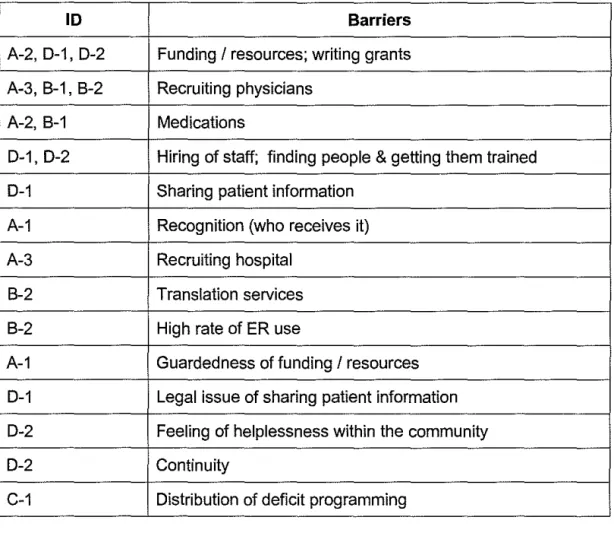
Overall, as Table 2 makes clear, many of the barriers that emerged were
unique to the particular collaboration and even to a particular respondent.
However, four kinds of responses did surface from multiple respondents.
three different respondents representing two different collaborations. Two
different respondents mentioned "medications" and "hiring staff' as barriers; the
representatives who mentioned medications were speaking for two different
collaborative networks; hiring concerns were mentioned by two different people,
but those people came from the same collaborative network Interestingly,
"patient confidentiality'' arose unprompted as a barrier in only one interview.
Discussion and Conclusion
Each of the four community collaboration projects approached patient
confidentiality in slightly different ways, though some common themes emerged.
The use of clinic-specific medical Release of Records forms and the use of legal
assistance to develop forms were the communities' most common solutions. In
some ways, each method allows the collaborative organizational leaders to avoid
direct entanglement in state and federal laws. The medical Release of Records
forms circumvent the legal issues by providing legal consent for sharing patient
medical records. Collaborative networks that use them do not have to be
concerned with deciphering what part of patient health information can be shared
between organizations. Of note, the use of a consent form complies with the
HIPAA Privacy rule and North Carolina General Statutes, GS8-53 and
GS131E-310. Because we do not know the prior level of legal expertise of the
collaborative partners, we do no know whether this choice was incidental or
intentional.
The use of legal consultants is perhaps a clear attempt on the part of the
collaborative networks to solve the problem of integrating state and federal laws.
This method permits collaborative networks to take advantage of appropriate
Administrators of safety net organizations do not have to be directly concerned or
familiar with the intricacies of confidentiality law; yet, their reliance on
recognizably expert advisors helps prevent such laws from becoming barriers
health care integration and potentially hindering the care for the uninsured.
Historically, medical consent forms have been individually prepared for a specific
facility. Thus, when providers began to form collaborations, perhaps it was
simply easier to leave the individual forms in place. However, it is interesting to
note that three of the four respondents who indicated that they used legal
assistance also mentioned that they used a single shared consent form for
collaborative providers (Example in Appendix E). Perhaps this indicates that
collaborations that use such shared forms are taking a more active role in
addressing patient confidentiality and are recognizing a more efficient means to
comply with state and federal regulations. The use of shared consent forms may
also suggest that those collaborations have different organizational or structural
networks. It is more likely, however, that their legal consultants recognized
provisions in the law such as OHCA and the business associates concept that
permit organizations to share forms and
I
or policies. Given the limitedinformation that we collected, we cannot really tease out which variable played
the larger role, but such an exercise would be an interesting topic of follow-up
research.
The structure of the interview guide places the initial question about general
barriers to collaborative formation before any questions about patient
confidentiality. The fact that the sharing of patient information sharing only arose
spontaneously in only one interview seems to suggest that many of the
respondents do not view patient confidentiality as an obstacle to forming a
our interviews were often very aware of the federal laws protecting confidentiality,
but were completely unfamiliar with specific state laws. Collaborations may
either assume (1) that compliance with federal law equates to compliance with
state or (2) that federal law always preempts state law. However, as we noted in
the introduction, federal and state laws may be quite different and require
different policies and procedures for compliance. In addition, there are few state
laws which are actually preempted by the HIPAA Privacy Rule. Although,
several of the respondents interviewed for this project were unaware of the
existence of state confidentiality laws, their organizations and collaborations are
still responsible for complying with the state legislature. Take together, these
findings raise the question of whether it is necessary for organizations to have
prior knowledge or direct awareness of the state confidentiality laws. Since state
laws may differ from the federal standard, collaborations who are unaware of
state requirements and do not seek state legal assistance may be at risk.
Our findings seem to suggest that modalities for addressing confidentiality will
be the same regardless of the level of knowledge about state confidentiality laws.
Both the collaborations who used legal assistance and those who did not, used
some type of consent form or medical release of records form to share patient
information. Thus, perhaps it is not important for safety net organizations to have
a direct working knowledge of state confidentiality regulations. However, if
organizations are not well versed in confidentiality laws, it will be beneficial to
have a legal representative review any forms they do intend to use to insure that
the forms will meet both federal and state regulations.
The case studies presented here provide a list of many other barriers to
collaboration between safety net providers beyond those of patient
physician recruitment is supported by other literature 11• In fact, of the barriers
listed, these two along with medications were the only barriers mentioned by
multiple collaboration sites with other obstacles appearing to be unique to the
individual collaborations. These findings suggest two things. On the one hand,
all communities who are attempting to develop any type of collaboration may
need to take careful consideration of available resources, physician/provider
recruitment, and possible medication provisions. On the other hand,
communities should also be aware of barriers that may be specific to a particular
type of collaboration or within a particular community demographic.
In this increasingly electronic age, another consideration for community
collaborations is how state and federal confidentiality laws will affect the use of
electronic medical records. None of the collaborations in our project were using
electronic medical records but one respondent, representing Community A said
that the collaboration is attempting to develop an electronic medical record. At
this point, Community A is using legal assistance to develop consent forms
associated with the use of the electronic medical record that will comply with both
federal and state laws where applicable. As the health environment becomes
more complex it will be more important than ever to seek guidance in deciphering
the equally complex laws that govern patient confidentiality.
This project provided an opportunity to collect information on collaborative
networks in North Carolina. Abundant literature addresses the need for patient
confidentiality and compliance with the HIPAA privacy rule; however, as we
previously noted, limited published literature specifically addresses confidentiality
as a barrier to health care safety net collaboration models. In addition, there is a
significant lack of information specifically concerning NC confidentially law and its
difficult to know how generalizable these findings are. This project was not
originally designed for the specific purpose of assessing the affect of patient
confidentiality protections on collaborative networks. The project was, instead,
designed to develop a broad picture of North Carolina safety net collaborations,
and that larger goal is reflected in the structure of the interview and its questions.
The data that we collected on confidentiality are very limited and likely barely
scratch the surface of confidentiality. Follow-up projects should delve more
deeply into the process by which consent and medical release of records forms
were designed.
This paper includes a very small sample of the communities in North
Carolina, and we only analyzed a small sub-sample of representatives from the
chosen collaborations. Thus, the data really only reflect the perceptions of a few
key stakeholders who are involved in the collaborations. Future projects may
include a larger number of safety net collaborations as well as a larger sample of
respondents from each collaborative network. Researchers should also take
care that respondents involved in the interview process are individuals who were
directly involved in discussion and decisions regarding patient confidentiality and
the formation of any documents that may be used, including persons from the
safety net organization and any legal personnel who were recruited to assist.
As more safety net collaborations develop, we will have less need to
investigate barriers to collaborative formation. Instead, to continue to improve
the care provided to uninsured populations, we will need to move beyond
examinations of collaborative initiation; to turn to evaluations of the collaborative
networks' challenges as they try to serve their communities. Having understood
to address the barriers such as sustainability of the networks they have built
-these collaboratives will face in the future ..
Acknowledgments
I would like to thank the North Carolina Institute of Medicine for allowing me to
participate in this project. In addition, I would like to thank Sue-Tolleson
Appendix A
NC SAFETY NET COMMUNITY COLLABORATION CONSENT SCRIPT
(Including Script to Obtain Permission for Name of Knowledgeable Individual)
IRB Study# 05-2778
Hello, my name is . I am a (student/staff member) from the North Carolina Institute of Medicine. We are conducting case studies about community collaborations to expand care to the uninsured. This study is an outgrowth of a NC 10M Safety Net Task Force that explored ways to expand the healthcare safety net to serve more uninsured.
The Task Force found that few North Carolina communities were able to address all the healthcare needs of the uninsured. Many communities have fragmented systems of care, due-in part-to the difficulties in creating community
collaborations. Some of the counties that had the greatest success in serving the uninsured were those that developed partnerships across institutions. We are trying to collect information about these successful community collaborations, so that they can be shared as possible models with other communities across the state.
We understand that your organization is involved in a community collaboration in -::--::--county to serve the uninsured. Is this correct? (Yes/No). If No, thank them for their time and end the call). If yes, We are looking for a knowledgeable person in your organization that could answer some questions about the
community collaboration.
Is that you? Yes/No. If yes. state: Your participation in this study is completely voluntary. That means you do not have to participate in this survey unless you want to. I would like to email you a fact sheet that describes the study in more detail. Could you please give me your email mail address so that I can email you the fact sheet? (Alternatively, ask for a fax number if no email address).
Send the fact sheet and then wait for them to read it (or call back).
Now that you have read the fact sheet, would you be willing to answer some questions to help me understand the collaborations and partnerships that exist in your community to serve the uninsured. (If yes, proceed; if not, thank them for their time and end the call). The interview should last about one hour. Would this be a good time to talk, or would you like to schedule another time.
Once we have the name of the appropriate person, repeat introductory section that describes the study. Then read the following:
Your participation in this study is completely voluntary. That means you do not have to participate in this survey unless you want to. I would like to email you a fact sheet that describes the study in more detail. Could you please give me your email mail address so that I can email you the fact sheet?
(Alternatively, ask for a fax number if no email address).
Send the fact sheet and then wait for them to read it (or call back).
Now that you have read the fact sheet, would you be willing to answer some questions to help me understand the collaborations and partnerships that exist in your community to serve the uninsured. (If yes, proceed; if not, thank them for their time and end the call). The interview should last about one hour. Would this be a good time to talk, or would you like to schedule another time.
Appendix B
HEALTHCARE SAFETY NET ORGANIZATIONS IN NORTH CAROLINA
COMMUNITY COLLABORATIONS
Who is conducting the study?
The NC Institute of Medicine (NC I OM), in conjunction with a Safety Net Advisory Council (SNAC)1, is collecting information about safety net organizations that
provide healthcare services to the uninsured. This is an outgrowth of the NC 10M Safety Net Task Force, which developed ideas to strengthen community collaborations in order to expand and strengthen the capacity of safety-net providers to serve the uninsured.
(http://www.nciom.org/projects/SafetyNetlsafetynetreport.html)
What is the purpose of the research study?
The purpose of the study is to obtain background information about successful North Carolina community collaborations that have been created to provide healthcare services to the uninsured. The NC IOM Task Force found that few North Carolina communities were able to address all the healthcare needs of the uninsured. Many communities have fragmented systems of care, due-in part-to the difficulties in creating community collaborations. Some of the counties that had the most success serving the uninsured were those that developed
collaborations and partnerships across institutions. We are trying to collect information about these successful community collaborations, so that they can be shared as possible models with other communities across the state.