Public Health 101 for the Undergraduate Student
By
Matthew DeAugustinis
A Master‟s Paper submitted to the faculty of the University of North Carolina at Chapel Hill
in partial fulfillment of the requirements for the degree of Master of Public Health in
the Public Health Leadership Program.
Chapel Hill
2010
_________________________________ Advisor:
______________________ Date
_________________________________
Second Reader:
______________________
Table of Contents
Introduction Page 3
Background and Rationale Page 6
Review of Literature Page 10
Program Plan
Program Context Page 27
Program Framework Page 30
Goals and Objectives Page 31
Program Theory Page 33
Logic Model Page 37
Implementation Plan Page 38
Sustainability Page 40
Evaluation Plan
Approach to Evaluation Page 41
Evaluation Study Design and Methods Page 44
Evaluation Planning Tables Page 48
Dissemination Plan Page 60
Final Remarks Page 61
Works Cited Page 63
Introduction
We propose to design, and begin implementation of a three hour credit undergraduate
course introducing students to basics of public health in the United States using the framework
outlined by the Centers for Disease Control and Prevention (CDC) curriculum framework.1 We
also describe an evaluation plan to assess the outcome related to this course. By implementing
such a course, we will be beginning to address the lack of public health education in today‟s
citizenry which is hampering informed decision making among health care reform advocates and
voters considering various health care policies as well as addressing a dearth of basic public
health knowledge in students pursuing careers in health care. This lack of a basic foundation
leads to a lack of educated career decision making, as well as public health practitioners (whether
nurses, doctors, public health officials, or health administrators) who are not cognizant of the
broader realm within which they operate.2 Furthermore, we envision participants‟ improved
public health knowledge benefitting them in personal and family health related decision making,
contemplating environmental concerns and interpreting health information they encounter in
news media, in addition to many other benefits.
The curriculum framework (see “Background and Rationale”) focuses on five primary
topics. Topic one encompasses an overview of public health and basic principles of the field.
Topic two delves deeper into population health tools and social behavioral associated with public
health. Topic three discusses disease and disability as defined by the CDC. This topic includes
environmental health and safety as well as communicable and non-communicable diseases.
Topic four focuses on health care and health systems. Discussions in this portion of the
These will include health disparities and vulnerable populations, public health preparedness and
disaster management, community health, quality improvement and global health.1 With aims to
reproduce this curriculum on a nationwide basis for undergraduate universities, our initial plan is
to pilot the program as a course at the University of North Carolina at Chapel Hill (UNC-CH).
Our program plan will center on the exploration of the education needs that are most
important to a basic public health foundation. As this course will be directed at a general
undergraduate population, our program plan will focus on a course that can feasibly be taken by
any undergraduate student. In designing the program plan, we will address the steps necessary to
implement this course as a pilot program at a nationally recognized University. Our target
population will be college undergraduate students with a particular focus on freshmen. Our hope
would be that over the first three years of a pilot course, proper program evaluation would lead to
a more developed curriculum that will become a substantive course offering that could be
disseminated to undergraduate campuses nationwide. This basic education on the fundamentals
of public health will serve to create citizens better equipped to make informed health care
decisions, understand policies that affect public health, and appreciate the many social factors
that shape the health of the nation.
The evaluation plan for this course will be two-part. A quasi-experimental design will be
used in the pre- /post- testing of students in the course, and ideally a control group of similar
students. This design will be used to gather quantitative data on the courses ability to impart new
knowledge of public health on participants. An observational design will be used to gather
qualitative data on various aspects of program implementation as well as student participants‟, stakeholders‟ and program staff‟s views on the course and the obstacles and successes met
will be utilized in the observations portion of the evaluation. Results from this evaluation will be
shared with stakeholders, including students, as they become available, and will be used to
Background and Rationale
The U.S. health care system is complex, inefficient, and costly. The health of the U.S.
population ranks poorly compared with other developed nations that invest far less per capita in
health care. It is clear that improving the health of our nation‟s citizens is a critically important
goal.3,4 Health care reform must be carried out incrementally, over many years and include
changes within various parts of a fragmented system. To be effective and accepted, health care
reform that improves public health will require cultural and educational change not only on the
part of physicians, health care executives, and policy makers, but also among the American
citizenry.5 In 2003, the Institute of Medicine (IOM) concluded that keeping the nation healthy
required not only well-educated public health professionals but also a citizenry educated in
public health. The IOM therefore recommended that all undergraduates have access to education
in public health.5 With 27.2% of individuals in the U.S. completing a bachelor‟s degree and 52.5% completing at least „some college‟ in 2004, undergraduate education provides a promising
initial population for which to implement changes in the health care education of our citizenry.6
In 2006, a Consensus Conference group made specific recommendations for developing
undergraduate public health curricula.1 It is further recognized that inclusion of such content
would be excellent preparation for health professions education, including medical school.
Bearing these facts in mind, this program will set in motion the design of a pilot
undergraduate (college) course in public health using the CDC recommended framework
presented at the end of this section. Development of this course will involve a survey of US
colleges (including UNC-CH) to assess the current landscape and content of any undergraduate
to the framework proposed. Data will be obtained using this assessment and further literature
review for future development of the course curriculum. Focus groups consisting of current
UNC-CH undergraduates will be conducted with the goal of refining the initial list of topics and
competencies necessary to develop the curriculum. An evaluation of public health texts will
follow to find a course text that might be applicable to the final curriculum.
The proposed program will be a general introduction course on public health and is
envisioned as something to be available to all undergraduates. The proposed program would be
piloted at the University of North Carolina at Chapel Hill and focus primarily on the first year
class of undergraduates. The primary purpose of specifically targeting first year students is to
enable them to shape their undergraduate experience to adapt to any career or interest changes
brought about by participation in this course as well as to incorporate knowledge gained in this
course to their chosen career.
In developing this program, we will use materials from the curriculum proposed at the
2006 Consensus Conference on Undergraduate Public Health Education.7 Beyond a basic
framework outlining the curriculum we seek to implement, this framework has the benefit of
being substantiated by its link to prominent education organizations. Namely, this framework
was sponsored by the Council of Colleges of Arts and Sciences, the Association of Schools of
Public Health and the Association for Prevention Teaching and Research. In addition, it has
been endorsed by the national Center for Disease Control and Prevention.1
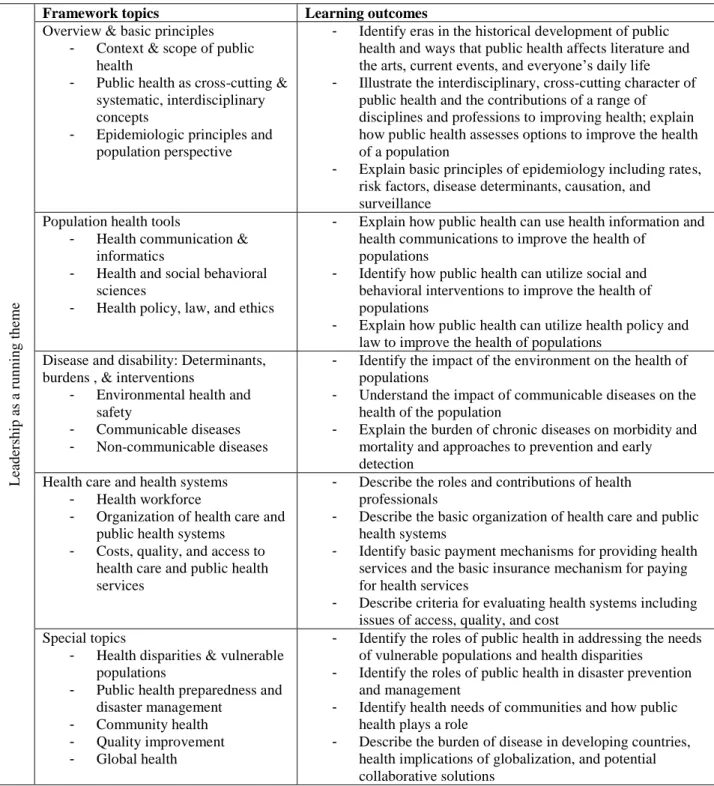
The CDC curriculum framework (Table 1) focuses on five primary topics. Topic one
comprises an overview and examination of basic principles with a portion focusing on the
context and scope of public health as well as public health‟s interdisciplinary nature,
into population health tools including communication, informatics, health and social behavioral
sciences and health policy, law and ethics. Topic three discusses disease and disability and their
associated determinants, burdens and interventions. This topic includes environmental health
and safety as well as communicable and non-communicable diseases. Topic four focuses on
health care and health systems. Discussions in this portion of the curriculum focus on the health
workforce, organization of health care and public health systems, health costs, quality and
access. The last topic of the curriculum focuses on special topics. These include health
disparities and vulnerable populations, public health preparedness and disaster management,
community health, quality improvement and global health. Topics are discussed at an
introductory level without the depth found in graduate level work. Those students who are
interested in furthering their knowledge in any of the topics discussed will be encouraged to
Table 1 - CDC Recommended “Public Health 101” Curriculum Framework
L ea d er sh ip as a r u n n in g th em eFramework topics Learning outcomes
Overview & basic principles
- Context & scope of public health
- Public health as cross-cutting & systematic, interdisciplinary concepts
- Epidemiologic principles and population perspective
- Identify eras in the historical development of public health and ways that public health affects literature and the arts, current events, and everyone‟s daily life
- Illustrate the interdisciplinary, cross-cutting character of public health and the contributions of a range of disciplines and professions to improving health; explain how public health assesses options to improve the health of a population
- Explain basic principles of epidemiology including rates, risk factors, disease determinants, causation, and
surveillance Population health tools
- Health communication & informatics
- Health and social behavioral sciences
- Health policy, law, and ethics
- Explain how public health can use health information and health communications to improve the health of
populations
- Identify how public health can utilize social and behavioral interventions to improve the health of populations
- Explain how public health can utilize health policy and law to improve the health of populations
Disease and disability: Determinants, burdens , & interventions
- Environmental health and safety
- Communicable diseases
- Non-communicable diseases
- Identify the impact of the environment on the health of populations
- Understand the impact of communicable diseases on the health of the population
- Explain the burden of chronic diseases on morbidity and mortality and approaches to prevention and early detection
Health care and health systems
- Health workforce
- Organization of health care and public health systems
- Costs, quality, and access to health care and public health services
- Describe the roles and contributions of health professionals
- Describe the basic organization of health care and public health systems
- Identify basic payment mechanisms for providing health services and the basic insurance mechanism for paying for health services
- Describe criteria for evaluating health systems including issues of access, quality, and cost
Special topics
- Health disparities & vulnerable populations
- Public health preparedness and disaster management
- Community health
- Quality improvement
- Global health
- Identify the roles of public health in addressing the needs of vulnerable populations and health disparities
- Identify the roles of public health in disaster prevention and management
- Identify health needs of communities and how public health plays a role
- Describe the burden of disease in developing countries, health implications of globalization, and potential collaborative solutions
Review of Literature
Introduction
The goal of this literature review is to identify papers describing the development and
implementation of public health courses designed for undergraduate students. It was important
in doing this review to distinguish between those works seeking to develop a public health
course targeting undergraduates pursuing any major and those looking at the design of an
undergraduate public health major or minor. The program plans of these studies, as well as their
evaluations, were analyzed to assess their success and applicability to our program plan and
evaluation. By reviewing the state of current literature, the implementation and evaluation of
this program may benefit from these previous curriculum designs and evaluations.
Search Strategy
The Education Resources Information Center (ERIC) database was utilized first, as this
program plan addresses an education topic at its core. The search string “(Undergraduate) AND
(public health) AND (course)” was used, limiting the articles searched to those written in English
and being published between 1990 and 2010 to reflect relatively contemporary public health
information and current education structures. This search returned 20 matches. The PubMed
database was then searched using the search string “(Undergraduate AND "Public Health" AND
course AND education) NOT cancer NOT treatment.” The addition of the terms “education NOT cancer NOT treatment” was necessary given that the PubMed database is not primarily an
education database like ERIC. These articles were limited to those written in English and being
published between 1990 and 2010. This search returned 81 matches. I then excluded articles,
public health issues as the primary topics of the course or did not consider general undergraduate students as the course‟s target population. At this point, one article from each database was
retained. Google Scholar and ISI Web of Science were also searched, but yielded no new
articles. A search of the cited works in both articles yielded no additional works.
Additional Investigation
In addition to the two published reports, I contacted the Association for Prevention Teaching and Research (APTR), the CDC partner in developing the framework for the “Public
Health 101”, to investigate their experience with the usage of their curriculum framework.8 I
learned that in 2007 the APTR had provided funding through the APTR-CDC Cooperative
Agreement with the Innovation in Public Health Education project award.9 This funding was
provided to thirteen institutions developing eight public health and six epidemiology courses for
undergraduates. At the time of this writing, no formal evaluation of these courses had been
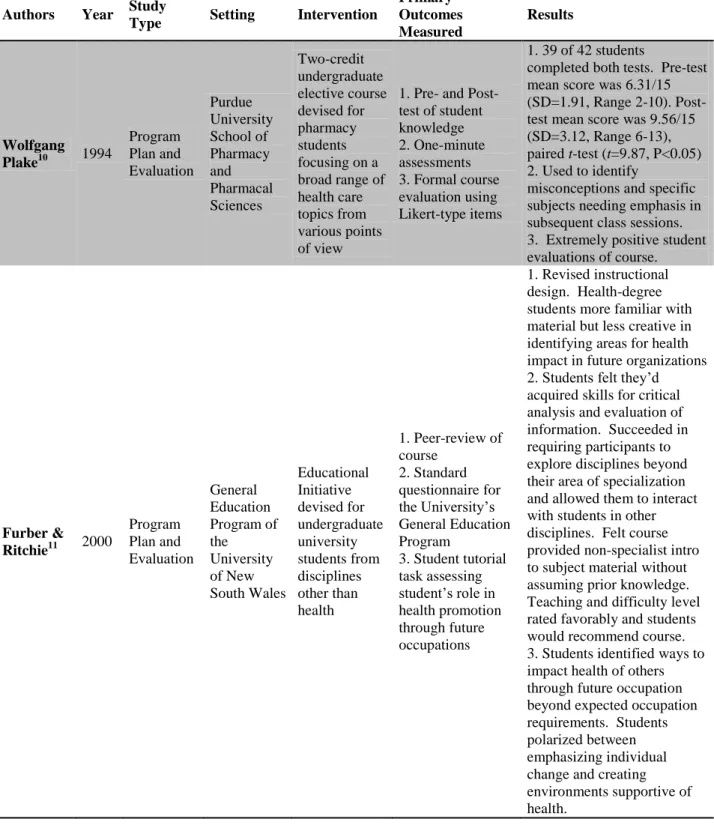
Summary Table of Reviewed Articles
Authors Year Study
Type Setting Intervention
Primary Outcomes Measured
Results
Wolfgang Plake10 1994
Program Plan and Evaluation Purdue University School of Pharmacy and Pharmacal Sciences Two-credit undergraduate elective course devised for pharmacy students focusing on a broad range of health care topics from various points of view
1. Pre- and Post-test of student knowledge 2. One-minute assessments 3. Formal course evaluation using Likert-type items
1. 39 of 42 students
completed both tests. Pre-test mean score was 6.31/15 (SD=1.91, Range 2-10). Post-test mean score was 9.56/15 (SD=3.12, Range 6-13), paired t-test (t=9.87, P<0.05) 2. Used to identify
misconceptions and specific subjects needing emphasis in subsequent class sessions. 3. Extremely positive student evaluations of course.
Furber & Ritchie11 2000
Program Plan and Evaluation General Education Program of the University of New South Wales Educational Initiative devised for undergraduate university students from disciplines other than health
1. Peer-review of course 2. Standard questionnaire for the University‟s General Education Program
3. Student tutorial task assessing student‟s role in health promotion through future occupations
1. Revised instructional design. Health-degree students more familiar with material but less creative in identifying areas for health impact in future organizations 2. Students felt they‟d acquired skills for critical analysis and evaluation of information. Succeeded in requiring participants to explore disciplines beyond their area of specialization and allowed them to interact with students in other disciplines. Felt course provided non-specialist intro to subject material without assuming prior knowledge. Teaching and difficulty level rated favorably and students would recommend course. 3. Students identified ways to impact health of others through future occupation beyond expected occupation requirements. Students polarized between emphasizing individual change and creating environments supportive of health.
Wolfgang & Plake 1994 Description of Intervention
Wolfgang and Plake‟s article, Development and Assessment of an Undergraduate
Elective Course in Health Policy, explored the development, implementation and evaluation of
an undergraduate course designed for pharmacy students focusing on a wide range of issues
facing health care providers, consumers and payers.10 It was developed at the Purdue University
School of Pharmacy and Pharmacal Sciences to address the need for future health care
professionals to be well acquainted with the structure of the American health care system and the
options available for its reform. It was written in the context, and refers explicitly to the national
debate on health reform which occurred during the Clinton administration.
The course was offered to undergraduate pharmacy students as a two-credit elective titled “Issues in Health Policy” with successful completion of a required second-year course focusing
on the role of pharmacists and pharmaceuticals in the American health care system being the
only course prerequisite. The first offering for the course was in the fall semester of 1993 and
was implemented in two sections. The course syllabus indicated that its purpose was “to better
acquaint students with key issues shaping health policy, as well as the current health care reform movement, in the United States.” Course content decisions were made by the course instructor
following a critical review of current health care journals and texts to identify a range of topics
considered appropriate for the course.
The course outline was developed following the literature review and is presented in the
Appendix. To guide the implementation and gauge the success of the curriculum, 10 specific
course goals were created and listed in the syllabus. These goals assessed students‟ development
1. Trends in health care costs and cost containment efforts;
2. The role of managed care in the U.S. health care system;
3. The structure and impact of both the Prospective Payment System and the Resource
Based Relative Value Scale;
4. Current issues influencing health care institutions and professionals;
5. The definition and assessment of quality care;
6. The structure of the health insurance industry;
7. The design of Medicare and Medicaid, and the problems faced by these programs;
8. The issue of health care rationing;
9. Health care reform efforts at the state and national levels; and
10.Foreign health care systems and how they compare to the U.S. system.
The course also sought to advance three additional specific goals for pharmaceutical
education which were outlined in the Purdue University School of Pharmacy Science‟s strategic
plan. These included involving students as active learners by minimizing the use of formal
lectures and putting greater responsibility on students for self-directed learning, developing
verbal and written communication skills through frequent use of class discussions and writing
assignments, and enhancement of students‟ abilities to recognize, analyze and solve problems
involving health policy issues through the use of small group exercises.
Course format focused on review and discussion of health care literature readings. A focus
was maintained on the implications of reading topics for the pharmacy profession. Articles
utilized by the course came from an assortment of prominent health care journals that
economists, physicians, etc.). A framework was provided to students to aid in article critique.
This framework was provided to students in their course manuals for each assigned reading, and
asked students to identify the following:
i. Main points of the article
ii. One aspect of the article that was least clear
iii. Questions that remained uppermost in their minds after reading the article
iv. Any implications the article had for pharmacy
The authors describe the extensive use of small group exercises to provide students with
opportunities to define and solve problems facing the American health care system. Course
grading was outlined by the authors. The grade was allocated between four individual papers
written over the course of the semester tasking students with formulating and justifying a
position on an issue or to propose and defend a solution to a health care related problem, class
participation rated using a scale available in the Appendix, and performance on a set of nine quizzes each consisting of two short essays questions based on the previous week‟s readings
and/or lectures.
Strength of Methods
Implementation methods for this program plan were well documented given the
constraint of a journal article. The authors described the process for developing the syllabus,
assigning course goals, course format, and course grading. Student recruitment and funding
were not discussed by the authors, nor was administrative implementation or instructor
identification and hiring.
Syllabus development was not discussed at length beyond the reference to the instructor‟s
other individuals took part in this syllabus development or whether departmental support was
offered or utilized. Course topics were identified and provided so that readers could assess the
syllabus for inclusion of various health care topics.
The setting of specific syllabus goals does aid the reader in identifying the purpose of the
topics chosen by the instructor. While the syllabus goals were helpful in interpreting the course
outline, the reasons for choosing these specific goals were not discussed. Additional specific
goals were further identified as being utilized to satisfy Purdue University School of Pharmacy Science‟s strategic plan for pharmaceutical education requirements. The purpose of these goals
was well documented.
A quick but informative course format discussion was provided, indicating the overall
and day-to-day implementation of the course. The authors also provided examples of specific
article topics utilized as well as source journals used for course content. An explanation was also
provided for the use of active style learning and a separate description of small group exercises
was provided to further explore the utilization and implementation of active learning in this
course. Ample examples of course activities and description of course materials, including the
framework provided to students for article critique, were provided by the authors.
A course grading description was provided to address the practical issues of an
undergraduate course offering credit as well as to identify what the authors felt was important to
determine successful participation in this course. Examples of grading rubrics were provided, as
well as explanation for certain grading methods including one which allowed students to
resubmit papers after receiving instructor critique and having a chance to make revisions.
Objective participation grading was also enhanced by the inclusion of a graduate student
Course evaluation utilized administration of identical pre- and post-tests, several “one-minute assessments”, and a formal course evaluation conducted during the last class session.
The pre- and post-test consisted of 15 true-false items used to determine whether knowledge of
health care system/policy issues increased during the semester. The authors did not discuss the
development or delivery of this tool. “One-minute assessments” consisted of one or two
open-ended questions used to allow students to comment on important concepts, raise questions,
and/or identify issues requiring further clarification. An additional tool used analogy assessment
tools to determine degree of understanding. This tool was substantiated using references
describing its utilization in an academic setting. Examples of the contents of these assessments
were provided. The formal course evaluation consisted of 21 Likert-type items selected from
200 items available for inclusion on the Instructor and Course Appraisal form obtained from the
Purdue University Center for Instructional Services. These questions asked students to assess the instructor‟s teaching style, course format, and applicability of the material to their profession,
course assignments and the course grading system. Students were also provided with an
opportunity to include written comments about the course.
Interpretation of Evaluation
A total of 42 students enrolled in the first course offering. There was no discussion of
course drop-outs or demographic composition of the course. Of the 42 students, 39 completed
both the pretest and posttest used to evaluate whether students‟ knowledge of the curriculum
topics increased over the course of the semester. Out of 15 possible points, the students‟ mean
score on the pretest was 6.31 (SD=1.91), with scores ranging from two to ten. On the posttest,
which students were not encouraged to study for because it did not impact their grade, the mean
indicated that the students‟ level of knowledge increased over the course of the semester. This
evaluation method suffers from a very high risk of bias due to students‟ desire to please the
course instructor who is also the program developer. Although students were encouraged not to
study, the desire to perform well and the fact that the post-test was the same as the pre-test puts
into question this evaluation methods ability to demonstrate genuine increase in knowledge as a
result of course participation. Due to the constraints of course evaluation, other more desirable
methods may be difficult to administer or develop.
Student responses to the Likert-type formal course evaluation were identified as
extremely positive. Student responses to the most relevant objective questions from the course
appraisal form were presented and are available in the publications Appendix. Representative
student written comments were provided, and indicated positive assessment of the course by the
students.
The authors did not identify any of the evaluation methods as reflecting the ten goals of
the syllabus. It is possible that these goals were addressed in the pre- and post-tests, but this was
not explicitly stated. The authors point out that student comments indicated that the course
positively impacted students on three specific educational outcomes identified prior to the
course: involving students as active learners, development of verbal and written communication
skills, and enhancement in the ability to recognize, analyze and solve problems. Furthermore,
the authors suggested that the students‟ written comments indicated improvement in health care
system/policy issue knowledge as well as increased student confidence in discussing these issues
with others.
The primary author, who was also the course instructor, commented in the personal
to the success of this course. Given the fluctuating nature of health care issues, the author felt
that discussion rather than objective fact learning was the best form of instruction to understand
the course material. He pointed out that, although knowledge improvement was evident in the
pre- and post-test, it was students‟ willingness to critically approach health care issues and their
feeling of being better prepared to function as health care professionals that will serve the
students best.
Applicability
This article provides an excellent description of the implementation of a course designed
to impart a greater understanding of health care to pharmacy students. Unfortunately, the course,
in its pilot implementation, did not seek to enroll students outside of the pharmacy school.
Furthermore, the topics covered in the course focus primarily on health care issues of cost,
payment systems, hospital issues, quality of care, insurance, rationing, reform and international
health care systems while neglecting other important public health topics recommended by the
CDC framework. As this course was developed over a decade prior to those CDC
recommendations, it is not expected that the course topics would mirror those in the framework.
If more curriculum tools were provided, this article could serve as a template from which
to develop a workable course on the basics of health care. Unfortunately, it assumes some prior
knowledge of health care related subjects as it is focused on students pursuing a health care
degree. This course would only be suitable to the goals and objectives of a “Public Health 101 for the Undergraduate” course if it reduced topics specific to health care practitioners and added
in basic discussions on major public health issues.
The author made the point in the conclusion that this course is set to enter its second
outside of the School of Pharmacy. It is mentioned that expanding the course in this way would
benefit not only students in other disciplines, but offer an “outside” perspective to the pharmacy
students.
I believe that this course offers a glimpse at the successful implementation of a course to
increase health care knowledge. With a broader focus that includes more public health topics,
this course may come close to offering the same advantages of our proposed Public Health 101
for the Undergraduate. It is unfortunate that further evaluation of this course has not been made
available through published literature.
Furber & Ritchie 2000 Description of Intervention
Furber and Ritchie‟s article, Spreading the Word: Teaching Health Promotion to Students
from Disciplines Other than Health, explored the implementation and evaluation of an
awareness-raising educational initiative in the form of a course devised for undergraduate
university students in the University of New South Wales General Education Program from
disciplines other than health.11 The paper builds off numerous calls for intersectoral
collaboration as a strategic educational approach to promoting health with examples dating back
to 1978. Initial opportunistic discussions with undergraduates led to the course title of “Promoting Healthy Lifestyles and Healthy Environments” which was meant to address the
general student interest in personal development and fitness while addressing the education goals
of social, physical and politico-economic determinants of health as well. Objectives of the
course were designed to enable students to:
Describe a wide range of health promotion strategies;
Appraise the major current issues in health promotion; and
Appreciate the necessity for interaction between various professions for the promotion of
health.
To meet the requirement of the General Education Program the course was offered through a
two-hour session, once a week during the 14-week semester. Equal time was allotted for
interactive tutorial sessions and formal lectures. Tutorials were designed to accommodate 15 to
20 students. Lectures were designed to raise pertinent issues with tutorials providing for the
development of critical thinking and analysis of and reflection on lecture content. The focus of lectures began on promotion of the students‟ own health and moved from this to topics regarding
promoting the health of others. A topic list organized by week taught is available in the
publications Appendix.
Strength of Methods
Although the authors gave ample support for the institution of an intersectoral education
initiative, they did not cite any sources for the development of the course topics and curriculum. Information provided on the program development phase is limited to “opportunistic
discussions” with undergraduate students and health promotion ideals found in the literature.
While resources for health promotion initiatives designed for undergraduates not pursuing a
health-related major may have been and still are lacking, an explanation regarding the design of
the curriculum is crucial to evaluating the utility and academic grounding of this initiative.
No mention of budget, identification and recruitment of an instructor(s) or departmental
collaboration was mentioned. The authors did discuss timing of the course and elements needed
to satisfy elective criteria necessary in fulfilling some of the General Education Program‟s
requirements. Recruitment of students was not discussed in this article. Curriculum specifics
were neither referenced nor discussed beyond general themes and objectives and a topic list by
week.
Course evaluation was performed utilizing the following: peer-review through regular
meetings between lecturers and tutors focusing on course content and process, the University‟s
General Education Program standard questionnaire focusing on course quality and activities, and
through one of the student tutorial tasks which explored students‟ ideas on how their future
occupation could positively influence the health of others. No examples of the content of these
evaluation methods were given or referenced in the article. Also, no quantitative analysis was
discussed beyond student enrollment and number of students from various degree programs.
Peer-review examined appropriateness of course objective, sequencing of subject topics,
effectiveness of course materials and relevance of assessment tasks. Although the authors note
that recommendations from these sessions were used to modify the instructional design, there is
no mention of what the specific recommendations were. Furthermore, the authors provide no
discussion of what insight was gained through the examination of course objectives, the
sequencing of subject topics or the relevance of assessment tasks.
The University‟s General Education Program Evaluation was used to gain a student
perspective of the course. The composition of this evaluation questionnaire was not discussed
questionnaire was given, the breadth and purpose of the questionnaire, beyond providing student
perspective, was not discussed.
The tutorial task portion of the evaluation was chosen because it was considered an
important measure of the impact of the course. The authors did not suggest why identifying the students‟ ideas on how their future occupation could positively influence the health of others was
the tutorial task chosen to measure the impact of the course on students, nor did they describe
any of the other tutorial tasks assigned during the course. Furthermore, the authors made no
mention of before-and-after student assessment to evaluate knowledge that was gained
specifically through participation in the course. Furthermore, no control group was used to
assess the utility of this course.
Interpretation of Evaluation
The main results of the peer-review process were minor modifications incorporated into
the revised instructional design and qualitative insights into differences between students from
different fields. The modifications made were not discussed, nor did the authors discuss why
these modifications were suggested or incorporated. The sole insight into differences between
students mentioned was that those students pursuing health-related degrees were more familiar
with health-related issues but were less creative in identifying ways in which their future
organization could have an impact on health. There was no mention of how this insight was
made, leaving the reader to assume that it was gleaned from discussion amongst lecturers and
tutors, as this is how the peer-review process is described. This portion of the evaluation did not
involve any external evaluators and is thus biased to the opinions of instructors and tutors
The university‟s General Education Program evaluation questionnaire was assumed to be
a generic questionnaire administered to all participants of courses classified as General
Education Programs, though no mention of the questionnaire content was made. Also, the
administration of this questionnaire was not discussed; therefore the reader is unable to ascertain
whether external evaluators were involved as proctors for this evaluation. Assuming that the
questionnaire was developed by the General Education Program, this assessment may be
considered an external evaluation tool. Twenty-seven of the 31 students in the course completed
this evaluation. No discussion of the types of students that did take and did not take the
evaluation was presented. The authors asserted that the assessment indicated that most of the
students thought the course offered adequate systematic analysis, criticism and reflection and
that they developed skills needed to engage in critical analysis and evaluation of information.
No reference was made as to how this assertion was reached. Furthermore, they indicated that
responses to the questionnaire demonstrated that the course succeeded in requiring participants to
explore new disciplines beyond their areas of specialization and provided opportunity to interact
with students from other disciplines. This insight seems rudimentary considering the
composition of the students in the course. The students did seem to indicate that the course
provided a non-specialist introduction to the subject material without presuming prior
knowledge. Students also rated the teaching of the course favorably, the course difficulty as
appropriate and indicated that they would recommend the course to other students. Again, no
mention was made of how this insight was reached. The small number of course participants
does make quantitative assessment difficult to interpret, though no attempt seems to have been
The tutorial task evaluation seems to stem from students‟ completion of a course
assignment, though this is not explicitly discussed. Results from this evaluation demonstrated
that all students had an appreciation of ways in which their future occupation could have an
impact on the health of others. This observation is supported by examples of ways in which
students perceived that their future occupations could promote health at the individual and
environmental levels. No explanation was made for how this assessment indicates effects of
program participation rather than inherent insight on the students‟ part. The authors also asserted that the student responses to this task indicated a “real understanding of the determinants of
health” without substantiating the claim with how the responses demonstrated this understanding
or what determinants of health were used to assess this understanding. No mention was made of
how this particular tutorial task was chosen to evaluate the impact of the course on student
participants. Also, this evaluation process can be assumed to include only internal evaluation,
with no mention made of external evaluator participation in this assessment.
Applicability
Although this program plan and evaluation article explored the successful
implementation of an undergraduate course discussing health topics with students from
non-health related majors, it was lacking in specifics of implementation as well as evaluation. This
article would not be suitable as a guide in the development of a similar program at another
institution. Furthermore, the evaluation methods used were poorly described and poorly
substantiated leaving the reader unsure of the impact of the program and its effect on participant
knowledge.
Beyond providing literature support for the implementation of intersectoral education
implementation. One such pitfall is the difficulty in designing adequate evaluation of program
success and impact with inadequate examples in the literature. Furthermore, the small size of a
pilot program makes it difficult to design quantitative measures that are statistically helpful after
only a single pilot course has been completed, suggesting that a qualitative approach may have
been better. Incorporating these insights into this program plan and evaluation will be crucial to
providing a positive contribution to the literature on undergraduate health education. In the authors‟ conclusion, the case is made that the actual implementation of an
intersectoral collaborative course is a small but effective contribution in a series of incremental
steps towards the desired effect of improvement and expansion in undergraduate public health
education. The authors also pointed to the need for further research to determine the lasting effect of such courses on students‟ lives years after participation in such courses. Sustainability
of this particular course is not discussed in the article. Investigation of the further development
and offering of this course, or whether it was sustained, would be helpful in evaluating the
Program Context
The context of a program plan seeking to introduce public health education to United
States college undergraduates is a society teeming with speculation and discussion on the future
of American health care. This environment provides a fertile political landscape in which a more
educated citizenry offers the hope of more informed decision making, but also poses the
potential challenge of partisan opinions hindering implementation of an education program
aimed at addressing a potentially contentious political topic. While it may be easy to elicit
agreement on the need for public health education, is it likely that agreement on the content of
public health education will be more difficult to find. This is suggested by the extensive partisan
divide evident during the 2009/2010 health care reform debate between congressional Democrats
and Republicans. While the local political landscape at the University of North Carolina at
Chapel Hill may provide a less contentious atmosphere, successful implementation of the course
at UNC-CH may draw greater attention. One strategy with which to approach this challenge is
to maintain a focus on presenting a politically neutral view of the current state of public health
by presenting the various sides of this issue while offering various options employed by other
international public health and health care systems without expressing favoritism for specific
changes.
Public health education does fall under the auspices of two national priorities: education
and health reform. Having such priorities at the forefront of the national political and social
mindset may encourage rapid acceptance of a pilot program addressing both issues. The risk we
may encounter in this environment is an atmosphere that encourages too rapid development and
To address this issue, program development and implementation should be the focus of the team
producing this program for the UNC-CH pilot with consideration for broader development and
expansion given only after an adequate pilot has been introduced.
The acceptability of this program to the administration of the University of North
Carolina at Chapel Hill is a vital part of program implementation. Cooperation with the
undergraduate administration in the early phases of program development will serve to include
them and invest them in this plan should they agree to its necessity. Framing the need for such a
program will be vital in garnering their support. If that support is lacking, it will be essential that
support is procured through an individual school (Public Health or Medicine would be the most
probable choices), as sponsorship is necessary to introduce a new course. Once a syllabus and
course proposal have been submitted and approved by the undergraduate administration, a pilot
course may be implemented. If an individual school, such as the School of Public Health,
decides to sponsor the course, the administration of that school my approve the course for listing
within that school and open it to undergraduate students.
Technical and financial feasibility will rest on the establishment of administrative support
for a new course as well as the securing of curriculum materials and instructors for this course.
With administration support for a pilot course, it will be necessary to develop a basic curriculum
based primarily on the CDC curriculum suggestions and then identify the faculty/instructor(s)
responsible for its delivery as well as accompanying course syllabus and texts. It will then be
necessary to refine the curriculum with the course instructor(s) and integrate the course text(s)
appropriately. Only after these elements and a workable curriculum are in place can the
lacking, it will be necessary to make students aware of the course and encourage enrollment
through advertisement of the course.
Although many challenges exist in the context of this program plan, we believe those
challenges are surmountable and will serve to further refine our program as it moves forward.
We embrace such challenges and look forward to the implementation of improved public health
Program Framework
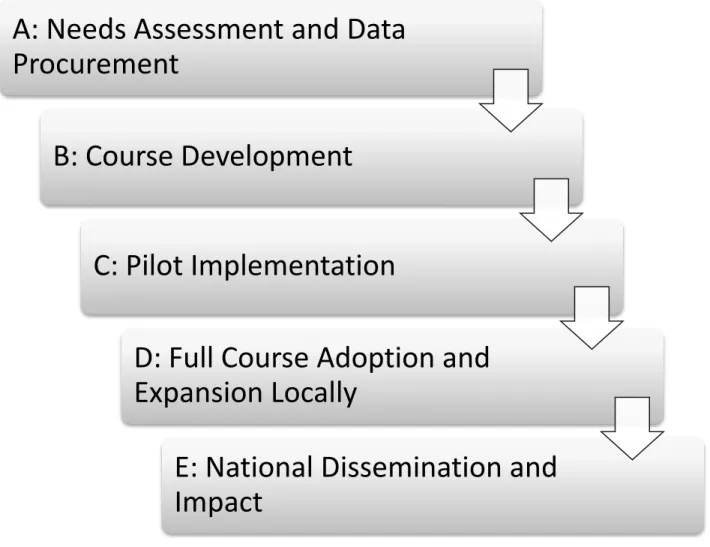
This program framework outlines the steps necessary to develop and implement this
course. The goals and objectives of this course refer back to this framework when referencing
phases of the course development and implementation. The scope of this program plan and
evaluation specifically addressed portions B and C of the below framework with discussion of
elements of A, D and E.
Figure 1. Program Framework
A: Needs Assessment and Data Procurement, B: Course Development, C: Pilot Implementation, D: Full Course
Adoption and Expansion Locally, E: National Dissemination and Impact
A: Needs Assessment and Data
Procurement
B: Course Development
C: Pilot Implementation
D: Full Course Adoption and
Expansion Locally
Goals and Objectives
Goal: “Improve undergraduate knowledge of public health”
Short Term Objectives (Implementation-1 year):
1. By March 2010, IRB approval will be obtained for student focus groups.A
2. By June 2010, data vital to curriculum development will be collected.A
3. By August 2010, a curriculum developed and instructor identified.B
4. By October 2010, syllabus and course proposal submitted to undergraduate University
administration and School of Public Health administration for course approval.C
Intermediate Objectives (1-2 years):
1. By December of 2010, the University of North Carolina at Chapel Hill (UNC) will offer
an elective in Public Health 101 open to freshmen. C
2. By August 2012, UNC will expand the elective to 2 course offerings each semester and
open the course to all undergraduate students. D
3. By December 2012, course enrollment in this course at UNC will grow to 100%. C,D
4. By December 2012, 50% of UNC undergraduates pursuing a public health or other health
care career will have participated in the Public Health 101 course. D
Long Term Objectives (2-5 years):
1. By August 2013, at least one university other than UNC will offer the Public Health 101
course to all undergraduate students. E
2. By August 2014, the University of North Carolina Schools of Medicine, Nursing and
Public Health will formally recommend the Public Health 101 course as a pre-requisite
3. By August 2015, 5 universities other than the UNC will offer the same or similar Public
Health 101 course to undergraduate students. E
4. By December 2015, the University of North Carolina‟s Schools of Medicine, Nursing and
Public Health will require applicants who are still attending college to have completed
the Public Health 101 course if offered at the institution they are attending. D/E
Program Theory
Our program plan seeks to address an educational need within the American citizenry.
Our focus will be the development and implementation of an undergraduate course introducing
undergraduate freshmen (initially, with the objective of expanding to all undergraduates after
successful pilot implementation) to public health in the United States. With a broad goal and
specific educational intervention, multiple program theory frameworks are useful. Below, I
cover some of the theories applicable to this program as well as examples of how the key
elements of these theories relate to our program.
Stages of Change Model
This model is significant to our program because of the diverse knowledge base of
participants in a Public Health 101 course, as well as varying interest among undergraduates in
participating in this course. Some students may never have contemplated taking a course in
public health (pre-contemplation), and may need to be actively „recruited.‟ These individuals
also represent the population that stands to benefit from the largest knowledge base
improvement. Activities to address the issue of pre-contemplative individual involvement will
focus on marketing the course to all individuals as well as using focus groups to investigate what
aspects of a public health course may appeal to those not previously considering taking a course
on the subject.
For students in the contemplation state, it will be important to emphasize why a course in
utilization throughout life, duty as an informed citizen/voter, participation in the health care
system through family and potential career options in health care.
For those in the decision, action and maintenance phases, it will be important to place
emphasis on the various roles of individuals in public health and health care. Demonstrating the
importance of understanding the system in which they hope to operate will be essential to
ensuring that students benefit from all aspects of the curriculum.
Health Belief Model
The health belief model is useful for this program in that it analyzes undergraduates‟
perception of whether a need for such a course exists. Key questions that should be addressed in
focus groups and kept in mind while designing the curriculum are:
- Do individual students think they have a deficiency in public health and health care
knowledge?
- How big of an issue do students think lack of public health knowledge is for them and
their fellow students?
- Do students believe that taking a single course on public health is enough to fill the
perceived knowledge gap?
- What are students‟ opinions of the benefits or costs of taking such a course (cost of
foregoing other courses, cost of extra time spent learning something not directly
applicable to their career choice, etc.)?
- What strategies might encourage students to enroll and are students confident that
Social Learning Theory
Similar to the Theories at a Glance example, parts of the social learning are essential to
the classroom environment. As an implemented course is the tool by which this program seeks
to reach its goal, it is important to address the concepts of social learning theory that apply to that
environment. Behavior capability relates to the need for the curriculum to impart upon students
the fundamental information about public health and health care necessary to make informed
decisions on person health care utilization, personal decisions related to public health issues,
assist family in making health care decisions, form educated opinions on health care policy as
needed to vote and understand the public political discourse on the subject, and to make
informed career choices. Expectations must be set forth so that students believe that they can
perform the aforementioned tasks after taking the course. Self-efficacy will be demonstrated in the individual students‟ confidence in making decisions and assertions associated with public
health after completion of this curriculum.
Organizational Change
The organizational change theory addresses the issue of curriculum adoption by the
Universities that seek to incorporate this course in their offerings. The flow is as follows:
- Problem Definition: the University must first acknowledge that lack of public health
knowledge is a problem worth addressing using University resources. One of our
functions is to make the case to the University that this problem deserves addressing
utilizing the University‟s resources. This will be done through compilation and
presentation of literature from reputable individuals and institutions suggesting
with a highly regarded School of Public Health, undergraduates do not have access to
a survey course that provides sufficient knowledge of public health for students to
utilize if they are not pursuing a degree related to public health.
- Initiation of Action: this stage would involve the University‟s adoption of a pilot
program. This may perhaps take place in something like a Freshmen Seminar at
UNC-Chapel Hill. Such a course would require fewer resources, but would be a step
toward addressing the problem.
- Implementation of Change: at this stage, the University would invest money in the
staffing, marketing and course slot for implementing this course. They would adjust
the size of the course and its prominence based on success in the pilot.
- Institutionalization of Change: at this stage, the University would commit to the
sustainability of this course as a fixture in the offerings of the University. The course
could be a part of the general college, but would more likely be offered through the
School of Public Health. The goal at this point, for the University, may be to
implement this course as a degree requirement to further encourage participation by
Logic Model
Resources Activities Outputs Short- & Long-
Term Outcomes
Impact
In order to accomplish our set of activities we will need the following:
In order to address our problem or asset we will conduct the following
activities:
We expect that once completed or under way these activities will produce the following evidence of service delivery:
We expect that if completed or ongoing these activities will lead to the following changes in 1–3 then 4–6 years:
We expect that if completed these activities will lead to the following changes in 7–10 years:
IRB ApprovalB
Data from:B
- Initial Survey
- Two focus groups
- Program Literature Review
- Survey of Existing Programs
- Curriculum Text Review
Endorsement from UNC-Chapel Hill Undergraduate administration, UNC School of Public Health, UNC School of
MedicineB
Course listing, location, time slot and advertisingC
Course Instructor(s)B FundingB Perform surveys, focus groups, literature review, survey of existing programsA Curriculum text reviewB Procure course materials (text, syllabi)B
Include course in semester course listingsC Advertise course to incoming undergraduate studentsC Meetings with program developers and course instructor(s)B,C Hire Course Instructor(s)B Compose Course CurriculumB
Teach CourseC
Data on undergraduate knowledge of public health topics and content interest, information on existing programs, course text applicable to final curriculumA,B
Working course curriculumB
# of course offeringsD # students enrolledC,D Increased Public Health knowledge among course participants as evidenced by student testingC,D
% Course AttendanceC,D Discussion(s) with UNC-SOM over inclusion in admission requirementsD
# of journal articles/poster presentationsC Short-term: Better understanding of current undergraduate public health knowledgeA
Pilot elective course in Public Health 101 offered to freshmenC
Instructor retention and implementation of permanent elective course in Public Health 101D
Publications outlining successful implementation of undergraduate Public Health 101 courseC
Long-term
Course offered at >5 Universities or Colleges other than UNCE Course publicly recommended by UNC-SOMD,E Increasing national exposure for course/programE Widespread offering of Public Health 101 course at numerous Universities nationwideE
Increased public health knowledge and awareness in graduates of Universities offering this courseE
Schools of Medicine and Public Health will require course when offered at an applicant‟s institutionE
Graduates of course demonstrating more informed career decisions leading to increased career satisfactionC,D,E
Implementation Plan
Implementation of this course initiative will begin with the formation of a program team
to develop and implement the pilot course at the University of North Carolina at Chapel Hill
(UNC-CH). The program team will be responsible for investigating course offerings at other
universities, reviewing published literature on the subject of public health undergraduate courses,
conduct focus groups to develop curriculum specific goals and objectives, develop basic course
curriculum, review literature for possible course texts and coordinate with undergraduate administration of the university and the university‟s school of public health to produce a course
offering. The program team will meet approximately once a month leading up to the course
implementation to discuss progress in all areas of course development. Once the course is
implemented, the program team will shift to program evaluation and sustainability.
The program team will first seek Institutional Review Board (IRB) approval to human
subject research needed as an initial needs assessment to develop this course. A systematic
review of literature in the area of undergraduate public health education will be conducted next
to assess possible frameworks with which to develop the UNC-CH pilot program. The next step in the program team‟s implementation will focus on gathering novel data through focus groups,
surveys and evaluation of programs at other universities. Specifically, two focus groups
consisting of undergraduate students over age 18 will be conducted. These focus groups will last
approximately 2.5 hours and be composed of 8 individuals each (Appendix A). Focus group
participants will also be issued a survey designed to gather data on demographics, knowledge,
experiences and opinions from participants with the potential for expanded administration further
will be obtained through internet searches as well as possible phone interviews with program
leaders of existing programs/courses. Data from focus groups, surveys and evaluation of current
programs at other universities will be combined with the systematic review of literature to
develop a specific framework for the course curriculum.
At this point, literature will be examined to identify potential course texts. The program
will then develop a curriculum based on data collected, course material identified (or developed
as need be), and seek out potential instructors for the course. After a working curriculum has
been completed and an instructor found, a course syllabus will be submitted to the undergraduate
and school of public health administrations to petition for a pilot course to be offered.
Activity Costs and Resources Timeline
IRB ApprovalA Time of Graduate Assistants March 2010
Systematic Review of Published Literature on Undergraduate Public Health EducationA
Time of Graduate Assistants,
Library Staff March 2010
Focus GroupsA
Time of Graduate Assistants, Cost of Paper Supplies, $400 for incentives
April 2010 – May 2010
SurveysA Time of Graduate Assistants,
Cost of Supplies April 2010 –June 2010 Review of Programs at Other
UniversitiesA
Time of Graduate Assistants,
Cost of phone interviews April 2010 – June 2010 Data SynthesisB Time of Graduate Assistants May 2010 – June 2010
Search for Course TextB
Time of Graduate Assistants, Cost of Texts included for evaluation
May 2010 – June 2010
Search and Hire Course InstructorB
Time of Program Team, Cost of
Salary(s) June 2010 – August 2010
Curriculum DevelopmentB Time of Program Team and Cost
of Materials May 2010 – August 2010
Syllabus Submitted to
Administrations of University and School of Public HealthB
Time of program staff July 2010 – October 2010
Advisory Council FormedB Time of program staff July 2010 – October 2010
Course Offered as First Year SeminarC
Cost of Classroom Time and
Sustainability
Sustainability is the cornerstone of this program‟s incremental success. The aim of the
pilot program is to demonstrate to the University of North Carolina at Chapel Hill, and other
universities in the United States, the ability and desirability of this undergraduate Public Health
101 course. Sustainability will focus on the dissemination of the course curriculum and program
plan, and the recruitment and retention of qualified instructors. Student interest in this course
will also be paramount to the sustainability of this course. Furthermore, buy-in from Universities
other than the University of North Carolina at Chapel Hill will be required to expand this
program and provide for a broad impact on undergraduate education in the United States. To
satisfy the long term goals of this program, growth and maintenance as well as ongoing
Approach to Evaluation
As an educational program, evaluation is paramount to the refinement of the program and
demonstration to outside institutions and funding sources that the program is worth continuing
and growing. Refinement of the program will come by evaluating the various outcomes both in
the implementation of the program and its effect on student knowledge. Implementation
evaluation will aid in identifying true program costs, staffing needs, materials needs, student
recruitment, and whether there is a need to expand resources to offer the program to more
students. Evaluating student knowledge and perspective gained through the course, we will be
able to identify whether the program, in its current form, is worth implementing. We will likely
be able to identify curriculum items that need improvement as well as identifying those topics
that need increased attention. Without this evaluation, we will not be able to garner the support
necessary to continue this program.
As the designer of this program plan I will be responsible for creating an evaluation plan
that mirrors the implementation process. I will not be the program director, nor will I be
significantly involved in the pilot program implementation or evaluation planned. My role as
evaluator will be primarily to use information gained in the program design process to anticipate
those evaluation measures that will provide the best assessment of program success and bring to
light those aspects of the program that need to be modified. I would recommend that evaluation
be carried out by both an internal and external evaluator. An internal evaluator, in the form of
the course instructor, would provide the experiential knowledge of the curriculum and student
participants necessary to offer insight into course modifications. One such insight would be
ensure that students benefit from all sections of the curriculum. An internal evaluator will also
have a better sense of the operation issues and concerns throughout the pilot course
implementation. External evaluators would need to have knowledge of methodological
assessment so that they may use the insight of the internal evaluator to provide advice on better
evaluation methods. Furthermore, an external evaluator would be able to proctor administration
of post pilot course evaluations, ensuring that the internal evaluator did not demonstrate bias in
evaluation administration due to a close relationship with the pilot course and its students.
There will be many diverse stakeholders who will need to be considered in the evaluation
of this program. The program creators and instructors will be interested in refining the program
to improve operations and student performance measures. These measures will be important to
the sustainability and expansion of the program. Their involvement will be continuous
throughout the program processes. The UNC administration will also be an important
stakeholder. As a provider of funding, administrative expenses and physical space, evaluation
must demonstrate to the administration that the course is worth continuing, that it provides a
valuable resource to the University. The administration may be included through taking part in
aspects such as operations, which directly utilize the administrations resources. The UNC
Schools of Public Health, Medicine and Nursing will also be key stakeholders. These schools
both may be included as sponsors for this program, and so will desire answers to the same
questions as the University at large, as well as providing questions on the relevance of the
curriculum. By involving them in curriculum evaluation, the expertise of these departments will
be vital in refining the program and keeping it temporally relevant over time. These departments
will also need to be convinced of the necessity of the course in their future students if we can
Other schools and peer review journals will be stakeholders in the sense that they will help
determine the possibility of program expansion. They will question the success, impact and
feasibility of the program, and will be involved in the process through publication of evaluation
results. Most importantly in this education initiative is serving the student participants who are
the stakeholders who invest tuition, time and effort into this program. Besides measure metrics
and opinions during evaluation, potential students will want to know that the course imparts
usable knowledge and skills.
Challenges of this program evaluation will include developing useful evaluation metrics
as well as having a population large enough to demonstrate significant change in those metrics.
Choosing education evaluation metrics will require the advice of experts in education evaluation
as well as knowledge of the curriculum topics. It will be important to ensure that evaluation
methods can provide encouragement to stakeholders and demonstrated its usefulness even before