Nevin Yang. Exploring the Effects of Searcher-Social Source Relationship When
Seeking Information Online. A Master’s Paper for the M.S. in I.S degree. April, 2012. 61 pages. Advisor: Robert Capra.
Finding information has become an essential skill in daily life, and people often turn to other people for assistance in finding information. This research study explores the effects of social source composition when seeking information online, and the decision process on selecting social sources, a human information source used by a searcher to help with an information need that may affect the search process, to collaborate with when searching. One-on-one interviews with graduate students were conducted and common characteristics and themes emerged. Effect on the information need and the search process caused by the relationship between the searcher and social sources were observed. The factors of trust, familiarity, and authority in the social source impacted the information seeking process in areas of communication, information sharing, and
information need. Despite the observed effects of searcher-social source relationship, success in satisfying an information need appears unaffected by relationship.
Headings:
Collaborative Search
Information Retrieval / Social aspects
by Nevin Yang
A Master’s paper submitted to the faculty of the School of Information and Library Science of the University of North Carolina at Chapel Hill
in partial fulfillment of the requirements for the degree of Master of Science in
Information Science.
Chapel Hill, North Carolina
April 2012
Approved by
_______________________________________
Table of Contents
Introduction ... 2
Literature Review... 5
Methodology ... 15
Results ... 24
Discussion ... 37
Conclusion ... 48
References ... 51
Appendix A – Search Strategy for Literature ... 53
Appendix B – Interview Guide ... 54
Introduction
With the rapid development of online search engines, information has never been
more available at a searcher’s fingertips. However, this abundance also has a dark side
for searchers in the form of information overload and frustration of keeping up with new
hardware and software. Searchers must sift through large amounts of information,
gradually discover relevant information, and then complete a task. Information retrieval
(IR) and information seeking (IS) systems have typically been designed for individual
searcher without much regard to tapping into the power of the searcher’s community.
When seeking information, people often tap into a number of people’s knowledge and
consolidate information from multiple sources on their information horizon to complete a
task for non-work purposes (Savolainen, 2008). Human sources were observed to be
most significant in early phases of information seeking during Savolainen’s (2008) study
followed by networked sources such as websites or e-mail. Collaborative search is an
approach designed to combines these two sources into one IR system to help the searcher
most effectively complete an information seeking task. The idea has been around since
2003 in Barry Smyth’s paper on collaborative web search. The major commercial search
engine, Google, has attempted to incorporate the social aspect in search with their “+1”
feature in which Google users can “+1” a page to indicate their recommendation of a web
site. Collaborative search attempts to create context for a query by incorporating
The current state of knowledge in the collaborative search area does not appear to
focus much on how the different compositions of a searcher’s social network affect
information seeking. There has been a great deal of research on collaborative search and
the benefits compared to traditional Web search. A searcher’s information pathway
usually first comprises of social sources that the searcher feels can help them with an
information need. However, there has not been a critical analysis of what relationship
these people have to the searcher and how the different social relations influence the
information seeking process.
Searchers often request help from other people as a major source when satisfying
an information need. However, there is a noticeable lack of exploration of the
relationship these other people have with the searcher. The scarcity of research on what
type of relationship a person has to a searcher when acting as an information source is
one I hope to help rectify. Understanding how other people help a searcher successfully
satisfy an information need could greatly improve how online search works today.
Library and Information Science (LIS) researchers and system designers would
most likely be interested in this research as their involvement in the search space would
benefit from a more detailed understanding from how the social context affects
information seeking. Although other people have been identified as important sources
during the information seeking process, current online search studies do not readily
reflect this aspect of the nature of a source’s connection to the searcher. Finding out
more about the effects of social connections through this research will help LIS
systems designers to create products that leverage these social connections to improve
information seeking.
This study will contribute to existing knowledge of collaborative search by
exploring who a searcher contacts in an information seeking context. This research will
also help generate more attention on the long-ignored aspect of interactions with other
individuals during an information seeking process. The information seeking process is
not a solitary endeavor undertaken by a single individual; rather, the process is a dynamic
set of events that transforms with every interaction the information seekers has with other
individuals. This paper will explore the effect of these various social sources consulted
when a searcher conducts an online information seeking task.
My study will attempt to address the following research questions:
1. How do people engage in collaborative search?
2. Why would people collaborate instead of searching alone?
3. How does the relationship between a searcher and social sources affect the
Literature Review
Introduction
Information retrieval today encompasses a multi-disciplinary approach as
information grows ever more abundant. Searchers suffer from information overload and
frustration with technology as they attempt to sift through large amounts of information
before eventually discovering relevant information to satisfy an information need. People
often follow a process of social search where they tap into social resources to help filter
through the information overload and find the information they need (Morris, Teevan, &
Panovich, 2010).
When looking for information, we often consult people we know as sources of
information to help us achieve our information need, whether as domain experts or to
help discuss concepts among other reasons. Who we consult during these information
seeking tasks varies widely depending on the topic. Many current studies do not discuss
or analyze how the collaborative information seeking process is affected when the
searcher consults different people with varying levels of familiarity. Other people that a
searcher consults have been identified as important information sources during the
information seeking process and newer information seeking models reflect growing
recognition of this importance. My study will help contribute to the existing literature by
attempting to discern some general effects that the searcher-social source relationship has
Knowledge of whether social sources are important can help drive further product
innovation in spaces other than search, where social context has already been added such
as Google +1 and Bing with Facebook Friends. In a survey, Morris et al. (2010) asked
participants if they have “ever cooperated with other people to search the Web.”
Over half of the respondents in a collaborative web search survey said they explicitly
collaborated at least once a month on an online search, and one quarter of those
respondents admitted to collaborating weekly on search tasks (Morris et al., 2010). The
researchers actually believe the figure was underestimated as subsequent questions
revealed that only 2.9% of respondents did not engage in any of the sample collaborative
search activities listed in the study, such as messaging other people to coordinate search
or working together in person to suggest alternative query terms. Understanding the
effects of these social searches in online information seeking can help establish a
precedent such that other fields can also attempt to leverage the beneficial effects of
social context. It can also help provide further evidence for designers to create
information retrieval systems that support collaborative behavior and take into account
the different relationships other people have with the information seeker.
To put the research into the social source composition during information seeking in
context, there is a need to start the discussion by looking at an overview of how searchers
decide on sources of information, how group dynamics play a role in search, and a
variety of individual types of searching to better understand search with a social context.
Source Preferences
When seeking information, searchers often consult two sources to help navigate
sources. Human sources were favored most strongly as sources of problem-specific
information because other people “were praised for their capacity to provide filtered and
experience-based information about the problematic issue at hand” (Savolainen, 2008).
This suggests that human sources are extremely important in the information seeking
process, and a greater understanding of these sources could help us design systems that
tap into these resources more effectively. Savolainen (2008) does not explicitly define
networked sources but it appears to be sources involving electronic means of accessing
information through the Internet as his examples are “e-mail; mailing lists; WWW.” He
also refers to networked sources as the Internet when discussing findings regarding the
preference criteria of source types. Savolainen (2008) found that networked sources were
mentioned less frequently than human sources but still occupied a significant position on
the information horizon. It is not clear if this trend still exists because technology, along
with usage and attitude toward technology, rapidly evolves and the state of technology
may be very different compared to when Savolainen’s study was conducted in 2008.
A study regarding group member familiarity suggests the familiarity a person has
with their human resources may play a role in the information seeking process despite not
affecting the performance of successful task completion (Janssen, Erkens, Kirschner, &
Kanselaar, 2007). Janssen et al.’s 2007 study illustrates the existing work in the area that
this study hopes to contribute to and was constrained by the fact that all participants were
11th grade high school students who were already in class together. The type of
relationship would most likely vary greatly despite most group members being
classmates with just differing levels of familiarity, but the relationship dynamics were not
dynamics affect the information seeking process on top of what Janssen et al. (2007) have
already discovered.
However, the study’s observations on the effects of familiarity provide some
valuable insights into its potential effects on the effect of social sources during
information seeking. Higher levels of familiarity did result in other positive effects.
Janssen did witness that higher familiarity led to more critical and exploratory
perceptions, more positive perceptions and less negative perceptions. Higher familiarity
also acted as a significant predictor for several collaborative activities, such as social
support and social resistance messages within group communication. It also led to
significantly less administrative activities, such as monitoring of task activities and
task-related questions, so members could focus on their tasks rather than the logistics of
collaborating. Using the above-mentioned observations regarding familiarity as a basis,
it is likely that the social sources will have an effect on a person’s information seeking
process.
One significant piece of the group member familiarity study was its usage of a
survey technique to measure group members’ familiarity with each other rather than
asking for self-identified relationships (Janssen et al., 2007). The survey had its own
questions and guidelines for measuring familiarity based on the answers which helps
ensure that the students do not inconsistently identify their relationship with others using
inconsistent terminology. This type of familiarity measure was drawn from a previous
work (Adams 2005) and would be useful to implement in studying the effects of social
sources as there is an independent metric to gauge the relationship between a searcher
from Adams’s work in 2005 with some differences which are explained in the
methodology section.
Modes of Information Seeking
Existing research has examined some aspects of my proposed research question
but does not observe the question in its entirety. Evans and Chi’s model of social search
appears to be the closest to capturing the social relationships between searcher and
human information sources through interactions but still fails to identify and assess the
relationship of these consulted social sources with the searcher. Evans and Chi (2008)
define social search as “an umbrella term used to describe search acts that make use of
social interactions with others. These interactions may be explicit or implicit, co-located
or remote, synchronous or asynchronous.” The model provides an integrated model of
social search, specifically noting where and why social interactions occurred before,
during, and after a search event. Social search refers broadly to the process of “finding
information online with the assistance of social resources, such as by asking friends,
reference librarians, or unknown persons online for assistance” (Morris et al., 2010). The
term essentially combines Savolainen’s (2008) idea of human information sources and
networked sources into one information retrieval approach to help a searcher most
effectively succeed in seeking information.
Marchionini’s (2006) idea of exploratory search blends “querying and browsing
strategies from retrieval that is best served by analytical strategies” and encompasses two
information-seeking activities: the learn and the investigate tasks. First, the learning task
involves multiple iterations and return sets of objects that require cognitive processing
extant knowledge and aim to allow the searcher to analyze, synthesize, and evaluate
results. This model of information seeking views the search problem “from the vantage
of an active human with information needs, information skills, powerful digital library
resources situated in global and locally connected communities—all of which evolve
over time” (Marchionini, 2006). Although it lacks the social context, exploratory search
should be considered another type of search. However, it is especially pertinent to my
study as I believe that consulted social sources will have an effect on the information
seeking process by helping to iteratively refine all aspects of the process over time
through these consultations.
Collaborative search is inherently social as it is collaboration between multiple
people seeking information for a shared goal. Collaborative systems can be classified
along four dimensions: intent, depth of mediation, concurrency, and location
(Golovchinsky, Qvarfordt, & Pickets, 2010). The study also identifies a number of roles
a person may play in a collaborative search: peer, domain novice/expert, search
novice/expert, prospector, and a miner. These roles are further discussed in the analysis
section of my study and used to help classify human sources in my study along with the
measure of familiarity from the group member familiarity study (Janssen et al., 2007).
These dimensions help differentiate information seeking systems, and the classification
helps establish characteristics to identify in systems and consider how to enhance
collaboration. This study helps frame my research but is not as appropriate as a social
search model because collaborative search assumes that people are always collectively
working together to search for information (Golovchinsky et al., 2010). The difference is
information seeking process rather than how group dynamics play a role in a
collaborative effort. Social search can be considered as a subset of collaborative search
in this context. Golovchinsky et al. (2010) also recognize that existing tools do not
effectively support ad hoc collaboration common in a variety of information seeking
situations. This research will help to provide evidence related to this collaborative
context and drive more thoughtful product design that takes into account the social
dynamics of a collaborative search.
These models of information seeking acknowledge that human information
sources are utilized in an information seeking task, but they do not specifically examine
how the relationship plays an effect on the process despite identifying the significance of
social sources. My research will primarily discuss relationships at a level of “friend” or
“professor” rather than in a role such as “prospector,” but Golovchinsky et al.’s roles
(2010) will also be discussed. Like most current research in information seeking, these
works do not delve into the effects different types of individuals have on search and
instead generalize all human information sources into a black box that searchers may use
for help during search.
Common Types of Searches
In “Taxonomy of Web Search”, (Broder, 2002), the author classifies web queries
into 3 classes: (1) navigational, the immediate intent to reach a particular site; (2)
informational, the intent to acquire some information assumed to be present on more web
pages; and, (3) transactional, the intent to perform some web-mediated activity.
Informational searches (59.3%) seem to be the most common type of search online
successfully finding information, 72% of searchers take action, either to organize or
distribute the information, but a significant number, 28%, do not act on that information
any further and end the search process there.
These query types are helpful, but there is a need to understand common
collaborative information seeking tasks as well to help describe what a searcher is
intending to accomplish. The top three most popular task descriptions include travel
planning (27.5%), general shopping tasks (25.7%), and literature search (20.2%). The
remaining five task descriptions are also significant but not as common: technical
information (16.5%), fact finding (16.5%), social planning (12.8%), medical information
(6.4%), and real estate (6.4%) (Morris, 2008). The knowledge of common information
seeking tasks will help focus the research into tasks most relevant to searchers and help
further unravel a person’s complex information seeking process. Do people consult
diverse social sources for different types of information needs? What are the effects of
these differing social sources on different types of information needs, if any observable
impact exists? For example, if I consult my parents about buying a house, how is their
effect on my information seeking process different compared to if I asked a friend when
both social sources have comparable domain expertise? A shared understanding of
popular types of information seeking tasks helps to ensure higher relevance for future
researchers to build upon this exploratory study.
Directly Related Research
A Master’s student from the University of North Carolina at Chapel Hill has
explored a similar topic of group relationships in collaborative exploratory search. In
Exploratory Search,” she focuses on collaborators rather than an information seeker
tapping human information sources and how that dynamic affects the search. Shelby’s
main contributions to this field are her observations that collaborators expanded and
narrowed each other’s information seeking processes by contributing information and
direction as well as alleviating anxiety over uncertainty in the process (Shelby, 2011).
She built upon a previous study regarding group member familiarity (Janssen et al., 2007)
by also looking at trust between the collaborators. This study also draws some of the
familiarity concepts presented regarding measuring group member familiarity from
Janssen et al.’s 2007 study.
Summary
After reviewing the current pertinent literature related to my research topic, I
recognize the limitations that exist in the area of social sources and information seeking.
The goal of my research study is to contribute to the current body of knowledge by
providing an exploratory study of how a searcher’s relationships with people who act as
sources of information affect the information seeking process. Research has suggested a
heavy preference of searchers to utilize human information sources during information
seeking and that the familiarity level with social sources may play a role in the process as
well. Like Janssen et al.’s 2007 study, this study uses a biased sample of graduate
students to address research questions because of time constraints. Many of the current
modes of information seeking identify human information sources during the search
process but do not delve into the details of the relationship between searcher and
searches and common information seeking tasks will help set boundaries for where the
effects may show.
Applying the benefits of understanding the effects of various social sources based
on a searcher’s familiarity with the social source may extend beyond the information
seeking process and may possibly be generalized to sensemaking and decision making as
well. The focus in this study is to begin to explore the nature of the relationships of
human information sources with the searcher so that the results may spur further study
Methodology
Goals of the Study
The goals of this research study were to gain a better understanding of:
1. How do people engage in collaborative search?
2. Why would people collaborate instead of searching alone?
3. How does the relationship between a searcher and social sources affect the
information need and the search process?
Method Description
For this study, semi-structured interviews were conducted face-to-face in a quiet,
semi-private room with graduate students enrolled in the University of North Carolina at
Chapel Hill who have experience with searching online electronically and have asked
other people for help during an online search that lasted multiple days or weeks.
Semi-structured interviews are interviews with “predetermined questions, but the order can be
modified based upon the interviewer’s perceptions of what seems most appropriate”
(Wildemuth, 2009, p. 233). During the interview, question wording may be changed and
explanations given. Particular questions which seem inappropriate with a particular
interviewee may be omitted, or additional ones included as well (Wildemuth, 2009, p.
233).
Conducting a semi-structured interview after the tasks are completed is
be directly observed (Creswell, 2009, p. 179). Semi-structured interviews display the
researcher’s awareness that individuals understand the world differently and depending
on the person, some questions may need probing and elaboration (Wildemuth, 2009, p.
233). Wildemuth (2009) describes this type of interviewing as involving “less rigidity
and more leeway than structured interviews but are more organized and systematic than
unstructured interviews in developing the conversation” (p. 233). Consistency is ensured
across interviews through the use of an interview guide to provide structure and
predetermined questions. An interviewer may probe beyond a participant’s answers to
predetermined questions adapted to a given situation to uncover a deeper understanding.
This method is especially appropriate for my research problem as the collaborative
information seeking process is difficult to examine in a lab setting, and an information
need requiring collaboration may span days, sometimes weeks. Asking participants to
reflect on their experiences will help ensure that the whole collaborative process can be
captured in a short period of time.
Population and Sampling
The nonprobability sampling approach in this research was used by first
considering this study as an extensive study intending to discover common properties of
or patterns that hold within a population (Wildemuth, 2009, p. 129). Convenience
sampling, a form of nonprobability sampling, was chosen because of time constraints;
this approach is a recruitment process where researchers recruit people because they are
available. Inclusion and exclusion criteria will still be imposed on the population of
interest from this sample to specify who is eligible. Wildemuth (2009) states the
population definition” (p. 121). As this is an exploratory study with a time constraint, a
small sample size will still allow me to achieve the research goals previously stated. A
sample size of six participants was ultimately chosen after sending out a recruitment
email using the University of North Carolina’s (UNC) mass mailing system
(https://notify.isis.unc.edu/massmail/).
Identifying and recruiting participants first started with a careful definition of the
population of interest. As convenience sampling is a nonprobability sampling approach,
there were some differences between the target population and the study population
(Wildemuth, 2009, p. 117). The target population is defined as adults in the 18-60 age
range who have experience in searching while cooperating with others to resolve an
information need. The study population was defined as graduate students enrolled at
UNC-Chapel Hill. This population will be expected to have experience with computers
and collaborative searches, such as travel planning, general shopping tasks, literature
search, or social planning (Morris, 2008).
The primary researcher was responsible for the recruitment process and
corresponding with the potential participants through e-mail and phone. Recruitment for
this study was conducted by sending out a recruitment email through the School of
Information and Library Science’s graduate student mailing list and UNC’s mass mail
system (https://notify.isis.unc.edu/massmail/), which reaches students who have chosen to
receive informational emails. Although requests to local acquaintances, friends, and
family were considered, there was no need as the study’s time constraints prevented an
increase in participants. The eligibility criteria for participating in this research require
collaborated previously to complete an information need in multiple occasions within the
past two years. A financial incentive of $10 cash was given to participants upon the
completion of the interview. The incentive would have been pro-rated for the time the
participant spent during the interview should the participant decide to quit. For example,
if the participant withdrew after half of the interview was completed, the participant
would receive half of the incentive. However, all participants completed the entire
interview so pro-rating the financial incentive was unnecessary.
Study Procedures
After potential participants expressed interest in participating in the study, they
were contacted through e-mail to arrange for an available time to be interviewed on
UNC’s campus, and to answer any questions they had about the study. Participants were
allowed to bring any material or devices they wanted to refer to when discussing their
collaborative search experiences. Once the participant arrived to the pre-arranged
interview location at the mutually agreed upon time, general information regarding the
study was explained to them. A consent form was also signed by the interviewer and
interviewee prior to the interview or audio recording starting. After the written consent,
the audio recording device was turned on and set to record, and the interview began. For
the interview itself, the study followed the interview guide’s structure and questions. The
interview was heavily influenced by Creswell’s (2009) suggested interview protocol
which includes the following structural components: a heading, interviewer instructions
to ensure standard procedures across interviews, the questions (including an ice-breaker,
main questions, and followed by concluding statement or question), probes to follow up
final thank-you statement to acknowledge the time spent by participant (Creswell, 2009,
p. 183). In this study, there was no extra space between questions as the responses were
only recorded through the audio recording device and not through interviewer notes.
Interview length for the study ranged from thirty minutes to a little under one hour per
participant.
Interview Guide
The interview guide proposed for use during the study is included in Appendix B.
The questions were developed through a combination of reviewing relevant literature and
considering the research objectives driving the study. The interview guide was further
refined after receiving feedback from my research advisor.
The interviews began with an icebreaker which consisted of introductions and
exchanging pleasantries. This initial portion of the interview was not recorded as the
consent form was signed at the end of this section. Once the consent form was signed,
the audio recording and research interview began. The recorded interview started with
questions regarding the interviewee’s background in search, familiarity with people
consulted for help during search, collaborative search, and comfort with technology. The
interviewer then asked the participant to describe two collaborative search experiences
and provided examples for collaborative search, examples were collaborative task
descriptions drawn from the most popular topics in Morris’s 2008 study, so the
participant could better understand our definition of collaborative search. The example
first given to the participant was one involving travel planning with friends as travel
planning was the task described most often in the Morris 2008 study. Another example
other people during the process as general shopping tasks was the second most frequent
topic (Morris, 2008). Through discussion with the interviewer, two recent experiences
that the participant felt comfortable to describe were identified where both instances were
a self-motivated task but with different purposes (e.g., one with an academic purpose and
one for travel). Then, the interviewer asked a series of framing questions about each
experience, including a question intended to reveal level of familiarity on a 4-point scale
with the people consulted drawn from an Adams study in 2005, with the goal of
collecting data to reveal insights into the study’s primary research questions. Unlike the
Adams study (2005) where four questions were included to prompt the participant to
consider other members of the group in the context of previous team or project situations,
this study only used the one-item question of a subjective assessment of familiarity for
the people consulted. Some possible framing questions about a search experience are
what was the information need or why did you have this information need. The
interviewer continued by asking more detailed questions regarding the collaboration to
try to elicit more discussion regarding communication channels, choice in methods, the
collaboration aspect of the experience, and who in particular the participant consulted.
Once these questions had been answered, the process repeated again for the second
identified search experience. Upon completion of the second set of questions, wrap-up
questions were asked, such as asking participant to reflect on their overall collaborative
search experience and to contrast their two experiences. Finally, the interviewer thanked
the participant for taking the time to participate in the interview and offered the $10 cash
incentive for successfully completing the interview.
A possible issue was the confidentiality of data—participants were informed that
their personal information would not be made public unless they volunteered to do so.
No participant decided to make their personal information public, and data was encrypted
using TrueCrypt, an open-source encryption software application. Another possible
ethical issue was the possibility of personal, intimate information being disclosed during
the data collection process (Creswell, 2009, p. 91). The privacy of the participant was
protected and this protection was conveyed to all participants.
Data Collection
The data was collected by the interviewer who is also the primary researcher. The
interview was recorded using a digital audio recorder for the duration of the interview
that was later transcribed using “paraphrased transcription” in which the entire interview
was not transcribed, only points considered significant by the researcher. During the
interview, hand-written notes were not taken by the interviewer as writing was
considered to be detrimental to a smooth interview. After the interview was finished, the
researcher took general notes regarding the interview overall that may not be apparent in
the recording. The collected data was analyzed with themes centering on the research
questions, especially collaborative search and how a social source’s relationship plays
into that process. It was done electronically to allow for easier organization and iterating
revisions of the data.
The questions asked during the semistructured interview were all from the
interview guide. The icebreaker question allowed the interviewer to build rapport with
the interviewee. Asking about an interviewee’s background helped frame the discussion,
searcher and social sources, and informing the interviewer of what probing questions that
may be helpful later on. After the background, the interviewer asked questions relevant
to the research questions to try to collect data to infer themes and build common
characteristics across interviews. The questions regarding collaboration were especially
helpful for observing common concepts. Repeating the questions when inquiring about
two search experiences with different social sources helped explore the effects of a
relationship between the searcher and the social source on a search by providing a larger
number of experiences.
Data Analysis
The data analysis started with a basic qualitative analysis format of (1) collecting
qualitative data, (2) analyzing it for themes or perspectives, and (3) reporting major
themes shared across the data, usually four to five. After transcribing the interviews and
analyzing the collected data, inductive coding was used to elicit themes and common
characteristics among the different experiences discussed. Given the difficult process of
coding by hand, a computer was used as it “may be faster and more efficient than hand
coding” (Creswell, 2009, p. 188). Computers more easily facilitate the tasks of
comparing different codes, locating all passages coded the same, and determining
whether participants are responding to a code idea in similar or different ways. No
qualitative data analysis tool was used, such as NVivo or ATLAS.ti, because the low
number of participants resulted in a manageable volume of data collected, and, therefore,
such a program did not offer as much benefit considering the learning curve required to
utilize it effectively.
The study method focusing on qualitative interviewing has benefits and
limitations (Creswell, 2009, p. 179). Regarding the benefits, interviewing is useful when
participants cannot be directly observed, and they can also provide historical information.
Interviewers can control the line of questioning, so they may keep the focus of the
interview on topics related to the research. Regarding limitations, the data provided by
interviewing is indirect information filtered through the views of interviewees. It is also
in a designated place rather than the natural field settings. Additionally, the presence of a
researcher may bias responses compared to if the searcher was freely discussing
experiences. Not all participants will be equally articulate and perceptive. For this study,
there is also a possibility of the participant learning the questions when discussing their
first search experience and then continuing on the second one. It may introduce some
bias to the second set of answers as they will begin to think of their search experience as
framed by the first experience’s discussion.
Steps were taken to ensure that the data is collected reliably (Creswell, 2009, p.
190). The paraphrased transcripts were checked to make sure the documentation does not
contain obvious mistake made during transcription. Validity was addressed primarily
through the strategy of making sure the data will be interpreted using rich, thick
descriptions to convey the findings; the description “may transport readers to the setting
and give the discussion an element of shared experiences” (Creswell, 2009, p. 192). An
additional strategy was used for addressing bias by asking participants to discuss
experiences one after another in quick succession to hopefully prevent any participant
Results
Overview
A total of twelve search experiences were collected through semistructured
interviews as each of the six participants in the study discussed two experiences. Each of
the six participants referred to an academic experience, which is likely a side effect of the
participant selection used for the study. Graduate students were recruited, and graduate
students often have to write a thesis or pursue research in a field they are interested in.
This common trait of graduate students was reflected in their choice in types of
experiences to discuss during the interviews. In addition, participants were asked to
discuss a second experience, and for the second experience, they were mostly considered
under the umbrella of personal searches and there was more variety in information needs
such as shopping, travel, event planning, or a hobby. One of the six participants did not
discuss a personal search for his second experience; he instead discussed a work-related
experience. It was still considered a self-motivated information need as he “really
thought this would be a way for the community to thrive.” When discussing the social
information source that participants consulted during their search process, I use the terms
“social source” and “collaborator” interchangeably as the consulted people fulfilled both
roles in this study.
As preliminary questions, participants were asked how often they asked others for help
when searching for information, their comfort level on finding information online, and if
they had a preference in who they chose to collaborate with online. All six participants
responded that they asked others for help frequently—at least once or twice a week. One
participant also added that she asked others for help much more often when she was
younger, but she still asked for help fairly frequently. Another participant also felt that
he asked others more often when it was an ongoing information need of personal interest,
specifically music in his case.
All six participants expressed confidence with finding information online and felt
“fairly comfortable” or “pretty comfortable.” One especially confident participant
expanded by saying he “does not feel uncomfortable at all” when looking for information
online. One participant did specify that there was less comfort with academic searches
and would be a “4-5 on a 10-point scale.” Another participant also provided a cautionary
tone and clarified her comfort level by saying there may be trouble if there was a lack of
context regarding the information need.
Regarding collaboration preferences, five of six participants said they had “no
preference” with collaboration, and there was one that did state a preference. This
participant said he would not want to collaborate with his professor online because his
professor “had a special rule of not more than one email per day.” “When I am trying to
Search Experiences
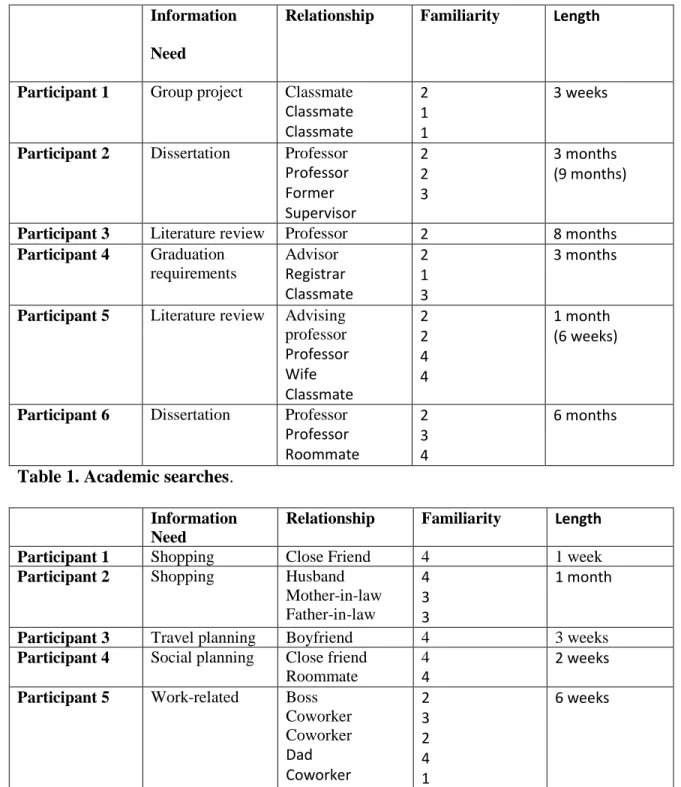
Information
Need
Relationship Familiarity Length
Participant 1 Group project Classmate
Classmate Classmate 2 1 1 3 weeks
Participant 2 Dissertation Professor
Professor Former Supervisor 2 2 3 3 months (9 months)
Participant 3 Literature review Professor 2 8 months
Participant 4 Graduation
requirements Advisor Registrar Classmate 2 1 3 3 months
Participant 5 Literature review Advising professor Professor Wife Classmate 2 2 4 4 1 month (6 weeks)
Participant 6 Dissertation Professor
Professor Roommate 2 3 4 6 months
Table 1. Academic searches.
Information Need
Relationship Familiarity Length
Participant 1 Shopping Close Friend 4 1 week
Participant 2 Shopping Husband
Mother-in-law Father-in-law 4 3 3 1 month
Participant 3 Travel planning Boyfriend 4 3 weeks
Participant 4 Social planning Close friend
Roommate
4 4
2 weeks
Participant 5 Work-related Boss
Coworker Coworker Dad Coworker 2 3 2 4 1 6 weeks
Participant 6 Music Friend 4 3 days
Table 2. Personal searches
In the tables above, the amount of time in parentheses under the column “Length”
but not yet unfinished. Familiarity was measured by a participant’s self-reported value
using a 4-point scale with 4 being “know this person very well” and 1 being “hardly
know this person.”
The twelve search experiences the participants were asked to discuss were
self-motivated and they typically leveraged their social information sources’ knowledge for
other resources to discover further sources of information and increase their knowledge.
In Table 1, two important differences between the academic and personal search
experiences emerged during the interviews. First, in the academic searches, the searcher
often had a lower level of familiarity with their collaborator(s), who were also considered
social sources of information in this study, on average compared to when their
information need was personal instead of academic. Four of six participants had no
collaborator with a familiarity of 4, the highest, in their academic searches, but these
same four participants would collaborate with a person of the highest familiarity in their
personal searches. Second, participants typically consulted more people as information
sources if their information need was academic—about three people on average for
academic searches compared to about two people for personal searches. Third, academic
search experiences tended to be of greater length, an average of 14.5 weeks in search
duration, compared to the personal search experiences, an average of 2.75 weeks in
search duration, perhaps because of external pressures and factors not explored in this
study. The study’s eligibility criteria for participants included experiences that were
multiple days or weeks, and it seemed that participants focused on a similar timeframe
for the personal search experiences. The similarity of personal search experience length
describe an experience with a duration of multiple days or weeks to participants.
However, for academic information needs, five out of six participants did report a length
of one month or greater for their information seeking process. The difference in search
length between academic and personal may be due to the different scope in the
information needs. Academic searches tended to be comprehensive literature reviews
whereas personal searches consisted of information needs that lent themselves to being
more quickly resolved. The increased expectations of an academic information need may
also play a role in the increased length as the searchers were graduate students who
needed to deliver a finished product to a professor.
The information need descriptions for personal searches were categorized using
the popular task descriptions from a previous study that discovered frequent collaborative
tasks (Morris, 2008). Morris’s popular task descriptions, in order from most popular to
least popular, included travel planning, general shopping tasks, literature search, technical
information, fact finding, social planning, medical information, and real estate. Two of
the information needs, finding music and work collaborations, did not seem to fit in any
of Morris’s popular task descriptions, so generic terms were utilized to describe those
information needs.
Of the six personal search experiences discussed, only two participants shared a
similar information need of shopping as shown in Table 2. There was a mix of
information needs that drove the experiences the participants chose to discuss. The four
personal searches out of six listed in Table 2 involved at least one social source where the
searcher had a familiarity level of 4 (4 was the highest, “know this person well”) with the
Three of six personal searches only involved one other collaborator, while the remaining
three experiences had a group size ranging from two to five other collaborators. There
seemed to be no relationship between the difference in group sizes and the length of an
information need or between the type of information need and group size. The
participants also stated that they did not contact any other people even as information
sources other than the collaborators listed.
Level of Familiarity
There was a notable difference in the levels of familiarity between academic
search experiences and personal search experiences reported by the participants. For the
academic searches, participants had an average familiarity of 2.35 with their social
sources. For the personal searches, participants had an average familiarity of 3.23 with
their social sources. Although it is unclear if the observed difference is statistically
significant due to the small number of participants, the metric provides insight on the
overall difference in familiarity of information sources that participants consulted. The
increased average familiarity for the personal searches could be because of extra social
factors where the increased familiarity results in increased desire to help the searcher
resolve an information need. Social factors may also be involved--the collaborator does
not want the searcher to think they are unhelpful. No collaborators were interviewed
about their experience in helping the searcher.
Despite the difference in the reported levels of familiarity between academic and
personal searches, the level of familiarity that participants had with their social
information sources did not seem to have any effect on the perceived success of
did not have the resources necessary to ask participants to complete a specific
collaborative task and compare the results. The self-reported success and levels of
familiarity were only their subjective appraisal of the collaborative search experience and
their relationship without any metrics implemented to measure the success or
relationship.
Reasons for Collaboration
Five of six participants revealed that there was no requirement to collaborate with
the people they chose to consult in order to satisfy their information needs. However,
they chose to collaborate rather than search in isolation because they believed
cooperating with others was “very helpful.” One participant even described the
cooperation as crucial and it was “probably the most important thing I’ve done so far by
just being able to get their [his social sources] input.” A participant shared the positive
sentiment and said the voluntary decision to collaborate “was more of a personal desire to
find things faster. It was not a requirement at all… I could have done it on my own—
slowly and just as good.” One participant espoused the benefit from collaborating of
figuring out the initial steps to satisfying an information need:
I wouldn’t know where to start. It would be really hard not to work with them when they have so much more experience in this area. They can help me find sources to do some initial research.
There were often additional cues that informed the participant that this person in
particular may be helpful in quickly finding more information regarding their information
need. These additional cues would not be possible without the searcher having an
established relationship with the social source prior to the information need.
Facebook page giving out these Spotify updates. That really told me he was really into music… I thought he would be a good person to talk to.
Three of the six participants actually considered the cooperation with others
unhelpful at times because of the overhead involved in collaborating, even though they
might have considered their overall collaborative search experiences successful. One
participant thought it was less helpful to collaborate because she had to cater to other
people’s desires as well. Another participant agreed by saying that it was “more for the
project” rather than a collaboration borne out of the desire to improve the information
seeking process. A third participant believed that the consulted information source
should take a more active role in helping her with her information need:
It was kind of unhelpful… after he gave me the journals to look through and a few books, other than that, I kind of disseminated the research in the articles that were out there and kind of did most of the work on my own.
Collaborative Communication
Email Face-to-face Phone Text Message IM
Search experiences
8 9 4 1 1
Table 3. Communication methods.
Search experiences may involve multiple communication methods; therefore, the
total number of communication methods reported in Table 3 may be greater than twelve,
which was the total number of experiences. The reported communication methods
showed a preference for synchronous communication through face-to-face, phone, and
instant message (IM). Synchronous communication was useful because it allowed for
real-time collaboration, especially in the face-to-face situations. Collaboration using
synchronous communication was used sporadically during the information seeking
progressing toward resolving their information need. Despite the perceived necessity of
synchronous communication to verify successful progress, the bulk of the information
seeking time was conducted asynchronously where participants collected information and
then presented it in some form to their collaborators, such as in notes, a document, or a
conversation piece. One participant said her group emailed PowerPoint presentations to
each other with “one person in charge of putting them all together. Another participant
said that she liked to print out abstracts and references and show them to her professor to
receive feedback and make progress in her information need. Technology limitations
also played a role in the choice for communication methods. One participant said that her
mother-in-law lacked Internet skills, which suggests a social aspect of preference in
choice of communication methods. She did not force her mother-in-law to use her
preferred communication method of email as she knew that her mother-in-law would
have trouble with that method of communication. Relationship with the social source
seems to have affected the choice in communication method as well for three of the six
participants. One participant said “with my classmates and wife, it’s been more
conversation-based” because he felt more familiar with them. Another participant
mentioned a preference for email but did not use it because “that’s just something I sorta
know—that’s not how they like to communicate.”
Asynchronous communication methods of email and text message were still
significant methods, and in some cases they were preferred over real-time, synchronous
communication. One participant chose text message over email because “it’s easier to
text with friends than it is to email… emails can take forever.” The participant felt that
used phone calls and texting to contact each other instead of other methods like email.
Calling or texting also has more noticeable notification to a person such as ringing or
vibrating compared to email where the participant has to intentionally have the email
application open to view new emails.
When communicating during the information seeking process, the data was
compiled in many different formats that the searcher felt was most appropriate for the
information need. For the music search, data was shared in the form of a YouTube
playlist. Music videos that the collaborator believed the searcher would be interested in
were added to a YouTube playlist and then the playlist link was shared to the searcher.
The searcher then went through the playlist and discovered artists to listen to after
watching the music videos. When looking for information for a dissertation, participants
compiled their collected information in a Word document. One participant said he
“wrote down the publication, the author, and the title of the article, so [he] can go back to
it and reference it.” The compilation of data for a particular information need may
transform afterwards to accomplish a goal that was not discussed in the interview. The
same participant just mentioned said that after he compiled references for articles relevant
to a literature review, he will eventually compile all the data in a PowerPoint presentation
and discuss it with his professor. For some information needs, there was no specific
method of documentation, and the participant may just keep all the data collected during
the information seeking process mentally with little to no physical records.
Effects of Relationship on Search Process
Participants were asked how they felt about the relationship with their social
were also asked whether they felt that their relationship with social sources posed any
challenge to the information seeking process. Five of the six participants felt there was
an effect on the search process or sharing during the process because of their relationship
with their social source. Participants were directly asked during the interview if they
believed their relationship with their social sources affected the search process. Most of
the participants did not feel like the relationship with their social source posed an
obstacle, but one participant did believe that there was a challenge because of the
relationship. He thought that his relationship with his professor was “a little more formal
than between me and my roommate.” He elaborated further on the challenge:
This affects the collaboration in a very nuanced, qualitative way. I would just call my roommate or just knock on his door… while with my professor, I would write a little more formally and more politely. It was more time-consuming and formal [to talk with professor].
When discussing the personal search experiences that tended to be more personal,
participants decided to consult social sources that they were more familiar with, as noted
previously in the average level of familiarity of 3.23. This suggests that when people
conduct more personal searches, people tend to turn to those that they are familiar with
despite one participant saying “it was just response time… relationship didn’t really
matter.” When including the academic searches, participants still felt that relationship
had an effect, which sometimes manifested in ways such as previously mentioned as an
obstacle. Although one participant felt that there was no major effect due to the
relationship with her social sources in her two experiences, the remaining five
participants all stated that they believed there was some form effect directly caused by the
One participant felt the close relationship (familiarity level of 4) with her
boyfriend in particular affected sharing because she shared more with her boyfriend than
she would with others, especially during face-to-face conversations regarding the
information need.
I would've shared more of my apprehension over how much money it was; I definitely share more with him than I share with others … We have a more
intimate relationship. We have a very open and honest relationship so if I felt that anytime I didn't want to go, I could've definitely shared it with him.
A second participant agreed that close relationships (familiarity level with her two
collaborators were 4) affected sharing during the information seeking process because
she felt more at ease:
[I was] probably a lot more laid back in how I communicated information. [I] didn’t feel the need to be as detailed … as long as they had the broad strokes of what we were doing and the time, that was sufficient.
A third participant expanded on the trend as possibly having a proximity effect on
top of relationship:
[There was] more sharing when I was more familiar. Similarly with my own roommate, I would share more between us because we would also meet face-to-face everyday so that also creates a context.
The difference in position authority and knowledge caused each of the six
participants to be more conscientious of their communication with their social sources,
especially in cases of professors. One participant said he “would probably be more
specific with my professors than with friends or family” because “they would understand
a little more and they’re interested in those specifics.” A different participant confessed
that with her professor, she was “more interested in being seen academically and more
concerned with being well-written.” She was also concerned with “social desirability—I
notion and its effect on her information seeking process because she was “kind of less
demanding and more subservient [compared to with her boyfriend] because I know I
Discussion
Overview
This study aimed to explore whether there was an effect of the relationship
between a searcher and their consulted social sources of information and what some of
the effects were if discovered. The interviews questions were designed to elicit
information regarding group collaboration sparked from a singular person’s information
need. Through the interviews, the study explored how people engaged in collaborative
search, why people collaborate instead of searching alone, and how the relationship
between a searcher and consulted social sources of information affected the initial
information need and the information seeking process. Several themes and common
characteristics emerged from analyzing the results above, related to the process of
information seeking in collaborative search experiences.
Overall, participants responded that they consulted other people frequently, at
least once or twice a week, which contrasted with previous findings of only 25.7% of
people collaborating on a weekly basis (Morris, 2008). The study population may be
biased because graduate students conduct regular collaborative searches borne out of
academic information needs, but their ease in discussing other, more personal, search
experiences suggests that people may be beginning to collaborate more frequently.
Morris’s 2008 study had a population where only 38% were considered researchers, but
graduate curriculum. This bias toward researchers may have also have affected their
comfort level with searching online as graduate students frequently search online for
information and demonstrate greater proficiency in seeking information online compared
to other populations of greater age or groups that may show less proficiency or frequency
due to the digital divide.
How do people engage in collaborative search?
The first research question of this study was to discover more information on how
people engaged in collaborative search. After data analysis, some general components
emerged from how participants conducted their search. Participants would start out with
an information need, individually conduct basic searches to get an overview of the
information need, decide to consult other people, choose their social sources
(collaborators), glean knowledge relevant to the information need or information seeking
process from the collaborators, communicate to collaborators, share data with the
collaborators, and then compile the data into a meaningful form to satisfy their
information need. The common steps the participants undertook do not reflect the
entirety of their information seeking process as the study focused on the collaborative
aspects of the search and the searcher’s relationship with social sources. However, it is a
rough approximation for their information seeking process. After analyzing the data and
generalizing the steps that the participants used, the steps seemed to match Evans and
Chi’s (2008) social search model. Overall, participants followed the social search model
outlined by Evans and Chi (2008); their common steps above mirrored the model’s steps
of identifying an information need, gathering requirements, formulating representation,
were not explored in this study. For example if the information need was to find a dress,
the goal of why the participant wanted the dress or for what purpose was not investigated
in-depth.
In Golovchinsky’s (2009) study, he proposed a taxonomy to classify the
relationships between the searcher and the collaborators. Peers are collaborators that use
their system independently and combine their results manually. Domain experts are
variations on the peer role where the collaborator has expert knowledge in the domain of
interest and can provide more relevant information. Search experts are collaborators with
a higher degree of expertise or familiarity with search tools and can give search tips to
make searching more efficient. A prospector generates many queries to explore a
collection and identify a few relevant documents before using a new query. A miner
discovers more details on documents identified by the prospector’s queries. Prospector
and miner parallel the search expert and domain expert roles but focus on decomposing
the information seeking task into subtasks rather than being driven by a searcher’s
knowledge. In this study, participants tended to consult social sources that fulfilled the
roles driven by a person’s knowledge, domain expert especially. There were also a few
cases where participants consulted a social source that was a search expert. One
participant said his classmates “are the ones who are able to help with navigating the
more academic sites to make the search a little bit easier. There were cases where
collaborators could be considered simply peers, such as a group project. The group
project had four people, and the participant explained that the information need was
miners because there was no person that played the prospector role to provide the miners
with queries to discover more detailed information.
Participants primarily used email and face-to-face to communicate with
collaborators. No existing collaborative tool was mentioned by participants, such as
online document sharing (e.g., Google Docs), video conferencing (e.g., Skype video
chats), or screen sharing (e.g., remote desktop). The reliance on email and face-to-face
methods may be due to a lack of existing systems that provide easy ways to collaborate
between multiple people. Existing information retrieval systems are mostly geared
toward individuals rather than groups collaborating to achieve a singular information
need. Another possibility for participants refraining from using existing collaborative
tools as mentioned above may be due to being unfamiliar and untrained in those types of
collaborative methods. Using a new tool presents a barrier, even if small, that in a group
setting may be challenging.
During the interview, participants were also asked if they could think of ways to
improve collaborative tools so it would be easier to collaborate online. Participants
recognized that there were issues with the collaboration tools available, but they have
accepted the restrictions and do their best to work within the constraints. For example,
one participant discusses an issue with email:
“If email didn’t have miscommunication or technology didn’t have the tendency to have some miscommunication, it’d be extraordinarily helpful. I wouldn’t need to do face-to-face meetings [all the time] and everything could just be done.”
It is unclear whether their inability to suggest improvements lies in the fact that
improvements to existing collaboration strategies have not been considered before, as one
collaborative tools available. Although participants were asked about improvement
suggestions for collaborative search, they may not have been prepared to provide such
suggestions in the few minutes allowed for the question during the interview to generate
and express improvements.
Evans and Chi’s (2008) model of social search is a good foundation to
understanding the information seeking process that people undergo to satisfy an
information need, especially in how a person engages in collaborative search (Evans &
Chi, 2008). The model explicitly lists social interactions as methods of information
exchange interwoven during different steps during each of the three major stages of
search: before search, during search, and after search. The model is missing the social
interaction during identification of an information need. Participants cited that their
information need was refined and sometimes sparked by social interactions with the
people they interacted with. What the model also lacks is the breakdown of social
interactions and how the relationships with social sources in these roles impact the steps
in the search process other than information exchange. This study has suggested that the
social interaction between searcher and social sources has more effects than merely
information exchange, so a more comprehensive model of information seeking should
reflect that fact. Some of the effects of how the searcher-collaborator relationship has
affected the search at multiple stages include the decision to collaborate before search
and communicating and sharing information before search, during search, and after
search. Therefore, this nuanced effect of relationships with social sources should be
added to the model to better reflect the relationship’s impact on the search process. The