In the 2015 calendar year, the Office of U.S. Foreign Disaster Assistance (OFDA)
provided an estimated $780 million in relief aid to countries stricken by natural disasters,
responding to 27 emergencies such as earthquakes, floods, and droughts (OFDA, 2015; OFDA,
2016). While these numbers are certainly not insignificant, a quick search of the EM-DAT
database compiled by The Centre for Research on the Epidemiology of Disasters provides a list
of 365 natural disasters occurring across the world, excluding the United States, in 2015 alone1
(Guha-Sapir et al., 2016). Thus, there are 338 documented instances in which a country affected by a natural disaster in 2015 did not receive relief aid from the OFDA branch of the United
States Agency for International Development (USAID).2 For example, a flood in the African
country of Ghana that affected 5,000 people received no funding from USAID, while a cyclone
in Kiribati affecting 1,500 people (according to EM-DAT) received $50,000 of USAID support
(Guha-Sapir et al., 2016; OFDA, 2015, p. 72). Why did Kiribati, rather than Ghana, draw aid?
What differentiates the select 27 disasters from the remaining 338? More generally, what
determines the varying amounts of United States government resources that are devoted to
international natural disaster relief in different locations and why?
To begin, it is useful to say a bit about why I have chosen to study only natural disasters
to the exclusion of other “disasters” like civil conflicts. I hope to better understand how the U.S.
responds to situations in which citizens of other nations face destruction due to impersonal
forces, i.e., not closely linked to their own actions, those of their government, or conditions
influenced by other countries. Thus, these events are somewhat “apolitical” in a way that armed
1 The OFDA estimates do not include occurrences of “complex disasters,” as the OFDA labels
conflicts are not, and I desire to analyze whether political and economic concerns nonetheless
factor into relief aid decisions in these instances. The results of this study are likely to suggest
normative implications for the policies and practices that guide the United States in its decisions
to allocate disaster relief aid. If it is the case that democracies, for example, are
disproportionately favored for relief aid, is this an acceptable component of U.S. aid
distributions? Should countries grant more aid following a disaster to nations with more
“favorable” characteristics than others? Or is it problematic that individual people, potentially
with no hand in choosing these characteristics, are passed over for aid? Alternatively, it may be
true that the U.S. allocates aid almost entirely on the basis of need, and one might argue that
there are other important considerations beyond this one. A background of knowledge regarding
our nation’s behavior related to relief aid dispensation is a useful beginning point for examining
these types of questions and the implications they have for current modes of distribution. The
intent of this study is to contribute to the conversation surrounding this knowledge.
To accomplish this, I conduct a quantitative analysis examining cases of international
natural disasters spanning the time period from 1991 to 2014. My study is divided into two main
parts: a selection stage and an allocation stage. In the selection stage, I examine a number of
variables’ effects on a country’s likelihood of receiving aid at all, and in the allocation stage, I
analyze the variables’ influences on the actual amount of aid a country receives. I believe that
need factors are important in both relief aid selection and allocation, but that “self-interest”
factors such as political and economic ties also influence aid flows. My findings support this
theory, particularly regarding the United States’ decision of whether or not to grant any aid to a
Relief Aid Selection Versus Allocation
When considering the types of factors that structure aid decisions, it is useful to separate
the question of whether to grant any aid at all to a country that experiences a disaster from the
question of the exact amount of aid that is ultimately obligated. One might consider the first
decision as a “selection,” i.e., which countries are selected to receive any aid, and the second
decision as one of “allocation,” i.e., how much aid to send to the country once it has been
chosen. A quick description of the OFDA process for making aid decisions suggests that
separating aid distributions into two stages is reflective of the actual decision-making process
undertaken by USAID. The USAID administrator acts as the designated coordinator for
international disaster assistance from the U.S. government, and it is the responsibility of the U.S.
Ambassador or Chief of Mission in a given country to declare an event a disaster in need of U.S.
assistance. The OFDA branch of USAID delineates three criteria for making this declaration,
which are: “the magnitude of the disaster is beyond the capacity of the host country to respond,
the host country requests, or is willing to accept, assistance, and a response is in the interest of
the [U.S. government]”3 (OFDA, 2010, p. 13). This declaration process constitutes the
“selection.” Once the declaration has been made, there are five possible activities that the OFDA
can undertake, which include immediate provision of up to $50,000 to the U.S. Embassy or
USAID mission in the country to address the disaster (with the potential for a subsequent
increase in funds), deployment of an emergency response team to the affected area(s), activation
of a response management team in Washington, D.C., disbursement of emergency relief supplies
from OFDA’s warehouses, and/or support for “relief and rehabilitation activities through grants
3 This last consideration is of particular interest to my theory and provides some indication that
to implementing organizations” (OFDA, 2010, p. 13). These processes constitute the
“allocation.”
It seems plausible that the determination of whether or not to provide any relief aid at all
and the choice of how much aid to actually provide a country may be based on slightly differing
considerations, which explains why many of the studies mentioned below analyze disaster relief
aid decisions in these two stages separately.4 There are a number of reasons why there could be
differences between the factors that drive decisions in the two stages, the most obvious of which
is that the actors making the two determinations may be different in some meaningful way.
Additionally, the importance of considering the U.S.’s self-interest in declaring a disaster (the
“selection”) is explicitly stated in the three criteria delineated in some OFDA reports, whereas it
is not obviously referenced in regard to the specific amount of money to allocate. To illuminate
and further explore these potential differences, this study is split into a selection and an
allocation stage.
Literature Review Foreign Aid
Disaster relief aid is a subset of what is generally dubbed “humanitarian” or “foreign”
aid, and it is thus necessary to identify the particular place that this subject occupies in the wider
field. R.S. Eckaus (1970) pioneered one of the earliest studies of U.S. foreign aid and provides a
useful definition of this type of aid. He states that it consists in “economic assistance, i.e. real
resources of goods and services, provided under concessionary terms and, therefore, not
4 Although the process delineated above applies to relief aid from the United States specifically
available on a purely commercial basis” (p. 448). This relatively umbrella-like conception makes
apparent that a number of distinct types of aid fall under such a categorization. Adelman (2007)
provides some guidance as to these types by describing what she takes to be the “three pillars of
the U.S. foreign aid agenda—disaster relief… development assistance, and security assistance”
(p. 63). While the literature surrounding U.S. disaster relief aid specifically is less prolific,
humanitarian aid in general has received much attention in academia, which I will briefly review.
However, because disaster relief aid is logically more akin to development aid, which aims to
reduce poverty in foreign nations, I will focus on the major schools of thought surrounding these
types of humanitarian aid.5 This excludes security assistance aid in the form of military
deployment, which I believe entails far different decision-making processes than those related to
funding anti-poverty initiatives and disaster relief.
Eckaus (1970) outlines five potential “arguments” for foreign aid that provide a useful
starting point for conceptualizing the competing sides of the debate over what determines the
relative amounts of aid that donor countries allocate to recipient countries. These are: The
Humanitarian Argument, The Individual Self-Interest Argument, The National Economic
Interest Argument, The National Security Interest Argument: Cold War Competition and
International Alliances, and The National Security Argument: Improving the International
Environment. The second and last of the list, which, respectively, point to the individual interests
of citizens within a state to provide aid and to generally improving the international environment
by using aid, have grown less prevalent since the publishing of this article. However, the
remaining three, which suggest motives of humanitarianism, economics, and foreign policy in
aid decisions, are important today. These three arguments can be grouped into two main
categories and extrapolated into the central buckets of the overall debate: first, that aid is
provided for purely humanitarian, altruistic reasons and second, that more “self-interested”
considerations such as political, economic, and security factors are the drivers of foreign aid.
Although usually acknowledging the nuance of the matter, scholars typically lean
towards one end of the humanitarian versus national “self-interest” spectrum of opinion
regarding the motives for foreign aid. Further, competing notions exist regarding what a
“humanitarian” and/or otherwise motivated distribution of aid actually is. On the humanitarian
side, Adelman (2007) asserts that aid does generally go to countries in need of assistance, which
an older study by Abrams and Lewis (1992) corroborates. The latter two authors also add a
slightly different conception of the humanitarian argument by asserting that aid benefactors
should pay attention to the human rights records of governments in recipient countries, and find
that the U.S. does, in fact, reward nations for protecting human rights by granting them aid
(Abrams and Lewis, 1992). Some scholars, however, outright refute that aid is provided for
humanitarian reasons. For example, in a study of European Union aid, Bigsten, Platteau, and
Tengstan (2011) find that if aid were based on need, it would favor poorer countries more than it
currently does. In terms of other, “self-interest” motives, many studies suggest that political and
economic interests play a role in aid distributions. Some find that certain raw materials, favorable
climate for investment, and potential default as a debtor influence aid, and one study finds that
Canadian aid favors countries that import goods from Canada (Apodaca, 2017; Macdonald and
Hoddinott, 2004). Others contend that aid is utilized to strengthen alliances, keep allied regimes
in power, build foreign bases, reduce terrorist threats, and more (Apodaca, 2017; Abrams and
Lewis, 1992). Thus, the literature encompassing foreign aid in general is relatively divided on
Disaster Relief Aid
I now turn to disaster relief aid specifically, which is the particular subject of this study.
Disaster relief aid differs from other types of foreign aid in that it is not intended for economic
development or assistance in combatting a civil and/or international conflict, but specifically to
address the human, infrastructural, and other casualties that accompany the occurrence of a
disaster.6 Further, the possible motives for disaster relief aid distributions may differ from those
that structure general humanitarian aid in a significant way: it seems as if they should be
intuitively independent of political and economic7 influences, as the occurrences themselves are
unrelated to these factors. However, some scholars suggest that such considerations nonetheless
do influence disaster relief aid allocations. The field surrounding disaster relief aid is much
narrower than that outlined above, but the sides of the debate are relatively similar. Some suggest
that disaster relief aid is allocated along the lines of the “Humanitarian Argument,” thus
allocating based on need and treating countries equally otherwise, while others contend that
factors unrelated to need influence aid decisions. Further, the relative influences of these factors
in comparison to one another are contested. Before addressing this particular debate, however, I
will outline a number of factors that the literature generally concurs do influence relief aid flows.
There are five factors influencing disaster relief aid that are well supported by the
literature: need, disaster type, media attention, colonial ties, and geographic distance. However,
only the first four have been studied specifically in terms of aid from the United States. Firstly,
and granting some credibility to the “Humanitarian Argument,” need matters. Numerous studies
6 Some scholars do consider the results of various types of civil strife as disasters, and I note this
when it is true of the studies I discuss. However, my study does not include civil conflicts in its understanding of disaster relief aid.
7 By “economic influences,” I mean donor motives for granting aid that are related to their own
show that considerations of need nearly always have some effect on aid distributions, causing the
central debate to center around how much this influence is relative to that of other potential
motivating factors. Further, need is measured differently across different studies. Popular
measures can be separated into two main categories and include: a country’s ability to handle a
natural disaster (often measured by GDP per capita, but also by population density and infant
mortality rate), and severity of the disaster (measured by total number of people affected by the
disaster, total killed, and/or total damages). For example, Kevlihan, DeRouen, and Biglaiser
(2014) measure need in all of the ways listed above excepting a country’s GDP per capita, while
Eisensee and Stromberg (2007) only use total killed and total affected to measure the severity of
the disaster and thus the need of the country affected by it. Other studies that find that need is a
significant influence on disaster relief aid allocations include Drury, Olson, and Van Belle
(2005), Stromberg (2007), and Fink and Redaelli (2009).
Secondly, type of disaster matters. In particular, several studies suggest that droughts
receive the most aid. In one of the first studies on the determinants of U.S. disaster relief, Drury,
Olson, and Van Belle8 (2005) examine a multitude of potential factors affecting aid during the
time period of 1964 to 1995. They examine the decision to provide aid in both the selection stage
and in the allocation stage, i.e., whether any aid at all is administered for the disaster and how
much. Disaster type is one of the few variables that are significant at both stages of the analysis.
They find that droughts are both more likely to be selected to receive aid and that they typically
get more aid than other disaster types such as floods, earthquakes, etc. (Drury et al., 2005). Fink
and Redaelli (2009), who examine disasters occurring from 1989 to 2009, obtain similar
findings, although their study examines aid from a number of donor countries including the U.S.,
rather than U.S. aid specifically. Further, their findings suggest that the reason that droughts
garner so much aid is because they enact more severe casualties than most other disaster types do
due to their length and overall magnitude. A table in this study exemplifies this by displaying
that, over the time period of their study, the average amount of people killed by droughts was
16,600,000, whereas floods averaged at 5,477,815 killed and earthquakes 310,855 (Fink and
Redaelli, 2009, p. 25). DOVB (2005) concur with Fink and Redaelli’s (2009) reasoning
regarding this finding in their study.
Thirdly, media attention influences aid. DOVB (2005) find that media attention, as
measured by the number of stories about a disaster in the New York Times, significantly
increases a country’s probability of receiving aid and the amount of aid it receives for a disaster.
Additionally, Eisensee and Stromberg (2007) analyze disasters from 1968 to 2002 to determine
whether news coverage affects U.S. disaster relief aid allocations and measure the “news
coverage” variable differently than the conception forwarded by DOVB (2005). The problem
with the older study’s measure is that it is plausible that aid and news coverage are both driven
by the magnitude of the disaster, rendering problematic any conclusion that coverage itself
influences aid. To handle this issue, Eisensee and Stromberg (2007) develop a new way to
measure the effect of news coverage on disaster relief aid by analyzing the availability of other
newsworthy material at the time of the disaster, and discover that relief aid flows are influenced
by whether or not the disaster happens at the same time as other major news events. The only
logical explanation for this, the authors contend, is that these events crowd out disaster relief
coverage, and disaster relief coverage influences aid. They do note that the effect on aid differs
across disasters and is most likely to influence disasters that are marginal in the decision
Stromberg, 2007, p. 712). Kevlihan, DeRouen, and Biglaiser9 (2014), who examine solely U.S.
aid flows, choose not to include a measure of media attention as an independent variable. The
authors note this decision and state that they assume “a relatively efficient information market
when it comes to humanitarian emergencies,” suggesting that they do believe media to be a
potentially important factor in understanding U.S. aid flows (Kevlihan et al., 2014, p. 852). Thus,
there seems to be some concurrence that media attention does influence disaster relief aid.
Finally, colonial ties and geographic distance have been shown to influence disaster relief
aid allocations. DOVB (2005), Stromberg (2007), and Fink and Redaelli (2009) all note that the
influence of colonial ties on aid is significant in their statistical analyses. As a side note,
Stromberg (2007) also finds that donors are more likely to give aid to countries they share a
language with, which may be related to this propensity to help one’s former colonies.
Additionally, Stromberg (2007) finds that more distant countries are less likely to receive aid
than geographically closer nations are, and Fink and Redaelli (2009) obtain a similar result.
These findings can be combined to suggest that geopolitical interests are important in
determining aid flows, which is further supported by some of the literature surrounding
humanitarian aid in general. For example, Abrams and Lewis (1993) find in their study of U.S
foreign aid distributed during the 1989 fiscal year that Central American countries (among
others) received higher amounts of aid than others did because of the strategic interest that these
countries held for the U.S. at this time, which is linked to the fact that they geographically
neighbor the U.S. It should be noted, however, that, of the discussed articles, only that by DOVB
(2005) studies U.S. disaster relief aid specifically. The remaining three examine either relief aid
from a number of donor countries or general U.S. foreign aid, as in the case just mentioned.
Thus, there is little current information to support that geographic distance influences the United
States’ relief aid decisions.
The fact that these five factors have been shown to influence disaster relief aid flows
suggests that, at base, there are some underlying motivations for aid allocations from donor to
recipient countries that do not follow strict need.10 However, to best examine this assertion, it is
important to analyze both of the two primary conceptualizations of need: the economic
“neediness” of the country itself, and the severity of the disaster. Further, as I have noted, I
believe that the influence of disaster type on aid allocations is likely linked to differences of
severity between disasters. Additionally, the illustrated influences of colonial ties and geographic
distance indicate that historical and geopolitical factors do seem to factor into aid decisions,
bringing to mind that other, more clearly political and economic considerations may as well,
which I discuss in the following paragraphs. Finally, the purported effects of U.S. media
attention on aid point to the role that factors internal to the United States may play in foreign
relief allocations. Given this, it is surprising that few studies examine the prosperity of the giving
country as a potential factor in understanding its aid distributions. Only DOVB (2005) does so,
utilizing U.S. budget deficit as a proxy for its economic well-being at the time of a disaster’s
occurring in a foreign country. They find that a larger U.S. budget deficit does, in fact, lower’s
the probability of a country’s receiving aid (Drury et al., 2005, p. 467). I include the five
discussed factors, excepting media attention,11 in my study, and add one to signify U.S.
prosperity in an attempt to further consider its influence on U.S. disaster relief aid.
10 Four of which have been shown to influence U.S. disaster relief aid specifically.
As mentioned, the literature on disaster relief aid is divided on the issue of the relative
influences of need versus “self-interest,” or politically and economically motivated factors, on
aid allocations, which is the primary subject of this study. Two studies, that by Drury, Olson, and
Van Belle (2005) and that by Kevlihan, DeRouen, and Biglaiser (2014), serve as the
cornerstones of this debate. The DOVB study analyzes disasters drawn from a dataset complied
by the Office of U.S. Foreign Disaster Assistance ranging from 1964 to 1995 and examines aid
decisions in the selection and allocation stages. The central thesis of their project is that political
factors are important in aid distributions, especially in the selection stage. They find that
considerations such as international alliances, a country’s regime type, U.S disasters, and media
attention affect disaster relief aid in the selection stage, and that factors related to foreign policy
do not significantly affect aid in the allocation stage. However, the authors discover that
variables measuring domestic concerns like U.S. disasters and news coverage of the disaster do
influence how much aid the U.S. grants a disaster-stricken country. This is not to say that their
study does not also suggest that matters of need influence aid, but that they are tempered by
non-need related considerations (Drury et al., 2005).12
KDB (2014), on the other hand, frame their study as a response to DOVB (2005) and
obtain contrasting results. They utilize a different dataset, EM-DAT, which is compiled by a
group of agencies, rather than by a U.S. agency like the dataset that DOVB utilize, and study
disasters from 1989 to 2009 (Kevlihan et al., 2014, p. 841, 839). The authors find that need
factors far outweigh the influence of other “self-interest” factors on U.S. relief aid flows, and
also discover differences in how aid is allocated before and after the events in the U.S. on
12 Fink and Redaelli (2009) align themselves with this position, finding that political and
September 11, 2001. The potential influencing factors that the study uses to examine whether
U.S. aid distributions are “self-interested” are: a country’s extent of democracy, bilateral trade
with the U.S., and its affinity with the U.S. in terms of United Nations General Assembly voting.
They measure need using battle deaths, total damages, total dead, total affected, and infant
mortality rate (Kevlihan et al., 2014). There are thus several differences between this study and
DOVB’s (2005) study, first of which is that KDB (2014) include civil conflicts as disasters
(hence their use of battle deaths as a measure of need). Secondly, the types of variables in the
KDB (2014) study differ from those in DOVB (2005), specifically the inclusion of bilateral trade
and UNGA voting record, and exclusion of media attention, formal alliances, and several others.
Overall, KDB (2014) find that the “self-interest” variables have, if any, only a minor influence
on aid and are reliant on the time period in question. Thus, the two studies are opposing. Using
this contention as a starting point, I will discuss three factors central to the need versus
“self-interest” debate in the disaster relief aid literature: political (or, regime type) affinity, foreign
policy affinity, and bilateral trade.
First, a factor that these two studies obtain differing findings for is that of political
affinity, or, similarity of a country’s regime type with the U.S.’s.13 DOVB (2005) find that a
country’s extent of democracy has a small (positive) effect on whether or not that country is
selected for aid but has no influence on the dollar amount granted to the country. KDB (2014)
find that democracies are more likely to be selected for aid before 9/11 occurred, and less likely
to receive any after 9/11. They also find that political affinity has no effect on the actual amounts
of aid allocated (Kevlihan et al., 2014). The differences in these findings could possibly be
13 The idea is that a country displaying a greater extent of democratic governance possesses more
attributed to difference of time period, as DOVB (2005) do not cover any disasters following
9/11.14 DOVB (2005) do find that whether or not the disaster occurred during the Cold War
partially explains U.S. aid distributions, which lends some credence to the notion that major
security events (like 9/11) may significantly alter aid trends. Additionally, it is worth noting
again that the latter study includes civil conflicts as disasters, and it would be interesting to
discover whether the relationships they find (or do not find) hold when these types of “disasters”
are excluded.
Second, the importance of foreign policy affinity in aid flows is contested in the
literature. Stromberg (2007), KDB (2014), and Fink and Redealli (2009) measure this type of
affinity using a metric of vote similarity in the U.N. General Assembly and obtain divergent
results. Because KDB (2014) examine U.S. aid only, their study focuses upon other countries’
similarities to U.S. voting patterns, i.e., foreign policy affinity with the U.S. The studies by
Stromberg (2007) and Fink and Redaelli (2009), however, examine aid flows from a number of
donor countries. Stromberg, who analyzes disasters occurring between 1968 and 2002, suggests
that vote affinity has little effect on aid, but the other two studies disagree. KDB (2014) does
propose that, before 9/11, vote affinity has little influence on aid. However, after 9/11, they find
that close allies in terms of UNGA voting record are less likely to be selected for aid from the
U.S., but once in the allocation stage, allies receive larger amounts of aid than countries
espousing less affinity with the U.S. do (Kevlihan et al., 2014). Fink and Redaelli’s (2009)
analysis also suggests that donors in general are more likely to provide aid to countries that are
not aligned with their voting patterns. Differing from KDB, however, they find in the allocation
14 If this is, in fact, the case, then the two studies do not necessarily strongly oppose one in other
stage that aid amount increases as affinity decreases. Some of these differences between the
latter two studies may be due to the fact that KDB (2014) focus only on relief aid from the U.S.,
while Fink and Redealli (2009) do not limit their study in this way. However, this cannot explain
the difference between Stromberg’s and Fink and Redealli’s conclusions, indicating that the
subject warrants further inquiry.
Foreign policy affinity has also been measured in terms of formal alliances, and this
alternative operationalization has similarly failed to yield agreement regarding its ability to
predict aid. DOVB (2005) and Stromberg (2007) both utilize the Correlates of War dataset to test
the relationship between alliances and disaster relief aid, and DOVB (2005) find that alliances
are strong predictors of aid during the selection stage, but not during the allocation stage. The
authors of the former study also draw the conclusion that alliances more strongly predict aid
during the Cold War than otherwise (Drury et al., 2005). Stromberg (2007), conversely, finds
that formal alliances have little effect on aid. Thus, it is notable that the two studies
operationalize formal alliances in the exact same manner yet yield differing results. Possible
reasons for this phenomenon are that the former study focuses on U.S. aid only, while the latter
does not, and the difference of time period between the two studies.15
The final contested factor prominent in the disaster relief aid literature is the importance
of bilateral trading relationships to aid flows. While regime type and UNGA vote speak
primarily to certain potential political motivations in allocating aid, this variable clearly points to
the possibility that economic motives drive aid to some extent. In fact, Stromberg (2007) and
KDB (2014) both find that trade relationships do (positively) influence aid flows in the selection
15 Stromberg (2007) examines disasters occurring seven years beyond those that DOVB (2005)
stage, although KDB notes that this is only true of their findings during the pre-9/11 period.
Stromberg (2007) also asserts that the greater the bilateral trading relationship between countries,
the greater amount of aid the recipient country will receive from the donor government in the
allocation stage. KDB (2014), however, conclude that trade relationships have no effect on the
amount of U.S. aid allocated to a country for disaster relief. On a slightly different note, Fink and
Redealli (2009) suggest that the type of goods that a country has to trade may matter, as they
discover that donor governments overall display a preference for oil exporters when selecting
countries to assist (p. 742). Thus, there seems to be a moderately strong case for the conclusion
that economic factors have some influence on relief aid. However, work remains to be done
regarding what exactly this influence is, especially in reference to U.S. aid specifically.
Although it has been mentioned throughout this section in relation to other factors, the
role that the terrorist events that occurred in the United States on September 11th, 2001 may play
in U.S. disaster relief aid flows is worth reconsidering in its entirety here. Most of the sources
outlined above do not study disasters following 2001, and two that do (Eisensee and Stromberg,
2007; Stromberg, 2007) only reach to 2002.16 However, KDB (2014) examine a time period
ending in 2009, allowing them eight years of post-9/11 relief aid to study. The researchers
analyze each of the factors they examine on data separated into pre-9/11 and post-9/11 time
periods and find significant differences in how the U.S. distributes aid between the two periods.
They find that, pre-9/11, neither the variables that they use to measure need nor those utilized to
measure “self-interest” have a strong influence on aid distributions. However, need factors such
as total damages and total dead have a slight influence in the pre-9/11 selection stage, and a
greater extent of democracy renders countries slightly more likely to be selected for aid. Bilateral
trade also may have a slight (positive) influences in this stage, as it is significant in some of the
models in which the authors include it. Very few of the need variables and none of those
measuring “self-interest” are significant in the pre-9/11 allocation stage. In the post-9/11
selection stage, KDB find that the need variables have a strong influence on aid and that foreign
policy affinity (UNGA vote) has a significant and negative influence, meaning that close allies in
terms of U.N. voting are actually less likely to be selected for aid. In the post-9/11 allocation
stage, need factors such as battle deaths, number affected, and infant mortality rate have a
significant influence on aid. Additionally, foreign policy affinity has a positive effect on the
amount of U.S. aid a country receives in the years following 9/11 ((Kevlihan et al., 2014, p.
845-847). These are novel findings that have not been extensively studied following KDB’s (2014)
article.
In sum, there are two major sides to the debate over what factors influence humanitarian
aid to foreign countries in general. A humanitarian motivations camp exists on one end of the
spectrum and a “self-interest”/political and economic factors camp occupies the other. Both sides
have been supported by numerous studies throughout the years, although most find that both
humanitarian and other, non-need-based factors play a role. The debate around disaster relief aid
is similar, although the extant literature is less abundant. The literature seems relatively certain
about the influence of five factors on disaster relief aid flows: need, disaster type, media
attention, colonial ties, and geographic distance. Researchers are divided, however, on if and to
what extent political affinity (regime type), foreign policy affinity (in terms of UNGA voting and
formal alliances), and trade relationships influence aid flows. Additionally, Kevlihan, DeRouen,
and Biglaiser (2014) discover interesting differences in how U.S. aid is distributed between the
contested factors outlined above by measuring some of them in a manner updated from previous
studies, and by examining aid from the U.S. only. I also examine the potential effects of many of
the DOVB (2005) variables on U.S. aid that have been neglected in more recent studies on a
different dataset covering a more recent time period, and I examine any differences in their
effects before and after 9/11.
Theory and Hypotheses
As previously stated, this study is divided into a selection and allocation stage. In these
two stages I, respectively, analyze the factors that influence whether or not a country receives aid
at all and how much it does in fact receive. In the selection stage, I believe that political and
economic concerns such as extensive trade relationships, similar political value systems, and
propensity for similar voting in the United Nations General Assembly17 will result in a greater
likelihood of a country receiving U.S. aid for disaster relief. Further, in the allocation stage, I
predict that the more extensive these trading relationships are, the more similar the country’s
political value system is to the United States’, and the greater the affinity between a country’s
voting and the United States’ voting in the UNGA, the greater the amount of disaster relief aid a
country receives from the U.S. will be. However, while I expect these factors to influence both
the decision of whether or not to provide aid and how much aid to provide in the same, positive
direction, I do propose that the influence of each factor relative to the others and to
considerations of need may differ between these two distinct ways of conceptualizing the aid
decision. Thus, I study the factors separately in both a selection and allocation stage in the hopes
of better understanding these differences.
This argument is in part rooted in the realist tradition of thinking about relations between
countries but is not necessarily limited to strict self-interest and/or power politics. In the
introduction of her scholarly book, Attina (2012) describes the rise of humanitarian aid and
intervention in the last decades. She references the “responsibility to protect” (R2P) ideal, which
applies to aid and intervention for a wide range of issues, such as abuses of human rights by
political leaders and other domestic problems, rather than only natural disasters as I am
considering them (Attina, 2012, p. 5). However, her descriptions of competing arguments for
how to account for the growth in international humanitarian aid and intervention apply nicely to
the subject that I treat. Attina (2012) states, “To a realist thinker, humanitarian aid and
intervention is carried out for substantial reasons like security and economic interests” (p. 9).
Although I draw on this school of thought, my theory differs in a number of important ways.
Firstly, I am not suggesting that the United States maintains an Office of Foreign Disaster
Assistance and aids disaster-stricken countries solely due to ulterior motives of security and
national self-interest. Rather, I mean to determine whether considerations outside of the need of
the afflicted countries contribute to aid decisions, not necessarily whether these are the only
drivers of these decisions. This brings me to the second way in which my theory departs from
realism. The three key factors that I examine do not necessarily measure strict self-interest, but
rather political and economic considerations in a broader sense. Perhaps the trading relationships
concept most closely fits the realist model, as the most obvious reason that the United States
would aid countries that it maintains extensive trading relationships with is to protect a valuable
source of imports and market for exports. However, the potential influence of political value
system on aid distributions may be related to certain interests like moral readiness to aid those
ways for the United States to help other liberal democracies in terms of maintaining reciprocal
friendships, this seems unlikely to be the only driver of this hypothesized propensity. Finally,
U.N. vote affinity measures self-interest to some extent, as the United States may wish to make a
point to “reward” nations friendly to its issue positions in the hopes that such actions will be
remembered in future voting situations. However, whether or not it is solely and necessarily
self-interested to aid one’s “friends” seems debatable.
A quick enumeration and explanation of my hypotheses based on the above theory
follows in the order of the three key factors I examine as just discussed above.
H1: The more extensive a country’s trading relationship with the United States, the more likely that country is to receive disaster relief aid for a natural disaster/the greater the
amount of aid that country receives will be.
My reasoning behind this hypothesis is that the United States desires to maintain stable trading
partners, and a disaster may jeopardize this stability. Further, the more extensive the trading
relationship is, the more that the United States has to lose if a natural disaster disrupts it, hence, a
greater push to provide relief aid and to do so in greater amounts.
H2: The more similar a country’s political value system is to that of the U.S., the more likely that country is to receive disaster relief aid for a natural disaster/the greater the
amount of aid that country receives will be.
As mentioned, the logic underlying this hypothesis is that the United States maintains a greater
propensity to aid those countries that it deems friendly to its political value system (i.e., fellow
democracies). This may in large part be due to a greater likelihood of identifying with those that
share similar values to oneself, and thus more sensitivity to the problems plaguing them. It does
that they share traits, values, and experiences with, simply because they identify with them more
so than with others who seem more distant or alien. Thus, a propensity to aid countries with
similar political value systems to the United States’ may largely be an extension of this
proclivity. This motivation is likely also augmented by security considerations. Perhaps the U.S.
desires to strengthen informal alliances with those that it naturally identifies with, resulting in
efforts to aid democracies more than nations characterized by other government systems.
H3: The greater the propensity of a country to vote concurrently with the United States in the U.N. General Assembly, the more likely that country is to receive aid for a natural
disaster/the greater the amount of aid that country receives will be.
I hypothesize that this relationship exists due to similar factors like those described above in
relation to H2 and also as a type of political incentivizing. The United States may simply more readily aid those with similar issue positions in the U.N. in some part due to a natural inclination
to aid those that agree with oneself. Additionally, it is plausible that the U.S. hopes to maintain
these types of beneficial similarities by fermenting informal relationships using aid resources,
i.e., by insinuating itself as “friendly” to the nation receiving the aid and hoping that this is
remembered in future instances of voting and otherwise.
In addition to these three key factors, I hope to study the impact of 9/11 on U.S. aid
flows. Thus, I will also study the influence of the above factors on disaster relief aid when
divided into two time periods: 1991-2001 (pre-9/11) and 2002-2014 (post-9/11). I anticipate that
the relationships between all of the three key factors and aid will be stronger post-9/11 than they
are pre-9/11.18 From this follows a fourth, more general hypothesis.
H4: Political and economic interests will be more strongly related to aid outcomes in the selection and allocation stages after 9/11 than they are before 9/11.
I hypothesize in this way because I believe there is a logical connection between feelings of
threat and interest in foreign policy strategy intended to make other nations “friendly” to oneself.
My reasoning is as follows. 9/11 created a more acute sensitivity to the possibility of threats
directly affecting U.S. citizens, and feelings of threat induce propensities to protect oneself
against future threats. One way to address and offset future threats is to have a wide base of
outside support in order to procure potential help with security problems or simply to present a
larger and more formidable front to enemies. Funneling aid to countries that one shares trade
ties, a political system, and/or opinions on foreign policy issues with helps to solidify friendships
that already have some basis in another political or economic factor. These relationships act as a
means to broaden one’s circle of “friendly” nations that a future enemy may offend, thus
decreasing the likelihood of a threat coming to fruition. Therefore, the U.S. will want to
strengthen these friendships by granting aid more frequently and in greater amounts to “friendly”
countries than they do for others. These considerations are likely more prevalent after 9/11 due to
increased threat perceptions, so the strength of the potential relationships between the three
factors and aid should increase during the post-9/11 time period.
Research Design Case Selection
The observations in this study are country-years, encompassing those years in which a
EM-DAT19 thresholds for classifying an event as a “disaster,” which requires the event to conform to
at least one of the following criteria: 10 or more people dead, 100 or more people affected, the
declaration of a state of emergency, and/or a call for international assistance (“Frequently Asked
Questions,” n.d.). The dataset includes disasters from 1900 to the present, but I focus on the
population of disasters (by these criteria) from 1991 to 2014 (Guha-Sapir et al., 2016). This includes only cases occurring after the Cold War period and will thus encompass years in which
the constitution of the international system has been relatively stable. Additionally, the study
examines solely natural disasters, which I consider to be unexpected events resulting from
natural factors. Examples include: floods, droughts, landslides, earthquakes, storms, and others.
Specifically, I exclude domestic conflicts from the research design. This decision distinguishes
my study from a number of others which do not make such a distinction. As aforementioned, I
elect not to analyze “disasters” stemming from issues like civil conflicts because I want to better
understand how the U.S. responds to situations where citizens of other nations face destruction
due to impersonal forces, and I do not believe civil conflicts to be impersonal.
Further, I exclude all OECD (The Organization for Economic Cooperation and
Development) countries and their related territories and dependencies to create a dataset of
primarily developing countries. I do this, in part, because I utilize some of the data from KDB’s
(2014) study to conduct my own, and they select their cases in this manner.20 The justification
for such a decision is that OECD countries generally possess sufficient resources to address the
19 A disaster database created and maintained by the Centre for Research on the Epidemiology of
Disasters.
20 Their study also excludes several countries either due to lack of available data and/or the
effects of natural disasters without needing extensive international assistance, and these countries
can aid their related territories and dependencies when they are disaster-stricken. The United
States Office of Foreign Disaster Assistance clearly seems to reason along these lines, as very
few relatively wealthy countries receive aid from the United States (OFDA, several years).
Specification of Dependent and Independent Variables
The dependent variable that I utilize in this study is disaster relief aid allocated by the
United States government and carried out through the Office of U.S. Foreign Disaster Assistance
branch of USAID. Disaster relief aid includes any aid in the form of money, workers, and other
resources that the OFDA itself includes in its annual reports detailing aid for specific disasters.
Importantly, the data that I utilize for this variable are aid amounts obligated as responses to
disasters. Following KDB (2014), I examine amounts obligated instead of actual amounts spent
as “it is the decision to obligate [and how much] which indicates US intent to provide assistance
to these emergencies,” and these intentions are the primary subject of this study (p. 844). Further,
I analyze only aid directed as responses to specific disasters, excluding any aid allocated for
other reasons like preparedness. As mentioned, I study disaster relief aid distributions in two
stages: selection, whether a country receives any aid for a disaster, and allocation, the actual
amount of aid the country receives.21
My independent variables of interest, as previously suggested, are trading relationships,
political value system, and voting record in the United States General Assembly. In terms of the
first independent variable, I measure extensiveness of a country’s bilateral trade with the United
States. For the second independent variable, I gauge countries’ affinity with the United States in
regards to the extent that they are democracies. Finally, in terms of the third independent
variable, I utilize countries’ levels of concurrent/dissonant voting with the United States’ voting
patterns in the U.N. General Assembly.
Variables and Data Collection Dependent Variable
I operationalize the dependent variable of disaster relief aid from the U.S. in two ways. In
the selection stage, I record whether any aid was administered for the disaster(s) at all, where “0”
denotes no aid granted and “1” denotes occurrence of aid from the U.S. I utilize OFDA Annual
Reports, Kevlihan, DeRouen, and Biglaiser’s data from their 2014 study, and EM-DAT to
compile the data for this variable. The USAID website maintains an archive of OFDA Annual
Reports, which detail aid allocations from the OFDA for that fiscal year, including the countries
that receive aid and for what, how much aid is granted, some severity measures for the disaster,
and the approximate date of the disaster (OFDA, several years). However, the earliest report in
the archive is for Fiscal Year 2000, and my study begins in 1991. I was able to obtain Kevlihan,
DeRouen, and Biglaiser’s (2014) replication data reaching up to 2002, which they gather from
older OFDA reports (p. 844). I utilize their data for the years 1991 to 2002, and update the data
using OFDA reports from the USAID website (several years).22 Importantly, KDB’s (2014)
22 OFDA reports are categorized by fiscal year, which runs from October 1 of the preceding year
study includes aid from the OFDA targeted towards a number of “disasters” that stem from civil
conflicts and, more generally, are not necessarily natural disasters. I exclude from their data and
data from OFDA annual reports any aid for “disasters” that are not natural disasters, such as
instances of civil strife, epidemics, refugee issues, and others. Additionally, the OFDA labels a
number of the disasters that it responds to as “complex disasters,” which are almost always
related to civil conflicts and do not typically include the effects of natural disasters (OFDA,
several years). For this reason, I have also excluded them. This is important because I use
EM-DAT for my case selection of natural disasters, and this database of natural disasters does not
include most of the aforementioned non-natural disasters. If the OFDA reports list a country as
receiving aid for a disaster, I code it as a “1” for the selection stage of the model. For negative
cases, if EM-DAT records that a disaster occurred in a country, but the OFDA reports do not
state that aid was granted for it, I code it as a “0.”
In the allocation stage, I examine the dependent variable as aid in constant 1992 U.S.
dollars. As noted above, I draw the dollar amounts from KDB’s (2014) study and OFDA annual
reports (several years). I utilize KDB’s data for the years 1991 to 2002, and data from online
OFDA reports from 2003 to 2014, and, as mentioned, only include aid for natural disasters. To
adjust for inflation, I convert the raw aid amounts into constant 1992 dollars, using Consumer
Price Index data from the U.S. Department of Labor to construct the adjustment factors (U.S.
Dep. of Labor).
Independent Variables
Regarding the first independent variable, I operationalize trading relationships between
the United States and foreign countries (labeled “bilateral trade”) by measuring the extent of
trade between the two countries as a percent of U.S. total trade. To calculate the yearly extent of
bilateral trade, I add total exports from the U.S. to the other country during a given year and
imports from the other country to the U.S. during that same year. Subsequently, I divide the
extent of bilateral trade between the countries by total U.S. trade with the world in the given year
to create a percentage. Extent of bilateral trade and total U.S. trade are in millions of U.S.
dollars, and data for these measures come from the United States Census Bureau (2017a; 2017b).
The reasoning behind measuring trading relationships between the U.S. and foreign countries as
a share of U.S. total trade is as follows. This project seeks to determine whether certain political
and economic variables affect the United States’ decisions to provide disaster relief aid to other
countries. By using this measure, I hope to capture the importance of a particular trading
relationship to the United States in a way that an objective measure may not. The thought is that,
the larger the share of a particular relationship of the total amount of trade that the U.S. engages
with worldwide, the more important that relationship is to the U.S.23
To operationalize the second independent variable, political value system (labeled
“democracy”), I use the V-Dem polyarchy index in the V-Dem Version 7.1 Dataset (Coppedge et
al., 2017a. & Pemstein, 2017). The index measures the extent of a country’s electoral democracy,
and takes into account freedom of association, freedom of expression, clean elections, elected
23 Katherine Barbieri (1996) utilizes this operationalization of trade share to calculate dyadic
measures of salience, symmetry, and interdependence to examine the effects of economic
officials, and suffrage. The index is aggregated using a mathematical formula that produces
interval level values, which range from 0 to 1, where 0 represents the lowest level of electoral
democracy and 1 represents the highest level of electoral democracy (Coppedge et al., 2017a, p.
49). Because the disasters that I examine span a 23-year time period, I use time series data for
this variable. I use the electoral democracy index because it represents the most basic aspect of
what most people consider to constitute democracy: elections. There are a number of other ways
in which democracy can be conceptualized, but I hope to understand whether U.S. aid flows are
responsive to the presence of clean and competitive elections in other countries.
For the third independent variable, I operationalize voting record in the United States
General Assembly (labeled “U.N. agreement”) by utilizing Affinity of Nations Scores (Bailey et
al., n.d.a). The scores range from 0, which represents total disagreement, to 1, which represents
total agreement. They are calculated as follows. If a country votes in opposition to the United
States on an issue in the U.N. General Assembly, it is coded as a 0, and if it votes in concurrence,
it is coded as a 1. If one country abstains to vote on the issue, it is coded as 0.5.24 The scores are
then averaged for each country-year by taking the sum of all the affinity scores for that country
in a given year divided by the number of issues voted on that year (Bailey et al., n.d.b).
As described above, each of the three independent variables are essentially calculated as
percentages. The trade variable is a percentage of U.S. trade, and observations for the remaining
two variables can only span between 0 and 1. One could conceive of a “1” for level of
democracy as a 100% score for democracy, and a “1” for U.N. agreement as a country’s agreeing
100% with the United States. For ease of interpreting the results of the statistical models, I
24 This is an improvement over previous measures in which an abstention and a vote in either
convert each of these variables into a whole percent rather than a decimal by multiplying each of
them by 100. Thus, 2% is denoted in my dataset as a “2” rather than as a .02.
Control Variables
One of the intentions of this project is to compare the effects of the three independent
variables on the dependent variable of disaster relief aid to the influence of need. Although how
much a country needs relief aid to handle a natural disaster certainly seems likely to influence the
aid it receives from the United States, I am interested in determining how great of an effect this
has in relation to the listed independent variables, i.e. are considerations of need mitigated by
other, non-need-based factors? For this reason, I control for need and in doing so make these
comparisons. In the selection and allocation stages, I control for “need” in terms of magnitude of
the disaster and the relative ability of the country to address the results of the disaster without
international assistance. I operationalize need in terms of a disaster’s magnitude by measuring
total affected as a percentage of the country’s population.25 The intent of formulating this
measure as percentage of the population is to determine how much of the country is damaged by
the disaster. For example, a disaster that affects the same amount of people in a small nation like
Haiti and a large country like India nonetheless seems to cause more damage in Haiti than it does
in India, as a larger proportion of Haitians are harmed than Indians. Data for total affected come
from EM-DAT, and population data comes from KDB (2014) and is updated using World Bank
Data (Guha-Sapir et al., 2016; Kevlihan, et al., 2014; World Bank, 2017b).26 Additionally, I control for countries’ GDP per capita in the selection and allocation stages as an additional
measure of need, as it signifies the prosperity of those countries and thus ability to address the
aftermath of a natural disaster without foreign assistance. Following DOVB (2005) I adjust GDP
per capita for purchasing power parity and derive this data from the World Bank (2017c).27
Additionally, I control for type of disaster, availability of U.S. resources for aid, history
of U.S. possession, and geographical proximity. First, EM-DAT categorizes disasters by type,
and I utilize these categories to control for disaster type in the selection stage (Guha-Sapir et al., 2016). Because my observations are country-years, there are some cases in which a country experiences more than one disaster in a given year. Where this is the case, I use the category of
the most severe disaster that occurred during that year. Additionally, the OFDA reports (several
years) categorize the disasters that USAID administers aid for, and I use these disaster type
categories for the allocation stage of my research design.28 I do this because these categories may
more accurately reflect which specific disasters the OFDA intends to target with its aid
26 OFDA (several years) also records total affected, and these numbers are sometimes different
than EM-DAT’s. However, I elect to not utilize these estimates because I believe that there is something to be said for using an objective measure rather than one generated by the aid
administering institution to reduce the risk of bias. Further, EM-DAT derives its estimates from a number of sources, which may add to the accuracy of the dataset’s numbers.
27 Purchasing power parity is a means to equalize the purchasing power of different currencies by
adjusting for the variation in price levels in different countries. This is accomplished by taking the same good(s) or service(s) in different countries and calculating the ratio of the relative prices of these good(s) or service(s) (OECD, Purchasing Power Parities-FAQ).
28 In the case that OFDA includes two related categories for a single instance of aid
administration such as “hurricane/floods,” I code the category as the initial disaster that caused the subsequent one, if applicable. In this example, then, I code the category as “hurricane.” If the two disasters are unrelated, both disaster categories are denoted for the observation.
administrations, which is the question that I mean to study.29 However, I cannot use OFDA
categories for disasters that do not receive any aid because the OFDA does not record them,
which is why I utilize the EM-DAT categories for the selection stage. Second, to operationalize
availability of U.S. resources for aid, I utilize U.S. GDP growth, with the mind that more growth
indicates greater economic prosperity and resources for aid. This data comes from the World
Bank (2017a). Third, countries often maintain close relationships with their former colonies and
territories, and thus may feel more responsible for their well-being than for other countries’ and
provide them greater aid. I utilize a dichotomous variable for this control, in which a “1” denotes
that the country is a former possession of the U.S. and a “0” denotes that it is not. Fourth, I
control for geographical proximity to the United States because it seems likely that the U.S. is
more attuned to the problems of its close neighbors, as they may be more likely to affect the U.S
itself. To operationalize this variable, I measure the distance between country capitals in miles
using a distance calculator from Timeanddistance.com (n.d.).
Following KDB (2014), I do not control for media attention and thus assume a relatively
pervasive and efficient dissemination of information regarding natural disasters across cases. The
authors justify this choice by stating that the assumption seems plausible given “the growth in
global communications, the Internet, and increased interest and concern regarding both
humanitarian emergencies, the relatively weaker capacity of states to hide or deny the existence
of humanitarian emergencies, and the impact of natural disasters and related climate change
concerns” (Kevlihan et al., 2014, p. 852). Additionally, as Eisensee and Stromberg (2007)
illustrate, accurately measuring the media attention that a particular disaster receives with the
29 The data from older (1991 to 2002) OFDA reports come from KDB (2014), and I draw the
mind to gauge its impact on aid flows is difficult given the fact that more serious disasters are
likely to receive more media attention and garner more aid.
Method
To test my hypotheses, I utilize logistic regression models (also called “logit” models) for
the selection stage of the study and standard linear regression (OLS) models for the allocation
stage. A logistic regression model is appropriate for the first stage due to the binary nature of the
dependent variable, which is whether or not a country receives aid at all, represented by a “0” or
a “1.” The logistic regression model estimates the probability that the dependent variable will
equal 1, i.e., whether a country receives aid, as a function of the independent variables. A linear
regression model is appropriate for the allocation stage because the dependent variable in this
section, amount of aid in constant U.S. dollars, is interval level, meaning that it specifies the
order of the measurements and the distance between them. The regression model analyzes
whether the particular set of variables that I have chosen are significant predictors of the
dependent variable, aid amount.
For the selection stage, I first run a separate logit model for each key independent
variable with all controls. Then, I run a model with all the independent variables and control
variables. Model 1, labeled “Trade,” examines the effect of the bilateral trade variable and all
controls on the likelihood of a country’s receiving aid. Model 2, labeled “Democracy,” examines
the impact of the level of democracy variable and all controls on the likelihood of a country’s
receiving aid. Model 3, labeled “U.N. Vote,” examines the effect of the U.N. agreement variable
and all controls on the likelihood of a country’s receiving aid. Finally, Model 4, labeled
For the allocation stage, I run four regression models along the same lines as those
described above, one for each key independent variable and controls and one for all the variables
together. The models are labeled in the same order as above, first the bilateral trade variable, the
democracy variable, and the U.N. agreement variable, labeled, respectively, “Trade,”
“Democracy,” and “U.N. Vote.” The regression that examines all variables is labeled
“Combined.” Additionally, in this stage, I run the regression models on the natural log of the
dependent variable.30
In both the selection and allocation stages, I lag the three key independent variables
(bilateral trade, political value system, and U.N. agreement). I do this because it is problematic to
attempt to explain a disaster occurring in early January of 2002, for example, with 2002 trade
relationships, governmental practices, and/or UNGA votes that have not yet occurred. Thus, I
implement a one-year lag for these variables.31 I also lag the control variables U.S. GDP growth
and GDP per capita of the country experiencing a natural disaster by a year to ensure that I am
not attempting to explain current disaster responses by controlling for future economic activity.
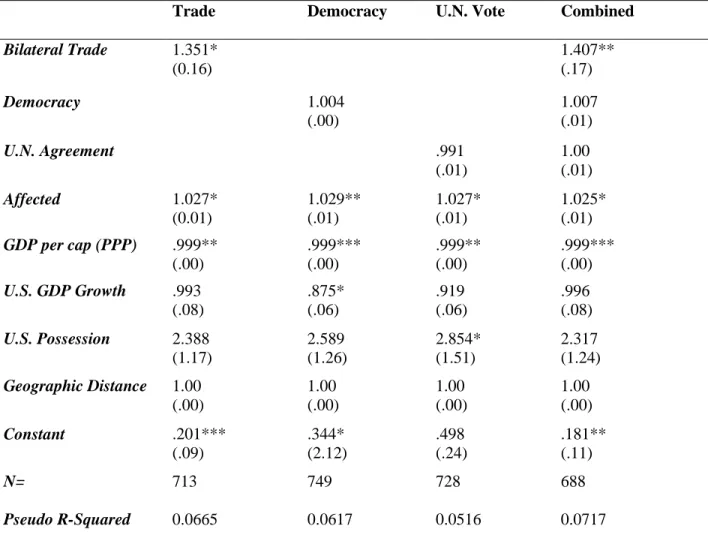
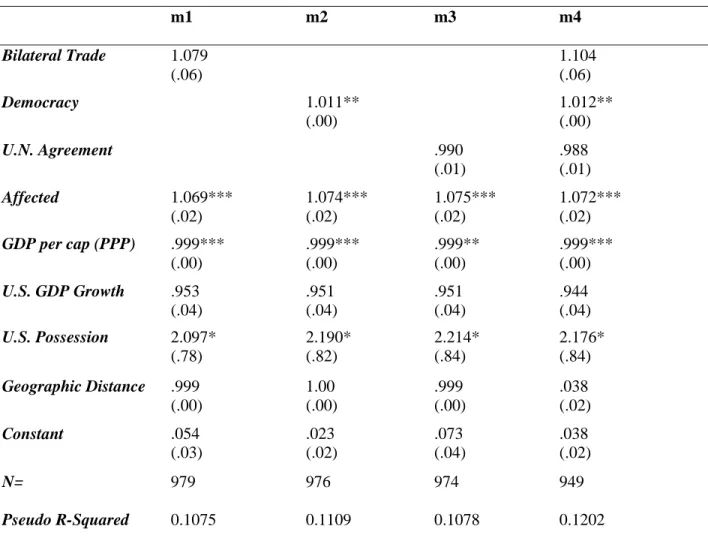
Additionally, I repeat the analyses described above after dividing the data into two
distinct time periods: pre and post-9/11. Thus, I have four separate logit and regression output
tables for this section: pre-9/11 selection, post-9/11 selection, pre-9/11 allocation, and post-9/11
allocation. As previously suggested, I do this to examine whether or not a disaster’s occurring
30 Running the models on the raw aid numbers provide results largely consistent with Table 2 below, except that neither U.N. agreement nor geographic distance are significant in any model. 31 Due to the fact that the data spanning 1991 to 2002 follows the fiscal year and that spanning
pre or post-9/11 changes the relative ability of each independent variable to predict U.S. aid
flows.
Results
Disasters 1991-2014
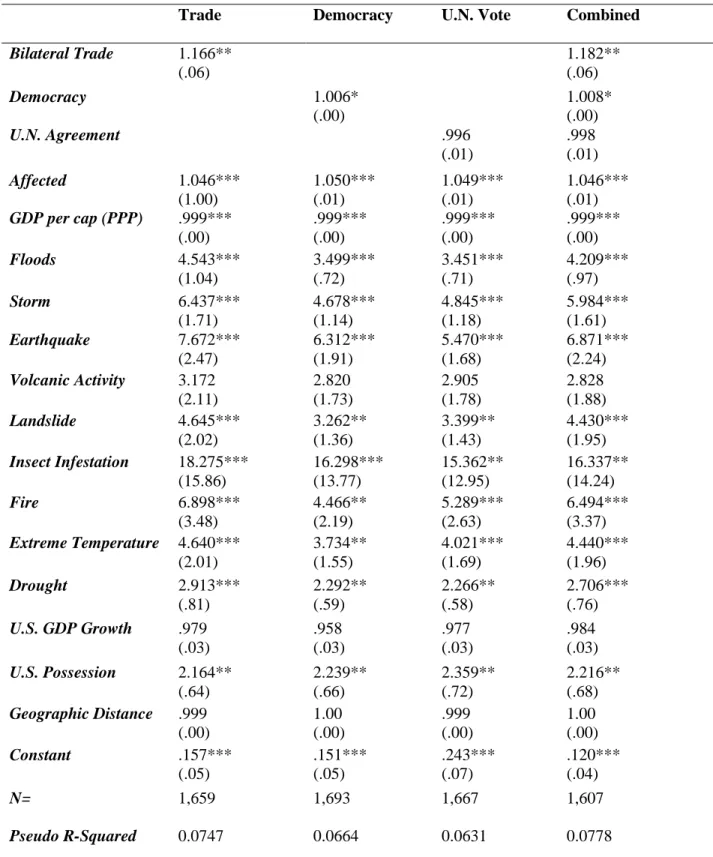
Table 1 summarizes the results of the selection stage logistic regressions on the entirety of the disaster data.32 Of the three key independent variables, only trade and democracy are
significant in any model. U.N. agreement, conversely, is not significant in any model. Trade is
significant at the 99% confidence level and democracy is significant at the 95% confidence level
in the models in which they are included. The odds ratios for both of these variables in all
models they are included in are above 1, meaning that both the extensiveness of trading
relationships with the U.S. and level of a country’s democracy have a positive relationship with
the odds of receiving aid. The odds ratios for these two variables are also relatively similar. Take
the ratios for these two variables in the fourth “Combined” model, for example. Odds ratios
compare two observations that are one unit apart, and the unit in these cases is a “1” or 1%.
Thus, for bilateral trade, a country with a 1% greater amount of bilateral trade with the U.S. (as a
portion of U.S. total trade) than another has 1.182 times the odds of receiving aid than the latter
does. For democracy, an observation with a 1% greater democracy score than another has 1.008
times the odds of receiving aid than the latter does. Therefore, in this stage, these two variables
have a significant and positive effect on aid selection and support my first and second
hypotheses. Further, the influence of the two variables in comparison to one another are
relatively equal, with trade’s effect being slightly larger.
Of the variables measuring need, both affected and GDP per capita (adjusted for PPP) are
significant in all four models at the 99.9% confidence level. The odds ratios for affected are all
around 1.05, meaning that an observation with a 1% greater percent of the population affected
than another has about 1.05 times the odds of receiving aid than the latter does (a positive
relationship). The odds ratios for GDP per capita are a bit less than 1, meaning that a country
with a lower GDP per capita has higher odds of receiving aid than a country with a higher GDP
per capita does. Thus, need does influence disaster relief aid selection, but it appears that trade
relationships and level of democracy do as well.
Additionally, several other control variables are significant in the selection stage. All
disaster type indicator variables are significant and positive at the 99% or 99.9% confidence
level except volcanic activity, and occurrences of earthquakes and insect infestations maintain
the greatest odds of receiving aid in all four models.33 History of U.S. possession is significant in
all models at the 99% confidence level, and the odds ratios for each model are near 2.2,
indicating that countries that have been possessed by the U.S. are about 2.2 times more likely to
receive aid than those that have not been. U.S. GDP growth and geographic distance are not
statistically significant in any model.
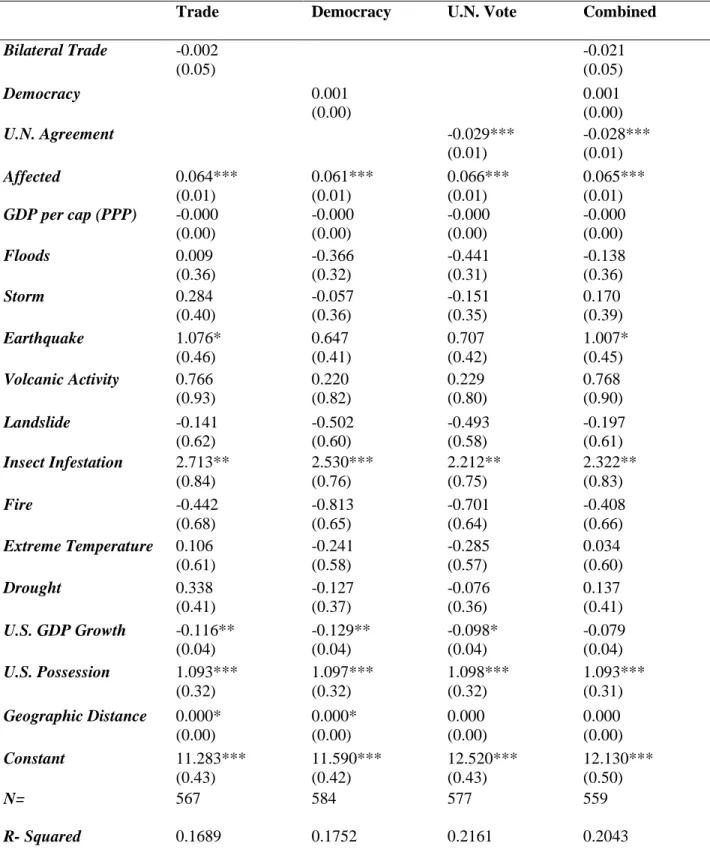
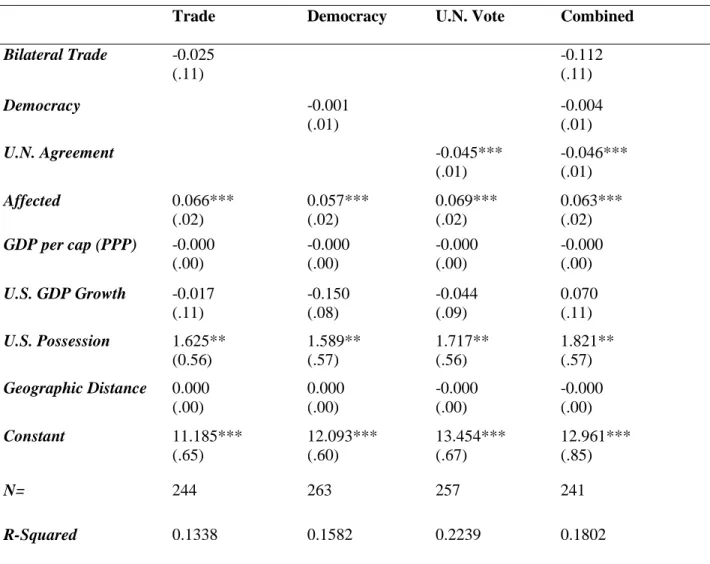
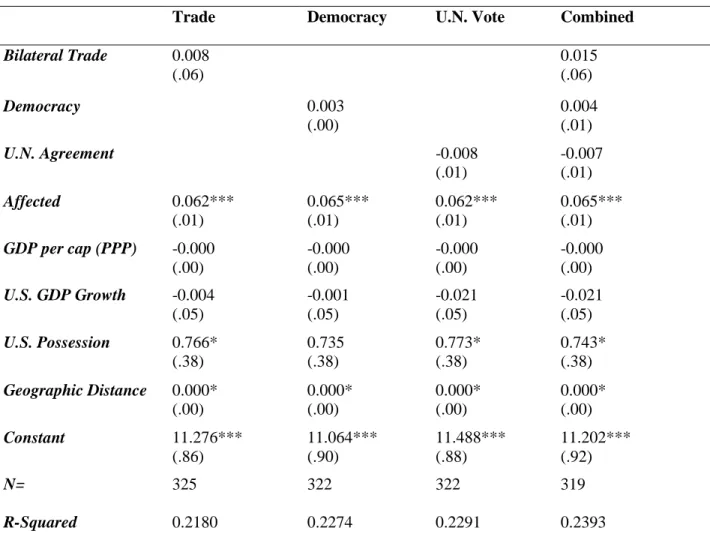
Table 2 summarizes the results of the allocation stage OLS regressions on the entire disaster dataset. Interestingly, whereas U.N. agreement is the only key independent variable that
is not significant in the selection stage, it is the only key independent variable that is significant
in the allocation stage. In both models in which it is included (“U.N. Vote” and “Combined”),
U.N. agreement is significant at the 99.9% confidence level. However, the coefficients are
33 The indicator variables may nearly all be significant because there are relatively few instances