Sharif University of Technology
Scientia IranicaTransactions C: Chemistry and Chemical Engineering http://scientiairanica.sharif.edu
A 3D polyoxoniobate-based framework showing
performance in dye removal from aqueous solution
B. Safarkoopayeh
a, A. Abbasi
a;, A.H. Mokarizadeh
b, A. Shayesteh
a,
and M. Naja
aa. School of Chemistry, College of Science, University of Tehran, Tehran, P.O. Box 14155-6455, Iran. b. School of Chemical Engineering, University of Tehran, Tehran, P.O. Box 1417466191, Iran. Received 26 December 2018; received in revised form 31 August 2019; accepted 7 October 2019
KEYWORDS Polyoxoniobate; Dye removal; X-ray structure; Water pollutant; DFT calculations; QTAIM.
Abstract. A polyoxoniobate-based 3D framework [K8H30Nb6O31] (1) was prepared
through a hydrothermal method and characterized by single crystal X-ray diraction, Powder X-Ray Diraction (PXRD), solid state UV-visible, and thermogravimetric analysis (TGA). Structure and properties of 1 were investigated by various computational methods. Quantum Theory of Atoms in Molecules (QTAIM) and NBO studies together with thermogravimetric analysis suggest the existence of strong interactions among potassium ion, Lindqvist hexaniobate, and water molecules. Hirshfeld surfaces around the Nb6O819
reveal that the Lindqvist ion acts as a 3 ligand for the alkali cations. One remarkable
detail about the structure is the presence of an encaged potassium ion, surrounded by six water molecules and four potassium ions. The prepared polyoxoniobate (PONb) was tested in the removal of diazo dye pollutant in water. The result shows that 1 has good activity and stability during the dye removal process and can be recovered and reused at least for ve cycles.
© 2019 Sharif University of Technology. All rights reserved.
1. Introduction
During the past few decades, global environmental pollution has become one of the most serious topics. Many industries such as textile, cosmetics, leather, and plastic expel many toxic and carcinogenic organic compounds that seriously pollute water [1-7]. Among such pollutants, organic dyes have a great inuence on photosynthetic activity in aquatic biota and, thus, the
*. Corresponding author. Tel.: +98 21 61113644; Fax: +98 21 66495291
E-mail addresses: [email protected] (B. Safarkoopayeh); a [email protected] (A. Abbasi); [email protected] (A.H. Mokarizadeh); [email protected] (A. Shayesteh);
[email protected] (M. Naja) doi: 10.24200/sci.2019.52548.2770
treatment of dye wastewater is of critical importance to modern societies.
Removal of dye pollutants by degradation is gen-erally challenging due to the intrinsic stability of these compounds towards light and oxidation reactions [8-10]. Various methods including physical, chemical, and biological approaches have been investigated for dye wastewater treatment [11-13]. Physical methods such as adsorption, ion-exchange, or liquid-liquid extraction have proven to be ineective towards pollutants, since they are easily transferred to other organic pollutants, leading to secondary pollution. Biological methods, on the other hand, suer from several limitations including high-cost equipment and low degradation rates [14,15]. On the contrary, Advanced Oxidation Process (AOP) that uses highly reactive radicals, such as hydroxyl radical and O2, oers excellent pathways for the degradation of organic dye pollutants in water.
3388 B. Safarkoopayeh et al./Scientia Iranica, Transactions C: Chemistry and ... 26 (2019) 3387{3399
This process, however, has its own disadvantages and requires low pH and UV light [16-19]. Therefore, investigations into more ecient catalytic systems are of critical importance to nd practical solutions to this problem. Owing to their ferroelectric, piezoelectric, and photocatalytic properties, niobate powders have recently attracted tremendous attention [20-25]. Poly-oxoniobates [26-32] and other polyoxometalates [33-40] have also proved to be ecient catalysts for numerous reactions such as water oxidation, dye degradation, chemical warfare degradation, Knoevenagel condensa-tion, and alcohol epoxidation.
In the present study, obtained ndings on the syn-thesis and characterization of a novel polyoxoniobate-based 3D framework [K8H30Nb6O31] (1), prepared
by hydrothermal method, are reported. Removal of Bismarck brown as a representative of dye pollutants is investigated in water and under mild conditions. Furthermore, this study performs calculations for de-termining relative geometric structures, Bond Order (B.O.), electron density, and other properties of the 3D framework using DFT calculations, QTAIM, NBO, and reduced density gradient.
2. Experimental
2.1. Materials and methods
All chemicals were purchased from commercial sources and used as received. Bismarck brown was obtained from Sigma. The PXRD patterns were recorded using a Philips diractometer with Cu K radiation
(K = 1:5406 A). The FT-IR spectra were acquired
on a Bruker Equinox 55 spectrometer equipped with a single reection diamond ATR system. The UV-Vis spectra were obtained using a Perkin Elmer Lambda 850 spectrophotometer.
2.2. Synthesis of K8H30Nb6O31
An aqueous solution (12 mL) containing 4.8 g potas-sium hydroxide and 2.65 g Nb2O5 was poured into
a 23 mL Teon-lined stainless-steel autoclave. The autoclave was sealed and heated in an oven at 200C for
24 h and, then, cooled to room temperature at a rate of 12.5C/h. Colorless block crystals suitable for X-ray
structural analysis were isolated by ltration, washed with distilled water, and dried at ambient temperature. 2.3. Synthesis of K6H2Nb6O19.13H2O Salt
K6H2Nb6O19.13H2O salt was synthesized using the
method proposed by Cavaleiro et al. In the typical synthesis, 30 mL aqueous solutions of KOH:Nb2O5
(60:1 ratio) were heated at 200C for 24 h. To the
obtained solution, an equivalent volume of absolute ethanol was added and the precipitated solid was ltered, washed with cold water-ethanol (50%), and dried at ambient temperature [41].
2.4. Single crystal X-ray diraction
X-ray data for the titled compound were collected on Marresearch 345 dtb diractometer using Mo K
radiation ( = 0:71073 A) at 295 K. The structure was solved by direct methods using SHELXS-97, and the obtained model was rened with SHELXL-97 [42]. All non-hydrogen atoms were rened anisotropically. Hydrogen atoms were added at ideal positions and rened using a riding model.
2.5. Dye removal procedure
In a typical procedure for the degradation of Bismarck brown, 30 mg of 1 was suspended in a fresh aqueous dye solution (C0 = 0:5 g/L, 100 mL), and the suspension
was stirred at a given time under mild conditions. The samples were withdrawn periodically for UV-Vis analysis to investigate the color removal of the dye at 457 nm. Dye removal was then calculated according to the following equation:
Color removal (%) = [(A0 A)=A0] 100; (1)
where A0 and A are the initial and nal absorbance
values of the dye, respectively. 3. Computational details
To get detailed insights into the electronic structure of 1, density functional theory calculations were done with the PBE0 functional [43] and the Def2-TZVP basis sets [44] using the ORCA 3.0.3 program [45]. The natural bond orbital analysis was performed using the GenNBO program, [46] and the bonding characteristics were analyzed by the quantum theory of atoms in molecules (QTAIM) and reduced density gradient with the Multiwfn 3.3.7 program [47].
4. Results and discussion 4.1. Structure of K8H30Nb6O31
Crystallographic parameters of 1 are given in Table 1. As seen in Figure 1, the asymmetric unit of this compound comprises [Nb4O12]4 , seven K+, and nine
water molecules. The polyoxoniobate (PONb) cluster contains six Nb centres with octahedral geometry. Four types of O atoms exist in 1 including terminal (Ot),
bridging (Ob), and two kinds of central O (Oc). Three
types of Nb-Ot are observed in the PONb in which
O atom is connected to one, two, or three K+ ions,
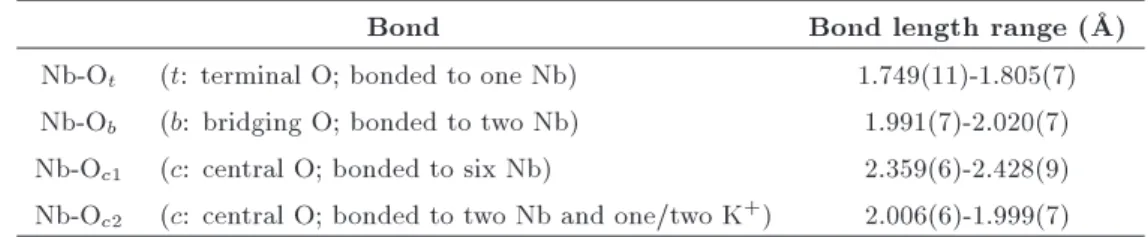
respectively. The bond length ranges for Nb-O are presented in Table 2. Three K+ ions are bonded to
the bridge oxygens (O6, O5, and O2), while the rest of K+ ions are connected to O
tatoms.
There are hydrogen bonding interactions between water molecules and O atoms of the PONb clusters (Figure 2(a)). Some of these interactions are shown in Table 3. The Nb6O819 anions are linked together
Table 1. Crystal and structure renement data for 1. Compound
Empirical formula K8H30Nb6O31
Molecular weight 1396.50
Crystal system Orthorhombic
Space group Pnma
Temperature (K) 293(2)
a (A) 23.996(5) A
b (A) 10.085(2) A
c (A) 13.008(3) A
= = () 90.00
Cell volume (A3) 3147.93(120) A3
Z 4
(g cm 3) 2.947
(mm 1) 3.279
Total reections 15987
Unique reections 3053
Observed reections [F2> 2(F2)] 2744
Data/restraints/parameters 3053/35/290 Goodness-of-t (GOF) on F2 1.114
R [F2> 2(F2)] (R
1, wR2) 0.0714, 0.1833
R (all data) (R1, wR2) 0.0787, 0.1890
through potassium cations and water molecules form-ing the 3D framework, depicted in Figure 2(b). 4.2. Molecular structure
Geometry optimization of Nb6O819 began with initial
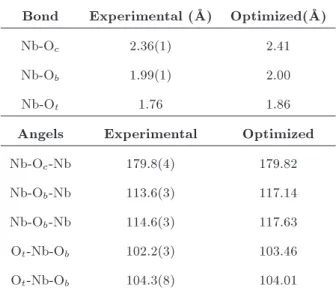
atomic coordinates from the single crystal X-ray struc-ture. Optimized bond lengths and bond angles of 1 are
Figure 1. ORTEP diagram of 1.
listed in Table 4. All bond lengths and angels are in good agreement with the experimental data obtained through single crystal X-ray diraction. Maximum deviations of the calculated bond lengths and bond angles from the experimental data are 0.10 A (Nb-Ot)
and 3.0 (Nb-Ob-Nb). These deviations originate from
the strong interaction of Ot and Ob with potassium
cations in the solid phase structure. For the optimiza-tion of encaged potassium ion and Lindqvist ion with its surrounding atoms, the X-ray experimental atomic
Table 2. Bond length range in 1.
Bond Bond length range (A)
Nb-Ot (t: terminal O; bonded to one Nb) 1.749(11)-1.805(7)
Nb-Ob (b: bridging O; bonded to two Nb) 1.991(7)-2.020(7)
Nb-Oc1 (c: central O; bonded to six Nb) 2.359(6)-2.428(9)
Nb-Oc2 (c: central O; bonded to two Nb and one/two K+) 2.006(6)-1.999(7)
Table 3. Hydrogen bonding interactions in 1.
DH...A D...A D-H H...A <D-H-A Symm. code
O14H14A...O11 2.874(12) 0.85(9) 2.02(10) 175(14) x; 3=2 y; z O19H19A...O11 2.750(12) 0.85(10) 1.94(10) 159(11) x; y; z
O15H15A...O3 2.680(16) 0.85(5) 1.84(4) 167(18) 1=2 x; 1 y; 1=2 + z O13H13B...O10 2.710(12) 0.86(14) 1.93(14) 150(16) 1=2 x; 1 y; 1=2 + z
3390 B. Safarkoopayeh et al./Scientia Iranica, Transactions C: Chemistry and ... 26 (2019) 3387{3399
Figure 2. (a) hydrogen bonding interactions. (b) Packing in 1. Table 4. Selected bond lengths and angles in 1.
Bond Experimental (A) Optimized(A)
Nb-Oc 2.36(1) 2.41
Nb-Ob 1.99(1) 2.00
Nb-Ot 1.76 1.86
Angels Experimental Optimized
Nb-Oc-Nb 179.8(4) 179.82
Nb-Ob-Nb 113.6(3) 117.14
Nb-Ob-Nb 114.6(3) 117.63
Ot-Nb-Ob 102.2(3) 103.46
Ot-Nb-Ob 104.3(8) 104.01
coordinates were xed and only the hydrogen atoms were optimized.
4.3. Molecular crystal analysis with Hirshfeld surfaces
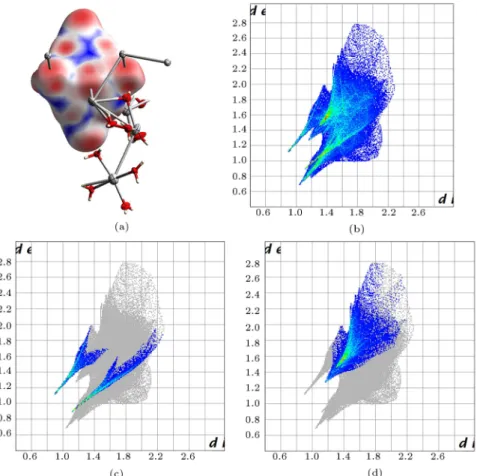
In order to obtain deeper insights into intermolec-ular interactions in the molecintermolec-ular crystal, Hirshfeld surface [48-50] and the related 2D-ngerprint plot [51-53] were calculated by crystal explorer software [54]. Hirshfeld surface and the related 2D-ngerprint plots for the hexaniobate are shown in Figure 3. It can be seen that the most important interactions surrounding Nb6O819 are Nb...O/O...Nb (14.9%) and
K...O/O...K (24.7%) and appear as spikes in 2D n-gerprint plots.
The investigation of Hirshfeld surfaces around Nb6O19reveals that one of the favored bonding modes
for potassium cations is on the face of the super
octahedron and through three K+ O
b links; in other
words, the Lindqvist ion acts as a 3ligand to the alkali
cations. Another favored bonding mode is found to be bonding between terminal oxygen (Ot) and potassium
cations (Figure 4).
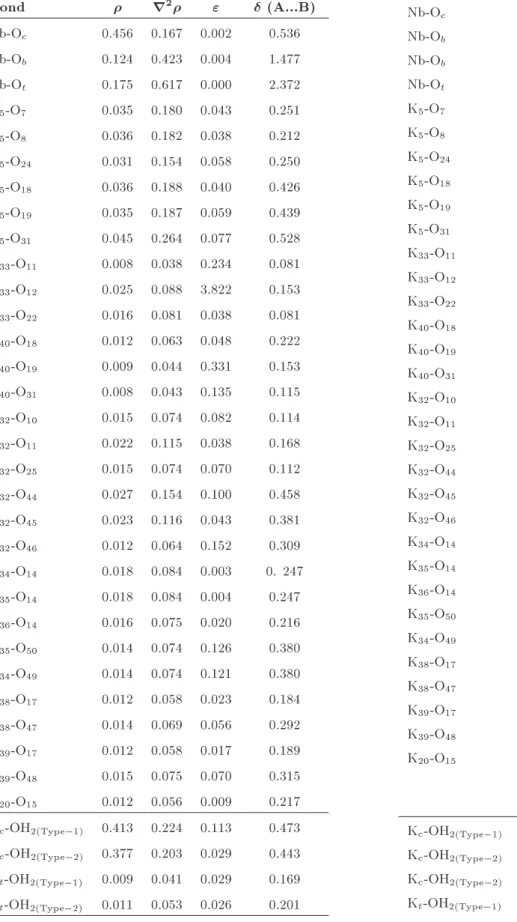
Hirshfeld surface and the related 2D-Fingerprint plots for the encaged potassium ion are shown in Figure 5. The dominant interactions surrounding the encaged potassium are O...H/H...O/O (37.3%) and K...O/O...K (13.6%) and appear as spikes in 2D ngerprint plots. The red spot over the potassium ion conrms the presence of rather strong interactions between potassium cation and water molecules. 4.4. QTAIM and reduced density gradient The most ecient method to analyze the electron density is Quantum Theory of Atoms In Molecules (QTAIM) [55,56]. It was used here to obtain a better insight into bonding characteristics in 1 and the encaged potassium ion in the molecular crystal. For this purpose, QTAIM and NBO calculations were performed on the packing structure of 1 (Figure 6) to provide a better understanding of the strength of intermolecular interactions in the solid structure. In addition, reduced density gradient analysis was performed on the encaged potassium to investigate the bonds in more detail [57]. QTAIM result shows considerable electron sharing between potassium ion and oxygen atoms in Lindqvist hexaniobate ion with the surrounding atoms. The results are summarized in Table 5.
The Delocalization Indices (DI) for these bonds indicate considerable amounts of electron sharing be-tween potassium ions and water molecules. The re-duced density gradient analysis conrmed the presence of weak and moderate interactions in the encaged
Figure 3. (a) Hirshfeld surfaces mapped with dnormfor Nb6O19. (b) Respected ngerprint plot. (c) Nb...O/O...Nb
highlighted. (d) K...O/O...K highlighted.
Figure 4. 3 bonding mode of the super-octahedron
cluster face to alkali cations.
potassium structure. The gradient isosurface for the encaged potassium is displayed in Figure 7.
4.5. Natural bond orbitals
The NBO method is used in order to understand the intra-molecular interaction of 1 and the encaged
potassium and to complete the information obtained by QTAIM and reduced density gradient analysis. The calculated Mayer bond indices and natural atomic charges are given in Table 6. NBO results of atomic charges agree with the calculated electrostatic poten-tial map of [Nb6O19]8 (Figure S1 in Supplementary
Information).
4.6. Thermogravimetric analysis (TGA) The thermal properties of 1 were studied by TGA in the temperature range of 30-600C. TGA analysis
of 1 is shown in Figure 8. The major weight loss up to 225C was attributed to the decomposition of
compound 1. It was found that the mass loss value of 16.17% was consistent with a calculated value of 15.47%, which is attributed to crystalline water of compound 1.
4.7. Spectroscopic studies
Lindqvist hexaniobate exists in water as: [ H3Nb6O19]5 ; [H2Nb6O19]6 ;
[HNb6O19]7 ; and [Nb6O19]8 ;
at pH = 8, 10, 12, and 14, respectively [58]. Solid state UV-visible spectrum of 1 and solution spectra of
3392 B. Safarkoopayeh et al./Scientia Iranica, Transactions C: Chemistry and ... 26 (2019) 3387{3399
Figure 5. (a) Hirshfeld surfaces mapped with dnorm for encage potassium ion. (b) Respected ngerprint plot. (c)
K...O/O...K highlighted. (d) O...H/H...O highlighted.
Figure 6. Lindqvist hexaniobate ion with its surrounding atoms.
hexaniobate salt at dierent pH values were recorded (Figure 9). All possible hydrogenated structures, i.e., two possible structures for [HNb6O19]7 , seven
for [H2Nb6O19]6 , and twenty two for [H3Nb6O19]5 ,
were optimized with the PBE0 functional and the def2-TZVP basis sets in water using the COSMO solvation model [59,60]. Structures and their relative energies are summarized in Figure S2 and Table S1 (see Supplementary Information). The lowest energy isomer for each protonation state was chosen for DFT calculations. As shown in Figure 9(b), the TD-DFT spectra at both pH values (8 and 10) agree well with the experimental data.
4.8. Dye removal process
The dye removal of 1 is evaluated in the color removal of Bismarck brown as a diazo dye pollutant in water un-der mild conditions. The corresponding color removal eciency of the dye is calculated using calibration curve (Figure S3 in Supplementary Information) and Eq. (1). From Figure 10, it can be seen that the absorption intensity of the dye decreases as the reaction progresses. These results suggest that compound 1 can act as an active catalyst for organic dye removal. In order to investigate the eect of sunlight, the catalytic experiment was repeated in a dark environment as well. The decolorization eciency was the same, suggesting that sunlight cannot rule out the catalytic process.
Table 5. Bond critical point electron densities (), their Laplacin (r2), ellipticities ("), and delocalization index
for selected bonds in 1 and for the encaged potassium.
Bond r2 " (A...B)
Nb-Oc 0.456 0.167 0.002 0.536
Nb-Ob 0.124 0.423 0.004 1.477
Nb-Ot 0.175 0.617 0.000 2.372
K5-O7 0.035 0.180 0.043 0.251
K5-O8 0.036 0.182 0.038 0.212
K5-O24 0.031 0.154 0.058 0.250
K5-O18 0.036 0.188 0.040 0.426
K5-O19 0.035 0.187 0.059 0.439
K5-O31 0.045 0.264 0.077 0.528
K33-O11 0.008 0.038 0.234 0.081
K33-O12 0.025 0.088 3.822 0.153
K33-O22 0.016 0.081 0.038 0.081
K40-O18 0.012 0.063 0.048 0.222
K40-O19 0.009 0.044 0.331 0.153
K40-O31 0.008 0.043 0.135 0.115
K32-O10 0.015 0.074 0.082 0.114
K32-O11 0.022 0.115 0.038 0.168
K32-O25 0.015 0.074 0.070 0.112
K32-O44 0.027 0.154 0.100 0.458
K32-O45 0.023 0.116 0.043 0.381
K32-O46 0.012 0.064 0.152 0.309
K34-O14 0.018 0.084 0.003 0. 247
K35-O14 0.018 0.084 0.004 0.247
K36-O14 0.016 0.075 0.020 0.216
K35-O50 0.014 0.074 0.126 0.380
K34-O49 0.014 0.074 0.121 0.380
K38-O17 0.012 0.058 0.023 0.184
K38-O47 0.014 0.069 0.056 0.292
K39-O17 0.012 0.058 0.017 0.189
K39-O48 0.015 0.075 0.070 0.315
K20-O15 0.012 0.056 0.009 0.217
Kc-OH2(Type 1) 0.413 0.224 0.113 0.473
Kc-OH2(Type 2) 0.377 0.203 0.029 0.443
Kt-OH2(Type 1) 0.009 0.041 0.029 0.169
Kt-OH2(Type 2) 0.011 0.053 0.026 0.201 Note: Kc: Central potassium ion; Kt: Terminal potassium ion.
Table 6. Mayer B.O. and natural atomic charges of the selected bonds and atoms in 1 and encaged potassium.
Bond B.O. Atom Charge
Nb-Oc 0.164 Nb 1.64
Nb-Ob 0.724 Oc -1.04
Nb-Ob 0.772 Ob -0.90
Nb-Ot 1.495 Ot -1.00
K5-O7 0.044 K5 0.89
K5-O8 0.075 K20 0.99
K5-O24 0.030 K33 0.97
K5-O18 0.046 K32 0.95
K5-O19 0.038 K34 0.97
K5-O31 0.054 K35 0.97
K33-O11 0.075 K36 0.97
K33-O12 0.104 K38 0.98
K33-O22 0.076 K39 0.98
K40-O18 0.125 K40 0.99
K40-O19 0.104 O7 -1.05
K40-O31 0.080 O8 -1.01
K32-O10 0.012 O10 -0.90
K32-O11 0.025 O11 -1.02
K32-O25 0.010 O12 -0.98
K32-O44 0.105 O14 -1.16
K32-O45 0.088 O15 -0.89
K32-O46 0.072 O18 -0.99
K34-O14 0.160 O19 -1.04
K35-O14 0.161 O22 -0.98
K36-O14 0.147 O24 -1.03
K35-O50 0.109 O25 -0.91
K34-O49 0.108 O31 -1.03
K38-O17 0.128 O44 -0.96
K38-O47 0.107 O45 -0.98
K39-O17 0.077 O46 -0.97
K39-O48 0.117 O47 -1.03
K20-O15 0.180 O48 -1.05
O49 -1.01
O50 -1.01
Kc-OH2(Type 1) 0.112 Kc 0.99
Kc-OH2(Type 2) 0.111 Kt 0.99
Kc-OH2(Type 2) 0.111 O -1.01
Kt-OH2(Type 1) 0.101
3394 B. Safarkoopayeh et al./Scientia Iranica, Transactions C: Chemistry and ... 26 (2019) 3387{3399
Figure 7. (a) Gradient isosurfaces (s = 0:5). (b) Respected RDG plot of encaged potassium.
Figure 8. TGA curve of 1.
Geometry optimization of Bismarck brown struc-ture suggests that the approximate geometric size of the dye molecule is as 17:0310:2610:26 A (Figure S4 in Supplementary Information). The combination of this result and the packing structure of 1 (Figure 2) reveals that cavities in 1 are not capable of taking the dye.
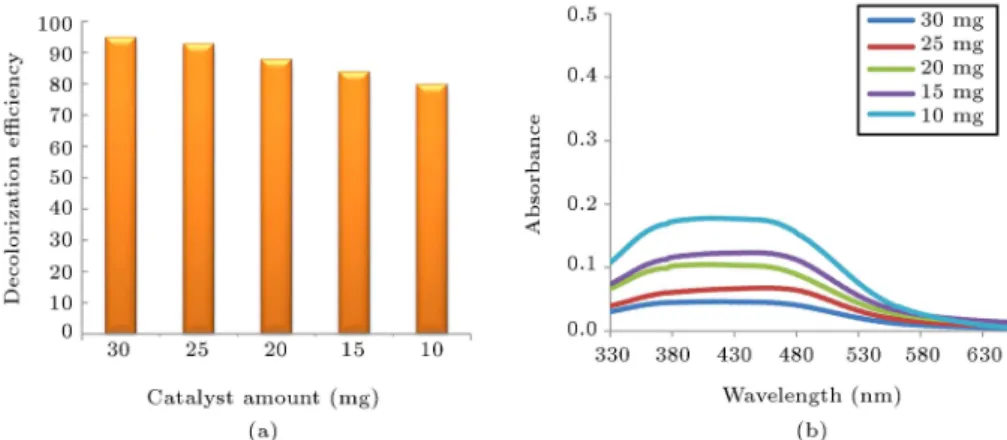
In order to study the eect of the catalyst amount on the color removal process, experiments were carried out in the presence of dierent amounts of the cat-alysts, while the other variables were kept constant. The results, summarized in Figure 11, show that by decreasing the amount of the catalyst from 30 to 10 mg, the decolorization eciency decreases from 95 to 80.
The life span of a catalyst is of great importance when considering its industrial applications. Herein, this study examined the catalytic recyclability by re-covering and reusing the catalysts for ve cycles. After each experiment, the suspensions were centrifuged and the catalysts were separated. The recycled catalysts were washed with acetone and water and, then, were reused in the next catalytic experiment. The
decol-Figure 9. (a) Solid state UV-visible spectrum of 1. (b) Solution UV-visible spectra of partially protonated Nb6O819 and the related theoretical spectra from TD-DFT
calculations.
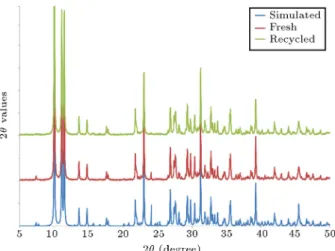
orization eciency of the dye in the presence of the recovered catalyst is illustrated in Figure 12(a). It is evident that the catalytic activity of the recycled catalysts remains almost unchanged after ve repeated experiments. The PXRD patterns (Figure 13) of the catalysts after and before the catalytic reactions are the
Figure 10. (a) Color removal activity of 1. (b) UV-Vis spectra of Bismarck brown during the color removal process in the presence of 1.
Figure 11. (a) Decolorization eciency of Bismarck brown dye using dierent amounts of the catalysts. (b) UV-Vis spectra of Bismarck brown after 30 min treatment with dierent amounts of 1.
Figure 12. (a) Decolorization eciency of Bismarck brown dye using recovered 1. (b) UV-Vis spectra of Bismarck brown after 30 min treatment with recovered 1.
same, indicating the stability of the catalysts during the decolorization process.
From Figure 14, it can be seen that the FT-IR spectrum of the dye molecule has changed after the dye removal process. The FT-IR spectrum of the Bismarck brown exhibits bands at 875 and 709 cm 1,
corresponding to aromatic C{H stretching and bending vibrations, respectively. The stretching vibrations of aromatic C=C bonds are observed at 1520 1627
cm 1, and the band at 1242 cm 1 is attributed to
the C{N stretching vibration. After about 20 min, the intensities of the bands decrease, suggesting the degra-dation of the dye structure. The Ion Chromatography (IC) analysis of the dye solution after decolorization showed that the dye mineralized into inorganic species such as NO3, NO2, and Cl indicated the catalytic process of the dye removal (Figure S5 in Supplementary Information).
3396 B. Safarkoopayeh et al./Scientia Iranica, Transactions C: Chemistry and ... 26 (2019) 3387{3399
Figure 13. Powder X-ray diraction patterns of 1.
Figure 14. Changes in the FT-IR spectra of Bismarck brown before and after contacting with 1.
5. Conclusion
A novel polyoxoniobate-based 3D framework [K8H30Nb6O31] (1) was prepared through the
hydrothermal process and characterized by single crystal X-ray diraction. The structure and properties of 1 were fully investigated with various computational methods. The results of these calculations together with thermogravimetric analysis suggested strong interactions among potassium ion, Lindquist hexaniobate, and water molecules, which led to the formation of a 3D niobate framework. It was found that compound 1 acted as an ecient catalyst for removing Bismarck brown as a typical diazo dye pollutant in wastewaters. Compound 1 showed good stability during the color removal process and could be easily separated from the aqueous suspension and reused for at least ve cycles.
Supplementary Information
Supplementary Information is available at:
http://scientiairanica.sharif.edu/jule?ar sle=124313
Acknowledgments
The authors appreciate the University of Tehran for nancial support.
References
1. Ahuja, S. and Hristovski, K., Novel Solutions to Water Pollution, ACS Publications (2013).
2. Bunzel, K., Kattwinkel, M., and Liess, M. \Ef-fects of organic pollutants from wastewater treatment plants on aquatic invertebrate communities", Water Research, 47, pp. 597-606 (2013).
3. Malaj, E., Peter, C., and Grote, R. \Organic chemicals jeopardize the health of freshwater ecosystems on the continental scale", PNAS, 111, pp. 9549-9554 (2014).
4. Copaciu, F., Opris, O., and Coman, V. \Diuse water pollution by anthraquinone and azo dyes in environ-ment importantly alters foliage volatiles, carotenoids and physiology in wheat (Triticum aestivum)", Water, Air, Soil Pollut, 224, p. 1478 (2013).
5. Bafana, A., Devi, S., and Chakrabarti, T. \Azo dyes: past, present and the future", Environ. Rev, 19, pp. 350-371 (2011).
6. Spellman, F.R., The Drinking Water Handbook, CRC Press (2017).
7. Hassaan, M.A. and El Nemr, A. \Health and envi-ronmental impacts of dyes: mini review", Am. J. of Environ. Sci. Eng., 1, pp. 64-67 (2017).
8. Chen, S., Zhang, J., and Zhang, C. \Equilibrium and kinetic studies of methyl orange and methyl violet ad-sorption on activated carbon derived from Phragmites australis", Desalination, 252, pp. 149-156 (2010).
9. Ding, J., Yang, Z., He, C., et al. \UiO-66 (Zr) coupled with Bi2MoO6 as photocatalyst for
visible-light promoted dye degradation", J. Colloid Interface Sci., 497, pp. 126-133 (2017).
10. Zhao, H., Xia, Q., Xing, H., et al. \Construction of pillared-layer MOF as ecient visible-light pho-tocatalysts for aqueous Cr (VI) reduction and dye degradation", ACS Sustain Chem Eng, 5, pp. 4449-4456 (2017).
11. Crini, G. \Non-conventional low-cost adsorbents for dye removal: a review", Bioresour. Technol., 97, pp. 1061-1085 (2006).
12. Mittal, A., Malviya, A., and Kaur, D., et al. \Studies on the adsorption kinetics and isotherms for the re-moval and recovery of methyl orange from wastewaters using waste materials", J. Hazard. Mater., 148, pp. 229-240 (2007).
13. Mahmoodi, N., Abdi, M., Oveisi, J., et al. \Metal-organic framework (MIL-100 (Fe)): Synthesis, detailed photocatalytic dye degradation ability in colored tex-tile wastewater and recycling", Mater. Res. Bull, 100, pp. 357-366 (2018).
14. Baldrian, P., Merhautova, V., Gabriel, J., et al. \Decolorization of synthetic dyes by hydrogen peroxide with heterogeneous catalysis by mixed iron oxides", Appl. Catal., B., 66, pp. 258-264 (2006).
15. Bilal, M., Iqbal, H.M., Hu, H., et al. \Enhanced bio-catalytic performance and dye degradation potential of chitosan-encapsulated horseradish peroxidase in a packed bed reactor system", Sci. Total Environ., 575, pp. 1352-1360 (2017).
16. Karcher, S., Kornmuller, A., and Jekel, M. \Anion exchange resins for removal of reactive dyes from textile wastewaters", Water Research, 36, pp. 4717-4724 (2002).
17. Gemeay, A.H., Mansour, I.A., El-Sharkawy, R.G., et al. \Kinetics and mechanism of the heterogeneous catalyzed oxidative degradation of indigo carmine", J. Mol. Catal. A: Chem., 193, pp. 109-120 (2003).
18. Atchudan, R., Edison, T., Perumal, S.I., et al. \Ef-fective photocatalytic degradation of anthropogenic dyes using graphene oxide grafting titanium dioxide nanoparticles under UV-light irradiation", J. Pho-tochem. Photobiol., A., 333, pp. 92-104 (2017).
19. Salama, A., Mohamed, A., Aboamera, N.M., et al. \Photocatalytic degradation of organic dyes using composite nanobers under UV irradiation", App. Nan. Sci., 8, pp. 155-161 (2018).
20. Roof, I.P., Park, S., Vogt, T., et al. \Crystal growth of two new niobates, La2KNbO6 and Nd2KNbO6:
struc-tural, dielectric, photophysical, and photocatalytic properties", Chem. Mater., 20, pp. 3327-3335 (2008).
21. Li, G., Kako, T., Wang, D., et al. \Composition dependence of the photophysical and photocatalytic properties of (AgNbO3)1 x (NaNbO3)x solid
solu-tions", J. Solid State Chem., 180, pp. 2845-2850 (2007).
22. Xing, J., Tan, Z., Yuan, J., et al. \Structure and electrical properties of (0:965 x)(K 0.48 Na 0.52) NbO3 x BiGaO3 0:035 (Bi 0.5 Na 0.5) ZrO3
piezoelectric ceramics", RSC Advances, 6, pp. 57210-57216 (2016).
23. Katsumata, K., Cordonier, C.E., Shichi, T., et al. \Photocatalytic activity of NaNbO3 thin lms",
JACS., 131, pp. 3856-3857 (2009).
24. Oliveira, L., Gonsalves, M., Guerreiro, M., et al. \A new catalyst material based on niobia/iron oxide composite on the oxidation of organic contaminants in water via heterogeneous Fenton mechanisms", Appl. Catal., A., 316, pp. 117-124 (2007).
25. Wang, C., Zhang, M., Stern, B., et al. \Nanophotonic lithium niobate electro-optic modulators", Optics Ex-press, 26, pp. 1547-1555 (2018).
26. Feliczak, A., Walczak, K., Wawrzynczak, A., et al. \The use of mesoporous molecular sieves containing niobium for the synthesis of vegetable oil-based prod-ucts", Catal. Today., 140, pp. 23-29 (2009).
27. Dong, J., Hu, J., Chi, Y., et al. \A polyoxoniobate-polyoxovanadate double-anion catalyst for simulta-neous oxidative and hydrolytic decontamination of chemical warfare agent simulants", Angew. Chem. Int. Ed., 56, pp. 4473-4477 (2017).
28. Liu, Y., Guo, S., Ding, L., et al. \Lindqvist polyox-oniobate ion-assisted electrodeposition of cobalt and nickel water oxidation catalysts", ACS Appl. Mater. Interfaces., 7, pp. 16632-16644 (2015).
29. Li, L., Niu, Y., Dong, K., et al. \A Ni-containing decaniobate incorporating organic ligands: synthesis, structure, and catalysis for allylic alcohol epoxida-tion", RSC Advances, 7, pp. 28696-28701 (2017).
30. Kinnan, M.K., Creasy, W.R., Fullmer, L., et al. \Nerve agent degradation with polyoxoniobates", Eur. J. Inorg. Chem., pp. 2361-2367 (2014).
31. Ge, W., Wang, X., Zhang, L., et al. \Fully-occupied Keggin type polyoxometalate as solid base for cat-alyzing CO2 cycloaddition and Knoevenagel
conden-sation", Cat. Sci. & Tech., 6, pp. 460-467 (2016).
32. Xu, Q., Niu, Y., Wang, G., et al. \Polyoxoniobates as a superior Lewis base eciently catalyzed Knoevenagel condensation", J. Mol. Catal., 453, pp. 93-99 (2018).
33. Zheng, R., Zhang, H., Liu, Y., et al. \Ag-ligand modied tungstovandates and their ecient catalysis degradation properties for methylene blue", J. Solid State Chem., 246, pp. 258-263 (2017).
34. Liu, Y., Zheng, R., Han, Z., et al. \Supramolecular hybrids of polytungstates and their adsorption prop-erties for methylene blue", J. Solid State Chem., 231, pp. 169-174 (2015).
35. Tella, A.C., Olawale, M.D., Neuburger, M., et al. \Synthesis and crystal structure of Cd-based metal-organic framework for removal of methyl-orange from aqueous solution", J. Solid State Chem., 255, pp. 157-166 (2017).
36. Yan, J., Zhao, X., Huang, J., et al. \Synthesis and characterization of two polyoxometalates consisting of dierent Cu-ligand hydrogen phosphate units", J. Solid State Chem., 211, pp. 200-205 (2014).
37. Teng, C., Xiao, H., Cai, Q., et al. \Two supramolecular complexes based on polyoxometalates and Co-EDTA units via covalent connection or non-covalent interac-tion", J. Solid State Chem., 243, pp. 146-153 (2016).
38. Zhang, H., Guo, L., Jiao, J., et al. \Ionic self-assembly of polyoxometalate-dopamine hybrid nanoowers with excellent catalytic activity for dyes", ACS Sustain Chem Eng., 5, pp. 1358-1367 (2017).
3398 B. Safarkoopayeh et al./Scientia Iranica, Transactions C: Chemistry and ... 26 (2019) 3387{3399
39. Farhadi, S., Mahmoudi, F., Amini, M.M., et al. \Synthesis and characterization of a series of novel perovskite-type LaMnO3/Keggin-type
polyoxometa-late hybrid nanomaterials for fast and selective removal of cationic dyes from aqueous solutions", J. Chem. Soc., Dalton Trans., 46, pp. 3252-3264 (2017).
40. Herrmann, S., Matteis, L., de la Fuente, J., et al. \Removal of multiple contaminants from water by polyoxometalate supported ionic liquid phases (POM-SILPs)", Angew. Chem. Int. Ed., 56, pp. 1667-1670 (2017).
41. Santos, I., Loureiro, L., Silva, M., et al. \Studies on the hydrothermal synthesis of niobium oxides", Polyhedron., 21, pp. 2009-2015 (2002).
42. Sheldrick, G.M. \A short history of SHELX", Acta Crystallogr Sect A: Found Crystallogr, 64, pp. 112-122 (2008).
43. Perdew, J.P., Ernzerhof, M., and Burke, K. \Rationale for mixing exact exchange with density functional approximations", J. Chem. Phys., 105, pp. 9982-9985 (1996).
44. Weigend, F. and Ahlrichs, R. \Balanced basis sets of split valence, triple zeta valence and quadruple zeta valence quality for H to Rn: Design and assessment of accuracy", Phys. Chem. Chem. Phys., 7, pp. 3297-3305 (2005).
45. Neese, F. \The ORCA program system", Wires Com-put Mol Sci., 2, pp. 73-78 (2012).
46. Weinhold, F. and Landis, C.R. \Natural bond orbitals and extensions of localized bonding concepts", Chem Educ Res Pract., 2, pp. 91-104 (2001).
47. Lu, T. and Chen, F. \Multiwfn: a multifunctional wavefunction analyzer", J. Comput. Chem., 33, pp. 580-592 (2012).
48. Spackman, M.A. and Jayatilaka, D. \Hirshfeld surface analysis", CrystEngComm, 11, pp. 19-32 (2009).
49. Hirshfeld, F.L. \Bonded-atom fragments for describing molecular charge densities" , Theor. Chem. Acc., 44, pp. 129-138 (1977).
50. Clausen, H.F., Chevallier, M.S., Spackman, M.A., et al. \Three new co-crystals of hydroquinone: crystal structures and Hirshfeld surface analysis of intermolec-ular interactions", New J. Chem., 34, pp. 193-199 (2010).
51. Rohl, A.L., Moret, M., Kaminsky, W., et al. \Hirsh-feld surfaces identify inadequacies in computations of intermolecular interactions in crystals: pentamorphic 1, 8-dihydroxyanthraquinone", Cryst. Growth Des., 8, pp. 4517-4525 (2008).
52. Parkin, A., Barr, G.J., Spackman, M.A., et al. \Com-paring entire crystal structures: structural genetic n-gerprinting", CrystEngComm, 9, pp. 648-652 (2007).
53. Spackman, M.A. and McKinnon, J.J. \Fingerprint-ing intermolecular interactions in molecular crystals", CrystEngComm, 4, pp. 378-392 (2002).
54. Wol, S., Grimwood, D., McKinnon, J., Jayatilaka, D., and Spackman, M. (2007).
55. Bader, R., The Quantum Theory of Atoms in Molecules, Clarendon Press, Oxford (1990).
56. Matta, C.F. and Boyd, R.J. \An introduction to the quantum theory of atoms in molecules", The Quantum Theory of Atoms in Molecules: From Solid State to DNA and Drug Design, Wiley (2007).
57. Johnson, E.R., Keinan, S., Mori-Sanchez, P., et al. \Revealing noncovalent interactions", JACS., 132, pp. 6498-6506 (2010).
58. Black, J., Nyman, M., Casey, W. \Kinetics of 17O-exchange reactions in aqueous metal-oxo nanoclus-ters", Geochim. Cosmochim. Acta., 70, p. A53 (2006).
59. Klamt, A. \Conductor-like screening model for real solvents: a new approach to the quantitative calcu-lation of solvation phenomena", J. Phys. Chem., 99, pp. 2224-2235 (1995).
60. Klamt, A. \The COSMO and COSMO-RS solvation models", Wires. Comput. Mol. Sci., 1, pp. 699-709 (2011).
Appendix
Supporting data CSD 431187 contains the supple-mentary crystallographic data for complex. These data are available free of charge via www.ccdc. cam.ac.uk/conts/retrieving.html, or from the Cam-bridge Crystallographic Data Centre, 12, Union Road, Cambridge CB2 1EZ, UK fax: +44-1223-336033; or [email protected].
Biographies
Barzin Safarkoopayeh received his MSc from Sharif University of Technology in 2014; currently, he is a PhD Student at University of Tehran. His re-search interest is synthesis and characterization of new MOFs and investigating their gas adsorption properties and predicting absorption/emission spectra of light emitting diodes using TD-DFT and multireference CASSCF/NEVPT2 computational methods.
Alireza Abbasi received his BSc degree in Applied Chemistry from Sharif University of Technology in 1996; he obtained MSc and PhD degrees in Structural Chemistry from Stockholm University in 2003 and 2005, respectively. He is currently a Full Professor at the School of Chemistry, College of Science, Univer-sity of Tehran. His research interests include X-ray crystallography, structural chemistry, metal-organic frameworks, nanomaterials and catalysis.
Abdol Hadi Mokarizadeh received his MSc from Chemical Engineering, University of Tehran. During his master's studies, he worked on molecular dynamic
and Monte Carlo simulations. Currently, he is spending his PhD at University of Akron Polymer Science, USA. Alireza Shayesteh received a BSc degree from Uni-versity of Isfahan in 2001 and a PhD degree from University of Waterloo in 2006. He is currently an As-sociate Professor of Physical Chemistry in University of Tehran. Moreover, his research interests are molecular spectroscopy and computational chemistry.
Mahnaz Naja received her BSc and MSc degrees in Pure and Inorganic Chemistry from Alzahra University in 2005 and 2008, respectively. She obtained her PhD degree in Inorganic Chemistry from University of Tehran in 2015 and, then, undertook post-doctoral research in the eld of catalysis in the group of Professor Alireza Abbasi. Her research interests in-clude polyoxometalates, coordination polymers, and nanomaterials as catalysts.