Samuel J. Stover. Web-Based Internal Communication Tools in ARL Reference Departments. A Master’s Paper for the M.S. in L.S degree. April, 2012. 38 pages. Advisor: Barbara B. Moran
This study is an exploratory survey of the Web-based internal communication tools used by reference departments in member institutions of the Association of Research Libraries (ARL). In particular, Web 2.0 technologies contribute significantly to collaborative content creation and knowledge management, and reference departments have adopted them for various functions within staff workflow. The results of this study indicate that many reference departments have implemented Web 2.0 technologies for staff
communication, to various ends and varying degrees of success. In addition to recommending best practices for their implementation, areas for further research are suggested.
Headings:
Communication & Technology
Academic Libraries -- Reference Services Web 2.0
Blogs
by
Samuel J. Stover
A Master’s paper submitted to the faculty of the School of Information and Library Science of the University of North Carolina at Chapel Hill
in partial fulfillment of the requirements for the degree of Master of Science in
Library Science.
Chapel Hill, North Carolina April 2012
Approved by
Table of Contents
Table of Tables...2
Introduction...3
Literature Review...5
Web 2.0 Technologies...6
Wikis...7
Blogs...9
Methodology...11
Findings...14
Discussion...22
Best Practices...24
Conclusion...27
Bibliography...28
Appendix 1: Recruitment Email...32
Table of Tables
Table 1: Tools in Use...14
Table 2: How the Tools are Used...16
Table 3: Staff Contribution...18
Table 4: Frequency of Usage...20
Introduction
Librarians are in the business of managing and disseminating information, a role which they have played for many centuries. Though the modern era has witnessed a blossoming of new formats and contexts in which information appears, the primary goal of a librarian as the manager, collector, and distributor of information remains consistent. As a profession, librarianship has been thoroughly equipped to manage others’
information. It is for this reason that librarians are in the business of knowledge-management.
However, despite this centuries-old vocation, librarians have not been as adept at managing the information they produce throughout the course of their workday, or at retaining their own operational and institutional knowledge. In an information age, the success of an organization depends largely upon the ability of its constituents to
communicate and access information effectively, and a library is certainly no exception. For those departments operating a point of service, the impetus to communicate
procedural information is even more pronounced, as library staff must also be able to articulate their institutional knowledge to patrons. Consequently, it is important to determine those tools and practices that may positively impact internal communication in those departments.
media; blogs and wikis being the most popular types. Because these technologies offer great potential for collaboration and dynamic communication, they should be considered for their potential benefit to library communication and practice.
This study is a survey of the use of these web-based communication technologies in the reference departments of academic libraries. For the sake of scope and depth, it does not seek to address communication across departments, nor does it attempt a full audit of departmental communication. The study merely begins to ask questions of how reference departments use communication technologies at the present time, and it draws
Literature Review
Little current literature exists concerning the general subject of internal
communication in the reference departments of academic libraries. In fact, one may be hard-pressed to discover much current literature written in the field of librarianship about internal communication within an academic library. The one exception examines
communication on a systems level, developing a plan from business literature for a communication audit (Chalmers 2006). Chalmers notes in his own discussion of sources the silence of library literature on the subject after the 1970s.
A review of literature across disciplines was needed to acquire useful perspectives on the communication technologies used in reference departments. The literature concerned with the use of Web 2.0 technologies in academic libraries is often limited to library’s communication with patrons (Kim 2010, Bordeaux 2007, Blair 2006, Swanson 2006). There are many ways to assess the ways libraries use Web 2.0 technologies to
communicate with patrons, and many authors have focused solely on what constitutes good communication practices and good content (Stephens 2006). While a significant body of literature has been written about these technologies and their capabilities for providing service, the literature available on internal communication remains relatively sparse by comparison.
describe the implementation of one form of technology and the impact of that change on library practice (Costello 2010, Rodriguez 2010, Honeyman 2009, McIntyre 2008). While useful for anecdotal knowledge, this of research does not tend to scale well, as it looks at the implementation of a single technology or set of technologies within the context of one library system.
Web 2.0 Technologies
In the past two decades, the burgeoning Web 2.0 phenomenon has greatly transformed the way individuals communicate with one another. Web 2.0 technologies are those technologies that allow for dynamic—and very often collaborative—content creation on the Web. Social media sites such as Facebook and Twitter have proven a huge success. They are ubiquitous, accessed by millions from a number of different platforms and devices. Similarly, but with perhaps less revolutionary results, these tools have also been adopted in the workplace. They allow for a distributed authorship for content, and for less hierarchical form of communication. This makes them excellent knowledge-sharing tools, and many institutions have found it useful to incorporate them into their workflow. The key to their utility in an organization is their ability to facilitate collaboration and corporate efforts. “These tools allow staff to communicate with each other in new ways,”
write Costello and Bosque (2010), “enhancing collaboration, knowledge sharing, and communication, while remaining easy to access and use” (144). Web 2.0 tools may well
facilitate inter-departmental dialogue, precisely because they appeal to the social nature of staff. As Baxter (2010) writes, “The social nature of organizations…makes the use of
In addition to allowing for a dynamic, collaborative environment, Web 2.0
technologies are also better equipped to handle issues of knowledge management. As Rodriguez (2010) remarks, “Less frequently do libraries focus on gathering and
preserving organizational knowledge, that which is created and stored in the heads of individual workers, or that which results from working teams” (108). This may prove
problematic, as an institution’s ability to retain its organizational knowledge is extremely important, particularly in an academic library. Web 2.0 technologies may assist
librarians in holding onto this organizational knowledge by providing an easily used format for producing and retaining content. They are easily learned technologies that are much more permanent than email, making them a promising consideration for those institutions struggling to manage their own institutional knowledge (Farkas 2007).
In academic libraries, blogs and wikis are currently the two most commonly used Web 2.0 technologies. Both platforms allow users to disseminate content much more easily than a static website, and their community-emphasis makes them an appealing tool for communication within an organization or department. They may be implemented to solve many different communication problems, depending on the needs and
communication styles of the department.
Wikis
Wikis are potentially the most promising of the Web 2.0 technologies available for internal communication. A wiki is defined as “a Web site that allows visitors to make changes, contributions, or corrections.”1
Through this medium, a group of individuals may collectively edit a body of content, adding text, hyperlinks, and additional media in real-time. While blogs offer a greater degree of aesthetic appeal, wikis offer greater
functionality as a format for shared authorship of content. The user-contributed encyclopedia Wikipedia is the most striking and often-cited example. Its site allows millions of readers to actively edit and revise entries as they please, ranging across all manner of topics and languages. While it may have a very simple look, the website fosters an unprecedented level of collaborative writing and engagement across continents. At the departmental level, implementing and maintaining a wiki requires staff training. Despite this, wikis are fairly easy to master and use (Avram 2006). There is substantial literature discussing the effective uses of wikis, which do at times seem to be preferred for internal communication over their blog counterparts. Wikis function may function best as a means for internal communication. Kai-Wah Chu’s (2009) research indicates that half of the wiki-users among an academic library population used a “private” wiki model most suited to internal communication (172-3).
As tools best used for collaborative writing, they have been employed for a wide range of purposes. The literature indicates that wikis are best for project and knowledge
management, whether at the department level or at the institutional level (Kai-Wah Chu 2009, Bejune 2007). While some wikis may be an eye-sore, lacking the graphical functionalities of blogs and static websites, they do offer the greatest potential for the co-authoring of content. Booth (2007) argues that while “wikis are currently the least popular conversational technology…they hold the greatest potential for facilitating knowledge management needs” (300-1). While a blog may be well-suited for posting
important upcoming events for patrons, wikis are best suited to internal use (Bejune). Because they are relatively easy to use, wikis have even been used to replace
would normally be needed to maintain and implement a library intranet (Costello 2010, Dworak 2009). As Fichter (2007) acknowledges, “The ability to organize information on an ‘as needed basis’ and tap into the collective wisdom can really set a wiki apart from a
traditional content management system” (57). As wikis and blogs used for internal communication will often be found nested within a conventional intranet, it is telling that several institutions are entirely replacing their intranets with a wiki alternative.
Blogs
Blogs are defined by Webster-Merriam dictionary as “a Web site that contains an online personal journal with reflections, comments, and often hyperlinks provided by the writer.”2
It is a web log, a site that is frequently formatted to display entries, or posts, with the most recent content listed appearing at the top. Often, the readership of a blog will be able to add comments to a post on a blog, allowing for discussion and feedback to take place.
Blogs are most often used by academic libraries for communication with patrons, often as glorified “bulletin boards” for posting news-related items and publicizing events
(Pomerantz 2006). These blogs tend to reflect the activities of the library system as a whole, and tend not to publicize the individual goings-on of specific departments within the library. As such, most library blogs are externally-focused, rather than used for internal communication (Rodriguez 2010). Consequently, few reference departments seem to use blogs to communicate directly with patrons or other library stakeholders— there would simply not be enough information to maintain a blog for just one department. Instead, reference departments tend to use blogs for internal communication. The literature includes several examples of reference departments implementing blogs for this
Methodology
This study attempted to determine the use of web-based communication tools for internal communication within reference departments in participating member libraries of the Association of Research Libraries. It was postulated that, as the premier research libraries in North America, members of the ARL may be viewed as a significant
benchmark for innovation within the academic library community. They could provide a helpful glimpse of how early-adopters of web-based tools within the academic library community incorporated them into their workflow. Only academic ARL libraries in the United States were targeted, so as to establish a group of departments that would seem most similar to one another in mission, size, and communication needs.
From within that sample, only departments that were distinctly reference departments (or a very similar department) were approached. The participants were limited to the department heads of those reference departments. In the case in which a library had multiple reference departments, the reference department in the main library, or a social science and humanities library, was approached. For the sake of consistency and generalizability, only those libraries that met these criteria and had an actual department devoted to providing reference work were asked to participate. Eighty-seven reference departments met these criteria.
software. Qualtrics offered very useful tools that were implemented to save the respondents’ time and return more valid results. Using display logic, the questionnaire
only asked questions about technologies the respondent initially indicated his or her department used. The software would not display questions inapplicable to the respondent’s department, based on previous responses. For example, if an individual
indicated that their department only used email and an intranet to communicate internally, they would not be asked additional questions about blog and wiki use.
A previous study conducted by Kristen Costello and Darcy Del Bosque (2010) heavily influenced the content of this particularly survey. Questions were designed to be
exploratory in nature, hoping to eke out what sorts of communications were used and how. Several questions were focused on varying aspects of use—frequency, volume, and purpose, and many questions provided the option to offer additional information or explanations where appropriate. The questions were developed to allow respondents freedom to include additional information and comments at nearly every question, so that they would not feel completely limited in their choice. The questions are reproduced in their entirety in the Appendix 2.
Findings
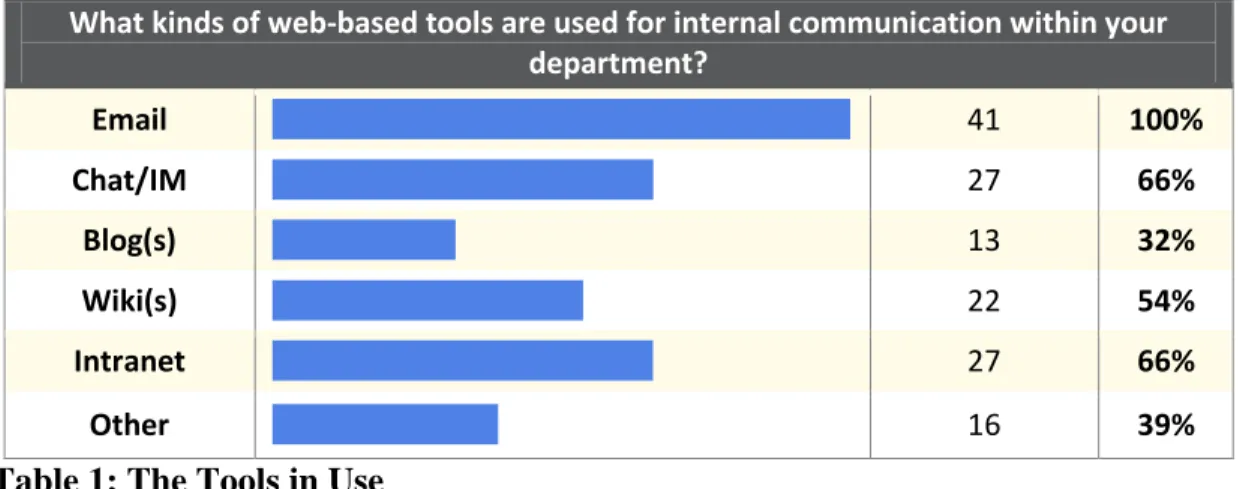
Unsurprisingly, all the reference departments surveyed used email to communicate internally, while every other technology ranged in use and significance, as may be observed from Table 1. Email is still the most common and frequently-used
communication technology in reference departments. As such a commonplace form of communication, email appears to be the lowest common-denominator in the workplace, often still the “official” form of communication within an academic library. The
literature also attests to the fact that, despite the growing prevalence and experimentation with Web 2.0 technologies, email continues to be the primary conduit for internal
communication within reference departments (Costello 2010, Rodriguez 2010).
What kinds of web-based tools are used for internal communication within your department?
Email 41 100%
Chat/IM 27 66%
Blog(s) 13 32%
Wiki(s) 22 54%
Intranet 27 66%
Other 16 39%
Table 1: The Tools in Use
communication tool. We answer chat and text messages ref questions, but mostly use email for internal communications.” “Although we have many forms of communication, email is still the most efficient.” While these departments incorporated new
communication technologies into their workflow, email was still viewed as the most reliable or most direct form of communication.
Despite the primacy of email use, 12% of respondents expressed direct doubts about email’s role in their departments’ internal communication. While it is an expedient way
to communicate, the consensus among these comments was that email is not easily organized, is prone to loss or missed audience. One respondent wrote that using email, “[it] is sometimes difficult to remember who is on what list, so I may miss collection
development colleagues who need the same information as front-line reference staff.” Another mentioned that “…a downside [to using email for staff communication] is the
ease with which people can lose or misfile emails, potentially causing some confusion later.” “I don't like using email for so many kinds of communication, because not everyone saves it, so there's not an easily accessible archive of it.”
In addition to the consternation over problems of discovery or loss of information, respondents also found the lack of dynamic interaction to be a problem with email use. “Email use is often one way information. In my opinion, it is not an effective way to
Chat/Instant Messaging technologies accounted for a sizeable user majority, with two-thirds of respondents indicating that their department used this technology for internal communication. The use of instant messaging technologies in reference departments takes two tracks—either for the use of a digital reference service for patrons, or as a means of internal communication. The literature is replete with discussions on the practice and effectiveness of chat reference, but very little has been written on the use of instant messaging technology for internal communication.
Please select the kind(s) of internal communication shared among staff
Email Chat/IM Blog(s) Wiki(s) Intranet
Departmental
News/Memos 40 98% 0 0% 7 54% 11 50% 11 41%
Changes in
Procedure 40 98% 0 0% 10 77% 9 41% 11 41%
Meeting
Minutes 32 78% 0 0% 2 15% 11 50% 20 74%
Staff/Student
Training 22 54% 0 0% 6 46% 13 59% 16 59%
FAQs 21 51% 2 7% 9 69% 15 68% 14 52%
Informal
Communication 41 100% 24 89% 7 54% 2 9% 4 15%
Other 10 24% 14 52% 4 31% 9 41% 12 44%
Table 2: How the Tools Are Used
The internal application for Chat/IM tools is fairly limited. There is a strong
consensus that chat is generally used for quick, informal communication, and questions concerning scheduling. As may be seen in Table 2, nearly ninety percent of respondents whose departments use chat tools indicated that they were used for informal
Generally respondents indicated that instant messaging technologies have saved time by replacing face-to-face or telephone conversations that would have largely revolved around scheduling. While the other technologies mentioned accounted for a wide range of purposes, the ways in which reference departments use Instant Messaging does not seem to have expanded beyond the immediate and expedient. Nor have all departments experienced a wide variety of chat tool use. Twenty-two percent of chat tool users mentioned that only some or a few of their staff use chat/IM.
The number of respondents who reported that their departments use wikis seems to have underscored the findings of the few empirical studies of Web 2.0 internal
communication in academic libraries (Bejune 2007). Around half of the respondents said their departments use wikis for internal communication. The number of non-users of wikis seems to roughly corroborate the findings of Kai-Wah Chu (2009), who found that around one-third of surveyed libraries reported that they did not plan to use wikis in the future.
Departments seem to use wikis for a wide scope of purposes. In particular, wikis were reported to provide a place for multiple sources of information. Nearly half of those who said their departments used wikis mentioned that they had replaced paper copies of manuals, forms, procedures, binders, calendars, and other documents. The general consensus was that departmental wikis uncluttered a lot of departmental workspace by providing an easily-accessed hub for procedural information. Nine percent of
shared department drives, and the same percentage used wikis to replace emails about schedule changes and procedure.
Blogs also appear to have a wide range of application, though there were nine (twenty-two percent) fewer departments using blogs for internal communication than wikis. In addition to the uses indicated through the questionnaire, respondents also seemed to indicate that blogs were used in similar ways to wikis. Twenty-three percent of blog users reported that their departments’ printed guides and other forms were replaced by their internal blogs. Just as many respondents also used their blogs for email
management (either for saving important emails or for reducing the volume of email) and for staff training purposes.
Please select the answer that best describes staff contribution
Blog(s) Wiki(s) Intranet
All staff members post content 0 0% 2 9% 6 22%
Most staff members post content 1 8% 3 14% 4 15%
About half of staff members post content 4 31% 6 27% 1 4%
Few staff members post content 8 62% 11 50% 15 56%
No one posts content 0 0% 0 0% 1 4%
Total 13 100% 22 100% 27 100%
Table 3: Staff Contribution
However, a few respondents indicated only lukewarm support for the Web 2.0
technologies used in their department. Concerning one wiki, a respondent mentioned that “it has never taken off as a place to share content and add content as a community.” Another indicated that “Nobody is particularly crazy about the wiki. Few use it, most
consternations are reflected in the further descriptions of blog use. One respondent did not find their blog to be “a very useful tool,” while another indicated that it was
“infrequently used and consulted,” that it was not “as dynamic as hoped.” [See Table 3].
In addition to the technologies mentioned above, respondents were also asked to identify the ways in which they used their library intranets for internal communication, if they did so. An intranet may be little more than a staff or institutional web site that is password protected or hidden behind a firewall. It could be as complex as a content management system, such as Sharepoint or other commercial software. As may be expected from such a broad category, respondents provided a wide range of answers. For example, nearly sixty-six percent of all respondents reported that their department used the library’s intranet for internal communication. Nearly three-quarters of departments
using intranets reported that they were used to communicate meeting minutes. Otherwise, usage patterns seemed reasonably similar to wikis and blogs.
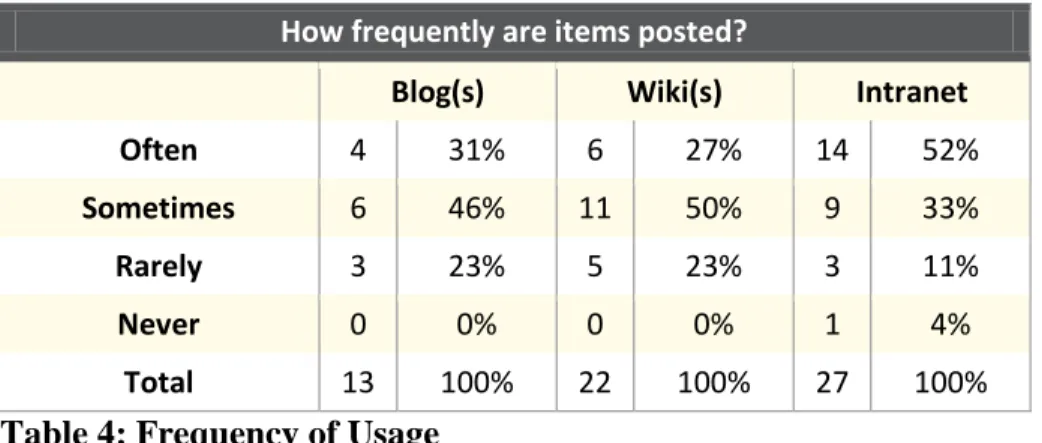
How frequently are items posted?
Blog(s) Wiki(s) Intranet
Often 4 31% 6 27% 14 52%
Sometimes 6 46% 11 50% 9 33%
Rarely 3 23% 5 23% 3 11%
Never 0 0% 0 0% 1 4%
Total 13 100% 22 100% 27 100%
Table 4: Frequency of Usage
For more than half of all of the blogs, wikis, and the intranet use, content was posted by “few individuals,” the burden of posting content resting on a few people. Of the three,
the findings indicate that more staff used the intranet, and more frequently, than either blogs or wikis. However, intranets tend to have more general information, blogs/wikis more specific/departmental information.
Wikis were the only technology in which half of respondents claimed their department received postings from half or more of its members, and the more frequently a
department updated its wiki, the more likely will multiple staff members would
contribute to posting content. This lends credibility to the claim that wikis are useful as a collaborative writing tool. Of departments that did use either a blog or a wiki, more staff tended to contribute to wikis, on average, than blogs, but only slightly.
How long has your department been using these technologies?
Chat/IM Blog(s) Wiki(s) Intranet
5 or more years 13 48% 4 31% 5 23% 19 73%
3-4 years 8 30% 6 46% 12 55% 3 12%
1-2 years 5 19% 2 15% 5 23% 1 4%
6 months to 1 year 1 4% 1 8% 0 0% 2 8%
Less than 6 months 0 0% 0 0% 0 0% 1 4%
Total 27 100% 13 100% 22 100% 26 100%
As can be seen in Table 5, more than 20% of the respondents’ Chat/IM tools, blogs, and wikis were newly implemented within the last two years, it is clear that departments are interested in making use of these tools. While one may still observe an increase in the implementation of intranets, the speed at which they are being newly implemented seems to be diminishing. However, because interest in implementing Web 2.0 and other
interactive technologies is high, it will behoove departments to thoughtfully consider how they will implement these tools. To what extent they will find appropriate use for them in their workflow, or how useful those tools will be, will depend largely upon the culture of the department, the receptivity and buy-in of the staff, and the amount of training the departments’ staff receives.
Finally, in addition to the technologies mentioned directly in the questionnaire, 10% of respondents also mentioned using Google Docs for their communication. Respondents also mentioned using other social networking sites, such as Yammer and Twitter, and course management applications, such as Sakai and Blackboard. Knowledge
Discussion
The findings from this study indicate that reference departments are using a wide variety of tools to communicate internally. There appears to be little consistency among reference ARL reference departments, as many find different applications for the same tool. What does seem constant is the primacy of email as an internal communication medium. Every reference department uses some form of email to communicate, and the information conveyed through this medium is considerably vast.
Web 2.0 technologies seem to experience a wide breadth of usage. They have in some cases improved the flow of information within a department. While many web-based technologies have saved clutter and paper documentation, the extent to which they have improved workflow functioning or revolutionized staff communication varies
tremendously. For this reason, this study may be considered a pilot study, testing the waters of the academic libraries for a general survey of use and interest.
communicate. For the sake of scope and limited availability of resources, these elements were not included in this particular study.
In addition to the content of the survey, the scope of the study could also be seen as a limitation. ARL libraries are large academic institutions. They have larger budgets and more resources, both in financial terms and in personnel. As a result, this study only considers the largest and best funded members of the academic library universe. It does not investigate the use of web-based communication tools at the smaller institutions, libraries with smaller budgets or less access to technical skills.
Libraries with smaller budgets may find occasion to use the same technologies for different purposes. Because Web 2.0 technologies can often be implemented with little cost to the host institution, they may be used as a cost-saving alternative to a proprietary content-management system. There are examples in the literature of blogs and wikis being used in this way, or as an alternative to a hard-coded website. Consequently, more research needs to be done on academic libraries of different sizes, to see if the results scale across institutions.
Best Practices
For institutions considering the implementation of a dynamic communication tool, such as a blog or a wiki, consider the following: It seems as though staff training, proper planning, software choices, and planned implementation are all necessary ingredients. From the comments on the survey, and through what may be gleaned from the literature, taking the time to train one’s staff effectively may ensure that they actually use the tool
Furthermore, several authors also mention the need to have an advocate or
“champion” for the implementation of a blog or wiki (Baxter 2010, Fichter 2008, Gordon
2006). This advocate may also need to continue after the implementation as the custodian, or as Darlene Fichter describes it, a “gardener” (56-7). As about half of the blogs and wikis currently being used by this study’s respondents are updated by only a few members of the whole department, this role is very important. In a more extreme case, one respondent acknowledged that he/she was generally the only one who posted content at all. Be aware that this, too, will add to the workload of at least one individual, depending on the amount of information posted and the degree to which the tool will be replacing other materials, such as forms and print manuals.
Selecting the proper product for your institution will also require time and diligence (Glogowski 2008, McIntyre 2010). Making those choices will depend on the level of IT support upon which your department can rely, as well as the technical skills available within your department. Privacy and firewall protection are also options to consider, as some platforms will only allow you to have a “searchable” interface if the content is
made publicly viewable. A general consensus among the literature is that MediaWiki is the standard for wikis in academic libraries. MediaWiki is the platform upon which Wikipedia is based (Kai-Wah Chu 2009, Bejune 2007, Dworak 2009).
It seems as though Web 2.0 technologies are not always the most effective solution for a departmental communication strategy, despite their “promise” of collaborative writing
and learning. Booth (2007) ascribes to librarians “the temptation…to identify a
Conclusion
A reference department need not implement all of the tools mentioned above for effective internal communication. Based on the responses from this study, it seems as though a reference department’s culture and communication style determines the sorts of tools that may be useful for effective communication. A department with more technical expertise, or a willingness to experiment, may benefit from Web 2.0 tools in a way that one with different set of communication needs and technical proficiencies will not. Because an academic library’s business is that of managing information, how a
department can better manage its own information is a matter of great importance. The success of a department may be directly related to the ability of its members to
Bibliography
Asllani, A., Ettkin, L. P., & Somasundar, A. (2008). Sharing Knowledge with
Conversational Technologies: Web Logs Versus Discussion Boards. International Journal of Information Technology and Management, 7(2), 217-230.
Avram, G. (2006). At the Crossroads of Knowledge Management and Social Software. Electronic Journal of Knowledge Management, 4(1), 1-10.
Bardyn, T. P. (2009). Library Blogs: What's Most Important Success within the Enterprise? Computers in Libraries 29(6), 12-16.
Baxter, G. J., Connolly, T. M.; Stansfield, M. H. (2010). Organisational Blogs: Benefits and Challenges of Implementation. Learning Organization, 17(6), 515-528. Bejune, M. M. (2007). Wikis in Libraries. Information Technology and Libraries, 26(3),
26-38.
Blair, J., & Cranston, C. (2006). Preparing for the Birth of Our Library Blog: Expectant Parents Do a Lot of Planning before Baby's Arrival; Expectant Bloggers Should Do the Same. Computers in Libraries. 26(2), 10-13, 54.
Booth, A. (2007). Blogs, Wikis and Podcasts: The “Evaluation Bypass” in Action? Health Information & Libraries Journal, 24(4), 298-302.
Bordeaux, A., & Boyd, M. (2007). Blogs, Wikis and Podcasts. Serials Librarian, 52(3-4), 263-269.
Costello, K., & Bosque, D. D. (2010). For Better or Worse: Using Wikis and Blogs for Staff Communication in an Academic Library. Journal of Web Librarianship, 4(2-3), 143-160.
Cromity, J. (2011). Fostering Internal Communication. Online, 35(4), 34+.
Draper, L., & Turnage, M. (2008). Blogmania. Internet Reference Services Quarterly, 13(1), 15-55.
Dworak, E., & Jeffery, K. (2009). Wiki to the rescue: Creating a more dynamic intranet. Library Hi Tech, 27(3), 403-410.
Ellis, T. J., & Ralph, L. L. (2009). An Investigation of a Knowledge Management Solution for the Improvement of Reference Services. Journal of Information, Information Technology, and Organizations, 4, 17-38.
Farkas, M. (2007). Who Moved My E-Mail? Sharing What We Know through Blogs and Wikis. American Libraries, 38(10), 30.
Fichter, D., & Wisniewski, J. (2008). Wiki While You Work. Online, 32(3), 55-57. Glogowski, J., & Steiner, S. (2008). The Life of a Wiki. Internet Reference Services
Quarterly, 13(1), 87-98.
Gordon, R. S., & Michael, S. (2006). How and Why to Try a Blog for Staff Communication. Computers in Libraries, 26(2), 50.
Haupt, J. (2007). From Zero to Wiki: Proposing and Implementing a Library Wiki. Journal of Web Librarianship, 1(1), 77-92.
Honeyman, G. (2009). The Fridge: Internal Communications at the State Library of Victoria. Electronic Library, the, 27(5), 863-868.
Kai-Wah Chu, S. (2009). Using Wikis in Academic Libraries. The Journal of Academic Librarianship, 35(2), 170-176.
Kapp, K. M. (2007). Tools and Techniques for Transferring Know-How from Boomers to Gamers. Global Business & Organizational Excellence, 26(5), 22-37.
Kim, Y., & Abbas, J. (2010). Adoption of Library 2.0 Functionalities by Academic Libraries and Users: A Knowledge Management Perspective. The Journal of Academic Librarianship, 36(3), 211-218.
Leandri, S. J. (2007, 01; 2012/1). 5 Ways to Improve Your Corporate Blogs. 11(1), 14-18.
Lombardo, N. T., Mower, A., & McFarland, M. M. (2008). Putting Wikis to Work in Libraries. Medical Reference Services Quarterly, 27(2), 129-145.
McIntyre, A., & Nicolle, J. (2008). Biblioblogging: Blogs for Library Communication. Electronic Library, 26(5), 683-694.
Nelson, E. (2008). Knowledge Management for Libraries. Library Administration & Management, 22(3), 135-137.
Oyadonghan, J. C. (2010). Information Flow Patterns in Organizations: The Library in Focus. Library Philosophy and Practice.
Rodriguez, J. (2010). Social Software in Academic Libraries for Internal Communication and Knowledge Management: A Comparison of Two Reference Blog
Implementations. Internet Reference Services Quarterly, 15(2), 107-124. Swanson, T. A. (2006). Looking to the Future: Implementing Blogs in a Community
College Library. Internet Reference Services Quarterly, 11(3), 57-67. Wagner, C., & Bolloju, N. (2005). Editorial Preface: Supporting Knowledge
Management in Organizations with Conversational Technologies: Discussion Forums, Weblogs, and Wikis. Journal of Database Management, 16(2), I-VIII. Ward, R. (2006). Blogs and wikis: A Personal Journey. Business Information Review,
23(4), 235-240.
Welsh, A. (2007). Internal Wikis for Procedures and Training: From Tacit Knowledge to Self-Guided Learning. 31(6), 26-29.
Appendix 1: Recruitment Email
Dear Colleague:
I am writing to request your participation in a research study of the of the electronic communication technologies used by reference departments for internal communication. You are being asked to participate because you are listed as the head of a reference (or similar) department in an ARL library. Though one of our profession's strengths is managing useful information, the ways in which we communicate with one another vary significantly. It is hoped that this study will uncover practical information about the ways in which reference departments do and may communicate internally.
I ask that you simply fill out this short electronic questionnaire. The following questionnaire should take under 10 minutes of your time.
This study is being conducted under the review of the IRB and the School of Information and Library Science (SILS) at the University of North Carolina at Chapel Hill.
Participation in study is entirely voluntary, with minimal risk. Your participation in this study may be terminated at any time, and any question may be skipped without penalty.
All the information you choose to provide will be entirely confidential. No identifying information will be placed on your questionnaire, and any information acquired from the polling process will be deleted upon final analysis of the results. Electronic submission of this survey will be taken as an indication of your consent to participate in this research. Thank you for your consideration. If you would like a copy of the study report, or if you should have any questions or concerns, please feel free to contact me at
[email protected], or by phone, at (330)618-2718. Dr. Barbara Moran, a member of the SILS faculty, will be advising this study, and she may be reached at
[email protected], or by phone, at (919)962-8067. The IRB may be contacted by phone, at (919)966-3113.
Sincerely, Samuel Stover MLS Candidate 2012
School of Information and Library Science University of North Carolina at Chapel Hill [email protected]
Appendix 2: Questionnaire and Respondents’ Comments
Q1 What kinds of web-based tools are used for internal communication within your department? Please check all that apply:
Email (1)
Chat/IM (2)
Blog(s) (3)
Wiki(s) (4)
Intranet (5)
Other (please specify) (6) ____________________
Q2 Please select the kind(s) of internal communication shared among staff via email. Check all that apply:
Departmental News/Memos (1)
Changes in Procedure (2)
Meeting Minutes (3)
Staff/Student Training (4)
Frequently Asked Questions (5)
Informal Communication (6)
Other (please specify) (7) ____________________
Q3 Do you have any additional comments about email use within your department? If so, please comment in the space provided below:
Q4 Please select the kind(s) of internal communication shared among staff with Chat/IM tools. Check all that apply:
Departmental News/Memos (1)
Changes in Procedure (2)
Meeting Minutes (3)
Staff/Student Training (4)
Frequently Asked Questions (5)
Informal Communication (6)
Other (please specify) (7) ____________________
Q5 How long has your department been using Chat/IM tools?
5 or more years (1)
3-4 years (2)
1-2 years (3)
6 months to 1 year (4)
Less than 6 months (5)
Don't Know (6)
Q6 Have Chat/IM tools replaced any forms of internal communication in your department?
Yes (1)
Q7 What forms of internal communication have been replaced by Chat/IM tools in your department?
Q8 Do you have any additional comments about the use of Chat/IM tools within your department? If so, please comment in the space provided below:
Q9 Please select the kind(s) of internal communication shared among staff on your department’s blog(s). Check all that apply:
Departmental News/Memos (1)
Changes in Procedure (2)
Meeting Minutes (3)
Staff/Student Training (4)
Frequently Asked Questions (5)
Informal Communication (6)
Other (please specify) (7) ____________________
Q10 Please select the Answer: that best describes staff contribution to your department’s blog(s):
All staff members post content (1)
Most staff members post content (2)
About half of staff members post content (3)
Few staff members post content (4)
No one posts content (5)
Q11 How frequently are items posted on your department’s blog(s)?
Often (1)
Sometimes (2)
Rarely (3)
Never (4)
Q12 How long has your department been using blogs for internal communication?
5 or more years (1)
3-4 years (2)
1-2 years (3)
6 months to 1 year (4)
Less than 6 months (5)
Don't Know (6)
Q13 Have blogs replaced any forms of internal communication in your department?
Yes (1)
No (2)
Q15 Do you have any additional comments about blog use within your department? If so, please comment in the space provided below:
Q16 Select the kind(s) of internal communication shared among staff on your department’s wiki(s). Please check all that apply:
Departmental News/Memos (1)
Changes in Procedure (2)
Meeting Minutes (3)
Staff/Student Training (4)
Frequently Asked Questions (5)
Informal Communication (6)
Other (please specify) (7) ____________________
Q17 Please select the Answer: that best describes staff contribution to your department’s wiki(s):
All staff members post content (1)
Most staff members post content (2)
About half of staff members post content (3)
Few staff members post content (4)
No one posts content (5)
Q18 How frequently are items posted on your department’s wiki(s)?
Often (1)
Sometimes (2)
Rarely (3)
Never (4)
Q19 How long has your department been using wikis for internal communication?
5 or more years (1)
3-4 years (2)
1-2 years (3)
6 months to 1 year (4)
Less than 6 months (5)
Q20 Have wikis replaced any forms of internal communication in your department?
Yes (1)
No (2)
Q21 What forms of internal communication have been replaced by wikis in your department?
Q22 Do you have any additional comments about wiki use within your department? If so, please comment in the space provided below:
Departmental News/Memos (1)
Changes in Procedure (2)
Meeting Minutes (3)
Staff/Student Training (4)
Frequently Asked Questions (5)
Informal Communication (6)
Other (please specify) (7) ____________________
Q24 Please select the Answer: that best describes staff contribution to your intranet:
All staff members post content (1)
Most staff members post content (2)
About half of staff members post content (3)
Few staff members post content (4)
No one posts content (5)
Q25 How frequently are items posted on your intranet?
Often (1)
Sometimes (2)
Rarely (3)
Never (4)
Q26 How long has your department been using your intranet for internal communication?
5 or more years (1)
3-4 years (2)
1-2 years (3)
6 months to 1 year (4)
Less than 6 months (5)
Q27 Has your intranet replaced any forms of internal communication in your department?
Yes (1)
No (2)
Q28 What forms of internal communication have been replaced by your intranet in your department?
Q29 Do you have any additional comments about intranet use in your department? If so, please comment in the space provided below: