
A Framework for ICT-Oriented Sustainable
Development through Mapping from ICT
Concerns onto Sustainability Indicators
Mohammad Azadnia*Faculty Member and Head of ITLABs ICT Research Institute
Tehran, Iran [email protected]
Shamsossadat Zahedi Faculty Member and Professor Allameh Tabatabae University
Tehran, Iran [email protected]
Received: 22 April 2018 - Accepted: 24 August 2018
Abstract—Sustainable development establishes a framework in which environmental policies and development strategies interact each other, and in the process of economic development, the long-term environmental value and human society is taken into account. In addition, ICT is rapidly transforming all aspects of human life and there is less of a sense of our lives that have not been directly or indirectly affected by the ICT. Our studies of the previous frameworks on the effects of ICT on the goals of sustainable development show that most of them fall into two categories. There are a number of frameworks that have introduced general and high-level ICT impacts on sustainability development in the first category, and the second category refers to some specific technologies or specific SDGs. In this paper, we have proposed a framework that addresses all technologies and concerns related to ICT and all SDGs. The main objective of this framework is to show the impact and mapping between SDGs, ICT concepts and technologies, ICT concerns, and ICT development success factors that can be used directly to evaluate the growth and degradation of each of them. The ICT concerns classified into four categories and mapped by ICT technologies and concepts to sustainable development and its goals and ICT development and its concerns.
Keywords-component; Sustainable Development, ICT Concerns, Framework.
I. INTRODUCTION*
Development is a process in which cultural, social, economic and political institutions are transformed in a fundamental and proportional manner to newly known capacities, and the community's welfare state improvement during this process. Undoubtedly, improving the quality of life indicators can be seen as the ultimate goal of any economic and social development program.
* Correspond author
One of the main achievements of the Rio +20 Conference in June 2012 was the post-2015 development agenda and the goals of sustainable development. The member states committed themselves to launch, within Rio +20 2015, "the creation of a comprehensive, transparent and open international process for all stakeholders on the goals of sustainable development, with the approach of expanding the global goals of sustainable development agreed by the United Nations General
Volume 10- Number 4 – Autumn 2018 (61 -72)
Assembly". It will be a multi-stakeholder process involving "United Nations actors and civil society to create a comprehensive framework for developing and developed countries."
It was also a subject of new issues that were not included in the mandate of the Rio +20 agenda of the General Assembly resolution. It was suggested a year before of organizing the meeting by the Colombian government. These new items were focused on the Green Economy Roadmap. Developing countries have accepted the goals of sustainable development as a "Concept and an operational tool" and emphasized the need to identify the principles and elements that form the framework along the objectives. In their view, the key principle here was the same principle of "Joint but different responsibility," and any commitment that is made to these goals must be based on equality [1].
One of the most important branches of science and technology that can play an effective role in this field is the ICT. ICT has a prominent influence on the affairs of modern societies, and it is impossible to imagine life in this century without it. ICT is rapidly transforming all aspects of human life and there is less of a sense of our lives that have not been directly or indirectly affected by the ICT. However, how much ICT can play a role in the development, and how it should play its role is being discussed in this paper. This research seeks to propose "A Framework for ICT-Oriented Sustainable Development through Mapping from ICT Concerns onto Sustainability Indicators".
In section II, we cover basic ideas in sustainable development, ICT technologies and concepts and their effects onto sustainable development. In section III, we have a brief review of approaches to sustainable development based on ICT. Then in section IV, we explain our proposed framework based on ICT concerns. The validation of framework is proofed in section V and finally we have a conclusion in section VI.
II. BASIC IDEAS IN SUSTAINABLE
DEVELOPMENT AND ICT
The necessary changes to reach the sustainable future have always been in the face of social-cultural constraints of societies. These changes are necessary for the rethinking of disparate social patterns and values, as well as the revival of beliefs, traditions and patterns that are rooted in the historical culture of a communities and consistent with sustainable thinking. The social dimension of sustainable development is related to human relationships, excellence and the well-being of individuals, health, education, different cultures, equality and the elimination of poverty. Some of the barriers are something such as harming people's health, poor access to safe water, shortage of public access to appropriate educational facilities, high rates of
illiteracy, and a large number of people below the poverty line.
The economic dimension of sustainable development includes growth and other economic parameters, in which the well-being of individuals and societies must be maximized through the optimal use of natural resources and the fair distribution of benefits. Sustainability in the economy can be defined in order to create a fair and balanced human society and guarantees the enjoyment of individual human beings over the time without compromising on biological, natural and cultural resources.
The theme of the ecosystem and the natural environment of the planet and its environmental constraints have been addressed by many scholars since the early 1980s. They believed that if human beings, likewise, destroy nature and consume the resources and, naturally, continue to return to nature with unwanted pollutants and artifacts, with the help of their own hands, it will not long take a serious risk to the survival of its generation. Exploitation of the environment, increasing the acceleration of depletion of resources and energy, the production of wastes and hazardous waste, the destruction of forests and species extinction, environmental pollution (water, air and soil), greenhouse gas emissions and the destruction of the ozone layer and the warming of the earth and its catastrophic consequences in the environment are some of the problems and barriers of achieving sustainability in the environmental dimension of development [1].
A. Sustainability Development
Although several different models are presented for sustainable development, but all of them have a common base. All of them consider environment, economy and society as the main pillar of sustainability and development.
Sustainable Development Goals
The goals of sustainable development should be based on all the principles of the Rio Declaration, Agenda 21 and the Johannesburg Implementation Plan, and take into consideration the different situations, capacities and priorities of the countries. These goals should be coherent with the United Nations Development Agenda beyond 2015, which, after numerous discussions, was finally proposed, entitled "Transformation in our world: Agenda 2030 for Sustainable Development". So, along with the agreements, the goals of sustainable development will replace the Millennium Development Goals after 2015. The 2030 agenda is considered for the development of the 17 target, which includes 169 indicators. These goals are intended for different countries in various economic, social, institutional and environmental fields. The goals of sustainable development have shown in Table 1.
Table 1. Sustainable Development Goals Classified into Three Dimensions [2]
Millennium Development Goals (MDGs)
The MDGs are actually eight major goals that were agreed upon in the United Nations in 2000 and were mandated to be implemented by 2015 and, with their realization, respond to the main challenges of the world's development. The Millennium Declaration was approved by 189 countries in September 2000, with 147 political leaders. These eight meta-targets, which are broken down into 21 target goals and that can be measured with 60 indicators.
B. Basic Concepts of ICT
ICT refers to the use of computer and telecommunication devices for collecting, processing, organizing, storing and disseminating the information, including audio, image and text. The technology of communication and information is swiftly transforming all dimensions of human life. There are fewer faces of our lives that have not been directly or indirectly affected by ICT [3]. In this section, we explain modern and most of the ICT concept and technologies that effects on our life.
In Section III, we will outline the proposed framework. For this purpose, ICT concepts and technologies that are directly related to each SDG are presented. In this section, we describe each of these concepts and technologies, briefly. We consider them in our proposed Framework.
Smart Agriculture or Smart Farming “indicates the
application of modern ICT into agriculture and
includes automated irrigation systems, optimized farm management, precision agriculture, integrated real-time weather information, traceability and tracking systems, M2M/IOT, soil sensors and satellites” [4].
E-health services are “healthcare services that
supported by electronic processes and communication and includes electronic data storage, remote diagnostics videoconferencing, wearables, biosensors, personalized medicine and DNA sequencing, augmented reality” [5].
Augmented Reality is “an interactive environment
from a real world, where real-world objects through cognitive computer information are sometimes expanded in various sensory states, including visual, auditory, haptic, somatosensory, and olfactory” [6].
Gamification is using game design elements and
non-gaming principles. “Gamification typically incorporates game design elements to improve user interaction, organizational productivity, flow, learning, crowdsourcing, employee evaluation and recruitment, ease of use, system usefulness, physical exercise, traffic violations, voter irregularities, and so on” [7].
M-learning or mobile learning is "a mobile
learning across a variety of backgrounds, through social interaction and content, using personal electronic devices. It is a form of distance learning who m-learners use mobile education technology for their convenience [8].
Ubiquitous Learning Environment is a state of affairs for learning in everywhere. “Education takes place in every aspect for the student, but the student may not even be aware of the learning process. Source data is embedded in objects and students do not have to do anything to do learning” [9].
Smart Water Management is defined as “the
activity of planning, developing, distributing and managing the best use of water resources based on ICT” [10] and includes smart levees, smart pipes, soil sensors, smart meters, rain water harvesting systems, remote irrigation management systems, consumption control apps and e-billing.
Smart Levee “prepares information on the past,
current and expected status of its end users to make informed decisions to maintain at the level of flood protection required” [11].
Smart pipe, is “an intelligent pipe based on the fact
that a pipe communicates with its sensor signal level about its position” [1123].
Electronic billing or electronic bill payment and
presentment is “sending a bill or an invoice via the Internet by seller and paying electronically by customers.” [13].
Smart Energy System is “an approach in which
intelligent grids, heat and gas are integrated with storage technologies, in order to collaborate between them to achieve a desirable solution for each sector as well as the system. Comprehensive energy harmonization includes smart grid, smart appliances, energy storage, predictive analytics, sensors, demand response technology [14].
Smart Grid is “an electric grid that includes a
variety of energy operations and measures including smart meters, smart appliances, renewable energy sources and efficient energy sources” [15].
E-work or electronic working is “a term used to
describe a work that uses telecommunications technology for remote work from an office location” [16].
Smart manufacturing is “a widespread product mix
that uses integrated computing, a high level of adaptability and rapid design changes, digital information technology, and more flexible workforce training.” It includes 3-D printing, industrial Internet of Things (IOT) and Machine-to-Machine (M2M), Data analytics & cloud computing, cyber-physical systems (CPS), embedded system production technology, drones and robotics. [17]
Smart City Mobility includes “e-mobility, mobile
ride sharing, inter-modality, driverless transportation, connected infrastructure and IOT. Mobility today means the smart city monitors, traffic flow independently and responds flexibly to problems. Additionally, mobility can be customized using a new communication infrastructure” [18].
Electro mobility (e-mobility) is “a general term for
the development of propulsion engines to prevent
vehicle design from using fossil fuels and carbon emissions” [19].
Smart Building is “a building integrates into
information, organization, control, materials and construction as a whole system of building, adapted, reactive, to eliminate drivers for building, energy and interest variation, life span, comfort and satisfaction” [20].
Smart Conservation includes advanced mapping
and data analytics, sub-marine, coastal and inland smart sensors, drones, real-time satellite imaging, smart monitoring, real-time weather forecasting [3].
E-government is “the use of electronic
communications devices, such as computers and the Internet to provide public services to citizens and other persons in a country or region”, and includes big data analytics, smart police, e-identity, open government (datasets, public apps using open data), predictive analytics and algorithms for crime forecasting, online voting, augmented reality, drones and robotics and neuroscience [21].
C. Sustainable Development and ICT effects
ICTs can have positive and negative effects on sustainable development. On the one hand, ICT development can be realized with higher efficiency and, on the other hand, ICT itself as a product (or service) or as a tool for the empowerment of other sectors can be an obstacle to the realization of the goals of sustainable development. Table 2 to Table 4 summarize the main positive and negative effects of ICT on environment, economic and society.
GeSI (Global e-Sustainability Initiative) is “a leading source of impartial information, resources and best practices to achieve integrated social and environmental sustainability through ICT”.
GeSI simplifies real world solutions to real world subjects both within the ICT industry and the greater sustainable community (https://gesi.org). GeSI summary report, describes barriers to ICT deployment based on three perspective includes rules of the game, supply and demand [3].
III. ABRIEF REVIEW OF APPROACHES TO
SUSTAINABILITY DEVELOPMENT BASED ON ICT
A. ICT and SDGs
While none of the SDGs is directly points to ICT, several targets make references to it and other technologies. The 2030 Agenda for Sustainable Development also recognizes that “The spread of information and communication technology has great potential to accelerate human progress, to bridge the digital divide and to develop knowledge societies". ITU has made a concerted effort to highlight the role of ICT to play in achieving the SDGs. ITU proposed a list of eight ICT indicators, covering eight targets within Goals 1, 4, 5, 9, 16, 17. The February 2016 version of the IAEG-SDGs
report includes the following seven ICT indicators
covering 6 targets under Goals 4, 5, 9, and 17 [23].
Table 2. The Environmental positive and negative effects of ICT [22]
Positive effect Negative effect
The first type effect or direct effect
The use of ICT, such as the use of ICT for environmental monitoring
and control
The environmental impact of production and use of ICT, such as e-waste The second type effect or
indirect effect Restructuring to the non-material
Non-complete substitution of ICT for other materials
The Table 3. The Economic Positive and Negative Effects of ICT
Positive effects Negative effects
The driving force behind the economy Increased economic growth
Providing useful information
Use of ICT facilities for optimal product and service delivery Improving the economic situation
Improving economic growth
The transformation of production, processing, storage and distribution of information
Provides useful information by changing the direction of information, data and images
Making it possible to access the strategic aspects of ICT use Impact on consumer economic behavior on demand side Affecting producer behavior on the supply side
Increasing economic distance between countries and communities benefiting from ICT
The possibility of fraud and electronic fraud
Table 4. The Society Positive and Negative Effects of ICT
Positive effects Negative effects
Reduce learning constraints Strengthening equal opportunities
Training human resources appropriate to the level of knowledge and information
Efficiency and productivity in education Acquiring new teaching skills in coaches Dora Medical Opportunity
Development of integrated systems for storing and retrieving patient information
Creating facilities for fair distribution of drugs
Prevent possible misuse of the distribution of medical and medical facilities
Helping to train human health professionals
The use of online articles and scientific documentation in this field
Increased risk of social isolation
Under-question the traditional authority of coaches as the absolute source of knowledge and information
Surface of bringing students Lack of face-to-face
relationship between the pupils and the coach The risk of disclosure of
patient information Lack of face-to-face
relationship between physician and patients
Hilty and Hercheui have presented a conceptual framework to introduce relationship between ICT and sustainable development which implied reviewing the normative concept of sustainable development into environmental, societal and economical dimensions and analyzing information and communication technology and sustainable development to recognize levels of environmental impacts, people, social and ecologically compatibility of ICT on sustainable development [24].
J. Wu and et al. argue that, although several related SDGs to ICT, such as SDGs 3, 11, and 13, have been well identified and targeted with enormous literatures reported in the ACM digital libraries and IEEE, some other goals such as SDGs 5, 10, and 16 have not been particularly aware and
talked by the technical research communities [25]. ICT business advantages, containing increases in sales, the cost reductions, creating competitive benefits, efficient resource consumption, employee satisfaction and well-being, accruing to companies tracking sustainability strategies. The GeSI, for example, reasoned that digital solutions from all areas of life could directly contribute to SDGs achievements. The digital solutions are essential and transform the world rapidly, with nice suggestions to a positive impact to reach all of the SDGs [3].
Microsoft for example, have ‘emphasize eight SDGs and has focused its major attention on SDGs 16, 13, 11, 9, 8, 5, 4 and 3, because of their special alignment with Microsoft’s business and
humanitarian strategies [26].
Indeed, the GeSI [3] argued that digital solutions have an extensive potential to reduce greenhouse gas emissions and recommended that smart agriculture, smart manufacturing, smart mobility, smart buildings and smart energy could cut global greenhouse gas emissions by some twenty percent by 2030.
The GSM Association is a trade body that shows the interests of mobile network operators worldwide, uniting more than 750 operators with almost 400 companies in the broader mobile ecosystem, including software companies, handset and device makers, internet companies, equipment and organizations in adjacent industry sectors (https://www.gsma.com/aboutus/). The GSMA reported that, since 2015 the mobile industry’s impact has increased across all 17 SDGs. the most improved SDGs impact score since 2015 are on SDGs 13 (Action for Climate Change), 11 (Sustainable Cities and Communities) and 3 (Good Health and Well-being) [27].
Peter Jones and et al. consider ICT effects on SDGs and opportunities from four perspective include business, power of ICT, role of governments and economic growth [28].
Hilty and Aebischer emended a review of how to use the transformational power of ICT to develop more sustainable patterns of production and consumption which focuses on a broad diversity of special issues including energy demands of data centers, smart sustainable cities, the recycling of ICT equipment, software support for supply chains, the energy intensity of the internet and the interdependency of energy, information and growth [29]. In addition, ITU, in collaboration with partners, has been working to contribute to each and every SDG [30].
Research by the Brookings Institution in one section examines how successful countries are in terms of sustainable development goals based on the 2030s vision. In this way, 18 different indicators have been studied and the result showed that the success rate of countries in achieving these goals was based on the success rate of commissions. A review of these numbers has shown that Iran has been working on five indicators of "child mortality", "life expectancy", "access to elementary education", "access to primary education" and "eradicate extreme poverty" has had the maximum influences. However, it is long and long before the development of sustainable development designers in Iran in relation to gender equality indicators and the quality of pre-primary education. An interesting point in this estimate is the totally different situation of Iran in relation to the two indicators of "elementary education" and "pre-primary education". The Brookings Institution, in addition to the current coordinates of countries, reflects the general trend governing the promotion of sustainable development
goals in different ways. In this section, the indicators are divided into five categories: "obtained", "pursuing", "needing serious action", "requiring action" and "recurring". "Overweight children," "access to water resources," "extravagance" and "pre-primary education" are four indicators that, according to the Brookings Institution, their current trend in Iran involves a rollback [31].
However, the development trend in Iran has led to the convergence of the indicators of "extreme poverty", "elementary education", "access to electricity", "child mortality" and "adult mortality" with the target. Interestingly, with regard to Iran, one aspect of the development process is that the indicators are either in a favorable situation or require action to be accelerated and no indicators are currently in the "pursuit" situation [31].
S. Zahedi considered culture and politics factors for sustainable development in addition to environment, society and economy. Considering that in most of the frameworks and models proposed, only social, economic and environmental dimensions are considered like OECD and UNCTAD models, and also from the perspective of ICT are less important than the cultural and political dimensions, these two dimensions are not considered in this framework [32].
B. ICT-Oriented Sustainable Development
Frameworks
O. Kostoska and L. Kocarev [2] proposed a new ICT framework for addressing sustainable development goals. The proposed framework endorses six novel approaches: holistic, increased-awareness, data-intensive, governance-enhanced, two-way and responsible. The final ICT Framework for SDGs in this approach shown in Fig. 1.
In this framework, there are three building blocks including governance module, sustainability module and data module. Data module designed for collecting, preparing, analyzing, visualizing, managing and preserving data from three sources including social, sensor and statistical data at three levels of decision-making, temporal, and spatial. Sustainability module used for mapping SDGs at local level, to assure coverage of stakeholders, for providing priority ranking of SDGs, implementing SDGs at local level, and sharing knowledge and managing it. Governance module suggested for providing fair, network, adaptive, trustworthy and collaborative governance [2].
Some studies have developed frameworks for discovering how ICT can provide livelihoods for people in developing countries such as the Sustainable Livelihoods Framework (SLF). E. T. Lwoga and R. Z. Sangeda [33] done a comprehensive study about the frameworks on sustainable development. They argue that initial studies focus on evaluating the contribution of technology in various dimensions of development.
Figure 1. Novel ICT Framework for SDGs (with permission) [2] The Influence of ICT infrastructure on reducing
growth micro and small enterprises (MSEs), ICT-Rural Poverty linkages framework and growth model. In addition, authors in [34] consider other models include the mobile telephones impact model, Constructive Technology Assessment Approach and the Concept of Technology Appropriation. They focused on technology and ICT adoption models like Technology Adoption Model (TAM), ICT Adoption Model for Socially Excluded Groups, and Model of E-government Portal Use, Global IT Adoption Model, Evaluation Model of the Digital Business Environment, and Model of Adoption of Technology in the Home.
GeSI considers most powerful digital solution against SDGs [3] that are summarized in Table 5.
IV. THE SUGGESTED FRAMEWORK FOR
MAPPING ICTCONCERNS ONTO THE SDGS
A. Basic Requirements and ICT Concerns
Based on reviews and backgrounds in section II, III and considering [29], [32], [35], [36], [37], [38] and [39] idea for ICT and sustainable developments, we have divided Dimensions of ICT, successiveness of ICT and concerns as follow:
ICT Basic Concerns: Awareness, Availability,
Accessibility, Affordability.
Success of ICT for sustainable development:
Integrity, Scalability, Sustainability.
Y. Punia [39] explained the above concepts as follow:
Integrity: ICT cannot directly attain SDGs rather it needs to be integrated with development like social process.
Scalability: The Issues of development are wide in area that a singular exclusive or group of people cannot solve it, rather it requires cooperation and sharing experiences and scaling it to the mass for its betterment.
Sustainability: ICT for sustainable development should be economic and valuable for end-users. ICT for sustainable development should be sustainable if it provides value for end-users.
Awareness: Some people may not be aware of the
use and benefits of ICT because of illiteracy. They do not even know what and how they can do with ICT.
Availability: Hardware and software may not be available to meet all users' needs. Especially in rural areas, there is less chance of access to computer and telecommunication facilities.
Accessibility: Ability to use ICT. Many e-learning programmers are on the Internet to gain sustainable development. Most people do not know how to use e-learning.
Affordability: Using ICT, including the cost of hardware and software, is too costly, sometimes beyond the power of the people. ICT software or equipment sometimes goes beyond average income of the ordinary people.
B. The Framework Itself
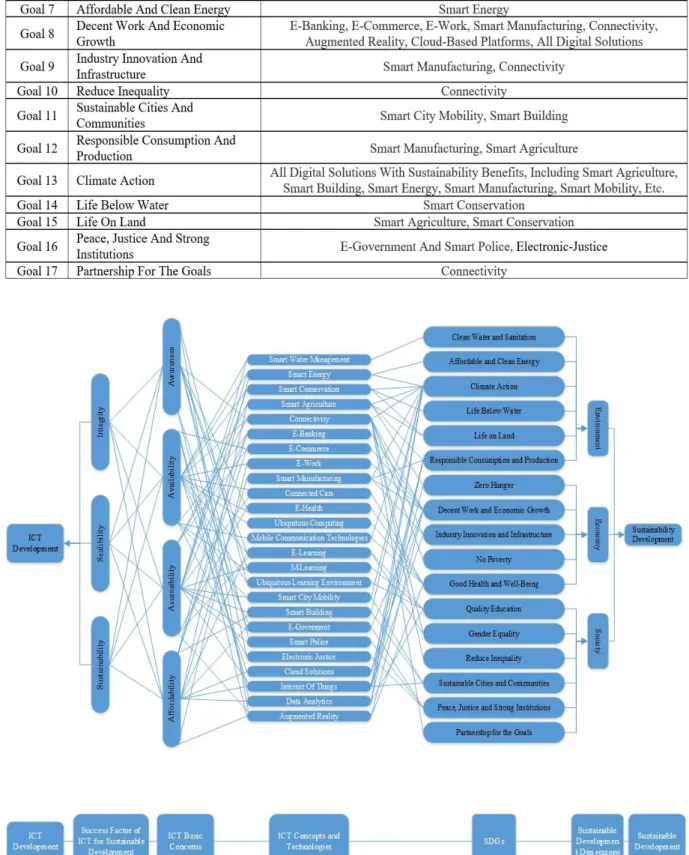
In this section, we proposed the framework for ICT-oriented sustainable development through mapping from ICT concerns onto sustainability indicators. The focus of framework is on ICT concepts and technologies. In the other words, promotion of ICT concepts and solving ICT concerns directly or indirectly lead to sustainable development and improve the ICT success factors. In this manner, firstly each of sustainability development goals mapped into ICT concepts and technologies based on research results summarized in Table 5. Then SDGs mapped to dimensions of sustainable development and finally in right part of the framework we achieve to sustainable development.
According to our studies, described in Section III, most of the proposed frameworks and studies on the effects of ICT on sustainable development goals are divided into two categories. In the first category, the frameworks explain only general and high-level ICT impacts on sustainability development like the basic concerns, and the second category only focuses on some specific technologies or specific SDGs like education or some SDGs.
Table 5. ICT Concepts and Technologies for SDGs
Figure 2. Proposed Framework
In fact, our proposed framework, on the one hand, shows that the investment or lack of attention to ICT technology will affect some SDGs, and on the other hand, each of these concepts and technologies will effects on the growth or degradation of each four main concerns. As a result, it is a comprehensive framework that shows the relationship between sustainable development and ICT development which can be easily viewed and evaluated.
Given the inherent characteristics of ICT concerns, all other concerns fall into one of the four types of declared concerns (Accessibility, Availability, Awareness and Affordability). For this reason, each of the technologies and concepts mentioned in the proposed framework deals with at least one of the concerns revealed. According to surveys (explained in section II and III), each of these technologies and concepts play their role in influencing sustainable development goals. So the common part of these two approaches are the technologies and concepts that help to solve both ICT concerns and achieve the sustainable development goals.
Within the left part of the framework that is illustrated in Fig. 2, ICT concepts and technologies mapped into ICT concerns for achieving sustainable development through ICT, based on inheritance effects of each ICT concern, concept or technology. Then each concern mapped into success factors of ICT for sustainable development and finally it led to ICT development. The most important contribution in this study is mapping ICT concerns that effects on both sustainable development and ICT development. The ICT concerns were extracted from literature reviews. In the middle of the framework, the ICT concepts and technologies are listed. In one hand they mapped to 17 sustainable development goals based on directly effects of them on SDGs. For example, SDG 4 “Quality Education” take directly effect by E-Learning, Data Analytics, Augmented Reality, M-Learning, ULE. Then each goals of sustainable development led to one of the dimensions of sustainability development (Environment, Economy and Society). On the other hand, each of the ICT concepts and technologies can be mapped into ICT concerns that includes awareness, availability, accessibility and affordability. These concerns and dimensions explained in the previous section. The ICT concerns have full mesh communication with success factor of ICT for sustainable development that contains integrity, scalability and sustainability. Finally, this success factors leads to ICT development for sustainable development. In the next section, we proof the validity of the framework.
V. VALIDATION OF THE FRAMEWORK
We validate our framework based on "argumentation" and "fishbone diagram". First, we
explain fishbone diagram briefly. Then, we discuss our framework validation and explain fishbone diagram for our framework.
A. Fishbone Diagrams as a Mean for Validation
Fishbone diagrams (also called Ishikawa diagrams, herringbone diagrams) are “causal diagrams created by Kaoru Ishikawa that show the causes of a particular event. The common use of the Ishikawa charts is product design and quality malfunction prevention to identify potential factors that have a generic effect. Any cause or causes of incompatibility are the source of change. Causes are usually classified into several main categories to classify these sources of diversity” [40].
The defect is shown as the head of the fish to the right, with the causes of the left being spread as the fishbone; ligaments from the main part for the main causes, with the following branches for root causes, are required at different levels. [41].
B. Validation based on argumentation Using
fishbone diagram
The GeSI report, in more detail explains the communication between sustainable development goals and gathered digital solutions of positive impacts on SDGs [3]. In addition, we can see that GeSI noted about relationship between availability, accessibility, affordability and awareness in several cases in the report, like: “low affordability of ICT solutions”, “lack of digital skills”, “increase of digital skills”, “limited awareness of ICT’s potential among stakeholders”, etc.
In the SDGs targets, we can see some of them for the measures and challenges like: “Ensure that people have awareness for sustainable development and lifestyles” (T 12.8), “Improve education, awareness-raising and human and institutional capacity on climate change mitigation, adaptation, impact reduction and early warning” (T 13.3), “Increase youth’s vocational skill levels” (T 4.4) and “Increase supply of skilled teachers” (T 4.c). ICT dimensions directly affect this measures and challenges.
These relationships have two directions. For example, awareness can increase content and content can increase awareness. In success factors of ICT, the sustainable development is considered that we have some targets in SDGs like: “Implementing integrated water resources management at all levels” (T 6.5), “Integrating climate change measures into national policies, strategies and planning” (T 13.2) and SDG 17 that persists on integrity.
In addition, we know about absence of integrated standards in technologies, the prevalence of infrastructure and connectivity monopolies, as well as weak and inadequate regulation, prevents digital expansion on a scale.
Figure 3. Fishbone Diagram for Effects of ICT concerns and Technologies on Sustainable development For this part GeSI [3], offers barriers to the
efficient operation of ICT and the widespread use of ICT on a large scale, such as restrictions on political and regulatory sanctions for the expansion of information and communication technology or barriers, such as lack of capital for infrastructure projects or innovative digital testing solutions prevent the attraction of ICTs or barriers to demand, such as lack of appropriate digital skills among users and entrepreneurs [2], authors noted about awareness, accessibility, affordability and availability.
They believe that the mobile bandwidth measurement provides many achievements in accessibility, scalability and affordability which can enable countries to create multiple development gaps with the highest speed recorded without spending traditional infrastructure. The fishbone diagram for effects of ICT on sustainable development is presented in Fig. 3. In this figure, the effects of ICT technologies on sustainable development goals are illustrated. It shows that these effects are led to ICT concerns effects on sustainable development.
As shown in Fig. 3, availability, accessibility, affordability and awareness are four main components for both sustainable development and ICT development. Based on the studies that have been mentioned in this article, the comprehensiveness of these components has caused the other concerns of the ICT to be a subset of these components. On the other hand, SDGs can be viewed from the perspective of these four components. In
addition, each of the concepts and technologies in some way depends on one of these components. Finally, their impact on the proposed framework can be measured and evaluated.
Another explanation for proofing the right part of the framework is numeric statistics presented by GeSI report [3], In GeSI, the positive impact of ICT on each SDG is given in Table 5 with respect to the technologies mentioned and related. Thus, how these effects and statistics related to each of them are described in Table 6. In this table, we can see positive impact of ICT in one column and illustrative data points in another column for each SDG. This table mapped to Table 5 completely.
VI. CONCLUDING REMARKS
Since the effects of ICT on sustainable development are not overlooked, in this paper we have attempted to provide a framework for sustainable ICT-Oriented development through mapping from ICT concerns onto sustainability indicators. According to the studies, the concepts, technologies and concerns in the field of ICT, have an effect at least in one of the goals of sustainable development. This influences on many factors, including awareness, accessibility, affordability and availability, scalability, integrity and sustainability that affect both sustainable development and ICT. On the one hand, the rise or decline of ICT technologies mentioned in this paper directly can have a negative or positive influence on the goals of sustainable development.
Table 6. ICT poitive impacts to each SDGs and illustrative data points (with permission) [3]
On the other hand, ICT concerns that are included in four categories of awareness, accessibility, affordability and availability are also directly affected by ICT technologies, both in the ICT sector and in sustainable development. For future work, these effects can be measured and converted to digit. Thus, the impact of each of the mentioned ICT technologies on both the ICT concerns and the sustainable development goals will be calculated and estimated by using statistical methods.
REFERENCES
[1] M. Azadnia, “The Model of Evaluating ICT Effects in Sustainable Development Design and Explanation”, PHD Thesis, Institute forHumanities and Cultural Studies, July 2017.
[2] Kostoska, Olivera; Kocarev, Ljupco, "A Novel ICT
Framework for Sustainable Development
Goals." Sustainability 11, no. 7, 2019.
[3] GeSI (Global e-Sustainability Initiative) Report. “System Transformation: How Digital Solutions Will Drive Progress towards the Sustainable Development Goals”, 2016. [4] Garriz, I.; Gorroti, I.; Cambra, C. Smart Agriculture
European Platform; Navarra Agraria INTIA: Navarra, Spain, 2017; p. 223. ISBN 0214-6401.
[5] Della Mea VWhat is e-Health (2): The death of telemedicine. J Med Internet Res 2001;3(2):e22 URL:
https://www.jmir.org/2001/2/e22, DOI:
10.2196/jmir.3.2.e22, PMID: 11720964, PMCID:
PMC1761900.
[6] Schueffel, Patrick, The Concise Fintech Compendium, Fribourg, Switzerland, 2017: School of Management Fribourg (HEG-FR), Switzerland.
[7] Huotari, K., & Hamari, J. (2012). "Defining Gamification – A Service Marketing Perspective". Proceedings of the 16th International Academic MindTrek Conference 2012, Tampere, Finland, October 3–5.
[8] Crescente, Mary Louise; Lee, Doris (March 2011). "Critical issues of m-learning: design models, adoption processes, and future trends". Journal of the Chinese Institute of Industrial Engineers. 28 (2): 111–123.
[9] Jones, V. & Jo, J.H. (2004). Ubiquitous learning environment: An adaptive teaching system using ubiquitous technology. In R. Atkinson, C. McBeath, D. Jonas-Dwyer & R. Phillips (Eds), Beyond the comfort zone: Proceedings of the 21st ASCILITE Conference (pp. 468-474). Perth, 5-8 December.
[10] Tom´as Robles1, Ram´on Alcarria2_, Diego Mart´ın1, Mariano Navarro3, Rodrigo Calero3, Sof´ıa Iglesias3, and Manuel L´opez3, “An IoT based reference architecture for smart water management processes”, Journal of Wireless Mobile Networks, Ubiquitous Computing, and Dependable Applications, volume: 6, number: 1, pp. 4-23, 2015.ca [11] Victor Hopman, Pauline Kruiver, Andr´e Koelewijn, and
Ton Peters. How to create a smart levee. In Proc. 8th international symposium on field measurements in GeoMechanics, pages 12–16, 2011.
[12] Fraga-Lamas, P.; Noceda-Davila, D.; Fernández-Caramés, T.M.; Díaz-Bouza, M.A.; Vilar Montesinos, M. Smart Pipe System for a Shipyard 4.0. Sensors 2016, 16, 2186. [13] "What is EBPP (electronic bill presentment and payment)?".
webopedia.com. Retrieved 2019-02-13.
[14] Lund H. Renewable energy systems - a smart energy systems approach to the choice and modeling of 100% renewable solutions. second ed. Academic Press; 2014.
[15] Saleh, M. S.; Althaibani, A.; Esa, Y.; Mhandi, Y.; Mohamed, A. A. (October 2015). Impact of clustering microgrids on their stability and resilience during blackouts. 2015 International Conference on Smart Grid and Clean Energy Technologies (ICSGCE). pp. 195–200. [16] https://www.wdc.ie/e-working-what-are-the-trends/ Access
on: 2019-02-23.
[17] Davis, Jim; Edgar, Thomas; Porter, James; Bernaden, John; Sarli, Michael (2012-12-20). "Smart manufacturing, manufacturing intelligence and demand-dynamic performance". Computers & Chemical Engineering. FOCAPO 2012. 47: 145–156.
[18] http://www.ict-smart-cities-center.com/en/smart-cities/mobilitaet/. Access: 2019-04-11.
[19] https://www.techopedia.com/definition/30913/electro-mobility-e-mobility: 2019-04-12.
[20] A.H. Buckman, M. Mayfield, Stephen B.M. Beck, (2014) "What is a Smart Building?", Smart and Sustainable Built Environment, Vol. 3 Issue: 2, pp.92-109.
[21] Jeong Chun Hai @Ibrahim. (2007). Fundamental of Development Administration. Selangor: Scholar Press. ISBN 978-967-5-04508-0.
[22] M. Azadnia, Sh. Zahedi, A. Majjedin, M. R. Pourabedy, “Analysis of the Impact of ICT on Sustainable Development using Sustainability Indicators”, International Journal of Computer Applications, Volume 169 – No.6, July 2017. [23]
Https://www.itu.int/en/ITU-D/Statistics/Pages/intlcoop/sdgs/default.aspx, Access: 05/14/2019.
[24] L. M. Hilty, M. D. Hercheui, “ICT and Sustainable Development”, 9th IFIP TC9 International Conference on Human Choice and Computers (HCC) / 1st IFIP TC11 International Conference on Critical Information Infrastructure Protection (CIP) / Held as Part of World Computer Congress (WCC), Sep 2010, Brisbane, Australia. pp. 227-235.
[25] Wu, J.; Guo, S.; Huang, H.; Liu, W.; Xiang, Y. Information and Communications Technologies for Sustainable Development Goals: State-of-the-Art, Needs and Perspectives. IEEE Commun. Surv. Tutor. 2018, 20, 2389– 2406.
[26] https://www.microsoft.com/en-us/about/corporate-responsibility/un-sdgs, Access: 05/20/2019.
[27] GSMA Report, “Mobile Industry Impact Report: Sustainable Development Goals”, 2018.
[28] Jones, P., Wynn, M., Hillier, D., & Comfort, D. (2017). The Sustainable Development Goals and Information and Communication Technologies. Indonesian Journal of Sustainability Accounting and Management, 1(1), 1–15. [29] Hilty, L.M.; Aebischer, B. ICT for Sustainability: An
Emerging Research Field. In ICT Innovations for Sustainability; Hilty, L.M., Aebischer, B., Eds.; Springer International Publishing: Cham, Switzerland, 2015. [30]
https://www.itu.int/web/pp-18/en/backgrounder/6050-icts- to-achieve-the-united-nations-sustainable-development-goals, Access: 05/18/2019.
[31] H. Kharas, J. W. McArthur, and K. Rasmussen,” HOW
MANY PEOPLE WILL THE WORLD LEAVE
BEHIND?”, Global Economy & Development at Brookings, Working Paper 123, September 2018. [32] S. Zahedi, “Comprehensive Sustainable Development”,
Allameh Tabatabaei University Publication, 2016. [33] Lwoga, E.T., Sangeda, R.Z.: ICTs and development in
developing countries: a systematic review of reviews. Electron. J. Inf. Syst. Dev. Countries 85, e12060 (2018). [34] Perraton, H. and C. Creed,“Applying New Technologies
AND COST-EFFECTIVE DELIVERY SYSTEMS IN
BASIC EDUCATION”, International Research Foundation for Open Learning, 2000, p. 38-39.
[35] Pólkowski Z., Ethical Issues in the Use and implementation of ICT, in: Sankalpa: Journal of Management & Research, ed. R. Khajuria, R. Banerjee i K. Sinha, 4th International Conference on “Business Ethic for Good Corporate Governance & Sustainability”, Gujarat Technological University, Ahmedabad, 6-7 February 2015, pp. 2-5. [36] Garegae K.G. (2015) Issues and Concerns About the
Integration of ICT into the Teaching and Learning of Mathematics in Africa: Botswana Case. In: Cho S. (eds) Selected Regular Lectures from the 12th International Congress on Mathematical Education. Springer, Cham. [37] Blum-Ross, A., Donoso, V., Dinh, T., Mascheroni, G.,
O’Neill, B., Riesmeyer, C., and Stoilova, M. (2018). Looking forward: Technological and social change in the lives of European children and young people.
[38] Report for the ICT Coalition for Children Online. Brussels: ICT Coalition.Relhan, Gaurav; Ionkova, Kremena; Huque, Rumana. 2012. Good Urban Governance through ICT:Issues, Analysis, and Strategies. World Bank, Washington, DC. © World Bank.
[39] Y. Punia, “Information and Communication Technology For Sustainable Development”, Voice of Research, Vol. 5 Issue 1, June 2016.
[40] Ishikawa, Kaoru (1968). Guide to Quality Control. Tokyo: JUSE.
[41] Ishikawa, Kaoru (1976). Guide to Quality Control. Asian Productivity Organization. ISBN 92-833-1036-5.
AUTHOR`S INFORMATION
Mohammad Azadnia received his Ph.D. degree from IHSS, and M.Sc. degree from Sharif University of Technology. He has been working at ICT Research Institute since 1988 and has been a member of IT faculty since 2000. He is the head of ITRC IT labs since 2015. He has many publication and experiences in NLP, IR, Localization and related fields. He is the Secretary of JTC1-SC41 (Internet of Things and related technologies) in Iran.
Shamsossadat Zahedi was born in Tehran. He has been honored with the title of Professor and the first Iranian woman who received Ph.D. degree in management. Professor Zahedi has got her bachelor and master degree in administrative sciences from the University of Tehran. In addition, she received a master's degree in administrative sciences from the University of Southern California and her master's and Ph.D. degree in public administration from the University of Claremont, California.
![Table 1. Sustainable Development Goals Classified into Three Dimensions [2]](https://thumb-us.123doks.com/thumbv2/123dok_us/8369469.2222826/3.893.114.785.100.588/table-sustainable-development-goals-classified-dimensions.webp)
![Table 2. The Environmental positive and negative effects of ICT [22]](https://thumb-us.123doks.com/thumbv2/123dok_us/8369469.2222826/5.893.121.797.87.838/table-environmental-positive-negative-effects-ict.webp)
![Figure 1. Novel ICT Framework for SDGs (with permission) [2]](https://thumb-us.123doks.com/thumbv2/123dok_us/8369469.2222826/7.893.104.791.81.374/figure-novel-ict-framework-sdgs-permission.webp)
![Figure 3. Fishbone Diagram for Effects of ICT concerns and Technologies on Sustainable development For this part GeSI [3], offers barriers to the](https://thumb-us.123doks.com/thumbv2/123dok_us/8369469.2222826/10.893.105.788.93.552/fishbone-diagram-effects-concerns-technologies-sustainable-development-barriers.webp)
![Table 6. ICT poitive impacts to each SDGs and illustrative data points (with permission) [3]](https://thumb-us.123doks.com/thumbv2/123dok_us/8369469.2222826/11.893.111.780.99.632/table-ict-poitive-impacts-sdgs-illustrative-points-permission.webp)
