ELUCIDATING PARENTAL PERCEPTION OF HEALTH MESSAGES IN PUBLIC SERVICE ANNOUNCEMENTS ON SIDS AND CO-SLEEPING
by
Crystal Nicholson-Springer, M.D., Master of Science in Public Health (MSPH) Candidate
A paper presented to the faculty of The University of North Carolina at Chapel Hill in partial fulfillment of the requirements for the degree of Master of Science in Public Health in the
Department of Maternal and Child Health.
Chapel Hill, N. C. 2012
1
Table of Contents
I. Abstract 2
II. Introduction 3
III. Methods 5
Theoretical Basis Study Design & Participants Advertisements (Appendix A) Survey Responses (Appendix B) Data Collection and Analysis IV. Results Table 1 Demographic Data 13
Table 2 Demographic Makeup of the Five Focus Groups 14
Table 3 Sleep Demographic Questions/ Credible Sources of Information on SIDS 14
Table 4 Ratings of Trustworthiness of Sources 15
Table 5 Knowledge of SIDS at Risk Factors 16
Five Themes Graphic Imaging 16
Target Audience 21
Purpose/Point of the Message 22
Accuracy/Level of Credibility 24
Lessons Learned 26
V. Discussion 27
VI. Conclusion 32
2 I. Abstract
Objective:
To conduct a formative research study to assess how women of reproductive age understand selected public service announcements (PSAs) that depict a causal relationship between co-sleeping and SIDS. To compare women’s understanding of these ads among groups with first-time expectant parents or parents, matched by SES.
Methods:
Five focus groups were conducted by a single moderator. Four groups included mothers with children under the age of 2, and 1 group included first-time expectant mothers, with a total recruitment of 31 participants. At the end of the recruitment phase, 3 groups of high
socioeconomic status (SES) mothers, 1 group of low SES mothers, and 1 group of high SES first-time expectant women were populated.
Attempts were made to match participants into homogenous groups of similar SES status using education and WIC eligibility as proxies. The result was 3 high SES groups that included 63% non-Hispanic White, 30% non-Hispanic Black, and 7% Hispanic. The group of low SES consisted of 3 African American women. The first time expectant mother group included four white high SES women. Each focus group session was approximately 90 minutes long and centered on discussion of 4 PSAs relating SIDS and sleeping in parental bed (here-in referred to as “co-sleeping”).
Results:
3
Therefore, participants stated they were unable to determine the accuracy and credibility of the ad overall.
Conclusions:
This study revealed that parents and expectant parents varied in their impression of PSAs depicting a causal relationship between co-sleeping and SIDS. Some participants opined that the shock value of negative ads was intentional to capture the attention of the target audience and encourage them to investigate the topic further through research. Other participants found the ads to be inaccurate because they relied heavily on analogies implying a causative relationship between co-sleeping and SIDS without mentioning SIDS directly, or explaining why infants might die in adult beds. Although participants’ opinion on the use of negative ads to educate the public on infant sleep varied, there was general agreement that educational ads should rely heavily on statistical data from credible sources recognized nationally for providing health related information on infant and child care needs.
I. Introduction
Sudden infant death syndrome (SIDS) is a diagnosis assigned to infant deaths that cannot be explained otherwise after a thorough case investigation, autopsy, and review of clinical history.1 Sudden unexpected infant death (SUID) includes SIDS but also includes deaths that can be attributed to other conditions including: asphyxiation, suffocation, entrapment, infection, ingestions, metabolic disease and trauma (intentional or unintentional).2 Despite the decline in SIDS-related infant deaths from the onset of the Back to Sleep program in 1995 through 2001, from 2001-2006 the SIDS rates remained constant. SIDS persists as the third leading cause of infant mortality and the leading cause of post-neonatal (28 days to 1 year of age) mortality.2 SIDS mortality rates also vary by ethnic and racial groups, with infants of African American and American Indian/Alaska Native heritage at 99 per 100,000 live births and 112 per 100,000 live births, respectively, compared to non-Hispanic white infants at 55 per 100,000 live births in 2006. SIDS rates for Asian/Pacific Islander and Hispanic infants were 22 per 100,000 live births nearly less than half that of non-Hispanic White infants.2
4
Academy of Pediatrics’ (AAP) current recommendations for creating a safe sleep environment include: “… supine positioning, use of a firm sleep surface, breastfeeding, room sharing-without bed-sharing, routine immunization, consideration of a pacifier, and avoidance of soft bedding, overheating, and exposure to tobacco, smoke, alcohol and illicit drugs.”2
Within these guidelines, most safe sleep information mandates strict adherence to a solitary sleeping arrangement for the infant. “…Some local municipalities have attempted to make this point more strong by telling parents to never bed-share, with public-service advertising designed to shock parents into compliance.”3
The Safe Sleep messages promoted in Public Service Announcement (PSAs) include “Do not bedshare” and “Babies can die when sleeping in adult beds” without itemizing the circumstances that make bed-sharing dangerous, offering appropriate guidelines for making bed-sharing safer, or any mention of the drawbacks of solitary infant sleep. The current AAP guidelines for safe infant sleep also identify breastfeeding as a protective mechanism against SIDS. However, the same guidelines endorse room sharing without bed-sharing among mother and infant dyads despite data that demonstrate that bed-sharing can increase the frequency and duration of breastfeeding overall.4
The mechanisms identified as protective among breastfeed infants include the increased arousabilty of breastfed infants in active sleep compared to bottle-fed infants (during the peak period, 2 to 3 months of age, in which SIDS is most likely to occur) as well as the immunologic benefit of breast milk providing immunoglobulins and cytokines at a time where production is low, -decreasing infants’ risk for infections (commonly seen to precede the death of many SIDS related cases yet not sufficient to have caused the death alone).5 Given that there is no definitive study to show an increase risk for SIDS among breastfeeding mothers who bed-share lacking any additional at risk factors (such as smoking, obesity, alcohol use or the use of arousal altering medications) as well as the proven evidence of the protective effects of breastfeeding against SIDS, PSAs that depict a causal link between SIDS and bed-sharing can be considered
5 Objectives:
To conduct a formative research study to assess how women of reproductive age understand selected public service announcements (PSAs) that depict a causal relationship between co-sleeping and SIDS. To compare women’s understanding of these ads among groups with first-time expectant parents or parents, matched by SES.
II. Methods Theoretical basis
The manner in which women understand the PSA’s may influence their sleep behaviors. Focus groups are a proven approach for gathering qualitative data enabling researchers to “…
comprehend social phenomena in naturalistic rather than experimental settings” in order to ascertain “…the meanings, views and experiences of respondents” through interactional
discussions in order to generate the reasoning behind their interpretation of the messaging within PSAs.6 In this case, women’s -understanding of safe infant sleep messaging is inadequate do to the complexity of the conflicting data on SIDS, breastfeeding and bed-sharing as well as the number of variables that exist as confounders in SIDS related deaths that are not addressed among breastfeeding dyads where these at risk factors are absent.2,6 By conducting a series of focus groups, we are able to provide an open forum for participants’ to express their opinions and thoughts7. In addition, this technique allows us to assess through observation of within-group interactions what, if any, are the shared meanings for the group these ads are targeting8. Focus groups probe both the cognitive and emotional responses of participants while observing the group dynamic in order to see the world from their perspective.7
We utilized a purposeful sample as opposed to a random sample in order to create homogenous groups based on ethnicity and socioeconomic status, minimizing social or cultural disparities in order to promote a “…free-flowing discussion among participants” on a topic they would have a shared knowledge or expertise about, -such as SIDS and infant sleep practices.9,10 We categorized the participants into 2 groups based on their parental status: 1) Parental (i.e., consisting of
6
the messaging in PSAs would show some degree of contrast as a result of their experience as compared to non-parental groups preparing for their first birth.6
Study Design and Participants
Recruitment for the study occurred July 3-August 6, 2012, and the focus groups from August 7-August 11, 2012. Selection criteria for participation included: > 18 years of age, social status and educational attainment, and either 1) non-parental: first-time expecting woman, OR, 2) parental: woman with a child/children under the age of 2. An attempt was made to create homogenous groups of similar ethnicity, education and socioeconomic status (SES) utilizing a set of questions to assess these factors. Education and WIC eligibility were used as proxies for socioeconomic status. Those participants with less than or equal to a 2-year degree and/or a recipient of WIC were categorized as low SES while others with greater than or equal to a 4-year degree as high SES. At the end of the recruitment phase, 4 parental focus groups were assembled as 3 groups of high SES mothers (Group 1 n=9, Group 2 n=10 and Group 3 n=5) and 1 group of low SES mothers (n= 3) and the 1 non-parental group consisted of high SES first-time expectant women (n=4). Each participant received a $10 gift certificate for her participation in the study.
For the high SES parental groups (Groups 1-3), participants were recruited from various locations including: local libraries, the mall, social networks online, LaLeche classes and a local church from the Raleigh, Durham and Chapel Hill areas. Two of these groups were conducted in a baby boutique in North Raleigh and the third at a local church in Durham.
For the low SES parental group (Group 4), participants were recruited from local libraries in the downtown and South Raleigh areas. One mother, recruited on site the day of the study, only contributed to the focus group discussion when prompted. As a result, her responses were minimal in comparison to other members in the group. Group 4 was conducted at the Southgate library in Raleigh.
The last focus groups, consisting of high SES expectant mothers (Group 5), were recruited from prenatal classes and social networks online. Group 5 was conducted at the Cameron Village library in Raleigh.
7
Ad 1. Baby with Knife in Bed. 1A. Caucasian Baby 1B. African American Baby
There are two versions of this ad with the same caption above the bed of a sleeping infant reading “Your Baby Sleeping With You Can Be Just As Dangerous” and written in smaller text
below “Babies can die when sleeping in adult beds. Always put your baby to sleep on his back, in a crib. If you can’t afford a crib, call (414) 286-8620.” In the lower right corner or lower left corner, depending on the ad, it reads the City of Milwaukee Health Department as the source of the ad. The noted difference between the 2 ads includes the race of the infants, their positioning in the bed and the proximity of each infant to the knife. In the ad the Caucasian baby is lying on its side with the index finger touching the butcher knife, while the African American infant is lying prone in close proximity to the knife but not touching. For groups 3 and 5 both ads were shown in order to foster a stronger connection to the ads among participants of different ethnicities. For groups 1 and 2 only ad 1A was shown and for group 4 only 1B was shown for the same reasons as stated previously.
Ad 2. “I want to Live”
The ad pictures the face of a baby with the words above the head stating “I want to Live! Don’t sleep with me in a bed, sofa or chair. I need to sleep alone in my crib. Don’t smoke anywhere near me. I need clean air. Share only your love.” The text is written in bold colors varying from dark pink, black to blue. At the end of the ad, 2 logos are seen, one from a Stillbirth Conference and another from the Delaware Alliance.
Ad 3. Headstone as a Headboard
The ad pictures a headstone as a headboard with the caption on the headstone reading, “FOR TOO MANY BABIES LAST YEAR, THIS WAS THEIR FINAL RESTING PLACE.” Beneath this caption, the empty bed has 2 pillows on it with a sheet and blanket pulled down. The room is also equipped with 2 nightstands one with a lamp and the other a clock posting the time 12:11. At the lower end of the ad the caption reads, “The safest place is in a crib” with the City of Milwaukee Health Department. www.Milwaukee.gov/safe-sleep-for-baby listed next to it as the source of the ad.
Ad 4. Mother and infant bonding in a hospital bed.
8
states “Mothers and Babies were made to be together. Help mom get as much sleep as she can by encouraging mom and baby to sleep in the same room as each other. This way mom and baby’s bodies will learn to be in sync with each other. That means as one is waking so is the other instead of mom being woken from a deep sleep by a crying baby. Important neurological,
physiological, and emotional development occurs when babies sleep in the same as their mothers. Give your baby the best, and keep your newborn with you.”
http://platypusmedia.com/files/Childrens%20Hospital%20Poster.pdf
Appendix B includes a complete list of all 22 survey questions. In tables 3-5 below, only 4 out of 13 sleep demographic and credible source of information on SIDS questions are presented in a table format. Eight questions were excluded from the table since parental sleep practices are age dependent as the infant grows, and we did not account for this in the study.
In response to the survey question, “Who have you discussed your baby’s sleep practices with?”, frequently cited responses among parents vs. non- parents included: spouses/partners
(92%,100%), friends (77%, 50%), family members(65%, 50%) and health care provider (62%, 0%), respectively, as seen in Table 3.
In response to the survey statement: “Check below all the sources that you use to obtain information about SIDS” -frequently cited responses among parents vs. first-time expectant parents included: Pediatrician (89%, 50%), Internet (78%, 75%), Media (74%, 25%), Friends (59%, 50%), Family (44%, 25%), and other health care provider (26%, 50%), respectively, as seen in Table 3.
In response to the survey statement, “Rate the trustworthiness of the different sources below on a scale of 1-5 with 1 “lowest” and 5 “highest”, the 3 most common sources selected among parental groups by their average rankings included pediatrician with 4.6, other health care provider with 4.3 and family with 3.4. In comparison, among expectant parents the 3 most common sources included pediatrician with 5.0 and other health care provider with 4.8, with family, friends and internet tied at 3 as seen in Table 4 below.
9
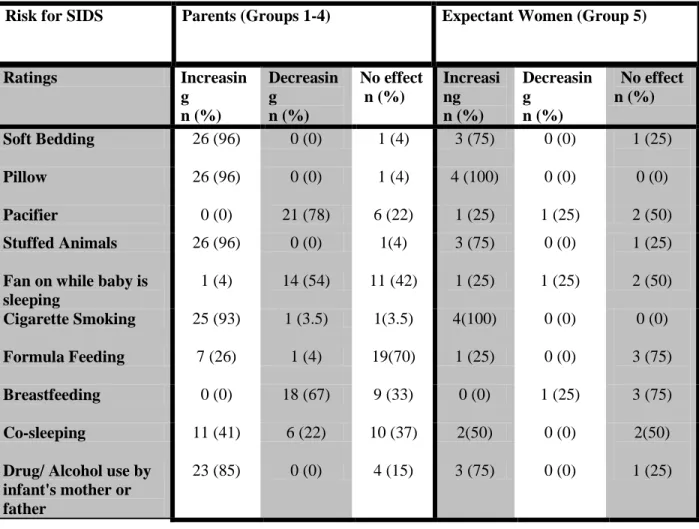
groups and expectant parents identified, pacifier (78 %, 25%), breastfeeding (67%, 25%), fan on while baby is sleeping (54%, 25%), and co-sleeping (22%, 0%) respectively as decreasing the risk of SIDS. The 4 most common responses under no effect on SIDS among parental groups and expectant parents included: formula feeding (70%, 75%), fan on while baby is sleeping (42%, 50%), breastfeeding (33%, 75%), and co-sleeping (37%, 50%) respectively as seen in Table 5 below.
Data Collection and Analysis
All participants completed a paper survey prior to the focus group, to collect demographic information, assess their knowledge of SIDS, and gather data on their past, current and/or future plans for infant sleep. Data from the paper surveys were placed into QualtricsTM, online
qualitative software, for further analysis. With the completion of the surveys, the five focus group sessions started, using 4 safe sleep print ads as the focal point of discussion under the guidance of a single moderator. In preparation for the study, the moderator completed the University of North Carolina Human Ethics Research certification and underwent training at the Odom Institute to develop the code book used for qualitative analysis of themes identified in the focus group discussions. The project was approved by the Office of Human Research Ethics at the University of North Carolina at Chapel Hill on June 25, 2012 (IRB # 12 1294). During each session
participants answered a set of open ended questions constructed within the moderator guide to assess their interpretation of the ads, their sense of validity of the information presented, and the likelihood of the ads to change their current or future planned behavior for infant sleep.
10
Participants’ responses within each of the five focus groups described in Table 2 were color coded and assembled into these five categories for each ad discussed in order to compare similarities and differences in their interpretation of the ads across the low SES group, the high SES groups, and first-time expectant mothers. It is important to note that the focus group, not the individual, was the unit of analysis. Responses coded from each of the 5 focus groups were analyzed in the context of the larger discussion. Though quotations from individuals are included in the results, conclusions are not made at the level of the individual.
III. Results
Table 1 contrasts the maternal age, ethnicity, level of education, WIC status and marital status among mothers vs. expectant mothers, totaling 27 and 4 respectively. For the 27 participants in the parental groups, the mean maternal age at the time of the study was 34 years compared to 31 years in the expectant mother group. Three of the parental focus groups conducted nearly met the criterion for high SES consisting of 22 mothers with 4 or more years of college. Two additional mothers, within Group 1, failed to meet this criterion with one with less than 4 years of college and the other with a high school diploma. In terms of ethnicity, the high SES groups (1-3)
consisted of 17 Non-Hispanic whites, 5 African Americans and 2 Hispanic classifying themselves as Puerto Rican and Brazilian respectively. In the low SES group (4), 2 out of 6 participants showed up for the survey with 1 additional person recruited on site -totaling 3African American mothers in this group. Of the 3 recruited, 2 received their high school diplomas and the 3rd mother her 4 year degree. Also among the parental groups, 24 of 27 or 89% of the mothers were married, and 3 of 27 or 11% were single. Within the expectant mothers group (5), the 4
11
The low SES parental group (Group 4) had the largest dropout rate with only 2 out of the 6 scheduled participants showing up for the group meeting. One additional participant was recruited on site the day of the study. Group 4 consisted of 3 participants all African American with a mean age of 34 years as seen in Table 2 below.
The last focus group consisted of 4 Caucasian first-time expectant mothers all meeting the criterion for high SES (Group 5). Within this group, only 4 out of the 7 scheduled participants showing up for the group meeting. The high SES expectant mother focus group consisted of 4 participants all non-Hispanic white, with a mean age of 31 years as seen in Table 2 below. As noted above, Groups 4 (low SES parents) and group 5 (first time expectant mothers) had the highest dropout rates. One unexpected issue in group formation was that educational status may not be a strong proxy for SES as two of the parents classified as low SES by education either ran their own business and/or lived within affluent communities. In addition, one parent in the low SES group had a 4 year degree yet resided within a lower income area. As a result, we did not turn away the 2 participants in Group 1 (with less than a 4 year degree) or the 1 participant in Group 4 (with a four year degree) who failed to meet the educational definition of the groups that best fit their schedule.
Tables 3, 4 and 5 below further contrast the difference between responses of the parental groups vs. expectant first-time mothers across questions assembled to ascertain their infant sleep history, SIDS knowledge, and ratings of credible sources of health related information. The percentages, in tables 3-5, also do not add up to 100% since participants could select more than one response for each question.
Following the review of the recorded transcripts of the 5 focus groups conducted, the following 5 themes emerged: 1)graphic imaging, 2) target audience, 3) purpose/ point of the message of the ads, 4) degree of accuracy/credibility and 5) the likelihood to influence or change behavior. The participants’ description of the ads both inductive and deductive, emerged interwoven seamlessly, lacking a clear distinction, between the two as the discussions occurred.
12
intimacy, loving and bonding as positive emotions. For target audience- participants either perceived the ads were addressing them directly or as part of the general population vs.
addressing others- defined as low SES, young mothers, mothers with low education, or mothers’ of a certain ethnic makeup. For the purpose or point of the message, we examined the
13 Table 1 Demographic Data
Demographic Data Parent
N= 27
Expectant Parents N=4
Mean age 34 31
Race/Ethnicity n% n%
Non-Hispanic White 17 (63) 4 (100)
Non- Hispanic Black 8 (30) 0
Hispanic/ Latino 2 (7) 0
Education
High School 3 (11) 0
Some College 1 (4) 0
4 year Degree 11 (41) 1 (25)
Graduate Degree 12 (44) 3 (75)
WIC Nutritional Support 1 (4) 0
Marital Status
Single 3 (11) 0
14
Table 2 Demographic Makeup of the Five Focus Groups
Group
High SES
Low SES Mean
Age (years)
Ethnicity
(self-classification)
Total # Participants
1-Parents * 34 78% Non-Hispanic White
22% Hispanic/ Latino
9
2-Parents * 33 90% Non-Hispanic White
10% Non-Hispanic Black
10
3-Parents * 36 80% Non- Hispanic Black
20% Non-Hispanic White
5
4-Parents * 34 100% Non-Hispanic Black 3
5-Non-parental, pregnant
* 31 100% Non-Hispanic White 4
Table 3 Sleep Demographic Questions/ Credible Sources of Information on SIDS Who have you discussed your baby's sleep practices with?
Circle all that apply.
Parents Expectant Parents
N= 27 N= 4
Your spouse or partner Response
n (%)
Response n (%)
Family member 24 (92) 4 (100)
Friends 17 (65) 2 (50)
Health Care Provider 20 (77) 2 (50)
16 (62) 0 (0)
Check below all the sources used to obtain info about SIDS
Pediatrician (infant's doctor) 24 (89) 2 (50)
Other Health Care Provider 7 (26) 2 (50)
Family 12 (44) 1`(25)
Friends 16 (59) 2 (50)
Media (magazines, newspapers, tv) 20 (74) 1 (25)
15
Table 4 Ratings of Trustworthiness of Sources (from 1-5, with 5 being most trustworthy) Rate trustworthiness of sources Parents
(Groups 1-4) Mean
Expectant Parents (Group 5)
Mean
Pediatrician (infant's doctor) 4.6 5.0
Other Health Care Provider 4.3 4.8
Family 3.4 3.3
Friends 3.3 3.3
Media (magazines, newspapers, tv) 3.2 3.0
16 Table 5 Knowledge of SIDS At Risk Factors
Risk for SIDS Parents (Groups 1-4) Expectant Women (Group 5)
Ratings Increasin
g n (%) Decreasin g n (%) No effect n (%) Increasi ng n (%) Decreasin g n (%) No effect n (%)
Soft Bedding 26 (96) 0 (0) 1 (4) 3 (75) 0 (0) 1 (25)
Pillow 26 (96) 0 (0) 1 (4) 4 (100) 0 (0) 0 (0)
Pacifier 0 (0) 21 (78) 6 (22) 1 (25) 1 (25) 2 (50)
Stuffed Animals 26 (96) 0 (0) 1(4) 3 (75) 0 (0) 1 (25)
Fan on while baby is sleeping
1 (4) 14 (54) 11 (42) 1 (25) 1 (25) 2 (50)
Cigarette Smoking 25 (93) 1 (3.5) 1(3.5) 4(100) 0 (0) 0 (0)
Formula Feeding 7 (26) 1 (4) 19(70) 1 (25) 0 (0) 3 (75)
Breastfeeding 0 (0) 18 (67) 9 (33) 0 (0) 1 (25) 3 (75)
Co-sleeping 11 (41) 6 (22) 10 (37) 2(50) 0 (0) 2(50)
Drug/ Alcohol use by infant's mother or father
23 (85) 0 (0) 4 (15) 3 (75) 0 (0) 1 (25)
Graphic Imaging
Ad 1 Baby with Knife in Bed
There appeared to be some differences in Group 1 between breastfeeding mothers and bottle-feeding mothers. Breastbottle-feeding mothers' responses to the graphics were expressed with emotion or feeling, along with a description of how the sleep practices in the ad was in stark contrast to their practices at home.
17
The same reaction to the ads were noted among bottle feeding mothers of multiples: “some shock value” and “definitely over exaggerated”. However, they rationalized that these components were purposefully made to catch the attention of the target audience they defined as younger/lower SES/uneducated mothers who may be unaware of the dangers of these sleep practices.
Mothers from Group 3 shared similar emotions and reactions to ad 1 with one difference. Instead of defending their co-sleeping by pointing out errors in the ad, the mothers in Group 3 had more of a reaction that reflected guilt or shame.
“… it makes me think that what I’m doing is not right and I’m not providing the best care for my child.” Another mother described her reaction as, “… it makes me feel like I’m a bad mother looking at this because I admit just honestly, I do co-sleep with my
daughter.” “… So I look at the picture and ask am I a bad mother?”
The reaction by Group 2 to ad 1 was as follows: Ad 1 proposed only one way to die of SIDS- in a bed -which they found to be one sided and misleading. They noted that the ad lacked information on other things that placed infants at risk and criticized the ad for failing to outline steps parents could take to minimize them.
In Group 4, one mother offered a literal interpretation of the ad, not comprehending it as an analogy.
“… I don’t think that the knife should be in the crib with the baby because that is very dangerous.”
Other mothers in Group 4 commented on the presence of the knife, the soft pillows and the blankets near the baby, making the connection that the knife was used as a symbol to relay to the public the dangers of co-sleeping. Even with this explanation, one mother was unable to make this leap and continued to see the knife in a literal form.
18
Following the discussion of graphics, Group 5 mothers then moved on to determine the point of the ad, struggling to determine its overall meaning. When comparing the two versions of ad 1, they appeared to react more to the facial expression of the infants as opposed to its implied message.
“… the young black infant sleeping, he looks very innocent and peaceful. He is not interacting with the knife.” On the other hand, “… the white infant is touching the knife. He has a weird facial expression and the ad looks very creepy.”
What appears to stand out in the pregnant womens’ assessment of both versions of ad is their attention to the facial expressions of the infants and their proximity to the knife, as opposed to the views on co-sleeping or SIDS expressed in the parental groups.
Ad 2 “I want to Live”
The “I want to Live” ad appeared to divide the groups, with Groups 4 and 5 showing support for the ad while mothers in groups 1-3 finding it lacking in key components.
“… a low production value, lacking in professionalism” consisting of a “…bunch of words” with phrasing seen in “…anti-abortion ads”.
For them, the ad appeared to put words in the infant’s mouth, “… sending the message through the baby, like he is speaking to us”. They felt that the text, “don’t sleep with me and don’t smoke near me,” created a mixed message diminishing the ability of the ad to deliver a concise message. Notably, parents against co-sleeping also agreed in the low production value of ad 2, yet they felt its message was still a valid one for a specific target audience, “…young uneducated mothers with limited resources.”
19 Ad 3. Headstone as a Headboard
Ad 3 seemingly evoked the strongest emotions among groups 1-3 as they interpreted the ad of the headstone as a headboard to imply death. Mothers described their emotions as fearful, scared, morbid, and sad. Those in support of co-sleeping looked over the ad to find inaccuracies yet they also agreed it contained some positive components. In comparison to ads 1 and 2, ad 3’s message was described by parents within groups 1-3 as educational, clearly stated and informative with a contact number for parents to obtain more information.
Mothers from Group 3 appeared to concentrate on the image of the tombstone and the text, “… the final resting place”, expressing how the ad made them feel about their decision to co-sleep, summarized by one mother in the group as “…it makes you really feel like an evil, evil person if you ever put your child anywhere near your bed.”
In Group 4, the one mother who struggled to comprehend the analogy in ad 1opened the discussion of ad 3. She noted the potential threat of the covers and pillows to an infant’s safety from the ad. Ad 3 appeared more transparent to her with its simple text and pictures that helped her to elucidate the meaning with ease. There was a consensus among the mothers in this group in that they found the text and graphic in ad 3 easy to understand and interpret. Group 5 participants agreed with the information presented in ad 3, finding validation from the ad that supported their views on the dangers of co-sleeping.
Ad 4. Mother and infant bonding in a hospital bed.
All mothers across Groups 1-4 spoke of the connection they felt to the ad with a smiling mother lying in bed next to her newborn. There was no mention of situation portrayed in the ad as the infant lay on its side on top of a pillow. Instead, they commented on the loving bond seen in the ad between mother and child and expressed how the image made them feel “… happy, peaceful and serene”, as it reminded them of the early days with their newborns.
20
arm band, the use of the word newborn, and the hospital room led some mothers to believe the ad was supporting room sharing as opposed to bed- sharing. While other mothers in the group expressed the text “in sync”, and “development” implied a longer time period than could be established in a short hospital stay. In the end, mothers in Groups 1-3 conceded that the ad was unclear in its recommendations to support room sharing or bed-sharing with the newborn at the hospital, at home or both.
One final output from Group 3 about ad 4 referred to its use of positive imagery, as opposed to negative imagery as seen in ads 1, 2, and 3. Mothers expressed a preference for ad 4’s use of a positive image that led them into good practices as opposed to negative ads that told them all the reasons why something is bad. Even with this endorsement for positive ads, one mother expressed that negative images last longer as they open dialogue about a topic, allowing the viewer to think about the information presented whereas positive ads once seen can be easily forgotten. Also, all ads, positive or negative, were limited in their ability to affect the target audience since they worked on a “…mother’s vulnerability” which is time dependent, diminishing as the infant gets older and is no longer at risk.
Group 4’s reaction to ad 4 were quite visible, with facial expressions of shaking heads and rolling eyes. Their changing opinion about the safety of co-sleeping, likely as a result of ads 1-2, caused them to view ad 4 as inaccurate. One mother expressed how the ad reinforced the same mixed message she received in the hospital, where staff instructed her to keep her newborn in the bassinet as well as keeping the baby skin to skin for nursing. A second mother felt the ad validated her experience in the hospital, where staff reinforced the benefits of co-sleeping. Although mothers in this group expressed feelings of love and happiness from the image of mother and child, their overall reaction to ad 4 was one of confusion. They described how ads 1-3’s messages were conflicting with the image and text depicted in ad 4. For this group, both the health department ads and the hospital ad were deemed credible sources. Therefore, both mothers expressed the need to discuss the matter further with their pediatricians for clarification.
21 Target Audience
Ad 1 Baby with Knife in Bed
Participants from Groups 1-3 examined each ad to determine what audience the ads were
attempting to address. Clues that stood out for them in ad 1 were the source of the ad, Milwaukee Health Department, and the text reference to provide aid to those in need. From this information, they ascertained the ad was targeting a specific audience consisting of young mothers, uneducated mothers and mothers with limited financial resources, along with parents who engaged in
attachment parenting independent of their SES. For Group 3, the definition expanded to include the age of the infant as a factor stating the ad was “…geared towards younger babies”, which they felt was inclusive of all races, SES groups and levels of education.
For groups 4 and 5, participants did not perceive from ad 1the “… lack of ability to afford a crib” as targeting a specific demographic. For group 5, they described how the text and the presence of a phone number in the ad added importance to the issue for all parents, expectant parents, and parents who co-sleep, failing to see age or SES as a factor. While in group 4, mothers expressed how they felt the ad was speaking directly to them and all mothers who engage in co-sleeping at home.
Ad 2 “I want to live”
The Groups 1-3 felt ad 2 targeted a similar demographic as ad 1. They referred to the simplicity of the phrasing and the need to educate the public about the dangers of smoking around infants as key components in the ad that defined the target audience for them. Group 3 also felt the ad targeted any persons that utilized public health services as well as those of similar race to the infant in the ad, which they determined to be either Hispanic or Asian. Group 4 felt ad 2 spoke to them directly while group 5 felt the ad addressed all caretakers of young infants/children
including “…grandparents or nannies who may fall asleep with the child in a chair or sofa.”
Ad 3. Headstone as a Headboard.
Most participants across the five focus Groups felt ad 3’s target audience was broader, speaking to the general population, in comparison to ads 1 and 2 which many felt addressed primarily a lower SES. Reasons cited for this conclusion included the polished language in the text,
22
for a general audience while others stating the health department logo remained a strong indication the ad was referring to parents of lower SES. Participants in group 5 compared the picture of bedroom to a hotel room stating it lacked essential items an infant requires on the night stand such as pampers, wipes, pacifier or bottle warmer. As a result of these reactions they extended this analogy to include in their definition of the target audience parents that are more career oriented and possibly “…out of touch” with the needs of children.
Ad 4. Mother and infant bonding in a hospital bed.
Most participants felt ad 4’s target audience included first-time and expectant mothers at the time of delivery or shortly thereafter. One mother expressed that the ad also addressed parents with a desire to have a specific birth experience where room sharing would be an option throughout their hospital stay. Both Group 3 and the Group 4 expanded their definition of the target audience. Parents within Group 3 noted that the target audience was also inclusive of parents engaged in attachment parenting, high SES parents, and breastfeeding mothers. Group 4 interpreted the target audience as including parents exposed to negative ads or mixed messages; they expressed a commonality with this audience in that they were exposed to similar messages in the hospital and in the current study itself.
Purpose/Point of the message Ad 1 Baby with Knife in Bed
Groups 1-3 expressed their opinion of the use of scare tactics as a common practice in public service announcements. One mother expressed her view on the use of negative ads stating the ads “…are trying to scare you into being compliant with the overall recommendation”. They also felt this method worked for certain demographics, citing as an example mothers of lower SES with limited education and resources.
23 Ad 2 “I want to Live”
Mothers in the Groups 1-3 agreed that ad 2’s attempt to describe the potential dangers of co-sleeping and smoking around an infant together was confusing. They felt the ad was crowded with too much information, creating a mixed message lacking clarity to decipher its overall intent. Participants also commented on how the ad failed to mention SIDS outright and did not provide statistics to support the text, all key components they identified as necessary to determine the central point of its message. The line “I want to live” was interpreted by some mothers within the high SES groups to mean, “…if you sleep with your baby then you don’t want them to live”, further implicating parents as the cause of infant death from SIDS. With this type of messaging, the group concluded the ad would be off-putting to mothers who practiced co-sleeping as part of their cultural norm, resulting in their overall rejection of the ad.
Group 4 offered no mention of the quality of the ad, the source of the ad or the degree of mixed messaging within the ad. Instead, the mothers in the group appear to take the information in the ad at face value. With further discussion, the mothers also expressed a change in their previous beliefs about the safety of co-sleeping, which they now no longer believed to be true. In the end, the transformation of their belief system on the safety of co-sleeping appears to be their overall take home message. Participants in Group 5 appeared less critical of ad 2, defining its “mixed message” in relation to the ad’s use of positive, “share only your love”, and negative, “don’t sleep with me, don’t smoke anywhere near me”, imagery and text. With a less critical eye, it seems that participants in Groups 4 and 5 appear more open to the ads, allowing them to extract some meaning behind each message, a practice not seen among mothers in Groups 1-3.
Ad 3. Headstone as a Headboard.
24
In the Group 4, the mothers all agreed ad 3 was more transparent compared to the other ads. They described how its simple text and pictures enabled them to interpret the meaning of the ad with ease. In comparison to the participants in Group 5, where mothers were divided on the issue, with one mother describing ad 3 as “powerful” in its attempts to relay the dangers of co-sleeping while the other found the negativity of ad 3to be a deterrent.
Ad 4. Mother and infant bonding in a hospital bed.
Participants in all 5 focus groups found ad 4 to be confusing on many levels. For mothers in Groups 1-3 and Group 5, the ad’s overall message was unclear in its endorsement of room sharing or bed-sharing in the hospital, at home or both. Group 3 felt the use of the word
“newborn” implied the ad referred to practices in the hospital and felt that any reference in the ad to a longer time period “… was not spelled out and only implied.” Among participants in Group 4, their apparent confusion occurred as a result of the contradiction of information presented in ads 1-3 endorsing the dangers of co-sleeping vs. ad 4 recommending co-sleeping. In the final assessment of ad 4, all parents across the different focus groups agreed the ad promoted bonding and being together with the infant as opposed to ads 1-3 which promoted “… keeping that distance when it comes to sleeping” as expressed by one mother in Group 2.
Accuracy/Level of credibility Ad 1 Baby with Knife in Bed
Participants, in Groups 1-3, spoke of their pre-knowledge on co-sleeping and SIDS as well as their practices for infant sleep at home in their final analysis of the accuracy of the ads shown3. Breastfeeding mothers in particular expressed feelings of anger towards the analogy presented in ad 1 comparing co-sleeping with an infant to lying in bed with a butcher knife. The mothers appeared to defend their practices at home by pointing out errors in the ad concerning the positioning of the infant on its side among soft pillows and a blanket. As a result of these discrepancies, they described the ad as “misleading” deeming it inaccurate and less credible. On the other hand, mothers opposed to the practice of co-sleeping appeared more supportive of the ad describing it as “… depicting a good message”.
25
co-sleeping when controlled for risk factors. Participants in Group 5 expressed how they felt validated by the ad, citing other credible sources supportive of the information presented in ad 1. They agreed ad 1reflected the information they obtained from health providers, family members and friends. Even with this positive endorsement they expressed an interest in seeing the ad backed by a statistic with a link to data they could research further on their own.
Ad 2 “I want to Live”
Groups 1-3 stated ad 2 lacked credibility, citing several reasons including: its lack of supportive statistical data, its use of unrecognizable sources (Stillbirth Conference & Delaware Alliance), its failure to provide contact information and its one sided view on co-sleeping. They further
expressed that the ad failed to provide information on the benefits of sleeping or how to co-sleep safely. Parents, who were against co-co-sleeping, expressed how the ad was valid for a specific target audience that they defined as young mothers, uneducated mothers and those with limited resources. Mothers in Group 4 and 5 found ad 2 to be credible and accurate. Ads 1 and 2 appeared to change the previous beliefs of mothers in Group 4 about the safety of co-sleeping, whereas, mothers in Group 5 appeared to question the use of the text “share only your love”, which they felt excluded other positive things a mother and child can share. Despite this shortcoming, they deemed the ad to be credible and accurate as well.
Ad 3. Headstone as a Headboard.
Participants in Groups 1-3 were divided in their statements concerning the level of accuracy found in ad 3. Some mothers described the ad as highly credible as a result of the polished language in the text, the professionalism of the ad, perceived safety of the bed (with limited pillows and other soft materials), and the follow up number provided to obtain more information. Others described how the text, “… For too many babies last year”, overstated the risk with a vague statistic, seemingly presenting a one sided view of SIDS. They noted that the ad appeared to imply that SIDS occurred only in bed, which they deemed false, diminishing the credibility of the ad overall. On the other hand, both participants in Groups 4 and 5 found ad 3 credible as it validated their beliefs on the dangers of co-sleeping.
Ad 4. Mother and infant bonding in a hospital bed.
26
positioning as acceptable because it was part of the conditioning of the hospital environment, “…as opposed to home, in a more natural environment.” For them, the wording neurological and physiological development appeared to add credibility to the ad along with the hospital logo, as opposed to other sources like the health department or some private organizations. Mothers also agreed ad 4 validated them parents. As one mother in Group 3 expressed, “…it makes me feel happy that I maybe did the right thing according to this ad.”
Mothers in Group 4 also appeared divided in their opinions of the credibility of ad 4, which they felt contradicted information learned about the dangers of co-sleeping in ads 1-3. As a result, one mother found ad 4 inaccurate, while another felt ad 4 validated messaging she had heard in the hospital. For both women, the health department and hospital were considered credible sources, and they surmised only a discussion with their pediatrician would help to clarify their confusion. Participants in Group 5 appeared to concentrate their attention on deciphering the overall meaning of ad 4, questioning if it supported room sharing or bed-sharing. Without this pertinent information, they found it difficult to accept the information in ad 4 as accurate.
Lessons Learned
Each session concluded with a discussion of which ads participants liked the least, the most, and why. We also asked participants what, if any, information they learned from the ads. Hence, participants were asked to group their responses to ads 1-5 together, only commenting on the ads deemed relevant to their views or practices at home.
Breastfeeding mothers in Groups 1-3 stated the ads did not persuade them to change their views on bed-sharing with their infants. They expressed how the ads either validated their infant sleep practices or placed them on the defensive, causing them to negate the message entirely.
27
Mothers in Group 4 shared different views on what they learned about the ads shown. In
reference to ad 1, one mother stated, “… I have learned that it is very unsafe for the child to be in their bed with a deadly utensil”. For this mother, throughout the study she appeared to not be able to comprehend the use of the knife as an analogy to the dangers of co-sleeping with an infant. While another mother stated, “What I’ve learned is that I am going to have to go home and do more research. I have more questions, and I haven’t really learned anything yet.” The final perspective from this group on the credibility of the ads was stated as follows:
“I think for every negative ad, there is a positive one, so I guess it is all depending on what your theories were to begin with and what research they had and what situation they encounter, but I still want to know what was it about putting your child in the bed that the babies have died sleeping with their parents. What was it that caused that death? That would be the question.”
Responses from participants in Group 5 showed the same variability as Groups 4 as they discussed what information they would take away from the ads presented in the study. One mother expressed her view of an infant’s need for independence and felt validated by ad 2 because “… it was very direct and it eliminated the need for any guilt that the parent might have about not being with their child all of the time.” While another in the group stated she disliked ads 1 and 3 for their negativity and preferred ad 2 because “…it was clear and concise”. There was consensus in Group 5, with mothers stating that they learned from the ads that the safest place for an infant was in a crib. Before the close on the summary discussions, all mothers in Group 5 expressed their plans to breastfeed, with one mother stating she would still use the co-sleeper and was not persuaded by the ad to change this decision and another stating that ad had 4 convinced her to room share and not bed-share, which she still believed was unsafe.
IV. Discussion
28
addition, parents within the group challenged the credibility of the ads by taking inventory of the source of the ad, its use of statistical data, and linkage to provide more information in their assessment of each ad’s meaning. The extent of the power of these factors was noted to influence even mothers supportive of co-sleeping to accept the information presented in ad 3 depicting a “headstone as a headboard”. Breastfeeding mothers in particular cited their acceptance of ad 3, despite its message against co-sleeping, as a result of its ability to deliver a clear message in a professional manner, formatted in way that addresses the general public, as opposed to targeting a specified segment. This reaction to the ad remained firm, despite the fact that the citation
(Milwaukee Health Department) was the same as ad 1, which members of the group had
dismissed because they felt it only targeted low “SES”. In their final remarks on what lessons, if any, were learned from these ads, all mothers in the high SES groups agreed they did not learn anything from these ads that they did not already know and did not feel the ads influenced them to change their current sleep practices.
The low SES and first-time pregnant women groups were less critical of the quality, text and style of the ads shown. They appeared more open to the ads as they worked to decipher meaning, extracting the components they deemed relevant even when the views presented in the ad contrasted with their own. There was no reference to an all or none approach in their acceptance of the ads as was seen in many of the high SES parental groups. Instead, each group felt the ads spoke to them directly or felt that they were included in the target population as part of a larger general audience. This particular theme was noted by the two participants in the low SES group that stood out since their recorded beliefs changed following their review of the ads. Both mothers were influenced by the ads to change their beliefs despite: 1) their history of
breastfeeding and co-sleeping successfully in the past and 2) the credibility of the cited support. What, then, led them to change their mind as we moved through the ads? Possible explanations for this change may be attributable to a series of factors: both mothers were pregnant and,
29
pregnancy, which would serve as a strong source of influence in her final decision making process. The combination of the degree of vulnerability existing in both low SES mothers (pregnant status), the birth order of their children (both had 2 year olds and may have felt their information on infant care was out of date) and the equal weight in credibility they awarded to the health department all played a role in allowing them to be more open to the ads, seeing
themselves as the target audience for the messaging presented in all of the ads. It was noted following summation that, although the group expressed a change in belief on the safety of co-sleeping earlier in the study, the conflicting messaging of ads 1-3 (against co-co-sleeping) vs. the positive messaging of ad 4 (for co-sleeping) left participants confused, stating they would need to do further research and consult their pediatricians for more information.
In the end, the low SES group denied learning anything from the ads as a whole. One mother expressed it by stating, “… but I still want to know what was it about putting your child in the bed that the babies have died sleeping with their parents. What was it that caused their death? That would be the question.” The negative ads (1-3) for her were unsuccessful in describing why co-sleeping was unsafe, and the ads failed to address what if any causal factors lead to the death of a child. This reaction was also shared among mothers in the high SES group, who questioned why the ads failed to mention SIDS directly and provide information on how to co-sleep safely. One final observation noted from the low SES group was one mother’s failure to comprehend ad 1’s use of analogy by depicting the dangers of co-sleeping, symbolically placing a butcher knife in bed with an infant. Other members in the group attempted to explain the use of the knife as a symbol, however, this mother was still unable to make this leap and continued to see the knife in its literal form. This example speaks to the limited ability of certain persons to decipher an ad that utilizes analogies to convey its message.
30
notable difference between the occurred, in Groups 5 compared to Groups (1-3) was their
understanding of the target audience for ad 1. For example, all of the high SES groups defined ad 1’s target audience as individuals of low SES since the ad referenced providing assistance for those unable to afford a crib. This same ad appeared more general to the pregnant women’s group who felt the need to provide a crib for those who could not afford it only served as proof of the importance of the issue for the general population. What is apparent in their assessment of ad 1 is not only how they interpret the text and graphics, but also whether or not they see themselves as a recipient of that message as opposed to a particular segment of the population. The pregnant women’s group apparently combined their previous beliefs on the dangers of co-sleeping, their sense of validation by the ads that supported this view, their level of vulnerability due to their pregnancy status, and their admitted lack of knowledge on infant care in their acceptance of the messages depicted in these ads.
It is also important to note that among all five focus groups, only the first time pregnant women stated they learned anything from these ads, and some in that group noted that the ads had influenced them to change their planned behavior. One mother in particular expressed a pre-existing belief in the independence of a child and accepted ad 2 as supportive of her views to not room share with her infant. By the end of the study, she commented on how ad 4 taught her about the benefits of room sharing for the development of the infant, which she now now planned to incorporate as a practice after the birth of her child.
Strengths and Limitations
There were several limitations in this study. First, some of the groups were limited by their small sample size. Secondly, the ethnic diversity within some groups could have inhibited some respondents: without an equal representation of race/ethnicity with the groups, the data may be skewed to represent the opinion of the majority or dominant subgroup. Further, the low SES group (n=3) was small in comparison to the high SES groups (n=24). The first time expectant mothers group (n=4) lacked any diversity in education and ethnicity as all participants recruited represented one race and met the qualifications for high SES and the small sample size also may diminish the degree of variability of responses, as the groups’ dynamic is changed allowing those most outspoken in the group the ability to influence the responses of others.
31
degree of anonymity, some persons within the groups may have tailored their response to answers deemed socially acceptable to the groups with which they were affiliated. Also by definition this selection process to recruit all eligible and willing subjects is not random and along therefore is not a probability sample.
The final limitation results from the probable existence of both a social desirability bias and volunteer bias within the study. The low SES group may have been subjected to social
desirability bias possibly led by the depiction of the negative ads against co-sleeping as seen in ads 1-3 as a representation of the normative views of the research team and/or populace causing them to view the practice of bed-sharing as a result of the study as socially undesirable. Whereas, the condition of volunteer bias could occur as the selection of participants in the study was not random. Therefore study participants’ views may not be a true representation of those within the general population.8 In the midst of the assembly of these groups, matching participants by ethnicity, education and SES, some lurking variables may exist influencing the results that the researches may be unaware of.
One aspect of the study identified as strength is the relationship developed by the researcher with several key leaders in the community. This was necessary in order to promote, recruit and conduct the focus group in locales that participants’ would recognize as part of their natural environment. These community leaders added credibility to the project itself through their support, which was essential in the recruitment and retention phase of the study.
Recommendations
Participants identified some components as essential to add credibility to PSAs designed to educate the public on infant safe sleep practices. Parents come from a place of knowledge, so the information presented in the ads should be 1) factual, and 2) based on research with statistics to back it up from a credible source. Parents preferred credible sources such as national
organizations, like the American Academy of Pediatrics, as opposed to state or regional ones that may not be recognizable by the general public, like the health department.
32
use of positive or negative imagery in the messaging of PSAs. They preferred positive ads that validated or affirmed their current practices however they noted that some degree of negativity helped to catch the attention of the target audience, if they also empowered the parent to seek out more information with a link to a website considered a credible source.
Ad 4’s depiction of a mother an infant sharing a hospital bed was most effective out of the 4 ads because it resonated more positively than any other across all participants within the five groups, but in different ways. Parents who breastfeed and bed-share described how the ad validated their decision providing information on the neurological and physiological benefits of bonding with your newborn. Further, parents that were against bed-sharing, found ad 4 comforting as it brought up memories of their first hours with their newborn and felt the ad promoted room sharing since it was depicted in a hospital setting. Finally, the only ad deemed by any group as educational to the point where one parent expressed how it influenced her to change her behavior to adopt the practice of room sharing with her infant, after delivery, was ad 4.
V. Conclusions
This study found that parents and expectant women agree that PSAs depicting a causal
33 Appendix A
Advertisement #1 A: Baby with Knife in Bed / Advertisement #1 B: Baby with Knife in Bed
What is the first thing you notice about this ad?(what catches your eye first) What do you think the picture is trying to tell you?
Who do you think this advertisement is for?
“Your baby sleeping with you can be just as dangerous.” What do you think they mean by this? How does it make you feel?
34 Advertisement #2
What is the first thing you notice about this ad?(What catches your eye first?) What do you think this picture is trying to tell you?
Who do you think this advertisement is for?
“I want to live. Share only your love.” What do you think they mean by this? How does it make you feel?
35 Advertisement #3
What is the first thing you notice about this ad? (What catches your eye first?)
What do you think this picture is trying to tell you? (What do you think they mean by this advertisement?
Who do you think this advertisement is for?
“For too many babies last year, this was their final resting place. What do you think they mean by this?
How does it make you feel?
Do you agree with the information in this ad? Discuss
36 Advertisement #4
What is the first thing you notice about this ad? (What catches your eye first?)
What do you think this picture is trying to tell you? (What do you think they mean by this advertisement?)
Who do you think this advertisement is for?
“Mothers and Babies were made to be together.” What do you think they mean by this? How does it make you feel?
37 Appendix B
Survey Questions on Parental Demographic Information/ Sleeping Habits for their infants/ SIDS Knowledge/Credible Sources of Information on SIDs.
How old are you? ___________ What is your gender?
a. female b. male
Are you currently pregnant? a. yes
b. no
Do you have any children under the age of 2? a. yes
b. no
What is your race?
a. White b. African-American
c. Asian/Other Pacific Islander d. American Indian/Alaskan Native e. Other (please specify): _____________
What is your ethnicity? a. Hispanic/ Latino
b. Other (please specify)_______________ Do you receive any nutritional support from WIC? a. yes
b. no
What is the highest level of education you have completed? a. less than high school b. 2 year degree
c. high school d. 4 year degree e. some college f. Graduate Please describe your marital status?
a. Single b. Married
c. Divorced d. Widowed
What room does your baby sleep in?
Where does your baby typically sleep?(parents can chose more than one option) Does your baby sleep in the same place for naps as they do at nighttime? Do they sleep in the same location throughout the night?
38
Which sleep accessories, if any, does your baby use (circle all that apply)?
Does your baby sleep in bed alone or share a bed with someone else (circle all that apply)? Who have you discussed your baby's sleep practices with (circle all that apply)?
Assessment of Knowledge about SIDS and Safe Sleep
Have you ever heard about Sudden Infant Death Syndrome, also known as SIDS? Check below all the sources that you use to obtain information about SIDS.
Rate the trustworthiness of the different sources below on a scale of 1-5 with 1 "lowest" and 5 " highest.
The safest position for a resting infant is
For each of the options below, mark the box that applies if you think the following increases the risk of SIDS, decreases the risk of SIDS or doesn’t have any effect on SIDS. If you have never heard of SIDS, please skip this question.
Survey Results on Expecting Parents Demographic Information/ Plans for Infant Sleep/SIDS Knowledge/ Credible Sources of Information on SIDs
How old are you? ___________ What is your gender?
a. female b. male
Are you currently pregnant? a. yes
b. no
Do you have any children under the age of 2? a. yes
b. no
What is your race?
a. White b. African-American
c. Asian/Other Pacific Islander d. American Indian/Alaskan Native e. Other (please specify): _____________
What is your ethnicity? a. Hispanic/ Latino
b. Other (please specify)_______________ Do you receive any nutritional support from WIC? a. yes
39
What is the highest level of education you have completed? a. less than high school b. 2 year degree
c. high school d. 4 year degree e. some college f. Graduate Please describe your marital status?
a. Single b. Married
c. Divorced d. Widowed In what room do your plan for your baby to sleep? Where do you think your baby will usually sleep?
Do you think your baby will sleep in the same place for naps as they do at nigh-time? Do you think your baby will sleep in the same location throughout the night?
Do you think your baby will sleep mostly on their back, stomach, or side?
Which sleep accessories, if any, do you plan to use with your baby (circle all that apply)? Do you think your baby will sleep alone or share a bed with someone else (circle all that apply)? Who have you discussed your plans for your baby's sleep practices with (circle all that apply)? Assessment of Knowledge about SIDS and Safe Sleep
Have you ever heard about Sudden Infant Death Syndrome, also known as SIDS? Check below all the sources that you use to obtain information about SIDS.
Rate the trustworthiness of the different sources below on a scale of 1-5 with 1 "lowest" and 5 " highest”
The safest position for a resting infant is
40 VII. References
1. Willinger M, James LS, Catz C. Defining the Sudden Infant Death Syndrome (SIDS):
Deliberations of An Expert Panel Convened by the National Institute of Child Health and Human Development. Pediatr Pathol. 1991; 11(5):677-684
http://www.ncbi.nlm.nih.gov/pubmed/1745639
2. Moon RY. SIDS and Other Sleep-Related Infant Deaths: Expansion of Recommendations for a Safe Infant Sleeping Environment. Pediatrics (Evanston). 2011; 128(5): e 1341-e 1367.
http://pediatrics.aappublications.org/content/128/5/e1341.full.html
3. Tackett KK, Gong Z, Hale TW. Mother-Infant Sleep Locations and Nighttime Feeding Behavior. US Data from the Survey of Mother’s Sleep and Fatigue. (online). 2010(cited 2012 March 14). Available from: URL: http://
www.breastfeedingmadesimple.com/CL_1-1_infant_sleep_location.pdf
4. McCoy R, Hunt C, Laski S, et al. Frequency of Bed Sharing and its Relationship to Breastfeeding. Journal of Developmental & Behavioral Pediatrics. 25(3):141-149. http://www.ncbi.nlm.nih.gov/pubmed/15194897
5. Hauck FR, Thompson JMD, Tanabe KO, Moon RY, Vennemann MM. Breastfeeding and reduced risk of sudden infant death syndrome: a meta-analysis. Pediatrics 2011; 128(1):103-110. http://www.pediatricsdigest.mobi/content/128/1/103.short
6. Powell RA, Single HM. Focus Groups. International Journal for Quality in Health Care, Vol 8. No. 5 pp 499-504. http://intqhc.oxfordjournals.org/content/8/5/499.full.pdf+html
7. Heary CM, Hennessy E. The Use of Focus Group Interviews in Pediatric Health Care Research. Journal of Pediatric Psychology, Vol. 27, No. 1 2002. pp 47-57
http://jpepsy.oxfordjournals.org/content/27/1/47.abstract
8. Hockenberry-Eaton M, Hinds PS, O’Neill J, Alcoser P, Bottomley S, Kline N, Euell K, Howard V, Gattuso J, 1999. Developing a conceptual model for fatigue in children. European Journal of Oncology Nursing, 3, 5-11.
9. Redmond R, Curtis E. Focus groups: Principles and Process. Nurse Res 2009; 16 (3):57-69. http://europepmc.org/abstract/MED/19425401
10. Devers KJ, Frankel RM. Study Design in Qualitative Research--2: Sampling and Data Collection Strategies. Education for Health (Abingdon, England) 2000; 13(2):263-271. http://europepmc.org/abstract/MED/14742088