CREATING AND EVALUATING A TOOLKIT FOR SHARED MEDICAL APPOINTMENTS FOR HYPERTENSION MANAGEMENT IN A JAIL SETTING
Erin A. Flitt
A project submitted to the faculty at the University of North Carolina at Chapel Hill in partial fulfillment of the requirements for the degree of Doctor of Nursing Practice in the
School of Nursing.
Chapel Hill 2015
© 2015 Erin A. Flitt
ABSTRACT
Erin A. Flitt: Creating and Evaluating a Toolkit for Shared Medical Appointments for Hypertension Management in a Jail Setting
(Under the direction of Debra J. Barksdale)
There is a higher prevalence of hypertension in jail inmates than in the general population and it has been estimated that up to 50% of inmates have hypertension (Binswanger, Krueger, & Steiner, 2011). This project describes the creation of an evidence-based toolkit for clinicians that will assist in implementing the shared medical appointment approach for the treatment of hypertension in a jail in North Carolina. The toolkit prototype was created based upon the standards of the National Commission on Correctional Health Care and evidenced based literature. Two focus groups comprised of medical and correctional staff were held to discuss the feasibility and appropriateness of the toolkit for a jail setting. Some of the concerns expressed by the focus group
participants included volume of participants in need of assistance to manage their
hypertension versus volume the approach could serve, length of the assessment tool, and the series/number of encounters required of the shared medical appointment approach. Based on the focus group input, it is not feasible at this time to implement the shared medical appointment approach for treatment of hypertension in this jail setting. Thus, the feedback was used to revise the toolkit to create a more practical one-time clinical
TABLE OF CONTENTS CHAPTER 1: CREATING AND EVALUATING A TOOLKIT
FOR SHARED MEDICAL APPOINTMENTS FOR HYPERTENSION
MANAGEMENT IN A JAIL SETTING...1
Problem Statement...………...………...2
Purpose...……….. ...3
Conceptual and Theoretical Framework……… ...3
Review of Literature……...………...4
Non-Adherence………...7
The Need for Novel Approaches……...………...9
CHAPTER 2: METHOLOGY……….. ...11
Design……… ...11
Participants and Setting………...12
Phase I: Review of the Literature and Hypertension Management Guidelines ………...12
Phase II: Development of the Shared Medical Appointment Toolkit for Hypertension Management………...13
Step 1: Development of a Toolkit Prototype………...13
Toolkit Basics………...13
Step 2: The Focus Group………...18
Focus Group Results………...18
CHAPTER 3: DISCUSSION……….………...25
Economic Implications………...26
Limitations………...27
Recommendations………...27
Conclusions………...28
APPENDIX 1: TOOLKIT PROTOTYPE………...29
APPENDIX 2: FINAL TOOLKIT………...78
LIST OF TABLES
CHAPTER 1: CREATING AND EVALUATING A TOOLKIT FOR SHARED MEDICAL APPOINTMENTS FOR HYPERTENSION MANAGEMENT IN A
JAIL SETTING
Hypertension is one of the most common chronic conditions seen in primary care with a prevalence of roughly 30% in the general population (Egan, Huchinson, &
Ferdinand, 2014). If not detected and appropriately treated, hypertension can lead to renal failure, myocardial infarction, stroke, and death (Egan et. al., 2014). Medication therapies are effective in lowering blood pressure, but it is estimated that non-adherence rates are roughly 57% (Alhalaiqa, Deane, Nawafleh, Clark, & Gray, 2012).
In the United States, jail inmates have a higher prevalence of chronic illness than the general population. In inmates between the ages of 50 and 60 years, the rate of hypertension is as high as 50% (Binswanger, Krueger, & Steiner, 2011). It is well documented that African American adults in the general population are
disproportionately affected by hypertension compared with White or Hispanic adults (Egan et. al, 2014). Given the overrepresentation of African American males in the correctional system, the overall prevalence rates of hypertension among the incarcerated are skewed higher (Dumont, Allen, Brockman, Alexander, & Rich, 2013). Nevertheless, even when prevalence data is adjusted for race, inmates consistently have higher rates of hypertension than non-institutionalized adults (Binswanger et. al., 2009; Arries &
One intervention that has proven successful in the management of certain chronic conditions is the shared medical appointment. Shared medical appointments are group visits defined by condition where practitioners utilize social integration, interactive education, and medication management to achieve improved disease outcomes (Edelman et. al., 2012). Shared medical appointments are typical 90-120 minutes long and can accommodate 6-20 participants (Edelman et. al., 2012). Techniques such as motivational interviewing and guided discussion are used to facilitate participant skill building to reduce ambivalence and progress to self-efficacy and formulating an action plan (USVA, 2008; Matulich, 2013). Applying this intervention to the jail setting will allow care to occur earlier in the intake process and more frequently than traditional chronic care visits, as well as provide support to decrease barriers to treatment adherence. This approach increases the likelihood of reaching inmates with shorter lengths of stay prior to their return to the community, resulting in a positive effect on community health and the entire local health care system. Shared medical appointments meet National Commission on Correctional Health Care (NCCHC) accreditation standards pertaining to health promotion, self-care, medical diets, tobacco use, discharge planning, continuity and coordination of care during incarceration, and chronic disease services (NCCHC, 2014). In socioeconomic groups where health literacy may be low but peer support is high, the shared medical appointment may be the optimal model to augment the traditional one-on-one visits (Egger et. al., 2014).
Problem Statement
traditional chronic care clinics, inmates do not consistently follow treatment regimens. The literature suggests racial and ethnic disparities, dietary preferences, chronic stress, smoking, low socioeconomic status, lack of self-efficacy, lack of health insurance and poor access to care as barriers to adherence to hypertension treatment regimes in this population (Binswanger et. al., 2011; Hicken, Lee, Morenoff, House, & Williams, 2014; Travis, Western, & Redburn, 2013; Marks & Turner, 2014; Kinner & Wang, 2014; Dumont et. al., 2013). A potential solution to this problem is the implementation of the shared medical appointment.
Purpose
The purpose of this project is to create and evaluate the feasibility of an evidence-based toolkit for clinicians to use to implement the shared medical appointments
approach for the treatment of hypertension in a jail in North Carolina. Conceptual and Theoretical Framework
information systems, health care organization, and community resources to strengthen the provider-patient relationship (Coleman et. al., 2009).
In the planned shared medical appointment, self-management support is addressed in the focused content and interactive education of visits and includes basic information about hypertension, self-management, skill building, emphasis on patient empowerment, and development of problem solving skills. Decision support for the shared medical appointment involves treatment decisions and recommendations for hypertension from the guidelines by the Eighth Joint National Committee (JNC-8) and the American Heart Association (James et. al., 2014; American Heart Association, 2015). In the jail setting, the clinical information system component of this model is the electronic medical record, which has the ability to track medication adherence, query populations, and store
individual patient information to track plan of care and treatment. Information regarding community resources, reinforcing evidence-based approaches, adherence to a low-sodium diet and medication regimens, formulation of an individual participant’s release plan, and procedures for providing transitional medication upon release are all addressed in the toolkit. The chronic care model framework goals are to transition care from reactive treatment to proactive treatment (Coleman et. al., 2009). Shared medical appointments are perfectly aligned with the chronic care model in that they address these six areas of care delivery and the toolkit was designed to capitalize on all of these areas.
Review of Literature
usually operated by counties or municipalities and jail inmates are incarcerated for short periods of time in jail facilities, generally for misdemeanor sentencing or while awaiting trial (Binswanger et. al., 2009). In the United States, it is estimated that over 11 million people are processed through local jails each year (Marks & Turner, 2014; Kinner & Wang, 2014). Many inmates leave jail rapidly after posting bail, having charges dropped, or receiving a sentence. This makes the average weekly turnover approximately 60% (Marks & Turner, 2014). After release, jail inmates’ health problems often burden the local community health system (Marks & Turner, 2014). When reentering the
community, former inmates with poorly managed conditions are overrepresented in acute care settings (Kinner & Wang, 2014). There is emerging evidence of a correlation
between poor health outcomes and risk of recidivism (i.e. relapse into criminal behavior); therefore, addressing processes to improve health outcomes may indirectly affect public safety (Kinner & Wang, 2014).
Jail inmates have poorer health and higher prevalence of underlying chronic illness compared to the general population (Binswanger et. al., 2009; Kinner & Wang, 2014; Travis et. al., 2013). Widespread characteristics that trend among inmates are low levels of education, substance abuse, alcohol abuse, smoking, poor nutrition, mental illness, and low levels of self-efficacy which exacerbate poorly managed chronic illness (Binswanger et. al., 2009; Kinner & Wang, 2014). Chronic psychological stress may be as important as hyperlipidemia when ranking risk factors for cardiovascular disease (Binswanger et. al., 2009; Kinner & Wang, 2014; Travis et. al., 2013; Hicken et. al., 2014).
Racial disparities are increased in both incarceration and hypertension.
Hypertension occurs at an earlier age in African-Americans, with approximately 40% prevalence overall, compared to 30% for Caucasians over the past few decades (Hicken et. al., 2014). In 2013, the African-American incarceration rate was 3,119 per 100,000 compared to the Caucasian incarceration rate of 487 per 100,000 (Dumont et. al., 2013).
Many inmates are uninsured therefore the jail setting is their sole source of health care (Marks & Turner, 2014; Ross, 2011). Ninety percent of those leaving jail reenter the community without health insurance of any kind and thus the investment of health care received in jail is lost (Marks & Turner, 2014; Kinner & Wang, 2014). Adequate discharge planning that includes facilitating health care upon reintegration and
identifying and enrolling Medicaid eligible inmates would smooth the transition back to the community (Marks & Turner, 2014).
design and implementation of health promotion programs. Consciousness of blood pressure measurement (i.e. self-awareness) is a key factor to blood pressure control, which is lower in patients who infrequently use health care (Egan et. al. 2014). Increasing knowledge, creating positive relationships with providers, and facilitating social support can greatly affect self-management in patients with hypertension (Flynn et. al., 2013). The following five key areas must be address with any hypertension treatment regimen in order to overcome barriers.
Non-adherence
Adherence is the extent to which personal behaviors correspond to an agreed upon plan of care, or treatment regimens, with a health care provider (Alghurair et. al., 2012). Non-adherence to treatment regimens may be intentional or unintentional, and is
complicated by many factors (Bailey, Oramasionwu, & Wolf, 2013). Adherence is not a single behavior, but multiple behaviors that are influenced by environmental, social, and individual dynamics (Stein, 2011). To improve adherence, a thorough understanding of patient perceptions and experiences must be explored (Marshal, Wolfe, & McKevitt, 2012). Adherence assumes that skills, resources, and motivation are present to follow health care recommendations (Hill et. al., 2011). Medication adherence, health literacy, dietary choices, and tobacco use are all components influencing hypertension treatment adherence.
Medication adherence. Medication adherence is one of the many factors that
and increased health care costs (Hill, Houston, & DeGuest, 2011). The integration of the medication self-management model can examine barriers in the steps of fill, understand, organize, take, monitor, and sustain to identify gaps in health literacy (Bailey et. al., 2013). In addition to self-reporting, ability to pay, and pill counts, exploring experiences of symptoms and concerns about drug side effects are all part of a comprehensive intervention (Marshall, Wolfe, & McKevitt, 2012; Hill et. al., 2011).
Health literacy. Low health literacy is linked to reduced medication adherence
and greater use of emergency care (The Cecil G. Sheps Center for Health Service Research, 2013). Health literacy, defined as an individual’s capacity to comprehend health information, plays a major role in analyzing adherence behaviors (Bailey et. al., 2013). In one study, self-efficacy and health literacy were built in the form of adherence therapy and based on the premise that the patient’s beliefs impacted their adherence to their medication regimen. Cognitive and motivational interviewing was used to
successfully modify beliefs, improve adherence, and reduce blood pressure (Alhalaiqa et. al., 2011).
Diet. The Dietary Approaches to Stop Hypertension (DASH) diet is the first line, non-pharmacologic treatment for hypertension (Epstein et. al., 2012). This diet
sensitive while enhancing family and social support, which may result in improved adherence after release (Epstein et. al., 2012).
Tobacco use. Inmates have a prevalence of smoking up to three times that of the general population, ranging from 84% to 88% (Arries & Maposa, 2013). The average tobacco use per day is equal to 20 cigarettes, with the mean age of onset of tobacco use before the age of 15 years (Arries & Maposa, 2013). Incorporating smoking cessation as part of a comprehensive intervention aimed at decreasing hypertension can greatly contribute to improved outcomes (Hayes, Leischow, Lawrence, & Lee, 2010). Currently, usual care for smoking cessation is the distribution of written information.
The Need for Novel Approaches
Novel approaches are needed and shared medical appointments can address and target some key behaviors that may decrease hypertension, as well as identify and address barriers to health promoting behaviors (Egan et. al., 2014). Shared medical appointments are a multifaceted intervention based on health conditions that combine interactive education, social support, technical assistance with medications, and facilitation to obtain community resources (Edelman et. al., 2012). Benefits have been achieved in blood pressure measures and reduction of cardiovascular risk in studies that concentrated on interventions to improve diabetes outcomes (Kirsh et. al, 2007; Edelman et. al., 2010).
studies of shared medical appointments with usual care for diabetes; all studies were associated with decreased levels of hemoglobin A1C (mean difference=-0.55;CI, -0.99 to -0.11) (Edelman et. al., 2010). Five studies reported effects on systolic blood pressure, showing a consistent and statically significant effect (mean difference=5.2; CI, 7.40 to -3.05) (Edelman et. al., 2010).
The review of the literature yielded no studies on the shared medical appointment model for chronic disease processes in the jail or prison setting. There was literature addressing group interventions and peer led teaching centered on HIV and women’s health issues in prisons, but the program was not led by a medical provider (Zack, Smith, Andrews, & May, 2013; St. Lawrence et. al., 1997; Goldstein, Warner-Robbins, McLean, Macatula, & Conlin, 2009; Sifunda et. al., 2008). A successful shared medical
CHAPTER 2: METHODOLOGY Design
The project included multiple phases to design and determine the feasibility of a toolkit for implementation of the shared medical appointment approach for hypertension management in a jail setting. This project was reviewed by the Office of Human
Research Ethics at the University of North Carolina at Chapel Hill and determined to be exempt from Institutional Review Board approval, as it does not constitute human subject research. Phase I consisted of a review of literature and hypertension management
guidelines. Phase II was the actual development of the toolkit and included evaluation by focus groups. Guided by the chronic care model and best practices for toolkit
development, a prototype was designed and presented to staff of the jail for feedback. Phase III included revision of the toolkit based upon the feedback from the jail staff. The feedback was use to make revisions to accommodate staff preferences and maximize operational efficiency, while maintaining National Commission on Correctional Health Care standards for chronic care management.
disease progression and complication, and foster improved function” (NCCHC, 2014, p.107). The program incorporates regular visits, treatment plans, and patient education. Participants and Setting
Two focus groups were conducted consisting of a convenience sample of staff that are employed in the medical department and jail setting. Participants in the first group included one physician, one nurse, and one correctional officer. Participants in the second focus group consisted of one physician assistant, one director of nursing, two nurses, and one correctional officer.
The setting for the focus groups was the Gaston County Jail and Annex. This facility has over 185,000 square feet and an operating inmate capacity of 527 men and women ages 16 and over. The jail houses state pretrial detainees, convicted inmates, pretrial federal inmates, weekender inmates, federal work release inmates, and detainees for Immigrations and Customs for up to 72 hours.
Phases and Process
visit” were used. These searches were limited to publications after 2008. Searches were also done using: “chronic care model”; “treatment adherence”; and “toolkit.”
Phase II: Development of the Shared Medical Appointment Toolkit for Hypertension Management
Step 1: Development of a Toolkit Prototype
A toolkit prototype was designed based upon the guide Facilitator’s Guide:
Implementation Toolkit: Intervention and Organizational Readiness (The California
Social Work Education Center [CalSWEC], 2015). The guide was developed by The California Social Work Education Center (CalSWEC). Based out of the University of California at Berkley’s School of Social Work, CalSWEC is the nation's largest coalition of social work educators who collaborate to provide professional education, student support, in-service training, and workforce evaluation research (CalSWEC, 2015). The guide provides a systematic process for evaluating an intervention by collecting
background information, assessing organizational readiness, building a toolkit, and conducting focus groups.
Toolkit Basics. The toolkit prototype is found in appendix1. Objectives of the toolkit include: to provide staff with a blueprint to implement the shared medical appointment approach to manage hypertension, to provide background information of current jail standards and evidence-based hypertension management guidelines, and to provide site-specific resource material for participants to receive follow up care when integrating back into the community. A basic overview of the elements of the toolkit and the approach for the shared medical appointment are presented below.
an overall participant goal of increased awareness of blood pressure was presented. The shared medical appointment approach is defined and explained. The chronic care model is outlined as the framework for the topic based appointments and the six elements of self-management support, clinical information systems, decision support community resource and policies, organizational support, and delivery system design is presented. Benefits for jail staff and for participants are explored.
Background information. This section presents accreditation standards of health
promotion, self-care, medical diets, tobacco use, discharge planning, continuity of care during incarceration, and chronic disease services as required by the National
Commission on Correctional Health Care. Elements, characteristics, and goals of the shared medical appointment are outlined. Research and agencies that have participated in the use of shared medical appointments are presented. Group dynamics and physical environment are identified as essential elements in the approach. Goals for the shared medical appointment are: to allow providers more interaction time with participants, utilize techniques to build problem solving skills, practice goal setting, formulate an action plan, and to develop motivation and self-efficacy through peer support. The roles of facilitator and provider are defined and responsibilities of each are introduced.
Skills needed. Skills used during shared medical appointments such as
clinical examples of its application (Matulich, 2013). The process elements of motivational interviewing of engaging, focusing, evoking, and planning are defined (Matulich, 2013).
The concept of low health literacy is introduced with the definition, prevalence information and an example of the teach-back method. Guided discussions are presented as a means to facilitate the shared medical appointment and minimize the provider’s voice during the session (Edelman et. al., 2012; USVA, 2008). The priority of participant skill building is emphasized to practice problem solving during peer interactions (USVA, 2008).
Preparing for the shared medical appointment. Current evidence-based practice
references from the National Commission on Correctional Health Care guide on
hypertension and the American Heart Association algorithm for treatment are provided in this section. Inclusion and exclusion criteria for creating a hypertension registry are outlined. Appropriate participants includes: male inmates, over the age of 21, prescribed hypertension medication, with a body mass index of over 25, and a blood pressure measurement not yet at individual goal. Inappropriate characteristics are outlined as those with an elevated security status, in protective custody, conflicting gang affiliations with others in the group, and inmates with major psychiatric illness. A step-by-step approach is presented on preparation for the pre-implementation phase of the shared medical appointment, including labs, vital signs and collection instructions and inclusion of the Hypertension Self Care Profile.
Implementation guide. Agenda setting for the shared medical appointment and
the elements of a check-in process, instructions on handling introductions, individual participant sessions (i.e. physical exam, medication adjustment), using session handouts to guide group discussion, and debriefing among staff after the session. Handouts with key points for topic discussions are introduced for each of the four sessions. These topics correspond to educational topics suggested by the National Commission on Correctional Health Care and the American Heart Association guidelines. Information and exercises are adapted from evidence-based resources from the Centers for Disease Control (CDC), National Institute of Health, JNC-8, and the American Heart Association. Critical
environmental provisions concerning seating and tone of the visit are overviewed. Curriculum includes education and self-management strategies for: alcohol and tobacco, diet for hypertension control, medications adherence, and stress and weight management.
Session handouts and health literacy. Health literacy universal precautions (i.e.
the assumption that every participant has low health literacy) were used when developing the session handouts (The Cecil G. Sheps Center for Health Service Research, 2013). The information and diagrams on the session handouts is adapted from evidence-based
resources on the related topic from national organizations such as CDC, National Institute of Health, and American Heart Association. Communication skills for staff, such as the teach-back method, are overviewed in the toolkit (Coleman, 2011). Addressing health literacy was a priority when developing reference information, communicating
community resources to participants, and teaching skills to staff.
alternative coping strategies are presented as key points for the session. Examples of triggers are presented (e.g. feeling stressed, after finishing a meal, talking on the phone). The guided activity for participants is to create a list of three reasons they would want to become smoke free. The list is discussed, motivational interviewing is used to set goals and formulate an action plan in the group setting (CDC, 2015). A blood pressure
measurement guide, national quit phone line, and community resource information are included (American Heart Association, 2015; CDC, 2015).
In week two, dietary recommendations and sodium restrictions are overviewed. The handout and guided activities of food label reading are the focus of practice and discussion. Comparisons between frozen peas and canned peas are used as a practical application (NIH, 2003). Sodium saving tips and fast food options are provided in handout form (McDonalds, 2015; Frensenius Medical Care, 2015). The blood pressure measurement guide and community resource information are also included (American Heart Association, 2015).
The third shared medical appointment handout focused on prescription medications. How to access the bridge medication program offered at release is
discussed. Guided discussion focused around categories of hypertension medication (e.g. diuretics, beta-blockers, ACE inhibitors) and the side effects each may cause are
presented. Options and strategies utilized are discussed to improve adherence to
individual medication regimens. The blood pressure measurement guide and community resource information are included (American Heart Association, 2015).
moderate intensity physical activity. Guided discussions as to how this might be accomplished on the individual level are explored. Motivational interviewing is used to help participants set goals and form an action plan to incorporate physical activity and identify stress triggers. The blood pressure measurement guide, body mass index chart, and community resource information is included (American Heart Association, 2015; NIH, 2003).
Evaluation and conclusion. Instructions on evaluation of the four shared medical
appointments is included. Measures to collect, such as the repeated Hypertension Self Care Profile and blood pressure flows, are listed. The process of debriefing among staff is reviewed to adjust for delivery need and correct operational flow challenges.
Step 2: The Focus Group
The toolkit prototype was distributed and two focus groups were held for staff and other non-inmate stakeholders. An overview of the toolkit prototype was presented. Participants were asked about their perceptions, opinions, beliefs, and attitudes about the toolkit prototype and the feasibility of implementing the shared medical appointment for hypertension management in jail populations. Qualitative data were collected during this focus group discussion. Trends were identified and summarized from the feedback across both focus groups.
There was no compensation or incentive for participating in the focus group. Participants in the focus group were questioned in the following areas:
1. Perspectives and attitudes on the concept of shared medical visits,
2. Baseline assessment of training needs for implementation of shared medical visits for hypertension management,
3. Recommendations, issues and opportunities to consider for implementation, and 4. Perspectives on next steps for implementation.
Feedback recorded across both groups was very similar and themes emerged as 1) concerns about the multiple shared medical appointments as a set, 2) the volume of participants who could be eligible to participate versus the small volume who would be served, and 3) the length of the validated assessment tool (Hypertension Self Care Profile) used to assess and evaluate health behaviors, motivation, and self-efficacy.
Theme 1: Concern about multiple shared medical appointments. Focus group
participants voiced concerns over the logistical issues and time investment that would present when trying to maintain the same group of inmates for four weeks to complete the set of proposed visits. One staff member stated that many factors play into inmate availability, not just the fact that they leave the facility. “The inmate could be in court, have a attorney meeting, have family visitation, or be locked down, it would be less complicated and easier for staff to access inmates who are available for one extended session.”
inmates with hypertension. “We have 180 inmates with hypertension at any given time, as many inmates as possible should have a chance to attend,” one focus group member advocated. A medical staff member brought up the possibility that a select group of inmates that were poorly controlled could benefit from the multiple shared medical appointment approach, but it would not be an efficient and sustainable first line use of resources.
Theme 2: The large volume of participants needing help. Focus group
participants also voiced concerns over the actual participant volume needing help with hypertension management compared to the potential small participant volume that could be accommodated by the shared medical appointments. “At any given time there are approximately 180 inmates in the facility with hypertension” was repeated. All of the focus group members were in agreement that although involving ten participants in four sessions may be more effective on outcomes, a longer session that could reach 12-15 participants would be more efficient. During discussion it was discovered that availability of the meeting space and the extra officer to chaperone the sessions could only occur a maximum of once a week due to limited resources. One group participant said, “if we are able to see 15 inmates a week in a one session, we would be able to potentially reach 60 inmates using the same resources as the proposed program.” Another group participant pointed out, “ If we are only going to see ten inmates a month we will never be able to keep up.”
Theme 3: Assessment tool is too long. The medical staff represented in the focus
profile collected before the shared medical appointment set and after. The pre- and post-intervention scores would be compared to evaluate the post-intervention. Focus group
participants felt that, not only would it be time-consuming and labor-intensive to collect, participants would tire of being asked 60 questions. One group participant said, “we ask inmates so many questions to meet all the other requirements for standard of care, I can’t imagine asking 60 more! We are typically doing good if we can obtain answers for the questions we have to know to take care of them.” When they realized that the
questionnaire would be collected, not once, but twice (once before the shared medical appointment set and then again after the shared medical appointment set for evaluation purposes) they were certainly against it. They did consider that collecting information in the domains of baseline health behaviors, current motivation, and confidence levels (self-efficacy) were a good way to evaluate the effectiveness of material and content covered in the session.
Other comments. Many comments across both groups viewed a one session
option as an efficient way to meet the time constrain of seeing chronic care clinic inmates within 45 days of booking, as set by facility policy. Although the group participants understood the gains that may be made in health outcomes on the individual participant level, the pressures of time efficiencies and workflow improvement were more important and the practical priority at this time.
Phase III: Revision of the ToolKit and Presentation to the Staff
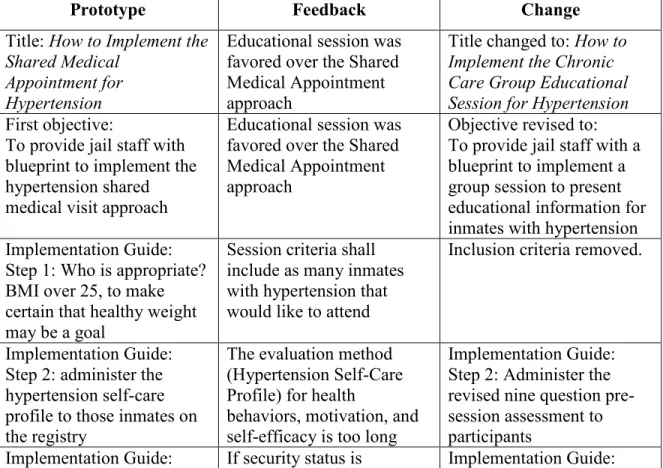
The revised toolkit is included in appendix 2. Specific changes as a result of the focus group feedback are below in table 1. After the revisions were made to incorporate focus group feedback, it was evident that the core elements of the shared medical appointment approach were missing. For this reason, the title of the final product was changed to How to Implement the Chronic Care Group Educational Session for
Hypertension Management. Guided discussions, motivational interviewing, and rapport
building cannot be established over a one-time, one-hour session when delivering all of the information originally covered in the four shared medical appointment set. The
information on motivational interviewing and guided discussions was retained in the final toolkit to encourage the development of those skills by the staff, as they are useful in participant interactions. Specific changes to the initial toolkit are included in Table 1. Table 1 Changes to Shared Medical Appointment Toolkit Prototype
Prototype Feedback Change
Title: How to Implement the Shared Medical
Appointment for Hypertension
Educational session was favored over the Shared Medical Appointment approach
Title changed to: How to Implement the Chronic Care Group Educational Session for Hypertension First objective:
To provide jail staff with blueprint to implement the hypertension shared medical visit approach
Educational session was favored over the Shared Medical Appointment approach
Objective revised to: To provide jail staff with a blueprint to implement a group session to present educational information for inmates with hypertension Implementation Guide:
Step 1: Who is appropriate? BMI over 25, to make certain that healthy weight may be a goal
Session criteria shall include as many inmates with hypertension that would like to attend
Inclusion criteria removed.
Implementation Guide: Step 2: administer the hypertension self-care profile to those inmates on the registry
The evaluation method (Hypertension Self-Care Profile) for health
behaviors, motivation, and self-efficacy is too long
Step 3: Select 10 inmates from the registry
acceptable, the session may accommodate more than 10 inmates
Step 3: Select 12-15 inmates from the registry Hypertension Self-Care
Profile
The evaluation method (Hypertension Self-Care Profile) for health
behaviors, motivation, and self-efficacy is too long
Pre-Session Assessment was created to briefly assess current behavior, current motivation, and self-efficacy (confidence) Preparing for the Shared
Medical Appointment
Instead of extended discussion time, it is more practical to condense all of the topics into one session.
Instructions modified to include different
terminology for group session. Instructions on setting the tone remained so that staff may be exposed to the skills that are key elements of the shared medical visit approach, although they are not required.
SMA Week 1: Smoking and Tobacco
The 4 separate shared medical appointments would be more useful if condensed into 1session
Key Points added to Group Educational Session
Agenda
Content reduced to 1 handout for the Group Educational Session SMA Week 2: Diet for
Hypertension
The 4 separate shared medical appointments would be more useful if condensed into 1session
Key Points added to Group Educational Session
Agenda
Content reduced to 1 handout for the Group Educational Session American Heart
Association: Why Should I Limit Sodium included McDonalds: Simple Steps to Save on Sodium included Fresenius: Lower Sodium Fast Food Options included SMA Week 3: Prescription
Medications
The 4 separate shared medical appointments
Content reduced to 1 handout for the Group Educational Session Medication Chart deleted SMA Week 4: Stress and
Weight Management
The 4 separate shared medical appointments would be more useful if condensed into 1session
Key Points added to Group Educational Session
Agenda
Content reduced to 1 handout for the Group Educational Session Body Mass Index chart added
Evaluation:
Repeat the Hypertension Self-Care Profile given at the end of 4 SMAs
The evaluation method (Hypertension Self-Care Profile) for health
behaviors, motivation, and self-efficacy is too long
Evaluation:
Repeat the pre-session assessment at the end of the Group Education Session
The toolkit objectives were rewritten to accommodate revised title and language. The term ‘shared medical appointment’ was replaced with ‘group educational session.’ The inclusion criteria of BMI greater than 25 was removed. The focus group participants expressed a desire to include as many inmates as possible with hypertension who were interested in participating in the group session. They felt this specific criterion would exclude many who could benefit from other topics addressed. The Hypertension Self Care Profile was replaced with a brief nine question assessment that reflected the
CHAPTER 3: DISCUSSION
The concept of shared medical appointments has been used in the Veterans Affairs health system, managed care organizations, and primary care practices (Edelman et. al., 2012; USVA, 2008). The shared appointments have proven effective in the management of diabetes and has been associated with decreased A1C levels and shown effects on systolic blood pressure (Edelman et. al., 2010; USVA, 2008). Prior to
beginning this project, the concept of the shared medical appointment had been discussed with the sheriff and the medical director at the jail and it was felt that this would be a great enhancement to care. The initial plan was to implement a four-week shared medical appointment set covering separate topics of behavioral factors related to
hypertension management in the jail setting. Due to other issues, the focus switched from actually implementing the shared medical appointment to developing a toolkit and
exploring the feasibility of that resource with the jail staff.
which included a one time educational session including the information from the shared medical appointment toolkit, was developed.
The notion of group educational sessions is not foreign to the jail. The jail has an existing, successful inmate education program in place. The library of the jail is a common meeting place for inmate groups such as general education development (GED) classes, human immunodeficiency virus (HIV) education, Alcoholics Anonymous, and substance abuse education (Gaston County Government, 2015). The room has adequate space, audio-visual equipment, and seating to accommodate a group session. Procedures are already in place for correctional staff to transport, handoff, and facilitate inmate movement and security for educational programs.
Economic Implications
Modifying the existing process with the group educational session instead of the shared medical appointment model may have economic impact. The group educational session would provide chronic disease management, health education, and community resources to 60 inmates within a 30-day time period (15 inmates per week) with no more resource investment. Because nearly all inmates return to the community, incarceration is a public health opportunity to reach the medically underserved and address health
disparities (Dumont et. al., 2013). When inmates return to the community, complex health problems and chronic disease management become public health problems (Kinner & Wang, 2014). Improvement in efficiency could improve hypertension control, resulting in economic benefits realized in the community health system.
safety could also economically benefit the community as an effort to reduce crime (Kinner & Wang, 2014). One important way to break the cycle of reentry to jail is to link inmates with community services to address health needs and provide tools to manage their health, and not to loose the investment made in health care provided in the jail (Marks & Turner, 2014).
Limitations
Inmates were not included in the focus groups, due to the protected status of the vulnerable population. Without inmate input, key stakeholder’s perceptions and opinions are missing in the evaluation of the toolkit. Scheduling difficulties prevented other representation from the community clinic providing follow up care from attending. Feedback from the different perspective could have been useful when revising the toolkit. Recommendations
Conclusion
In summary, the shared medical appointment might not be an effective approach for hypertension management in this jail setting at this time. The shared medical
appointment approach will not be implemented in this setting due to inmate participant volume, sustainability concerns, and alternative resource allocation.
REFERENCES
Alghurair, S., Hughes, C., Simpson, S., & Guirguis, L. (2012). A systematic review of patient self-reported barriers of adherence to antihypertensive medications using the world health organization multidimensional adherence model. The Journal of
Clinical Hypertension, 14(12), 877-886.
Alhalaiqa, F., Deane, K., Nawafleh, A., Clark, A., & Gray, R. (2012). Adherence therapy for medication non-compliant patients with hypertension: A randomized
controlled trial. Journal of Human Hypertension, 26(2), 117-126.
American Heart Association (2015). High blood pressure resources for professionals. Retrieved
from:http://www.heart.org/HEARTORG/Conditions/HighBloodPressure/HighBlo
odPressureToolsResources/High-Blood-Pressure-Resources-For-Professionals_UCM_461722_Article.jsp
Arries, E., & Maposa, S. (2013). Cardiovascular risk factors among prisoners. Journal of
Forensic Nursing, 9(1), 52-64. Doi: 10.1097/JFN.0b013e31827a59ef
Bailey, S., Oramasionwu, C., & Wolf, M. (2013). Rethinking adherence: A health literacy–informed model of medication self-management. Journal of Health
Communication, 18(sup1), 20-30.
Binswanger, A., Kruegar, P., & Steiner, J. (2011). Prevalence of chronic medical conditions among jail and prison inmates in the USA compared with the general population. Journal of Epidemiology in Community Health, 63, 912-919.
California Social Work Education Center (CalSWEC) (2015). Facilitator's guide
implementation toolkit: intervention and organizational readiness. Retrieved from
(
http://calswec.berkeley.edu/toolkits/implementation-toolkits/how-build-implementation-toolkit-start-finish).
California Social Work Education Center (CalSWEC) (2015). Factsheet. Retrieved from: http://calswec.berkeley.edu/sites/default/files/uploads/pdf/CalSWEC/calswec-factsheet.pdf
Coleman, K., Austin, B., Brach, C., & Wagner, E. (2009). Evidence on the chronic care model in the new millennium. Health Affairs(28), 75-85.
Dumont, D., Allen, S., Brockmann, B., Alexander, N., & Rich, J. (2013). Incarceration, community health, and racial disparities. Journal of Health Care for the Poor and
Underserved, 24(1), 78-88. Doi:10.1353/hpu.2013.000
Edelman, D., Fredrickson, S., Melnyk, S., Coffman, C., Jeffreys, A., Datta, S., . . . Stewart, H. (2010). Medical clinics versus usual care for patients with both diabetes and hypertension: a randomized trial. Annals of Internal
Medicine, 152(11), 689-696.
Egan, B., Li, J., Huchinson, F., & Ferdinand, K. (2014). Hypertension in the United States 1999-2012; Progress toward Healthy People 202 goals. Circulation, CIRCULATIONAHA-114.
Egger, G., Binns, A., Cole, M., Ewald, D., Davies, L., Meldrum, H.,...Noffsinger, E. (2014). Shared medical appointments: an adjunct for chronic disease management in Australia? Australian Family Physician, 43(3), 151-154.
Epstein, D., Sherwood, A., Smith, P., Craighead, L., Caccia, C., Lin, P.,…& Blumenthal, J. (2012). Determinants and consequences of adherence to the dietary approaches to stop hypertension diet in african-american and white adults with high blood pressure results from the ENCORE trial. Journal of the Academy of Nutrition &
Dietetics, 112(11), 1763-1773.
Flynn, S., Ameling, J., Hill-Briggs, F., Wolff, J., Bone, L., Levine, D...& Boulware, L. (2013). Facilitators and barriers to hypertension self-management in urban African-Americans: Perspectives of patients and family members. Patient
preference and adherence, 7, 741-749.
Frensenius Medical Care (2015). Lower sodium fast food options. Retrieved from : http://www.pennockhealth.com/Brochures/Lowersodium%20Fast%Food%20Opti ons.pdf
Gaston County Government (2015, April 4). Sheriff’s Office: Detention. Retrieved from: http://www.gastongov.com/departments/sheriff/detention
Goldstein, E., Warner-Robbins, C., McLean, C., Macatula, L., & Conlin, R. (2009). A peer-driven mentoring case management community reentry model: An
application for jails and prisons. Family & Community Health, 32(4), 309-313. Hayes, J., Leischow, S., Lawrence, D., & Lee, T. (2010). Adherence to treatment for
tobacco dependence: Association with smoking abstinence and predictors of adherence. Nicotine & Tobacco Research, ntq047.
Hicken, M., Lee, H., Morenoff, J., House, J., & Williams, D. (2014). Racial/ethnic disparities in hypertension prevalence: Reconsidering the role of chronic stress.
American Journal of Public Health, 104(1), 117-123.
James, P., Oparil, S., Carter, B., Cushman, W., Dennison-Himmelfarb, C., Handler, J., ... & Ortiz, E. (2014). 2014 evidence-based guideline for the management of high blood pressure in adults: report from the panel members appointed to the Eighth Joint National Committee (JNC 8). JAMA, 311(5), 507-520.
Kinner, S. & Wang, E. (2014). The case for improving the health of ex-prisoners.
American Journal of Public Health, 104(8), 1352-1355.
Kirsh, S., Watts, S., Pascuzzi, K., O'Day, M. E., Davison, D., Strauss, G., ... Aron, D. C. (2007). Shared medical appointments based on the chronic care model: a quality improvement project to address the challenges of patients with diabetes with high cardiovascular risk. Quality & Safety in Health Care, 16, 349-353. doi:
10.1136/qshc.2006.019158
US Veterans Administration (2008). VA shared medical appointments for patients with diabetes: maximizing patient and provider expertise to strengthen care
management. Retrieved from:
http://www.queri.research.va.gov/tools/diabetes/shared-medappt.pdf
Madson, M., Loignon, A., and Lane, C. (2009). Training in motivational interviewing: a systematic review. Journal of Substance Abuse Treatment, 36, 101-109. Doi: 10.1016/j.jsat.2008.05.005
Marks, J. & Turner, N. (2014). The critical link between health care and jails. Health
Affairs, 33(3), 443-447. Doi: 10.1377/hlthaff.2013.1350
Marshall, I., Wolfe, C., & McKevitt, C. (2012). Lay perspectives on hypertension and drug adherence: Systematic review of quantitative research. BMJ: British
Medical Journal, 345.
Matulich, B. (2013). Introduction to motivational interviewing. Retrieved from: http://www.youtube.com/watch?v=s3MCJZ7OGRk.
McDonalds (2015). Simple steps to save on sodium. Retrieved from:
http://www.mcdonalds.com/content/dam/McDonalds/Documents/McDonalds_Si mpleStepsToSaveOnSodium.pdf
National Commission on Correctional Health Care (2014). Standards for Health Services
in Jails. Chicago, Illinois.
Rose, L., Sawyer, A., & Everett, A. (2014). Cardiovascular health literacy and treatment adherence in persons with serious mental illness. Issues in Mental Health
education intervention for prison inmates in South Africa. Health Education &
Behavior, 35(4), 494-508.
Stein, K. (2011). The group appointment trend gains traction: how dietetics fits into a new model of health care delivery. Journal of the American Dietetic Association, 340-353.
St. Lawrence, J., Eldridge, G., Shelby, M., Little, C., Brasfield, T., & O’Bannon III, R. (1997). HIV risk reduction for incarcerated women: A comparison of brief
interventions based on two theoretical models. Journal of Consulting and Clinical
Psychology, 65(3), 504.
The Cecil G. Sheps Center for Health Service Research (2013). Health literacy universal precautions toolkit for cardiology, Ver. 7. 2013. Retrieved from:
http://www.shepscenter.unc.edu/wp-content/uploads/2013/05/Health-Literacy-Toolkit-Cardiology.pdf
Thompson, C., Meeuwisse, I., Dahlke, R., & Drummond, N. (2014). Group medical visits in primary care for patients with diabetes and low socioeconomic status: users' perspectives and lessons for practitioners. Canadian Journal of Diabetes, 38, 198-204. doi: 10.1016/j.jcjd.2014.03.012
Travis, J., Western, B., & Redburn, S. (2014). The growth of incarceration in the United States: Exploring causes and consequences.
Zack, B., Smith, C., Andrews, M. C., & May, J. P. (2013). Peer health education in Haiti’s National Penitentiary the “health trough walls” experience. Journal of