UNNATURAL AMINO ACID MUTAGENESIS: PROGRESS TOWARDS NON-NATURAL BIOCATALYSIS AND INVESTIGATIONS OF PROTEIN
THERMODYNAMICS VIA 19F NMR
Amy E. Rydeen
A dissertation submitted to the faculty at the University of North Carolina at Chapel Hill in partial fulfillment of the requirement for the degree of Doctor of Philosophy in
the Department of Chemistry (Biological) in the College of Arts and Sciences.
Chapel Hill 2018
Approved by: Eric Brustad Gary Pielak Bo Li
ABSTRACT
Amy E. Rydeen: Unnatural amino acid mutagenesis: Progress towards non-natural biocatalysis and investigations of protein thermodynamics via 19F NMR
(Under the direction of Eric Brustad)
Evolution created the complex and versatile protein landscape that underpins cellular function, through the combinatorial assembly of only 20 canonical amino acids. Contemporarily, protein engineers are expanding the capabilities of protein beyond the constraints of natural selection by tailoring them for applications in a ‘man-made’ world. For instance, proteins are finding widespread success as immuno-therapeutics and as industrial catalysts for the production small molecule pharmaceuticals. However, the pursuit of protein engineers is hindered by the limited chemical functionality imparted by the natural proteinogenic amino acids. In vivo unnatural amino acid mutagenesis technology, also known as genetic code
expansion, has allowed the localized and/or widespread installment of non-canonical amino acids bearing non-natural functional groups. This simple yet powerful
technology has supplemented the fundamental few with hundreds of unnatural amino acids (UAAs). Despite the numerous applications of UAAs that have been disclosed, there still exists significant potential for further exploration.
proline-elaborated UAAs perform aqueous aldol chemistry, however fail to transfer this activity to a protein scaffold. The groundwork discussed herein should assist future efforts towards the creation of protein catalysts with UAA-based reactivity. In addition, we utilized a 19F UAA to study the stability of a protein and weak protein
ACKNOWLEDGEMENTS
To my mentor, thank you Eric for your endless enthusiasm and support of all my research and career explorations. I truly appreciate being given the opportunity to make my phD, ‘my own’. To Gary, thank you for your hospitality, in your home and lab. You remind me to appreciate simplicity, whether it be a glass of champagne or a well-behaved protein, it’s the small things in life.
To my lab, all former and present members, and fellow red pod lab mates, thank you for always being there when I needed a hand, to discuss my projects, lend reagents, or an excuse to go for a walk.
I would like to thank the community of Franklin Street Yoga Center. I am constantly supported by the friendships and skills I developed through my practice. I owe my health, mentally and physically, to the studio.
Most graciously, I thank my family. I can’t understate how thankful I am to have had my sister and brothers close by and present during this journey. Our weekly meals together kept everything in perspective. To Austin, thank you for reminding me I am capable and for making me delicious salads for lunch, our
PREFACE
At the time this thesis was composed, the final chapter, 19F NMR investigation of protein and protein complex stability via unnatural amino acid mutagenesis, was submitted as a research report to the Proceedings of the National Academy of Science (PNAS). The text of the chapter is verbatim as submitted, however the title was changed to reflect the narrative of this thesis. The title of the submitted
research report, was “Osmolytes are compatible with protein surfaces”.
TABLE OF CONTENTS
LIST OF MAIN TABLES ... xi
LIST OF MAIN FIGURES ... xii
LIST OF SUPPLEMENTARY TABLES ... xiv
LIST OF SUPPLEMENTARY FIGURES ... xv
LIST OF ABBREVIATIONS ... xvi
CHAPTER 1: In vivo unnatural amino acid mutagenesis ... 1
1.1 An introduction to genetic code expansion technology ... 1
1.2 Selected applications of UAAs ... 6
1.2.1 UAAs install synthetic catalysts in protein scaffolds ... 6
1.2.2 Photocrosslinking UAAs investigate protein-protein interactions ... 11
1.2.3 UAAs as 19F NMR probes ... 14
1.3 Furthering these applications of UAAs ... 16
1.3.1 UAAs as synthetic catalysts in protein scaffolds ... 16
1.3.2 Quantifying protein complex stability via 19F NMR UAA probes ... 20
CHAPTER 2: Genetically encoding organo-catalytic unnatural amino acids ... 22
2.1 Introduction ... 22
2.2 Results and discussion ... 28
2.2.1 Unnatural amino acid design and synthesis ... 28
2.2.2 The search for a Pro4AF synthetase ... 31
2.2.3 MbPylRS accepts ProK ... 33
2.2.5 Optimization of ProK incorporation by MbPylRS ... 38
2.2.6 Efforts towards the directed evolution of MbPylRS ... 41
2.2.7 Protein host selection and catalytic evaluation ... 45
2.2.8 Incorporation of ProK within protein scaffolds ... 50
2.2.9 Evaluating the reactivity of a ProK containing protein scaffold ... 55
2.2.10 PyrrolK, the carbamate version of ProK ... 57
2.3 Conclusions ... 62
2.4 Materials and Methods ... 68
2.4.1 Protein expression, purification and characterization ... 68
2.4.2 Amino acid toxicity test ... 68
2.4.3 Plasmid construction and mutagenesis ... 69
2.4.4 Small scale UAA incorporation ... 69
2.4.5 Large scale scaffold protein preparation ... 70
2.4.6 GFP-based synthetase screen for Pro4AF incorporation ... 71
2.4.7 GFP fluorescence measurements ... 72
2.4.8 Positive/negative selection system ... 72
2.4.9 Error prone MbpylRS library and FAC sorting ... 74
2.4.10 Aldol reaction ... 74
2.4.11 Reductive amination ... 75
2.5 Supporting Information ... 76
2.5.1 Protein and DNA sequences ... 76
2.5.2 Primer Sequences ... 80
CHAPTER 3: 19F NMR Investigation of protein and protein complex stability via
unnatural amino acid mutagenesis ... 91
3.1 Introduction ... 91
3.2 Results ... 93
3.2.1 Cosolute selection ... 93
3.2.2 Model Proteins ... 94
3.2.3 Quantifying Unfolding and Dimerization ... 95
3.2.4 Cosolute effects on unfolding and dissociation. ... 96
3.2.5 Electrostatic contributions to ΔΔG°’%→' ... 99
3.3 Discussion ... 100
3.4 Materials and Methods ... 102
3.4.1 Materials ... 102
3.4.2 Protein ... 102
3.4.3 NMR ... 104
3.5 Supporting Information ... 105
3.5.1 Supplementary Text ... 105
3.5.2 Supplementary Tables ... 107
3.5.3 Supplementary Figures ... 110
LIST OF MAIN TABLES
LIST OF MAIN FIGURES
Figure 1.1 Site-specific UAA incorporation ... 3
Figure 1.2 UAAs genetically encoded, in vivo, as of 2015 ... 6
Figure 1.3 UAA-based bio-conjugation strategies ... 8
Figure 1.4 UAA-based SPAAC creates cyclopropanation ArM ... 9
Figure 1.5 Directed evolution of bio-conjugation UAA-based ArM ... 11
Figure 1.6 Photocrosslinking UAAs and corresponding reactive radical species ... 13
Figure 1.7 Bpa identifies residues of membrane protein-protein interaction ... 14
Figure 1.8 TFMF at dimer interface reports structural changes via 19F NMR ... 16
Figure 1.9 In vivo incorporation of metal binding UAA for catalysis ... 17
Figure 1.10 Advantage of installation of UAA-based catalyst ... 19
Figure 2.1 Enamine and iminium ion catalysis by secondary amines ... 26
Figure 2.2 Versatility of proline as enamine and iminium ion organocatalyst ... 27
Figure 2.3 Substrates of engineered MjTyRS ... 29
Figure 2.4 Substrates of the wild type pyrrolysine synthetase (WT-PylRS) ... 30
Figure 2.5 Proline-containing UAAs: Pro4F and ProK ... 31
Figure 2.6 Incorporation of ProK into GFP by MbPylRS ... 34
Figure 2.7 Quantification of model aldol reaction ... 37
Figure 2.8 ProK catalyzed model aldol reaction ... 38
Figure 2.9 Optimization of UAA incorporation system for ProK ... 40
Figure 2.10 Direction evolution of MbPylRS via a 4 site-saturation ‘NNK’ library .... 42
Figure 2.11 FAC sorting of error prone library fails to identify improvements ... 44
Figure 2.12 Evaluation of aldol activity in wild type scaffold proteins ... 48
Figure 2.13 Elimination of WT-DERA aldol catalysis ... 50
Figure 2.15 Searching locations within DERA to incorporate ProK ... 52
Figure 2.16 Searching tHisF for locations to install ProK ... 54
Figure 2.17 Mass spectrometry analysis of tHisF50ProK and tHisF50BocK ... 55
Figure 2.18 Mechanism of model aldol reaction and reductive amination. ... 56
Figure 2.19 Reductive amination evaluates nucleophilicity of tHisF50ProK ... 57
Figure 2.20 PyrrolK ... 59
Figure 2.21 Evolution of MbPylRS for PyrrolK ... 61
Figure 2.22 Buffer optimization of PyrrolK aldol reaction ... 62
Figure 2.23 Example complex proline/ pyrolidine organocatalysts ... 63
Figure 2.24 Promiscuous enamine chemistry of 4-OT ... 65
Figure 3.1 Quantification of protein- and dimer-stability by 19F NMR ... 96
LIST OF SUPPLEMENTARY TABLES
LIST OF SUPPLEMENTARY FIGURES
Figure S1 Cosolute structures ... 110
Figure S2 Selective incorporation of TFMF ... 111
Figure S3 Thermal Stability of SH3 and SH3-Y37TFMF by 19F NMR. ... 112
Figure S4 1H-15N HSQC spectrum of GB1-A34TFMF ... 113
Figure S5 Binding isotherms of GB1-A34TFMF ... 114
Figure S6 19F NMR spectra of GB1-A34TFMF at various pH values ... 115
Figure S7 DLS characterization of GB1 aggregate at pH 4.0. ... 116
Figure S8 NaCl induced changes in fraction dimer ... 117
LIST OF ABBREVIATIONS
°C Degrees Celsius
∆𝐺/→0°1 Free energy of dissociation
∆𝐺2→3°1 Free energy of unfolding
𝛥𝛥𝐺/→0°’ Change in the free energy of dissociation
∆∆𝐺2→3°1 Change in the free energy of unfolding
2XYT Yeast extract tryptone
4-OT 4-oxalocrotonate tautomerase
9-BBN 9-Borabicyclo[3.3.1]nonane
aaRS-tRNA Amino-acyl tRNA synthetase-tRNA
Ala Alanine
Amp Ampicillin
Arg, R Arginine
ArM(s) Artificial metalloenzyme(s)
Asn, N Asparagine
BCN Bicyclo[6.1.0]nonyne
BocK N-Boc-L-lysine
Bpa p-benzoyl-L-phenylalanine
BpyAla (2,2’-bipyridin-5yl) alanine
Cat Chloramphenicol acyltransferase
Cm Chloramphenicol
Cys, C Cysteine
dATP Deoxyadenosine triphosphate
DCC N,N’-Dicyclohexylcarbodiimide
DCM Dichloromethane
dCTP Deoxycytidine triphosphate
DERA 2-deoxyribose-5-phophate aldolase
dGTP Deoxyguanosine triphosphate
DIPEA N,N-Diisopropylethylamine
DMF N,N-dimethylformamide
DMSO Dimethylsulfoxide
DNA Deoxyribonucleic acid
dTTP Deoxythymidine triphosphate
E. coli Escherichia coli
EDC•HCl 3-(3-Dimethylaminoproply)-1-ethyl-carbodimide hydrochloride
e.e. Enantiomeric excess
EP Error prone
FACS Fluorescence assisted cell sorting FPLC Fast protein liquid chromatography
GB1 B1 domain of the streptococcal immunoglobulin binding protein G
GFP Green fluorescent protein
Gln, Q Glutamine
Glu, E Glutamate
HCl Hydrochloric acid
HPLC High performance liquid chromatography
Hr Hour (s)
HEPES 4-(2-hydroxyethyl)-1-piperazineethanesulfonic acid
HOBt Hydroxybenzotriazole
HSQC 15N-1H heteronuclear single quantum correlation IGPS Indole-3-glycerol phosphate synthase
IPTG Isopropyl ß-D-1-thioglactopyranoside
Ile, I Isoleucine
Kan Kanamycin
KD Dissociation constant
kDA Kilodaltons
KPi Potassium phosphate
LB Lysogeny broth
LCMS Liquid chromatography mass spectrometry
Leu, L Leucine
LmrR Lactoccocal multidrug resistance regulator
Lys, K Lysine
M Molar
MbPylRS Methanosarcina barkeri pyrrolysyl-tRNA synthetase
MHz Megahertz
Min Minutes (s)
Mm Methanosarcina mazei
mM mili molar
Mol Mole
MS Mass spectrometry
NaCl Sodium chloride
NaCNBH3 Sodium cyanoborohydride
NaOH Sodium hydroxide
NMR Nuclear magnetic resonance
NNK Randomized library site where N=any base and K=G or T
OD Optical density
PBS Phosphate buffered saline
pCNFRS p-cyanophenylalanine amino acyl tRNA synthetase
PCR Polymerase chain reaction
PDB Protein data bank
PEG Polyethyleneglycol
pH Decimal logarithm of hydronium ion concentration
Phe, F Phenylalanine
pKa Acid dissociation constant
POP Prolyl oligopeptidase
Pro, P Proline
Pro4AF D-prolyl-4-amino-L-phenylalanine
ProK D-prolyl-L-lysine
Q-TOF Quadrupole time-of-flight
SDS-PAGE Sodium dodecyl sulfate polyacrylamide gel electrophoresis
SH3 the SH3 domain of the Drosophila signal transduction protein drk
Ser, S Serine
sfGFP Superfolder green fluorescent protein SPAAC Strain-promoted azide-alkyne cycloaddition
Strep Streptomycin
TAG Amber stop codon
TBNS trans-beta-nitro styrene
Tet Tetracycline
TFA Trifluoroacetic acid
TFMF Trifluoromethyl-L-phenylalanine
tHisF Histidine synthase F
Thr, T Threonine
TIC Total ion count
TMAO Trimethylamine-N-oxide
tRNA Transfer RNA
Tyr, Y Tyrosine
UAA Unnatural amino acid
UV Ultraviolet
Val, V Valine
CHAPTER 1: IN VIVO UNNATURAL AMINO ACID MUTAGENESIS 1.1 An introduction to genetic code expansion technology
The in vivo incorporation of unnatural amino acids (UAAs) has proven to be an invaluable tool for the engineering of proteins and enzymes. UAAs can enhance protein stability, enzyme activity and selectivity, allow biophysical investigations of protein binding interactions, stability and dynamics, and create proteins with controlled and tunable photo- and chemical-reactive properties. Reviews of this technology, including its applications and the wealth of UAAs incorporated, continue to grow in size and number (1-8).
The installation of UAAs in protein sequences has been approached in
several ways in multiple organisms. Overall, two general approaches have emerged: residue-specific and site-specific incorporation of UAAs. Residue-specific
incorporation replaces each location of a specific residue with a non-natural
deprivation of the canonical amino acid isostere from the growth media, which complicates and often contaminates scaled protein preparations. A major drawback to the residue specific method is the inability to select a single location for UAA incorporation.
The focus of this dissertation is the site-specific incorporation of UAAs via codon reassignment and suppression. This approach offers complete control over the location at which the UAA is installed and allows for multiple UAAs to be
incorporated by reassigning multiple sense or non-sense codons. Herein, we employ Escherichia coli (E. coli) as a heterologous host for the engineering and production of proteins containing UAAs.
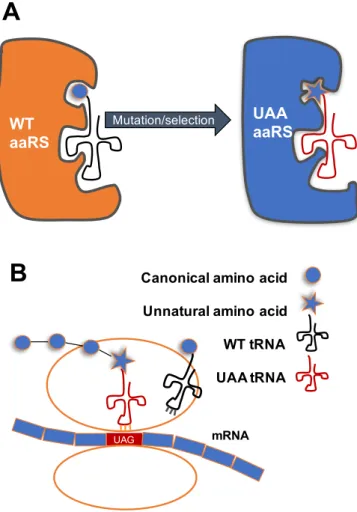
Site-specific incorporation of UAAs depends on the creation of orthogonal amino-acyl tRNA synthetase-tRNA (aaRS-tRNA) pairs unique for an UAA and reassigned codon. Orthogonality implies that the synthetase will not aminoacylate endogenous tRNAs and, in parallel, that the tRNA will not be recognized by native amino-acyl tRNA synthetases. The creation of orthogonal aaRS-tRNA pairs, in some cases, has proven to be straightforward since translational machinery from vastly different domains of life often do not cross-react with the E. coli translational apparatus. Two sets of aaRS-tRNA pairs have found widespread usage: the Methanococcua jannaschii tyrosyl-tRNA synthetase (MjTyrRS)-tRNA and the Methanosarcina mazei or Methanosarcina barkeri pyrrolysyl-tRNA synthetase (Mm or MbPylRS)-tRNA.
encode for the unnatural amino acid. This is accomplished first mutating the anti-codon loop of the tRNA (tRNACUA); however, additional tRNA mutations are
sometimes required to improve TAG-suppression efficiency. Next, the amino acid binding site of the synthetase is mutated and variants are screened or selected for the ability to specifically charge the tRNACUA with the unnatural amino acid of
interest, Figure 1.1. Several positive and negative selection have been reported and have found wide spread application for the isolation of an orthogonal synthetase from often-large number, > 106, of generated mutant synthetases (7).
Figure 1.1 Site-specific UAA incorporation
(A) mutation and selection of an aaRS from different domain of life creates an orthogonal aaRS specific for the UAA. (B) UAG codons in mRNA encode for the UAA during translation on the
ribosome.
E. Coli
Mutation/selection WT
aaRS
UAA aaRS
A
Unnatural amino acid Canonical amino acid
WT tRNA
UAG mRNA
Extensive mutational exploration of both MjTyRS and Mm- or MbPylRS has resulted in the creation of orthogonal aaRS-tRNA pairs specific for UAAs that span diverse structures and sizes, as shown in Figure 1.2. In summary, protein engineers, once limited by the diversity of the 20 canonical amino acids when making structural and chemical modifications to amino acid side chains, now have access to over 150 unnatural amino acids containing diverse structures and non-natural chemical functional groups (2). Functional diversity of unnatural amino acids that have been site specifically genetically encoded include: (1) biophysical, spectroscopic and imaging probes, (2) handles for bio-orthogonal reactions, (3) post translation
modifications (PTM) or PTM mimetics, and (4) activated motifs such as photo-caged, photo-isomerizable, or photo-crosslinkable amino acids. The reader is
1 2 3 4 5 6 7 8 9
11
10 12 13 14 15 16 17 18
19 20 21 22 23 24 25 26
27 28 29 30 31 32
33 34 35 36 37 38 39 40 41 42
43 44 45 46 47 48 49 50
v
51 52 53 54 55 56 57 58 59
60 61 62 63 64 65 66 67 68 69
70 71 72 73 74 75 76 77 78 79
80 81 82 83 84 85 86 87 88 89
Figure 1.2 UAAs genetically encoded, in vivo, as of 2015
The color of the number indicates the aaRS/tRNA pair used, orange is MjTyRS, blue is Mm or
MbPylRS and green is other. Figure adapted from [Chem. Sci., 2015, 6, 50.]-Published by The Royal Society of Chemistr
1.2 Selected applications of UAAs
To underscore the functional utility of genetic code expansion methodology, select, but representative, applications of UAA mutagenesis are described below.
1.2.1 UAAs install synthetic catalysts in protein scaffolds
Over billions of years, evolution has fine-tuned enzymes with catalytic capabilities near perfection. Enzymes demonstrate unrivaled selectivity, rate
99 100 101 102 103 104 105 106 107
108 109 110 111 112 113 114 115 116 117 118
119 120 121 122 122 123 125 126 127 128
129 130 131 132 133 134 135 136 137 138
139 140 141 142 143 144 145 146 147
148 149 150 151 152 153 154 155 156 157 158
enhancements and catalytic efficiencies for their native reactions (11, 12).
Employing enzymes as compliments and/or supplements to conventional synthetic catalysts in industrial processes is a highly sought after goal. For example, enzymes operate under environmentally benign reaction conditions including in water at room temperature, neutral pH and without the need for organic solvents. However, it has proven challenging to engineer enzymes to catalyze industrial reactions on
manmade substrates or to carry out chemical transformations that do not already occur in nature. The chemical capabilities of enzymes, resulting from the canonical 20 amino acids and cofactors, are uniquely suited for and thereby limited by the natural world in which they evolved.
Genetic code expansion technology merges the chemical ingenuity and creativity of man with that exquisite and powerful translational machinery already developed by nature. Thus, the UAA mutagenesis provides a unique mechanism to expand enzyme chemical functionality beyond the constraints of nature’s design. For example, mounting conventional synthetic catalysts at a single site within protein active sites is possible through the use of UAAs displaying handles for covalent bioconjugation. Several classes of UAAs containing bio-orthogonal, or
biocompatible, conjugation handles have been developed including reactive sites for Cu(I)-catalyzed or copper free alkyne-azide cycloaddtion (the so-called ‘click’
Figure 1.3 UAA-based bio-conjugation strategies
(A) Select bio-orthogonal reactions for conjugation of catalysts to protein scaffolds. *Reactive functionality can be switched between catalytic moiety and UAA. For example, in the Cu(I)-free cycloaddition, a cyclooctyne UAA can be coupled with a catalytic moiety displaying an azide. Figure is
adapted from Nat Chem Biol., 2013, 8, 475. (B) Select UAAs containing reactive bio-orthogonal handles.
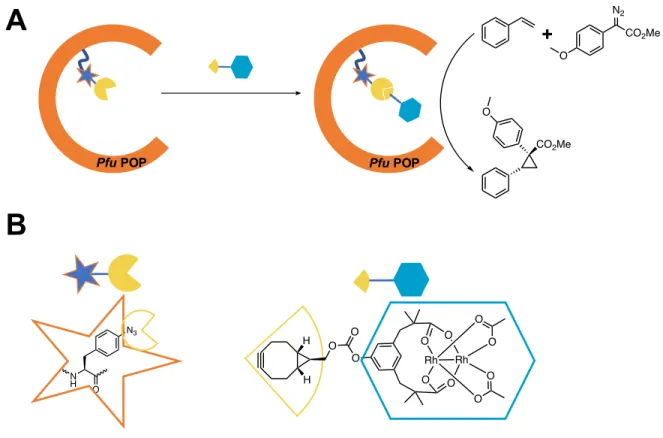
UAA-based bioconjugation strategies, in particular, the strain-promoted azide-alkyne cycloaddition (SPAAC, Figure 1.3A Cu(I)-free cycloaddition), have been exploited in the engineering of artificial metalloenzymes (ArMs) (14) . ArMs are hybrid catalysts composed of a covalently implanted conventional transition metal catalyst within the hydrophobic pocket of a protein scaffold. SPAAC between bicyclo[6.1.0]nonyne (BCN) and azide substituted reactive partners is a poplar conjugation strategy due to its rapid second order kinetics, bioorthogonality and specificity. Generally, an azide containing UAA is genetically encoded in a protein and subsequently reacted with a BCN-decorated transition metal catalyst. Because the conjugation will not proceed on naturally occurring amino acids, in theory, any protein could serve as a host, provided it can accommodate the UAA-catalyst pair.
P O O
P O H N
N3 Staudinger
ligation*
N N N
N3 Cu(I)-catalyzed
cycloaddtion N N N N3 Cu(I)-free Cycloaddtion * N N
N N H
H H N N Diels-Alder cycloaddition* Catalytic moiety Incorporated UAA
H2N CO2H
HN O
O H H
H2N CO2H
HN O
O
H2N CO2H NH
N N N N
H2N CO2H
NN N N
H2N CO2H HN O
O N3
H2N CO2H
Highly stable proteins with large active sites, such as Pfu-POP, a member of the prolyl oligopeptidase (POP) family from Pyrococcus furiosus and tHisF, a
synthase subunit of the glutaminase synthase from Thermatoga maritima have successfully hosted bulky BCN substituted synthetic metal catalysts (14, 15). Figure 1.4 shows a schematic for the creation of an example ArM for cyclopropanation via bioconjugation of a BCN-substituted dirhodium catalyst with an azide UAA in the pocket of a scaffold protein.
Figure 1.4 UAA-based SPAAC creates cyclopropanation ArM
(A) A prolyl oligopeptidase from Pyrococcus furiosus displaying genetically encoded p-azidophenylalanine within the active site is conjugated to bicyclo[6.1.0]nonyne substituted dirhodium complex and catalyzes the model cyclopropanation of styrene with donor-acceptor diazo compounds.
(B) SPAAC bio-conjugation partners for the creation of an artificial metalloenzyme (ArM).
Primary ArM designs, constructed initially in a naïve protein scaffold by conjugation of the UAA and transition metal-catalyst, does not typically fabricate
CO2Me N2
O
CO2Me
O
Rh
O O O
O Rh
O
O
O O
O O
O H
H
N H
N3
O
A
B
+
catalysts with desirable yields or selectivities. Protein scaffolds often need to be engineered to complement and supplement the chemistry imparted by the catalyst. Rational mutagenesis of residues in proximity to the catalyst can enhance reactivity and/or selectivity but the methodology is time consuming and limited by the
availability of a crystal structural for guidance (16). In addition, mutations outside of the active site can often contribute favorably to non-natural function, in unpredictable ways (17). However, mutations outside of the active site are difficult to predict, a priori, and require rigorous screening efforts to identify from random mutation libraries.
Directed evolution has been established as a key methodology for the non-rational engineering of enzymes for non-natural catalysis (18). Directed evolution mimics natural selection through iterative rounds of mutagenesis and screening the mutant library for improvements in a desired characteristic. Recently, Lewis reported the first directed evolution of an ArM via non-rational mutagenesis (17). An ArM was constructed via SPAAC between a BCN substituted dirhodium catalyst and an azide displaying UAA in the active site of pfu POP. The enzyme was evolved through iterative rounds of error prone PCR and screening the library for improvements in the selectivity of cyclopropanation between alkene and diazo compounds. The resulting variant, obtained after 3 rounds of evolution contained 4 mutations, both within and beyond the active site, catalyzed the cyclopropanation with improved selectivity (92% e.e.) and yield (~75%) compared to the parent ArM.
metal centers into proteins. However, there are a number of alternative catalytic strategies, including organocatalysis and photoredox catalysis, that have yet to be explored in this expanding field of protein design. Chapter two of this thesis
describes our progress at engineering novel UAA structures that will open novel organocatalytic motifs into biocatalysts.
Figure 1.5 Directed evolution of bio-conjugation UAA-based ArM
The scaffold protein, POP, is non-rationally mutated via error prone PCR to create a library of protein variants that are co-transformed with a plasmid harboring the orthogonal aaRS-tRNA pair specific for the UAA. The scaffold variants are then expressed in the presence of UAA, lysed and clarified in a 96 well format. The ArM is constructed by addition of the catalyst equipped with the handle for
bio-conjugation to the UAA. The resulting ArMs are screened for catalytic improvements, in this case, improved enantioselectivity in the cyclopropanation between styrene and diazo substrates. Hits are
then verified on a large scale and subjected to further rounds of mutation and screening for further improvements. Figure adapted from Nature Chemistry, 2018,10, 318.
1.2.2 Photocrosslinking UAAs investigate protein-protein interactions
Protein-protein interactions are universal and essential to the function of the cell. Mapping the cellular network of protein-protein interactions, which include both strong and weak contacts, furthers our understanding of disease (19). Traditional methods for studying these interactions, such as yeast 2-hybrid (Y2H) assays, are
POP scaffold gene
library of mutant genes
colonies each carrying different mutant POP
screen mutants for improvements random mutagenesis co-transform with UAA incorporation plasmid 1. conjugate bio-orthogonal catalyst 2. scavenge excess unreacted catalyst Time (min) Ab s o rb a n c e isolate POP gene and repeat if insufficient isolate, express and characterize sufficient hits on
large scale
ArM library
scaffold library
CO2Me
N2
O CO2Me O
Directed Evolution
ArM library
1. express mutant POP in 96 well format 2. lyse and
performed under non-native conditions. Therefore, location specific and fleeting physiological interactions escape detection. Further, the Y2H methodology favors detection of strong interactions and many critical protein-protein interactions are weak and transient (20). Photocrosslinking UAAs offer many benefits over traditional non-covalent techniques of investigating the interaction of macromolecules in vivo and in vitro.
Photocrosslinking UAAs are activated by ultraviolet light to form radicals that undergo reaction with functional groups on a nearby associated proteins to
covalently trap an otherwise weak interaction (3). Photocrosslinking UAAs detect specific protein-protein interactions and have minimal false identifications due to the high reactivity, short half-life and the ability of the activated state to relax or react with itself or water in the absence of a binding partner. The site-specific
incorporation of three classes of photo-crosslinking UAAs, including
Figure 1.6 Photocrosslinking UAAs and corresponding reactive radical species
The site-specific incorporation of p-benzoyl-L-phenylalanine (Bpa, UAA #5 Figure 1.2) has found wide spread application in probing protein-protein interactions in Escherichia coli (21). The interaction between transmembrane protein complex, SecYEG, and SecA was elucidated, in vivo, using this UAA, Figure 1.7 (27). The SecA – SecYEG interaction mediates post-translational translocation of outer membrane and periplasmic proteins across the inner membrane of E. coli. Bpa was site-specifically incorporated at 53 sites in the SecY protein of the SecYEG complex. This extensive scanning strategy identified previously unknown sites where SecA interacts with SecY in agreement with the crystal structure of the complex. Further, dynamics of the interaction were elucidated via in vivo experiments under stabilized conditions where the protein is locked in a ‘membrane inserted’ state and in vitro experiments where components (ATP, substrate, etc) were systematically omitted to probe how the interaction is dependent on the functional state of the both partners.
H2N CO2H O
H2N CO2H
CF3
N N
H2N CO2H N3
H2N CO2H
O
F
H2N CO2H
O F
F
H2N CO2H
O
NO2
H2N CO2H
O
NO2
F
H2N CO2H
OH N3
H2N CO2H
HN O
O N N
H2N CO2H
HN HN
O N N
benzophenones azides diazarines
N O
CF3
This example highlights the ability of site-specific UAA incorporation to study a difficult binding interaction under physiological conditions.
Figure 1.7 Bpa identifies residues of membrane protein-protein interaction
The structure of SecA, blue, and SecY, orange, complex, PDB ID: 3DIN. The residues where Bpa was incorporated and in vivo crosslinking was observed are shown as yellow spheres.
Photocrosslinking UAAs are superior to non-covalent affinity based methods for the identification of weak, transient interactions. They provide structural
information about distinct interfaces via site-specific interrogation of single residues in a protein-protein, protein-nucleic acid and/or protein-ligand interaction. Lastly, the identification of unknown biologically relevant interactions with minimal nonspecific linking facilitates the discovery and correct mapping of macromolecular interactions.
1.2.3 UAAs as 19F NMR probes
Nuclear magnetic resonance (NMR) spectroscopy is a fundamental tool in the investigation of macromolecular structures, interactions, dynamics and
thermodynamics. Proteins can be studied in vitro and in vivo at a global and SecA
residue–specific level via NMR. Fluorine is an ideal nucleus for the visualization of protein by NMR. 19F is 100% naturally abundant, scarcely found in biology,
hypersensitive to chemical environment when compared to 1H yet similar in size and therefore tolerated with minimal structural rearrangements (28). Labeling with 19F
permits study of proteins otherwise too large for conventional 1H- and 15N-based NMR experiments. In addition, the spectra are significantly more simple to interpret (29). For these reasons, several UAAs containing fluorine have been developed and applied in the study of macromolecules via 19F NMR, see UAA # 34, 42, 46, and 47 Figure 1.2.
The site-specific incorporation of 19F UAAs overcomes drawbacks of residue specific technology for producing 19F labeled proteins. Coaxing the native
translational machinery to use fluorinated derivatives of natural amino acids, such as tryptophan, seldom reaches 95% incorporation at a single site and produces
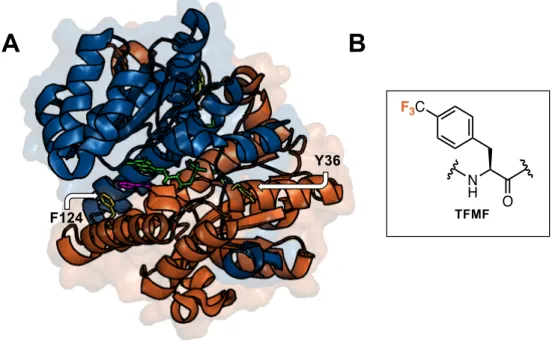
variability in labels throughout a protein sequence (30). The first report of the site-specific incorporation of a fluorine containing UAA, trifluoromethyl-L-phenylalanine (TFMF, UAA # 42 Figure 1.2), detailed the in vivo production of large quantities of uniform, homogenous, singly 19F labeled protein (31). The UAA was incorporated at
Figure 1.8 TFMF at dimer interface reports structural changes via 19F NMR
(A) Dimer shown with subunits colored orange and blue, PDB code: 1ICR. Site for TFMF are colored yellow, Phe 124 of the active site and Try36 at the interface. Bound flavin mononucleotide, cofactor,
is green and nicotinic acid, inhibitor, is pink. (B) Structure of TFMF.
1.3 Furthering these applications of UAAs
This dissertation, rooted in the previously described applications of UAAs, furthers a novel yet underexplored application of UAA mutagenesis and expands upon established applications. Firstly, inspired by the UAA-based conjugation of synthetic catalyst in protein scaffolds, we report progress towards the direct installation of catalytic moieties via the in vivo incorporation of catalytic UAAs employing orthogonal aaRS-tRNA pairs. We then discuss an 19F NMR biophysical investigation of protein and protein complex stability utilizing the UAA,
trifluoromethyl-L-phenylalanine (TFMF).
1.3.1 UAAs as synthetic catalysts in protein scaffolds
The genetic incorporation of catalytic unnatural amino acids as a mean to introduce non-natural chemistry to protein scaffolds represents an untapped
Y36
F124
N H F3C
O
TFMF
application of genetic code expansion technology. There is only one instance of in vivo unnatural amino acid incorporation for direct enantioselective catalysis (32). A metal binding amino acid, (2,2’-bipyridin-5yl) alanine (BpyAla), was installed in the hydrophobic cavity of the dimer interface of Lactoccocal multidrug resistance
regulator (LmrR). The protein harboring the unnatural amino acid bound to copper(II) was able to catalyze a Friedel-Crafts acylation of 2-methylindole with 22%
conversion and 66% enantiomeric excess after optimization of location of the UAA and mutation to residues proximal the Cu(II) catalyst, Figure 1.9.
Figure 1.9 In vivo incorporation of metal binding UAA for catalysis
Friedel-Crafts acylation of indoles by ArM created by genetically encoding BpyAla at the dimer interface of LmrR. Enantioselectivity was improved by rational mutagenesis of residues proximal to
BpyAla.
In contrast to the singular report of a UAA acting as the catalytic moiety of protein catalyst, UAAs are frequently used to tether conventional catalysts in the hydrophobic pocket of protein scaffolds (33). Although this strategy has successfully fashioned ArMs for enantiocatalysis, it represents a significant engineering effort. We suggest that engineering non-natural protein catalysts via in vivo incorporation of
catalyst % conversion % e.e.
Cu(NO3)2 98
-LmrR-Bipy-CuII 27 49
LmrR-E107A-Bipy-CuII 22 66
N
N O
N H O
N H O
O N
N
* LmrR
LmrR
N N
Cu2+
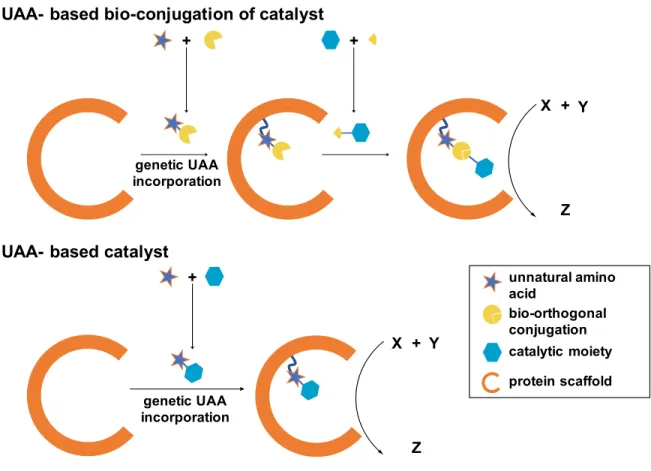
catalytic amino acids offers advantages over UAA- or canonical amino acid-based conjugation strategies. The most prominent benefit would be the direct simplification of the catalyst production methodology, Figure 1.10. When utilizing a catalytic UAA, the active protein scaffold is purified from a heterologous host and characterized in a single event. In contrast, for unnatural amino acid-based bio-conjugation of a
catalyst, the protein scaffold must be purified from the expression host, conjugated to a catalyst and subsequently re-purified from non-conjugated catalyst.
Consequently, iterative optimization, i.e. directed evolution, of the hybrid protein-catalyst conjugate is challenging and only one instance has been reported (17). Directed evolution, consisting of random mutagenesis followed by high throughput screening of the mutant library necessitated the removal of excess non-conjugated catalyst prior to screening to avoid skewing of yields and selectivities, Figure 1.5.
Selection of a protein scaffold to host the catalyst is a complicated endeavor of concern to both direct-UAA and bioconjugation-UAA based strategies for catalyst immobilization. In both cases, the scaffold should be highly stable in order to tolerate extensive mutations for engineering and optimization, and to facilitate high
places challenging steric constraints on the proteins’ hydrophobic core. Catalytic UAA’s negate the inclusion of bio-conjugation handles that often contribute to the steric bulk of the conjugated catalyst. Catalytic UAAs may also alleviate the
complexity and laborious nature of synthesizing both bio-conjugation partners, the UAA and the catalyst.
Figure 1.10 Advantage of installation of UAA-based catalyst
In vivo incorporation of catalytic UAAs may prove more attractive than alternative strategies for the creation of non-natural protein catalysts, including cysteine conjugation of catalysts and recruitment of cofactor-based catalysts in a protein scaffold. ArMs have been created via the introduction of a single cysteine residue and subsequent nucleophilic attack of the residue on a reactive site on a conventional catalyst (34). This strategy can require labor intensive mutational
+ +
+
UAA- based bio-conjugation of catalyst
UAA- based catalyst
X + Y
Z
X + Y
Z
unnatural amino acid
bio-orthogonal conjugation catalytic moiety
protein scaffold genetic UAA
incorporation
efforts if many cysteines must be removed from the native protein scaffold (35). In contrast, UAA-based catalysts only require a single TAG mutation to site-selectively install the catalyst. Another popular strategy for the construction of ArM is the
recruitment of cofactor-like catalysts to protein hydrophobic cores. For example, synthesizing a biotin containing catalytic complex and sequestering it within the streptavidin cavity has created ArM with novel non-natural catalytic functionality (36). However, this strategy suffers from the same labor intensive methodology as does the UAA-based bio-conjugation of catalysts within protein hosts. In addition, it is specific to the mutational and spatial restrictions of the streptavidin pocket. UAA-based installment of catalytic moieties would be possible in any given protein scaffold with the introduction a single TAG codon mutation.
1.3.2 Quantifying protein complex stability via 19F NMR UAA probes
Non-natural chemical functionality contributed by UAAs has furthered the study of protein-protein interactions. Specifically, light activated photocrosslinking UAAs have been extensively exploited to probe protein interfaces in a site-specific manner (27). This technology has accelerated the identification of weak protein-protein interactions under physiological conditions (20). However, by nature of the covalent, irreversible, entrapment of protein binding partners, equilibrium
thermodynamic quantification of the interaction is not possible. Therefore, other strategies must be undertaken to determine how manipulation of the environment under which the interaction occurs effects the stability of the complex.
In the final chapter in this dissertation, we employ a 19F-containing UAA,
under various conditions. This project adds to the small subset of 19F NMR protein investigations that utilize the site specific in vivo incorporation of unnatural amino acids (30, 31, 37-40). To date, the favored method to install 19F probes is the residue specific manner exploiting native translational machinery (29, 41-43). However, replacing all locations of a residue (typically tryptophan or tyrosine) with fluorinated derivatives can destabilize the protein structure and complicate assigning
resonances, especially for large proteins with many labeling sites. These
impediments can limit ideal proteins for investigation to those with single sites for fluorine labeling and those that tolerate structural perturbations. In addition, protein expression must be done under deprived conditions or in auxotrophic strains to reduce canonical amino acid incorporation. Utilizing of the site-specific incorporation of UAAs provides a singly labeled protein expressed in rich media in standard
CHAPTER 2: GENETICALLY ENCODING ORGANO-CATALYTIC UNNATURAL AMINO ACIDS
2.1 Introduction
In nature, enzymes catalyze the synthesis of complex, enantiopure
compounds with impressive rate enhancements (kcat/knon), highlighted by the highest
observed kcat/knon reaching ~ 1021 (44). Moreover, enzymes operate under mild
conditions, i.e. in water at physiological temperature, pressure and pH. Consequently, enzymes are increasingly being applied to the production of agrochemicals, pharmaceuticals, and fine and bulk chemical commodities (45). While enzymes are attractive alternatives and/or complements to synthetic catalysts, they are inherently limited by their chemical composition. This restricts the synthetic applications of enzymes to chemical transformations observed in nature. Expanding the catalytic behavior of enzymes beyond the ability of the canonical amino acids, native cofactors and bioavailable substrates is a contemporary goal.
sphere provided by the biomolecular scaffold can be tuned to enhance the selectivity and activity of the metal-based chemistry. However, transition metals often require unfavorable reaction conditions such as the need for degassed buffer, absence of light and inert atmospheres (50-52). The de novo design of proteins with non-natural capabilities is appealing but computational efforts, to date, have yielded catalyst with catalytic efficiencies that are orders of magnitude lower than native enzymes (53). These activities may reflect current limitations in computational methods, which are unable to account for long-range, cooperative interactions and the complex and dynamic nature of protein fluctuations (47). Frances Arnold and colleagues engineer non-natural enzymatic catalysts by exploiting the promiscuity of metal cofactors in natural enzymes. Heme-enzymes including cytochrome P450s, cytochrome C and globins, have all been evolved to catalyze diverse reactions including, olefin
cyclopropanation, C-H amination, sulfimidation and N-H insertions through
mechanistic intermediates similar to the active oxidant of cytochrome P450 (54, 55). However, this strategy is limited to reactions that are mechanistically similar to existing enzyme catalysis.
have been incorporated into proteins via this approach, Figure 1.2, attesting to the diverse chemical structure that can be translated by the ribosome (2).
While the chemical functionality made available by UAA technology continues to grow, its applications for enantioselective catalysis remain confined to a select few approaches. With respect to biocatalysis, the use of UAAs has been markedly
under-investigated. UAAs have predominately been employed as biorthogonal chemical handles for the covalent attachment of metal-based catalysts within a protein scaffold. This approach has created novel iron proteins that carry out the Fenton reaction (56) and Rh2 catalysts competent for non-natural carbenoid
insertion reactions including cyclopropanation of olefins (33). However, bulky conjugation handles place steric constraints on the choice of scaffold, limiting options. In addition, the methodology necessitates synthesis of both catalyst and UAA equipped with conjugation partners. Lastly, the protein must be purified and characterized from the heterologous host, followed by conjugation and subsequent purification and characterization.
(32). Although modular exploration of chiral and steric aspects of the surrounding protein scaffold enhanced the UAA-based activity.
The majority of non-natural enzyme catalysis centers on transition metal-based chemistries. Herein, we draw inspiration from the marriage of metallo- and biocatalysis and seek to unite bio- and organocatalysis. Since the year 2000, organocatalysis, the use of small organic molecules to catalyze reactions has exploded in the synthetic community. Sparked by two back-to-back publications by Barbas and MacMilllan, the field of organocatalysis has grown rapidly (57, 58). Organocatalysts are typically cheap, available in enantiopure forms, operate under mild conditions and are less toxic than metal catalysts (59). Through the work of groups such as MacMillan, Barbas, Corey, JØrgensen and List, organocatalysis has
been established as an invaluable tool, complementary to transition metal based approaches, for the enantioselective construction of molecules (59-67).
Therefore, we propose the site-specific in vivo incorporation of
organocatalytic amino acids into protein scaffolds for the evolution of novel enzymes with the potential for stereo-selective catalysis. Enzymatic active sites provide an environment for engineered selectivity and activity while, in a complementary fashion, the organocatalyst motif should foster broadly applicable modes of action for various chemical transformations in a manner that is dependent on the UAA side chain.
enamine and iminium ion formation, Figure 2.1. This dual activation can be used for nucleophilic (enamine) or electrophilic (iminium ion) activation of carbonyl containing compounds.
Figure 2.1 Enamine and iminium ion catalysis by secondary amines
(A) enamine mode of activation and potential nucleophilic reactions. (B) Iminium ion activation mode and potential electrophilic transformations.
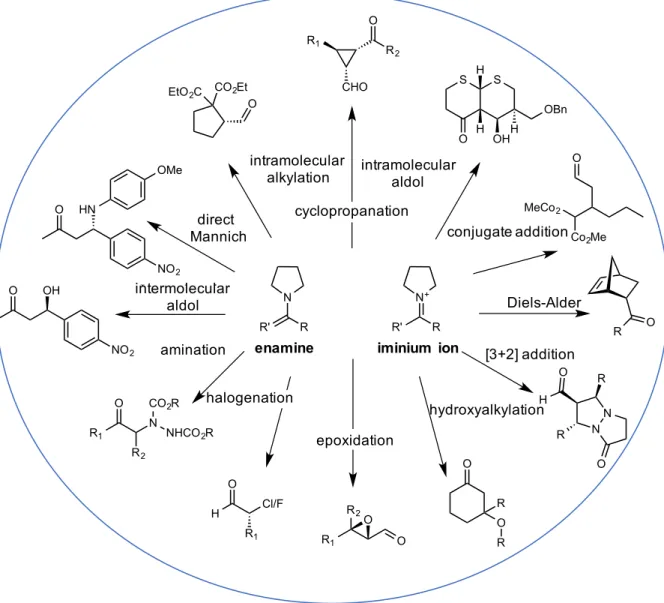
Representative of this chemistry, the amino acid proline has served as a model and highly utilized secondary amine organocatalyst, Figure 2.2. Since the initial documentation of the proline catalyzed intermolecular aldol reaction, proline has been applied to many enamine-type reactions (57). In addition, proline has been utilized as a Lewis acid catalyst through iminium ion formation and employed in various cycloadditions as well as conjugate addition reactions functionalizing α, β unsaturated compounds. Furthermore, cyclopropanation and epoxidation are possible under a tandem mechanism in which the enamine formed after addition to
Enamine catalysis N+ R R2 X Y -Y X Y
X N+
R
R2
X
Y- O
R R2 X O R R2 X Y H HY N H N H N R R2 N H R O R2 enamine N+ R R2 iminium ion addition substitution R2 O R R2 N R H O R Nu N R H N+ R H NH+ R R 1,2-addition trans-amination R2 N+ R
Iminium ion catalysis
cycloaddition O O O Nu N+ 1,4-addition enamine A B
H2O H+
H2O
the iminium ion is trapped by an electrophilic species (68, 69). We hypothesize that the genetic incorporation of proline containing amino acids will enable the
construction of evolvable protein catalysts for enantioselective enamine/iminium ion based via mechanisms that are comparable and complementary to reactions
catalyzed by simple small molecule proline derivatives.
Figure 2.2 Versatility of proline as enamine and iminium ion organocatalyst
N N+
R Intermolecualr Aldol O OH NO2 O HN NO2 OMe Amination R1 O R2 N CO2R
NHCO2R
Halogenation H O R1 Cl/F CHO R2 O R1 O R2
R1 O
Cyclopropanation
Epoxidation
R' R R'
Intermolecualr Aldol S S O OBn H H OHH Conjugate Addition MeCo2
Co2Me O Diels-Alder R O [3+2] Addition N N O R O H R Hydroxyalkylation O O R R Direct Mannich Intramolecular Alkylation
CO2Et EtO2C
O
intramolecular
alkylation intramolecular aldol
cyclopropanation conjugate addition Diels-Alder [3+2] addition hydroxyalkylation epoxidation halogenation amination intermolecular aldol direct Mannich
2.2 Results and discussion
2.2.1 Unnatural amino acid design and synthesis
We began our efforts with the design and synthesis of two unnatural amino acids equipped with a proline moiety. The structures of the amino acid were designed to target both sets of commonly used orthogonal aaRS/tRNA pairs: the Methanococcua jannaschii tyrosyl-tRNA synthetase (MjTyrRS)-tRNA and the
pyrrolysyl-tRNA synthetase (PylRS)-tRNA from Methanosarcina barkeri, by creating a tyrosine and pyrrolysine based unnatural amino acid.
For the orthogonal MjTryRS-tRNA pair, many of the first reports of UAA incorporation centered on para-substituted phenyl ring derivatives for use in bioconjugation (24, 70-73). In addition, bulky para-substituents such as tetrazine (74), tetrazole (75), and benzophenone (21) groups and conjugated aromatic systems such as 2-naphthol (76) have been incorporated by engineered MjTyRS variants. Inspired by the successful engineering of MjTyRS for the in vivo
Figure 2.3 Substrates of engineered MjTyRS
(A) The native substrate of MjTyRS. (B) The proline containing tyrosine derived UAA utilized in this study. (C) Diverse UAAs in vivo incorporated by the orthogonal MjTyRS/tRNA pair.
Codon reassignment in E.coli utilizing the orthogonal aaRS/tRNA machinery pyrrolysine (the so-called 22nd canonical amino acid), has been very successful due to the remarkably flexible substrate scope demonstrated by the wild type pyrrolysyl tRNA synthetase (PylRS) and its variants. The earliest investigation into the
structural requirements for PylRS substrate recognition identified several proficient substrate analogs (2, 5, 6 in Figure 2.4) (77) followed by numerous and growing reports of the diverse chemical structures accommodated by PylRS and its variants, see Figure 1.2. Related to our efforts, this study reported the incorporation of a proline-modified pyrrolysine analog, D-prolyl-L-lysine (ProK), albeit with poor efficiency (77). Based on the known flexibility of PylRS, we also chose ProK as a starting point for our efforts.
C
tyrosine Pro4AF
A
B
1. 2.
3. 4. 5. 6. 7.
H2N
O
OH OH
H2N
O
OH NH
O N
H
H2N
O
OH O
H2N O
OH O
H2N
O OH H N N N N N
H2N
O OH N N N N
H2N O
OH
Figure 2.4 Substrates of the wild type pyrrolysine synthetase (WT-PylRS)
(A) The 22nd amino acid, pyrrolysine. (B) UAAs utilized in this study: ProK, the proline containing UAA and BocK, a positive control for WT-PylRS. (C) Diverse UAAs recognized by WT-PylRS that are
structurally and chemical similar to proK.
The synthesis of Pro4AF and ProK are described in detail in Small molecule synthesis and characterization 2.5.3. Briefly, to construct Pro4AF, a 9-BBN
protecting group strategy was employed followed by routine amine to amide
dicylcohexylcarboiimide coupling. The 9-BBN protection of 4-amino-L-phenylalanine and subsequent coupling to Boc-D-proline proceeded in an overall 53% yield. The synthesis of ProK was modified from original reports in which yields were not
conducive to scaled preparation. Our synthetic strategy first activated Boc-D-proline as a N-hydroxysuccinimide carbonate followed by coupling to N-a-Boc-protected L-lysine followed by dual deprotection. The three-step synthesis was carried out in an overall yield of 64%. Unnatural amino acid synthesis was verified by mass
spectrometry and 1H NMR analysis, see 2.5.41H NMR .
H2N NH O
O
OH O
H2N NH O O OH S NH
H2N NH O
O
OH O
H2N NH O
O OH O
H2N
NH O O OH O
C
pyrrolysineH2N
NH O
N
O
OH H3C
H2N
NH O NH O OH ProK
H2N
NH O O OH O BocK
A
B
1. 2. 3.
Figure 2.5 Proline-containing UAAs: Pro4F and ProK
2.2.2 The search for a Pro4AF synthetase
Initial efforts focused on the in vivo incorporation of Pro4AF. This work
represents the first report of a proline containing MjTyRS-targeted UAA. Therefore, a synthetase must be identified or evolved to recognize and incorporate Pro4AF into protein sequences. Our approach was to first screen a collection of synthetases available to us, in house, for successful incorporation of Pro4AF in response to the amber TAG codon. Variants of the MjTyrRS and MbPylRS were assessed given both systems have been engineered to accept para-substituted phenylalanine amino acids (4, 78). We selected a span of tyrosine-based synthetases that demonstrate broad substrate tolerance encompassing bulky hydrophobic para-substituents as
H2N
HO O NH O NH Pro4AF NH O NH
H2N
HO O ProK m/z [M+H] = 278.1499
Observed mass: 278.1504
m/z [M+H] = 244.1656 Observed mass: 244.1669
well as small polar substituents. Our screen also included alanine mutations at amino acid positions N246 and C248 in the MbPylRS system, which have been shown to induce broad tolerance to phenylalanine derivatives, including bulky para-substituted derivatives (78), in PylRS. The complete list of synthetases evaluated is given in Table 2.1.
We utilized a green fluorescent protein (GFP) construct with a TAG codon at position 149 to screen potential tRNA synthetases. The detailed procedure is described in the methods (“GFP-based synthetase screen for Pro4AF
incorporation”). Briefly, each individual tRNA synthetases was co-transformed with a GFP-149TAG construct. Expression was then carried out in the presence of Pro4AF. If the TAG codon was suppressed with the UAA, full length GFP would be produced and the extent of expression was qualitatively determined by fluorescence intensity of clarified lysates. Expression was simultaneously carried out in the absence of Pro4AF to judge the level of expression resulting from TAG suppression with canonical amino acids. Synthetases were deemed successful if fluorescence
Table 2.1 Aminoacyl-tRNA synthetases evaluated for Pro4AF incorporation
MjTyrRS variants MbPylRS variants
p-acetyl-phenylalanine pyrrolysine
p-azido-phenylalanine pyrrolysine L274A C313A Y349F p-benzoylphenylalanine pyrrolysine L274A C313S Y349F p-(2,2'-bipyridin-5-yl)alanine pyrrolysine C313A Y349F
p-boronophenylalanine pyrrolysine C313S Y349F
p-cyano-phenylalanine pyrrolysine Y349F
p-carboxylmethyl-phenyalanine pyrrolysine 246A 248A p-(7-hydroxycoumarin-4-yl) ethylglycine pyrrolysine 246A 248L p-(8-hydroxy-quinolin-3-yl)alanine pyrrolysine 246V 248W
p-iodo-phenylalanine pyrrolysine 246S 248W p-isopropyl-phenylalanine pyrrolysine 246T 248T p-hydroxy-L-phenyllactic acid pyrrolysine HRS p-proparglyoxyphenylalanine
p-nitrophenylalnine 3-(2-naphthyl)alanine o-nitrobenzyl-tyrosine
sulfotyrosine o-methyl-tyrosine p-amino-phenylalanine
tyrosine
2.2.3 MbPylRS accepts ProK
In light of unsuccessful attempts to incorporate a tyrosine-based proline UAA, in vivo, we turned our attention to the pyrrolysine based UAA, ProK. This UAA has been previously identified as a substrate analogue of the pyrrolysyl-tRNA synthetase from Methanosarcina barkeri (MbPylRS), albeit with a reported 18% suppression efficiency (77). This observation was qualitatively verified in our hands using the GFP-based fluorescence reporting system. Herein, we report fluorescence intensity with respect to 1 mM BocK (an efficient substrate of MbPylRS known to be
times greater than in the absence of ProK. A 2-fold improvement was observed with the addition of 5 mM ProK to the media, Figure 2.6, however further increases in amino acid concentration did not provided additional improvements in incorporation. GFP obtained from expressions in the presence of ProK was purified from cellular lysate and subjected to analysis via mass spectrometry, which revealed the
successful incorporation of intact ProK at position 149 (Figure 2.6, expected mass, m/z = 27938.6, observed mass m/z = 27938.6).
Figure 2.6 Incorporation of ProK into GFP by MbPylRS
(A) GFP fluorescence intensity of clarified lysate after expression in the absence, negative control, and presence of UAAs. (B,C) Mass spectrometry analysis of GFP149ProK, expected mass, m/z = 27938.6, observed mass m/z = 27938.6. Truncation corresponding to cleavage of starting methionine
residue is observed.
2.2.4 Free ProK aldol catalysis
After verification of incorporation of ProK into a protein sequence in response to TAG codon with MbPylRS, we next sought to characterize the catalytic
intermolecular aldol reaction, a hallmark reaction for amine catalyst development, was chosen to evaluate enamine reactivity of ProK. This reaction was selected because it is amenable to high-throughput screening as demonstrated by its utilization in the computational design of aldolase enzymes (53). In addition, there are several commercially available or synthetically straightforward retro-aldol and aldol chromogenic/fluorescence probes with divergent structures and sizes that may facilitate future screening and directed evolution (53, 79, 80). We anticipate protein hosts will require sterically compatible substrates such that diverse and
commercially available substrates provide ideal model systems. In addition, after installation of the UAA in a protein host, improvements in catalysis will be necessary by mutational exploration of the protein host. Reactions that exhibits a characteristic absorbance or fluorescence signature provide convenient screens for assessing improvements in catalytic competency among protein variants.
To begin, acetone and 4-nitrobenzaldehyde were selected as aldol
substrates. Product standards were synthesized consistent with previous reports (81). HPLC and comparison to an internal standard [trans-beta nitro styrene (TBNS)] was used to quantity conversion via peak integration, Figure 2.7. The optimal
reaction, however the reaction is typically performed in organic solvents, such as DMSO (57). We suggest the improved catalysis by free ProK may be the result of a phase separation where catalysis is occurring in a concentrated organic layer whose formation is more favorable with ProK than proline (82, 83).
To summarize our initial findings, we have designed an UAA that is
Figure 2.7 Quantification of model aldol reaction
(A) HPLC trace: an isocratic solvent system of 95:5 hexanes:ethanol was used at a flow rate of 1 ml/min. Detection was monitored at 254 nm. Enantiomeric excess was not determined. (B) aldol product standard curve: serial dilutions of a standard were performed. Internal standard at 5 mM was
added to each sample and 5 µL was injected into Agilent LC 1260 Infinity II system.
Figure 2.8 ProK catalyzed model aldol reaction
(A) Model aldol reaction with corresponding HPLC trace of aldol product obtained at various concentrations of phosphate buffer. The optimized reaction conditions were determined to be 30
mol% ProK, 200 mM phosphate, 400 mM Na+, 10 mM aldehyde, 100 mM acetone, pH 7.4. (B) Comparison of 30 mol% proline and ProK catalyzed aldol reaction in the optimized buffered
conditions.
2.2.5 Optimization of ProK incorporation by MbPylRS
Previously, we determined that WT-MbPylRS incorporated ProK into GFP, in response to a TAG codon, roughly 10-fold less efficient than BocK, a positive UAA control. For future catalytic evaluation of ProK-containing proteins, however, we anticipate high catalyst loadings will be necessary, reflecting standard conditions for organocatalysic reactions in the literature. Accordingly, we next focused our efforts on the improvement of MbPylRS-mediated ProK incorporation. We first performed a series of experiments aimed at exploring vector-based effect on incorporation, in addition to improvements in ProK incorporation via mutation and evolution of the synthetase. 0 50 100 150 200 250
15 15.5 1616 16.5 17 17.5 18 18.5 19 19.5 20
250
150
50
17 18 19
200 mM phosphate
150 mM phosphate
100 mM phosphate
50 mM phosphate
Time (min) Abs orba nc e H O NO2 O
30 mol% ProK
rt, 24 hrs
pH 7.4 NO2
O OH
10 mM 100 mM
NO2 O OH
NO2 O OH
To begin, a comparative analysis between commonly utilized expressions systems was performed. A pET/pUltra and pBK/pBad dual plasmid systems have been developed and frequently used in our laboratory for unnatural amino acid mutagenesis (84, 85). These systems differ in location of tRNA and tRNA
synthetase, as well as promoters for expression of all system components and the origins of replication. Notably, the fundamental principles of these two systems as it pertains to UAA expression are the same, however, in our experience, different UAA-containing proteins as well as different UAAs have shown disparate performances depending on the plasmid pair.
We compared a pET-GFP-2TAG/pUltra-MbpylRS-MmpylT system with a pBK-MbpylRS/pBad-sfGFP149TAG.his-pylT system. By fluorescence intensity, expression of GFP was 2-fold greater with the pBK/pBad plasmid system than pET/pUltra. In addition, background incorporation of canonical amino acid incorporation in the absence of the unnatural amino acid was greater with the pET/pUltra system when compared to the pBK/pBad system, Figure 2.9. Moving forward with our optimized vector expression system for this particular protein and UAA, we transitioned to identifying improvements in incorporation efficiency by reaching out to mutations to the active site of MbPylRS that have been shown to improve the incorporation of similar UAAs. One mutation, Y349F, is known to improve amino acylation rates in PylRS (86). The Y349F mutation improved GFP expression in the presence of ProK by an additional 2-fold as judged by
Quantification of ProK incorporation in GFP as determined by mass of purified protein obtained in the presence of BocK and ProK with MbPylRS-Y349F demonstrated 12% of the incorporation of the positive control with BocK.
Figure 2.9 Optimization of UAA incorporation system for ProK
2.2.6 Efforts towards the directed evolution of MbPylRS
Our previous efforts to increase incorporation efficiency of ProK by MbPylRS, which focused on the logistics of plasmid construction as well as a single known beneficial mutations, resulted in modest improvements. However, a single mutation, Y349F, provided improvements in ProK incorporation. This result suggested the possibility that other mutations to the PylRS scaffold may provide enhancement in incorporation efficiency. Therefore, we chose to carry out the direct evolution of the PylRS synthetase in an active directed manner. We employed a four
site-saturation “NNK” randomized library of MbPylRS that was created by a previous lab member, Joshua Gober. The sites chosen (see Figure 2.10) have all been shown to improve the incorporation of various N-ε-derivatized lysine UAAs (78). “NNK” codons (N = A,T,G,or C; K = T, or G), encoding all possible 20 canonical amino acids, were cloned onto the activating Y349F mutation to create
pBK-MbPylRS-Y349F/L305NNK/Y306NNK/L309NNK/C348NNK, Figure 2.10.
The library of mutant MbPylRS variants was selected for the ability to specifically suppress a TAG codon with ProK even in the presence of canonical amino acids through iterative rounds of positive and negative selection. For positive selections, we made use of a plasmid (pREP-pylT, Figure 2.10) harboring an
Figure 2.10) (88). In this selection, cells were grown in the absence of ProK and expression of the toxic protein was induced using arabinose. Cells that survive the negative selection should be specific for ProK since the synthetase did not suppress the TAG codon with canonical amino acids. The detailed protocol for the selection is described in Positive/negative selection system 2.4.8. Multiple rounds of increasing chloramphenicol stringency followed by screening of 200 isolated colonies for improvements in GFP-based fluorescence resulted in no improved variants when compared to the parent, MbPylRS-Y349F. A reduced diversity library of Y271, L274 and L270 NNK was carried through the same procedure and no improvements were identified.
Figure 2.10 Direction evolution of MbPylRS via a 4 site-saturation ‘NNK’ library
(A) MbPylRS, PDB ID: 2ZIM, with adenylated pyrrolysine shown in blue and residues targeted for ‘NNK’ codons shown in yellow. (B) Plasmids used to select for improvements in ProK incorporation.
Failure to identify beneficial mutations for the improved incorporation of ProK from an active site-directed site-saturation library of MbPylRS, prompted us to
chloramphenicol acyltransferaseTAG
Barnase2TAG
L309
C348
L305 Y306
pBK-MbpylRS
LYLC NNK pRep-pylT
PylRS LYLC NNK Pyl tRNA
pBad-barnase2TAG
pBad-sfGFP149TAG
sfGF9149TAG
prone (EP) polymerase chain reaction (PCR) is an established means to introduce random nucleotide mutations in a gene sequence. We created EP libraries of the MbPyLRS-Y349F gene. The detailed EP PCR methodology is described in Error prone MbpylRS library and FAC sorting 2.4.9. Briefly, PCR reactions were
performed with variations in the concentration of manganese chloride to decrease the fidelity of DNA polymerase in the presence of a thymine and cytosine biased nucleotide pool, to limit innate biases in nucleotide substitution patterns. The mutation rate of EP PCR reactions can be controlled by varying the MnCl2
concentration. We found, libraries of MbPylRS-Y349F could be obtained containing low mutation rates (1-2 per gene) or high mutation rates (up to 8 mutations per gene). We examined two error prone libraries bearing either low mutation rates (~2 per gene) to maximize the number of active synthetases in the library, or a high mutation rate (~6 per gene) to maximize mutational diversity. These libraries were co-transformed with pBad-sfGFP149TAG.his-pylT, to enable in cell screening of ProK incorporation via florescence assisted cell sorting, as described in Error prone MbpylRS library and FAC sorting.
As an alternative to antibiotic selections, fluorescence assisted cell sorting (FACS) based on GFP fluorescence was employed to identify mutants with