The digital revolution in phenotyping
Anika Oellrich*, Nigel Collier*, Tudor Groza*, Dietrich Rebholz-Schuhmann*,
Nigam Shah*, Olivier Bodenreider, Mary Regina Boland, Ivo Georgiev,
Hongfang Liu, Kevin Livingston, Augustin Luna, Ann-Marie Mallon,
Prashanti Manda, Peter N. Robinson, Gabriella Rustici, Michelle Simon,
Liqin Wang, Rainer Winnenburg and Michel Dumontier
Corresponding author: Anika Oellrich, Wellcome Trust Sanger Institute, Wellcome Trust Genome Campus, Hinxton, CB10 1SD, United Kingdom. E-mail: [email protected]
* These authors contributed equally to this work.
Anika Oellrichis a Senior Bioinformatician at the Wellcome Trust Sanger Institute. Her work focuses on aspects of phenotype mining, in large data sets as well as scientific literature.
Nigel Collieris Principal Research Associate at the University of Cambridge where he is co-head of the Language Technology Laboratory. His research brings together computational techniques for machine understanding of text.
Tudor Grozais the Phenomics Team Leader at the Kinghorn Center for Clinical Genomics, Garvan Institute of Medical Research. His research focuses on phenotype acquisition and application in a clinical setting.
Dietrich Rebholz-Schuhmannis Professor for Informatics at the National University of Ireland and Site Director of the Insight Centre for Data Analytics in Galway. His research focuses on biomedical semantic web technologies.
Nigam Shahis an Assistant Professor of Medicine and Biomedical Informatics at Stanford University. His research focuses on using ontologies and text-mining to enable learning from electronic medical records.
Olivier Bodenreideris a Senior Scientist at the US National Library of Medicine. His research focuses on terminology and ontology in the biomedical domain. Mary Regina Bolandis a PhD fellow in the Department of Biomedical Informatics at Columbia University, New York, NY, USA. Her research involves de-veloping informatics algorithms for epidemiology and genetics.
Ivo Georgievis a Postdoctoral Fellow at Computational Bioscience Program at the University of Colorado School of Medicine. He researches methods for unsupervised extraction of biological mechanism information from domain corpora of biomedical publications.
Hongfang Liuis an associate professor in biomedical informatics at Mayo College of Medicine, Rochester, MN, USA. Her research areas include biomedical natural language processing and data mining.
Kevin Livingstonis a Research Associate at the University of Colorado School of Medicine. His research focuses on knowledge representation and reason-ing to support data integration and hypothesis generation.
Augustin Lunais a Research Scholar at Memorial Sloan Kettering Cancer Center. He is a recipient of the NIH NRSA Ruth Kirschstein Postdoctoral Fellowship for drug discovery-related research.
Ann-Marie Mallonis the Head of Bioinformatics at the Medical Research Council Mammalian Genetics Unit. Her research focuses on developing tools for analyzing large-scale mouse functional data from high-throughput phenotyping.
Prashanti Mandais a postdoctoral associate in the Department of Biology at the University of North Carolina, Chapel Hill. Her research interests include Bioinformatics, Bio-ontologies, Semantic Similarity and Data Mining.
Peter N. Robinsonis Professor for Medical Genomics at Charite´ Universita¨tsmedizin Berlin and Professor of Bioinformatics at the Free University Berlin. His re-search interests include computational phenotype analysis, exome and genome sequencing, bioinformatics for next-generation sequencing and Marfan syndrome.
Gabriella Rusticiis the Bioinformatics Training Manager at the School of Biological Sciences of the University of Cambridge, UK. She is an active contributor to the development of the Cellular Microscopy Phenotype Ontology for the annotation of cellular phenotypes derived from high-content screening data. Michelle Simonis a postdoc in the Bioinformatics department of the Mammalian Genetics Unit, MRC, Harwell, UK. Her research areas include, phenomics, functional genomics and next-generation sequencing.
Liqin Wangis a PhD fellow in the Department of Biomedical Informatics at University of Utah, Salt Lake City, UT, USA. Her research focuses on medical knowledge acquisition and disease-specific ontologies development and application.
Rainer Winnenburgis a postdoctoral fellow at the Center for Biomedical Informatics Research at Stanford University. He is interested in information ex-traction from biomedical ontologies, electronic medical records and literature.
Michel Dumontieris an Associate Professor of Medicine at the Center for Biomedical Informatics Research at Stanford University. His research focuses on developing methods for biomedical knowledge discovery.
Submitted:3 June 2015;Received (in revised form):4 August 2015 VCThe Author 2015. Published by Oxford University Press.
This is an Open Access article distributed under the terms of the Creative Commons Attribution License (http://creativecommons.org/licenses/by/4.0/), which permits unrestricted reuse, distribution, and reproduction in any medium, provided the original work is properly cited.
819
doi: 10.1093/bib/bbv083
Abstract
Phenotypes have gained increased notoriety in the clinical and biological domain owing to their application in numerous areas such as the discovery of disease genes and drug targets, phylogenetics and pharmacogenomics. Phenotypes, defined as observable characteristics of organisms, can be seen as one of the bridges that lead to a translation of experimental find-ings into clinical applications and thereby support ‘bench to bedside’ efforts. However, to build this translational bridge, a common and universal understanding of phenotypes is required that goes beyond domain-specific definitions. To achieve this ambitious goal, a digital revolution is ongoing that enables the encoding of data in computer-readable formats and the data storage in specialized repositories, ready for integration, enabling translational research. While phenome research is an ongoing endeavor, the true potential hidden in the currently available data still needs to be unlocked, offering exciting opportunities for the forthcoming years. Here, we provide insights into the state-of-the-art in digital phenotyping, by means of representing, acquiring and analyzing phenotype data. In addition, we provide visions of this field for future research work that could enable better applications of phenotype data.
Key words: phenomics; phenotypes; acquisition; interoperability; semantic representation; knowledge discovery
Introduction
Phenotypes are broadly defined as observable characteristics of organisms and have gained great importance since the discov-ery of the causative relationship between a given underlying genetic mechanism (e.g. gene expression levels, mutations) and its phenotypic manifestation. Subsequently, diverse initiatives have focused on developing and curating resources that capture this causal relationship at multiple levels and in the context of multiple organisms. Examples include, but are not limited to the Online Mendelian Inheritance in Man (OMIM) database [1], the Mouse Genome Informatics database (MGD) [2], FlyBase [3] and the Zebrafish Model Organism database (ZFIN) [4].
The increasing development and exploitation of phenotypes has led to a varied range of applications: identifying disease genes [5–9] and characterizing functionally yet unclassified genes [10–12], repurposing drugs [13,14], pharmacogenomics [15–17] and pharmacovigilance [18], as well as solving evolu-tionary questions [19,20].
The goal of this review is to synthesize the state-of-the-art in the past 10 years of Phenome Research, and hence provide a unique and broad access point for those interested in studying topics in specific areas of phenomics. The areas covered include both phenotype data evolving from biological experiments and data needed in a clinical environment. This work also presents visions for the coming years in phenomics research, as it de-rives a series of open challenges, based on input collected from the community. We note here that the work addressed in this article focuses on computational phenotyping, i.e. the collec-tion, representation and processing of phenotypes in a com-puter-interpretable format.
To enable a structured navigation of the field, we map the content of the review onto the four conceptual dimensions of phenomics, considered from a computational perspective (de-picted inFigure 1): representation, interoperability, acquisition and processing. These four dimensions have been identified and described in an earlier review [21] and are used for simpli-city here. Representation focuses on semantic modeling and as-pects of knowledge capturing. Interoperability, an orthogonal dimension to representation, aims to facilitate intra- and interspecies phenotype mappings. Acquisition refers to the transformation of the raw data into semi-structured or struc-tured phenotype representations. Processing (or application) uses externalized phenotypes to address fundamental or spe-cific challenges, from variant prioritization and diagnosis to individualized preventive care or drug repurposing.
Each of these dimensions encapsulates a multitude of as-pects that reflect in their aggregated form the intrinsic complex-ity of phenotypes. For example, subject to the underlying domain, the granularity of the representation of phenotypes may differ depending on their application. While biologists cap-ture data that may be too detailed for clinical applications, clin-icians need solid and thoroughly supported evidence to be able to test hypotheses derived from biological experiments. Furthermore, phenotypes may be defined and represented in the context of different organisms, e.g. decreased bone mineral density (MP:0000063) in the Mammalian Phenotype Ontology (MP) [22] and Osteopenia (HP:0000938) in the Human Phenotype Ontology (HPO) [23], even though they may share an underlying goal from a translational perspective, such as the documenta-tion of a certain gene funcdocumenta-tion. This leads to the need for achieving cross-species interoperability to enable integrated processing. Finally, the phenotype acquisition process poses its own challenges, i.e. technical (process automation or interface usability), social (incentive) and ethical (privacy). In the follow-ing we discuss in depth each of the dimensions introduced above. A summary of all the resources provided in this manu-script is provided inTable 1.
State-of-the-art phenome research
Representation
A phenotype can be any observation of a normal or abnormal state of an anatomical, physiological or biochemical property of an organism. While phenotypes in a biological domain are re-corded as results from biological experiments, phenotypes in a clinical domain are used to report the assessment of patients. Phenotypes span from the molecular level to the organism level [42]. To enable the other three dimensions to reach their full po-tential, a representation is needed that is well understood by humans, and at the same time, computer-readable and hence amenable to computational analyses. Such a representation does not only have to cover normal and abnormal phenotypes within a species, but also has to facilitate the bridging across species and enable integration of heterogeneous data at differ-ent levels of granularity.
with domain-specific relationships—e.g. HPO or MP. While free text descriptions support a better human understanding, they limit the possibilities for automated data analysis [43]. With the abundance and ever-increasing amount of data, the ultimate goal is to build a uniform and consistent computer-readable representation, one that enables a seamless collection and inte-gration of phenotypes recorded in biological studies, as well as in a clinical environment. Ideally, this uniform, global represen-tation would also account for both qualified and quantified data and enable flexible conversion where possible. In cases where conversion is not possible, this universal representation would have to be extended with mappings.
Ontologies to represent phenotypes
adopting this representation consists of concept definitions like ‘erythrocytopenia’ or ‘deficiency of red blood cells’ / ‘deficiency of erythrocytes’. These concepts are easily understood by humans and also facilitate computational analysis.
The post-composed representation uses elementary pheno-typic units from existing ontologies to compose specific com-plex phenotypes. One mechanism to postcompose phenotypes is the entity-quality (EQ) statement approach [24,44]. For ex-ample, instead of defining ‘erythrocytopenia’ as an atomic con-cept, this approach represents the meaning of the phenotype by linking the quality ‘deficiency’ with the anatomic entity ‘red blood cells’. This link is then captured via a logical axiom using concepts introduced by existing ontologies, such as the Gene Ontology (GO) [26] and the Phenotypic quality and Trait Ontology (PATO) [24]. The caveats of the postcomposition result from the development overheads in building post-composed statements. Additionally, a number of pre-composed phenotype ontologies still need to be transformed into a post-composed representation.
‘Normal’ and ‘abnormal’ phenotypes
Some of the existing phenotype representations focus on devi-ations of phenotypes (i.e. their status or quality, from a
reference phenotype) [27]. The reference phenotype in the case of model organisms could be either the wild type of the organ-ism or a specific strain from which the mutation has been gen-erated. In the best case, the phenotype representations form the core that enables interoperability of different data reposito-ries, possibly covering different organisms and being collected with different aims in mind. The quality of the phenotypic re-source, i.e. the consistency of the phenotypic definitions, the overall structure of the phenotype semantic resource and in particular the completeness of the electronic resource, holds the key to enabling efficient data analysis, interpretation and decision support.
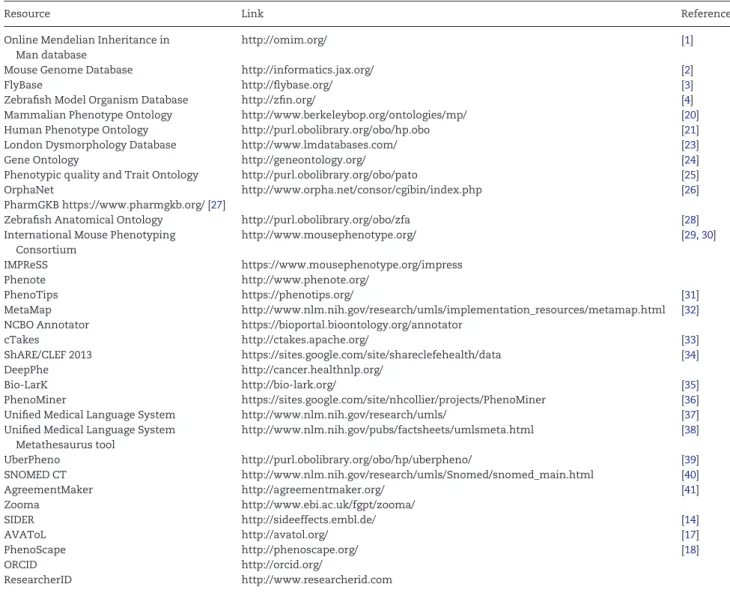
To extend beyond representing ‘abnormal’, Shimoyamaet al. have extended the representation of phenotypes to also incorp-orate environmental factors as well as methods used to meas-ure the phenotype [45]. The developed ontologies have been used to annotate both rat (http://rgd.mcw.edu/wg/physiology) and human data (http://cover.wustl.edu/Cover/). Furthermore, the suggested framework allows for the annotation of quanti-fied phenotypes (e.g. ‘blood sugar levels>8.5 mmol/L’) instead of ‘abnormal / increased blood sugar levels’. While this way of representation could be used to represent the reference pheno-type, a data curator is needed to provide this information. Table 1. Summarizes all resources mentioned throughout the manuscript, together with their URL and reference (where applicable)
Resource Link Reference
Online Mendelian Inheritance in Man database
http://omim.org/ [1]
Mouse Genome Database http://informatics.jax.org/ [2]
FlyBase http://flybase.org/ [3]
Zebrafish Model Organism Database http://zfin.org/ [4]
Mammalian Phenotype Ontology http://www.berkeleybop.org/ontologies/mp/ [20]
Human Phenotype Ontology http://purl.obolibrary.org/obo/hp.obo [21]
London Dysmorphology Database http://www.lmdatabases.com/ [23]
Gene Ontology http://geneontology.org/ [24]
Phenotypic quality and Trait Ontology http://purl.obolibrary.org/obo/pato [25]
OrphaNet http://www.orpha.net/consor/cgibin/index.php [26]
PharmGKB https://www.pharmgkb.org/ [27]
Zebrafish Anatomical Ontology http://purl.obolibrary.org/obo/zfa [28]
International Mouse Phenotyping Consortium
http://www.mousephenotype.org/ [29,30]
IMPReSS https://www.mousephenotype.org/impress
Phenote http://www.phenote.org/
PhenoTips https://phenotips.org/ [31]
MetaMap http://www.nlm.nih.gov/research/umls/implementation_resources/metamap.html [32]
NCBO Annotator https://bioportal.bioontology.org/annotator
cTakes http://ctakes.apache.org/ [33]
ShARE/CLEF 2013 https://sites.google.com/site/shareclefehealth/data [34]
DeepPhe http://cancer.healthnlp.org/
Bio-LarK http://bio-lark.org/ [35]
PhenoMiner https://sites.google.com/site/nhcollier/projects/PhenoMiner [36]
Unified Medical Language System http://www.nlm.nih.gov/research/umls/ [37]
Unified Medical Language System Metathesaurus tool
http://www.nlm.nih.gov/pubs/factsheets/umlsmeta.html [38]
UberPheno http://purl.obolibrary.org/obo/hp/uberpheno/ [39]
SNOMED CT http://www.nlm.nih.gov/research/umls/Snomed/snomed_main.html [40]
AgreementMaker http://agreementmaker.org/ [41]
Zooma http://www.ebi.ac.uk/fgpt/zooma/
SIDER http://sideeffects.embl.de/ [14]
AVAToL http://avatol.org/ [17]
PhenoScape http://phenoscape.org/ [18]
ORCID http://orcid.org/
Conversions from the different states of ‘normal’, e.g. similar tests in different species, are not automatically available.
Representing qualitative and quantitative phenotypes
Other desiderata for phenotype representations are focused on the exploitation of ontologies for efficient propagation of experi-mental findings in basic phenomics research into the clinical domain and improved research efficiency in both domains (translational medicine). Consequently, phenotype descriptions have to meet clinical needs and cover those diseases that are most relevant to the clinical context. Experimental phenotypic descriptions are detailed and reflect the experimental setup, whereas clinical descriptions suffer from time constraints and thus tend to lack observational detail. Furthermore, experimen-tal and clinical phenotypic descriptions may be organized at di-verse levels of granularity and may be biased toward a specific perspective. For example, experimental findings provide the op-portunity to capture and represent quantitative traits (e.g. ‘blood sugar>8.5 mmol/L’), which may require adaptation into qualitative terms (‘high blood sugar’) for clinical purposes. Similarly, from a diagnosis perspective, one may require a com-plete and individualized view over the phenotypic profile, which may include degrees of severity [28] and longitudinal phenotypes [29], hence adding to the overall complexity of the representation.
Representation of phenotypes: summary
The resources for representing phenotypes have reached a point where they are able to provide a solid and rich foundation for building advanced acquisition and processing mechanisms. Open challenges still exist, e.g. modeling degrees of severity, normal states or negation (i.e. explicitly mentioning the absence of an abnormality) or mapping quantitative traits to qualitative concepts to provide deep knowledge capturing methodologies.
Acquisition
Acquisition involves the collection and storage of phenotype in-formation from various resources (seeFigure 3), such as OMIM or OrphaNet, a rare disease database [30]. While some of these resources are mainly built through manual curation, e.g. MGD, others rely already on (semi-)automated preprocessing to en-hance curator throughput. For example, PharmGKB [46] uses an automated classification system to determine relevant publica-tions and extract gene–drug relapublica-tionships that are then pro-vided to curators for verification [31,47].
Manual acquisition of phenotypes
phenotype descriptions from MP along with supporting evidence. ZFIN similarly provides phenotypic data with evidence coming from manual curation and individual investigator contributions using the Phenote software (http://www.phenote.org/). Phenote allows description of phenotypes in an EQ format, which makes use of any ontology in the Open Biological and Biomedical Ontologies [48] format, including PATO, the Zebrafish Anatomical Ontology [32] and GO.
The International Mouse Phenotyping Consortium (IMPC) [33,49] has applied phenotype encoding standards [50] through a set of standard operating procedures (SOPs; as defined in IMPReSS: https://www.mousephenotype.org/impress) for re-cording high-throughput phenotype measurements in the lab. Each of the SOPs describes not only the experimental setup for the measurement of the required parameters, but also the ontology annotation this test may induce. For example, the SOP designed to assess the grip strength of a mouse includes the suggestion of the MP term ‘abnormal grip strength’ (MP:0001515).
In addition to Phenote mentioned above, one example of a system that was designed specifically for phenotype capture in a manual mode is PhenoTips [51]. This open-source system as-sists clinicians to record phenotypic profiles for patients with rare genetic disorders using HP and OMIM, potentially allowing for diagnosis and comparative phenotype analysis.
Discovering evidence for the causes of human disorders and providing treatment are common goals across the clinical and scientific communities. However, the understanding of pheno-types has traditionally been different between the two com-munities. Clinicians generally consider phenotypes to be aberrations, i.e. deviations from normal morphology, physi-ology or behavior [52], while scientists working on biological ex-periments, such as mutation exex-periments, have adopted a more pragmatic definition of a selective profile of all the observable characteristics of an organism. This division stems in part from a focus on the overt expression of the syndromes themselves
[53] on the one hand and on the pathway from syndrome to gene expression on the other. Both are crucial to understanding the complex nature of disorders, as Sabbet al. point out [53]. This difference is reflected in the type of data that each commu-nity creates and the systems that have been built to support data capture by each.
Semi-automated and automated phenotype acquisition
With the increasing amount of data that is published on a day-to-day basis, manual approaches for data curation become more and more time-demanding and costly, so that computer assistance in screening (document retrieval) and preparing data (information extraction) is unavoidable. The degree to which computer assistance is enabled determines whether the method is automated or automated. While in a semi-automated setting a curator manually verifies the extracted data, in an automated setting no manual input is required. However, given the absence of manual verification and the cur-rent state-of-the-art in text processing, the data generated with an automated method may contain some incorrect data.
extraction of phenotypes in specific disease domains is a key challenge.
Extraction of structured information from electronic health records (EHRs) has a long history of research, e.g. [35,36,38,55]. Progress has been hampered by the balance that needs to be drawn between respecting patient privacy and the need for data to develop comparable gold standards. In the past few years, several initiatives have led the way in making available anony-mized collections of EHRs, e.g. Informatics for Integrating Biology and the Bedside (i2b2) [56] and recently ShARE/CLEF 2013 [57]. These tasks aim to identify entities of clinical interest including medical problems, tests and treatments. While nei-ther of these data sets explicitly annotates phenotypes, these entities are highly relevant to phenotype acquisition. Fuet al. suggested an annotation scheme to capture phenotypes for chronic obstructive pulmonary disease in EHRs, which has been implemented in Argo [58] to annotate a corpus of 1000 clinical records [59]. Furthermore, the newly launched DeepPhe project (http://cancer.healthnlp.org/) focusses on phenotypes relevant in the cancer genomics domain.
Using the scientific literature as a source, several groups have been active in developing approaches explicitly for pheno-types. These include the Bio-LarK system, which has been applied to skeletal dysplasia [39] and the PhenoMiner system, which has been applied to the cardiovascular and autoimmune systems [60]. Work by Khordadet al.[37] has looked at a more mixed domain using the Unified Medical Language System (UMLS) Metathesaurus tool [40]. Ongoing challenges in process-ing EHRs are: descriptive namprocess-ing (e.g. typical course face, het-erogeneous ECG abnormalities), disjoint phenotype mentions (e.g. blood pressure was observed to be elevated) and coordi-nated terms (e.g. slow healing and excessive scarring). Harmonization to existing ontologies presents an additional layer of challenge in deciding how to align phenotype mentions that are more or less specific than extant concepts and how to provide sufficient evidence for human curators.
While automated methods are not as thorough as curators, they overcome some of the bottlenecks experienced with man-ual curation, e.g. high time consumption and low throughput. In general, there is a trade-off between thoroughness (precision) and the amount of acquired data (recall) returned as results from these methods, i.e. automated methods may not return all relevant results and may return some incorrect results.
Acquisition of phenotypes: summary
The acquisition and harmonization of phenotypes is an ongoing challenge to be met using evidence from a variety of sources (e.g. EHRs, scientific literature, clinical reports). The key issue for automated approaches involving natural language process-ing support is to identify and resolve lexical, syntactic and se-mantic heterogeneity.
Interoperability
The interoperability dimension of phenomics research focuses on making all the available phenotype data integrable with other data sources, e.g. diseases or results from genome ana-lyses. The overarching goal of interoperability is to facilitate translational research and biological discoveries [21]. Current and past work falling into this dimension can be summarized as standardization efforts, alignment of phenotypes within and across species and mapping to other resources. Challenges arise from the many levels of complexity phenotypes can span [42] as
well as the development of multiple, and mostly disparate, re-porting schemes [22,23,41].
Interoperability through semantic layers
A prerequisite for interoperable phenotype resources is a se-mantic layer that spans across the resources applied and allows to keep the consistency and specificity contained in each of the resources. For example, despite standardization efforts such as the Minimal Information for Mouse Phenotyping Procedures [61], the existing landscape of mouse phenotype resources is not fully interoperable and hard to manage [62]. A similar scen-ario is seen in hospitals where different wards use disparate ways of describing a patient. As a consequence, the data for a patient cannot readily be used for further analysis, preventing potential holistic treatment opportunities. However, the need for standardized reporting has been recognized and is imple-mented through SOPs in the IMPC [33,49,50].
While historically there have been different phenotype rep-resentations for different species, such as the human, mamma-lian, fly and worm phenotype ontology (see 2.1 representation), EQ statements (seeFigure 2) have been suggested to integrate phenotypes across different species [24, 44]. In addition, an amendment to the existing EQ statements was suggested to make them interoperable with anatomy and physiology ontolo-gies [63] to extend the links across the different layers of com-plexity. To make the annotation for three different species (human, mouse and zebrafish) more accessible, Ko¨hler and au-thors made the UberPheno ontology publicly available [64].
Interoperability achieved through mappings (alignment)
Further to the representation of phenotypes with EQ state-ments, manual [65] and automated methods are in progress to align different pre-composed semantic representations. One ex-ample is UMLS [66] that combines over 180 vocabularies, termi-nologies and ontologies, such as SNOMED CT [67]. The integration of new resources into UMLS is semi-automated. Conflicts between concepts from newly added resources and concepts already in UMLS are manually resolved to ensure a high-quality alignment of all the incorporated terminologies, vocabularies and ontologies.
As an alternative to manual and semi-automated solutions, tools exist that provide fully automated alignments between ontologies, such as AgreementMaker [68] and Zooma (http:// www.ebi.ac.uk/fgpt/zooma/). While AgreementMaker takes lex-ical matching and ontologlex-ical features into account, Zooma uses phonetic matching algorithms for the alignment. In many cases, the resulting alignments often associate one term with multiple concepts (1:n mapping). Bottlenecks in the automated alignment are caused by species-specific jargon [69,70] and by phenotypes that only exist in one of the species and not the other.
coverage is required to unlock the full potential of knowledge discovery using phenotype data.
Interoperability of phenotypes: summary
The need for unified and integrable representation of pheno-types has been recognized, and projects are underway to im-prove the current situation. However, there is still a huge amount of legacy data that need to be dealt with.
Processing
Processing (or application) is concerned with the use of pheno-type data that have either been reported in structured form or extracted with, for example, text mining methods (see acquisi-tion methods of phenotypes). Subject to the target domain, the usage of phenotype data can be classified into four broad cate-gories: (i) clinical research (diagnosis, prognosis, patient match-making, variant prioritization, personalized medicine, drug side effects); (ii) study of genome–phenome interactions to advance the understanding of disease causation or achieve personalized therapies; (iii) cross-resource consistency analysis; and (iv) evo-lutionary research. It is worth noting that in most cases pheno-type data have been used in a cross-species context, hence transforming the interoperability dimension into a first-class citizen, rather than an application scenario.
Application of phenotypes to study the origins and pathology of diseases
The application area of clinical research consists of a varied set of specific goals, which represent in practice coherent research streams on their own. Phenotypes have been used as unique source of data, for example, for disease prediction [72,73], min-ing key disease characteristics or characteristic phenotypes [16, 17,74] or patient match-making [51]. Furthermore, phenotypes have been used to support the understanding of the genetic mechanism of diseases via direct association with genotype data [5,9,12], as a mapping bridge across species data [7,8] and in conjunction with the entire set of OMICS data [75] or to im-prove variant prioritization for accurate diagnosis [76,77].
More recently, phenotypes have played a major role as a dis-covery agent in large-scale genome-wide association studies [78– 80]. In particular, projects such as the 100 000 Genomes Project (http://www.genomicsengland.co.uk/the-100000-genomes-project/) as well as the eMerge Network (https://emerge.mc.vanderbilt.edu/ ?page id¼58) aim to support the area of Pharmacogenetics by linking data from EHRs to sequence information from patients to improve diagnosis and treatment. Similarly, Phenome-wide Association Studies (PheWAS) [81–83] allow for the identification of genes that possibly implicate a disease and can provide prov-enance for results determined through Genome-wide associ-ation studies.
Phenotypes and ethnicity
Generic phenotypes have an immense potential, which has been only recently discovered and exploited. For example, eth-nic differences have been shown to explain the optimal states of the human blood glucose levels—expressed via the relation-ship between insulin sensitivity and insulin response [84]. Similarly, when used in the context of a shared genetic architec-ture, such data validated the existence of statistically significant relationships between the platelet count and alcohol depend-ence, or between the alkaline phosphatase level and venous thromboembolism [85]. This application area is characterized by a specific set of challenges, emerging from the novel
combination of numeric data (from tests and measurement), abnormalities and standard traits. One important and still un-solved problem in the processing of phenotypes is the lack of alignment between measurement representations and pheno-typic abnormalities, as well as the ability of representing states of normality and longitudinal phenotypic data resulting from tests and measurements.
Phenotypes in drug repurposing
Phenotypes expose the effects of drug treatments, and hence, enable the study of their general effects, the relation between dosage and effects, as well as the interaction between drugs. Existing literature on this topic maps perfectly onto these three aspects. Phenotypes, as adverse drug reactions, have been mod-eled and captured, as early as 2010, by the SIDER initiative [14] and have been used to investigate the causal relationship be-tween dosage and effect by [15]. In an exercise that combines large-scale acquisition and processing, LePenduet al.have used phenotypes as indicators of adverse drug reactions, as well as signals of adverse events associated with drug–drug inter-actions [18]. Finally, with the increasing curation, adoption and use of cross-species phenotype data, it has been shown that an effective mapping between model organisms and drug effect profiles based on similarity can be applied to successfully sug-gest candidate drug targets [13].
Phenotypes in evolutionary studies
In this context, phenotypes have been used to understand pat-terns of diversification and to gain additional knowledge on trait evolution. Two particular initiatives have focused on this aspect. The AVAToL project [19] represents a collaborative and multidisciplinary effort that combines text mining, image ana-lysis and the wisdom of the crowds to discover and document species phenotypes. Their ultimate goal is to advance phylogen-etics research and to enable a faster and more accurate con-struction of the Tree of Life. The Phenoscape knowledge base [20], on the other hand, integrates phenotype data acquired on over 2500 teleost fishes with structured phenotype data from zebrafish genes to infer candidate genes that explain pheno-typic variety, and hence, enable the formulation of evolution-ary/devolutionary hypotheses.
Processing of phenotypes: summary
The quality and range of phenotype applications are curbed only by the quality and availability of the underlying data. Limitations arise, for example, from the missing or incorrect cross-species phenotypes alignment, either owing to their foun-dational representation or owing to inconsistencies in the level of granularity. Similarly, challenges are encountered when rep-resenting and acquiring the more profound dimensions of phenotypes, including degrees of severity, use of ambiguous ex-pressions or temporality (in a longitudinal data sense), which then hamper the development of complex solutions.
A future perspective of phenome research
on, as well as clinicians working in all different areas of human medicine. To reach a common understanding, reporting stand-ards and guidelines need to be derived that facilitate communi-cation across domains as well as large-scale computational analysis.
Furthermore, universal agreement has to be found as to what additional aspects of phenotypes are relevant and have not or only sparsely been accounted for in any of the four do-mains. Such aspects include types of measurements, proven-ance, evidence and time. To overcome the social barriers to adoption, some sort of credit assignment mechanism, akin to citation, will be necessary to track the usage of ‘good’ and reus-able phenotypes. Existing author tracking systems such as ORCID (http://orcid.org/) and ResearcherID (http://www. researcherid.com/) can probably be reused to document author-ship of phenotype models, and track usage as well as provenance.
Another important universal issue to overcome is the re-cording of ‘normal’ phenotypes. Currently, phenomics in the area of disease gene discovery is geared toward the collection and analyses of ‘abnormal’ phenotypes, e.g. those resulting from diseases or gene modifications. However, the derivation of an ‘abnormal’ phenotype is always the result of a comparison with what is considered to be ‘normal’, which is collected only in some cases [45]. The record of more ‘normal’ phenotypes would allow for more fine-grained analyses and the investiga-tion of causal relainvestiga-tionships between different condiinvestiga-tions, e.g. in cases of comorbidity.
From a representational point of view, the ultimate future goal is to overcome the limitations of species- and domain-specific representations and find a universal way of encoding phenotype data, independent from the granularity of the data. In addition, resources need to be built that address so far miss-ing aspects such as evidence or time aspects. For example, a small set of evidence codes have been established as part of GO to provide provenance in gene annotations, but also to provide means for computational analysis to avoid data circularity. Another aspect of phenotypes that has not been integrated yet into the representation of phenotypes are causality and tempor-ality, for example how the phenotypes change over time owing to stimuli in the environment or medication. While at the mo-ment the representations focus on reporting either a temporary snapshot of an individual examined in an experiment or as part of a medical investigation, the current representation models do not allow for the encoding of phenotype changes over time as a result to surrounding stimuli.
As we extend the scope of our joint understanding of pheno-types and adopt ways to represent this understanding, the ac-quisition of phenotypes has to change, too. Methods have to be developed that can accommodate the recording of additional aspects, such as evidence and time, e.g. when extracting infor-mation from the scientific literature. Furthermore, more reliable automated methods are needed that can cope with the com-plexity of free text in clinical settings as well as reporting mech-anisms in wet lab environments, to facilitate high-throughput and overcome the need for time- and cost-intensive manual labor. In addition and as mentioned earlier, the acquisition di-mension should also address the collection of ‘normal’ pheno-types in the future to improve the results obtained by processing the phenotype data.
Despite the widespread aims to achieve interoperability and make best use of the integrated resources, there are still chal-lenges that need to be addressed to achieve true interoperability of the existing and newly emerging resources, both
phenotype-specific and not. A long-term goal of the dimension of inter-operability is direct propagation of experimental findings into prevention and treatment options for patients in a hospital (‘from bench to bedside’). Related to this goal is the aim of per-sonalized treatments, by means of building patient-specific models, integrating phenotype data, that can then be used for simulations of possible treatment outcomes.
In the future, we anticipate a migration toward describing phenotypes as ‘models’ or classifiers that answer a particular question. For example ‘does the patient have pneumonia?’ or ‘does the patient have sepsis?’. The use of phenotyping will then be analogous to the use of classifiers in spam filters; al-ways running in the background and when an incoming sample (a patient record for example) results in a high confidence match, we would automatically receive an alert that the patient is potentially eligible for a clinical trial, is likely to benefit from a certain therapy or is at increased risk for certain complications.
With the improvement in any of the other dimensions, the processing of phenotypes will improve owing to an increase in the quality of data, but at the same time, will require extensions that can cope with additional data available in the future, such as ‘normal’ phenotypes, evidence for phenotype data and causal relationships encoded with time-dependencies. In gen-eral, a wide range of support and analysis tools are required to unlock the full potential of phenotype data.
Given the achievements in the past years, we look forward toward an exciting and promising decade of phenomics, with ample opportunities for researchers to get involved and contrib-ute to evolve and shape the emerging landscape.
Key Points
• Over the course of the past decade, phenotype data
has become a key factor in analyzing diseases and re-porting experimental outcomes.
• Successful applications of phenotypes include the
de-scription of experimental outcomes (e.g. the changes in phenotypes owing to gene modifications), computational knowledge discovery (e.g. in determining disease gene candidates) and reporting in clinical environments (e.g. patient monitoring).
• The research field of phenomics can be divided into
four main dimensions (presentation, acquisition, inter-operability and processing), each of which is depend-ent, to some extdepend-ent, on the others.
• While the development of each of the four dimensions
is individual, a common understanding and universal guidelines need to be established on how phenotypes are perceived and how they are used; a synchroniza-tion of efforts is needed.
• The future of phenomics research holds exciting
chal-lenges and has the potential to create a significant im-pact on the entire biomedical domain.
Funding
[301806 to N.C.]; the National Science Foundation [1207592 to I.G., DBI-1062404 and DBI-1062542 and EF-0905606 to P.M.]; the Bundesministerium fu¨r Bildung und Forschung [0313911 to P.N.R.]; the European Community’s Seventh Framework Programme [Grant Agreement 602300; SYBIL to P.N.R]; the Systems Microscopy NoE project [grant agree-ment 258068 to G.R.]; and the Defense Advanced Research Projects Agency [W911NF-14-C-0109 to K.L.]. T.G. was sup-ported by the Kinghorn Foundation. O.B. was supsup-ported by the Intramural Research Program of the NIH, National Library of Medicine. M.S. was supported by the Medical Research Council. L.W. was supported by the Homer Warner Center for Informatics Research of the IHC Health Services. R.W. was supported by an appointment to the NLM Research Participation Program administered by the Oak Ridge Institute for Science and Education through an inter-agency agreement between the U.S. Department of Energy and the National Library of Medicine.
References
1. Amberger J, Bocchini C, Hamosh A. A new face and new chal-lenges for Online Mendelian Inheritance in Man (OMIM). Human Mutation2011;32:564–7.
2. Blake JA, Bult CJ, Kadin JA,et al. The Mouse Genome Database (MGD): premier model organism resource for mammalian genomics and genetics.Nucleic Acids Res2011;39:D842–8. 3. Tweedie S, Ashburner M, Falls K,et al. FlyBase: enhancing
Drosophila Gene Ontology annotations.Nucleic Acids Research 2009;37:D555–9.
4. Howe DG, Bradford YM, Conlin T,et al. ZFIN, the Zebrafish Model Organism Database: increased support for mutants and transgenics.Nucleic Acids Research2013;41:D854–60. 5. Goh KI, Cusick ME, Valle D,et al. The human disease network.
Proc Natl Acad Sci USA2007;104:8685–90.
6. Hoehndorf R, Schofield PN, Gkoutos GV. PhenomeNET: a whole-phenome approach to disease gene discovery.Nucleic Acids Res2011;39:e119.
7. Smedley D, Oellrich A, Ko¨hler S,et al. PhenoDigm: analyzing curated annotations to associate animal models with human diseases.Database2013;bat025.
8. Washington NL, Haendel MA, Mungall CJ, et al. Linking human diseases to animal models using ontology-based phenotype annotation.PLoS Biol2009;7:e1000247.
9. Zhou X, Menche J, Baraba´si AL,et al. Human symptoms– disease network.Nat Commun2014;5.
10. Van Driel MA, Bruggeman J, Vriend G,et al. A text-mining ana-lysis of the human phenome.Eur J Hum Genet2006;14:535–42. 11. Groth P, Pavlova N, Kalev I,et al. PhenomicDB: a new
cross-species genotype/phenotype resource. Nucleic Acids Res 2007;35:D696–9.
12. Korbel JO, Doerks T, Jensen LJ,et al. Systematic association of genes to phenotypes by genome and literature mining.PLoS Biol2005;3:e134.
13. Hoehndorf R, Hiebert T, Hardy NW,et al. Mouse model pheno-types provide information about human drug targets. Bioinformatics2013;30:719–25.
14. Kuhn M, Campillos M, Letunic I,et al. A side effect resource to capture phenotypic effects of drugs.Mol Syst Biol2010;6:343. 15. Eriksson R, Werge T, Jensen LJ,et al. Dose-specific adverse
drug reaction identification in electronic patient records: temporal data mining in an inpatient psychiatric population. Drug Safety2014;37:237–47.
16. Lasko TA, Denny JC, Levy MA. Computational phenotype dis-covery using unsupervised feature learning over noisy, sparse, and irregular clinical data. eng.PLoS One2013;8:e66341. 17. Schulam P, Wigley F, Saria S. Clustering longitudinal clinical
marker trajectories from electronic health data: applications to phenotyping and endotype discovery. In Proceedings of the Twenty-Ninth AAAI Conference on Artificial Intelligence, Austin, Texas, USA, 2015.
18. LePendu P, Iyer SV, Bauer-Mehren A,et al. Pharmacovigilance using clinical notes.Clin Pharmacol Ther2013;93:547–55. 19. Burleigh G, Alphonse K, Alverson AJ,et al. Next-generation
phenomics for the tree of life.PLoS Curr2013;5.
20. Mabee P, Balhoff JP, Dahdul WM,et al. 500 000 fish pheno-types: The new informatics landscape for evolutionary and developmental biology of the vertebrate skeleton. J Appl Ichthyol2012;28:300–5.
21. Collier N, Oellrich A, Groza T. Toward knowledge support for analysis and interpretation of complex traits.Genome Biol 2013;14:214.
22. Smith CL, Eppig JT. The Mammalian Phenotype Ontology as a unifying standard for experimental and high-throughput phenotyping data.Mamm Genome2013;23:653–68.
23. Ko¨hler S, Doelken SC, Mungall CJ, et al. The Human Phenotype Ontology project: linking molecular biology and disease through phenotype data. Nucleic Acids Res 2014;42:D966–74.
24. Gkoutos GV, Mungall C, Doelken S,et al. Entity/quality-based logical definitions for the human skeletal phenome using PATO. In Proceedings of Annual International Conference of the IEEE Engineering in Medicine and Biology Society, Minneapolis, Minnesota, USA, 2009, 7069–72.
25. Winter RM, Baraitser M, Douglas JM. A computerised data base for the diagnosis of rare dysmorphic syndromes.J Med Genet1984;21:121–3.
26. Botstein D, Cherry JM, Ashburner M,et al. Gene Ontology: tool for the unification of biology.Nat Genet2000;25:25–9.
27. Hancock JM. Commentary on Shimoyamaet al.(2012): three ontologies to define phenotype measurement data. Front Genet2014;5.
28. Boland MR, Tatonetti NP, Hripcsak G. Development and valid-ation of a classificvalid-ation approach for extracting severity auto-matically from electronic health records. J Biomed Semant 2015;6:14.
29. Greenaway S, Blake A, Retha A,et al. Automatically annotat-ing temporal data from a phenotype-driven mutagenesis screen. InProceedings of Phenotype Day at ISMB, Dublin, Ireland, 2015.
30. Rath A, Olry A, Dhombres F,et al. Representation of rare dis-eases in health information systems: the Orphanet approach to serve a wide range of end users.Hum Mutat2012;33:803–8. 31. Thorn CF, Klein TE, Altman RB. PharmGKB.Methods Mol Biol
2005;311:179–91.
32. Sprague J, Bayraktaroglu L, Clements D,et al. The Zebrafish Information Network: the zebrafish model organism data-base.Nucleic Acids Res2006;34:D581–5.
33. Brown SDM, Moore MW. Towards an encyclopaedia of mam-malian gene function: the International Mouse Phenotyping Consortium.Dis Models Mech2012;5:289–92.
34. Aronson AR, Lang FM. An overview of MetaMap: historical perspective and recent advances. J Am Med Inform Assoc 2010;17:229–36.
36. Friedman C, Alderson PO, Austin JH,et al. A general natural-language text processor for clinical radiology.J Am Med Inform Assoc1994;1:161–74.
37. Khordad M, Mercer RE, Rogan P. Advances in Artificial Intelligence. Berlin Heidelberg: Springer, 2011, 246–57.
38. Hirschman L, Sager N, Lyman M. Automatic application of health care criteria to narrative patient records. InProceedings of the Annual Symposium on Computer Application in Medical Care, Washington D.C., USA, 1979.
39. Groza T, Hunter J, Zankl A. Mining skeletal phenotype de-scriptions from scientific literature.PLoS One2013;8:e55656. 40. Aronson AR. Effective mapping of biomedical text to the
UMLS Metathesaurus: the MetaMap program. InProceedings of American Medical Informatics Association (AMIA) Annual Symposium, Washington D.C., USA, 2001, 17–21.
41. Schindelman G,et al. Worm Phenotype Ontology: Integrating phenotype data within and beyond theC.eleganscommunity. BMC Bioinformatics2011;12:32.
42. Freimer N, Sabatti C. The human phenome project.Nat Genet 2003;34:15–21.
43. Oellrich A, Rebholz-Schuhmann D. A classification of existing phenotypical representations and methods for improvement. In Proceedings of the 2nd OBML Workshop, Mannheim, Germany, 2010. 44. Mungall CJ, Gkoutos GV, Smith CL,et al. Integrating pheno-type ontologies across multiple species. Genome Biol 2010;11:R2.
45. Shimoyama M, Nigam R, McIntosh LS,et al. Three ontologies to define phenotype measurement data.Front Genet2012;3:87. 46. Hewett M, Oliver DE, Rubin DL,et al. PharmGKB: the
pharma-cogenetics knowledge base.Nucleic Acids Res2002;30:163–5. 47. Rubin DL, Thorn CF, Klein TE,et al. A statistical approach to
scanning the biomedical literature for pharmacogenetics knowledge.J Am Med Inform Assoc2005;12:121–9.
48. Smith B, Ashburner M, Rosse C,et al. The OBO Foundry: coor-dinated evolution of ontologies to support biomedical data integration.Nat Biotechnol2007;25:1251–5.
49. White JK, Gerdin AK, Karp NA,et al. Genome-wide generation and systematic phenotyping of knockout mice reveals new roles for many genes.Cell2013;154:452–64.
50. Beck T, Morgan H, Blake A,et al. Practical application of ontol-ogies to annotate and analyse large scale raw mouse pheno-type data.BMC Bioinformatics2009;10:S2.
51. Girdea M, Dumitriu S, Fiume M,et al. PhenoTips: patient phe-notyping software for clinical and research use.Hum Mutat 2013;34:1057–65.
52. Robinson PN, Webber C. Phenotype ontologies and cross-species analysis for translational research. PLoS Genet 2014;10:e1004268.
53. Sabb FW, Burggren AC, Higier RG,et al. Challenges in pheno-type definition in the whole-genome era: multivariate mod-els of memory and intelligence.Neuroscience2009;164:88–107. 54. Savova GK, Masanz JJ, Ogren PV,et al. Mayo clinical Text Analysis and Knowledge Extraction System (cTAKES): archi-tecture, component evaluation and applications.J Am Med Inform Assoc2010;17:507–13.
55. Friedman C, Shagina L, Lussier Y,et al. Automated encoding of clinical documents based on natural language processing. J Am Med Inform Assoc2004;11:392–402.
56. Uzuner O¨ , South BR, Shen S,et al. 2010 i2b2/VA challenge on concepts, assertions, and relations in clinical text.J Am Med Inform Assoc2011;18:552–6.
57. Suominen H, Salantera¨ S, Velupillai S,et al.Information Access Evaluation. Multilinguality, Multimodality, and Visualization. Berlin Heidelberg; Springer, 2013, 212–31.
58. Rak R,et al. Argo: an integrative, interactive, text mining-based workbench supporting curation.Database2012; bas010. 59. Fu X, Batista-Navarro RTB, Rak R,et al. A strategy for annotat-ing clinical records with phenotypic information relatannotat-ing to the chronic obstructive pulmonary disease. InProceedings of Phenotype Day at ISMB, Boston, Massachusetts, USA, 2014. 60. Collier N, Tran M, LeH,et al. Learning to recognize
pheno-type candidates in the auto-immune literature using SVM re-ranking.PLoS One2013;8:e72965.
61. Mouse Phenotype Database Integration Consortium, Hancock JM, Adams NC,et al. Integration of mouse phenome data resources.Mamm Genome2007;18:157–63.
62. Smedley D, Schofield P, Chen CK,et al. Finding and sharing: new approaches to registries of databases and services for the biomedical sciences.Database2010;baq014.
63. Hoehndorf R Oellrich A, Rebholz-Schuhmann D. Interoperability between phenotype and anatomy ontologies. Bioinformatics2010;26:3112–18.
64. Ko¨hler S, Doelken SC, Ruef BJ,et al. Construction and accessi-bility of a cross-species phenotype ontology along with gene annotations for biomedical research.F1000Res2013;2:30. 65. Sarasua C, Simperl E, Noy NF. Crowdmap: Crowdsourcing
Ontology Alignment with Microtasks. The Semantic Web– ISWC 2012, Springer: Berlin Heidelberg, 2012, 525–41. 66. Bodenreider O. The Unified Medical Language System
(UMLS): integrating biomedical terminology.Nucleic Acids Res 2004;32:D267–70.
67. Stearns MQ,et al. SNOMED clinical terms: overview of the de-velopment process and project status. InProceedings of the American Medical Informatics Association (AIMA) Symposium, Washington D.C., USA, 2001, 662–6.
68. Cruz IF, Antonelli FP, Stroe C. AgreementMaker: efficient match-ing for large real-world schemas and ontologies. InProceedings of the VLDB Endowment, Lyon, France, 2009, Vol. 2, 1586–9.
69. Groth P, Weiss B, Pohlenz HD,et al. Mining phenotypes for gene function prediction.BMC Bioinformatics2008;9:136. 70. Leonelli S, Ankeny RA. Re-thinking organisms: The impact of
databases on model organism biology.Stud Hist Philos Biol Biomed Sci2012;43:29–36.
71. Papatheodorou I, Oellrich A, Smedley D. Linking gene expres-sion to phenotypes via pathway information.J Biomed Semant 2015;6:17.
72. Ko¨hler S, Schulz MH, Krawitz P,et al. Clinical diagnostics in human genetics with semantic similarity searches in ontolo-gies.Am J Hum Genet2009;85:457–64.
73. Paul R, Groza T, Hunter J,et al. Decision support methods for finding phenotype–disorder associations in the bone dyspla-sia domain.PLoS One2012;7:e50614.
74. Paul R,et al. Inferring characteristic phenotypes via class as-sociation rule mining in the bone dysplasia domain.J Biomed Inform2013;48:73–83.
75. Chen R, Mias GI, Li-Pook-Than J,et al. Personal omics profiling reveals dynamic molecular and medical phenotypes. Cell 2012;148:1293–307.
76. Robinson PN, Ko¨hler S, Oellrich A,et al. Improved exome pri-oritization of disease genes through cross-species phenotype comparison.Genome Res2014;24:340–8.
77. Zemojtel T, Ko¨hler S, Mackenroth L,et al. Effective diagnosis of genetic disease by computational phenotype analysis of the disease-associated genome.Sci Transl Med2014;6:252ra123. 78. Denny JC, Bastarache L, Ritchie MD,et al. Systematic
79. Hindorff LA, Sethupathy P, Junkins HA,et al. Potential etio-logic and functional implications of genome-wide associ-ation loci for human diseases and traits.Proc Natl Acad Sci USA2009;106:9362–7.
80. Welter D, MacArthur J, Morales J,et al. The NHGRI GWAS Catalog, a curated resource of SNP-trait associations.Nucleic Acids Res2014;42:D1001–6.
81. Denny JC, Ritchie MD, Basford MA, et al. PheWAS: demonstrating the feasibility of a phenome-wide scan to dis-cover gene-disease associations.Bioinformatics2010;26:1205– 10.
82. Pendergrass SA, Brown-Gentry K, Dudek SM,et al. Phenome-wide association study (PheWAS) for detection of pleiotropy
within the Population Architecture using Genomics and Epidemiology (PAGE) Network.PLoS Genet2013; e1003087. 83. Shameer K, Denny JC, Ding K,et al. A genome- and
phenome-wide association study to identify genetic variants influenc-ing platelet count and volume and their pleiotropic effects. Hum Genet2014;133:95–109.
84. Kodama K, Tojjar D, Yamada S,et al. Ethnic differences in the relationship between insulin sensitivity and insulin re-sponse: a systematic review and meta-analysis.Diabetes Care 2013;36:1789–96.