Predictive Characteristics of Elevated 1-Hour Glucose Challenge
Test Results for Gestational Diabetes
Alan T. N. Tita, M.D., Ph.D., Mark B. Landon, M.D., Yinglei Lai, Ph.D., Susan M. Ramin, M.D., Brian Casey, M.D., Ronald J. Wapner, M.D., Michael W. Varner, M.D., John M. Thorp Jr., M.D., Anthony Sciscione, D.O., Patrick Catalano, M.D., Margaret Harper, M.D., M.Sc., George Saade, M.D., Steve N. Caritis, M.D., Yoram Sorokin, M.D., Alan M. Peaceman, M.D., and Jorge E. Tolosa, M.D., M.S.C.E for the Eunice Kennedy Shriver National Institute of Child Health and Human Development (NICHD) Maternal-Fetal Medicine Units (MFMU) Network
Department of Obstetrics and Gynecology at the University of Alabama at Birmingham, Birmingham, AL; The Ohio State University, Columbus, OH; The University of Texas Health Science Center at Houston-Children's Memorial Hermann Hospital, Houston, TX; University of Texas Southwestern Medical Center, Dallas, TX; Columbia University, New York, NY; University of Utah, Salt Lake City, UT; University of North Carolina at Chapel Hill, Chapel Hill, NC; Drexel University, Philadelphia, PA; Case Western Reserve University-MetroHealth Medical Center, Cleveland, OH; Wake Forest University Health Sciences, Winston-Salem, NC; University of Texas Medical Branch, Galveston, TX; University of Pittsburgh, Pittsburgh, PA; Wayne State University,
Correspondence: Alan T. N. Tita, MD, PhD, 176F 10270, 619 19th St. S, Birmingham, AL 35249-7333, Phone: 205-934-5611, Fax: 205-975-9858, [email protected].
Reprints will not be available.
Presented in part as a poster at the 31st Annual Meeting of the Society for Maternal-Fetal Medicine in San Francisco, CA February 9-12, 2011.
In addition to the authors, other members of the Eunice Kennedy Shriver National Institute of Child Health and Human Development Maternal-Fetal Medicine Units Network are as follows:
University of Alabama at Birmingham – D. Rouse, J. Sheppard, J. Tisdale, A. Northen., W. Andrews.
University of Texas Southwestern Medical Center – K. Leveno, L. Moseley, J. Gold, D. Bradford, L. Fay, M. Garcia, F. Capellan Columbia University – M. Miodovnik, F. Malone, S. Bousleiman, H. Husami, V. Carmona, N. Fredericks, E. Gantioqui, B. Greenspan, M. Williams
University of Utah – K Anderson, P. Ashby, S. McAllister (University of Utah Health Sciences Center); S. Quinn, F. Castinella (LDS Hospital); A. Guzman, J. Steiner (McKay-Dee Hospital); J. Parker (Utah Valley Regional Medical Center)
Brown University – M. Carpenter, D. Catlow, D. Allard, M. Seebeck, J. Tillinghast The Ohio State University – J. Iams, F. Johnson, C. Latimer, E. Weinandy, B. Maselli University of North Carolina at Chapel Hill – K. Dorman, S. Brody, S. Timlin, J. Bernhardt
Drexel University – M. Hoffman, E. Guzman, M. Talucci, T. Grossman, C. Perez, L. Zeghibe, P. Tabangin
Case Western Reserve University-MetroHealth Medical Center – B. Mercer, B. Stetzer, C. Milluzzi, W. Dalton, S. Pichette Wake Forest University Health Sciences – M. Swain, P. Meis, J. White
The University of Texas Health Science Center at Houston – L. Gilstrap, K. Cannon, J. Martinez, D. Dusek University of Texas Medical Branch – J. Moss, J. Brandon, A. Jackson, G. Hankins, D. Sharp
University of Pittsburgh – M. Bickus, H. Birkland, M. Cotroneo, N. Cuddy Wayne State University – G. Norman, P. Lockhart, S. Blackwell, L. Quast Northwestern University – P. Simon, G. Mallett
Oregon Health & Science University - L. Davis, E. Lairson, C. Cromett, C. Naze, M. Blaser
The George Washington University Biostatistics Center – L. Mele, E. Thom, J. Zachary, B. Getachew, C. Cobb, L. Leuchtenburg, S.
HHS Public Access
Author manuscript
Am J Perinatol
. Author manuscript; available in PMC 2017 December 01.Published in final edited form as:
Am J Perinatol. 2017 December ; 34(14): 1464–1469. doi:10.1055/s-0037-1604243.
A
uthor Man
uscr
ipt
A
uthor Man
uscr
ipt
A
uthor Man
uscr
ipt
A
uthor Man
uscr
Detroit, MI; Northwestern University, Chicago, IL; Oregon Health & Science University, Portland, OR and The George Washington University Biostatistics Center, Washington, DC
Abstract
Objective—To estimate the optimal screen-positive 1-hour 50 gm glucose challenge test (GCT) threshold for gestational diabetes (GDM) and predictive characteristics of increasing screen-positive GCT threshold values (135-199 mg/dL) for GDM.
Study Design—Secondary analysis of a multicenter mild GDM study. At 24-30 weeks'
gestation, women with elevated GCT (135-199 mg/dL) completed a diagnostic 3-hour oral glucose tolerance test (OGTT). A novel change-point analysis method was used to compare the GDM rates for adjacent GCT values, delineating categories of changing risk such that values within categories have equal risk for GDM. Positive (PPV) and negative (NPV) predictive values for GDM were computed for increasing GCT cut-offs.
Results—In 7280 women with both GCT (135-199 mg/dL) and OGTT results, 4 GDM risk-equivalent GCT categories were identified with escalations at 144, 158, and 174 mg/dL (all p-values <0.05). The PPV for GDM increased from 33% to 64% as GCT increased from 135 to 199 mg/dL while the NPV decreased from 80% to 67%. PPVs were only 20% and 61% for risk-equivalent categories of 135-143 and 174-199 mg/dL respectively.
Conclusion—Elevated GCT cut-off values between 135-143 mg/dL may carry equivalent GDM risk. No threshold GCT value <199 mg/dL alone sufficiently predicts GDM.
Keywords
gestational diabetes mellitus; glucose challenge test; prediction; screening
Introduction
Gestational diabetes mellitus (GDM) complicates as many as 14% of pregnancies in the United States and is associated with adverse maternal and perinatal outcomes.1-5 There is currently a lack of consensus regarding the optimal approaches to screen and diagnose GDM.6,7 There is a lack of agreement on the use of a one or two step diagnostic approach. The American Diabetes Association (ADA) with the International Association of Diabetes and Pregnancy Study Groups (IADPSG) adopted the use of the single step 75 gm 2-hour OGTT approach.8,9 However, in the U.S. the two step approach is still most commonly used in accordance with findings from the 2013 NIH consensus conference and subsequent ACOG Bulletin on GDM. 4,10-11 In addition, for the two-step diagnostic strategy, the glucose level after a 1 hr 50-gram glucose challenge test (GCT) that is best to identify women at risk for GDM is controversial. 11-13 Positive screen cut-off values of 130, 135 or 140 mg/dL are variably used; 140 mg/dL is reported to detect 80% of women who will be diagnosed with GDM based on the 3 hour oral glucose tolerance test (OGTT), while a value of 130 mg/dL identifies 90%.2 The American College of Obstetricians and Gynecologists recommends a 1 hour 50-gram screen-positive cut-off value of either 130 or 140 mg/dL.11 A value of 216 mg/dL or greater has been associated with100% positive predictive value (PPV) for GDM while a value of 200 mg/dL or greater (for which a diagnostic OGTT is often
A
uthor Man
uscr
ipt
A
uthor Man
uscr
ipt
A
uthor Man
uscr
ipt
A
uthor Man
uscr
bypassed) has a PPV >90%.2,14 These data are from relatively old studies and contradict studies suggesting 100% PPV at GCT thresholds below 200 mg/dl.
Given the lack of consensus concerning optimal cut-offs, relating more contemporary screening GCT results to OGTT results diagnostic of GDM may estimate new screening values for which diagnostic testing may be omitted and an optimal threshold for a positive screen result. The purpose of this study was to evaluate abnormal GCT results 135-199 mg/dL as a screening test for the diagnosis of GDM using data collected in a GDM
treatment trial.5 Specifically, we sought to estimate the optimal screen positive threshold for GDM and whether any abnormal GCT threshold values < 200 mg/dL afford sufficient PPV (i.e.,>90%) to diagnose GDM.
Materials and Methods
We conducted a secondary analysis of data collected from women enrolled as part of the multicenter GDM treatment trial supported by the Eunice Kennedy Shriver National Institute of Child Health and Human Development Maternal-Fetal Medicine Units network from October 2002 through November 2007.5 In the primary study, women with no history of diabetes whose blood glucose concentration at their local center was between 135-199 mg/dL one hour after a 50 gm GCT at 24-30 weeks' gestation were invited to participate. Other exclusion criteria were abnormal glucose screening test prior to 24 weeks, prior gestational diabetes, prior stillbirth, multifetal pregnancy, asthma, chronic hypertension, corticosteroid therapy, known fetal anomaly and imminent preterm delivery. Eligible women completed a 3-hour OGTT that was analyzed centrally with clinicians blinded to the results. For this secondary analysis we included all women who had paired elevated GCT
(135-199mg/dL) and OGTT results. GDM was defined by the Fourth International Workshop-Conference on Gestational Diabetes criteria as ≥ 2 abnormal OGTT values: fasting ≥95; 1-hr ≥180; 2-hr ≥155; 3-hr ≥140 mg/dL.2
Categorical variables were analyzed using the chi square test or Fisher's exact test.
Continuous variables were analyzed using the Wilcoxon rank sum test or the Kruskal-Wallis test. Change-point analysis methodology with Bonferonni adjustment for multiple
comparisons (p-value < 1.1×10⁻⁶) was used to partition abnormal GCT values into risk-equivalent categories for GDM.15 Across the range from 135-199 mg/dL, the risks of GDM associated with adjacent GCT values were computed and compared. In this way, adjacent GCT values that showed statistically insignificant differences in GDM risk were used to delineate risk-equivalent GCT values. A modified dynamic programming algorithm was performed in order to achieve a global optimization for the partition of GCT range. More computational and statistical details have been described recently. 15 This is a novel application of change-point analysis methods. Unadjusted and adjusted odds ratios (OR) were calculated for risk-equivalent categories. The OR was adjusted for maternal age, body mass index (BMI) at enrollment and race/ethnicity. Positive predictive values (PPV), defined as the proportion of true positive among declared positives, and negative predictive values (NPV), defined as the proportion of true negative among declared negatives, were also computed for increasing GCT cut-offs along the range of 135-199 mg/dL. A result was considered statistically significant if the P-value was less than 0.05 and Bonferonni
A
uthor Man
uscr
ipt
A
uthor Man
uscr
ipt
A
uthor Man
uscr
ipt
A
uthor Man
uscr
adjustments were made for multiple comparisons. For supplementary analyses to evaluate whether results differed for Hispanic and non-Hispanic subgroups, likelihood ratio test was used. Analyses were performed with SAS statistical software (SAS Institute Inc, Cary NC) and R (http://www.r-project.org/). The primary study was approved by the Institutional Review Board at each participating center.
Results
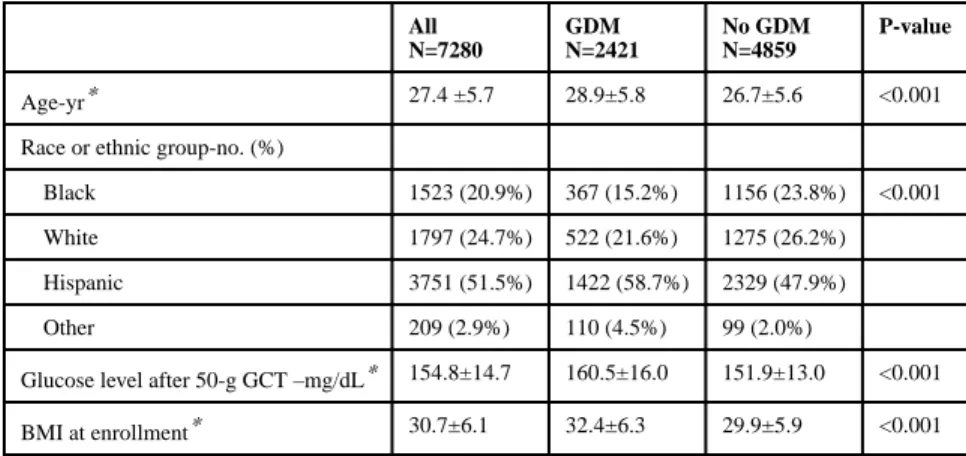
Out of 7298 women who had OGTT (including the 958 diagnosed with mild GDM and randomized5), a total of 7280 women with paired elevated GCT (135-199 mg/dL) and OGTT results screened for the GDM trial constituted our study population. Their baseline characteristics are presented in Table 1. The majority of patients were of Hispanic ethnicity (51.5%); 20.9% were Black and 24.7% non-Hispanic White. The mean age was 27.4 years and mean BMI was 30.7. Mean abnormal GCT result was 154.8 mg/dL. These
characteristics differed significantly between patients with and without GDM.
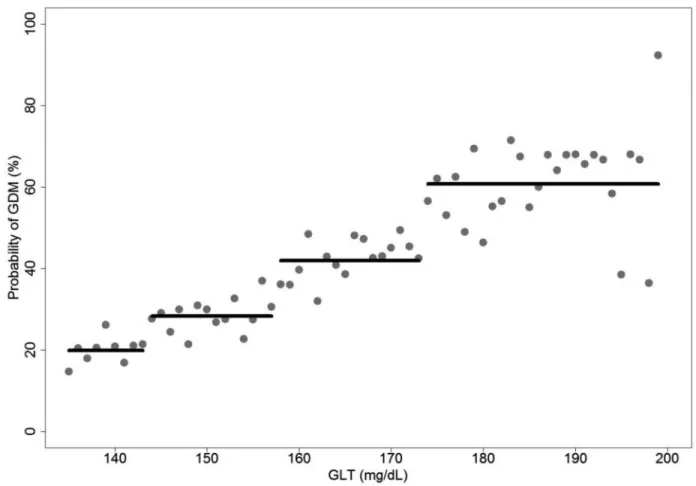
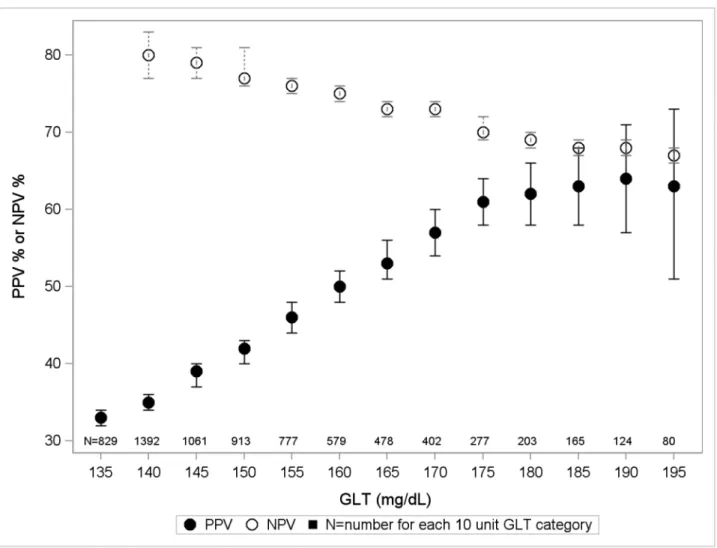
The risk of GDM based on the change-point analysis method is presented in Figure 1. Altogether, 4 different GDM risk-equivalent categories, corresponding to risk escalation at GCT values of 144, 158, and 174 mg/dL, were identified (p<0.05, Bonferroni adjusted). The risk of GDM was 20%, 28%, 42% and 61% for GCT values within risk equivalent categories of 135-143, 144-157, 158-173 and 174-199 mg/dL respectively. In Table 2, the unadjusted and adjusted OR (95% CI) for GDM associated with each risk-equivalent category of GCT relative to the first category (135-143 mg/dL) are given. There is a 1.6 to 6-fold increase in the risk of GDM with increasing GDM risk-equivalent category. The PPV and NPV (and their 95% CI) for escalating screen-positive cut-offs from 135-199 mg/dL are shown in Figure 2. The respective PPV and NPV values range from 35% and 80% for GCT value of 140 to 63% and 67% for GCT of 195 mg/dL. If we used a GCT cut-off of 144 as screen positive among the 7280 patients with GCT 135-199, 1957 (26.9%) with GCT<144 would avoid a GTT. Of 2421 patients with GDM, 389 (16.1%) with GCT<144 will not be diagnosed with GDM.
In additional analyses, we evaluated whether our reported risk-equivalent GCT categories differed by Hispanic or non-Hispanic subgroups. We compared findings for each subgroup to the reported overall risk-equivalent GCT categories. Our findings in the Hispanic subgroup (p= 0.168) and the non-Hispanic subgroup (p= 0.149) did not differ significantly from the overall findings. We also evaluated whether the risk-equivalent GCT categories differed by obesity status (BMI ≥30 at enrollment vs. BMI<30 at enrollment). We compared findings for each subgroup to the reported overall risk-equivalent GCT categories. Our findings in the obese subgroup (p=0.059) and the non-obese subgroup (p=0.693) did not differ significantly from the overall findings.
Comment
Based on a novel application of change-point analysis method, we identified 4
risk-equivalent categories along the range of abnormal GCT values from 135-199 mg/dL. These risk-equivalent GLT categories applied equally to both Hispanic and non-Hispanic
A
uthor Man
uscr
ipt
A
uthor Man
uscr
ipt
A
uthor Man
uscr
ipt
A
uthor Man
uscr
subgroups. The risk or PPV for GDM increased from 20% for GCT category 135-143 mg/dL to 61% for GCT category 174-199 mg/dL. In addition, the PPVs corresponding to 5-unit increments of abnormal GCT values from 135- 195 mg/dL ranged from 33 to 64% only. Therefore, no cut-off abnormal GCT value <199 mg/dL alone appeared sufficient (PPV >90%) for the diagnosis of GDM without an OGTT. The equivalence in GDM risk of GCT values between 135 and 143 mg/dL based on the novel method suggests that a screen positive cut-off as high as 144 rather than the empirical 140 (based on a 5 unit difference alone) should be evaluated as an alternative to 135 mg/dL. At the cut-off of 144, 26.9% of women who currently undergo GTT testing would not need to have the test, and the prevalence of 16.1% of women with a diagnosis of GDM would avoid the diagnosis.
In one study a GCT screen-positive cut-off of 143 mg/dL yielded a sensitivity of 83% and specificity of 87% while a cut-off of 135 mg/dL yielded a sensitivity of 100% and a specificity of 80%. Similar to our study, the probability of GDM for escalating screen-positive cut-offs ranged from 15% in the 135-144 mg/dL group to 50% in the 175-184 mg/dL group. However the probability of GDM was 100% when the GCT was greater than 185 mg/dL a finding that we do not replicate. There were no women diagnosed with GDM in the GCT range of 130-134 mg/dL.16 One study suggested that variation in screen positive thresholds for the GCT based on a woman's risk score for GDM (determined by age, BMI and race) would reduce the number of screening tests and increase the GDM detection rate.17 However this approach is not in common use in the US. Our data from a large contemporary cohort suggests that GCT values <144mg/dL confer GDM risk equivalent to risk associated with a GCT of 135.
Our study has a number of limitations. We did not include patients with GCT results <135 or ≥ 200 mg/dL. This did not allow for an evaluation of continuous GCT in these ranges and limited the calculation of PPV and NPV applicable to the entire screened population. Also, we could not compare our findings to those for the common alternative GCT cut-off of 130 mg/dL for a screen positive cut-off used by some providers. Our findings using a novel statistical application warrant further validation in a larger population. Of note, the study population did not include patients with prior history of gestational diabetes or chronic hypertension, limiting the generalizability to these patients and non-US cohorts with a different racial-ethnic make-up and less obesity.
The strengths of our study include the large number of contemporaneous women with elevation of GCT and the use of novel change-point analysis methodology to predict GDM. Thus these findings are directly applicable to patients with elevated GCT.
There is currently a lack of consensus worldwide regarding whether the one step (2-hour 75 gm OGTT) vs. a two-step (typically a 1-hour 50 gm GCT and 3-hour 100 gm OGTT) strategy for the diagnosis of GDM should be used.13 The American College of Obstetricians and Gynecologists (ACOG) recommends that all pregnant women be screened according to their history, clinical risk factors, or a laboratory screening test, and that laboratory screening and diagnosis may be omitted for low risk women. 11 Further, ACOG recommends the two step approach for those at high risk for GDM. 10,11 There appears to be poor agreement between the two tests and more women are diagnosed with GDM based on the 3-hour
A
uthor Man
uscr
ipt
A
uthor Man
uscr
ipt
A
uthor Man
uscr
ipt
A
uthor Man
uscr
OGTT (12% vs. 5% in one study).18 However, the screen positive rates will vary depending on the threshold value used for the 1-hour GCT and 3-hour GTT. On the strength of large clinical trials and observational studies the OGTT cut-offs based on the 4th International Workshop-Conference are commonly used.2,5,19 Several studies including a randomized trial also suggest that the two step approach involves less cost. 20-22
Overall, our results suggest that given the changes in GDM risk, cut-offs different from the traditional 5-unit increments should be considered for further evaluation of the GCT. Thus, 144 mg/dL instead of 140 may be evaluated as an alternative to 135 mg/dL, for
recommending an OGTT. Furthermore, no single abnormal value <200 mg/dL appears sufficient (without an OGTT) for the diagnosis of GDM. Given the relative linear association between levels of glycemia and adverse pregnancy outcomes, impact on pregnancy outcomes is also an important dimension to be considered in setting screen-positive thresholds.4,23 Data from a separate analysis of a sample of our study cohort with pregnancy outcomes suggest that GCT values of 140 or greater but not 135-139 mg/dL are associated with adverse pregnancy outcomes.24 Therefore, considered together, GCT screen-positive cut-offs higher than 135 mg/dL, and as high as 143 mg/dL appear to be appropriate.
Acknowledgments
The project described was supported by grants from the Eunice Kennedy Shriver National Institute of Child Health and Human Development (NICHD) [HD27915, HD34116, HD40485, HD34208, HD27869, HD40500, HD40560, HD34136, HD40544, HD27860, HD40545, HD53097, HD21410, HD27917, HD40512, HD53118, HD36801], General Clinical Research Centers Grant [M01-RR00034] and the National Center for Research Resources [UL1-RR024989, M01-RR00080, UL1-RR025764, C06-RR11234] and does not necessarily represent the official views of the NICHD or NIH.
The authors would like to thank Dana Figueroa. for contributing to study design and manuscript development; Francee Johnson, R.N., Joanne Tillinghast, R.N., and Susan Tolivaisa for coordination between clinical research centers; Elizabeth Thom, Ph.D., for study design, data management, statistical analysis, and manuscript
development; Lisa Mele, Sc.M., for statistical analysis; and Catherine Y. Spong, M.D. for protocol development and oversight.
References
1. Jovanovic L, Pettitt DJ. Gestational diabetes mellitus. JAMA. 2001; 286:2516–8. [PubMed: 11722247]
2. Metzger BE, Coustan DR. Summary and Recommendations of the Fourth International Workshop-Conference on Gestational Diabetes Mellitus. Diabetes Care. 1998 Aug; 21(Suppl 2):B161–7. [PubMed: 9704245]
3. Langer O, Yogev Y, Most O, Yexakis EMJ. Gestational diabetes: the consequences of not treating. AM J Obstet Gynecol. 2005; 192:989–97. [PubMed: 15846171]
4. The HAPO Study Cooperative Research Group. Hyperglycemia and adverse pregnancy outcomes. N Engl J Med. 2008; 358:1991–2002. [PubMed: 18463375]
5. Landon MB, Spong CY, Thom E, Carpenter MW, Ramin SM, Casey B, et al. A multicenter, randomized trial of treatment for mild gestational diabetes. N Engl J Med. 2009; 361:1339–48. [PubMed: 19797280]
6. Brody SE, Harris R, Lohr K. Screening for Gestational Diabetes: A Summary of the Evidence for the U.S. Preventive Services Task Force. Obstet Gynecol. 2003 Feb.101:380–92. [PubMed: 12576264]
7. Tuffnell, DJ., West, J., Walkinshaw, SA. Jn: The Cochrane Library. Chichester, UK: John Wiley & Sons Ltd; 2005. Treatments for gestational diabetes and impaired glucose tolerance in pregnancy (Cochrane Review).
A
uthor Man
uscr
ipt
A
uthor Man
uscr
ipt
A
uthor Man
uscr
ipt
A
uthor Man
uscr
8. International Association of Diabetes and Pregnancy Study Groups Consensus Panel. International Association of Diabetes and Pregnancy Study Groups Recommendations on the Diagnosis and Classification of Hyperglycemia in Pregnancy. Diabetes Care. 2010; 33:676–682. [PubMed: 20190296]
9. American Diabetes Association. Diagnosis and Classification of Diabetes Mellitus. Diabetes Care. 2011; 34(Suppl 1):S62–S69. [PubMed: 21193628]
10. American Diabetes Association. Diagnosis and Classification of Diabetes Mellitus. Diabetes Care. 2010; 33(Suppl 1):S62–69. [PubMed: 20042775]
11. American College of Obstetricians and Gynecologists (ACOG). Practice bulletin no. 137: gestational diabetes mellitus. Obstet Gynecol. 2013; 122(2 Pt 1):406–16. [PubMed: 23969827] 12. Dodd JM, Crowther CA, Antoniou G, Baghurst P, Robinson JS. Screening for gestational diabetes:
The effect of varying blood glucose definitions in the prediction of adverse maternal and infant health outcomes. Aust N Z J Obstet Gynaecol. 2007 Aug.47:307–12. [PubMed: 17627686] 13. Leary J, Pettit DJ, Jovanovic L. Gestational diabetes guidelines in a HAPO world. Best Prac Res
Clin Endocrinol Met. 2010 Aug.24:673–85.
14. Bobrowski RA, Bottoms SF, Micallef JA, Dombrowski MP. Is the 50-gram glucose screening test ever diagnostic? J Matern Fetal Med. 1996 Nov-Dec;5:317–20. [PubMed: 8972407]
15. Lai Y. On the adaptive partition approach to the detection of multiple change-points. PLoS ONE. 2011; 6(5):e19754. [PubMed: 21629694]
16. Carpenter M, Coustan D. Criteria for screening tests for gestational diabetes. Am J Obstet Gynecol. 1982 Dec.144:768–773. [PubMed: 7148898]
17. Naylor CD, Sermer M, Chen E, Farine D. Selective screening for gestational diabetes mellitus. Toronto Trihospital Gestational Diabetes Project Investigators. N Engl J Med. 1997 Nov 27; 337(22):1591–6. [PubMed: 9371855]
18. Mello G, Elena P, Ognibene A, Cioni R, Tondi F, Pezzati P, Pratesi M, Scarselli G, Messier G. Lack of concordance between the 75-g and 100-g glucose load tests for the diagnosis of gestational diabetes mellitus. Clin Chem. 2006 Sep.52:1633–4. [PubMed: 16940459] 19. Langer O, Conway DL, Berkus M, Xenakis EMJ, Gonzalez O. A comparison of glyburide and
insulin in women with gestational diabetes mellitus. N Engl J Med. 2000; 343:1134–38. [PubMed: 11036118]
20. Meltzer SJ, Snyder J, Penrod JR, Nudi M, Morin L. Gestational diabetes mellitus screening and diagnosis: a prospective randomized controlled trial comparing costs of one-step and two-step methods. BJOG. 2010; 117:407–415. [PubMed: 20105163]
21. Lavin JP Fr, Lavin PB, O'Donnell N. A comparison of costs associated with screening for gestational diabetes with two-tiered and one-tiered testing protocols. Am J Obstet Gynecol. 2001; 184:363–367. [PubMed: 11228488]
22. Nicholson WK, Fleisher LA, Fox HE, Powe NR. Screening for gestational diabetes: a decision and cost-effectiveness analysis of four screening strategies. Diabetes Care. 2005; 28:1482–1484. [PubMed: 15920072]
23. Landon MB, Mele L, Spong CY, Carpenter MW, Ramin SM, Casey B, et al. The relationship between maternal glycemia and perinatal outcome. Obstet Gynecol. 2011; 117:218–224. [PubMed: 21309194]
24. Figueroa D, Landon MB, Lai Y, Spong CY, Carpenter MW, et al. Relationship between the 1-hour glucose challenge test results and perinatal outcomes. Obstet Gynecol. 2013 Jun; 121(6):1241–7. [PubMed: 23812458]
A
uthor Man
uscr
ipt
A
uthor Man
uscr
ipt
A
uthor Man
uscr
ipt
A
uthor Man
uscr
Figure 1. Risk Equivalent Categories for the Probability of GDM Versus GCT Value
A change-point analysis method compared the outcome rates of GDM for adjacent GCT values. It identified 4 stepwise categories of increasing outcome rate for GDM. The values within each category carry a statistically equivalent risk for GDM. The black horizontal lines represent these 4 identified categories. The gray dots represent point-wise estimated
probabilities of GDM for GCT values.
A
uthor Man
uscr
ipt
A
uthor Man
uscr
ipt
A
uthor Man
uscr
ipt
A
uthor Man
uscr
Figure 2. The PPV and NPV for escalating GCT screen-positive cut-offs from 135-199 mg/dl
The 95% CI are also depicted around the PPV and NPV values.
A
uthor Man
uscr
ipt
A
uthor Man
uscr
ipt
A
uthor Man
uscr
ipt
A
uthor Man
uscr
A
uthor Man
uscr
ipt
A
uthor Man
uscr
ipt
A
uthor Man
uscr
ipt
A
uthor Man
uscr
ipt
Table 1
Characteristics of the study population
All N=7280
GDM N=2421
No GDM N=4859
P-value
Age-yr* 27.4 ±5.7 28.9±5.8 26.7±5.6 <0.001
Race or ethnic group-no. (%)
Black 1523 (20.9%) 367 (15.2%) 1156 (23.8%) <0.001
White 1797 (24.7%) 522 (21.6%) 1275 (26.2%)
Hispanic 3751 (51.5%) 1422 (58.7%) 2329 (47.9%)
Other 209 (2.9%) 110 (4.5%) 99 (2.0%)
Glucose level after 50-g GCT –mg/dL* 154.8±14.7 160.5±16.0 151.9±13.0 <0.001
BMI at enrollment* 30.7±6.1 32.4±6.3 29.9±5.9 <0.001
*
A
uthor Man
uscr
ipt
A
uthor Man
uscr
ipt
A
uthor Man
uscr
ipt
A
uthor Man
uscr
ipt
Table 2
Odds ratios for mild GDM by escalating GCT category with 135-143 mg/dL as the referent
GCT Category Unadjusted OR (95% CI) Adjusted OR (95% CI)*
135-143 mg/dL (n=1957)
Referent Referent
144-157 mg/dL (n=2729)
1.59 (1.38-1.82) 1.50 (1.29-1.74)
158-173 mg/dL (n=1676)
2.91 (2.51-3.38) 2.82 (2.41-3.31)
174-199 mg/dL (n=918)
6.25 (5.26-7.43) 5.79 (4.79-6.99)
*