May 2015
Disuniformity
Jason Rantanen
Lee Petherbridge Ph.D.
Follow this and additional works at:http://scholarship.law.ufl.edu/flr Part of theIntellectual Property Commons
This Article is brought to you for free and open access by UF Law Scholarship Repository. It has been accepted for inclusion in Florida Law Review by an authorized administrator of UF Law Scholarship Repository. For more information, please [email protected].
Recommended Citation
Jason Rantanen and Lee Petherbridge, Ph.D.*
Abstract
The United States Court of Appeals for the Federal Circuit is a response to a failure in judicial administration that produced a fractured, unworkable patent law—one that Congress concluded ill-served entrepreneurship and innovation. The purpose of the response—vesting exclusive jurisdiction for patent appeals in the Federal Circuit—was to permit that court to develop patent law in the direction of greater clarity and uniformity. Both at the time of the Federal Circuit’s creation and again more recently, scholars, judges, and practitioners have waged great debates over whether patent law uniformity furthers the ultimate goals of entrepreneurship and innovation. These debates have rested on a largely untested empirical proposition: That the Federal Circuit’s patent law jurisprudence embodies a move towards doctrinal uniformity. This Article reports an empirical study that examines patent law uniformity through the measure of open decisional disagreement between Federal Circuit judges. Its central empirical observation is a remarkable increase in decisional disagreement—indicative of a decline in doctrinal uniformity—among Federal Circuit judges over the past several years. This Article raises and discusses several possible explanations for its surprising observations, including, inter alia, the Supreme Court’s influence and personnel changes at the Federal Circuit. It also considers what the observations and explanations might contribute to a current debate over the merits of Congress’s decision to unify patent jurisdiction in the Federal Circuit.
INTRODUCTION ... 2008
I. STUDY DESIGN AND METHODS ... 2017
II. THE RECENT MOVE TOWARDS DISUNIFORMITY
AT THE FEDERAL CIRCUIT ... 2019
III. WHY MIGHT FEDERAL CIRCUIT OPINIONS
EVIDENCE GREATER JUDICIAL DISAGREEMENT? ... 2025
A. The Doctrinal Role of the Supreme Court ... 2025
B. The Signaling Role of the Supreme Court ... 2029
C. There is Something Going on at the Federal Circuit ... 2031
1. The Role of New Federal Circuit Judges ... 2032
2. A Role for Senior Judges ... 2034
3. A Decline in Judicial Collegiality ... 2037
4. A Shift in Appellate Philosophy ... 2039
IV. WHAT ABOUT UNIFORMITY? ... 2040
A. The Undoing of Congress’s Intent ... 2040
B. Uniformity and Subject Matter-Bound Courts? ... 2041
CONCLUSION ... 2042
INTRODUCTION
Over thirty years ago, through the vehicle of the Federal Courts Improvement Act of 1982, Congress established the United States Court of Appeals for the Federal Circuit.1 Congress granted the court a broad swath of subject matter jurisdiction,2 but the court is perhaps most famous for its exclusive jurisdiction over patent appeals whether arising from decisions of the U.S. District Courts, the Court of Federal Claims, the International Trade Commission, or the U.S. Patent and Trademark Office.3
When it comes to patent law, Congress’s goal for the court is not seriously disputed. In the time leading up to the creation of the Federal Circuit, the United States faced “economic recession, high unemployment,
1. Pub. L. No. 97-164, 96 Stat. 25 (codified as amended in scattered sections of 28 U.S.C. (2012)).
2. 28 U.S.C. § 1295 (2012) (providing the court with jurisdiction over final decisions of the United States Court of International Trade, final determinations of the United States International Trade Commission, final decisions of the Merit Systems Protection Board, and final decisions of agency boards of contract appeals). In addition to § 1295, Congress provided the court with jurisdiction over appeals involving, inter alia, patents and trademark registration. Id. § 1338. Congress also included tax refund claims, “any other civil action or claim against the United States, not exceeding $10,000 in amount, founded either upon the Constitution, or any Act of Congress, or any regulation of an executive department, or upon any express or implied contract with the United States” and takings claims in the Federal Circuit’s jurisdiction. Id. § 1346. Accord S.REP.NO.
97-275, at 4 (1981) (“[T]he Court of Appeals for the Federal Circuit provides such a forum for appeals from throughout the country in areas of the law where Congress determines that there is special need for national uniformity.”); id. at 6 (“The Court of Appeals for the Federal Circuit will not be a ‘specialized court,’ as that term is normally used. The court’s jurisdiction will not be limited to one type of case, or even to two or three types of cases. Rather, it will have a varied docket spanning a broad range of legal issues and types of cases.”).
mass layoffs of scientists and engineers, and extreme inflation.”4 Such
economic conditions encouraged the federal government to consider what might be done to improve matters, and a Carter administration “Domestic Policy Review” indicated that one policy approach to relieving the nation’s economic “malaise” was to encourage innovation.5
When considering the impact of patent law (one of many policy tools available to influence innovation), Congress was confronted with reports indicating that the legal infrastructure of the patent system was in disarray. Various reports, and testimony, for example, showed that patent law varied dramatically depending upon the courtroom and circuit in which parties found themselves.6 Other information demonstrated that the patent office was “‘freelancing’ with respect to the standards of patentability,” thereby encouraging a divergence between the legal frameworks applied by the patent office and the courts to central questions of patent law.7 The picture that emerged was one of an awkward legal infrastructure. The patent office and its reviewing court, the Court of Customs and Patent Appeals, developed and applied standards of patentability to decide whether patents should validly issue, and the regional circuit courts developed and applied their own different standards to determine whether a given patent had validly issued.8 Congress, moreover, was informed that the Supreme Court rarely stepped in to resolve inconsistencies in patent law, and might not be well equipped to do so even if it were so inclined.9
4. Pauline Newman, The Federal Circuit in Perspective, 54AM.U.L.REV.821, 822 (2005).
5. Marion T. Bennett, The United States Court of Appeals for the Federal Circuit—Origins,
in THE UNITED STATES COURT OF APPEALS FOR THE FEDERAL CIRCUIT:AHISTORY 1982–1990 1, 8
(1991).
6. See Charles W. Adams, The Court of Appeals for the Federal Circuit: More Than a National Patent Court, 49MO.L.REV.43, 55–57 (1984) (noting regional circuit variability in
standards for patentability);Rochelle Cooper Dreyfuss, The Federal Circuit: A Case Study in Specialized Courts, 64N.Y.U.L.REV.1, 7 (1989) (noting that patents were “twice as likely to be
held valid and infringed in the Fifth Circuit than in the Seventh Circuit, and almost four times more likely to be enforced in the Seventh Circuit than in the Second Circuit”); see, e.g., S.REP.NO.
97-275, at 5 (reporting that “patent law [i]s an area in which the application of the law to the facts of a case often produces different outcomes in different courtrooms in substantially similar cases”).
7. R. Polk Wagner & Lee Petherbridge, Is the Federal Circuit Succeeding?: An Empirical Assessment of Judicial Performance, 152U.PA.L.REV.1105, 1115 (2004).
8. See Dreyfuss, supra note 6, at 6 (explaining that the PTO was free to develop its own standards for patentability, but could not impose those standards on Article III federal courts). 9. See S.REP.NO. 97-275, at 3 (“The Supreme Court now appears to be operating at—or
Legislators were told that the resulting lack of uniformity in patent law harmed innovation because it enhanced uncertainty about how the law would treat the outputs of investment in technological entrepreneurship. If uncertainty in the patent system could be lessened, it was argued, investment returns would be more predictable and innovation would increase.10
Thus, Congress’s goal for the Federal Circuit and patent law is founded on a consistent and unambiguous11 line of reasoning: Vesting exclusive
jurisdiction for patent appeals in the Federal Circuit12 will permit that court to develop patent law in the direction of greater clarity, uniformity, and predictability in application.
It is thus somewhat surprising that a survey of the academic literature indicates that relatively little attention13 has been paid to the question of whether the Federal Circuit has succeeded in making patent law more
10. See S.REP.NO. 97-275, at 6 (reporting testimony that stability in patent law has an effect on innovation and that reducing uncertainty is important to business decision making).
11. It is not only context that informs this interpretation. The legislative history is full of statements expressing Congress’s intentions with respect to the court. See id. at 5 (1981), reprinted in 1982 U.S.C.C.A.N. at 15 (“[T]he Federal Circuit . . . provides a forum that will increase doctrinal stability in the field of patent law.”); id. at 2 (1981), reprinted in 1982 U.S.C.C.A.N. at 11–12 (stating that one purpose of the Federal Courts Improvement Act of 1982 is “to improve the administration of the patent law by centralizing appeals in patent cases”); see id. at 6 (1981),
reprinted in 1982 U.S.C.C.A.N. at 16 (stating a desire for doctrinal uniformity and stability in patent law).
12. Seeid. at 7 (“Decisions of this court will have precedential effect throughout the country . . . .”). Butsee Holmes Grp., Inc. v. Vornado Air Circulation Sys., Inc., 535 U.S. 826, 834 (2002) (returning jurisdiction over a subset of claims to the regional circuits), superseded by statute, Leahy-Smith America Invents Act, Pub. L. No. 112-29, § 19(b), 125 Stat. 284 (2011) (codified at 28 U.S.C. § 1295(a)(4) (2012)). The legislative history of Public Law No. 112-29 reiterated Congress’s original goal in creating the Federal Circuit. H.R.REP.NO. 109-407, at 5 (2006). In an
early draft of the language that would become section 19(b), the House Judiciary Committee remarked that it “believes Holmes Group contravened the will of Congress when it created the Federal Circuit,” adding that “the Committee is concerned that the decision will lead to an erosion in the uniformity or coherence in patent law that has been steadily building since the Circuit’s creation in 1982.” Id.
13. There has been a small flourishing of literature recently mirroring somewhat the debates surrounding the creation of the Federal Circuit and the weaknesses of uniformity. See Craig Allen Nard & John F. Duffy, Rethinking Patent Law’s Uniformity Principle, 101NW.U.L.REV.1619,
1621 (2007); Lee Petherbridge, Patent Law Uniformity?, 22HARV.J.L.&TECH.421,455–57
(2009); see also Paul R. Gugliuzza, Rethinking Federal Circuit Jurisdiction, 100 GEO.L.J. 1437, 1465 (2012) (discussing the Federal Circuits jurisdiction over non-patent cases and how this may prevent the court from developing expertise and thus consistency in its application of patent law); Diane P. Wood, Keynote Address: Is It Time to Abolish the Federal Circuit’s Exclusive Jurisdiction in Patent Cases?, 13CHI.-KENT J.INTELL.PROP.1,1–2 (2014) (critiquing the need for a specialized
uniform.14 The best available evidence on the question comes from a small
number of comprehensive empirical studies that address some fairly ubiquitous patent doctrines. This evidence indicates that some central areas of patent law still lack doctrinal uniformity.15
Another line of evidence that might point in the same direction—the direction of incomplete uniformity—comes from a number of reversal (of district court judgments) rate studies.16 These studies are of very
14. To be clear, by “uniformity,” we are referring to the straightforward idea that, as cases are the law, the law is not uniform when judges divide over how they come out. This situation is further amplified when, as is typical, judges can actually marshal cases to support competing views of what the law is. On this point, a few commentators on an earlier draft suggested a more detailed unpacking of the different conceptions that might embody uniformity. For purposes of this study, however, we do not see an attempt to parse out concepts such as indeterminacy, predictability, precision etc. as particularly helpful in explaining our findings or hypotheses given that in practice, all of these concepts tend to be correlated with one another.
15. The claim construction doctrine addresses the interpretation of language that defines a patent’s scope. See Wagner & Petherbridge, supra note 7, at 1163 (finding evidence of competing jurisprudential approaches to claim construction questions); R. Polk Wagner & Lee Petherbridge,
Did Phillips Change Anything? Empirical Analysis of the Federal Circuit's Claim Construction Jurisprudence, in INTELLECTUAL PROPERTY AND THE COMMON LAW 134–35, 137–38, 148
(Shyamkrishna Balganesh ed., 2013) (showing that the different jurisprudential approaches to claim construction questions continue to persist after Phillips v. AWH Corp., 415 F.3d 1303 (Fed. Cir. 2005) (en banc), an opinion that addresses the doctrinal divide in the Federal Circuit’s approach to claim construction issues). The doctrine of equivalents “determines whether an accused infringer’s conduct, while not infringing the letter of a patent, may still be enjoined because it is close enough to the letter of a patent.” Petherbridge, supra note 13, at 432, 457 (showing evidence consistent with judge diversity in the application of the doctrine of equivalents). The inequitable conduct doctrine, is designed to punish patent applicants who engage in inequitable behavior towards the public while acquiring a patent. See Lee Petherbridge, et al., The Federal Circuit and Inequitable Conduct: An Empirical Assessment, 84 S.CAL.L.REV. 1293, 1349 (2011) (showing evidence that
Federal Circuit judges may be applying stricter standards to inequitable conduct determinations than the lower courts they are reviewing).
16. See, e.g., J. Jonas Anderson & Peter S. Menell, Informal Deference: A Historical, Empirical, and Normative Analysis of Patent Claim Construction, 108 NW.U.L.REV.1, 76–77
(2014) (arguing that although the Federal Circuit’s reversal rate of claim terms decreased between 2004 and 2011, the de novo standard of review applied to such cases ought to be narrowed to a clearly erroneous standard in order to lead to more predictable results and more meaningful trial court proceedings); Christian A. Chu, Empirical Analysis of the Federal Circuit’s Claim Construction Trends, 16BERKELEY TECH.L.J.1075,1143 (2001) (finding “there is a trend showing
an increase in claim construction modifications and claim interpretation-based reversals” by the Federal Circuit since 1998); Christopher A. Cotropia, Determining Uniformity Within the Federal Circuit by Measuring Dissent and En Banc Review, 43LOY. L.A.L. REV.801, 825 (2010) (concluding that “the Federal Circuit . . . lacks uniformity in its thought on legal issues [and] fails to use the en banc review process to resolve these disagreements” (emphasis added)); Kimberly A. Moore, Are District Court Judges Equipped to Resolve Patent Cases?, 15HARV.J.L.&TECH.1,38
questionable usefulness, however, and it might not even be right to interpret them as evidence concerning doctrinal uniformity. But because we think such an interpretation might be suggested, at least when reversal rate studies are taken in view of the comprehensive empirical studies mentioned above, we give them some attention here.
Reversal rate studies have typically focused on just one patent law doctrine, claim construction, and are usually interpreted as evidence of relatively high reversal rates.17 If the reversal rates reported by these
studies are in fact “high,”—and it has never been properly shown that they are—that could be consistent with a lack of doctrinal uniformity. The main problem with interpreting reversal rate studies in the context of the question of doctrinal uniformity is that the observed reversal rates might have been observed even if the relevant doctrine were fairly uniform. An underlying reason for this problem is a statistical error known as “selection bias” that occurs when the sample chosen for observation is biased somehow. Studies counting outcomes like “reversed” or “vacated” are usually thought especially vulnerable to one type of selection bias, selection for close cases, because if one assumes the legal process is working efficiently, cases that reach a written judgment and written decision on appeal might also be cases that present the closest questions under the law. 18 They might therefore be expected to distribute fairly evenly (or otherwise depending on a number of factors) between reversals and affirmances. If efficiency factors encourage the selection of close cases, reversal rate studies in isolation become difficult, if not impenetrable, to interpret as meaningful to the issue of doctrinal uniformity. A reversal rate of 50%, for example, might be found whether or not a doctrine is uniform as long as the doctrine—again, whether uniform or not—allows for some cases with outcomes that are difficult to predict.19
Keeping this concern in mind, the comprehensive empirical studies mentioned earlier are less vulnerable than reversal rate studies (although not immune) to the effects of selection bias because they look directly at the content of the jurisprudence or look at the judge-dependency of
that the best interpretation of currently available data is “that the claim construction reversal rate is unduly high and has generally been increasing in the last fifteen years”).
17. See, e.g., Schwartz, supra note 16, at 1106 (discussing an article that finds reversal rates for claim constructions cases as the highest among all appealed patent law issues); Wagner & Petherbridge, supra note 7, at 1127 (noting two separate studies that found reversal rates of up to 50% for claim construction jurisprudence).
18. See, e.g., Schwartz, supra note 16, at 1101 (noting that “parties will settle all but the closest cases”).
decisions. Since some of those comprehensive studies demonstrate that the law of claim construction still lacks doctrinal uniformity,20 one might expect that some component of the reversal rates observed in studies looking at the Federal Circuit’s treatment of district court claim constructions is a consequence of poor doctrinal uniformity as opposed to selection bias.21 Reversal rate studies, on this interpretation, become plausibly relevant to the question of doctrinal uniformity.
Unfortunately, for the purposes of easy analysis, another view of selection bias complicates22 this interpretation. Under this alternative view, high-appearing reversal rates for specific doctrinal issues might be more likely to occur in the context of settled doctrine.The insight here is that appellants are likely to direct an appeal toward those specific issues upon which the district court clearly erred—i.e., judgments that are inconsistent with established doctrine—rather than those that present closely contested questions of law. Similarly, appellants are unlikely to appeal those issues on which the district court ruled in a manner consistent with established doctrine because there is a relatively low likelihood that they will prevail. This leads to a somewhat counterintuitive correlation between doctrinal uniformity and reversal rates: as doctrinal stability increases at the Federal Circuit, one could expect a higher and higher rate of reversal for issues involving settled doctrine as appellants shift their focus to other issues to argue on appeal, except in circumstances in which the district court clearly got it “wrong.”
If this second view is correct, or, perhaps operates at the same time as the more consensus interpretation of selection basis set forth earlier, the meaning of reversal rate studies to the question of doctrinal uniformity becomes further muddled. Evidence from reversal rate studies is still plausibly relevant to the question of doctrinal uniformity, but on the second view, if reversal rate studies have, in fact, been observing “high” reversal rates it suggests uniformity in claim construction doctrine, placing the second view at odds with the evidence of the earlier mentioned empirical studies that have directly observed a lack of uniformity in the law of claim construction. As one attempts to resolve the conflict between evidence and theory, one might plausibly conclude, counter to conventional wisdom, that
20. Seesupra note 15.
21. See Wagner & Petherbridge, supra note 7, at 1144–45 (showing that district court judgments exhibiting one doctrinal approach were often reversed by Federal Circuit panels taking a different doctrinal approach). Further, if uniformity were present, at a minimum, some of those cases studied would not have needed appeal.
22. Specifically, the view that selection bias for close calls does not necessarily apply to individual issues in disputes, but rather there may be other factors driving selection of issues. See
the reversal rates observed by reversal rate studies are not “high,” rather they may be too “low” for a uniform doctrine. This view of claim construction reversal rates has never been disproven and might turn out to be correct, although the idea that claim construction reversal rates are too low is presently a minority perspective. Our purpose here, of course, is not to resolve theoretical issues about selection bias and claim construction reversal rates; the point to be made is that it is very difficult to understand how, in isolation, the evidence available from reversal rate studies applies to the question of doctrinal uniformity. Indeed, it is quite possible that observations of reversal rates might be unable to reveal anything of significance about doctrinal uniformity.
Beyond the evidence that comes from research, legal scholars23 and practitioners24 have also occasionally offered their subjective opinions on the question using more traditional approaches to reporting. These writings have tended toward the view that the Federal Circuit has improved the uniformity of the patent law, although they sometimes express displeasure with the content of the doctrine that has developed.25
An important measure of doctrinal uniformity not yet mentioned is the extent to which judges disagree openly, viz. through separate writings in judicial opinions, about the content of the law. Judicial disagreement over
23. See, e.g., Rochelle C. Dreyfuss, Percolation,Uniformity, and Coherent Adjudication: The Federal Circuit Experience, 66 SMU L. REV. 505, 539–40 (2013) [hereinafter Dreyfuss,
Percolation] (“[T]wo courts, hierarchically related, do not create the kind of interchange that is necessary to produce optimal law.”); Rochelle Cooper Dreyfuss, The Federal Circuit as an Institution: What Ought We to Expect?, 43LOY.L.A.L.REV.827,833 (2010) [hereinafter Dreyfuss,
What Ought We Expect] (“At the end of the day, it is impossible to know from the data presented whether the judges are generating a healthy number of diverse approaches to important new questions in patent law or are simply being stubborn.”); Rochelle Cooper Dreyfuss, In Search of Institutional Identity: The Federal Circuit Comes of Age, 23 BERKELEY TECH.L.J. 787, 827–28
(2008) [hereinafter Dreyfuss, In Search of] (noting that the Federal Circuit “has done less well in using its expertise to keep patent law responsive to changing technological facts and emerging national interests”); Rochelle Cooper Dreyfuss, The Federal Circuit: A Continuing Experiment in Specialization, 54 CASE W.RES.L.REV. 769, 800–01 (2004) [hereinafter Dreyfuss, A Continuing Experiment] (concluding that though the Federal Circuit has dramatically improved the patent system, that there is still room for improvement in its operation). See generally Dreyfuss, supra note 6 (discussing the benefits and drawbacks of specialized courts, as well as its effect on formulating a uniform system of law).
24. See, e.g., Donald R. Dunner, The U.S. Court of Appeals for the Federal Circuit: Its Critical Role in the Revitalization of U.S. Patent Jurisprudence, Past, Present, and Future, 43LOY.
L.A.L.REV.775,782–83 (2010) (“The bottom line at the conclusion of the first quarter century of the court’s existence is that the court has more than delighted its early proponents and surprised its opponents with its high level of performance.”); Dreyfuss, A Continuing Experiment, supra note 23, at 770–72 (reporting practitioner views).
the content of the law measures uniformity in both a symptomatic and a causative fashion. Judicial disagreement is symptomatic of a lack of uniformity because doctrinal variation permits and encourages judges to read the law differently. Judicial disagreement is also causative of a lack of uniformity because competing views about the content of the law leads to competing precedents. These precedents can become crystallized, leading to different flavors, standards, and sometimes even different rules within the same legal doctrine.
Perhaps the most objective (and one of the most traditionally accepted) way to measure judicial disagreement over the content of the law is to measure separate writings. Measuring judicial disagreement over the content of the law through separate writings can be imperfect depending on one’s point of view. The main problem is that a judge might occasionally author a separate writing even if the judge agrees with the majority’s decision concerning the judgment under review. For example, a judge may write a concurring opinion because he or she finds dispositive an issue the majority does not (a procedural one perhaps), and might at least be said to agree with the majority’s articulation of the law about the issue the majority finds dispositive.26 One the other hand, as noted above, whether this example is properly categorized as representing no disagreement about the content of the law depends on one’s point of view about what the law is. It might alternatively be said that the majority misapplied the law that the concurring judge is highlighting, and so the concurring opinion does reflect a difference in views about the content of the law. In any event, these sorts of cases do not seem that common and so represent a relatively small amount of separate opinion writings.
The more common examples are easier to acceptably categorize as reflecting judicial disagreements about the content of the law. Dissents, for example, tend to indicate a view that the majority misunderstood the law as it applies to the judgment under review, and most concurrences also take issue with a majority’s articulation and application of the law to a judgment. In these scenarios, such separate writings fairly serve as a measure of the extent to which judges disagree about the content of the law.
Surprisingly (particularly in light of the degree to which uniformity is so central to debates about the Federal Circuit), the extent to which judges openly disagree—that is, show disagreement through separate writings— about substantive issues of the patent law has been relatively unexplored. Of the few studies reporting information about Federal Circuit judicial
disagreement, perhaps the most significant are from Lefstin, who studied dissents at the Federal Circuit from 1983–2005, and Cotropia, who compared the Federal Circuit to a selected set of regional circuits on the measures of dissents and en banc reviews.27 Lefstin found patent litigation before the district courts to be “significantly more indeterminate than most other categories of cases reviewed by the Federal Circuit.”28 He also observed that while the rate of dissent at the Federal Circuit in appeals arising from district courts ranged from 1.41% to 13.27%, with an average of 7.35%,29 the rate seemed to be experiencing a heightened level towards the end of his study (2002–2005), leading him to call for further investigation.30 Cotropia found that for the period from 1998–2009, Federal Circuit judges on average tended to dissent in appeals generally about as much or more often than their counterparts in other circuits and dissented significantly more often when appeals involved patent law.31
In sum, the comprehensive empirical studies mentioned above that directly examine written doctrine and judicial dependency provide what is, presently, probably the best evidence concerning doctrinal uniformity. But while these studies do address commonly confronted doctrines, and so are quite informative, they do not address all aspects of patent law. This leaves open the possibility that uniformity has been approached in other areas and that perhaps a broader doctrinal assessment would paint a picture of generally improved uniformity. Reversal rate studies, when viewed through the lens of the empirical studies examining doctrine and judicial dependency, might be suggestive of poor uniformity in at least one doctrinal area (claim construction), but represent an even narrower sample of the patent law than the doctrinal empirical studies. Moreover, as we have just explained above, reversal rate studies might be meaningless to the question of patent law doctrinal uniformity depending on how they are affected by selection bias, a question that presently lacks a consensus
27. Jeffry A. Lefstin, The Measure of the Doubt: Dissent, Indeterminancy, and Interpretation at the Federal Circuit, 58 HASTINGS L.J. 1025, 1027, 1054 (2007); Cotropia, supra note 16, at 801;
see also Petherbridge, supra note 13, at 456 (collecting rates of separate writings (concurrences and dissents) in Federal Circuit written opinions); Dennis Crouch, Dissenting in Patent Cases, PATENTLYO.COM (Feb. 11, 2011),
http://www.patentlyo.com/patent/2011/02/dissenting-in-patent-cases.html (collecting statistics on dissents in three-member-panel patent opinions with Westlaw Headnotes released since January 1, 2000).
28. Lefstin, supra note 27, at 1089. 29. Id. at 1056.
30. Id. at 1090 (“Further study—perhaps investigating the influence of changes in court personnel—would be necessary before crediting legal or structural factors for the current era of dissent.”).
answer.
Studies concerning open judicial disagreement offer researchers a relatively unexplored perspective from which to observe doctrinal uniformity. Lefstin’s and Cotropia’s studies represent a solid starting point, but leave unanswered questions about the dynamics and mechanisms of doctrinal uniformity. This Article addresses both these questions.
This Article reports an empirical study that examines patent law uniformity through the measure of open decisional disagreement between Federal Circuit judges. It is important to point out that our purpose here is mainly descriptive, that is, we aim to observe and describe Federal Circuit behaviors that relate to Congress’s fundamental goals for the institution. The central empirical observation is a remarkable increase in decisional disagreement among Federal Circuit judges over the past several years, an observation we interpret as likely to reflect a decrease in doctrinal uniformity. While this Article does not attempt to make any airtight causative claims, it does discuss possible mechanisms that might explain the observations, and, in some instances, relates them to broader ideas about patent law uniformity and judicial decision-making.
What follows proceeds in three parts. Part I describes the study design and methodology. Part II presents the data and considers possible explanations for the observations. Part III considers what the observations might contribute to a current debate over the merits of Congress’s decision to unify patent jurisdiction in the Federal Circuit.
I. STUDY DESIGN AND METHODS
In order to examine the rate of agreement among Federal Circuit judges, all Federal Circuit written opinions and Rule 36 dispositions (which have no written opinion)32 in appeals arising from the district courts for a period
spanning October 13, 2004 to December 31, 2013 were collected from the
32. Under Federal Circuit Rule 36:
The court may enter a judgment of affirmance without opinion, citing this rule, when it determines that any of the following conditions exist and an opinion would have no precedential value:
(a) the judgment, decision, or order of the trial court appealed from is based on findings that are not clearly erroneous;
(b) the evidence supporting the jury’s verdict is sufficient;
(c) the record supports summary judgment, directed verdict, or judgment on the pleadings;
(d) the decision of an administrative agency warrants affirmance under the standard of review in the statute authorizing the petition for review; or (e) a judgment or decision has been entered without an error of law.
FED.CIR.R. 36, available at http://www.cafc.uscourts.gov/images/stories/rules-of-practice/rules.pdf
Federal Circuit’s website and reviewed.33We focused on the set of appeals
arising from the district courts because the vast majority of these appeals involve patent infringement suits.34 Out of concern that the data set might
be less complete for older time periods,35 samples from Westlaw were
checked against the dataset. This comparison indicated that while the written opinions provided on the website appear to be complete beginning in 2004, the Federal Circuit’s website did not contain any Rule 36 dispositions dated prior to July 11, 2007. Subsequent to that date, the Rule 36 dispositions were as complete as a sample taken from Westlaw.
Following collection, the opinions and Rule 36 dispositions were reviewed and relevant data recorded. Collected data fields included case identifying information, such as case name, date, etc., and decisional content information as follows: whether the opinion was a Rule 36 disposition or a written opinion; whether the opinion was precedential or nonprecedential; the degree of panel agreement (unanimous, majority, per curiam); whether there were dissenting or concurring judges; the panel members; and the authors of each majority, dissenting, or concurring
33. The Federal Circuit’s website states that it contains all of the court’s written opinions, “as well as orders selected by the court.” SeeOpinions & Orders Search, U.S.CT.APPEALS FOR FED.
CIRCUIT, http://www.cafc.uscourts.gov/opinions-orders/search/report.html (last visited July 8,
2014). The earliest opinion in an appeal arising from the district courts that was actually available on the court’s website, however is On-Line Techs. v. Bodenseewerk Perkin-Elmer GMBH, 386 F.3d 1133 (Fed. Cir. 2004). See http://www.cafc.uscourts.gov/opinions-orders/0/12950/all/page-2591-5.html(last visited July 8, 2014).
34. To be clear, our dataset encompasses the entire set of appeals arising from the district court, not just those that involve issues typical to a patent infringement suit. There are instances where the underlying dispute did not involve a patent infringement action. For example, an applicant for a patent or trademark registration may appeal certain adverse decisions of the United States Patent and Trademark Office (USPTO) to either the Federal Circuit or the district courts. See
35 U.S.C. §§ 141, 145 (2012). In addition, issues unrelated to patent law (such as a contract dispute or trademark infringement claim) might be properly appealed to the Federal Circuit if the underlying suit involved a patent claim. See 28 U.S.C. § 1295(a)(1); see, e.g.,3M Co. v. Mohan, 482 Fed. App’x. 574, 576–77 (Fed. Cir. 2012) (accepting jurisdiction over trademark infringement appeal where, below, the plaintiff had also claimed patent infringement regarding the same facts and circumstances). Due to the difficulty of drawing lines between issues that lie on the periphery of patent cases, however, we opted to treat the entire dataset as one unit. That said, the overwhelming majority of appeals in the dataset involved conventional issues of patent law and the dissents reflect that the disagreement is over substantive issues of patent law. Cf. Jason Rantanen, Predicting En Banc Issues, PATENTLYO.COM (June 13, 2012),
http://www.patentlyo.com/patent/2012/06/what-will-be-the-next-federal-circuit-en-banc-case.html (providing a graph of Federal Circuit dissents, by subject matter, from June 2010 to June 2012, illustrating that most dissents in that period relate to substantive issues).
35. Jason Rantanen, Recalibrating Our Empirical Understanding of Inequitable Conduct, 3 IPTHEORY 98, 104 (2013) (explaining that as Westlaw’s database of court filings becomes more
opinion. A complete list of the relevant fields is provided at Appendix A. The reliability of the data coder was assessed as follows: a subset of approximately 10% of the dataset was coded by a second person, and an intercoder agreement statistic, Cohen’s kappa,36 was calculated. In all instances, the kappa value indicated almost perfect agreement between the original coder and the second coder, indicating a high degree of intercoder reliability.37 Data was analyzed via standard statistical techniques as described in Part II.
II. THE RECENT MOVE TOWARDS DISUNIFORMITY AT THE FEDERAL
CIRCUIT
Figure 1 shows the degree to which all panel members agreed in precedential opinions, presented as a thirty-unit lagged average. While the graph reflects only precedential written opinions, the general pattern it shows is similar to that observed when all written opinions and Rule 36 dispositions are taken into account. In both cases there is generally greater panel agreement (particularly with Rule 36 summary affirmance since they are, by their nature, more likely to occur when panel members are unanimous).
Figure 1 depicts a remarkable downward trend in decisional agreement between Federal Circuit judges during the past several years. While the rate
36. Jacob Cohen, A Coefficient of Agreement for Nominal Scales, 20 EDUC.&PSYCHOL. MEASUREMENT 37, 46 (1960) (discovering and presenting a formula to calculate “[a] coefficient of
interjudge agreement for nominal scales” that “is directly interpretable as the proportion of joint judgments in which there is agreement, after chance agreement is excluded”); J. Richard Landis & Gary G. Koch, The Measurement of Observer Agreement for Categorical Data, 33 BIOMETRICS
159, 164–65 (1977) (providing a chart which translates into plain language various ranges of value for the “Kappa Statistic” when it is used to measure the strength of agreement between two data scales).
at which the Federal Circuit’s precedential opinions are unanimous certainly exhibits some variation, the trend line suggests a more than 20% drop in the rate at which panels were unanimous in precedential opinions between the end of 2004 and the end of 2013.38
Figure 2 shows that dissents are an important component of the decline in agreement, more forcefully suggesting that the downward trend in decisional agreement reflects a genuine decrease in patent law doctrinal uniformity. Although not quite as steep as the overall decline in unanimity shown in Figure 1, the trend line in Figure 2 reflects a more than 10% increase in the rate at which Federal Circuit judges dissent in precedential opinions.39
38. The regression is significant at the p < 0.01 level. The study endpoints were October 13, 2004 and December 31, 2013. Both Figures 1 and 2 begin at the 30th precedential opinion, i.e., the first lagged average. (Because the 30th opinion did not issue until 2005, the representation on chart
actually begins in 2005). Note that we are not suggesting that there is a gradual change over this time period. Rather, we are simply observing that a change has occurred over time. Various reviewers of an earlier draft of this Article noted that there appears to be a break point somewhere in the 2009–2011 time period, a suggestion that is consistent with the explanations we offer later in this Article. No reviewer, moreover, has seriously disputed that there appears to have been a change in court behavior over the period studied. To the extent that some readers might find it more empirically persuasive, we conducted a two period Chi-square analysis using January 1, 2010 as a break point and found a statistically significant difference (at the p < 0.01 level) between the rate at which panel opinions were unanimous before and after this cutoff. To be clear, we are not suggesting that January 1, 2010 is the date of some significant event or point of inflection; the date is merely an empirically informed, rough point in time useful for testing the idea that there has been a change between the early portion of our study and the later portion.
Viewed together, Figures 1 and 2 suggest that over the study period Federal Circuit panels are formally disagreeing40 with increasing frequency about the content of patent law. Indeed, at the extreme end, these data become even more surprising. For a recent period in the dataset, the thirty-opinion lagged average was sitting at an astonishing 37% unanimity rate for precedential opinions (Figure 1) while 43% of all precedential opinions involved a dissent (Figure 2). In other words, the rate at which judges were writing dissents had reached a point where it was higher than the rate at which panels were unanimous in precedential opinions.
Taken by itself, this data41 suggests the possibility that Federal Circuit patent law today is far from uniform. To the contrary, the data suggests a high degree of dis-uniformity in the way Federal Circuit judges understand and apply the patent law.
There are some fairly general issues concerning the central empirical observation of this study that are worth dispensing with at the outset. We begin by observing that the number of judges at the Federal Circuit has not substantially changed during the period studied. To be sure, there have been retirements, appointments, and moves to senior status (all of which might play a role in our observations, as we shall later discuss), but the number of Federal Circuit judges available to hear cases has not changed much during the period studied.42
Another general concern might be that the number of dissents has been altered by the Federal Circuit’s overall workload. Here, intuition is consistent with literature that suggests an increase in workload should produce a decrease in dissents, while a decrease in workload might provoke an increase in dissents.43
40. These are changes over time that may have begun even before our study period. The rate of dissents in all written opinions from the district courts that we observed in the years that our study encompassed (2005–2013) ranged from 13.3% to 26.4%, while the rate of dissents in all written opinions arising from the district courts from the period encompassed by Lefstin’s study ranged from approximately 2% to 13%. See Lefstin, supra note 27, at 1056.
41. As noted above, the data pattern holds, although it moderates somewhat for obvious reasons, when unpublished (but written) and Rule 36 summary affirmances are taken into account. 42. See infra Table 1.
43. See RICHARD A.POSNER, HOW JUDGES THINK 32 (2008) (“Most judges do not like to dissent . . . . Not only is it a bother and frays collegiality, and usually has no effect on the law, but it also tends to magnify the significance of the majority opinion.” (footnote omitted)); Lee Epstein et al., Why (and When) Judges Dissent: A Theoretical and Empirical Analysis, 3 J.LEGAL ANALYSIS
Figure 3, which depicts the number of appeals terminated by judges at the Federal Circuit each financial year44 and the number of dissents written that year, appears to show some modest variation that is not inconsistent with a modest decline in dissent rates from 2006–2009 as terminations increase. The pattern depicted for the period 2009–2013 does not reveal a similar relationship. Taking the modest variation together with the apparently inconsistent variation in more recent periods, we are inclined toward the interpretation that Figure 3 does not provide good evidence that the remarkable downward trend in Federal Circuit judicial agreement is well explained as a consequence of the court’s overall workload.
Another similar concern is that the Federal Circuit has changed the number of precedential opinions it writes, perhaps concentrating the court’s precedential work product on a smaller number of important cases more likely to trigger separate writings because of their significance.
44. The financial year for the Federal Circuit runs from October 1 of the preceding year to September 30. SeeStatistics, U.S.CT. OF APPEALS FOR FED.CIR.,
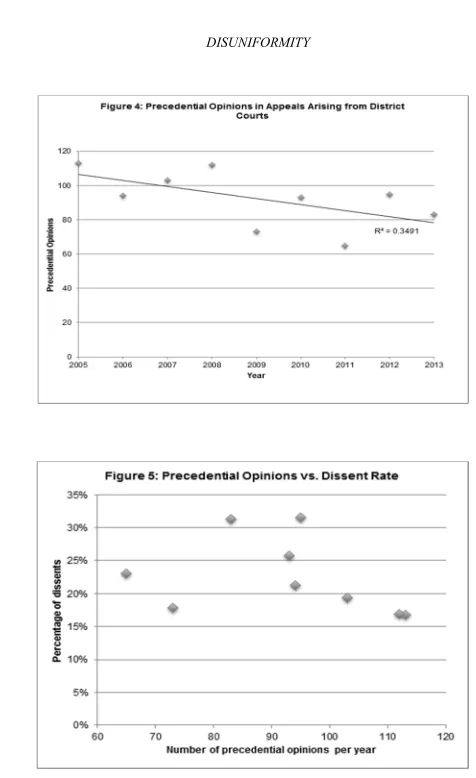
To examine this possibility, we looked at the number of precedential opinions issued by the Federal Circuit during the period studied. While Figure 445 does suggest a modest downward trend in numbers of precedential opinions, we are inclined to the view that the data does not reveal practically meaningful variation and note that in the years in which the Federal Circuit had the most dissents (2012 and 2013) the numbers of precedential opinions do not seem noticeably low. Figure 5 further indicates that the number of dissents in precedential patent cases do not seem to be particularly sensitive to the number of precedential patent opinions the court authors in a year. It thus appears that changes in precedential workload—possibly the most arduous form of judicial work and the place where open judicial disagreement is most likely to manifest—are not obviously an important driver of changes in judicial disagreement.
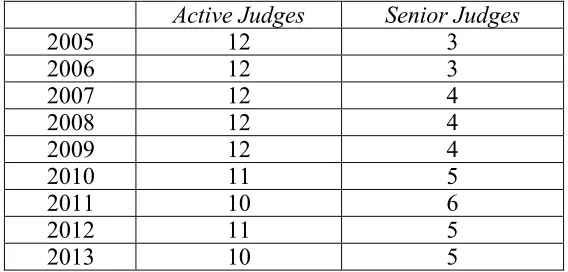
Finally, if there has been a workload change during the period studied, it was for circuit judges probably in the direction of an increase. The reason is that during the period studied, while the overall number of Federal Circuit judges did not change much, the ratio of active to senior judges did change. Table 1 shows that the ratio became smaller, viz. the Federal Circuit added a few senior judges and lost one or two circuit judges depending on the year considered.
Table 1: Active and Senior Judges at the Federal Circuit, 2005–201346
Active Judges Senior Judges
2005 12 3
2006 12 3
2007 12 4
2008 12 4
2009 12 4
2010 11 5
2011 10 6
2012 11 5
2013 10 5
Because senior judges tend to take on a reduced workload, the effect of this development was probably to increase the workload of the active judges. That being so, if the change in ratio of active to senior judges had an effect on a trend in decisional agreement among Federal Circuit judges, the literature, as noted above, suggests that effect would be to suppress, rather than promote open judicial disagreement about doctrinal content.47
The figures just discussed reveal no evidence of such movement, and as noted earlier suggest movement in the opposite direction.
In sum, the overall workload and precedential opinion output seems to have been fairly consistent during the period studied, suggesting that
46. History of the Federal Judiciary, FED.JUD.CENTER, http://www.fjc.gov/public/home.nsf/
hisj (last visited July 8, 2014) (providing individual profiles of federal judges and a database of information on the federal judiciary). Numbers of judges were counted as of the beginning of each year. For example, for 2010, eleven active judges (Mayer, Michel, Gajarsa, Linn, Bryson, Rader, Newman, Lourie, Dyk, Prost, and Moore) and five senior judges (Archer, Plager, Clevenger, Schall, and Friedman) were counted. Id.
meaningful explanations for the downward trend in decisional agreement among Federal Circuit judges over the past several years may lie elsewhere.
III. WHY MIGHT FEDERAL CIRCUIT OPINIONS EVIDENCE GREATER
JUDICIAL DISAGREEMENT?
The central empirical finding is evidence of a trend of increasing judicial disagreement in patent cases at the Federal Circuit across the last eight or so years. While the data underlying this study is not robust enough to allow us to specify much in the way of an empirical explanation, we are nonetheless able to do what law professors typically do: hypothesize about what might be causing the apparent trend based on our knowledge of events in the patent system and its judicial administration. This Part offers several possible explanations for our observations, with the caution that none of them are exclusive and that all might be working to some degree to encourage the observed increase in judicial disagreement.
A. The Doctrinal Role of the Supreme Court
Perhaps the most obvious place to begin in trying to understand why the Federal Circuit is exhibiting greater amounts of open judicial disagreement is with the Supreme Court of the United States. We begin by outlining three features of the Court’s patent jurisprudence that might help to explain how it encourages greater levels of disagreement among Federal Circuit judges.
The first is that the Supreme Court has been positively discouraging doctrinal uniformity in patent law, and encouraging legal uncertainty. For much of the first quarter-century of the Federal Circuit’s existence, the Supreme Court was a relatively rare participant in patent law.48 When the Court did intervene, it often did so with the express goal of helping the Federal Circuit improve the uniformity of patent law. For example, in
Markman v. Westview Instruments, Inc.,49 the Supreme Court determined
that claim construction was a question for the judge and not for the jury, in large part on the theory that such a decision would improve the uniformity of the law.50 Similarly, in Pfaff v. Wells Electronics, Inc.,51 the Supreme Court was express in its desire to announce a rule of decision even clearer
48. This led one commentator to characterize the Federal Circuit as the “supreme court of patents.” Mark D. Janis, Patent Law in the Age of the Invisible Supreme Court, 2001 U.ILL.L.REV. 387, 387 (2001).
49. 517 U.S. 370 (1996). 50. Id. at 390.
and more uniform in application than the one the Federal Circuit had developed.52
The Supreme Court’s patent jurisprudence has since undergone a noticeable change, moving in the direction of less uniformity in patent law.53 Perhaps one of the earliest examples of this is presented by Court’s
2002 decision in Festo Corp. v. Shoketsu Kinzoku Kogyo Kabushiki Co.54 In Festo, the Court rejected the Federal Circuit’s attempt to reduce uncertainty in the application of the doctrine of equivalents through a “complete bar” approach to prosecution history estoppel and replaced it with a “flexible bar” approach.55 Another notable case is the Court’s 2006 decision in eBay Inc. v. MercExchange L.L.C.56 By pretty much any measure, eBay reduced the uniformity of application of remedies law to patent cases, and encouraged judicial discretion in making remedy decisions.57 A third example representative of the Supreme Court’s
jurisprudential change of heart is KSR International Co. v. Teleflex Inc.58 That case, which addressed the doctrine of nonobviousness, made the application of the law less uniform by rejecting the Federal Circuit’s attempt to construct a uniform, evidence driven test for resolving obviousness inquiries.59
The net effect of decisions like Festo, eBay, and KSR has been to reduce the uniformity of patent doctrine and to increase the decisional space available to judges hearing patent cases and patent appeals. This additional judicial discretion permits Federal Circuit judges to indulge their normative appetites more frequently than they would be able to under a clearer, more uniform jurisprudence.60 The idea here can be nicely
52. Seeid. at 65–66 (“A rule that makes the timeliness of an application depend on the date when an invention is ‘substantially complete’ seriously undermines the interest in certainty . . . . Thus, petitioner’s argument calls into question the standard applied by the Court of Appeals . . . .” (footnote omitted)).
53. Cf. Timothy R. Holbrook, Explaining the Supreme Court’s Interest in Patent Law, 3 IP THEORY 62, 77 (2013) (concluding that the Supreme Court is in an era of heightened interest in
patent law).
54. 535 U.S. 722 (2002).
55. Id. at 738–40; see also Holbrook, supra note 53, at 76 (discussing the Supreme Court’s concern for the Federal Circuit’s preference for bright-line rules as demonstrated by the Festo
holding).
56. 547 U.S. 388 (2006).
57. Id. at 394; see also Michael W. Carroll, Patent Injunctions and the Problem of Uniformity Cost, 13 MICH.TELECOMM.&TECH.L.REV. 421, 431 (2007) (describing MercExchange as the Supreme Court rejecting the Federal Circuit’s uniform approach to granting injunctive relief).
58. 550 U.S. 398 (2007). 59. Id. at 415, 418.
introduced through the work of John Golden, who recognized that one of the ways patent law may develop over time involves a sort of serial resetting driven by Supreme Court participation.61 Even more important, however, is his argument’s recognition that in many instances the Supreme Court might not know what the correct uniform doctrine should be, and so in reviewing patent cases might be careful to avoid specifying the law.62 Instead, the Court might remain content, in most cases, with resetting the law—reopening decisional space by moving the law back from the detail accumulated by the Federal Circuit’s copious case law—to a more general statement or standard. Federal Circuit judges might then, less encumbered by older case law, set about re-specifying through another several years or decades of cases.63
A second reason why the Supreme Court may play a role in encouraging open judicial disagreement among Federal Circuit judges is that the Court has, by many accounts, been authoring decisions in patent cases that might be either incoherent or reflect conflicting rules of decision. Because the Federal Circuit is duty-bound to follow the Supreme Court, if the Court’s various decisions now lead more often to competing outcome choices, one might expect Federal Circuit judges to more often come into conflict than they did when competing Supreme Court precedents were not around (or if they existed in the past had been dealt with to the point that the Federal Circuit had reached a common understanding of their role in patent jurisprudence).
The subject matter eligibility cases sharply illustrate this explanation. Since 2010, the Supreme Court has issued three opinions relating to 35 U.S.C. § 101.64 These opinions are—in a word—controversial, and are
subject to multiple interpretations. The one thing that scholars, judges, and
disagree about if the only question is whether the district judge abused his discretion. If that is true, it makes our findings even more remarkable, because it suggests that the rate of dissent should be
lower following the cases discussed above, rather than higher.
61. John M. Golden, The Supreme Court As “Prime Percolator”: A Prescription for Appellate Review of Questions in Patent Law, 56 UCLAL.REV. 657, 674 (2009).
62. Id. at 686, 688.
63. A related point is that, as one commentator has observed, the Supreme Court’s resetting of patent law may have produced a backlash at the Federal Circuit, in which the court applied a hyper-interpretation of the Court’s precedent to reach a result that fits with its policy preferences.
See Lucas S. Osborn, Instrumentalism at the Federal Circuit, 56 ST.LOUIS U.L.J. 419, 419 (2012)
(arguing that “[t]he Federal Circuit hyper-interprets Supreme Court precedent out of a desire for certainty and relatively outcome-determinative rules”). If this is the case, and one keeps in mind that an appellate court is not a uniform body but is comprised of multiple judges each with their own policy preferences, it would fit in nicely with our suggestion that something is going on in the Federal Circuit itself. Seeinfra Subsection III.C.3.
practitioners are in agreement on is that these opinions create more legal conflict than they resolve.65 This conflict has caused then-Chief Judge Rader to repeatedly throw up his hands when faced with a subject matter eligibility dispute. “Our opinions spend page after page revisiting our cases and those of the Supreme Court, and still we continue to disagree vigorously over what is or is not patentable subject matter. Indeed, deciding what makes an idea ‘abstract’ is ‘reminiscent of the oenologists trying to describe a new wine.’”66
A third reason the Supreme Court might have responsibility for the increase in open judicial disagreement at the Federal Circuit ties the two previous reasons together and adds a third: That the Supreme Court has become more active in patent law during the period we studied than in years past.67 And by more active, we mean that the Court has taken more cases, written many more opinions, and in most of those opinions disapproved of the Federal Circuit’s jurisprudence.68 This reason thus incorporates the first two reasons. Not only may the Court be resetting patent law in specific areas and creating tensions between its precedents, but the effect is amplified by the Supreme Court’s increased activity and apparent discontent with the current substance of patent law. The Supreme Court may, in effect, have been speeding up the rate at which it destroys uniformity and introduces uncertainty into the patent law. The behavior of Federal Circuit judges might reflect this higher pace of change.
65. See, e.g., Dan L. Burk, Edifying Thoughts of a Patent Watcher: The Nature of DNA, 60 UCLAL.REV.DISCOURSE 92, 97–102 (2013)(discussing Myriad’svarious analyses and the difficulty in determining whether products of nature are a patentable subject matter); Dan Burk, The
“Runcible” Product of Nature Doctrine, SCOTUSBLOG (Feb. 4, 2013, 3:50 PM),
http://www.scotusblog.com/2013/02/the-runcible-product-of-nature-doctrine (noting how Bilski and
Mayo obfuscated the patentable subject matter analysis and also discussing how trial courts and the Federal Circuit have struggled to apply the “products of nature” doctrine as a result); Dan. L. Burk,
Anticipating Patentable Subject Matter, 65STAN.L.REV.ONLINE 109, 110–11 (Feb. 21, 2013),
http://www.stanfordlawreview.org/sites/default/files/online/articles/Burk_65_SLRO_109.pdf (arguing that patent law’s novelty requirement has been mistakenly imported into subject matter requirements).
66. Accenture Global Servs., GmbH v. Guidewire Software, Inc., 728 F.3d 1336, 1348 (Fed. Cir. 2013) (Rader, C.J., dissenting) (citations omitted) (quoting MySpace, Inc. v. GraphOn Corp., 672 F.3d 1250, 1259 (Fed. Cir. 2012)).
67. Holbrook, supra note 53, at 64 (providing a graph illustrating Supreme Court activity in patent, copyright, and trademark cases between 2000 and 2012).
68. Between 1982 and 2005, the Supreme Court issued approximately sixteen patent-related opinions, an average of about two-thirds of an opinion a year. Between 2006 and the date of this writing (December 31, 2013), it issued eighteen such opinions, an average of over two and one-half opinions a year. Much of this activity has been concentrated in the last two years: since 2011, the Court has issued ten patent-related opinions and is currently poised to issue at least three more this term. SeeSupreme Court Patent Cases, WRITTEN DESCRIPTION,http://writtendescription.blogspot.
B. The Signaling Role of the Supreme Court
A separate set of explanations for the observed increase in open judicial disagreement at the Federal Circuit can be usefully thought of in terms of a signaling role that the Supreme Court might be playing in patent law. This set of explanations is foreshadowed by the last reason we gave in the previous Section, particularly by the observation that much of the Supreme Court’s recent and rapidly expanding patent jurisprudence appears to express discontent with doctrine developed by the Federal Circuit. This Section sketches out some of the signals the Supreme Court might be sending with its recent blitzkrieg into patent law.
First, by reentering patent law jurisprudence, the Supreme Court has signaled that it is taking at least some of the jurisprudential rein, perhaps releasing some of the pressure Federal Circuit judges might feel to maintain doctrinal uniformity. For nearly a quarter century Federal Circuit judges were practically the sole guardians of Congress’s goal that patent law develop and maintain greater uniformity.69 With the Supreme Court apparently taking the jurisprudential reins, however, Federal Circuit judges may be less concerned that their words will be the final words about the content of the patent law. Other judges—Supreme Court justices—will have the last word, resolving competing views and unifying the law. Such a perception might discourage Federal Circuit judges from taking on the costs of building consensus, or, alternatively, it might encourage Federal Circuit judges to disagree with each other about the content of patent law. This latter choice might be made under the view that by recording doctrinal alternatives in their concurrences and dissents Federal Circuit judges will be assisting the Supreme Court when it steps in to select the appropriate doctrine.
A second explanation that might work cooperatively with the one just laid out is that the reputational reward for writing a dissent has increased since the Supreme Court has become more active in patent law. Here, we draw upon the economic theory of judicial behavior developed by Richard Posner.70 This model views the judge as a “rational, self-interested utility maximizer.”71 In other words, judges are driven to maximize their own
personal utility. In its most simplified terms, this could mean that judges are driven to maximize their leisure; but of course, maximization of leisure
69. See supra notes 11–12 and accompanying text (highlighting the pressures the Federal Circuit might feel to maintain doctrinal uniformity).
70. See generally POSNER, supra note 43, at 36 (“Much of the strategic and even the
sociological theory of judging can be subsumed under the economic theory,” which focuses on how a judge’s leisure preferences may impact her judicial utility, such as by encouraging settlement before trial); Epstein et al., supra note 43, at 132 (explaining the economic theory of judicial behavior and its relevancy to dissents and ideological heterogeneity).
is hardly the only thing judges might derive utility from. Judges might, for example, also derive utility from their judicial influence, whether from having their ideas adopted by other judges or from instituting broader reforms in the law.
Thus, one approach to understanding why judges do what they do is to consider judicial choices in terms of costs and benefits. Here, we discuss some relevant costs and benefits recognized by existing literature and consider how shifts in the Supreme Court’s behavior might affect those motivators of judicial behavior. On the one hand, there are two potentially substantial costs associated with writing a dissent: (1) it involves effort above and beyond that required for the job; and (2) it may cause the dissenters to incur reputation costs among their colleagues.72 Generalizable benefits on the other hand, tend to flow from the influence and enhanced reputation that the judge derives from a dissenting opinion.73
If one accepts that appellate judges derive utility when they write an opinion that is adopted or cited by others, and lose utility when they expend energy without those views being adopted or cited (because the effort and reputational costs outweigh the benefits from writing the dissent),74 it could follow that an appellate judge who writes a dissent for a disinterested Supreme Court may obtain little value from doing so. The judge might as well be Sisyphus, pushing his rock up the hill and seeing it roll back down. Better to join the majority opinion and try to get at least some of the judge’s own views included in it.
That calculus could change in a way that fuels a rise in dissents when an active Supreme Court enters the picture. Now, a dissenting judge has the potential for a substantial reputational payoff: The Supreme Court might grant certiorari and address, and perhaps even adopt a dissenting judge’s position.75 Indeed, by dissenting the judge may make it more likely for the Court to grant certiorari.76 Put another way, the presence of an active
72. See Epstein et al., supra note 43, at 103–04 (discussing the effort cost of writing a dissent).
73. Id. at 104. We recognize that different judges will place different utility values on these costs and benefits. Indeed, some judges may derive benefits simply from expressing their views, much like an artist might derive a benefit from the act of creating. See POSNER, supra note 43, at 62. In other words, we acknowledge that there may be variation among judges’ behavior. However, we think that it is likely that most judges will be influenced, at least at the margins, by the costs and benefits we describe.
74. An expectation consistent with Epstein et al., supra note 43, at 103–04, and, in these authors’ view, with common sense as well.
Supreme Court might encourage a positive feedback loop between dissents and reputational rewards that was simply absent when the Supreme Court rarely considered patent law. The consistency with which the Supreme Court has been rejecting Federal Circuit case law that reflects a majority consensus, moreover, might further fuel this mechanism.77 A judge who finds utility in being recognized by the Supreme Court may (correctly) perceive that he is more likely to obtain utility when the position he takes is “against” Federal Circuit law.
Although this Section is about a role the Supreme Court might play in encouraging disagreement between Federal Circuit judges about the content of the law, it seems appropriate here to mention that the Supreme Court is not the only audience for which Federal Circuit judges write. In 2011, Congress passed the America Invents Act, the “most significant legislative event affecting patent law and practice in more than half a century.”78 In doing so, Congress indicated that it, too, intends to play a role in the continued development of the patent system. This adds yet another audience—along with practitioners and academics—for Federal Circuit judges’ opinions,79 and with it the possibility of even greater rewards for a successful dissent.80
C. There is Something Going on at the Federal Circuit
An additional set of explanations for our observation that Federal Circuit judges are increasingly in disagreement about the content of patent
been written is statistically significantly higher than in the absence of dissent); Holbrook, supra
note 53, at 69–70 (commenting that intra-circuit splits at the Federal Circuit can send a signal to the Supreme Court).
77. See, e.g.,Global-Tech Appliances, Inc. v. SEB S.A., 131 S. Ct. 2060, 2070–71 (2011) (criticizing the Federal Circuit’s application of the proper willful blindness standard); Bilski v. Kappos, 130 S. Ct. 3218, 3231 (2010) (“[N]othing in today’s opinion should be read as endorsing interpretations of § 101 that the Court of Appeals for the Federal Circuit has used in the past.”); KSR Int’l Co. v. Teleflex Inc., 550 U.S. 398, 422 (2007) (“What we hold is that the fundamental misunderstandings identified above led the Court of Appeals in this case to apply a test inconsistent with our patent law decisions.”).
78. Jason Rantanen & Lee Petherbridge, Toward a System of Invention Registration: The Leahy-Smith America Invents Act, 110 MICH.L.REV.FIRST IMPRESSIONS 24, 24 (2011).
79. See also Mark D. Janis and Timothy R. Holbrook, Patent Law’s Audience, 97 MINN.L.
REV. 72, 86 (2012)(suggesting that the audience for patent law has changed dramatically from the
past). Indeed, patent law as a field has become more prominent as a result of broad social and economic trends. As Tun-Jen Chiang personally commented to us, this may increase both the external utility—writing for an audience with the intention of producing a change—and internal utility—the opportunity to voice opinions on issues the judges personally care about—of writing a dissent.
law might be found within the Federal Circuit itself. This Section outlines how possible developments at the Federal Circuit might play a role, at least in part, in reducing doctrinal uniformity. As before, the reasons we develop here are not exclusive and one or more could cooperate to explain our observations.
1. The Role of New Federal Circuit Judges
During the period studied, the Federal Circuit underwent an arguably unprecedented turnover of judges. Since 2009, the court has experienced a 50% turnover among active judges.81 The turnover among senior judges has been even more dramatic.82 Without question, the composition of the court by 2013 had become very different from its composition in 2009, let alone 2006. Might the addition of new judges encourage a decrease in the uniformity of patent law?
There is very little literature exploring whether the arrival of new judges has an impact on doctrinal uniformity, and what there is might lead in different directions. Perhaps the most on point work—since it addresses the Federal Circuit—is that of Wagner and Petherbridge.83 Based on
empirical evidence from judicial opinions, their work suggests that (then) new Judges Dyk and Linn were disruptive forces in Federal Circuit jurisprudence; in particular, that they were largely responsible for pushing the proceduralist agenda in the court’s claim construction jurisprudence.84 Given this precedent, perhaps part of an explanation for the observation that patent law doctrine appears increasingly disuniform is that a set of new judges with different views of the law than older Federal Circuit judges have arrived at the Federal Circuit.
This interpretation stands in some contrast to other work, not directly concerned with the Federal Circuit but concerned nonetheless with new appellate judges, that suggests that new judges are less likely to author dissenting opinions than experienced judges. The idea behind this suggestion has been labeled the “freshman effect,” and emphasizes the notion that new judges are less likely to write majority or dissenting opinions than their more experienced colleagues due to the need to
81. Judges Schall, Mayer, Linn, and Bryson took senior status and Judges Gajarsa and Michel retired from the court altogether. Judge Gajarsa initially took senior status before retiring from service in 2012. Those six vacancies, of a total of twelve judgeships, were filled by Judges O’Malley, Reyna, Wallach, Taranto, Chen, and Hughes. For more information on judicial nominations and vacancies, see JUDICIALNOMINATIONS.COM, http://www.judicialnominations.org/ (last visited May 12, 2014).
82. With the exception of Judge Plager, the set of senior judges at the end of our period studied was completely different form the set of senior judges at the beginning of our period studied.