Performance Analysis of OFDM System Using
MLSE Equalizer over Rayleigh Fading Channel
with Different Modulation Technique
Megha Gupta
1, Prof. Rajesh Nema
2, Dr. Ravi Shankar Mishra
3, Dr. Puran Gour
4Department of Electronics & Communication
NRI Institute of Information Science & Technology Bhopal(M.P.)
[email protected]
1, [email protected]
2, [email protected]
3,
[email protected]
4Abstract—In This paper we present an analytical approach to evaluate the performance analysis of OFDM system using MLSE Equalizer Over Rayleigh fading channel through the BPSK, QPSK, 4QAM & 16QAM Modulation Technique. Finally we are comparing BER performance in OFDM system using MLSE Equalizer through the modulation technique.
Index Terms—OFDM, ISI, Rayleigh fading channel, Maximum likelihood sequence estimation (MLSE) equalizer.
1. INTRODUCTION
The advent of multimedia applications in the wireless networks, the bandwidth needed for communications is invariably increased. The wireless network is that the communication channel and its characteristics change from time-to-time. This time-varying behavior of the channel provides variable amount of attenuation and time delay for different versions of the same transmitted signal. This necessitates the use of equalizer at the receiving end.
Electromagnetic (radio) signals are transmitted for the long-distance wireless transmission. The major problem with the reception of radio signals is fading caused by multipath propagation of the radio signals.
Inter symbol interference (ISI) also severely degrades the performance of high-speed wireless communication systems. ISI occurs when a transmission interferes with itself and the receiver cannot decode the transmission correctly. Various
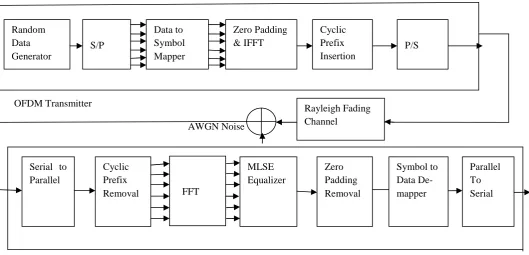
depicted in figure 1.The model consists of three subsections namely transmitter, channel and receiver.
2.1 TRANSMITTER
This subsection consists of following blocks.
Random data generator is used to generate a serial random binary data .This binary Data stream models the raw information that going to be transmitted. The serial binary data is then fed into OFDM transmitter.
The input serial binary data stream is grouped into word size required for transmission in this each word and word is converted into parallel stream. Each stream is used to modulate one carrier out of group of orthogonal carrier. it is called s/p converter
Data to symbol mapper is block does modulation like BPSK,QPSK ,QAM&16QAM .The data on each symbol is mapped to a particular phase based on the modulation method used .Each one the phase is assigned a unique pattern of binary bit .Usually each phase encodes an equal number of bits.
The IFFT converts frequency domain data into the time domain signal. Prior to IFFT mapping zero-padding is performed to adjust the IFFT bit size of length. Zero padding is used because the number of subcarriers may be less then bit size.
efficiency of the system .After the cyclic prefix has been added [5]
2.2 CHANNELMODEL:
Additive white Gaussian Noise (AWGN) is a channel model in which the only impairment to communication is a linear addition of wideband or white noise with a constant spectral density (expressed as watts par hertz of bandwidth) and a Gaussian distribution of amplitude. The model does not account for fading, frequency, selectivity, interference, nonlinearity or dispersion.
However, it produces simple and tractable mathematical models which are useful for gaining
insight into the underlying behavior of a system before these other phenomena are considered. Wideband Gaussian noise comes from many natural sources, such as the thermal vibrations of atoms in conductors (referred to as thermal noise or Johnson-Nyquist noise), shot noise, black body radiation from the earth and other warm objects and from celestial sources such as the sun[6].
AWGN does not work will thus the more specified model are used. Fading is deviation of the attenuation that a carried modulated telecommunication signal experiences over certain propagation media. A fading channel is communication Rayleigh fading is caused by multipath reception really fading is statistical model for the effect of propagation environment on a radio signal such as is used by wireless devices.
OFDM Transmitter
AWGN Noise
OFDM Receiver
Figure 1: OFDM Simulation Model Random
Data Generator
S/P
Data to Symbol Mapper
Zero Padding & IFFT
Cyclic Prefix Insertion
P/S
Rayleigh Fading Channel
Serial to Parallel
Cyclic Prefix
Removal FFT
MLSE Equalizer
Zero Padding Removal
Symbol to Data De-mapper
2.3 RECEIVER:
The receiver does the reverse in contrast to the transmitter. Firstly the serial output channel is a converted into parallel stream and then cyclic prefix bits are removed from it .Then FFT of Each symbol is performed .To remove these channel effect MLSE is performed equalized output is converted back to data words by demodulator the data words are then multiplexed to get the original data .
3. EQUALIZER:
Equalizer [7] is a digital filter that provides an approximate inverse of channel frequency response. Equalization is to mitigate the effects of ISI to decrease the probability of error that occurs without suppression of ISI, but this reduction of ISI effects has to be balanced with prevention of noise power enhancement.
3.1 MAXIMUM - LIKELIHOOD SEQUENCE ESTIMATION (MLSE):
The receiver uses a maximum-likelihood sequence estimation (MLSE) implemented by means of the Viterbi algorithm to compensate for the heavy selective distortions caused by multipath propagation. The performance of the receiver is evaluated through a channel simulator suitable for mobile communications. The results obtained show the good behavior characteristics for the receiver in different modes of operation. Easy implementation of the device using VLSI technology is expected For an optimized detector for digital signals the priority is not to reconstruct the transmitter signal, but it should do a best estimation of the transmitted data with the least possible number of errors. The receiver emulates the distorted channel. All possible transmitted data streams are fed into this distorted channel model. The receiver compares the time response with the actual received signal and determines the most likely signal. In cases that are most computationally straightforward, root mean square derivation can be used as the decision criterion for the lowest error probability.
4. RESULTS:
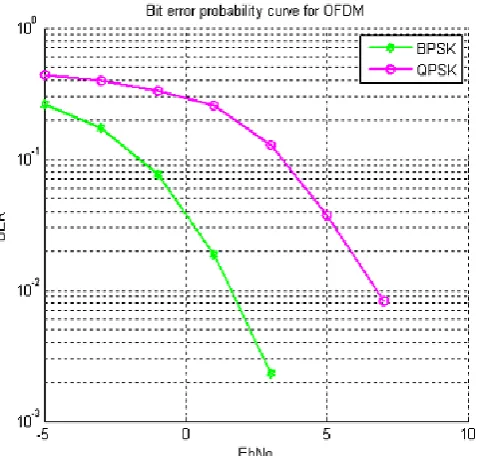
Simulation Results are plotted for bit error rate performance of OFDM System simulation is performed Rayleigh channel using BPSK, QPSK, 4QAM, 16QAM Modulation technique .We are comparing bit error rate performance of OFDM System using MLSE Equalizer . we are compare between BPSK Vs QPSK modulation technique .we found that BPSK is better than QPSK (Figure 2). Similarly we are comparing between 4QAM Vs 16QAM modulation technique. We Observed that 4QAM is better than 16QAM (Figure 3).
Similarly we are comparing between BPSK Vs 16QAM modulation technique. We observed that BPSK is better than 16QAM (Figure 4).
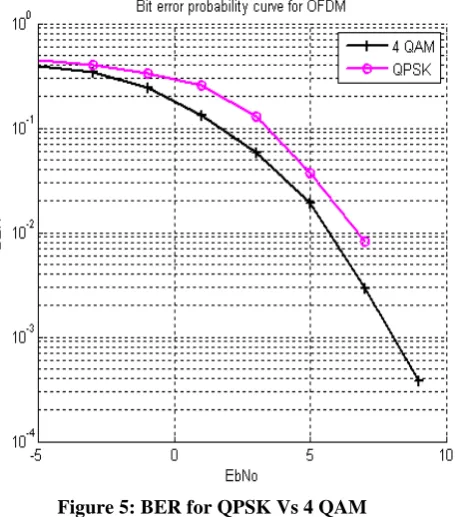
Similarly we are comparing between QPSK Vs 4 QAM modulations techniques. We observed that 4 QAM is better than QPSK (Figure 5).
Similarly we are comparing between BPSK Vs 4 QAM modulations techniques. We observed that BPSK is better than 4 QAM (Figure 6).
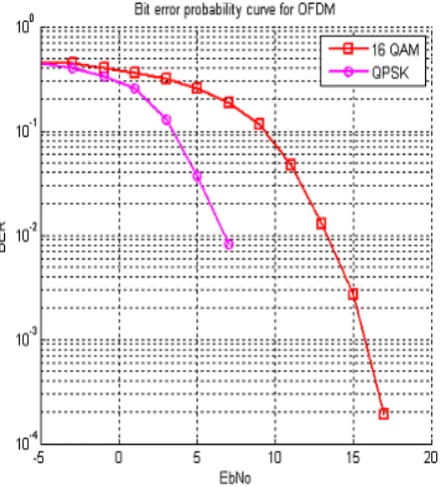
Similarly we are comparing between QPSK Vs 16 QAM modulations techniques. We observed that QPSK is better than 16 QAM (Figure 7).
Figure 3: BER for 4 QAM Vs 16 QAM modulation technique
Figure 4: BER for BPSK Vs 16 QAM modulation technique
Figure 5: BER for QPSK Vs 4 QAM modulation technique
Figure 7: BER for QPSK Vs 16 QAM modulation technique
5. CONCLUSION:
Rayleigh fading of signal which leads to inter symbol interference (ISI) maximum likelihood sequence estimation are used to improve the performance. The paper compares the performance of unequalized systems with the equalized system. The bit error performance is improved.
In this paper we have demonstrated the application of BPSK,QPSK,4QAM,16QAM,modulation technique in OFDM system with a view of reducing the inter symbol interference
6. REFERENCES:
[1]Theodore S. Rappaport, “Wireless Comm-unications”, 2nd
Edition, Prentice Hall of India, 2002.
[2] A. John and C Bingham, “Multicarrier modulation for data transmission: An idea whose time has come, ”IEEE
Commun. May, vol. 28,no.5,pp.5-14,may1990
[3] Zhengdao Wang,”OFDM or single carrier block transmission,”
IEEE Trans. On comm., vol. 52, no. 3, pp.380-394, mar-2004.
[4]Boumard Sand Mammela A “Channel estimation versus
equation in an OFDM WLAN system” in proc. Vehicular
Technology Conference, pp 653-657, 2001.
[5] B. Muquet, Zwang, G.B. Giannakis, M.de Courville and
P.Duhamel ,”Cyclic prefixing or zero padding for wireless multicarrier transmission,”IEEE Trans. On Comm., vol.50.no
12, pp.2136-2148, Dec 2002\
[6]P.Banelli, ‘’OFDM signal in fading channels ,” IEEE Trans, on
wireless comm. vol.2, no. 2, pp.284-293,mar.2003.
[7] M.X.Chang and Yu T.Su ,” performance analysis of Equalized OFDM systems in Rayleigh fading” IEEE Trans. On wireless
comm. Vol. 1 no.4. pp.721-732.oct2002
[8] M.Tuchler, C.Andrew, Singer and R .Koetter ,”Minimum Mean Squared Error equalization using priori information ,”IEEE
Trans, on signal process., vol. 50,no. 3, pp 673-683 mar.2002
[9]Megha Gupta,” Bit Error Rate performance in OFDM system
using MMSE & MLSE equalizer over Rayleigh fading channel through the bpsk,qpsk,4 qam ,16 qam modulation technique , in IJERA, vol.1,ISSUE 3,PP.1005-1011”
[10] John G. Proakis, “Digital Communications”, 3rd Edition,
McGraw Hill International Editions, 1995.
[11] William Stallings, “Wireless Communications and Networks”,
1stEdition, Pearson Education Asia, 2002.
[12]Rudra Pratap, “Getting Started with MATLAB”, Version 6, 1st
Edition, Oxford University Press, 2002
[13]Design and Implementation of Orthogonal Frequency Division
Multiplexing by: Alan C. Brooks • Stephen J. Hoelzer.