Research Journal
Volume 11, Issue 4, December 2017, pages 206–214
DOI: 10.12913/22998624/80850 Research Article
INFLUENCE OF POLYLACTIDE MODIFICATION WITH BLOWING AGENTS
ON SELECTED MECHANICAL PROPERTIES
Aneta Tor-Świątek1, Tomasz Garbacz1, Vladimir Sedlarik2, Petr Stloukal2, Pavel Kucharczyk2
1 Lublin University of Technology, Faculty of Mechanical Engineering, Department of Technology and Polymer Processing, 36 Nadbystrzycka St. 20-618 Lublin, e-mail: [email protected], [email protected]
2 Centre of Polymer Systems, Tomas Bata University in Zlin, tr. T. Bati 5678, 760 01 Zlin, Czech Republic, e-mail: [email protected]
ABSTRACT
The article presents research of modification of PLA with four types of blowing agents with a different decomposition characteristic. Modifications were made in both cellular extrusion and injection molding processes. The obtained results show that dosing blowing agents have the influence on mechanical properties and struc -ture morphology. Differences in the obtained results are also visible and significant between cellular processes.
Keywords: polylactide, blowing agent, extrusion, injection molding.
INTRODUCTION
Modification of polymeric materials is in -tended to give the products specific properties or, in case of hard to recycle materials, facilitate their processing. The modification process in -volves changing the technological conditions of the manufacturing process, the processing tools as well as the addition of auxiliary materials such as fillers, plasticizers and stabilizers. The aids can be divided into two main groups: processing and functional. Group of processing agents are processing stabilizers and processing modifiers. Functional agents include properties stabilizers and property modificators [3, 11, 12].
Functional modifiers are primarily property stabilizers that prevent undesired behavior of the material during its further use. The properties stabi -lizers include, among others, anti-aging agents that prevent the release of harmful disintegrants, metal deactivators, anti-aging electric cables and hydrod -esistant stabilizers, prevent water effect [2, 9].
A large separate group is property modifiers. They enable changing optical, mechanical, sur -face, flammability properties.
Modifiers include also porous and micropo -rous blowing agents (porophors). Their main in -gredient is gas, which, under appropriate condi -tions of the process, expands, resulting in porosity. The obtained product changes its structure from solid to porous. Mold the material so that the sepa -rated gas can be cooled down and concentrate the microporous material. This modifier affects many properties such as density, hardness, elasticity, tensile strength, stiffness [7, 8, 10, 14, 15].
Modification with the use of the blowing agents can be carried out using two main pro -cesses of plastics processing i.e. extrusion [4, 11, 12] and injection [1, 5, 6, 13]. In both cases, it is important to choose the type and quantity of the dosing blowing agent, and thus the conversion of processing parameters taking into account the characteristics and max. decomposition tempera -ture of the agent.
EXPERIMENTAL
During research polylactide (PLA) with trade name NatureWorks Ingeo 2002D was used. Ac -cording to the producer data PLA characterises
MFR (210oC; 2,16 kg): 5 – 7 g/10 min; tensile
strength: 7,7 MPa; yield stress: 8, 7 MPa; Young modulus: 500 MPa; elongation: 6.0%; impact by Izod: 0.24 J/m; color: transparent. Polylactide was modified with selected blowing agents with different decomposition characteristic.
In the experiments, various types of chemi -cal blowing agents were used: Expancel 950 MB manufactured by Akzo Nobel, Hydrocerol 530, Hydrocerol ITP 810, manufactured by Clariant Masterbatches GmbH and LyCell-F017 manufac -tured by Ly-TeC GmbH.
Hydrocerol 530 is an exothermic blowing agent with nucleating properties. It comes in a granular form, with the diameter of spherical grains ranging from 2.4 to 2.8 mm. In order to obtain high foaming process efficiency, the pro -cessing temperature should range between 120-170°C. Active substances in this blowing agent constitute a mixture of appropriately propor -tioned chemical compounds such as azodicar -bonamide.
LyCell-F017 is an endothermic blowing agent. It has the form of pellets with a diameter ranging from 1.2 to 1.8 mm and a length from
2.3 to 2.5 mm. This blowing agent is a mixture of sodium acid carbonate and 2–hydroxypropane-tricarboxylic acid (citric acid).
Expancel 950 MB is a blowing agent that has a form of spherical thermoplastic polymer capsules (microspheres) that contain a hydrocar -bon gas. This is an endothermic blowing agent. Expancel microspheres do not bond because the capsules retain their blocking properties, which pre-vents release of the constrained gas. Expancel 950 MB is a mixture that contains 65% micro -spheres in the copolymer of ethylene and vinyl acetate (EVA).
The decomposition products of the applied blowing agents mainly include carbon dioxide CO2, a small amount of water H2O and nitrogen N2. Selected properties of the discussed blowing agents are listed in Table 1.
Based on the adopted research program, poly -meric material for cellular extrusion and cellular injection molding was modified in such a way that the blowing agents were fed into it during the mechanical mixing process. The blowing agents used in the cellular processes were fed into the polymers being processed in the following quan
-Table 1. Selected properties of blowing agents used in the cellular injection molding process
No. Characteristic quantity Ly-Cell F017 Hydrocerol 530 Hydrocerol ITP810 Expancel 950 MB
1 Distribution Endothermic Exothermic Endothermic Microspheres
2 Decomposition initiation, ºC 155 170 160 130
3 Processing temperature, ºC 170 – 210 170-190 160 – 180 130–190
4 Dosage, % 0.5 – 2.0 0.5–2.0 1.0 – 5.0 0.5–2.5
tities: 0.5%, 1.5% and 3% by mass (w/w). In or -der to obtain high process efficiency for the above blowing agents, the processing temperature range was 160÷185°C.
The experimental tests were conducted on a laboratory technological line for profile extru -sion, its main component being a double-screw extruder EHP 2x20 Sline (Fig. 1), produced by Zamak Mercator (Poland). The extruder’s plasti -cizing unit had four heating zones, the screw had an L/D ratio of 25 and an outside diameter, D, of 20 mm. The rotational speed of the extruder screw ranged from 0 to 200 rpm and was adjusted continuously. The technological line also consist -ed of a head for profile extrusion. The head had a replaceable extruder die to enable extrusion of profiles with different sizes and shapes, both sym -metric and asym-metric.
Used for tape profile extrusion, the extruder die had a width of 15.5 mm and a height of 2.0 mm. The extruder head was made up of two heat -ing zones and two correspond-ing r-ing-shaped heaters mounted on the head body. The extrusion line also consisted of a cooling device that had a length of 1740 mm, width of 220 mm and depth of 200 mm. In the tests, we also used a belt haul-off; the belt had a width of 100 mm and a length of 2000 mm.
The extrusion process was carried out under the developed and imposed conditions, set in the extrusion process line. They included the follow -ing: temperature values of heating zones in the plasticizing unit were respectively: 125, 140, 150,
160, 165, 175, 180 and 195°C; temperature values in the head for the three heating zones were re -spectively: 190, 175 and 165°C. The determined rate of screw rotation was altered within the range of 50-100 rpm).Temperature of the cooling agent was 12÷14°C.
PLA modification was also made in injec -tion molding process with the use of the same blowing agents (Table 1). The test stand consists of a screw injection molding machine, Arburg AllRounder 320°C, equipped with an injection mold, as shown in Figure 2. The machine has a single-screw plasticizing system, with a screw diameter of 36 mm. A moveable subassembly of the injection mold is mounted to the moveable table of the machine, in which two mold cavities are located. The mold cavity has the shape and
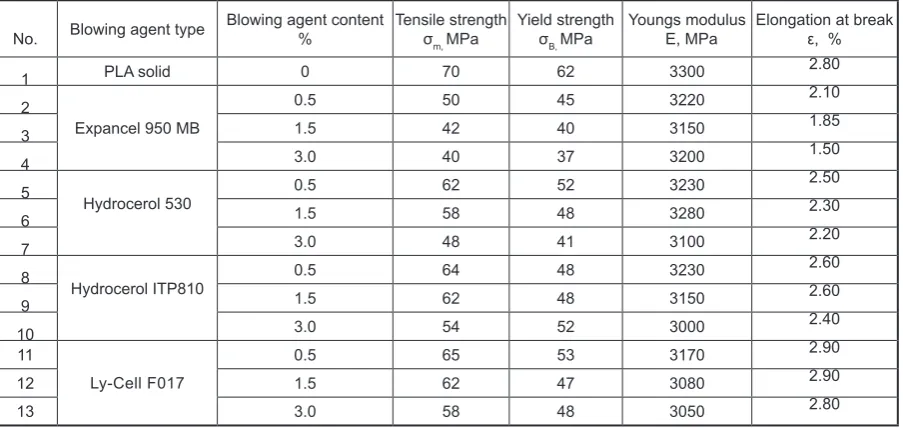
Table 2. Research results of the mechanical properties of the injection molded parts of PLA, average values given with accuracy 1 MPa
No. Blowing agent type Blowing agent content% Tensile strengthσm, MPa Yield strengthσB, MPa Youngs modulus E, MPa Elongation at breakε, %
1 PLA solid 0 70 62 3300 2.80
2
Expancel 950 MB
0.5 50 45 3220 2.10
3 1.5 42 40 3150 1.85
4 3.0 40 37 3200 1.50
5 Hydrocerol 530 0.5 62 52 3230 2.50
6 1.5 58 48 3280 2.30
7 3.0 48 41 3100 2.20
8
Hydrocerol ITP810 0.5 64 48 3230
2.60
9 1.5 62 48 3150 2.60
10 3.0 54 52 3000 2.40
11
Ly-Cell F017
0.5 65 53 3170 2.90
12 1.5 62 47 3080 2.90
13 3.0 58 48 3050 2.80
dimensions of a tensile specimen for static ten-sion tests, the so–called specimen type II [26], shown in Figure 3.
The mold cavity dimensions are as follows: length 150 mm, width from 10 to 20 mm, thick -ness 4 mm. Directly in the mold cavities there are point ejector pins mounted, with a diameter of 6mm. In the fixed subassembly of the mold, there are flow system channels which supply the poly -meric material to the mold cavities; the channels have a direct contact with an injection nozzle of the plasticizing system.
The following parameters of the cellular in -jection molding process were adopted: in-jection and clamping time - 2 seconds; molded piece cooling time - 30 s, temperature of thermostated mold - 19 ±1°C. Injection molding machine All
-Rounder 320°C do not have possibility to direct control and readout of injection pressure and counter-pressure. The value specifying the in -jection pressure is the pressure in the hydraulic system, aimed at testing the value of - 5 MPa. In the experiments, the temperatures of the poly -mers being investigated were set in the particu -lar heating zones of the plasticizing system in the following way: in zone I 160°C, in zone II – 170°C, III – 180°C, IV – 185°C.
In the framework of research program tensile strength and elongation at break were measured. The research of mechanical properties was made on tensile machine Zwick/Roel Z010 accord -ing to PN-EN ISO 527-1:1998 and PN-EN ISO 1798:2001. Strength properties of the injection molded parts under static tension were deter -mined using a testing machine manufactured by Zwick Z010. The machine was equipped with 10 kN screw wedge chucks together with the accessories. The measurements were done at a tensile speed of 10 mm/min and under the mea -suring load range 0÷500 N. The applied shape and dimensions of the specimens complied with the relevant norm. The specimen thickness cor -responded to the injection molded part thickness and it was measured and registered each time together with the width of the measuring length right before the tests.
The structure observations of the extrudate was made in passing light on metallographic mi -croscope Nikon ECLIPSE LV100ND with DS-U3 Digital Camera Control Unit.
Table 3. Research results of the mechanical properties of the extruded parts of PLA, average values given with accuracy 1 MPa
No. Blowing agent type Blowing agent content %
Tensile strength
σm, MPa
Yield strength
σB, MPa
Youngs modulus E, MPa
Elongation at break
ε, %
1 PLA solid 0 60 55 2700 4.00
2
Expancel 950 MB
0.5 55 55 2500 3.70
3 1.5 44 38 2450 2.80
4 3.0 35 35 1850 5.50
5
Hydrocerol 530 0.5 26 26 1900 2.00
6 1.5 25 25 1650 2.50
7 3.0 27 27 1900 2.50
8
Hydrocerol ITP810 0.5 25 25 1850 2.0
9 1.5 28 28 1940 3.0
10 3.0 25 25 1850 2.30
11
Ly-Cell F017
0.5 45 45 2000 4.50
12 1.5 45 45 2200 4.50
13 3.0 50 50 3000 4.00
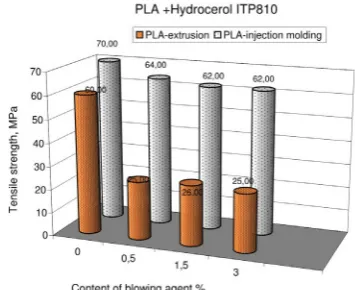
Significant differences in mechanical strength of the porous, both extruded and injec -tion molded parts, can be observed. For exam -ple, the blowing agent Hydrocerol 530 (Fig. 7), with the endothermic decomposition character -istics, dosed in the range from 0 to 3.0% causes a decrease in tensile strength by 55% in extruded part and about 30% in injected parts. In the case of polylactide with 3% content of blowing agent LyCell F017 (Fig. 6) the tensile strength de -crease average 16% in extruded parts and 17% in injected parts.
The blowing agent was dosed in 0.5-3.0% by weight, so as to produce extrudate and injection molding with a solid surface and a cellular core. The shape and outside dimensions of the product agree with shape and dimensions of solid prod -ucts made of the tested PLA.
Fig. 4. Dependence of tensile strength of the PLA extruded and injection molded parts on the content of
microspheres Expancel 950 MB
Fig. 5. Dependence of tensile strength of the PLA extruded and injection molded parts made on the con
-tent of endothermic blowing agent Ly-Cell F017
Fig. 6. Dependence of tensile strength of the PLA extruded and injection molded parts made on the con
-tent of exothermic blowing agent Hydrocerol 530
Fig. 7. Dependence of tensile strength of the PLA ex -truded and injection molded parts made on the content
of endothermic blowing agent Hydrocerol ITP810
RESULTS AND DISCUSSION
The results of determining selected mechani -cal properties of the injection molded and ex -truded parts, obtained at different contents of the blowing agent in the polymers being processed are shown in Table 2 and 3 and Figures 5-8.
With increased content of blowing agent in the injected material the value of the yield strength de -creases. Elongation at break decreases monotoni -cally, non-linearly, over the range increasing con -tent of blowing agent. This relationship is similar for each of the materials and blowing agents.
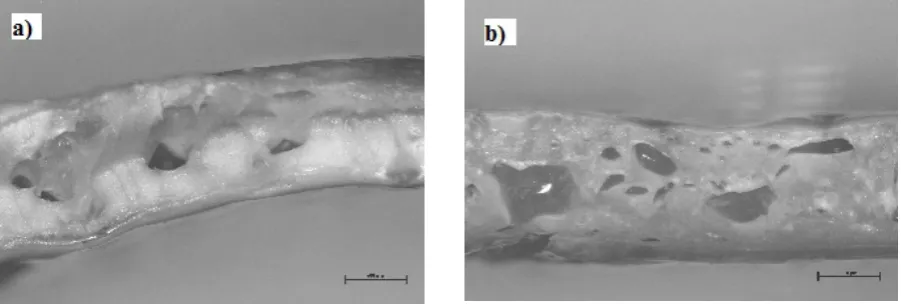
The macroscopic structure of the produced cellular tapes was examined at the stand for polymer cellular structure image analysis. The stand comprised a metallographic, optical im -age recording devices and a computer equipped with specialist software. Examples of the cellular
Fig. 8. Fragment of the cross section of the extruded PLA: a) solid, b) with 3% microspheres Expancel 950 MB
Fig. 9. Fragment of the cross section of the extruded PLA: a) with 1.5% Hydrocerol 530, b) with 3% Hydrocerol 530
Fig. 10. Fragment of the cross section of the extruded PLA: a) with 3% Ly-Cell F017, b) with 3% Hydrocerol ITP810
shape. The closer to the core the solid outer layer it is, the more the pore size increases (Fig. 9, 10). A discernible effect of the blowing agent used, its type and effect characteristics on the ob
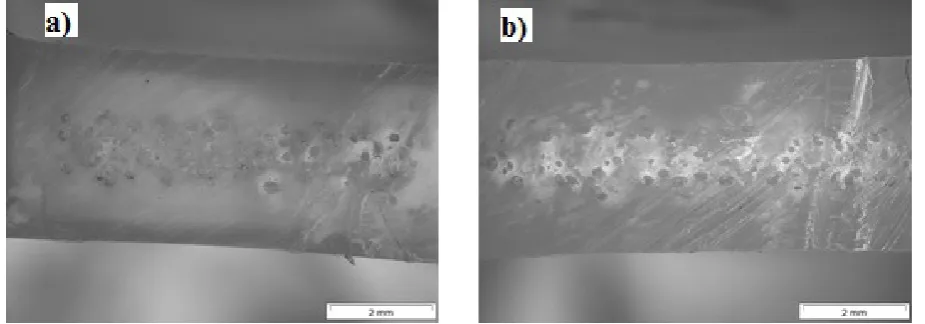
-tained morphology of porous molded pieces were observed. Based on the analysis of the photo -graphs taken, it has been found that the injection molded parts with 0.5% content of the blowing
Fig. 11. Fragment of the cross section of the injected PLA: a) solid, b) with 0.5% Hydrocerol ITP810
Fig. 12. Fragment of the cross section of the injected PLA: a) with 1.5% microspheres Expancel 950 MB, b) with 3% Hydrocerol 530
agent (Fig. 11-13) have a clearly visible solid out -er lay-er and their pore distribution is non-uniform to the greatest extent.
The change in the number of pores and their surface quantity in the cross section of the molded parts can also depend on cooling intensity. Fast cooling hampers the occurrence and growth of the pores, especially of those located closer to the surface layer (Figs. 12, 13). In the case of the po -rous parts produced using the blowing agent with the endothermic decomposition characteristics, the gas release in the course of processing comes to an end once the energy supply is stopped. The obtained porous structure is uniform; the pores have a spherical or quasi spherical shape. The pores have similar sizes, irrespective of their lo -cation in the product.
CONCLUSIONS
The tensile strengths results shown in the work are strongly dependent on the characteris -tics of the blowing agent used. Agent added to a 3%, irrespective of the characteristics of its activ -ity, it con-tributes to a significant deterioration in the strength properties of the tested PLA compo -sitions.
The porous structure is an advantage of ex -trusion and injection molded parts as it results in a decreased amount of the polymeric compos -ite needed in their production. Owing to the use of chemical blowing agents, porous parts have, among others, lower weight, enhanced damping properties, and lower processing shrinkage. The cellularity determines the gaseous phase content in a cellular product, determining at the same time the density decrease value of this product. Such content of the blowing agent in the polymer determines both the coating continuity over the whole cross section and the uniform distribution of pores and their similar sizes.
There was also a significant influence of the type of processing and technological conditions on the obtained mechanical strength values of the tested PLA compositions. In the extrusion pro -cess, the extruded profile is freely extruded and its cooling is carried out directly in the water in the cooling bath. The reason for this is the forma -tion of a product having a porous structure in the whole area, also in the top layer. In the injection molding process, the polymer compositions are cooled in a closed injection mold. Indirect cooling
of the composition, as a result of its contact with the cold surfaces of the injection mold cavities, re -sults in the formation of products having a broad solid top layer and a porous core. This results in reduced strength properties extruded composi -tions compared to injection molded composi-tions. The change in strength properties of the same PLA composition obtained in such different processing processes is up to 50%.
The strength properties discussed in the paper depend to a great extend also on the characteris -tics of the blowing agent used. This is largely due to thermal properties of the polymeric materials being used and the effect of the blowing agents on the polymeric materials used in the process. How -ever, such a dependence has not been thoroughly investigated yet and will, therefore, be a subject of further studies.
REFERENCES
1. Bociąga E., Palutkiewicz P. The influence of in -jection moulding parameters and blowing agent addition on selected properties, surface state and structure of HDPE parts. Polymer Engineering and Science, 4 (53), 2013, 679-704.
2. Jachowicz T., Gajdoš I.: Effect of natural ageing on some properties of oxybiodegrading agent-con -taining polypropylene products. Przemysl Chemic -zny, 11 (93) 2014, 1983-1885.
3. Klepka T., Jeziórska R. and Szadkowska A. Cienkościenne wyroby z modyfikowanego poliety -lenu dużej gęstości. Przemysł Chemiczny, 8, 2015, 1352-1355.
4. Garbacz T.: Structure and properties of cellular thin-walled cable coatings. Polimery 11-12 (57), 2012, 91-94.
5. Garbacz T., Palutkiewicz P.: Effectiveness of blow -ing agents in cellular injection mold-ing. Cellular Polymers 4 (34), 2015, 189-214.
6. Guo M.C., Heuzey M.C., Carreau P.J.: Cell struc -ture and dynamic properties of injection molded polypropylene foams. Polymer Engineering and Science, 47, 2007, 1070–1081.
7. Matuana L. M., Park C. B., Balatinecz J. J.: Struc -tures and mechanical properties of microcellular foamed polyvinyl chloride. Cellular Polymers, 17, 1998, 1-16.
8. Rizvi S.J.A., Bhatnagar N.: Microcellular PP vs. microcellular PP/MMT nanocomposites: A com -parative study of their mechanical behavior. Inter -national Polymer Processing, 26, 2011, 375-382. 9. Stloukal P., Kucharczyk P. Acceleration of poly
-ditions through utilization of a new, experimental, highly compatible additive. Polymer Degradation And Stability, 142, 2017, 217-225.
10. Tejeda E.H., Sahagún C.Z., González-Núñez R., Rodrigue D.: Morphology and mechanical prop -erties of foamed polyethylene–polypropylene blends. Journal of Cellular Plastics, 41, 2005, 417– 435.
11. Tor-Swiatek A. Evaluation of the effectiveness of the microcellular extrusion process of low density polyethylene. Eksploatacja I Niezawodnosc-Main -tenance and Reliability, 3 (15), 2013, 225-229. 12. Tor-Swiatek A. Characteristics of physical struc
-ture of poly(vinyl chloride) extrudate modified
with microspheres. Polimery, 7-8 (57), 2012, 577-580.
13. Turng LS, Kharbas H.: Development of a hybrid solid-microcellular co-injection molding process. International polymer processing, 19, 2004, 77-86. 14. Velasco J. I., Antunes M., Ayyad O., Saiz-Arroyo
C., Rodríguez-Pérez M. A., Hidalgo F., de Saja, J A..: Foams based on low density polyethylene/ hectorite nanocomposites: Thermal stability and thermo-mechanical properties. Journal of Applied Polymer Science, 105, 2007, 1658–1667.