2020, Vol. 4, No. 1, 79 –91 ISSN 2587-0130
Tyler J. VanderWeele, Harvard University, 677 Huntington Avenue, Boston MA 02115. Email: [email protected]
© 2019 JPPW. All rights reserved
Activities for Flourishing: An Evidence-Based Guide
Tyler J. VanderWeele
Harvard University, United States
The paper reviews various evidence-based activities that can be easily employed to promote human flourishing. The evidence from numerous randomized trials has now established a number of do-it-yourself activities that can be used to improve various aspects of well-being. Moreover, various relational and institutional commitments can be voluntarily pursued which likewise have been shown to have substantial effects on well-being. Each of these activities or commitments in some way involves an orientation to the good. The present paper reviews the nature of, and evidence for, various cognitive and behavioral activities and interventions, various relational and institutional commitments, and also various workbook interventions that have been shown to promote well-being. This is important for its own sake. It is also important in thinking about the tracking and measurement of well-being. Concerns are sometimes raised about the measurement of well-being that, if it is to be routinely assessed, then there is an accompanying responsibility to be able to offer support to those with low well-being measurements. This present guide to flourishing activities helps, at least partially, to address concerns about being able to support those with lower well-being levels if well-being assessment were to become routine.
Well-being, flourishing, intervention, gratitude, forgiveness, happiness
In recent years, there has been increasing interest in promoting, measuring, and studying well-being or flourishing. Well-being or flourishing might itself be defined as “a state in which all aspects of a person’s life are good” (VanderWeele, 2017a; VanderWeele, McNeely, and Koh, 2019a) or as “a state where people experience positive emotions, positive psychological functioning and positive social functioning, most of the time” (Mental Health Foundation of New Zealand, 2010). While efforts to promote physical health have received a great deal of attention in medical and public health initiatives, our understanding of what promotes other aspects of well-being like happiness, or purpose, or character, or good relationships is not as advanced. However, over time, contributions from positive psychology and well-being studies have given us some insight into the determinants of well-being, and how
individuals can improve well-being (Bolier et al., 2013; Sin and Lyubomirsky, 2009; VanderWeele, 2017a).
The purpose of this commentary is to provide a brief review of some of the activities, actions and interventions that individuals can implement on their own to enhance well-being. While there have been various prior meta-analyses and systematic reviews of positive psychology interventions (Bolier et al., 2013; Sin and Lyubomirsky, 2009; Hendricks et al., 2019), these are often technical and written for researchers. The present paper has been intentionally written in a way that is accessible to medical, business, or academic administrators, without a research background, while still being evidence-based, so as to encourage the assessment and tracking of well-being and flourishing, and its improvement, in a broad range of settings.
measures of flourishing and well-being have been put forward (e.g. Ryff, 1989; Keyes, 2002; National Research Council, 2013; Su, Tay, and Diener, 2014; Jarden and Jarden, 2016; Bache and Reardon, 2016; Allin and Hand, 2017; VanderWeele, 2017). A concern that is sometimes expressed concerning the use of these well-being measures in educational, workplace, medical, and government contexts for tracking, rather than research, purposes is: what can be done? If we assess someone’s well-being as being relatively low, then is there an accompanying responsibility to try to improve it? And how possibly can this be done with a set of outcomes so broad as what is sometimes considered in the measurement of well-being?
This is an important question. In some ways, the well-being questions themselves can constitute an intervention. Often well-being questions prompt reflection, self-understanding, and motivation to change. Well-being assessments may include domains as diverse as happiness and life satisfaction, mental and physical health, meaning and purposes, character and virtue, and close social relationships. Thinking about each of these domains of flourishing, and how to improve them, can itself be a helpful and powerful experience leading to reflection; in addition, the asking of such questions in a workplace or medical or educational setting may signal that someone cares (Węziak-Białowolska, Koosed, Leon, & McNeely, 2018; Mooney, 2019). These considerations are likewise important. However, more can in fact be done by way of easily intervening to enhance various aspects of well-being.
Considerable research has been devoted to how various positive psychological or behavioral interventions can improve well-being. While some syntheses of evidence focus only on interventions following the advent of the “positive psychology” movement (Bolier et al., 2013), the group of potential interventions and activities that might be useful in improving psychological well-being and flourishing is of course much broader (Schueller, Kashdan, and Parks, 2014). Much of the evidence comes from randomized trials in which individuals are randomly assigned to receive the intervention or not and then well-being outcomes are measured in follow-up (Bolier et al., 2013; Sin and Lyubomirsky, 2009; Hendricks et al., 2019). These are strong designs because the group receiving the intervention and the group not receiving the intervention will be comparable in all other aspects due to the random assignment. A number of these interventions are effectively do-it-yourself activities that can be implemented on one’s own, essentially without cost. As
will be seen below, other interventions require only a simple do-it-yourself workbook and many of these likewise have been evaluated in randomized trials and found to be effective in improving various well-being outcomes.
The list of activities and interventions that will be reviewed below is intended to focus on easy-to-employ activities, that are free or nearly so (e.g. require only the purchase of a workbook). While the list given below is not exhaustive, various other activities or interventions that have been shown to be effective (e.g. in-person marital counseling, job coaching, psychotherapy) may require special resources, or trained therapists or health care providers, or may require significant expense.
The interventions and activities described below are evidence-based. In some cases the interventions or activities have been evaluated in numerous randomized trials. However, the strength of the evidence for these interventions varies, and, for some, only one or two smaller randomized trials have been conducted and further research would be beneficial to confirm and replicate the results of past work.
In addition to positive psychology interventions, considerable research has shown that various relational and institutional commitments contribute to different aspects of flourishing and well-being. Work, marriage and religious community can all positively promote not only happiness, but also health, meaning and purpose, character, and a sense of having good relationships (Marks and Lambert, 1998; Waite and Gallagher, 2000; Wilcox et al., 2011; Li, Okereke, Chang, Kawachi, and VanderWeele, 2016; Li, Stamfer, Williams, and VanderWeele, 2016; VanderWeele, Li, Tsai, and Kawachi, 2016; VanderWeele et al., 2017; VanderWeele, 2017abc). Various interventions have been developed to promote well-being in these areas of life as well and decisions to participate can likewise be made voluntarily and promote well-being. While randomization for these sorts of activities is often not feasible or ethical, there is evidence from numerous rigorous observational studies for these effects (cf. VanderWeele, 2017a) and the implications of this research for promoting well-being, is also discussed.
It should be noted that the evidence to date from randomized trials in the cognitive and behavioral categories focuses on the average effects of the activity or intervention under study. It is possible that for those who have relatively low levels of well-being, the interventions may be more effective, or may be less effective, than they are on average, and this would require further study. However, the randomized trials from the workbook interventions on psychological distress are specifically designed to enhance various aspects of well-being for those who are struggling, and thus an important supplement to many of the positive psychology interventions. The entire set of activities, interventions, and commitments can be used singly, or in conjunction, and some may be more appropriate for particular individuals than others. Further work could be carried out on trying to tailor suggested activities to particular individuals’ characteristics (Cai, Tian, Wong, and Wei, 2011; VanderWeele, Luedtke, van der Laan, and Kessler, 2019b). Nevertheless, it is hoped that this brief overview of these various activities for flourishing will allow for a more extensive promotion of human flourishing.
In this first section, we will consider various cognitive exercises and activities that can enhance well-being. The three interventions or activities that will be discussed are (i) gratitude, (ii) savoring, and (iii) imagining one’s best possible self. These three can in some sense be respectively viewed as an orientation of the mind to what is good in either the past (gratitude), or in the present (savoring), or in the future (imagining).
Simple easy-to-use interventions have been developed to increase gratitude in life. There are numerous variations on these simple activities but the original intervention (Emmons and McCullough, 2003) consisted of taking time once per week to reflect upon five things in life that one was grateful for and writing these down, and then repeating this for ten consecutive weeks. In a randomized trial, those who were assigned to participate in this gratitude intervention as compared to writing about life events or hassles or having no instructions, were found to have higher levels of gratitude as well as better feelings about life as a whole, fewer physical symptom complaints, and more and better sleep (Emmons and McCullough, 2003). Another variation of this gratitude exercise had participants write down three things that went well each day; they were also to write about their causes, and to do this every night, for one week. Those
who were assigned to do this, versus simply writing about memories, had higher levels of happiness and lower levels of depressive symptoms, even six months later (Seligman, Steen, Park, and Peterson, 2005). There are of course numerous other variations on this exercise of expressing gratitude. A recent meta-analysis synthesizing the evidence from the various interventions that have been developed suggested that, although there is some variation across interventions, these types of gratitude exercises do tend to increase measures of gratitude and also feelings of psychological well-being more generally (Davis et al., 2016). A simple approach such as writing about, or sharing out loud with a spouse or a friend, three things that one is grateful for, once a week or three times a week, might help develop a habit of gratitude.
make these savoring approaches an easy way to enhance well-being.
Some research has indicated that an exercise consisting of imagining and writing about one’s best possible self increases various aspects of well-being (King, 2001; Boehm, Lyubomirsky, and Sheldon, 2011; Layous, Nelson, and Lyubomirsky, 2013). The exercise instructions typically consist of something similar to the following: “Think about your life in the future. Imagine that everything has gone as well as it possibly could. You have worked hard and succeeded at accomplishing all of your life goals. Think of this as the realization of all of your life dreams. Now, write about what you imagined” (King, 2001). One can reflect on this ideal life or “best possible self” with respect to family, romantic partner, friends, career, health, hobbies, goals, character, and so on. Further research is needed, but the evidence from some small randomized trials suggests that such an exercise has positive effects on one’s happiness and life satisfaction, on increasing optimism, and possibly on health (King, 2001; Boehm et al., 2011; Layous et al., 2013; Peters, Meevissen, and Hanssen, 2013). A recent meta-analysis combining evidence across 10 different trials likewise found effects of the intervention on increasing optimism (Malouff and Schutte, 2017). Such an intervention could perhaps be enhanced further by writing about goals, and plans, and actions that might help one to achieve the life of the “best possible self” that was envisioned.
In this second section, we will consider various behavioral activities or interventions that can enhance well-being. These three activities are the use of character strengths, acts of kindness towards others, and volunteering in the community. These three activites in some sense can be viewed as actions oriented towards what is good in oneself (character/virtue), what is good for others (acts of kindness), and what is good for the community (volunteering).
Aristotle (4th Cent. B.C.E./ 1925) argued that happiness is attained by action in accord with virtue. While the empirical study of virtues is relatively new (Petersen and Seligman, 2005), there is now some quantitative evidence that the exercise of virtue can indeed contribute to greater happiness. Results from a randomized trial suggest that the implementation of an intervention designed to promote the use of one’s central character strengths in new ways improves well-being (Seligman et
al., 2005). The intervention consists of taking a survey to identify one’s five central character strengths and then using one of these top five strengths in a new way, every day, for one week. Those who were assigned to do this, versus to simply write about memories, had higher levels of happiness and lower levels of depressive symptoms, even six months later. Similar effects on happiness and life satisfaction were found in a recent meta-analysis combining evidence across 9 different trials (Schutte and Malouff, 2019). The survey on character strengths (VIA Survey of Character Strengths) is accessible online and a brief version of the survey is also available (https://www.authentichappiness.sas.upenn.edu/testcent er). The surveys are free but do require registration. One can then explore new ways of employing these character strengths.
and Christakis, 2010; Jordan, Rand, Arbesman, Fowler, and Christakis, 2013; Chancellor, Margolis, and Lyubomirsky, 2018).
A number of observational studies have indicated that volunteering is associated with improvements in various aspects of well-being. In some sense, volunteering and regularly participating in various volunteering activities and organizations is a commitment to repeated acts of kindness, generally directed to an important goal of improving the life of a community. Volunteer organizations also can provide a powerful sense of social connection, and a common purpose. Observational studies, and meta-analyses of these, supported by some small randomized trials on promoting doing good, giving to others, and volunteering, have also indicated that those regularly engaged in volunteering tend to subsequently be happier, have more social activities, have better physical and mental health, and also live longer (Okun, Yeung, and Brown, 2013; Anderson et al., 2014; Pool, Agyemang, and Smalbrugge, 2017; Post, 2017). As examples, one study randomizing adolescents to 10 weeks of volunteer activity in a local elementary school indicated volunteering participants had better cardiovascular health markers at the end of follow-up (Schreier, Schonert-Reichl, and Chen 2013); another study randomized older adults to participate in a program helping young children for 15-hours a week for one year and found volunteering participants had higher levels of self-reported generativity during follow-up (Gruenewald et al., 2016). A recent paper, reviewing much of the empirical evidence for the effects of volunteering, suggested that a universal prescription of two hours per week of volunteering could have enormous effects on improving population health and general well-being (Post, 2017).
In this third section, we will consider various relational and institutional commitments and practices that can enhance well-being. Many of these cannot be randomized, but have been studied in numerous rigorous observational studies. They are voluntary activities and commitments that can substantially contribute to human flourishing, if and when participation in them is appropriate. Many of the cognitive and behavioral interventions and activities discussed above have important effects on happiness and life satisfaction, and on mental and physical health. Their effects on having a sense of purpose, on relationships, and on character itself is somewhat less clear. Many of the positive psychology
interventions designed to affect these other well-being outcomes have been less successful. It may be that the fostering of good relationships, and a sense of meaning and purpose, and becoming a good person requires longer term commitments and communities rather simply a one-off easy-to-use intervention or activity.
The three sets of institutional commitments that will be considered here concern work, marriage, and religious community. Research suggests that participation itself in these different communities and institutions can contribute to well-being (cf. VanderWeele, 2017a). However, various interventions have also been developed to enhance well-being and participation in each of these settings when a commitment to the community has already been made, and these will be explored as well. The three sets of institutional commitments that will be considered extend beyond oneself and are oriented to the good of communities. These three types of institutional commitments seek the good of family (marriage), the world (work), and the transcendent or divine (religious community).
The decision to marry, and attempting to find the right partner, can be very difficult. Research indicates that the commitment made in marriage affects numerous aspects of human flourishing. Marriage itself of course cannot be studied in a randomized trial, but evidence from longitudinal studies suggest that marriage, compared to being single or cohabiting, leads to better physical health, greater levels of happiness and life satisfaction, less depression, more meaning in life, greater financial stability and closer relationships (Marks and Lambert, 1998; Waite and Gallagher, 2000; Wilson and Oswald, 2005; Kaplan and Kronick, 2006; Manzoli, Villari, Pirone, and Boccia, 2007; Wood, Goesling, and Avellar, 2007; Wilcox et al., 2011). Marriage may not be the right decision for everyone, but the research indicates that the commitment in marriage is something quite different from cohabiting. One of the difficulties in studying the effects of marriage versus cohabiting is that couples that choose to marry, versus cohabit, may well be quite different from one another. Attempts are made to control for these differences statistically and it is likely that some of the differences in well-being between married and cohabiting couples are due to underlying differences in the individuals themselves, but the evidence also suggests that some of it is due to the actual effects of the commitment of marriage.
The commitment of marriage for life is hypothesized to have concrete implications for a couple, often including the merging of financial resources, a greater sense of security in the relationship, an increased capacity to plan, greater commitment to sexual fidelity, and stronger relationships with extended family (Waite and Gallagher, 2000). These things likely go on to affect various human flourishing outcomes such as health, happiness, meaning and purpose, character, financial stability and close social relationships. Moreover, research indicates that the children of married couples are likewise more likely to have better mental and physical health, to be happier in childhood and later in life, are less likely to engage in delinquent behaviors, are more likely to have better relationships with their parents, and are themselves less likely to later divorce (Waite and Gallagher, 2000; Wilcox et al., 2011). Single parents of course often do heroic work in caring for children, and should not be neglected in policy or in the provision of resources, but the research suggests that there are, on average, benefits to children of having both parents present and married. Thus, although the actual effects of the marriage commitment itself are not easy to study, there are plausible mechanisms for these effects,
and some progress has been made in understanding these. The decision to marry is an important one, and the research suggests various positive effects of marriage on human flourishing.
While marriage itself seems to contribute to health, happiness, meaning, purpose, character, financial stability and close social relationships, divorce, on average, does the opposite. Research indicates that divorce is associated longitudinally with poorer mental and physical health outcomes, lower levels of happiness and self-acceptance, lower levels of purpose in life, poorer relationship quality, poorer outcomes for children, and greater levels of poverty for both children and mothers (Marks and Lambert, 1998; Waite and Gallagher, 2000; Wilcox et al., 2011). The decision to divorce or stay married will often be difficult, and is compounded further in cases of infidelity or abuse. As is the case with studying the effects of the marriage commitment, it is likewise challenging to study the effect of divorce itself. This is because it can be difficult to distinguish the effects of divorce from just the poor relationship quality that might precede it. However, in spite of these difficulties, again the research seems to indicate that, at least on average, the effects of divorce are detrimental for spouses and children (Marks and Lambert, 1998; Waite and Gallagher, 2000; Wilcox et al., 2011). Efforts that can be made to enhance communication and relationship quality before marriage deteriorates could have beneficial effects on the flourishing of both spouses and children. The passage of time can sometimes of course also help. One study indicated that of those who were stably married and rated their marriage as “very unhappy”, 77% said that five years later the same marriage was either “very happy” or “quite happy” (Waite and Gallagher, 2000). Given the negative effects of divorce, and the positive effects of marriage, programs that can promote relationship and marriage quality, have potential to contribute to well-being.
employment, but work, conceived of as the sustained effort and contribution to meet the needs and desires of humanity, can also be constituted by care for children, or by more substantial and sustained volunteering to accomplish some good.
In addition to simply deciding to work, an approach to trying to make work better, and to shape it so that it better contributes to the well-being of oneself and others has been proposed in the form of what is sometimes called “job-crafting.” The idea of job crafting (Wrzesniewski and Dutton, 2001) is that one reflects upon one’s work environment and takes actions at work to try to (i) structure one’s tasks so that they can be done more effectively, or so that tedious tasks are no longer necessary, or so that more challenging tasks are available; (ii) have better, more meaningful, or more effective social relationships and interactions at work; and (iii) find meaning and purpose in the work being done. The longitudinal studies on job crafting and meta-analysis of these studies have suggested that the use of job crafting increases work engagement and performance and may also have effects on meaning in work and various measures of psychological well-being (Frederick and VanderWeele, 2018). Such job crafting can of course be done by simply setting time aside to reflect upon one’s work environment and how one might act, structure tasks, relate to other, or think about work differently. However, the researchers who provided the original theoretical framework for job crafting (Wrzesniewski and Dutton, 2001) have also developed a workbook to assist in the process of job-crafting. The workbook is available for a modest fee online
(http://positiveorgs.bus.umich.edu/cpo-tools/crafting-exercise/). These various approaches to job-crafting might help make work a more positive undertaking yet further conducive to flourishing.
A considerable body of research has suggested that religious service attendance powerfully affects health and also affects other aspects of flourishing such as meaning in life, character, and close social relationships (Koenig, King, and Carson, 2012; Li et al., 2016ab; VanderWeele et al., 2016, 2017; VanderWeele, 2017abc). Specifically, research has indicated that those who attend religious services at least weekly are about 30% less likely to die over a 10- to 20- year follow-up, are about 30% less likely to become depressed, and are over five times less likely to commit suicide (Chida et al., 2009; Li et al., 2016ab; VanderWeele et al., 2016). While religious service attendance cannot be randomized and the evidence comes from observational data,
research has used multiple measurements of religious service attendance and health over time to try to rule out the possibility that such associations are only due to reverse causation – that only those who are healthy can attend. Even using very rigorous methodology, taking into account whether changes in attendance precede health or vice versa, the associations between religious service attendance and better mental and physical health appear to be robust. Other evidence suggests that religious service attendance is associated with subsequently greater meaning in life, greater social connection and social support, and a 30% to 50% reduction in divorce (VanderWeele, 2017bc). One interesting aspect of the associations is that it seems to be service attendance, rather than religious or spiritual identity, or private practices that most strongly predicts health (VanderWeele et al., 2017). Something about the communal religious experience seems very much to matter. People of course do not generally become religious principally for the sake of health. However, for those who already positively identify with a religious tradition, attending services could be encouraged as a powerful, meaningful form of social participation, one that is central to the understanding of most religious groups and one that also powerfully affects numerous aspects of human flourishing. Of course the central purpose of most religious practices is not physical health, but rather often some form communion with the divine or transcendent, which is often seen as the highest good (Aquinas, 1274/1948; Catholic Church, 2000; Koenig et al., 2012; Westminster, 1647/2014). Given the focus of religion on the transcendent, it is perhaps remarkable that participation in religious communities affects so many human flourishing outcomes in the present also.
In this fourth section, we will consider three different book and workbook interventions that can help address various forms of psychological distress. These three book or workbook interventions address depression, anxiety, and forgiveness. They are essentially oriented towards the good in removing or recovering from what are sometimes conceived of as three central negative emotions: sadness (in the case of depression), fear (in the case of anxiety), and anger (experienced in unforgiveness).
is focused on changing the thought processes and behaviors that may contribute to depression and numerous forms of cognitive behavioral therapy have been shown to be effective in alleviating depression in randomized trials (Cuijpers, Cristea, Karyotaki, Reijnders, and Huibers, 2016). The principles of cognitive behavioral therapy have also been implemented in various self-help books. One particularly popular self-help book, “Feeling Good” by David Burns (1999), has itself been tested in several randomized trials, which have indicated that use of the book has effects on alleviating depression, with one meta-analysis of 6 studies suggesting a fairly substantial effect on depressive symptoms (Anderson et al., 2005). The book is available for purchase in numerous bookstores or online. The book is not a substitute for a trained therapist, and any severe form of depression should be addressed with the help of a professional. However, the existing evidence suggests that the workbooks may be helpful in at least alleviating more mild depressive symptoms.
Cognitive behavioral therapy interventions have also been developed to treat anxiety and many of these have been found to be effective in randomized trials (Cuijpers
et al., 2016). Do-it-yourself self-help, workbook, and computer- or internet-based cognitive behavioral therapy interventions are also available and have been shown in randomized trials to also be effective in alleviating anxiety, and in some contexts almost as effective as face-to-face cognitive behavioral therapy (Haug, Nordgreen, Öst, and Havik, 2012). While there are many popular self-help books and workbooks for anxiety treatment, not many of these have been assessed in randomized trials. A few earlier trials (Carlbring, Westling, and Andersson, 2000) found evidence for the effectiveness of a relatively early self-help book for panic disorder entitled “Don’t Panic” by George Clum. The book, however, is no longer in print. A popular and current self-help book on cognitive behavioral therapy for anxiety, “Mastery of Your Anxiety and Panic,” by Barlow and Craske (2007), was evaluated in one very small randomized trial (8 subjects per arm) and its use was compared to the use of the book complemented by in-person sessions with a therapist; the use of the book on its own was found to be nearly as effective (Hecker, Loses, Fritzler, and Fink, 1996). The book is available for purchase in numerous bookstores or online.
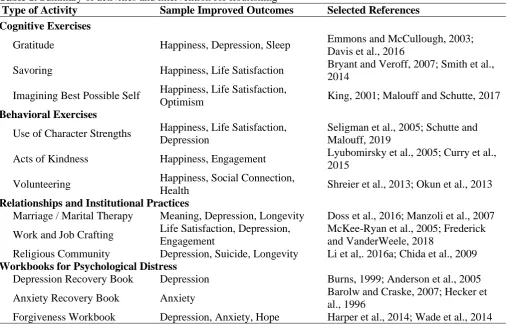
Table 1. Summary of activities and intervention for flourishing
Type of Activity Sample Improved Outcomes Selected References
Cognitive Exercises
Gratitude Happiness, Depression, Sleep Emmons and McCullough, 2003;
Davis et al., 2016
Savoring Happiness, Life Satisfaction Bryant and Veroff, 2007; Smith et al.,
2014
Imagining Best Possible Self Happiness, Life Satisfaction,
Optimism King, 2001; Malouff and Schutte, 2017
Behavioral Exercises
Use of Character Strengths Happiness, Life Satisfaction, Depression
Seligman et al., 2005; Schutte and Malouff, 2019
Acts of Kindness Happiness, Engagement Lyubomirsky et al., 2005; Curry et al.,
2015
Volunteering Happiness, Social Connection,
Health Shreier et al., 2013; Okun et al., 2013
Relationships and Institutional Practices
Marriage / Marital Therapy Meaning, Depression, Longevity Doss et al., 2016; Manzoli et al., 2007
Work and Job Crafting Life Satisfaction, Depression, Engagement
McKee-Ryan et al., 2005; Frederick and VanderWeele, 2018
Religious Community Depression, Suicide, Longevity Li et al,. 2016a; Chida et al., 2009
Workbooks for Psychological Distress
Depression Recovery Book Depression Burns, 1999; Anderson et al., 2005
Anxiety Recovery Book Anxiety Barolw and Craske, 2007; Hecker et
al., 1996
Further randomized trial evidence would be desirable as only one small trial has been conducted. Moreover, once again, these book resources are not substitutes for a trained therapist, and anxiety disorders should be addressed with the help of a professional.
Research has indicated that forgiving others for wrongs they have done to you is generally associated with better mental health, greater hope, and possibly better physical health (Wade, Hoyt, Kidwell, and Worthington, 2014; Toussaint et al., 2015; VanderWeele, 2018). Often forgiveness of another for a substantial wrong is difficult and takes considerable time. Forgiveness, conceived of as the replacing of ill-will with good-will towards the offender, is different from condoning, or reconciling, or not demanding justice. One can forgive, and hope for the ultimate good of the offender, while still pursuing a just outcome. Interventions have been developed to promote forgiveness for those who want to forgive and are struggling to do so. These interventions have been examined in randomized trials and have been shown to be effective not only in increasing forgiveness but also in decreasing depression, decreasing anxiety, and increasing hope (Wade et al., 2014). Most of the interventions require many sessions with a trained therapist or counselor. However, recently a workbook intervention to promote forgiveness has been developed with evidence of effectiveness from one small randomized trial (Harper et al., 2014). The “Path to Forgiveness” workbook is freely available online (http://www.evworthington-forgiveness.com/diy-workbooks). Further research on the effectiveness of such workbook interventions is needed, but the initial results seem to indicate that forgiveness itself can powerfully promote human flourishing and free the victim from recurrent cycles of anger and rumination.
In this paper we have considered a variety of activities and commitments that can promote human flourishing. We have examined three cognitive activities oriented towards the good in the past (gratitude), in the present (savoring), and in the future (imagining). We have examined three behavioral activities oriented towards seeking what is good in oneself (use of character strengths), for others (acts of kindness), and for the community (volunteering). We have examined three sets of institutional commitments oriented towards the good of family (marriage, and relationship therapy), the world (work, and job crafting), and the divine or transcendent (religious community). Finally, we have examined three
book or workbook interventions intended to address psychological distress over emotions of sadness (depression recovery), fear (anxiety recovery), and anger (forgiveness). Table 1 summarizes these interventions or activities, some of the outcomes for which there is evidence that they are changed, and a couple of representative references for that evidence. In each case, other than for the anxiety recovery book, one reference is given to a representative study, and another to a meta-analysis summarizing the evidence. Up to three changed outcomes for which there is evidence are given as examples. However, fuller details of the evidence and outcomes are given in the discussion above and, of course, in the original studies referenced. The potential for these various activities, interventions, and commitments to enhance well-being is substantial. Each is voluntary and nearly costless to participate in.
interventions can be employed to enhance human flourishing.
The author has served as a consultant for Aetna’s well-being assessment. The author has no financial interests in any of the workbooks or online activities or programs that are discussed in the paper. The author is a research collaborator with Everett Worthington who developed the forgiveness workbook intervention.
This research is support by Templeton Foundation grant 61075.
Tyler J. VanderWeele https://orcid.org/0000-0002-6112-0239
Received: June 29, 2019 Accepted: September 30, 2019 Published Online: November 12, 2019
Allin, P. & Hand, D. J. (2017). New statistics for old? - measuring the wellbeing of the UK. Journal of the
Royal Statistical Society, Series A, 180,1-22.
Anderson, L., Lewis, G., Araya, R., Elgie, R., Harrison, G., Proudfoot, J., Schmidt, U., Sharp, D., Weightman, A., & Williams, C. (2005). Self-help books for depression: how can practitioners and patients make the right choice? British Journal of General Practice, 55,387-392.
Anderson, N. D., Damianakis, T., Kröger, E., Wagner, L. M., Dawson, D. R., Binns, M. A., Bernstein, S., Caspi, E., Cook, S. L. & the BRAVO Team. (2014). The benefits associated with volunteering among seniors: a critical review and recommendations for future research. Psychological Bulletin, 140,1505-1533.
Aquinas, T. (1948). Summa Theologica. Complete
English translation in five volumes. Notre Dame, IN:
Ave Maria Press. (Original work published 1274). I.II.Q11,Q31.
Aristotle (1925). Aristotle The Nicomachean Ethics:
Translated with an Introduction. Oxford: Oxford
University Press. ISBN 0-19-283407-X. Translated: David Ross. Re-issued 1980, revised by J. L. Ackrill and J. O. Urmson.
Bache, I., & Reardon, L. (2016). The Politics and Policy
of Wellbeing. Edward Elgar Publishing. Cheltenham,
UK.
Barlow, D. H. & Craske M. G. (2007). Mastery of Your
Anxiety and Panic. 4th Edition. New York: Oxford
University Press.
Boehm, J. K., Lyubomirsky, S., & Sheldon, K. M. (2011) A longitudinal experimental study comparing the effectiveness of happiness-enhancing strategies in Anglo Americans and Asian Americans. Cognition &
Emotion, 25(7),1263-1272.
Bolier, L., Haverman, M., Westerhof, G. J., Riper, H., Smit, F., & Bohlmeijer, E. (2013). Positive psychology interventions: a meta-analysis of randomized controlled studies. BMC Public Health. 13,119. doi: 10.1186/1471-2458-13-119.
Burns, D. (1999). Feeling Good: The new mood therapy (Rev. ed.). New York: Avon.
Bryant, F. B. & Veroff, J. (2007): Savoring: A New
Model of Positive Experiences. Mahwah, NJ:
Lawrence Erlbaum Associates.
Call, V., & Heaton, T. (1997). Religious influence on marital stability. Journal for the Scientific Study of
Religion, 36,382-392.
Cai. T., Tian, L., Wong, P. H., & Wei, L. J. (2011). Analysis of randomized comparative clinical trial data for personalized treatment selections.
Biostatistics, 12,270–282.
Carlbring, P., Westling, B. E., & Andersson, G. (2000). A review of published self-help books for panic disorder. Scandinavian Journal of Behaviour
Therapy, 29,5-13.
Catholic Church. (2000). Catechism of the Catholic
Church (2nd ed.). Vatican City: Libreria Editrice
Vaticana.
Chancellor, J., Margolis, S., & Lyubomirsky, S. (2018) The propagation of everyday prosociality in the workplace. Journal of Positive Psychology, 13,271-283.
Clum, G. A. (1990). Coping With Panic: A Drug-Free
Approach to Dealing With Anxiety, Attacks
Brooks/Cole Publishing.
Chida, Y., Steptoe, A., & Powell, L. H. (2009). Religiosity/spirituality and mortality: A systematic
quantitative review. Psychotherapy and
Psychosomatics, 78(2),81–90.
Cuijpers, P., Cristea, I. A., Karyotaki, E., Reijnders, M., & Huibers, M. J. (2016). How effective are cognitive behavior therapies for major depression and anxiety disorders? A meta-analytic update of the evidence.
Curry, O. S., Rowland, L. A., Van Lissa, C. J., Zlotowitz, S., McAlaney, J., & Whitehouse, H. (2018). Happy to help? A systematic review and meta-analysis of the effects of performing acts of kindness on the well-being of the actor. Journal of Experimental Social
Psychology, 76,320–9.
Davis, D. E., Choe, E., Meyers, J., Wade, N., Varjas, K., Gifford, A., Quinn, A., Hook, J. N., Van Tongeren, D.R., Griffin, B. J., & Worthington, E. L. (2016). Thankful for the little things: a meta-analysis of gratitude interventions. Journal of Counseling
Psychology, 63,20-31.
Doss, B. D., Cicila, L. N., Georgia, E. J., Roddy, M. K., Nowlan, K. M., Benson, L. A., & Christensen, A. (2016). A randomized controlled trial of the web-based OurRelationship program: Effects on relationship and individual functioning. Journal of
Consulting and Clinical Psychology. 84:285-296.
Fowler, J. H., & Christakis, N. A. (2010). Cooperative behavior cascades in human social network.
Proceedings of the National Academy of Sciences,
107,5334-5338.
Emmons, R. A., & McCullough, M. E. (2003). Counting blessings versus burdens: An experimental investigation of gratitude and subjective well-being in daily life. Journal of Personality and Social
Psychology, 84,377-389.
Frederick, D. E. & VanderWeele, T. J. (2018). A meta-analysis of the association of job-crafting and work
engagement. Preprint available
at: https://osf.io/2xtk3/. Techical Report.
Gruenewald, T. L., Tanner, E. K., Fried, L. P., Carlson, M. C., Xue, Q. L., Parisi, J. M., ... & Seeman, T. E. (2015). The Baltimore experience corps trial: enhancing generativity via intergenerational activity engagement in later life. Journals of Gerontology Series B: Psychological Sciences and Social
Sciences, 71(4),661-670.
Halford, W. K. & Doss, B. D. (2016). New frontiers in the treatment of couples. International Journal of
Cognitive Therapy, 9(2),124-139.
Harper, Q., Worthington, E. L., Griffin, B. J., Lavelock, C. R., Hook, J. N., Vrana, S. R., & Greer, C. L. (2014). Efficacy of a workbook to promote forgiveness: a randomized controlled trial with university students. Journal of Clinical Psychology, 70,1158–1169.
Haug, T., Nordgreen, T., Öst, L. G., & Havik, O. E. (2012). Self-help treatment of anxiety disorders: A meta-analysis and meta-regression of effects and
potential moderators. Clinical Psychology Review, 32,425-445.
Hecker, J. E., Loses, M. C., Fritzler, B. K., & Fink, C. M. (1996). Self-directed versus therapist-directed cognitive behavioral treatment for panic disorder.
Journal of Anxiety Disorders, 10,253-265.
Hendriks, T., Schotanus-Dijkstra, M., Hassankhan, A., de Jong, J., & Bohlmeijer, E. (2019). The efficacy of multi-component positive psychology interventions: A systematic review and meta-analysis of randomized controlled trials. Journal of Happiness
Studies, 1-34. Published Online 11 February 2019;
https://doi.org/10.1007/s10902-019-00082-1
Jarden, A., & Jarden, R. (2016). Positive psychological assessment for the workplace. In L Oades et al. (Eds.),
The Wiley-Blackwell Handbook of Positive
Psychology at Work, pp. 415-437. Published Online:
19 Nov 2016: DOI: 10.1002/9781118977620.ch22 Jordan, J. J., Rand, D. G., Arbesman, S., Fowler, J. H., &
Christakis, N. A. (2013). Contagion of cooperation in static and fluid social networks. PLoS One, 8(6),e66199.
Kaplan, R. M. & Kronick, R. G. (2006). Marital Status and Longevity in the United States Population.
Journal of Epidemiology and Community Health,
60,760-765.
Kerr, S. L., O’Donovan, A., & Pepping, C. A. (2015). Can gratitude and kindness interventions enhance well-being in a clinical sample? Journal of Happiness
Studies, 16,17–36.
Keyes, C. L. (2002). The mental health continuum: from languishing to flourishing in life. Journal of Health
and Social Behavior, 43(2),207-222.
King, L. A. (2001). The health benefits of writing about life goals. Personality and Social Psychology
Bulletin, 27,798-807.
Koenig, H. G., King, D. E., & Carson, V. (2012).
Handbook of Religion and Health (2nd ed.). Oxford,
UK: Oxford University Press.
Layous, K., Nelson, S. K., & Lyubomirsky, S. (2013). What is the optimal way to deliver a positive activity intervention? The case of writing about one's best possible selves. Journal of Happiness Studies, 14,635-654.
Li, S., Okereke, O. I., Chang, S.-C., Kawachi, I., & VanderWeele, T. J. (2016a). Religious service attendance and depression among women – a prospective cohort study. Annals of Behavioral
Medicine, 50,876-884.
attendance and mortality among women. JAMA
Internal Medicine, 176(6),777-785.
Lyubomirsky, S., Sheldon, K. M., & Schkade, D. (2005). Pursuing happiness: the architecture of sustainable change. Review of General Psychology, 9,111-131. Malouff, J. M. & Schutte, N. S. (2017). Can
psychological interventions increase optimism? A meta-analysis. The Journal of Positive Psychology, 12(6),594-604.
Manzoli, L., Villari, P., Pirone, G. M., & Boccia, A. (2007). Marital Status and Mortality in the Elderly: A Systematic Review and Meta-Analysis. Social Science & Medicine, 64,77-94.
Marks, N. F. & Lambert, J. D. (1998). Marital status continuity and change among young and midlife adults longitudinal effects on psychological well-being. Journal of Family Issues, 19,652-686. Martín-María, N., Miret, M., Caballero, F. F.,
Rico-Uribe, L. A., Steptoe, A., Chatterji, S., & Ayuso-Mateos, J. L. (2017). The impact of subjective well-being on mortality: a meta-analysis of longitudinal studies in the general population. Psychosomatic
Medicine, 79(5),565-575.
McKee-Ryan, F., Song, Z., Wanberg, C. R., & Kinicki, A. J. (2005) Psychological and physical well-being during unemployment: A meta-analytic study.
Journal of Applied Psychology, 90,53–76.
Mental Health Foundation of New Zealand. (2010). Flourishing, Positive Mental Health and Wellbeing: How can they be increased?. Available at:
https://www.mentalhealth.org.nz/assets/Flourishing/ Flourishing-and-Positive-Mental-Health-Dec-2010.pdf (Last Accessed: September 12, 2019) Mooney, K. (2019). The next evolution of holistic
well-being. Available at :
https://www.linkedin.com/pulse/next-evolution-holistic-well-being-kay-mooney (Last Accessed: September 12, 2019)
National Research Council (2013). Subjective
Well-Being. Washington, DC: National Academies Press.
Okun, M. A., Yeung, E. W., & Brown, S. (2013). Volunteering by older adults and risk of mortality: A meta-analysis. Psychology and Aging, 28(2),564-577. Ouweneel, E., Le Blanc, P. M., & Schaufeli, W. B. (2014). On being grateful and kind: results of two randomized controlled trials on study-related emotions and academic engagement. The Journal of
Psychology, 148,37-60.
Paul, K. I., & Moser, K. (2009) Unemployment impairs mental health: Meta-analyses. Journal of Vocational
Behavior, 74,264–282.
Peters, M. L., Meevissen, Y. M. C., & Hanssen M. M. (2013). Specificity of the Best Possible Self intervention for increasing optimism: Comparison with a gratitude intervention. Terapia Psicológica, 31(1),93-100.
Peterson, C. & Seligman, M. E. P. (2005). Character
Strengths and Virtues. New York: Oxford University
Press.
Pool, M. S., Agyemang, C. O., & Smalbrugge, M. (2017). Interventions to improve social determinants of health among elderly ethnic minority groups: a review. The European Journal of Public Health, 27,1048-1054
Post, S. G. (2017). Rx It's good to be good (G2BG) 2017 commentary: prescribing volunteerism for health, happiness, resilience, and longevity. American
Journal of Health Promotion, 31,164-172.
Ryff, C. D. (1989). Happiness is everything, or is it? Explorations on the meaning of psychological well-being. Journal of Personality and Social Psychology, 57,1069–1081.
Schreier, H. M., Schonert-Reichl, K. A., & Chen, E. (2013). Effect of volunteering on risk factors for cardiovascular disease in adolescents: A randomized controlled trial. JAMA Pediatrics, 167(4),327-332. Schueller, S. M.., Kashdan, T. B., & Parks, A. C., (2014).
Synthesizing positive psychological interventions: Suggestions for conducting and interpreting meta-analyses. International Journal of Wellbeing, 4(1),91-98. doi:10.5502/ijw.v4i1.5
Schutte, N. S., & Malouff, J. M. (2019). The impact of signature character strengths interventions: A meta-analysis. Journal of Happiness Studies, 20(4),1179-1196.
Seligman, M. E. P., Steen, T. A., Park, N., & Peterson, C. (2005). Positive psychology progress: empirical validation of interventions. American Psychologist, 60,410–421.
Sin, N. L. & Lyubomirsky, S. (2009). Enhancing well-being and alleviating depressive symptoms with positive psychology interventions: a practice-friendly meta-analysis. Journal of Clinical Psychology: In
Session, 65(5),467-487.
Smith, J. L., Harrison, P. R., Kurtz, J. L., & Bryan, F. B. (2014). Nurturing the capacity to savor: interventions to enhance the enjoyment of positive experiences. In: A.C. Parks and S.M. Schueller (eds.). The Wiley Blackwell Handbook of Positive Psychological
Interventions. John Wiley and Sons: West Sussex,
Su, R., Tay, L., & Diener, E. (2014). The development and validation of the comprehensive inventory of thriving (CIT) and the brief inventory of thriving (BIT). Applied Psychology: Health and Well-Being, 6,251–279.
Toussaint, L. L., Worthington, E. L., & Williams, D. R. (2015). Forgiveness and Health: Scientific Evidence
and Theories Relating Forgiveness to Better Health.
Dordrecht, The Netherlands: Springer.
VanderWeele, T. J., Li, S., Tsai, A., & Kawachi, I. (2016a). Association between religious service attendance and lower suicide rates among US women.
JAMA Psychiatry, 73,845-851.
VanderWeele, T. J., Yu, J., Cozier, Y.C., Wise, L., Argentieri, M. A., Rosenberg, L., Palmer, J. R., & Shields, A. E. (2017). Religious service attendance, prayer, religious coping, and religious-spiritual identity as predictors of all-cause mortality in the Black Women’s Health Study. American Journal of
Epidemiology, 185,515-522.
VanderWeele, T. J. (2017a). On the promotion of human flourishing. Proceedings of the National Academy of
Sciences, U.S.A., 31,8148-8156.
VanderWeele, T. J. (2017b). Religious communities and human flourishing. Current Directions in
Psychological Science, 26,476-481.
VanderWeele, T. J. (2017c). Religion and health: a synthesis. In: Balboni, M.J. and Peteet, J.R. (eds.). Spirituality and Religion within the Culture of
Medicine: From Evidence to Practice. New York,
NY: Oxford University Press, p 357-401.
VanderWeele, T. J. (2018). Is forgiveness a public health issue? American Journal of Public Health, 108,189-190.
VanderWeele, T. J., McNeely, E., & Koh, H. K. (2019a). Reimagining health – flourishing. JAMA, 321,1667-1668.
VanderWeele, T. J., Luedtke A. R., van der Laan, M. J., & Kessler, R. C. (2019b). Selecting optimal subgroups for treatment using many covariates.
Epidemiology, 30,334-341.
VanderWeele, T. J., Mathur, M. B., & Chen, Y. (2019c). Media portrayals and public health implications for suicide and other behaviors. JAMA Psychiatry,
Published online May 29, 2019.
doi:10.1001/jamapsychiatry.2019.0842.
Wade, N. G., Hoyt, W. T., Kidwell, J. E., & Worthington E. L. (2014). Efficacy of psychotherapeutic interventions to promote forgiveness: a meta-analysis. Journal of Consulting and Clinical
Psychology, 82,154-170.
Waite, L. J. & Gallagher, M. (2000). The Case for
Marriage. New York: Doubleday.
Westminster. (2014). Westminster Shorter Catechism. Radford, VA: SMK books. (Original work published 1647).
Węziak-Białowolska, D., Koosed, T., Leon, C., & McNeely, E. (2018). A new approach to the well-being of factory workers in global supply chains: Evidence from apparel factories in Mexico, Sri Lanka, China and Cambodia. In Measuring the Impacts of Business on Well-Being and Sustainability (pp. 130–154). Paris: OECD and HEC Paris/SnO centre.
Wilcox, W. B. (2011). Why Marriage Matters: 30
Conclusions from the Social Sciences. 3rd Edition.
New York: Institute for American Values/National Marriage Project.
Wilcox, W. B., & Wolfinger, N. H. (2016). Soul Mates: Religion, Sex, Love, and Marriage among African
Americans and Latinos. New York: Oxford
University Press.
Wilson, C. M., & Oswald, A. J. (2005). How Does Marriage Affect Physical and Psychological Health? A Survey of the Longitudinal Evidence. IZA Bonn Discussion Paper No. 1619. The Institute for the Study of Labor.
Wood, R. G., Goesling, B., & Avellar, S. (2007). The Effects of Marriage on Health: A Synthesis of Recent Research Evidence. Mathematica Policy Research Inc.
Wood, A. M., & Joseph, S. (2010). The absence of positive psychological (eudemonic) well-being as a risk factor for depression: A ten year cohort study.
Journal of Affective Disorders, 122(3),213-217.