RESEARCH ARTICLE
Omega-3 fatty acids for the treatment
of depressive disorders in children
and adolescents: a meta-analysis of randomized
placebo-controlled trials
Li Zhang
1, Huan Liu
2, Li Kuang
2, Huaqing Meng
2and Xinyu Zhou
2*Abstract
Background: To investigate the efficacy and safety of omega-3 fatty acids (O3FA) in treating depressive disorders in children and adolescents.
Method: We conducted a comprehensive search in electronic databases and hand-searched articles included for rel-evant studies. We included randomized controlled trials which studied on O3FA for treatment of children and adoles-cents with depression. The standard mean differences (SMDs) and the odds ratios (ORs) with 95% confidence intervals (CIs) were estimated by a random-effects model. The primary outcomes were end-point depressive symptoms scores (efficacy) and all-cause discontinuation (safety). The secondary outcome of response rate was also assessed. Subgroup analyses were performed by age, severity of depression and dosage. Risk of bias assessment was performed based on the Jadad score and the Cochrane Collaboration’s risk-of-bias method.
Results: A total of four studies with 153 participants were included. In terms of efficacy, there was no significant
dif-ference of end-point depressive symptoms scores between O3FA and placebo (SMD =− 0.12, 95% CI − 0.53 to 0.30,
P = 0.58; I2= 30%). In terms of safety, the all-cause discontinuation showed no statistical significance between O3FA
and placebo (OR = 1.3, 95% CI 0.58 to 2.93, P = 0.53; I2= 0%). The response rate of O3FA was also not significant better
than that of placebo (OR = 1.57, 95% CI 0.26 to 9.39, P = 0.62; I2= 71%). Besides, there were also no significant
differ-ences in those subgroup analyses outcomes. The risk of bias of included trials were not high.
Conclusions: Only considering the limited evidence of O3FA in the acute treatment of major depressive disorder, it did not seem to offer a clear advantage for children and adolescents.
Keywords: Omega-3 fatty acids, Pediatric, Depression, Meta-analysis
© The Author(s) 2019. This article is distributed under the terms of the Creative Commons Attribution 4.0 International License
(http://creat iveco mmons .org/licen ses/by/4.0/), which permits unrestricted use, distribution, and reproduction in any medium,
provided you give appropriate credit to the original author(s) and the source, provide a link to the Creative Commons license, and indicate if changes were made. The Creative Commons Public Domain Dedication waiver (http://creativecommons.org/ publicdomain/zero/1.0/) applies to the data made available in this article, unless otherwise stated.
Background
Depression is a common and serious mental disorder. As reported, there are more than 350 million depressed people all over the world [1]. As to pediatric depression, the prevalence is also high, with approximately 2.8% of children and 5.6% of adolescents worldwide [2]. A 70% chance of pediatric depression will relapse in 5 years,
and half of young people would experience a recurrence at least once during their adult life [3]. Pediatric depres-sion is always under-diagnosed, because they may have only atypical depressive manifestations, such as irritabil-ity, mood fluctuating, and school refusal [4, 5]. Depres-sion does great harm to young people’s social ability, and it is a major risk factor for suicide in children and ado-lescents [1, 6]. There are mainly two therapies: psycho-therapy and pharmacopsycho-therapy. Although psychopsycho-therapy is recommended as the first-line treatment for depres-sion in children and adolescent [6], the effect is always mild [4]. Antidepressants are widely used in clinic and
Open Access
*Correspondence: [email protected]
2 Department of Psychiatry, The First Affiliated Hospital of Chongqing
Medical University, Yixueyuan Road, Yuzhong District, Chongqing 400016, People’s Republic of China
for moderate to severe pediatric depression, antidepres-sants and psychotherapy may be started concurrently [6]. However, in 2016, a network meta-analysis including 34 randomized placebo-controlled trials (RCTS) concluded that most antidepressant drugs did not seem to offer a clear benefit to pediatric depression [7]. And as early as in 2004 the US Food and Drug Administration (FDA) alerted clinicians to the increased risk of suicidality (sui-cidal thinking and behavior) in children and adolescents associated with antidepressants use [8].
Omega-3 fatty acids (O3FA), a kind of nutrients, is composed of eicosapentaenoic acid (EPA) and doco-sahexaenoic acid (DHA), which cannot be synthesized efficiently by human body, so dietary intake is the main source, such as fish oil, seafood, flaxseed oil and perilla oil [9]. Recently, researches found that O3FA supplemen-tation might be effective for several neuropsychiatric dis-orders, such as attention deficit hyperactivity disorder (ADHD) and autism spectrum disorder (ASD) [10–12]. It was also reported that higher fish consumption was related to a reduced depression risk [13, 14] and O3FA was an effective adjunctive treatment for adult depression [15, 16]. Several meta-analyses and reviews also showed that supplementation of O3FAs could relieve symptoms of depression for adult age groups [17–19], but no such evidence especially studied in depressed children and adolescents. Therefore, we conducted this meta-analysis to pool present evidences on efficacy and safety of O3FA compared to placebo in the treatment of children and adolescents with depressive disorders.
Method Literature search
We conducted a comprehensive search in the follow-ing electronic databases, includfollow-ing PubMed, Embase, Cochrane Library, Web of Science, and PsycINFO cita-tions, as well as some international trials registers, including WHO’s trials portal, US ClinicalTrials.gov, EU Clinical Trials Register and Australian New Zealand Clinical Trials Registry, up to July 2019. The following search terms were used: (‘omega-3’ or ‘n − 3’ or ‘polyun-saturated fatty acid*’ or ‘un‘polyun-saturated fatty acid*’ or ‘PUFA’ or ‘eicosapentaenoic acid’ or ‘docosahexaenoic acid’ or ‘EPA’ or ‘DHA’) and (‘child*’ or ‘adolesc*’ or ‘pediatri*’) and (‘depress*’ or ‘dysthymi*’ or ‘affective disorder*’ or ‘mood disorder*’). Relevant articles were also hand-searched for eligible reports. No limitations were applied in the search.
Selection criteria
We included: (1) RCTs with both parallel arms and cross-over design (for cross-cross-over trials, we only used data from the pre-crossover phase); (2) children (aged 6–12) and/or
adolescents (aged 13–18) with depressive disorders; (3) the intervention group could be O3FA treatment, or any component of it (EPA or DHA). No combined treatments like antidepressants or psychotherapy; (4) the comparison group should be placebo treatment; (5) efficacy outcome was assessed by depression scales. The most common questionnaire or instrument used in the youth are The Children’s Depression Rating Scale (CDRS), revised CDRS (CDRS-R), Beck Depression Inventory (BDI) and Children’s Depression Inventory (CDI). We used the end-point score of depressive scale in each group as our primary efficacy outcome. The secondary efficacy out-come was the response rate to omega-3 treatment. The response rate was defined as ≥ 50% change from baseline on depression score or a score of ≤ 28 at the end-point of a trial on the CDRS-R [20]. We also investigated all-cause discontinuation as safety outcome. We excluded: (1) tri-als without random design or with just quasi-random design; (2) data of outcomes couldn’t be acquired; (3) studies with duplicated data. Two authors (ZL and ZXY) reviewed all the screened trials independently according to the above inclusion and exclusion criteria with strong interrater agreement (κ = 0.90).
Data collection and risk of bias assessment
The following data were collected: publication informa-tion (the first author, publicainforma-tion year, study country), study and patients characteristics (study design type, sample size, age group, diagnostic criteria, severity of depression, rating scales, daily dosage and duration of O3FA, ratio or dosage of EPA and DHA), outcome data (baseline data, post-treatment data, drop-out rate, adverse events).
Risk of bias of the selected studies was assessed by the modified Jadad score [21] and the Cochrane Collabora-tion’s risk-of-bias method [22] simultaneously. Accord-ing to the modified Jadad score, we appraised risk of bias from four domains, including generation of allocation sequence, allocation concealment, investigator blind-ness, and description of withdrawals and dropouts. The specific scoring method was shown in Additional file 1: Figure S1.
All of the above data extraction and risk of bias assess-ment were finished by the two reviewers (ZL and ZXY) independently. When meeting missing data or informa-tion, one author would e-mail the authors for further acquisition. Disagreements were resolved by discussion.
Statistical analysis
continuous variables and the odds ratios (ORs) with 95% CIs to estimate effect size of dichotomous vari-ables. For continuous variables, difference of the end-point data with standard deviation (SD) between O3FA and placebo was the effect value [23]. A ran-dom-effects model was chosen to calculate the effect sizes for expected heterogeneity. If SD was unavail-able in a article and could not contact the authors, we would be calculate it from reported P values, t values, CIs or standard errors (SEs) in the article [24]. The heterogeneity was calculated by the test of inconsist-ency (I2) [25]. To investigate the possible sources of
heterogeneity, we conducted subgroup analyses. The publication bias was evaluated by Egger tests when there were more than ten trials [26]. A two-sided P value of less than 0.05 was considered statistically significant.
Results
Selection of studies
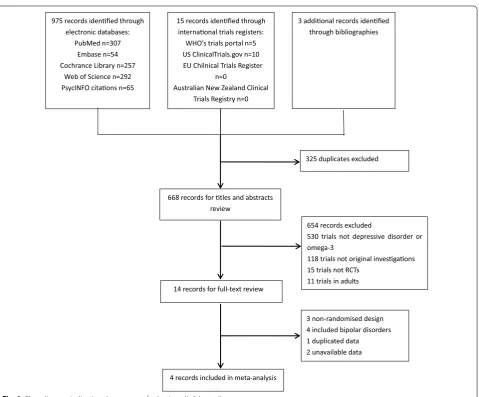
With the keywords above, a total of 993 records was yielded preliminarily, of which 990 records were from electronic databases and three records were from hand-search. After removing the 325 duplicates, 668 records were reviewed based on titles and abstracts. And then, 14 potentially eligible records were screened out for full-text review. With careful review and strict criteria, we finally included four RCT trials in this meta-analysis [27–30]. The flow diagram was shown in Fig. 1. The 14 excluded records were shown in Additional file 2: Table S1.
Description of the included studies
Most of the included studies were published in recent 2 years except the one by Nemet [29]. Of the four included studies, two were from America [27, 28],
3 non-randomised design 4 included bipolar disorders 1 duplicated data 2 unavailable data
4 records included in meta-analysis 668 records for tles and abstracts
review
14 records for full-text review
654 records excluded
530 trials not depressive disorder or omega-3
118 trials not original invesgaons 15 trials not RCTs
11 trials in adults 975 records idenfied through
electronic databases: PubMed n=307
Embase n=54 Cochrance Library n=257
Web of Science n=292 PsycINFO citaons n=65
3 addional records idenfied through bibliographies 15 records idenfied through
internaonal trials registers: WHO’s trials portal n=5 US ClinicalTrials.gov n=10 EU Chilnical Trials Register
n=0
Australian New Zealand Clinical Trials Registry n=0
325 duplicates excluded
whereas one from Europe [30] and the remaining one from Asia [29]. Two studies were conducted in children [27, 29], while the other two were performed in adoles-cents [28, 30]. However, mean sample size was 38 partici-pants, in which only one study by Gabbay [28] recruited more than 50 participants. Most participant experi-enced moderate to severe depressive symptoms at base-line on the depression rating scales. In the intervention groups, all the participants received O3FA with a fixed ratio of EPA to DHA and all the ratios of EPA to DHA were higher than 1:1, but there was still a significant dif-ference in the daily intake between studies (400 mg/day to 2289 mg/day). None of the studies provided a single ingredient oil. The whole treatment duration was rela-tively long with a mean duration of 12.5 weeks. Three studies chosen CSDR or CSDR-R [27–29] and one study applied CDI [30] to assess improvement in depressive symptoms. The characteristics of the included studies were shown in Table 1.
Risk of bias in the included studies
Generally, the quality of the included studies were not high. In the study by Nemets [29], the capsule used in the O3FA group was different from the one used in the placebo group in tone of internal color. This could result in failure in blinding of intervention. We found the num-ber of response in the placebo group was 0 in that study, which might be biased caused by failure in blinding of intervention. The result of the modified Jadad scores was shown in Table 1. The study quality assessed by the Cochrane Collaboration’s risk-of-bias method was shown in Additional file 3: Figure S2.
Results for outcomes
A total of four studies with 153 participants evaluated the efficacy and safety of O3FA for depressive disorders in children and adolescents [27–30]. In terms of efficacy outcomes, the summary effect size of end-point depres-sion scale scores, indicated that O3FA was not better than placebo in treating children and adolescents with depressive disorders, with a SMD of − 0.12 (95% CI − 0.53 to 0.30, P = 0.58; I2= 30%, P = 0.23; Fig. 2a). The
other efficacy outcome we were concerned about, the response rate, was also reported in three studies [27–29]. The response rate of O3FA group was still not superior compared to that of placebo group with a OR of 1.57 (95% CI 0.26 to 9.39, P = 0.62; I2= 71%, P = 0.03; Fig. 2b).
In terms of safety outcome, the OR for the all-cause discontinuation was 1.3 (95% CI 0.58 to 2.93, P = 0.53; I2= 0%, P = 0.65; Fig. 2c), which meant no statistical
sig-nificance between the O3FA group and placebo group. Subgroup analyses were also performed in the pri-mary efficacy outcome, stratified by mean age group
(≤ 12 years and > 12 years), severity of depression (mild and moderate to severe), and daily dosage of EPA (≤ 1 g/ day and > 1 g/day). No significance were found in those subgroups. Results of subgroup analyses were presented in Table 2. However, as to small number of included stud-ies, we couldn’t conducted sensitivity analysis or evalu-ated the publication bias.
Discussion
To our best knowledge, this was the first meta-analysis focused on the efficacy and safety of O3FA in children and adolescents with depressive disorders. Through a comprehensive search, we finally enrolled four eligible RCTs with 153 participants. According to the results, O3FA had no positive effects in treating depression in children and adolescents with no statistical significance. These results were in contrast to several previous meta-analyses specifically in adults [18, 19, 31, 32]. But these meta-analyses in adults presented great heterogeneity between studies ranging from 64 to 84.1%, which was mainly from different populations, diagnostic criteria and interventions. Of the four included studies in this meta-analysis, only one study by Nemets [29] had reported a beneficial efficacy of O3FA in the treatment of depression in children and adolescents. In that study, the response rate in the placebo group was 0, which was rare in clini-cal trials in depression among children and adolescents and might have magnified the efficacy of O3FA for chil-dren and adolescents. Data from that trial could hardly be generalized. What’s more, diagnostic criteria, severity of depression, daily dosage of EPA and DHA were all het-erogenous and trials were small scaled, so these results should be interpreted with cautions. Eicosapentaenoic acid (EPA) was reported to be responsible for the benefi-cial effects of O3FA in treating depression in adult [33] and was recommended a higher ratio than 1:1 when used combined EPA + DHA [34, 35]. In this review, we did not find greater benefits in studies with higher dose supple-mentation of EPA in young people.
Table 1 C har ac teristics of the f
our included studies
CDI Childr en ’s D epr ession I nv en tor y, CDRS -R Childr en ’s D epr ession R ating S cale -R evised , DHA doc osahe xaenoic acid , DSM-IV -TR Diag
nostic and S
ta
tistical M
anual of M
en tal Disor ders , t ex t r
evision of the 4th v
ersion, EPA eic osapen taenoic acid , ICD In ter na tional Classifica
tion of Diseases
, K-SADS S chedule f or A ffec tiv e Disor
ders and S
chiz
ophr
enia, the k
iddie v ersion, MDD major depr essiv e disor der , NR not r epor ted , y y ears
a T
he number of pa
tien
ts who w
er
e assig
ned r
andomly
b M
ean end daily dosage of O3F
A
c M
ean end daily dosage of EP
A
d T
her e ar e t w o diff er en
t doses of capsules
, one of which w
as 0.5 g c
on
taining 0.19 g EP
A and the other one w
as 1 g c
on
taining 0.4 g EP
A
e T
he Jadad t
otal sc
or
e 1–3 indica
tes lo
w qualit
y, 4–7 indica
tes high qualit
y Study Coun tr y N a M ale (%) A
ge group (mean)
D isease Se verit y D iag nostic crit eria O3F A s
daily dosage (g/d)
EP
A daily
dosage (g/d)
Ra tio of EP A:DHA D ur ation (w eeks) Ra ting scale End-poin t sc or es
Jadad sco
re e O3F A s arm Plac ebo arm Fr
istad 2016 [27
] USA 36 (18/18) 61.1 7–14 y (11.7) D epr es -siv e disor der M ild t o moder -ate DSM -IV -TR 1.9 1.4 7:1 12 CDRS-R 31.0 ± 9.0 31.0 ± 11.0 5 G abba y
2018 [28
] USA 51 (24/27) 41.7 12–19 y (16.1) MDD M oder -at e t o se ver e DSM -IV -TR 3.4 b 2.3 c 2:1 10 CDRS-R 36.5 ± 10.0 35.2 ± 10.6 4
Nemet 2006 [29
] Israel 28 (13/15) 75.0 6–12 y (10.1) MDD Se ve re K-SADS 1
0.4 or 0.38
d 2:1 16 CDRS 32.0 ± 20.5 53.6 ± 20.5 2 Tr ebatick a
2017 [30
] Slo vak ia 38 (19/19) 21.1 11–17 y (15.6) D epr es -siv e dis -or der or mix ed anxiet y
and depr
The results indicated that marine oil extract may be a preferable alternative treatments for children with ADHD who have just mild or subclinical hyperactivity,
inattention and impulsivity. Recent two meta-analyses also presented modest effects of O3FA in the reducing symptoms of ADHD children [42, 43]. Amminger et al. [11] found that O3FA could reduce hyperactivity and stereotypy symptoms in children with ASD. However, a review by James et al. [44] had not find any improve-ments of symptoms after supplementation of O3FA in people with ASD. The study by Woo et al. [45] also found that supplements of O3FA were acceptable in the pediat-ric eating disorders population.
Psychotherapy, mainly referring to cognitive behav-ioural therapy (CBT) and interpersonal psychotherapy (IPT), is still recommended as the first-line treatment for children and adolescents depression, unless the symptoms are severe [46–48]. But for the management of an uncomplicated or brief depression, mild psycho-social impairment, to begin treatment with education, support, and case management appears to be equally efficacious to psychotherapy [48, 49]. With regards to antidepressants, fluoxetine is the first-line medication for depression in children and adolescents [7, 47, 49]. However, use of antidepressants is not recommended in mild depressed youth considering serious adverse
Fig. 2 Forest plots for the outcomes compared O3FA with placebo. a Scores of depression rating scales; b the response rate; c all-cause
discontinuation
Table 2 Subgroup analyses of O3FA for the treatment of depressive disorders in children and adolescents
EPA eicosapentaenoic acid
a Children were aged between 6 and 12 years and adolescents were aged
between 13 and 18 years
Subgroups Overall effect Subgroup difference SMD (95% CI) P I2 (%) P
Mean age (years)a
≤ 12 [27, 29] − 0.45 (− 1.43, 0.53) 0.37 0 0.34 > 12 [28, 30] 0.07 (− 0.36, 0.51) 0.74
Severity of depression
Mild [27] − 0.00 (− 0.96, 0.67) 1.00 0 0.67 Moderate to
severe [28–30] − 0.19 (− 0.79, 0.40) 0.52 Daily dosage of EPA (g/day)
effects of drugs, and antidepressants are thought appro-priate only after an unsuccessful 3-month specific psy-chological therapy in moderate to severe depressed adolescents [47, 50]. For a child with moderate to severe depression and unresponsive to a 3-month spe-cific psychological therapy, antidepressants should still be prescribed with cautions [47].
O3FA has an excellent safety profile as dietary nutri-ent. Only one of the 153 participants stated more fre-quent defecation after taking O3FA [30]. No other adverse events, even any mild discomforts, were reported in the included studies in this review. More than that, no published literature had reported any side effects of O3FA so far. As no participant was discontin-ued for adverse events, the outcome of discontinuation for adverse events was not assessed. Meanwhile, the OR for all-cause discontinuation indicated no difference between O3FA and placebo.
This review has several limitations. Firstly, number of studies on children and adolescents with depressive dis-orders was small. Only four studies met our inclusion criteria. And in the only four eligible studies, the sample sizes were really small with the biggest enrollment of 51 participants. This downgraded the strength of evidence directly. Secondly, diagnostic criteria, severity of depres-sion, daily dosage of EPA and DHA were heterogenous in those included studies. However, due to small num-ber of the included studies, the value of I2 may have
lim-ited statistical power in finding heterogeneity. Thirdly, as polyunsaturated fatty acids are common nutrients in our diets, and baseline dietary intake varies in different pop-ulation [51]. However, none of the included studies had taken this into consideration in the study design.
Conclusions
The evidence available indicated no efficacy of O3FA for the treatment of children and adolescents. How-ever, for small number of trials and sample sizes, the strength of evidence was weak. Nevertheless, O3FA were safe without adverse events occurring.
Supplementary information
Supplementary information accompanies this paper at https ://doi.
org/10.1186/s1303 4-019-0296-x.
Additional file 1: Figure S1. The modified Jadad score.
Additional file 2: Table S1. Reasons for excluding the 10 studies.
Additional file 3: Figure S2. Risk of bias assessed by the Cochrane Col-laboration’s risk-of-bias method.
Abbreviations
BDI: Beck Depression Inventory; CDI: Children’s Depression Inventory; CDRS: Children’s Depression Rating Scale; CI: confidence interval; DHA:
docosahexaenoic acid; EPA: eicosapentaenoic acid; FDA: Food and Drug Administration; O3FA: omega-3 fatty acids; OR: odds ratio; RCT : randomized placebo-controlled trial; SE: standard error; SMD: standard mean difference.
Acknowledgements
Not applicable.
Authors’ contributions
LZ and XYZ contributed towards the study design. LZ, HL and XYZ contributed towards he identification of eligible studies and data extraction. LZ, HL and XYZ contributed towards data analysis. LZ, LK, HQM and XYZ contributed towards writing the manuscript. All authors read and approved the final manuscript.
Funding
This work was supported by the National Natural Science Foundation of China (Grant No. 81873800 and Grant No. 81701342).
Availability of data and materials
Not applicable.
Ethics approval and consent to participate
Not applicable.
Consent for publication
Not applicable.
Competing interests
The authors declare that they have no competing interests.
Author details
1 The First Branch, The First Affiliated Hospital of Chongqing Medical University,
Chongqing, China. 2 Department of Psychiatry, The First Affiliated Hospital
of Chongqing Medical University, Yixueyuan Road, Yuzhong District, Chong-qing 400016, People’s Republic of China.
Received: 18 May 2019 Accepted: 3 September 2019
References
1. Marcus M, Yasamy MT, Ommeren MV, Van Ommeren M, Chisholm D, Saxena S, et al. Depression: a global public health concern. Geneva: World Health Organization, Department of Mental Health and Substance Abuse; 2012.
2. Costello JE, Erkanli A, Angold A. Is there an epidemic of child or adoles-cent depression? J Child Psychol Psychiatry. 2006;47:1263–71. 3. Lopresti AL. A review of nutrient treatments for paediatric depression. J
Affect Disord. 2015;181:24–32.
4. Thapar A, Collishaw S, Pine DS, Thapar AK. Depression in adolescence. Lancet. 2012;379(9820):1056–67.
5. Olfson M, Blanco C, Wang S, Laje G, Correll CU. National trends in the mental health care of children, adolescents, and adults by office-based physicians. JAMA Psychiatry. 2014;71(1):81–90.
6. Hopkins K, Crosland P, Elliott N, Bewley S, For the Clinical Guidelines Update Committee B. Diagnosis and management of depression in children and young people: summary of updated NICE guidance. BMJ. 2015;350:h824.
7. Cipriani A, Zhou XY, Del GC, Hetrick SE, Qin B, Whittington C, et al. Com-parative efficacy and tolerability of antidepressants for major depressive disorder in children and adolescents: a network meta-analysis. Lancet. 2016;388(10047):881–90.
8. US Food and Drug Administration. Suicidality in children and adoles-cents being treated with antidepressant medications. https ://www. fda.gov/drugs /postm arket -drug-safet y-infor matio n-patie nts-and-provi ders/suici dalit y-child ren-and-adole scent s-being -treat ed-antid epres
sant-medic ation s. Accessed 2 May 2018.
10. Bos DJ, Oranje B, Veerhoek ES, Van Diepen RM, Weusten JM, Dem-melmair H, et al. Reduced symptoms of inattention after dietary Omega-3 fatty acid supplementation in boys with and without attention deficit/hyperactivity disorder. Neuropsychopharmacology. 2015;40(10):2298–306.
11. Amminger GP, Berger GE, Schäfer MR, Klier C, Friedrich MH, Feucht M. Omega-3 fatty acids supplementation in children with autism: a double-blind randomized, placebo-controlled pilot study. Biol Psychia-try. 2007;61(4):551–3.
12. Widenhorn-Müller K, Schwanda S, Scholz E, Spitzer M, Bode H. Effect of supplementation with long-chain ω-3 polyunsaturated fatty acids on behavior and cognition in children with attention deficit/hyperactivity disorder (ADHD): a randomized placebo-controlled intervention trial. Prostaglandins Leukot Essent Fatty Acids. 2014;91(1–2):49–60. 13. Lai JS, Hiles S, Bisquera A, Hure AJ, McEvoy M, Attia J. A systematic
review and meta-analysis of dietary patterns and depression in community-dwelling adults. Am J Clin Nutr. 2014;99(1):181–97. 14. Timonen M, Horrobin D, Jokelainen J, Laitinen J, Herva A, Räsänen P.
Fish consumption and depression: the Northern Finland 1966 birth cohort study. J Affect Disord. 2004;82(3):447–52.
15. Ginty AT, Conklin SM. Short-term supplementation of acute long-chain omega-3 polyunsaturated fatty acids may alter depression status and decrease symptomology among young adults with depression: a preliminary randomized and placebo controlled trial. Psychiatry Res. 2015;229(1–2):485–9.
16. Mozaffari-Khosravi H, Yassini-Ardakani M, Karamati M, Shariati-Bafghi SE. Eicosapentaenoic acid versus docosahexaenoic acid in mild-to-moderate depression: a randomized, double-blind, placebo-controlled trial. Eur Neuropsychopharmacol. 2013;23(7):636–44.
17. Grosso G, Galvano F, Marventano S, Malaguarnera M, Bucolo C, Drago F, et al. Omega-3 fatty acids and depression: scientific evidence and biological mechanisms. Oxidative Med Cell Longev. 2014;2014:313570. 18. Grosso G, Pajak A, Marventano S, Castellano S, Galvano F, Bucolo C,
et al. Role of Omega-3 fatty acids in the treatment of depressive disor-ders: a comprehensive meta-analysis of randomized clinical trials. PLoS ONE. 2014;9(5):e96905.
19. Scheffta C, Kilarskib LL, Tom B, Köhler S. Efficacy of adding nutritional supplements in unipolar depression: a systematic review and meta-analysis. Eur Neuropsychopharmacol. 2017;27(11):1090–109. 20. Riedel M, Möller HJ, Obermeier M, Schennach-Wolff R, Bauer M, Adli M,
et al. Response and remission criteria in major depression—a valida-tion of current practice. J Psychiatr Res. 2010;44(15):1063–8. 21. Jadad AR, Moore RA, Carroll D. Assessing the quality of reports of
randomized clinical trials: is blinding necessary? Control Clin Trials. 1996;17:1–12.
22. Higgins JP, Green S. Cochrane handbook for systematic reviews of interventions, version 5.1.0. Chichester: Wiley; 2011.
23. Cuijpers P, Weitz E, Cristea IA, Twisk J. Pre-post effect sizes should be avoided in meta-analyses. Epidemiol Psychiatr Sci. 2017;26(4):364–8. 24. Furukawa TA, Barbui C, Cipriani A, Brambilla P, Watanabe N. Imputing
missing standard deviations in meta-analyses can provide accurate results. J Clin Epidemiol. 2006;59(1):7–10.
25. Higgins JP, Thompson SG, Deeks JJ, Altman DG. Measuring inconsist-ency in meta-analyses. BMJ. 2003;327(7414):557–60.
26. Egger M, Davey Smith G, Schneider M, Schneider M, Minder C. Bias in meta-analysis detected by a simple, graphical test. BMJ. 1997;315(7109):629–34.
27. Fristad A, Vesco AT, Young AS, Fristad MA. Pilot RCT of omega-3 and individual-family psychoeducational psychotherapy for children and adolescents with depression. J Clin Child Adolesc Psychol. 2017;45(5):1025–37.
28. Gabbay V, Freed RD, Alonso CM, Senger S, Stadterman J, Davison BA, et al. A double-blind placebo-controlled trial of omega-3 fatty acids as a monotherapy for adolescent depression. J Clin Psychiatry. 2018;79(4):17m11596. https ://doi.org/10.4088/JCP.17m11 596. 29. Nemets H, Nemets B, Apter A, Bracha Z, Belmaker RH. Omega-3
treat-ment of childhood depression: a controlled, double-blind pilot study. Am J Psychiatry. 2006;163(6):1098–100.
30. Trebatická J, Hradečná Z, Böhmer F, Vaváková M, Waczulíková I, Garaiova I, et al. Emulsified omega-3 fatty-acids modulate the
symptoms of depressive disorder in children and adolescents: a pilot study. Child Adolesc Psychiatry Ment Health. 2017;11:30.
31. Bae JH, Kim G. Systematic review and meta-analysis of omega-3-fatty acids in elderly patients with depression. Nutr Res. 2018;50:1–9. 32. Mocking RJ, Harmsen I, Assies J, Koeter MW, Ruhé HG, Schene AH.
Meta-analysis and meta-regression of omega-3 polyunsaturated fatty acid supplementation for major depressive disorder. Transl Psychiatry. 2016;6:e756.
33. Martins JG. EPA but not DHA appears to be responsible for the efficacy of omega-3 long chain polyunsaturated fatty acid supplementation in depression: evidence from a meta-analysis of randomized controlled trials. J Am Coll Nutr. 2009;28(5):525–42.
34. Sublette ME, Ellis SP, Geant AL, Mann JJ. Meta-analysis of the effects of eicosapentaenoic acid (EPA) in clinical trials in depression. J Clin Psychiatry. 2011;72(12):1577–84.
35. Hallahan B, Ryan T, Hibbeln JR, Murray IT, Glynn S, Ramsden CE, et al. Efficacy of omega-3 highly unsaturated fatty acids in the treatment of depression. Br J Psychiatry. 2016;209(3):192–201.
36. Gillies D, Sinn JKH, Lad SS, Leach MJ, Ross MJ. Polyunsaturated fatty acids (PUFA) for attention deficit hyperactivity disorder (ADHD) in chil-dren and adolescents. Cochrane Database Syst Rev. 2012;7:CD007986. 37. Haag M. Essential fatty acids and the brain. Can J Psychiatry.
2003;48:195–203.
38. Innis SM. Dietary (n-3) fatty acids and brain development. J Nutr. 2007;137:855–9.
39. Iyer SP, Shafran I, Grayson D, Grayson DS, Kroenke CD, Neuringer M, Fair DA. Dietary omega-3 fatty acids modulate large-scale systems organi-zation in the rhesus macaque brain. J Neurosci. 2014;34(6):2065–74. 40. Chang JP, Su KP, Mondelli V, Pariante CM. Omega-3 polyunsaturated fatty acids in youths with attention deficit hyperactivity disorder: a systematic review and meta-analysis of clinical trials and biological studies. Neuropsychopharmacology. 2018;43:534–45.
41. Kean JD, Sarris J, Scholey A, Silberstein R, Downey LA, Stough C. Reduced inattention and hyperactivity and improved cognition after marine oil extract (PCSO-524®) supplementation in children and adolescents with clinical and subclinical symptoms of attention-deficit hyperactivity disorder (ADHD): a randomised, double-blind, placebo-controlled trial. Psychopharmacology. 2017;234(3):402–20. 42. Bloch MH, Qawasmi A. Omega-3 fatty acid supplementation for the
treatment of children with attention-deficit/hyperactivity disorder symptomatology: systematic review and meta-analysis. J Am Acad Child Adolesc Psychiatry. 2011;50(10):991–1000.
43. Sonuga-Barke EJS, Brandeis D, Cortese S, Daley D, Ferrin M, Holtmann M, et al. Nonpharmacological interventions for ADHD: systematic review and meta-analyses of randomized controlled trials of dietary and psychological treatments. Am J Psychiatry. 2013;170:275–89. 44. James S, Montgomery P, Williams K. Omega-3 fatty acids
supplementa-tion for autism spectrum disorders (ASD). Cochrane Database Syst Rev. 2011;11:CD007992.
45. Woo J, Couturier J, Pindiprolu B, Picard L, Maertens C, Leclerc A, et al. Acceptability and tolerability of omega-3 fatty acids as adjunctive treatment for children and adolescents with eating disorders. Eat Disord. 2017;25(2):114–21.
46. Cheung AH, Zuckerbrot RA, Jensen PS, Laraque D, Stein REK, GLAD-PC Steering Group. Guidelines for adolescent depression in primary care (GLAD-PC): part II. Treatment and ongoing management. Pediatrics. 2018;141(3):e20174082.
47. Lawton A, Moghraby OS. Depression in children and young peo-ple: identification and management in primary, community and secondary care (NICE guideline CG28). Arch Dis Child Educ Pract Ed. 2016;101(4):206–9.
48. McDermott B, Michael B, Suzanne P. The Beyondblue/NHMRC clinical practice guidelines: depression in adolescents and young adults-process considerations, key findings and implications for policy and practice. Aust N Z J Psychiatry. 2011;45:A10–1.
•fast, convenient online submission •
thorough peer review by experienced researchers in your field • rapid publication on acceptance
• support for research data, including large and complex data types •
gold Open Access which fosters wider collaboration and increased citations maximum visibility for your research: over 100M website views per year •
At BMC, research is always in progress.
Learn more biomedcentral.com/submissions
Ready to submit your research? Choose BMC and benefit from:
50. Hazell P. Depression in children and adolescents. BMJ Clin Evid. 2011;2001.
51. Osher Y, Belmaker RH, Nemets B. Clinical trials of PUFAs in depression: state of the art. World J Biol Psychiatry. 2006;7(4):223–30.
Publisher’s Note