* Corresponding author. Tel: + 98 111 3234201 E-mail: [email protected] (S. Jafari) © 2011 Growing Science Ltd. All rights reserved. doi: 10.5267/j.ijiec.2011.06.006
Contents lists available at GrowingScience
International Journal of Industrial Engineering Computations
homepage: www.GrowingScience.com/ijiecThe Karush–Kuhn–Tucker optimality conditions in minimum weight design of elastic rotating disks with variable thickness and density
Sanaz Jafari
Department of Mechanical Engineering, Babol University of Technology, P.O.Box 484, Babol, Iran
A R T I C L E I N F O A B S T R A C T
Article history: Received 1 May 2010 Received in revised form June, 20, 2011 Accepted 21 June 2011 Available online 22 June 2011
Rotating discs work mostly at high angular velocity. High speed results in large centrifugal forces in discs and induces large stresses and deformations. Minimizing weight of such disks yields various benefits such as low dead weights and lower costs. In order to attain a certain and reliable analysis, disk with variable thickness and density is considered. Semi-analytical solutions for the elastic stress distribution in rotating annular disks with uniform and variable thicknesses and densities are obtained under plane stress assumption by authors in previous works. The optimum disk profile for minimum weight design is achieved by the Karush–Kuhn– Tucker (KKT) optimality conditions. Inequality constrain equation is used in optimization to make sure that maximum von Mises stress is always less than yielding strength of the material of the disk.
© 2011 Growing Science Ltd. All rights reserved Keywords:
Rotating annular disk Variable thickness Variable density Optimization
Karush-Kuhn-Tucker method
1. Introduction
76 o (V & ad th T p k p ar 2 2 A (F S Ja d d w In (T σ
σ
w ci d 66 ptimization Vanderplaat & Campbell,ddition, in a he finite elem The main obj
revious wor kept under th
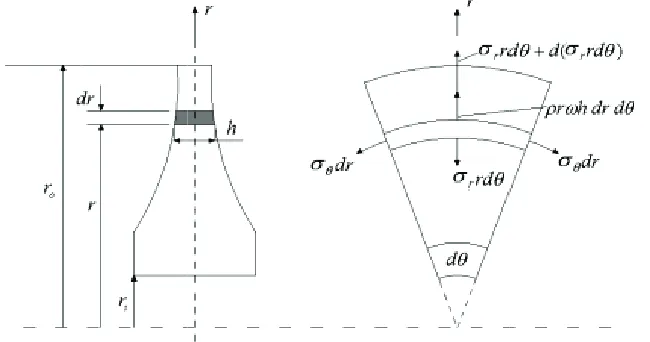
arameters th re discussed . Theoretica .1Governing Assuming tha Fig.1), varyi Simplifying t afari, 2008;
( r)
d
hr h
dr σ − σθ
where ρ =ρ(r
n the plane Timoshenko ⎢⎣ ⎡ − = 1 E 2 r μ μ σ 2 1 E θ
σ
μ
⎡ = ⎢ − ⎣where
u
is ircumferenti denotes differprocess. Fo s, 1990) als
1973) used a different ap ment method bjective of th rks to minim he allowabl hat fulfill the d in details in
al Backgrou
g equation o
at stresses d ing with radi
the radial eq Timoshenko
2 2,
h r
θ = − ρω
)
r isthe distr stress (
σ
z =o, 1970; Güv
⎥⎦ ⎤ ′ +u r u μ , , u u r
μ
⎡ + ′⎤ ⎥ ⎣ ⎦the radial d ial compone rentiation w
ox (1970) o o used the g sequential l pproach, Ch d with the fe
his work is mize the wei le value. In
ese constrain n (Rao, 2009
und
of rotating d
do not vary o ius, i.e. h=h
Fig. 1. Disk quilibrium co
o, 1970; Güv
ribution func 0
= ) the stres ven, 1995):
displacemen ents of the no with respect t
optimized a gradient of c linear progra hen Cheu (1
asible direct the utilizati ght of the d fact, the fo nts using KK 9; Peressini e
disk
over the thic )
(r h .
k profile and ondition for ven, 1995):
ction of dens ss-displacem
nt,
E
is the ormal stresso the radius
rotating di constraints. amming met
990) optimi tion method. on of the so disk under a ocus of this KT condition et al., 1988;
ckness of th
acting force an infinitesi
sity, and ω i
ment relation
e modulus and
μ
is the . The disk isisk using th Zienkiewicz thods for opt zed a rotatin .
olutions ach certain cond s research is
ns for optim Wide et al.,
he disk, let h
es on an elem imal elemen
is the angula ns are given
of elasticity Poisson’s ra s symmetric
he feasible z and Campb
timization o ng disk prof hieved by the
dition of vo s to identify mization. The
1970).
h be the thic
ment
nt of the disk
ar velocity of by Timoshe
y,
σ
rand σatio. In the E with respect
direction m bell (Zienki f rotating di file by comb
e authors in n-Mises stre y those geom e KKT cond
ckness of the
k gives (Hojj
f the disk. enko and Go
θ
σ are radia Eqs. (2-3) a p
and its profiles for thickness and density are assumed to vary as functions of radius (r) (Hojjati & Jafari, 2007; Hojjati & Hassani, 2008; Hojjati & Jafari, 2008; Hojjati & Jafari, 2009):
n
b r h r
h( )= ( )−
D ,
(4)
m
b r r) ( ) ( ρD
ρ = , (5)
where
n
andm
are geometric parameters (0≤n≤1,m≥0), b is the outer radius of the disk and hD is the thickness of the disk at r=b. Rotating disks with variable density can be considered as functionally graded materials (FGM) and the literatures devoted to this field is rich (Gamer, 1985; Güven, 1992; Bayat et al., 2008). Although, other material properties such as modulus of elasticity can also be assumed to vary with disk radius, in this research it is arbitrary decided to assume that Young’s modulus is constant as the case reported in the previous studies (Gamer, 1985; Güven, 1992; Hojjati & Jafari, 2008; Hojjati & Jafari, 2009). Substitution of Eqs. (2-5) in Eq. (1) yields the governing equation for the radial displacement:2
2 2
0
2 2
( 1) ( 1)
( ) ( ) ( ) ( )m (1 ) /
d n d n r
u r u r u r r E
dr r dr r b
μ ρ ω μ
− + +
+ − = − − . (6)
This is the differential equation governing on rotating disks in elastic form. In this research we have to use the results of the pervious works by the authors (Hojjati & Jafari, 2008; Hojjati & Jafari, 2009) for starting the disks optimization. Therefore solution of the elastic non-uniform thickness and density rotating disk (Eq.6) obtained by Homotopy perturbation method is derived as (Hojjati & Jafari, 2008):
) n 3 n 8 m ) 6 n ( m (
) 1 ( ) b r ( r r
c r
c ) r (
u 2
2 m 3 2 2
n 4 4 n 2 n
2 2
n 4 4 n 2 n
1
2 2
+ + − − + −
− −
+
= ⎟⎟
⎟ ⎠ ⎞ ⎜⎜
⎜ ⎝ ⎛ + +
− ⎟⎟
⎟ ⎠ ⎞ ⎜⎜
⎜ ⎝ ⎛ + +
+
μ Ε
μ ω
ρ μ
μ
D
,
(7)
where , are integration constants. The solution must be completed by incorporating a certain set of boundary conditions. Here, free boundary conditions are considered for annular disks. If both surfaces at inner and outer radius are free of any traction, then the boundary conditions are
0 ) ( )
(a = r b =
r
σ
σ
.2.2KKT Conditions
The necessary conditions for equality constrain that contained the Lagrange Multiplier theorem generally discussed in textbooks on calculus (Rao, 2009; Peressini et al., 1988; Wide et al., 1970). Then, the necessary conditions for the general constrained problem are obtained as an extension of the Lagrange Multiplier theorem. These are known as KKT necessary conditions. All optimum designs must satisfy these conditions. We now examine the problem for this optimization with equality and inequality constraints in the standard form:
)
(
min
f
x
subject to ( ) 1, ,
( ) 1, ,
i i
j j
h x b i m
g x c j r
= =
≤ =
"
"
(8)
In these relations x=
(
x1, ," xn)
′ is the vector of design variables,f(x) is an object function,j j x b
h ( )= is an equality constraint and gj(x)≤cj is inequality constraint, respectively and they are
768
constraint surface, the associated constraint is called an active constraint. At constrained minimum, only the active constraints are significant. Hence the first- order optimality condition (Eq. (9)) must be applied to inequality constraint (Peressini et al, 1988):
. 0 , 0 , 0 ) ( ) ( + ∇ = ≥ =
∇f x∗
λ
T g x∗ Tλ
λ
Tg(9) Those constraints satisfy Eq. (9) are known as active constraint and the necessary conditions are known as KKT conditions as follow (Rao, 2009),
. 0 , 0 , 0 , 0 . 2 . 0 ) ( , 0 ) ( . 1 = ≥ ≠ = ∇ + ∇ + ∇ ≤ = ∗ ∗ ∗ ∗ ∗ g u where g h u f x g x h T T T T j i
λ
λ
λ
(10)where u=
(
u1,....,um)
is the vector of a Lagrange multiplier for equality constraints and(
1,....
r)
λ
=
λ
λ
′
is the vector of a Lagrange multiplier for inequality constraints. Herex
∗, the minimizer, is assumed to be a regular point. A point that satisfies the KKT conditions is called a KKT point and may not be a minimum since the conditions are not sufficient. Second-order information is necessary to verify the nature of a KKT point. The second-order sufficiency conditions are as follow: If a KKT point x∗exists, such that the Hessian of the Lagrangian on the subspace tangent to the active constraints is positive definite atx∗, thenx
∗ is a local constraint minimum. We have defined Hessian matrix as the second partial derivatives off
(
x
)
as follow (Rao, 2009):int 0 tra activecons for j j L g g J x x XX T j j x x = ⎥ ⎥ ⎦ ⎤ ⎢ ⎢ ⎣ ⎡ ∇ ∇ = ∗ ∗ = = (11) where,
n
j
n
i
x
x
L
L
x x j ixx
1
....
,
1
....
2
=
=
⎥
⎥
⎦
⎤
⎢
⎢
⎣
⎡
∂
∂
∂
=
∗ = (12)We summarized these results here for the sake of simplicity, Model: min
f
subject to0 , 0 ≤ = g
h
Lagrangian function:
L
=
f
+
u
Th
+
λ
Tg
(13) KKT conditions: 0 , 0 , 0 0 , 0 . = ≥ ≠ ≤ = = + ∇ + ∇ g u g h o g h u f T T T T
λ
λ
λ
(14)Then for Eq. (8), the Lagrangian function equals to:
(
)
∑
(
)
∑
= = − + − + = r j j j j m i i ii h x b g x c
u x f u x L 1 1 ) ( ) ( ) ( ) , ,
( λ λ (15)
1 1
*
( , , ) ( ) ( ) ( ) 0
0, ( ) 0
( ) , 1, , .
m r
x i i j j
i j
j j j j
j j
L x u f x u h x g x
g x c
g x c j r
λ
λ
λ
λ
∗ ∗ ∗ ∗ ∗ ∗ ∗ ∗
= =
∗ ∗ ∗
∇ = ∇ +∑ ∇ +∑ ∇ =
⎡ ⎤
≥ ⎣ − ⎦=
≤ = "
(16)
Simultaneous solution of the above equations provides the calculations ofx∗.
3. Weight optimization of rotating disk
3.1Weight of annular disk
The weight of disk can be written as weight= w= ×γ Vwhere Vis volume of annular disk and
g
ρ
γ
=
is the specific gravity of disk where g is the gravity constant.V
w
weight
=
=
γ
*
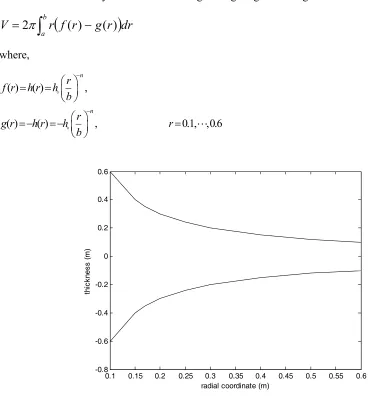
The volume of the body results from rotating the region given in Fig. 2 about vertical axis is:
(
)
∫
−
=
ba
r
f
r
g
r
dr
V
2
π
(
)
(
)
(17)where,
( ) ( ) ,
( ) ( ) , 0.1, ,0.6
n
n
r f r h r h
b r
g r h r h r
b
−
−
⎛ ⎞
= = ⎜ ⎟
⎝ ⎠ ⎛ ⎞
=− =− ⎜ ⎟ =
⎝ ⎠
D
D "
(18)
Fig. 2. Disk profile for n=1, a=0.1m, b=0.6m Using these relations, the volume of an infinitesimal element can be found as:
0.1 0.15 0.2 0.25 0.3 0.35 0.4 0.45 0.5 0.55 0.6
-0.8 -0.6 -0.4 -0.2 0 0.2 0.4 0.6
radial coordinate (m)
th
ic
kn
es
s (
m
770
4
.
n
r
dV
h
b
π
−
⎛ ⎞
=
⎜ ⎟
⎝ ⎠
D
(19)
Specific density of disk ρ(r)is assumed to vary with r and it is defined as:
m
b
r
r
⎟
⎠
⎞
⎜
⎝
⎛
=
ρ
Dρ
(
)
(20)where
ρ
Dis the density at inner radius i.e. r=b. Thus, the specific gravity of the disk equals to:( )
.
m
r
r
g
b
γ
=
ρ
⎛ ⎞
⎜ ⎟
⎝ ⎠
D
(21)
By using Eq. (19) and Eq. (21) and setting 9.81 / , the weight of the disk corresponds to:
(
)
⎟⎟⎠ ⎞ ⎜
⎜ ⎝ ⎛
× × ×
+ ×
−
× −
+ − −
= ⎟ ⎠ ⎞ ⎜ ⎝ ⎛ ⎟
⎠ ⎞ ⎜ ⎝ ⎛ =
=
+ − − +
− − =
=
−
∫
∫
n m n m m n
m m
n r
r
n m
n m
dr b r h r g b r dV
r w
5 3 66667 . 1 36 10
166667 . 1
66667 . 1 22676 . 976 2 1
4 )
( 0.6
1 .
0 ρD π D
γ (22)
3.2Governing constraint of rotating annular disk
That constrain used in this optimization is that the disk must remain in elastic region based on von-Mises criteria. In a plane stress rotating disk von von-Mises stress corresponds to:
θ θ
σ
σ
σ
σ
σ
e=
r2+
2−
r (23)Those stresses components exist in Eq. (23) are evaluated by using Eqs. (2-3) after substitution of Eq. (7 ) for radial displacement (u). The final relation for von-Mises stress does include the parameters n
and m used in Eqs. (4-5).
3.3Preparing weight and constraint functions for disk weight minimization
The optimization problem is reduced to minimization of objective function Wdisksubject to the stress constraint, whose complete statement is expressed as,
min subject to
disk
e W
σ
≤σ
DThe differences in scale of the objective function and the constraint may cause some difficulties. Hence, they should be normalized. The weight is normalized by dividing it over the disk at maximum weight conditions i.e. for m=0 and n=1.
0 , 1
) , (
= =
=
m n
disk W
W m n
W (24)
Equivalent von Mises stress can be dimensionless by dividing it by yield strength of the material:
D
σ
σ
σ
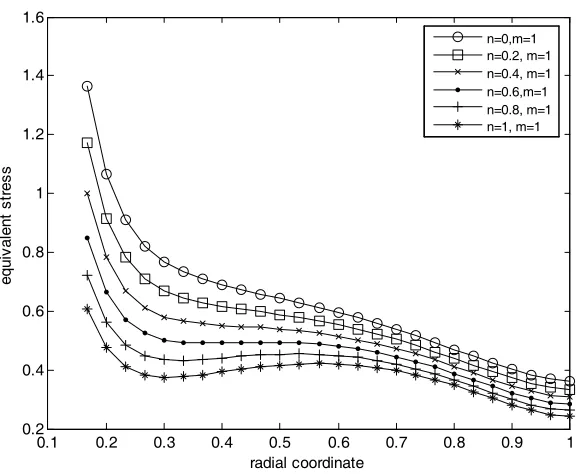
eFrom Fig. 3, it is obvious that for different values of m and n parameters, von Mises stress has its maximum value at inner radius i,e. at r=0.1 m in our case study. Therefore, the Eq. (25) can be reduced to the following equation which has no terms of r:
( )
D
σ
σ
σ
( , )= e r=0.1e n m (26)
The angular velocity of rotating disk can also be normalized as (Hojjati & Jafari, 2009):
D
σ
ρω
2b2=
Ω (27)
Fig. 3. Equivalent von Mises stresses on annular rotating disk with variable thickness and density for free boundary condition (m=1 and different value of at 1.5346 normalizd angular velocity)
4. Case Study
To show the performance of KKT optimization method in weight minimization of a rotating disk with variable thickness and density, application of the proposed method is presented here for two cases. The first case is when σe ≤σD, is assumed as the constraint and the other case is when σe ≤0.8 ,σD is used as failure stress
criterion. The later means that we wish to include a safety factor in the design, for instance, making the maximum von Mises stress as 0.8 times of yield strength of the material. Table (1) shows the material and the geometry properties used in the numerical examples (Jafari & Hojjati, 2011).
Table 1
Geometry and material properties of rotating disks
b (m) a(m) hD (m) ρD (kg/m 3)
E(GPa) υ ω (rad/s) σD (MPa)
0.6 0.1 0.1 7850 207 0.3 500 300
The optimization problem for the two constraints in normalized form state as follow:
min
W
disksubject to σe −A≤0,
0.1 0.2 0.3 0.4 0.5 0.6 0.7 0.8 0.9 1
0.2 0.4 0.6 0.8 1 1.2 1.4 1.6
radial coordinate
equi
va
lent
s
tr
es
s
772
where A is a real number that has value of 1 for the first constraint as σe ≤σD and 0.8 for second constraint as σe ≤0.8σD in normalized form (Jafari & Hojjati, 2011).
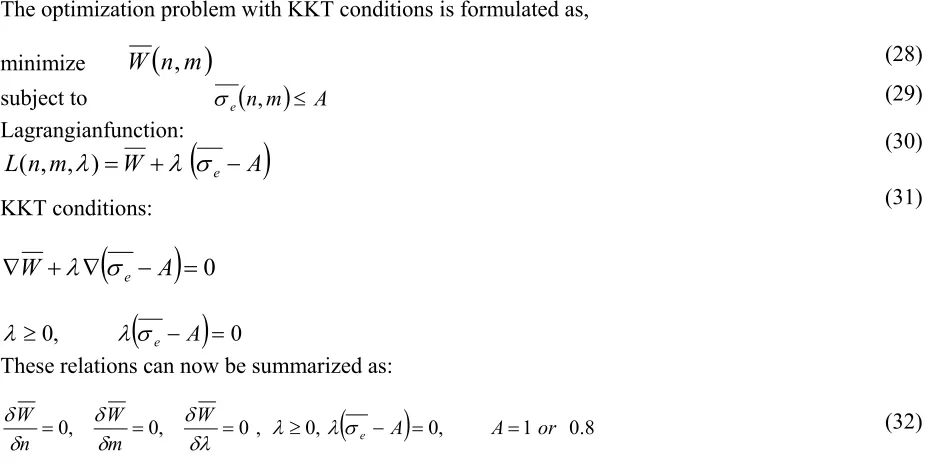
The optimization problem with KKT conditions is formulated as,
minimize
W
(
n
,
m
)
(28) subject to σe(
n,m)
≤ A (29) Lagrangianfunction:(
A
)
W
m
n
L
(
,
,
λ
)
=
+
λ
σ
e−
(30) KKT conditions:(
−
)
=
0
∇
+
∇
W
λ
σ
eA
(
)
0,
0 − =
≥
λ
σ
e Aλ
(31)
These relations can now be summarized as:
(
)
0, 1 0.8 ,0 , 0 ,
0 ,
0 W A A or
m W n
W
e − = =
≥ = =
= λ λσ
δλ δ δ
δ δ
δ (32)
Table 2 presents the results for the first constraint case while Table 3 shows the same results for the second constraint case, i.e. A=1. All the presented results are for Ω =1.5346.
Table 2
The optimal results for disk weight optimization under σe ≤σD constraint with A=1
Value of n Value of m Lagrange multiplier Weight reduction
KKT 0.43069 0.88913 0.25942 68%
Table 3
The optimal results for disk weight optimization under σe ≤0.8σD constraint with A=0.8
Value of n Value of m Lagrange multiplier Weight reduction
KKT 0.73873 0.85014 0.43020 61%
The values of
λ
for both cases are positive, which confirm that the calculated optimum point gives the minimum weight of disk. Based on Eq. (11), one can realize that the Hessian matrix for the above values is positive definite. Therefore, the sufficient condition is satisfied and these values minimize weight of the disk for given constraint.5. Discussions
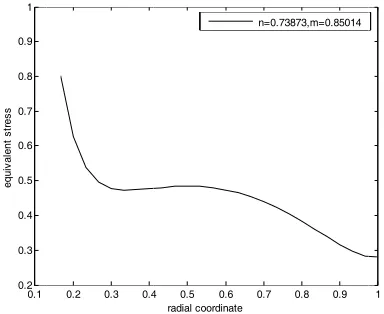
As it was mentioned before, KKT optimization method has been used for weight minimization of a rotating disk with non uniform thickness and material properties. For the first case of constraint defined as σe ≤σD , Fig. 4 shows the disc profile before (n=1) and after optimization. Using the
optimization method reviewed here, after design/optimization process, a weight reduction of 68% and maximum von Mises stress of 300 MPa (equal to the yield stress) was achieved. In Fig. 5 von Mises stress distribution for different radii has been shown for the optimized values of m and n. The obtained disk profile for the second case of constraint defined by σe ≤0.8σDis shown in Fig. 6.
se ex
6
In m st A th g ra th
een that the xpected.
Fig. 4
n=0.4
Fig. 6
n=0.7
. Concludin
n this paper minimum we tress. The L A plane stres he authors h
eometrical p adii have bee he maximum
von Mises s
4. Thicknes 43069 under
6. Thickness 73873 under
ng remarks
r, rotating a eight subject
agrange mu ss condition
has been us parameters o
en found wh m von Mises
stress throug
s profilefo
D
σ
σe ≤ c
profile for
σ σe ≤0.8
annular disk t to fulfillme ltiplier along
has been as sed to evalu of the shape hich reduces stress is sati
ghout the dis
or n=1 and constraint
n=1 and
D
σ constraint
ks of variab ent of certain
g with KKT sumed. Sem uate the mag e of the prof
the weight o isfied.
sk thickness
Fig
m= velo
t
F
m v
ble thicknes n condition T conditions mi exact solu gnitude of t file of a giv of the disk b
0.1 0
0.4 0.5 0.6 0.7 0.8 0.9 1 1.1
eq
ui
val
en
t s
tres
s
0.1 0.2 0.3 0.4 0.5 0.6 0.7 0.8 0.9 1
eq
ui
va
le
nt
s
tr
es
s
has been ke
g. 5. von Mi =0.88913 at
ocity under
Fig. 7. von M m=0.85014 a velocity unde
s and densi on the value theorem hav ution of the d the stress c ven disk wit by as much a
0.2 0.3 0.4
r
0.2 0.3 0.4
ept under the
ses stress fo 1.5346 no
D
σ
σe ≤ co
Mises stress fo at 1.5346 norm er σe ≤0.8σ
ity have be e of the max ve been used disk previou components
th predefined as 68% while
0.5 0.6 0.7
adial coordinate n=
4 0.5 0.6 0
radial coordinate n
e desired val
or n=0.43069 ormalizd an
onstraint
or n=0.73873 malizd angul
D
σ constraint
en optimize ximum von M
d in optimiz usly develop of the disk d inner and e the conditi
0.8 0.9
=0.43069,m=0.88913
0.7 0.8 0.9
n=0.73873,m=0.85014
lue as
9 and ngular
and ar t
ed for Mises zation. ped by k. The
outer ion on
1
774
References
Bayat, M, Saleem. M, Sahari. B.B, Hamouda, A.M.S, Mahdi, E. (2008). Analysis of functionally graded rotating disks with variable thickness. Mechanic Research Communications, 35, 283–309. Cheu, T. (1990). Procedures for shape optimization of gas turbine. Journal of computer structural,
54, 1–4.
Fox, RL. (1970). Optimization methods for engineering design. London: Addison-Wesley.
Gramer, U. (1983). Tresca’s yield condition and the rotating solid disk. Journal of Applied Mechanical Engineering, 50(3), 676-678.
Gramer, U. (1984). The elastic–plastic stress distribution in the rotating annulus and in the annulus under external pressure. Journal of Applied Mathematics & Mechanics/Zeitschrift, 64, 126–128. Gramer, U. (1985). Distribution in the rotating elastic–plastic disk. Journal of Applied Mathematics
& Mechanics/Zeitschrift, 65, 136–137.
Güven, U. (1992). Elastic-plastic stresses in a rotating annular disk of variable thickness and variable density. International Journal of Mechanical Science, 43, 1137-1153.
Güven, U. (1994). The fully plastic rotating disk of variable thickness. Journal of Applied Mathematics & Mechanics/Zeitschrift, 74, 61–65.
Güven, U. (1995). On the applicability of Tresca’s yield condition to the linear hardening rotating solid disk of variable thickness. Journal of Applied Mathematics & Mechanics/Zeitschrift, 75, 397–398.
Hojjati, M. H, & Jafari, S. (2007). Variational iteration solution of elastic non uniform thickness and density rotating disks, Far East Journal of Applied Mathematics, 29, 185-200.
Hojjati, M. H, & Hassani, A. (2008). Theoretical and numerical analyses of rotating discs of non-uniform thickness and density. International Journal of Pressure Vessels and Piping, 85, 694– 700.
Hojjati, M. H, & Jafari, S. (2008). Semi Exact Solution of Elastic Non Uniform Thickness and Density Rotating Disks by Homotopy Perturbation and Adomian's Decomposition Methods Part Ι: Elastic Solution. International Journal of Pressure Vessels and Piping, 85, 871-878.
Hojjati, M. H, & Jafari, S. (2009). Semi- Exact solution of non uniform thickness and density rotating disks Part II: Elastic-strain hardening solution. International Journal of Pressure Vessels and Piping, 86, 307-318.
Jafari, S, & Hojjati, M. H. (2011). Modern optimization methods in minimum weight design of elastic annular rotating disk with variable thickness. Advances in Applied Physics & Material Science-APMAS, 2011.
Malkov, V. P., & Salgankays, E. A. (1976). Optimum material distribution in rotating disks for minimum strength. Sov Aeronaut, 19, 46–50.
Rao, S. (2009). Engineering Optimization: Theory and Practice, 4th Edition , Wiley & Sons.
Peressini, AL, Sullivan, FE. (1988). The Mathematics of Nonlinear Programming, Berlin, New York, Springer.
Timoshenko, S. & Goodier, J, N. (1970). Theory of Elasticity, 3rd edition. McGraw-Hill, New York. Vanderplaats, G. N. (1990). Numerical optimization techniques for engineering design with
applications. 2nd ed. New York: McGraw-Hill.
Wide, D.J., & Papalambros , P. Y. (2000). Principles of optimal design, modeling and computation, 2nd edition, Cambridge University Press.