USF Scholarship: a digital repository @ Gleeson Library | Geschke
USF Scholarship: a digital repository @ Gleeson Library | Geschke
Center
Center
Master's Theses Theses, Dissertations, Capstones and Projects
1998
African-American Students in Higher Education: Attitudes and
African-American Students in Higher Education: Attitudes and
Perceptions that Relate to Persistence
Perceptions that Relate to Persistence
Frances L Ford McCullough
AFRICAN-AMERICAN STUDENTS IN HIGHER EDUCATION:
ATTITUDES AND PERCEPTIONS THAT RELATE TO PERSISTENCE
A Dissertation
Presented to
The Faculty of the School of Education
Organization and Leadership Department
In Partial Fulfillment
Of the Requirements for the Degree
Doctor of Education
by
Frances L. Ford McCullough
direction of the candidate's dissertation
committee and approved by the members of
the committee, has been presented to and
accepted by the Faculty of the School of
Education in partial fulfillment of the
requirements for the degree of Doctor of
Education. The content and research
methodologies presented in this work
represent the work of the candidate alone.
;/p~~
' D~teDissertation Committee
{J£l__~
Chairperson
Second Reader
1/AR'/C/'tf/
7
7~!J.~
Third Reader
It is with much pleasure that I acknowledge the following people for
their exceptional contributions to this study:
Dr. A. Calvin, my committee chair, for his valuable suggestions and his
willingness to work with me through the summer of 1997. Dr. Patricia
Mitchell and Dr. Rosita Galang, members of this dissertation committee, for
the many hours they spent reading and critiquing my dissertation.
Dr.
J.
van Keulun, my mentor, and Dr.J.
Perea, my advisor, of SanFrancisco State University, for their willingness to provide encouragement,
suggestions, and emotional support. Dr. Barbara Cannon and Dr. Dorothy
Carnegie for being members of an exceptional support team.
I give special thanks to Dr. R. Browning, Dr.
J.
Newton, and the staff atSan Francisco State University Public Research Institute for their valuable
assistance with data collection, and also to Dr.
J.
Julian and Frederick Castro ofthe San Francisco State University Human Relations Department for
allowing the use of their survey instrument and for helping to facilitate this
study.
I am especially appreciative of the students who completed and promptly
returned the questionnaires during the summer of 1997. Some of their candid
comments brought tears to my eyes; however as educators, it is crucial their
true opinions and perceptions of the educational environment be heard.
This dissertation is dedicated to my husband, Leo, in
appreciation of his unconditional support and patient tolerance of endless
stacks of books; to Mom, Ida Ford, who taught me to believe that "where
there is a will, there is a way;" to my daughter, Nancy L. McCullough, J.D. for
her professional expertise and support; and to Aunt Geneva and Uncle
Johnny Scruggs for bringing me into their California home, enabling me to
obtain an education, and for their ongoing and steadfast love and financial
support during the 17- to 22-year-old period.
Page
ACKNOWLEDGMENTS ... .iii
LIST OF TABLES ... viii
LIST OF FIGURES ... ix
CHAPTER I. THE RESEARCH PROBLEM ... 1
Statement of the Problem ... 1
Purpose of the Study ... 3
Background and Need for the Study ... .4
Rationale for the Study ... 6
Research Questions ... 8
Limitations of the Study ... 9
Significance of the Study ... 10
Definition of Terms ... 11
II. REVIEW OF RELATED LITERATURE ... 13
General Overview ... 13
Historical Background ... 13
College Compositions and Race Relations ... 15
Theoretical Basis of Student Change While Attending College ... 27
Influence of Attitudes on Intergroup Relations ... 30
Summary ... 41
CHAPTER
III. METHODOLOCY ... 43
Restatement of the Research Purpose ... 43
Research Methodology and Design ... .43
Study Population Sample ... 44
Instrumentation ... 45
Validity and Reliability ... .46
Data Collection ... 47
Data Analysis ... 48
Variables ... 49
IV. FINDINGS ... 51
Overview ... 51
Demographic Characteristics ... .52
Results of the Research ... 53
Research Findings: Question 1 ... 53
Research Findings: Question 2 ... .54
Results of the Qualitative Analysis ... 72
Experiences of Racial Discrimination ... 72
Cultural Mistreatment by Faculty ... 73
Reasons for Quitting ... 75
V. SUMMARY, CONCLUSIONS, IMPLICATIONS, AND RECOMMENDATIONS ... 79
Summary of Major Findings ... 79
Conclusions ... 83
Implications ... 85
CHAPTER
V. SUMMARY, CONCLUSIONS, IMPLICATIONS, AND
RECOMMENDATIONS (Continued)
Recommendations ... 86
For the Profession ... 86
For Future Educational Research ... 86
REFERENCES ... 88
APPENDICES San Francisco State Human Relations Survey ... 95
Statement of Agreement ... 96
Institutional Review Board Approval ... 97
Letter to Students ... 98
Table Page
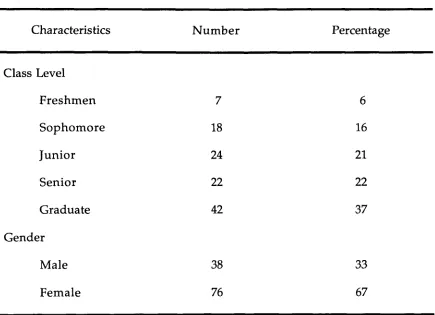
1. Demographics of Study Participants ... .52
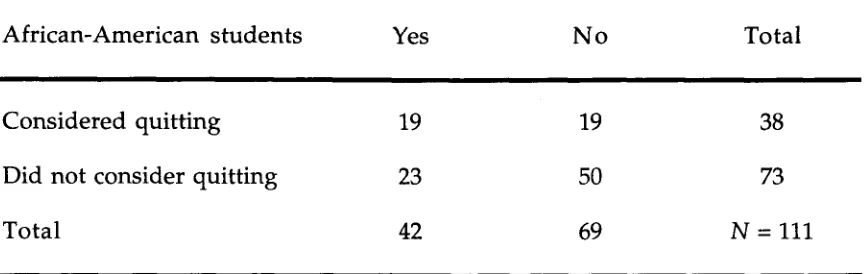
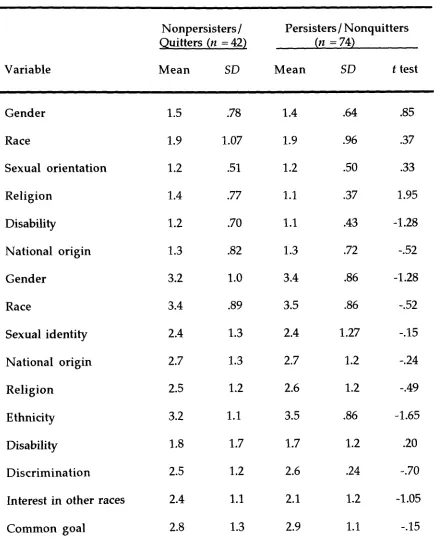
2. Perceptions of Racial Discrimination ... 54
3. Primary Variables and Related Survey Questions ... .56
4. Demographic Characteristics of Persisters and
Nonpersisters ... 58
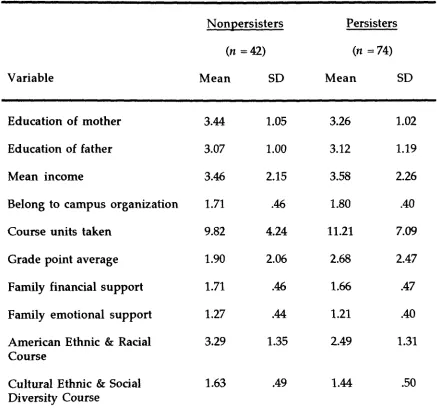
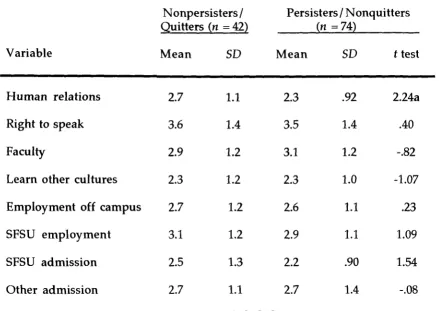
5. Results of the Univariate Analysis of Variance Comparing
Persisters and Nonpersisters ... 60
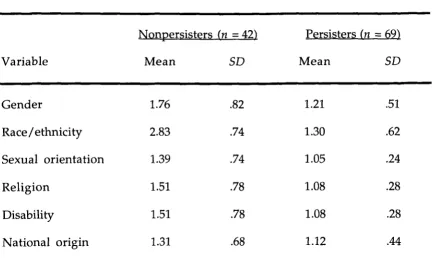
6. Mistreatment Based on Personal Characteristics of
Persisters and Nonpersisters ... 66
7. Perceptions and Attitudes Related to Discrimination of
Projected Nonpersisters and Projected Persisters ... 68
8. Opinions Surrounding Student Life for Projected Nonpersisters
and Projected Persisters ... 70
9. Opinions Surrounding Affirmative Action for Projected
Nonpersisters and Projected Persisters ... 71
Figure
1.
2.
Page
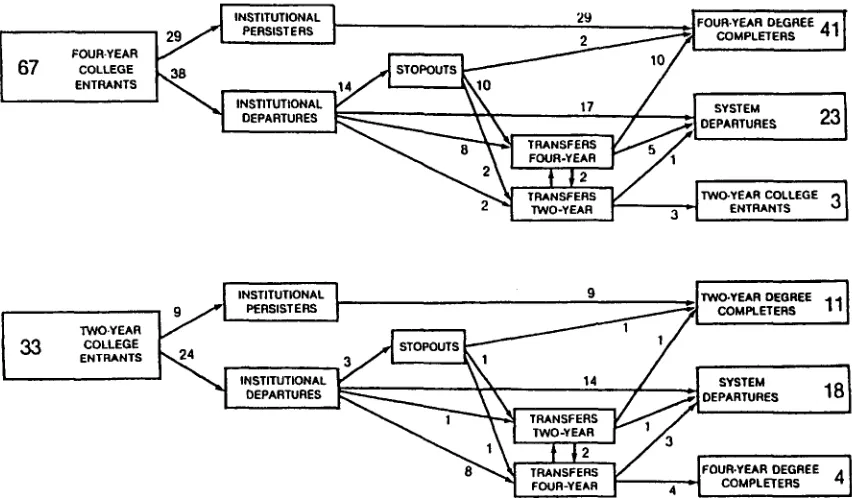
Flow of College Students through Higher Education ... 8
Evaluation of Mistreatment Based on Personal
Characteristics Across Class Levels ... 62
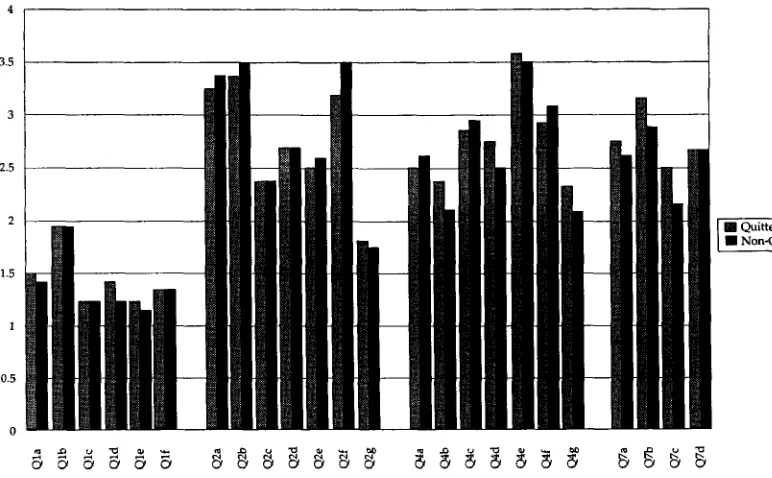
3. Differences between Quitters and Non-Quitters Based on
Primary Variables 1, 2, 4, and 7 ... 63
CHAPTER I
The Research Problem
Statement of the Problem
African-American students are less likely than Caucasian students to
earn a college degree. What are the campus climate and human relations
factors possibly contributing to either the persistence or attrition of
African-American students working to achieve a higher education? What might
institutions of higher education do to improve the retention and subsequent
success rate for this segment of the student population? An increasing
number of 18- to 24-year-old African-American students do indeed enroll in
college, but when compared with their Caucasian counterparts, fewer actually
complete their degrees.
The American Council on Education found that 44% of
African-American students completed their college degrees at 4-year institutions
compared with 54% of Caucasian students (Carter & Wilson, 1997). Moreover,
the American Council on Education recently published Minorities in Higher
Education, 1996-97 edition highlighted the fact that, in 1995,
African-Americans (15.8%) continued to trail Caucasians (26%) in the percentage of
25- to 29-year-olds with four or more years of college (cited in Carter &
Wilson, 1997).
When the small number of African-American college enrollees are
compared with graduates of the same population, the retention rate becomes
African-Americans were enrolled in 4-year colleges. Four years later, in 1990-91, only
65,338 bachelor of arts degrees were conferred on African-American students.
During the same period, 9,921,000 Caucasian students were enrolled and
904,061 received bachelor's degrees (Chronicle of Higher Education, 1994). The
most current results of the Sallie Mae National Retention Project Survey
conducted by the American Association of State Colleges and Universities
indicates a graduation rate for African-Americans of 30.4% and Caucasians
44.9% (Redd & Scott, 1997).
Research literature pertaining to college enrollment and retention
seem contradictory. Though this inconsistency is apparent across reports, all
literature reviewed for this study posits a problem of underrepresentation of
minorities in general and African-Americans in particular.
The student retention problem is particularly troublesome because an
increasing number of the projected jobs for the year 2000 will be knowledge
driven and demand highly technical skills. By the year 2000, American
workers who do not earn a college degree will be unable to compete for this
growing number of highly technical positions (U.S. Department of Labor,
Bureau of Statistics, 1991). ,
In addition to future job prospects, a college degree also has a
significant impact on income level for all workers. A recent report by the
American Council on Education (1995) stated that an individual with a
bachelor's degree earned an average of $12,000 to $14,000 per year more than a
One prominent leader of a Black organization pointed out that
African-Americans do participate in college; however, the problem is lack of
persistence through to degree conferment. McBay (1995) documented that
more than 50% of all African-American high school graduates do enroll in
college, but enrollment does not lead to graduation. "Attrition remains a
major problem for African-American students" (p. 37).
College attrition of African-Americans becomes more acute when
educational trends for the year 2000 are considered: (a) college demographic
changes indicate that more students of color, including African Americans,
will be entering college, (b) conversely, recent passage of the 1996 California
Civil Rights Initiative (i.e., Proposition 209) may severely impact the number
of African-Americans entering college, and (c) employers of the 2000
workforce will seek well-educated professionals possessing highly technical
skills.
Purpose of the Study
The purpose of this study is to identify and analyze the projected
persistence or nonpersistence of African-American students enrolled in San
Francisco State University (SFSU). This research adds to the understanding of
why African-American students depart from college prior to conferment of
their o~iginally sought college degree. Specifically, the intention of this study
is to add knowledge to the understanding of the environmental and human
relations factors possibly relating to either the persistence or nonpersistence of
Background and Need for the Study
African-American students are less likely than Caucasian students to
earn a college degree. A review of the literature does not indicate a consensus
surrounding noncognitive academic variables and their relationships to the
persistence of African-American students. Many past studies focus primarily
on the academic variables including high-school grade point average (GP A)
and college performance. This current study examines the relationship
between African-American students' plans to leave college and their
perception of personal and college environmental factors. Astin (1968)
defined college environment as those characteristics of the college that
constitute potential student stimuli capable of changing the student's sensory
input.
The current study is based on the premise that students become
nonpersisters when any of five factors--either alone or combined-influence
a change in their life. An investigation was conducted to learn how the five
factors relate to the persistence rate of African-American students in an
urban, multiethnic, 4-year public college. The five factors of study are (a)
student perceptions of discrimination toward themselves and others, (b)
student opinions surrounding campus life, (c) campus affiliations and
human relations courses attended, (d) the student intentions to leave college,
and (e) academic class level. Students of all ethnic groups leave college for a
variety of reasons including academic performance, economic constraints,
reason for early departure, student nonpersistence in college presents a
serious problem in a knowledge-driven and technology-based society.
Therefore, educators must investigate and gain greater understanding of
persistence and the campus climate to curtail the problem. This study is based
on student self-report of projected persistence or nonpersistence at SFSU.
Literature related to college factors and characteristics of the student
who does not complete college goals provide only partial answers to
questions related to the current problem of retention of African-American
students within institutions of higher education. Some recent research has
focused on the relationship between the ethnic diversity and composition of
the student population and the success rate of African-American students.
For example, Allen and Haniff (1991) reported that
Black students on White campuses have been shown to experience considerable difficulty in making the adjustment to an environment which is culturally different, academically demanding, and socially alienating. As a result, Black students sometimes do not experience reasonable levels of academic success and college satisfaction on campus. (p. 96)
Other research findings suggest that campus life influences student
success both positively and negatively (Allen & Haniff, 1991; Banks, 1992; Bell,
1975; Davis, 1991). Unfortunately, the literature reviewed for this study did
not examine the relationship between campus ethnic makeup and college
environmental factors relating to the early departure of African-American
Rationale for the Study
This study is based on Tinto's (1975, 1987) theoretical model of early
college departure. This explicit model was used in the current study to
examine the relationship between the college environmental factors and the
projected persistence or nonpersistence of African-American students within
a multiethnic urban college setting. Tinto's theoretical model of departure
suggests that the academic and social integration of students may describe a
condition that defines the actual or self-perceived position a student holds
within the academic and social systems. Negative integration tends to reduce
student acclimation into those systems (Pascarella & Terenzini, 1991; Tinto,
1975). The main objective of this study was to add to the understanding of
why African-Americans depart from college prior to conferment of a
bachelor's degree.
Tinto (1975, 1987) also offered a model describing institutional
influences on student early departure from college. It presumes four personal
characteristics: family background, academic aptitude, personality, and goal
commitment coupled with intentions. These attributes are also presumed to
interact with certain college environmental factors to influence a change in
the student (Tinto, 1987). In addition, Tinto's model looks specifically at
interactions between the student and various elements of the institution and
explains the longitudinal process. Underlying this model is Durkheim's
(1961) suicide theory, which suggests that a person who is alienated or isolated
Tinto and Durkheim models place great emphasis on the importance of
individual members having strong ties to their community. The stronger this
tie, the less likely they are to depart.
Tinto (1987) argues that, beyond the existence of possible
discrimination, minority students in general, and Black students in
particular, may find it especially difficult to find and become a member of a
supportive community within the college. Given the limited opportunities
for establishing commonalties, it seems more likely that African-American
students may experience a sense of alienation and isolation on some college
campuses. Consequently, the early college departure of African-American
students may be a manifestation of a negative college environment rather
than academic factors.
The Tinto (1987) model also considers intentions of early departure a
precursor to nonpersistence. It is apparent from Tinto's longitudinal model
that some students depart from college early because they had no original
intention of remaining through to degree completion (see Figure 1). Tinto
asserted that institutions rarely collect data related to academic intentions
upon student enrollment. However, this form of assessment with incoming
students could provide useful insight surrounding their reasons for
subsequent early departure. Intent to leave is a term pertaining to the
disposition with which individuals enter institutions of higher education
(Carnegie, 1984; Fishbein & Ajzen, 1975; Tinto, 1987). The Fishbein and Ajzen
the consequences of the behavior. According to the theory of intentions
presented by these researchers, intentions at any level of specialty are determined
by attitudes toward the behavior in question and its subjective norm.
FOUR-YEAR 67 COLLEGE
ENTRANTS
Figure 1. The flow of college students through higher education, by four- and
two-year entrants based on one hundred entrants. From (p. 21), by V Tinto, 1987,
Chicago: University of Chicago Press. Copyright 1987 by the University of
Chicago. Reprinted with permission.
Research Questions
Answers to the following two research questions were sought by
examining the relationship between the participants' perception of their campus
environment and their intentions to leave SFSU prior to degree attainment:
1. Are African-American students who reported experiences of racial
discrimination more likely to consider leaving SFSU prior to degree attainment
2. What are the campus environmental factors related to the projected
persistence of African-American students at SFSU-a multiethnic campus
setting?
Limitations of the Study
Delimitations. This study was confined to one postsecondary
institution located in the San Francisco Bay Area. The content of the data
collection instrument contained questions previously developed by
representatives of the institution of study to conduct a self-study of its human
relations climate. The questions are primarily formatted with Likert-type
scales or ranking scales for responses. The few open-ended questions offer
limited space for participant answers. The respondents were not instructed or
encouraged to use additional paper; however, several participants did
augment their responses.
Limitations. The findings of this study may not be generalizable to
other African-American student populations at other colleges without
precaution. The study sample for this research excluded all campus residents
since this group of students may not be representative of the population
under study. In addition, the experiences of African-Americans at this
particular university may be quite different from other similar colleges since
this facility has previously conducted a self-study of its campus climate and
Significance of the Study
The most important implication of the current study and it exploration
of factors relating to persistence is the need for educators to understand how
their own attitudes and perceptions impinge on the success of
African-American students pursuing a higher education. In addition, knowledge
gained surrounding the persistence of students will be of utmost importance
to educators and employers in general. The findings from this study will
increase employer awareness of the educational environment influencing
graduation rates and, ultimately, their own labor source.
By the year 2000, American workers who do not earn a college degree
will be unable to compete for the growing number of highly technical
positions. The increasing emphasis on higher education is expected to
continue. "Three out of the four fastest growing occupational groups will be
the executive, administrative, and managerial professional specialty; and
technician and related support occupations" (U.S. Department of Labor,
Bureau of Statistics, 1991, p. 3). While African Americans are expected to
account for a higher percentage of the 21st century workforce, their successful
completion of postsecondary education is lagging. In California, the problem
is expected to be exacerbated with the recent passage of Proposition 209. One
result of this proposition may be that fewer African-Americans will enter
postsecondary educational institutions; consequently, even fewer will persist
to degree conferment in a 4-year college. Therefore, it becomes imperative
college campuses prior to degree attainment. This study provides valuable
information related to environmental factors that influence student
persistence in college.
The Bureau of Labor Statistics reported that White non-Hispanics have
historically been the larger component of the labor force, but their number
has been dropping and is expected to fall further to approximately 64% by
2000. African-Americans, Hispanics, Asians, and other racial groups will
account for roughly 33% of labor force entrants (U.S. Department of Labor,
Bureau of Labor Statistics, 1991). Consequently, it is crucial that those students
who will comprise the new labor force in the coming century remain in
college and become appropriately educated.
Definition of Terms
The following operational definitions are provided in order to explain
the meaning of key terms and concepts pertinent to this study:
Attitude is a learned predisposition to respond in a consistently
favorable or unfavorable manner with respect to a given object (Fishbein &
Ajzen, 1975).
Attrition is the loss of student enrollment by natural causes.
Environmental factors refer to all elements of a college campus that
potentially present a stimulus for a student (Astin, 1968).
Human relations factors are interpersonal actions, behaviors,
Multiethnic campus is a college campus with students whose ethnicity
and cultural characteristics closely reflect the population of the local state. The
state of California reported an estimated race/ ethnic composition in 1995 of
the following: African American= 7%, Caucasian= 54%, Hispanic= 28%,
Asian/Pacific Islander= 10%, and Native American= 1% (State of California
Department of Finance, 1996).
Nonpersistent means departing from, or planning to depart from, a
4-year college prior to degree conferment.
Projected persisters or "nonquitters" refer to students enrolled at SFSU
at the time of the survey with no expectations of leaving prior to degree
attainment.
Projected non persisters or "quitters" are students enrolled at SFSU at
CHAPTER II
Review of Related Literature
General Overview
The review of literature for this study addressed four areas pertaining
to persistence as relevant to race relations in institutions of higher education.
The first area provides a general historical background of African-American
persistence in achieving access to higher education. The second reviews the
theoretical basis for student change. The racial composition of colleges and its
impact on African-American students comprises the third area, and the
fourth is research pertaining to the influence of attitudes and perceptions on
intergroup relations within the educational arena.
Historical Background
Americans have long viewed access to higher education as a means to
improve their economic conditions. Gaining equal access to postsecondary
education in this country, however, has not been an easy process for many
Americans. For African-Americans, access has often necessitated courtroom
battles. After gaining equal access, the literature indicates that
African-Americans, along with other students of color, face innumerable challenges
that result in a disproportionate dropout rate when compared with Caucasian
students. The literature also posits that the racial composition of a college or
university is directly correlated with academic achievement (Allen, 1992;
A long and turbulent history surrounds the current problem of
obtaining equal access to educational opportunities for African-Americans.
Like other Americans, Blacks have viewed higher education as a natural
means of improving their economic and social conditions. But, a review of
the historical legal process points to the complexities of achieving such equal
educational opportunities for this segment of the U.S. population. Although
the 13th amendment abolished slavery in 1896, it did not truly equalize
educational opportunities for African-Americans. Moreover, educational,
economical, and social progress gained during the Reconstruction Period
from 1866 to 1877 was impeded when the Plessery v. Ferguson decision ruled
that Blacks could legally be segregated to separate but equal public educational
facilities.
Many years later, on May 17, 1954, the Supreme Court decision in
Brown v. Board of Education of Topeka, Kansas revoked the 1896 decision of
Plessery v. Ferguson (Marshall & Wilkins, 1955). As a result,
African-Americans won the legal right to pursue equal access to higher education
opportunities. On the one hand, the persistence of African-Americans in
obtaining equal educational opportunities in the courts has been achieved.
On the other hand, the implementation of these equalized educational
opportunities on various college campuses has evolved into a complexity of
Now, 42 years after the Brown v. Board of Education of Topeka, Kansas
decision, many questions continue to be raised regarding equal educational
opportunities. Two such questions are the following:
1. Has the implementation of this landmark Supreme Court ruling
finally equalized the academic opportunities for all students?
2. How does the racial composition at colleges, along with attitudes and
behaviors, influence the persistence or nonpersistence of African-American
students in higher education?
College Compositions and Race Relations
The problems of student attrition and retention are far more complex
than previously assumed. Much of the current knowledge is based on
Caucasian students attending White or predominantly White colleges. Those
studies are extensive, but they focus primarily on academic variables. The
cultural context of a college or university-particularly the
underrepresentation of African-American faculty, staff, and
administration-may influence its ability to recruit and retain African-American students
(McGhee, Satcher, & Livingston, 1995).
Since the 1954 Supreme Court decision, which stimulated extensive
desegregation of public schools, equality of education has been associated with
integration. According to Allen (1992), now, more than four decades later,
research has revealed some negative attributes of various compositions at
College racial composition is correlated with academic achievement, high school grades, relations with professor, and class level. In general, African-American students who attend predominantly White schools report lower college grades, higher grades in high school, less favorable relations with their professors, and are, on average, younger than their peers who attend historically Black institutions. (p. 36)
Data collected by the National Study of Black College Students
(NSBCS), which is based at the University of Michigan in Ann Arbor was
reported by Allen and Haniff (1991) in a study they conducted. Allen and
Haniff analyzed this data to determine how the factors of academic
performance, racial attitudes, and college satisfaction relate to student gender
and campus race. The study was also concerned with three sets of causal
factors judged to be antecedent to and explanatory of observed differences in
student outcomes. The antecedent factors were grouped into the following
categories: (a) student background such as parental socioeconomic status and
high-school academic record; (b) college experiences such as involvement in
college activities, the academic competitiveness of the university, adjustment
to college life, and race relations on the campus; and (c) student personality
orientation such as self-concept and occupational aspiration.
A total of 1,583 student data reports collected in 1981 and 1983 were
analyzed (Allen & Haniff, 1991). Data were collected from several waves of
NSBCS data sets pertaining to the achievement, experience, attitudes, and
backgrounds of Black undergraduate students attending selected
state-supported universities. All of the universities participating in the 1981 and
The sample population for both years of study were currently enrolled
African-American undergraduates.
Data collection was facilitated in the Allen and Haniff (1991) study by
mailed questionnaires that students returned directly to the University of
Michigan with a provided business-reply envelope for subsequent coding and
computer tabulation. The selection of students for participation in this study
was random, based on lists of currently enrolled students supplied by the
various university registrar offices. Selected students received the
questionnaire and four follow-up reminders for their return.
Participants of the 1981 phase of data collection were Black
undergraduates at six predominantly White public universities: University of
Michigan, University of North Carolina in Chapel Hill, University of
California at Los Angeles, Arizona State University in Tempe, Memphis State
University in Tennessee, and the State University of New York at Stony
Brook. The 1983 phase of the NSBCS collected data from Black
undergraduates at eight predominantly Black public universities: North
Carolina Central University in Durham; Southern University in Baton
Rouge, Louisiana; Texas Southern at Houston in Texas; Jackson State
University in Jackson, Mississippi; North Carolina A & T State University in
Greensboro; Morgan State University in Baltimore, Maryland; Central State
University in Wilberforce, Ohio; and Florida A & M University in
Tallahassee. Both data sets were merged to compare and contrast students at
rate for 1981 was 27% and 35% for 1983 with a total sample of 1,583 students.
While the exact number of total participants is available, the breakdown of
those from Black and predominantly White universities cannot be
authenticated. Consequently, the findings from the NSBCS report could be
questionable (Allen & Haniff, 1991).
After analyzing the results, Allen and Haniff (1991) found that
academic performance varied in relation to student background, campus
experience, and personality orientation:
Black students on Black campuses reported significantly higher grade point averages than was true for their peers on White campuses. Three-quarters of the students in the White campus group versus two-thirds of students in the Black campus, reported grade point averages of less than 3.0 on a four-point scale. (p. 100)
Gender differences included males reporting higher GP As-72% were
below a 3.0 grade point average, whereas females reported 68% below 3.0.
Allen and Haniff (1991) reported eight other important campus results:
(a) neither family income nor the educational level of the mother were
predictors of student grade-point averages; (b) academic performance was
related to student satisfaction and involvement in college life; (c) grades were
higher for students who had not seriously contemplated leaving school and
for those who found their interests reflected in campus activities; (d) grades
were also higher for students who reported their relationships with faculty
and staff as favorable-a factor Allen and Haniff considered to be an
important dimension of college satisfaction; (e) academic performance was
(f) student racial attitudes varied by background, campus experience, and
orientation, as well as by gender; and (g) Black students on White campuses
were more likely to negatively describe unity among Black students on
campus (62% vs. 44% at Black campuses). Interestingly, perceptual differences
of Black unity also varied depending on the individual student's
involvement with campus life and his or her relations with White faculty. In
essence, the research found that Black students saw Black unity when they
were not positively connected to activities, faculty, and staff.
Student overall satisfaction with college was rated differently
depending on race and gender (Allen & Haniff, 1991). On Black campuses, two
thirds of the students indicated campus activity as being either somewhat or
considerably representative of their interests-males 56% and females 52%.
On White campuses, the comparable figure was 38%. When comparison of
extremes was made, great disparities between ethnic groups was revealed.
Twenty-six percent of the students on Black campuses were positive, whereas
only 8% of Black students on White campuses were positive. When queried
as to campus activities being representative of their interests, Black students
on Black campuses reported 10% of the activities as not at all representative of
their interests, compared with 19% on White campuses.
Correlational analyses conducted on the Allen and Haniff (1991) results
found no statistical relationship between the economic background of the
student and whether he or she had considered early departure from school.
less favorable where family income was the highest. This finding was
clarified by the researchers when their analyses revealed that Black students
with the highest incomes were enrolled at White campuses. Further, on
predominantly White campuses, Black students reported a far superior GP A
in high school; 49% reported 3.5 or better compared to 18% of the students on
Black campuses. In addition, Allen and Haniff found that the racial
composition of colleges and the major field choices of students indicated
differences depending on the type of campus. For example, 73% of students
on Black campuses versus 50% of the students on White campuses chose to
major in a specific profession.
Allen and Haniff (1991) concluded that interpersonal relationships
were central in the determination of how individual and institutional
characteristics influence the experience of Black students in institutions of
higher education. Interpersonal relationships form the bridge between
individual dispositions and institutional tendencies, and together, these
factors determine individual student outcomes. Allen and Haniff explained
that the manner in which a student perceives and responds to events within
the college will differentiate his or her individual college experience. Allen
(1992) emphasized several important interpretations of this research in the
following excerpt:
connection, acceptance, and extensive support and encouragement. (p. 36)
Aliens' interpretation is consistent with accumulated evidence on
human development indicating that most human beings develop best in
environments where they feel valued, protected, accepted, and socially
connected (Allen, 1992; Banks, 1992; Banks & Grambs, 1972). Davis and
Borders-Patterson (1973), in a study commissioned by the North Carolina
Board of Higher Education and supported by the college board, found that
Black students on White residential campuses become increasingly polarized,
more aware of their Black identity, and in many cases, increasingly hostile
toward the "White establishment" as their college years progressed.
Allen, Epps, and Haniff (1991) found a negative relationship between
the family income of an African-American student and the faculty-student
relationship on predominantly White campuses. According to the authors,
the higher the family income, the less favorable the report of faculty-student
relationship. However, based on the Tinto theory (1975, 1987), positive
faculty-student interaction is essential for a result of student persistence. Prior
studies pertaining to college life and African-American students on
predominantly White campuses suggest that negative attributes may
influence African-American nonpersistence rates on both White and Black
colleges. Davis (1991) found that "Professors/students/staff relations are
strong predictors of academic success and satisfaction of campus life for Black
students on White and Black campuses" (p. 154). Bennet (1980) found that
Bennet's findings suggest that, whether intentionally or unintentionally,
many teachers act in ways that inhibit the learning opportunities of poor,
Black, and Mexican-American students (p. 1).
As more African-American students enroll in previously White, and
hence predominantly White institutions, many educators are concerned
about the lack of a supportive social environment. "Access to predominantly
White universities and success in them cannot be assumed to be synonymous
for minorities" (Hare, 1991, p. 215). Noncognitive factors that relate to the
persistence of African-American students become even more complex when
racial attitudes are included in the focus of study. Banks and Grambs (1972)
"found a significant body of literature that suggests most White American
adults harbor negative attitudes toward Blacks and other ethnic groups" (p.
14). Scott (1995) found that teachers held prejudiced and stereotypical ideas
surrounding their minority students. This finding suggests that teachers need
to remove their own biased attitudes before they can be effective in
multicultural classrooms. Allen (1992) supports the findings of the Scott study
by suggesting that "the need for this kind of introspection is of paramount
importance when teachers are reared and socialized in White cultures and
educated at predominantly White colleges and universities" (p. 69).
Numerous studies consistently acknowledge a relationship between
the success of students of color in predominantly White college
environments and their social support networks (Allen, 1991; Allen & Haniff,
contrast, Steward, O'Leary, Boatwright, and Sauer (1996) investigated the issue
of a social support network on a large, predominantly White campus and
found no statistically significant differences across racial/ ethnic groups on a
measure of quality and composition of such networks. According to Steward
et al., their study controlled for certain factors that tend to influence support
seeking and receiving behaviors including (a) academic preparedness, (b)
enrollment status, and (c) age. It involved questioning 137 "successful"
students who "(a) were enrolled in college at 17.19 years of age, (b) would
graduate during the semester of data collection, (c) had mean ACT score of
21.8, and (d) were a mean age of 23.4 years" (p. 97). The study implemented
the Social Support Network Inventory developed by Oritt, Paul, and
Behrman (1985) that is designed to measure the quality and composition of
student social networks. Steward et al. admitted that their sample was quite
small and, more importantly, it was totally comprised of soon-to-graduate
seniors. Most previous studies dealt with freshmen and sophomore students
because seniors have already become integrated into the college community
and are not considered at risk for departure. Moreover, previous studies
indicate that 41 of every 100 college entrants will depart the system prior to
earning a degree. "Most of them, three-quarters, will leave in the first two
years of college, the greatest portion in the first year" (Tinto, 1987, p. 16).
Interestingly, D'Augelli and Hershberger (1993) conducted a similar
study of African-American undergraduates, highlighting the academic factors,
and found opposing results to the Steward et al. (1996) study. D' Augelli and
Hershberger also controlled for (a) academic grades, (b) current GPA, (c)
semester standing, (d) gender, and (e) academic major by matching each of the
factors across ethnic groups. Academic grades were obtained through official
transcripts and matched to be within .25 points above or below the target
students' GP A. Unlike Steward et al., D' Aguelli and Hershberger sought
information on student experience with discrimination and harassment on
campus.
D' Augelli and Hershberger (1993) questioned a total of 146 junior and
senior students-73 African-Americans and 73 Caucasians-attending a large
mid-Atlantic state university in a rural area. The researchers executed an
elaborate process to ensure that all participants were consistently matched
using the previously described standard. The instruments administered
consisted of (a) background questions seeking information related to personal
and family characteristics, and (b) questions concerning the frequency and
impact of 10 common student-life events such as worry over career and/ or
study major or inability to meet financial needs. The students subsequently
completed the General Well-Being (GWB) Schedule (Fazio, 1977), a 25-item
measure that containing scales measuring six aspects of subjective well-being.
The scales include health, worry, energy, satisfaction, depression, mood,
emotional behavioral control, and anxiety, as well as a total adjustment score.
According to D' Augelli and Hershberger, the higher the scores on this
survey instrument designed specifically for their study was also administered,
asking students about general and personal experiences with incidents
involving verbal harassment of African-American students on campus.
According to D' Augelli and Hershberger (1993), their final measure was a
modification of Norberg's Social Support Questionnaire.
D' Augelli and Hershberger (1993) reported important differences
between the background characteristics of African-American and Caucasian
students. For example, African-Americans reported that 40% of their
high-school peers were African-American and 47% were Caucasian, whereas
Caucasian students reported 7% of their high-school peers were
African-American compared to 84% Caucasian. African-African-Americans reported an
average family income of $28,306 and Caucasian students reported an average
family income of $32,282. This study found through the Norberg Social
Support Questionnaire responses that the African-American social network
contained significantly fewer college graduates.
D' Augelli and Herberger (1993) reported more similarity than
differences on the measure of 10 student events occurring within the
academic year of the study, as well as on the GWB Schedule. The data
analyses did, however, reveal several observed exceptions.
African-Americans demonstrated greater worry over job loss and meeting their
financial obligations than Caucasian students. However, the correlational
analysis indicated no relationship between the frequency of the events and
multivariate analysis of variance (MANOV A) of the six subscales of the GWB
Schedule, a marginally statistically significant difference was indicated
(p
=
.08). D' Augelli and Hershberger concluded that the only discernibledifference between the African-American and the Caucasian students was
their experience with racial discrimination on the campus. The researchers
acknowledged the possibility that, by their junior and senior year,
African-American students who persisted had developed important and stable social
support systems.
Unfortunately, both researchers in the two studies described (D' Augelli
& Hershberger, 1993; Steward et al., 1996) selected upper level students for
their sample. Given the fact that "three-quarters of nonpersisters leave college
during the first two years of college" (Tinto, 1987, p. 15), it seems apparent that
social support and campus climate studies would be most helpful when
conducted with sample populations younger than the junior and senior
college levels.
Allen (1992) pointed to the need for examination of the affective
domain as it relates to persistence in college. As the student composition
within colleges changes, it becomes important to understand the
interpersonal factors associated with the retention or attrition of all college
students. Pascarella and Terenzini (1991) found that students react and
respond to their college environment quite differently depending on how
Theoretical Basis of Student Change While Attending College
Theories related to the environmental and sociological origins of
change in college students provide understanding of the processes that
students encounter and how they impact their lives (Pascarella & Terenzini,
1991). Astin (1968) offered one of the earliest college impact models based on
his extensive study of the environment and the characteristics of 246 colleges.
According to this investigator, most factors of the institutional environment
affect the life of the student. He defines his broad sense of the college
environment as "including any characteristics of the college that constitutes a
potential stimulus for the student, i.e., that is capable of changing the
students' sensory input" (p. 3).
This current study is based on the theory of student departure from
college developed by Tinto (1975, 1987). Tinto (1987) offered a model centered
on the institutional influence on students. The problem of nonpersistence for
African-American students apparently occurs after the student enrolls in
college and begins to interact with the various elements within the college
environment. Therefore, the Tinto model, which focuses on the college
attrition process, offers a framework for the study of early student departure.
In 1991, Pascarella and Terenzini published a monumental synthesis of
most theoretical models pertaining to the changes in students while
attending college and their subsequent effects. According to these authors, the
object of their study was to review the theoretical group of past studies and
students change while in college and why. In their review of theories and
models of college student changes, their theoretical study of early school
departure focused on the following four impact models:
1. In 1970, Astin proposed one of the earliest college impact
models-the input-process-output model, which presumes models-the influence of any
variable for change to occur (cited in Pascarella & Terenzini, 1991).
2. The 1975 Tinto model addresses the intrainstitution influence on the
student occur (cited in Pascarella & Terenzini, 1991}.
3. In 1985, Pascarella presented a general causal model that considers
both the structural characteristics of the institution of higher education and
its general environment occur (cited in Pascarella & Terenzini, 1991).
4. In 1989, Weidman proposed a certain type of undergraduate
socialization that combined to influence student change (cited in Pascarella &
Terenzini, 1991).
Although Astin's proposal is listed among these impact models,
Pascarella and Terenzini (1991) contend that the theory of involvement he
proposes does not meet the general definitions of a true theory. Pascarella and
Terenzini support this argument by asserting the Kerlinger (1986) definition
of a theory: "A theory is a set of interrelated constructs (concepts), definitions,
and propositions that present a systematic view of phenomena by specifying
relations among variables, with the purpose of explaining and predicting the
phenomena" (cited in Pascarella & Terenzini, 1991, p. 53). Although the
descriptions and measurement of some of the very important differences in
the educational and social environment of various institutions.
The impact models described offer valuable propositions for
understanding changes and growth in undergraduates in general, but they do
not offer any particular theory relating to African-American students in
particular. Pascarella and Terenzini (1991} discuss a Black identity formation
model by Cross, which presumes that Black identity comprises idiosyncratic
and personal elements, as well as components derived from membership in a
historically disadvantaged, racially based society. According to Cross,
Parkham, and Helms (1991), "The social history of African-Americans has
been dominated by two competing processes: deracination or the attempt to
erase black consciousness, and nigrescence or the development of an
African-American identity" (p. 320). Cross (1991) explains his model in the following
excerpt:
Nigrescence model tends to have four or five stages. "A four stages summary" and the common point of departure is not the change process per se but an analysis of the identity to be changed. The person is first described as functioning in an ongoing steady-state (Stage 1) with a deracinated or "Negro identity"; following this, some event or series of events compel the person to seek and be a part of change (Stage 2); this is followed by psychological metamorphosis (Stage 3), and finally the person is described as having internalized the new black identity and enters another steady-state (Stage 4). The period of metamorphosis or transition is depicted as an intense struggle between the "old" and emerging "new" self; consequently, the writers saw the change process as being informed by rather than divorced from the character of the identify to be transformed. (p. 322)
Theoretical studies dealing with African-American students, as well as
well as different characteristics and backgrounds. The Cross et al. (1991)
model, along with the other four impact models, indicate that behavior and
integration into the college environment are closely related to interpersonal
interactions and the development of campus relationships.
Influence of Attitudes on Intergroup Relations
Since 1939, many studies have been conducted to investigate the effects
of educational and curricular experiences on the racial and ethnic attitudes
and beliefs of students. Banks (1992) reviewed the past 56 years of research
related to the modification of racial attitudes and found positive but
inconsistent results. Banks' literature review revealed that these racial and
ethnic attitudes can be positively affected through curriculum intervention.
According to Banks, (1992), the inconclusive results of such interventions
could have been influenced by many factors including the nature and
structure of the intervention, its duration, student characteristics,
characteristics of the school community, and the very important mediating
variable-the teacher.
McGhee et al. (1995) conducted a study on the attitudes of school faculty
toward African-American doctoral students on the variables of age, race, and
gender. The sincerity of faculty responses on a self-report survey regarding
their attitudes toward African-Americans was questioned. Banks (1995) and
McGhee et al. (1995) found that race was an important factor when attitudes
however, provided answers regarding how those attitudes potentially relate
to retention within a specific college system.
Many other studies pertaining to attitudes and intergroup relations and
educational environments have been published. Pioneer investigators in the
field, Clark and Clark (1970), demonstrated that Black youngsters who
attended "separate but equal" schools in 1954 were being made to feel inferior
to White students. These researchers investigated the need to equalize
educational opportunities and made a valuable contribution to existing
knowledge of racial identity. Other important literature relating to intergroup
relations within education include publications authored by Allen (1992),
Allen and Hanniff (1991), Banks (1992), Banks and Grambs (1972), Bell (1975),
Clark and Clark (1970), Coleman (1966), Cross (1971), Gay (1992), and Mead
(1934). An impressive amount of this literature offers a considerable
consensus on intergroup relations and educational persistence, although
other publications do present completely opposing views.
Kifer (1992) pointed out the problem with defining attitude. "There is
neither general agreement nor consensus about the definition of attitude" (p.
109). Kifer documents that leading social scientists have posited several
different definitions, the use of which is determined by the focus of study.
Included in the review of definitions presented by Kifer is a mention of
Allport (1954) who identified numerous definitions of attitudes, but settled
on one emphasizing attitude as a state of a person that influences a response
definition presented by Newcomb that suggests that attitude has two essential
components-one dealing with individual psychological states and their
relationship to objects or events, and the second emphasizing both variation
within individuals and the conditions in which they find themselves.
The Encyclopaedia Britannica Micropaedia (1973) defines attitudes as
"predispositions to classify objects and events and to react to them with
evaluative consistency" (p. 636). While there are many different definitions
for attitudes, some social scientists seem to agree that it has three
components: (a) affective (i.e., verbal statement of affect), (b) cognitive (i.e.,
perceptual responses and verbal statements of belief), and (c) behavioral
intention (i.e., overt actions and verbal statements concerning behavior)
(Cook & Selitiz, 1964; Fishbein & Ajzen, 1975).
In a recent publication, McGhee et al. (1995) reported on a study related
to the attitudes of school faculty toward African-American doctoral students.
McGhee et al. incorporated the independent variables of age, race, and gender
and found statistically significant differences in attitudes with the variable of
race. They sought college of education faculty nationwide to survey their
attitudes toward African-American doctoral students. A total of 600 surveys
were distributed and 278 (46%) were returned. Twelve of the surveys were
incorrectly completed, resulting in a total of 266 (44%) participants. McGhee et
al. chose college of education faculty because they have the highest
enrollment of African-American doctoral students. Sixty universities were
Education 1990-91 Directory. Deans of selected colleges were asked to
distribute 10 surveys to faculty members within their programs who were
qualified to teach doctoral students. The researchers disclosed and
documented that randomization could have been tainted during this
distribution process.
Thirty-five percent of the respondents in the McGhee et al. (1995) study
were female and 65% were male. The racial composition was the following:
Caucasian 85%, African-American 12%, Hispanic 1.1 %, Asian 1.5%, and Other
1.1 %. The age-groups of the sample population were as follows: 25-34 (1.5%),
35-44 (23%), 45-54 (40%), 55-64 (29%), 65 and over (7%). The primary
researcher of the McGhee et al. study designed a survey instrument to
specifically assess attitudes toward African-American students. Literature and
interview data collected from faculty and African-American doctoral students
at the study site-Auburn University-were incorporated into its design to
ensure the representative nature of each item. The Likert-type scale consisted
of 30 statements related to African-American doctoral students. Total scores
on the instrument could range from 30 to 80. Higher scores are indicative of
positive faculty attitudes toward African-American doctoral students. A pilot
study using the instrument yielded an alpha reliability coefficient of .84.
However, the researchers were confronted with negative opposition to this
"sensitive" instrument. Some participants added narrative responses to their
survey stating that most faculty members would not express their true
The data collected in the McGhee et al. (1995) study were analyzed
using an analysis of variances (ANOV A) on the independent variables of age,
race, and gender. The mean score was 152.12. The analyses revealed
statistically significant differences on the independent variable or race
between African-American students (p < .05) and Asian faculty (m
=
156.08).McGhee et al. concluded that, although statistically significant differences
were found on the race variable, the small number of responses from
Asian-American faculty raises questions regarding the meaningfulness of the
results.
In a very recent study, Brown and Robinson Kurpius (1997)
investigated the extent to which the following factors influenced the
academic persistence of American-Indian undergraduates: family
encouragement, academic preparation, aspirations, perceived discrimination,
social integration, interaction with faculty or other staff, value placed on
education, and academic performance. The researchers, using a modification
of the Tinto (1975) theory of educational persistence, employed a longitudinal
survey method by following up on an original survey designed to research
the academic behavior and attitudes of American Indian undergraduates.
Brown and Robinson Kurpius sought to identify factors that help American
Indian students persist in college through to the achievement of their degree
goals. The original survey was developed by Wolk and Melnick in 1989 to
gather data on 378 American Indians enrolled as undergraduates in a large
According to the researchers, a total of 292 students participated in the
original study. Brown and Robinson Kurpius (1997) linked data from the
original survey to academic behavior related to persistence 5 years later. They
used information on earned degrees and current educational status provided
by the registrar's office at the end of Fall1994. The researchers documented
that current educational status of the 292 students was based on whether a
student had received a bachelor's degree or was still currently enrolled at the
university. Brown and Robinson Kurpius then divided the sample
population into persisters (i.e., students who had earned a degree or were still
enrolled at the study site) and nonpersisters (i.e., students who had not
obtained a degree nor remained enrolled). Four of the students were
discovered to be working as faculty associates and eliminated from the study
because their enrollment data were not available.
The final sample in the Brown and Robinson Kurpius (1997) study
consisted of 288 American-Indian undergraduates. Of this total, 149 (52%)
were categorized as persisters and 139 (48%) as nonpersisters. The sample was
further categorized into 165 females and 123 males with age ranges from 18 to
47 (m
=
25) years. The majority of the participants were single (220), 49 weremarried, and according to the authors, the balance were divorced or separated.
Brown and Robinson Kurpius (1997) used the original 1989 survey
instrument that was administered to American Indians students with
selected changes. For their study, they selected the environmental factors
items dealing with challenges minority students were likely to face in the
university setting. Their final methodical procedure was to assess 288
students on 29 items: (a) interaction with faculty or staff, (b) perceived
discrimination, (c) social integration, (d) family encouragement, (e) value
placed on education, and (f) academic preparation/ aspiration. In addition, the
GP As of participants at the time of the initial survey were used as a seventh
variable. To ensure that each factor actually measured a different construct,
Brown and Robinson Kurpius calculated an interscale correlation, which
ranged from .02 for the relationship between academic performance,
perceived discrimination, and social integration to .36 between academic
performance and academic preparation/aspirations.
For their examination of the question related to whether the selected
seven variables would influence the academic persistence of American
Indian undergraduates, Brown and Robinson Kurpius (1997) performed
statistical tests of discriminant analysis and a MANOV A. After identifying
inconsistency across the seven variables, the data was further analyzed by
employing a one-way MANOV A to verify the finding of the discriminant
analysis. The researchers subsequently proceeded to investigate the
multivariate differences of the seven constructs through a one-way ANOV A.
When scores from the seven variable were analyzed, statistically
significant differences were revealed between persisters and nonpersisters on
three variables: (a) academic preparation/ aspiration, (b) academic
differences were revealed between persisters and nonpersisters on the other
four scales that analyzed perceived discrimination, social integration, family
encouragement, and value placed on education (Brown & Robinson Kurpius,
1997).
Brown and Robinson Kurpius (1997) concluded that (a) early attention
is essential for students who are not doing well academically, and (b) positive
faculty and staff interactions are essential to academic integration. The
researchers acknowledged that their methodological process of categorizing
all the original students into persisters or nonpersisters was flawed. By using
this method, they may have categorized a number of transfer students as
nonpersisters. However, their findings related to the importance of positive
faculty and staff interactions were consistent with other reports, suggesting
that such relationships are key factors to student academic success (Allen,
1992; Astin, 1972, 1996; Carnegie, 1984; Davis, 1991; McCullough, 1977;
Pascarella & Terenzini, 1991; Tinto, 1975, 1987).
The dynamics of positive interpersonal relations across ethnic groups
in colleges seem to be emerging as essential factors of student success. How
these various components of institutional interactions come together to
impact the persistence of African-American students 40 years after Brown v.
Board of Education of Topeka, Kansas posits an interesting area for future
exploratory research. There are a number of studies dealing with the
psychosocial dynamics of African-American students in different
qualitative method to explore and describe the experiences of eight
African-Americans who completed the doctoral process at predominantly White
universities within the 11 years preceding the study. According to the
authors, their specific intent was to generate hypotheses surrounding the
persistence of African-American students in doctoral programs.
Patterson-Stewart et al. gathered data by seeking answers to the two following
open-ended, discovery research questions:
1. How would you describe your doctoral experience?
2. How did these experiences contribute to your persistence through the
doctoral programs?
Patterson-Stewart et al. (1997) utilized the sampling strategies of
criterion-based selection and "snowballing." Because of the elaborate selection
strategy, only a small number of students actually participated in the study. By
using the snowballing method (i.e., the process of referring specific
informants to the research), problems relating to the representativeness of the
sample arose. Demographic information, however, indicated a diversity in
gender-three men and five women-as well as in occupations: clinical
psychologist (2), professor in counseling psychology education (1), professor in
educational administration (1), public school administrator (2), licensed
professional clinical counselor (1), and university administrator (1).
The Patterson-Stewart et al. (1997) procedures consisted of three