DEMOGRAPHIC RESEARCH
VOLUME 34, ARTICLE 26, PAGES 741
−
760
PUBLISHED 27 APRIL 2016
http://www.demographic-research.org/Volumes/Vol34/26/ DOI: 10.4054/DemRes.2016.34.26
Research Article
Union dissolution and migration
Thomas J. Cooke
Clara H. Mulder
Michael Thomas
©2016 Cooke, Mulder & Thomas.
This open-access work is published under the terms of the Creative Commons Attribution NonCommercial License 2.0 Germany, which permits use, reproduction & distribution in any medium for non-commercial purposes, provided the original author(s) and source are given credit.
1 Introduction 742
2 Conceptual framework 744
3 Data and methods 746
4 Results 749
5 Conclusion 754
6 Acknowledgements 755
Union dissolution and migration
Thomas J. Cooke1
Clara H. Mulder2
Michael Thomas3
Abstract
BACKGROUND
While there is a limited body of research regarding residential mobility and migration following union dissolution, there is a particular dearth of studies that go into detail about the factors that shape how union dissolution may result in long-distance migration.
OBJECTIVE
This research isolates and identifies the processes that influence inter-state migration in the period immediately following the dissolution of a marital union.
METHODS
Multilevel logit models of the probability of inter-state migration following the dissolution of marital unions are estimated using data drawn from the 1975 through 2011 US Panel Study of Income Dynamics (PSID).
RESULTS
The results provide support for a gendered model of family migration, indicate that separated parents are less likely to migrate than ex-partners without children, and suggest that the migration decisions of former partners may remain linked through their children even after the end of their union.
CONCLUSIONS
These results indicate that the migration of separated parents is constrained by the need for parents with joint or shared children to remain in close geographic proximity to each other. Since both the number of children living with separated parents and the number of those parents with joint or shared custody are increasing, it is likely that this plays some role in the long-term decline in US migration rates.
1 University of Connecticut, U.S.A.. E-Mail: [email protected].
1. Introduction
Some form of spatial mobility is an almost necessary consequence of union dissolution: at least one former partner must relocate and in many cases both former partners must find a new place of residence. Hence, the presumption is that spatial mobility following union dissolution is largely motivated by the practical need to find a new place of residence within tight spatial, temporal, and financial constraints (see Feijten and van Ham 2007, 2013). These constraints become clear from evidence indicating that union dissolution leads to elevated risks of moving out of home ownership and into lower-quality housing (Feijten 2005; Dewilde 2008, 2009; Dewilde and Stier 2014; Herbers, Mulder, and Mòdenes 2014). The divorced also tend to change residence more often and over shorter distances than otherwise similar married couples (Feijten and van Ham 2007, 2013). It should be noted, however, that Courgeau (1985) did not find elevated risks of residential relocation for any cohorts of divorced people, although his analyses focuses on moves by separated people rather than the immediate effect of separation on moving. Spatial mobility following divorce or separation is further complicated when minor children are present. Compared to those without children, separated parents tend to change residence over shorter distances (Mulder and Malmberg 2011) and to live closer to each other (Gram-Hanssen and Bech-Danielsen 2008; Stjernström and Strömgren 2012). Importantly, residential relocation associated with union dissolution also appears to be shaped by some of the same gendered dynamics that shape family migration decisions prior to union dissolution (Bielby and Bielby 1992; Halfacree 1995; Cooke 2008a, 2008b): women need relatively more resources, such as income, than men to stay in the home (Mulder et al. 2012), and therefore women seem to be more likely to leave the joint home than men (Mulder and Wagner 2010, 2012). However, women are less likely to leave the family home if the couple has children (Gram-Hanssen and Bech-Danielsen 2008; Mulder and Malmberg 2011).
spatial mobility, including long-distance migration – an observation that is consistent with one of Mincer’s (1978: 769) untested hypotheses: “ . . . when families disintegrate for whatever reason, locational equilibrium changes for many of the separated and divorced persons, and migration follows”.
However, this tendency is likely to be tempered by the need, and in some cases legal requirement (see Nazir 2009), for the increasing number of separated parents with joint or shared custody to live in close proximity to each other. Particularly when minor children move frequently between the two parents’ households, the parents tend to do their best to minimize the disruptions associated with this frequent movement and therefore to live near each other (see Gram-Hanssen and Bech-Danielsen 2008; Stjernström and Strömgren 2012; Bakker and Mulder 2013). Furthermore, it is not unreasonable to presume that if the migration of former partners is affected by gendered family dynamics, migration decisions following union dissolution are similarly affected. However, existing research has yet to even address in which circumstances union dissolution leads to decisions to migrate and in which circumstances it does not. Hence, the purpose of this research is to isolate and identify the processes that influence migration in the period immediately coincident with the dissolution of a marital union.
This research makes two important contributions to migration research. First, life course perspectives emphasize how migration is shaped by lives that are linked through the family but which may extend geographically beyond the immediate household (e.g., Mulder 2007; Michielin, Mulder, and Zorlu 2008). In the case of union dissolution, separated parents presumably desire to end their personal relationship. However, a variety of social, economic, and even legal processes may mean that the migration of separated parents remains geographically linked – through their children – long after the end of their union. This point has implications for the fundamental conceptualization of the family in migration research, suggesting that it extends to individuals who apparently have no desire to maintain their linked lives. Second, this research relies upon a gendered perspective of family migration to contextualize the effects of union dissolution on migration (see Bielby and Bielby 1992; Halfacree 1995; Cooke 2008b, 2008a). The basic premise is that union dissolution provides an opportunity to realize migration ambitions that were previously constrained. Hence, it is expected that partners who had less influence over previous migration decisions – such as women, for example – are most likely to migrate following union dissolution. As a consequence, this approach provides an indirect – but substantively useful – test of the gendered perspective on family migration.
The results provide support for the gendered model of family migration, indicate that separated parents are less likely to migrate than ex-partners without children, and suggest that the migration decisions of former partners may remain linked through their children even after the end of their union. Situating these findings within a broader context, the results suggest that the trend toward more complex family structures, such as those explored in this research, may be a factor in the long-term decline in aggregate US migration rates (see Fischer 2002; Wolf and Longino 2005; Cooke 2011; Molloy, Smith, and Wozniak 2011; Cooke 2013b).
2. Conceptual framework
This research frames the effects of union dissolution on migration within the context of family migration decision-making (see DaVanzo 1976; Sandell 1977, and Mincer 1978 for a discussion of basic concepts). The family context is relevant for two reasons. First, previous family migration decisions determine the place of residence at the time of dissolution, which in turn influences the consequent post-dissolution migration decision (Mincer 1978). Hence, it is necessary to understand the structure of previous family migration decisions in order to understand the nature of migration decisions at the time of dissolution. Second, the end of a union does not necessarily mean that former partners make migration decisions as single individuals but rather that these are likely shaped by restructured family dynamics: importantly, the living arrangements of minor children are assumed to continue to shape migration decisions following union dissolution.
The basic premise of family migration research is that it is difficult to satisfy the migration ambitions of all family members (DaVanzo 1976; Sandell 1977; Mincer 1978). One way to think about this is in terms of what may be called ‘locational conflict’: family members likely have varying and conflicting locational ambitions. Regardless of how these conflicts are resolved (see Cooke 2008b for a discussion of alternative perspectives), a necessary consequence of locational conflict is that a significant share of family members find themselves living in locations that are less than ideal (see Cooke 2013a). The exit of a partner – or any family member for that matter – from a family should therefore reduce locational conflict and present an opportunity to move to a more ideal location (e.g., for job opportunities, proximity to family members, access to schools, to form a new union, etc.) (Mincer 1978; Das, de Valk, and Merz 2016). Therefore, one would expect union dissolution to be associated with an increase in migration rates.
migration decisions are gendered (Bielby and Bielby 1992; Halfacree 1995; Cooke 2008b, 2008a). While the human capital characteristics of each spouse do influence the migration decisions of families, these decisions are biased toward the human capital characteristics of the husband (e.g., Compton and Pollak 2007). As a consequence, only when the wife has disproportionately higher levels of human capital than the husband is the family likely to take into account the wife’s human capital characteristics when deciding to move (Mulder and Malmberg 2014). Thus, individuals with relatively low levels of human capital, women, and especially women with low levels of human capital are likely to have had less influence over previous migration decisions, and are presumed to be more likely to live in a less-than-optimal location at the time of union dissolution. We therefore expect those with less relative human capital compared with their ex-partner, women, and particularly women with lower relative human capital, to be more likely to migrate after separation than others (Hypothesis 1).
Second, just because a union has dissolved does not mean that there are no longer any family location conflicts. In particular, parents are presumably confronted with complex migration decisions regarding their own migration ambitions following union dissolution vis-à-vis their children (e.g., the need for children to remain in the same school following the dissolution of their parents’ union). Importantly, these same dynamics are absent in the decision to migrate following union dissolution for childless ex-partners. Hence, non-parents have fewer locational conflicts than parents. We therefore expect non-parents to be more likely to migrate following union dissolution than parents (Hypothesis 2).
Finally, the immediate presumption – following from the idea that former partners sever their ties – is that the migration of former partners should be independent events: the migration decision of one former partner should be independent of the migration of the other former partner. However, for those with children this may not be true. In the majority of cases where both parents have some degree of involvement with their child (e.g., custody and visitation agreements), any migration intention on the part of one partner must be coordinated with the other partner and perhaps even approved of by him/her, as well as by a state family court. This leads to particularly complicated situations if the intention is to leave the state (Nazir 2009). Hence, for parents, locational conflict between the former partners may continue long after union dissolution. Therefore, it is expected that the migrations of parents following union dissolution are not independent of each other (Hypothesis 4). This last point extends the life course concept of the influence of linked lives on migration to include individuals who have no apparent desire to maintain their linked lives.
3. Data and methods
The hypotheses are tested by estimating models of the probability of interstate migration (moving and crossing a state boundary) in the period immediately following a marital dissolution as a function of family and individual characteristics immediately prior to a union separation. In most circumstances it could be argued that using state boundaries to define migration is not ideal, because some interstate moves are in fact short-distance moves whereas some intrastate moves are long-distance moves. In this particular case of migration following separation, however, interstate moves not only provide a convenient albeit imperfect proxy for migration but also have a substantive meaning, because the legal arrangements concerning child custody are decided on in state courts, with the common result being a legally imposed restriction on movement out of the state for separated parents (Nazir 2009).
wave (t=2). Because of missing data on important covariates before 1975, the sample is restricted to 1975 through 2011. Finally, note that our focus is on marital unions only and not cohabiting unions, primarily because prior to 1983 it is difficult to directly identify cohabiting partners in the PSID.
This sample of newly separated individuals is then merged with the PSID parent-child file to determine whether the former couple ever had any mutual parent-children, and the age and residential status of those children following the dissolution of the union (i.e., at t=2). Like all other available large-scale survey data, the PSID does not provide information on formal custody arrangements. Therefore this analysis instead identifies parents as ‘residential’ and ‘residential’ parents (who have residential and non-residential children, respectively) by comparing the child’s family ID with the parent’s family ID. For the unknown number of parents in the PSID who have joint or shared custody, it is presumed that the child is reported either where they reside most of the time or based upon their residence at the time of the survey.
While complete information is available on all partners and their children prior to union dissolution, there is incomplete information following union dissolution due to the way that non-sample members are tracked following dissolution. If both former partners are PSID sample members (i.e., they were probably married in 1968) then complete information on their location and that of any children (who are, by definition, PSID sample members) is reported following union dissolution. However, in the majority of cases only one partner is a PSID sample member. In these situations, three different types of data are available. First, if the couple does not have children then just the sample member is followed after dissolution. Thus, apart from original sample members, information on the migration of childless former partners is based almost entirely on the behavior of PSID sample members. Second, if a child (who is by definition a PSID sample member) resides with a parent who is not a PSID sample member, then there is complete information on the location of both parents and the location of their child following dissolution. Third, if a child resides with a parent who is a PSID sample member, then there is only information on the location of the PSID sample member parent and the child. While these tracking rules are presumed to be exogenous to decisions regarding migration and the residential location of children, the resulting sample only includes information on the post-dissolution location of both partners and their children for about 20% of the sample.
economic and health factors (McGonagle et al. 2012), it is possible that dropout has, to a certain extent, reduced its representativeness for separated people.
The dependent variable is whether an individual migrated from one state to another (1) or not (0), over the period that their marital union dissolved. The measurement is based on transition data: a move is recorded when the individual lived in a different state at time t=2 than at time t=0. This implies that multiple moves are not recorded, and those who migrate but move back within the two-year time frame are not observed as migrating. The analysis focuses on estimating the probability of an inter-state move as a function of four sets of variables (see Table 1 for variable definitions and descriptive statistics). First, standard correlates of migration are included as controls and main effects. Specifically, these include housing tenure, age, personal income (adjusted for inflation), level of education, and previous migration behavior. The second set of variables is designed to measure the role of parental status and children’s residential arrangements on migration following union dissolution. Four variables are defined in this regard: (1) whether the parent has any children aged less than 18 living with them, (2) whether the parent has any children aged less than 18 living apart from them, (3) whether the parent has any children aged 18 through 23 living with them, and (4) whether the parent has any child aged 18 through 23 living apart from them. Note that these categories are not exclusive; a parent may have a child 18-23 living with them, for example, and a child aged less than 18 living apart from them. The reference group – which for lack of a better term is referred to as ‘childless couples’ – includes individuals who either have never had any children or whose children are over the age of 23 and live with neither parent. A small number of observations were deleted when a child aged 24 or over resided with one of the parents. Third, to evaluate the role of gender and relative level of human capital in migration following union dissolution, gender is included as a main effect and interacted with three relative resource variables: the former partners’ relative age differential, relative years of education, and relative income. Finally, the models include fixed time-period and regional effects.
characteristics already included in the model. However, note that while the application of multilevel modeling provides a number of technical and substantive advantages over traditional regression methods that ignore ex-partner inter-dependency, it is important to be aware of potential limitations. Most significantly, level-2 variance components estimates can be unreliable when the number of units per cluster is small (McMahon, Pouget, and Tortu 2006; Snijders and Bosker 2012), as is the case in this study.
Table 1: Descriptive statistics
Variable Definition Mean
Migrant =1 if Changed State of Residence between t=0 and t=2, =0 Otherwise 0.09
Homeowner =1 if Own Home, =0 Otherwise 0.59
Age Age in Years 34.93
Income Previous Year's Income, Adjusted for Inflation 13627.89 High School Graduate =1 if High School Graduate, =0 Otherwise 0.67
College Graduate =1 if College Graduate, =0 Otherwise 0.16
Lived in Other Region =1 if Previously Lived in Another Region, =0 Otherwise 0.17 Residential Child <18 =1 if Child less than 18 Resides in Family, =0 Otherwise 0.38 Residential Child 18−23 =1 if Child 18 to 23 Resides in Family, =0 Otherwise 0.08 Non-Residential Child <18 =1 if Child less than 18 Resides Elsewhere, =0 Otherwise 0.18 Non-Residential Child 18−23 =1 if Child 18 to 23 Resides Elsewhere, =0 Otherwise 0.11
Difference in Age Age less Ex-Partner's Age -0.79
Difference in Education Years of Education less Ex-Partner's Years of Education 0.13
Share of Income Share of Former Couple's Income 0.47
Female =1 if Female, =0 Otherwise 0.61
1982 to 1991 Observation-Year between 1982 and 1991, inclusive 0.24 1992 to 2001 Observation-Year between 1992 and 2001, inclusive 0.30 2002 to 2011 Observation-Year between 2002 and 2011, inclusive 0.21
Midwest Resides in the Midwest 0.22
South Resides in the South 0.47
West Resides in the West 0.19
4. Results
calculated for both scenarios. The difference in these means is then the average marginal effect of the variable.
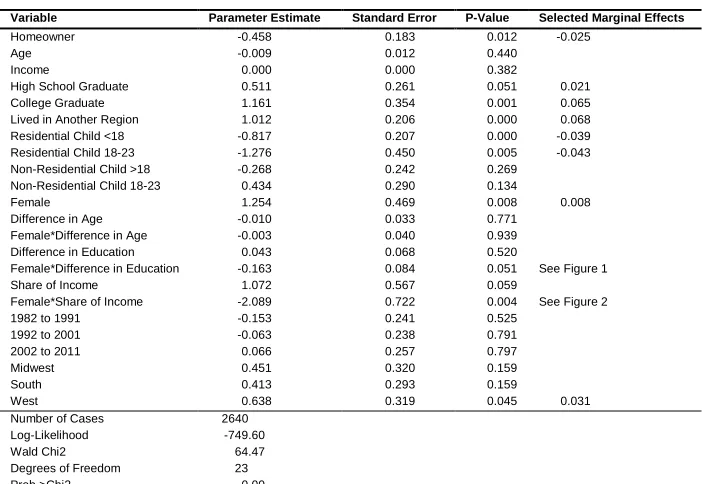
Table 2: Parameter estimates of model of probability of migration
Variable Parameter Estimate Standard Error P-Value Selected Marginal Effects
Homeowner -0.458 0.183 0.012 -0.025 Age -0.009 0.012 0.440
Income 0.000 0.000 0.382
High School Graduate 0.511 0.261 0.051 0.021 College Graduate 1.161 0.354 0.001 0.065 Lived in Another Region 1.012 0.206 0.000 0.068 Residential Child <18 -0.817 0.207 0.000 -0.039 Residential Child 18-23 -1.276 0.450 0.005 -0.043 Non-Residential Child >18 -0.268 0.242 0.269
Non-Residential Child 18-23 0.434 0.290 0.134
Female 1.254 0.469 0.008 0.008 Difference in Age -0.010 0.033 0.771
Female*Difference in Age -0.003 0.040 0.939 Difference in Education 0.043 0.068 0.520
Female*Difference in Education -0.163 0.084 0.051 See Figure 1 Share of Income 1.072 0.567 0.059
Female*Share of Income -2.089 0.722 0.004 See Figure 2 1982 to 1991 -0.153 0.241 0.525
1992 to 2001 -0.063 0.238 0.791 2002 to 2011 0.066 0.257 0.797 Midwest 0.451 0.320 0.159 South 0.413 0.293 0.159
West 0.638 0.319 0.045 0.031 Number of Cases 2640
Log-Likelihood -749.60 Wald Chi2 64.47 Degrees of Freedom 23 Prob.>Chi2 0.00
First, with regard to the control variables, migration is negatively associated with housing tenure, positively associated with having a high school diploma or a college degree, and positively associated with having previously lived in another region. The effects of age and income on migration are not statistically significant. With regard to the variables that are statistically significant, the effects are meaningful. In terms of average marginal effects, owning a home reduces the probability of moving by 2.5% relative to renting a home, being a high school graduate increases the probability of moving by 2.1% relative to not having a high school degree, having a college degree increases the probability of moving by 6.5% relative to not having a high school degree, and having previously lived in another region increases the probability of moving by 6.8% relative to not having previously lived in another region.
argument is that individuals with relatively low levels of human capital, women, and especially women with relatively low levels of human capital are likely to have had less influence over previous migration decisions, are presumed to be more likely to live in a less-than-optimal location at the time of union dissolution, and should therefore be more likely to migrate after separation. This hypothesis is evaluated with regard to three sets of parameters in interaction with gender: relative income, relative education, and relative age.
To begin, Table 2 shows that the gender variable is statistically significant and the average marginal effects indicate that women are barely 0.1% more likely to move after union dissolution than men. This effect is small but nonetheless consistent with the research hypothesis. However, gender is statistically significant in concert with relative income and marginally significant in combination with relative education (p=0.051), but not relative age. Since these are continuous variables, marginal effects need to be calculated over a range of values and thus these are shown – along with 95% confidence intervals – in Figures 1 and 2. So, for example, Figure 1 shows the marginal effect of gender on the probability of migration as a function of relative education. In this case, the effect of relative education on the migration of women relative to men decreases as women’s relative education increases. However, this effect is statistically insignificant (p>0.05) across all values.
Figure 1: Gender effect of relative education
Figure 2: Gender effect of relative income
other two are statistically insignificant. This indirectly implies that parents are less migratory than non-parents. This is confirmed by collapsing the four parental variables into one parental status variable, and then re-estimating the model (these results are not reported but available from the authors). In this case, the results are comparable in all other respects to the results reported in Table 2 but the parental parameter estimate is negative (-0.61) and statistically significant (p<0.001). More to the point, the average marginal effect is –3.2%, indicating that parents are less likely to move than non-parents.
The penultimate hypothesis focuses more specifically on the living arrangements of children by arguing that among parents, those without custody are more likely to migrate following union dissolution than those with custody. The results presented in Table 2 are consistent with this hypothesis: Having a residential child (no matter what age) significantly reduces bi-annual interstate migration rates. Specifically, having a residential child less than 18 years old reduces migration by 3.9% and having a residential child between 18 and 23 years old reduces migration by 4.3%. However, parents without residential children are just as likely to migrate as non-parents. This could be because this is a diverse population consisting of parents who are highly likely to migrate (e.g., those who have no desire to have a relationship with their child and those without visitation rights), as well as those who are highly unlikely to migrate (e.g., those who have joint or shared custody).
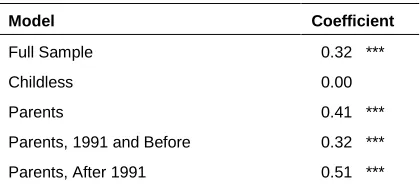
Finally, Hypothesis 4 focuses on the degree to which the migration behavior of former partners is correlated. The argument is that because of joint or shared custody and visitation agreements, the migration decisions of former partners remain linked even after their interest in maintaining a relationship with each other has ended. This hypothesis is explored via the Intra-Class Correlation Coefficient (ICC), with the relevant estimates reported in Table 3. Among the full sample, an ICC of 0.32 suggests a high degree of interdependence in the decision to migrate following union dissolution, having accounted for individual and couple composition. With that said, the question remains as to whether this is due to the presence of children. Consequently, in an attempt to answer this question, separate models for parents and non-parents are estimated along with their respective ICCs. The resultant ICC for non-parents is effectively zero while for parents it is 0.41.4 Hence, the post-separation migration decisions of parents, but not childless couples, are highly correlated. The obvious explanation is that these are related to visitation and custody arrangements. An indirect way of testing this hypothesis is to estimate the model among parents but to differentiate between the first twenty years of observations (prior to and including 1991) versus the last twenty years of observations (since 1991), under the assumption
4 Caution is in order in interpreting the ICC value for non-parents because there are so few ex-partners in the
that joint and shared custody was less common in the past than it is now. According to this logic, the ICC should be larger today than it was previously. Indeed, the ICC for the 1975−1991 model is much smaller than the ICC for the post-1991 model.
Table 3: Intra-class correlation coefficients
Model Coefficient
Full Sample 0.32 ***
Childless 0.00
Parents 0.41 ***
Parents, 1991 and Before 0.32 ***
Parents, After 1991 0.51 ***
Note: Significance: *<0.05; **<0.01; ***<0.001
5. Conclusion
Decades of empirical research suggest that family migration decisions are biased toward the human capital of the husband, implying that married women – and in particular women who have lower levels of human capital – have relatively little influence over family migration decisions. This implies that women are more likely to be living in less-than-satisfactory locales and as a consequence are more likely to migrate upon union dissolution. The empirical evidence presented in this analysis is consistent in this regard: women are more likely to migrate after dissolution than men and, in particular, women with relatively lower incomes are more likely to migrate after union dissolution. Hence, this analysis provides indirect empirical support for the gendered model of family migration and lends further credence to the argument that migration research in general must continue to seriously consider the role of gender in shaping migration behavior.
migration research by pointing out that it may even extend to individuals who have no apparent desire to maintain their linked lives.
A final implication of this research is in regard to the long-term decline in aggregate US migration rates since the early 1980s (see Fischer 2002; Wolf and Longino 2005; Cooke 2011; Molloy, Smith, and Wozniak 2011; Cooke 2013b). The results imply that the need for separated parents with joint or shared custody to geographically coordinate the living arrangements of their children is associated with reduced levels of migration. The creation of two families due to union dissolution is just one example of the ways in which families in the United States have become more complex over the last several decades (see Cancian, Meyer, and Cook 2011), but if this source of complexity is associated with reduced levels of migration then it is not unreasonable to conclude that the more general trend toward greater family complexity may be a significant driver in reducing aggregate migration rates.
6. Acknowledgements
References
Bakker, W. and Mulder, C.H. (2013). Characteristics of post-separation families in the netherlands: Shared residence versus resident mother arrangements. GeoJournal
78(5): 851−866. doi:10.1007/s10708-012-9470-x.
Bielby, W.T. and Bielby, D. (1992). I will follow him: Family ties, gender-role beliefs, and reluctance to relocate for a better job. American Journal of Sociology 97(5): 1241−1267. doi:10.1086/229901.
Cancian, M., Meyer, D., and Cook, S. (2011). The evolution of family complexity from the perspective of nonmarital children. Demography 48(3): 957−982.
doi:10.1007/s13524-011-0041-4.
Cancian, M., Meyer, D.R., Brown, P.R., and Cook, S.T. (2014). Who gets custody now? Dramatic changes in children’s living arrangements after divorce.
Demography 51(4): 1381−1396. doi:10.1007/s13524-014-0307-8.
Clark, W.A.V. and Huang, Y. (2004). Linking migration and mobility: Individual and contextual effects in housing markets in the UK. Regional Studies 38(6): 617−628. doi:10.1080/003434042000240932.
Clark, W.A.V. and Withers, S.D. (2007). Family migration and mobility sequences in the United States: Spatial mobility in the context of the life course. Demographic Research 17(20): 591−622. doi:10.4054/DemRes.2007.17.20.
Clark, W.A.V. (2013). Life course events and residential change: Unpacking age effects on the probability of moving. Journal of Population Research 30(4): 319–334.
doi:10.1007/s12546-013-9116-y.
Compton, J. and Pollak, R.A. (2007). Why are power couples increasingly concentrated in large metropolitan areas? Journal of Labor Economics 25(3): 475–512.
doi:10.1086/512706.
Cooke, T.J. (2008a). Gender role beliefs and family migration. Population, Space and Place 14(3): 163−175. doi:10.1002/psp.485.
Cooke, T.J. (2008b). Migration in a family way. Population, Space and Place 14(4): 255–265. doi:10.1002/psp.500.
Cooke, T.J. (2011). It is not just the economy: Declining migration and the rise of secular rootedness. Population, Space and Place 17(3): 193–203. doi:10.1002/
Cooke, T.J. (2013a). All tied up: Tied staying and tied migration within the United States, 1997 to 2007. Demographic Research 29(30): 817–836. doi:10.4054/
DemRes.2013.29.30.
Cooke, T.J. (2013b). Internal migration in decline. The Professional Geographer 65(4): 664–675. doi:10.1080/00330124.2012.724343.
Courgeau, D. (1985). Interaction between spatial mobility, family and career life-cycle: A French survey. European Sociological Review 1(2): 139–162.
Das, M., de Valk, H., and Merz, E.-M. (2016). Mothers' mobility after separation: Do grandmothers matter? Population, Space and Place. doi:10.1002/psp.2010. DaVanzo, J. (1976). Why families move: A model of the geographic mobility of married
couples. Santa Monica, CA: Rand.
Dewilde, C. (2008). Divorce and the housing movements of owner-occupiers: A European comparison. Housing Studies 23(6): 809–832. doi:10.1080/0267303
0802423151.
Dewilde, C. (2009). Divorce and housing: A European comparison of the housing consequences of divorce for men and women. In: Andres, H. and Hummelsheim, D. (eds.). When marriage ends: Economic and social consequences of partnership dissolution. Cheltenham, UK and Northampton, MA: Edward Elgar: 263–285. doi:10.4337/9781848447202.00019.
Dewilde, C. and Stier, H. (2014). Homeownership later in life − does divorce matter?
Advances in Life Course Research 20: 28–42. doi:10.1016/j.alcr.2014.01.002. Feijten, P. (2005). Union dissolution, unemployment and moving out of
homeownership. European Sociological Review: 59–71. doi:10.1093/esr/jci004. Feijten, P. and van Ham, M. (2007). Residential mobility and migration of the
separated. Demographic Research S6(21): 623–654. doi:10.4054/DemRes.
2007.17.21.
Feijten, P. and van Ham, M. (2013). The consequences of divorce and splitting up for spatial mobility in the UK. Comparative Population Studies 38(2): 405–432. Fischer, C.S. (2002). Ever-more rooted Americans. City & Community 1(2): 177–198.
doi:10.1111/1540-6040.00016.
Flowerdew, R. and Al-Hamad, A. (2004). The relationship between marriage, divorce and migration in a British data set. Journal of Ethnic and Migration Studies
Gram-Hanssen, K. and Bech-Danielsen, C. (2008). Home dissolution: What happens after separating? Housing Studies 23(3): 507–522. doi:10.1080/02673030802
020635.
Halfacree, K.H. (1995). Household migration and the structuration of patriarchy - evidence from the USA. Progress in Human Geography 19(2): 159–182. Herbers, D.J., Mulder, C.H., and Mòdenes, J.A. (2014). Moving out of home ownership
in later life: The influence of the family and housing careers. Housing Studies
29(7): 910–936. doi:10.1080/02673037.2014.923090.
McGonagle, K.A., Schoeni, R.F., Sastry, N., and Freedman, V.A. (2012). The panel study of income dynamics: Overview, recent innovations, and potential for life course research. Longitudinal and Life Course Studies 3(2): 268−284.
McMahon, J.M., Pouget, E.R., and Tortu, S. (2006). A guide for multilevel modeling of dyadic data with binary outcomes using SAS PROC nlmixed. Computational Statistics and Data Analysis 50(12): 3663–3680. doi:10.1016/j.csda.2005.08.
008.
Michielin, F., Mulder, C.H., and Zorlu, A. (2008). Distance to parents and geographical mobility. Population, Space and Place 14(4): 327–345. doi:10.1002/psp.509. Mincer, J. (1978). Family migration decisions. The Journal of Political Economy 86(5):
749–773. doi:10.1086/260710.
Molloy, R., Smith, C.L., and Wozniak, A. (2011). Internal migration in the United States. Journal of Economic Perspectives 25(2): 1–42. doi:10.3386/w17307. Mulder, C.H. (2007). The family context and residential choice: A challenge for new
research. Population, Space and Place 13(4): 265–278. doi:10.1002/psp.456. Mulder, C.H. and Wagner, M. (2010). Union dissolution and mobility: Who moves
from the family home after separation? Journal of Marriage and Family 72(5): 1263–1273. doi:10.1111/j.1741-3737.2010.00763.x.
Mulder, C.H. and Malmberg, G. (2011). Moving related to separation: Who moves and to what distance. Environment and Planning A 43(11): 2589–2607. doi:10.1068/
a43609.
Mulder, C.H. and Wagner, M. (2012). Moving after separation: The role of location-specific capital. Housing Studies 27(6): 839–852. doi:10.1080/02673037.2012.
651109.
Mulder, C.H. and Malmberg, G. (2014). Local ties and family migration. Environment and Planning A 46(9): 2195–2211. doi:10.1068/a130160p.
Nazir, S. (2009). The changing path to relocation: An update on post-divorce relocation issues. Journal of the American Academy of Matrimonial Law 22: 483–498. Sandell, S.H. (1977). Women and the economics of family migration. The Review of
Economics and Statistics 59(4): 406–414. doi:10.2307/1928705.
Snijders, T.A.B. and Bosker, R.J. (2012). Multilevel analysis: An introduction to basic and advanced multilevel modelling. Sage: London.
Stjernström, O. and Strömgren, M. (2012). Geographical distance between children and absent parents in separated families. Geografiska Annaler: Series B, Human Geography 94(3): 239–253. doi:10.1111/j.1468-0467.2012.00412.x.
Williams, R. (2012). Using the margins command to estimate and interpret adjusted predictions and marginal effects. Stata Journal 12(2): 308–331.
Wolf, D. and Longino, C. (2005). Our 'increasingly mobile society?' The curious persistence of a false belief. The Gerontologist 45: 5–11. doi:10.1093/geront/