Geschke Center
Doctor of Nursing Practice (DNP) Projects Theses, Dissertations, Capstones and Projects
Winter 12-12-2014
Overcoming Barriers to Screening for Anal
Intraepithelial Neoplasia for Persons Living with
HIV
Brandon Hastings
University of San Francisco, [email protected]
Follow this and additional works at:https://repository.usfca.edu/dnp
Part of theCommunity Health and Preventive Medicine Commons,Family Practice Nursing Commons, and theNeoplasms Commons
This Project is brought to you for free and open access by the Theses, Dissertations, Capstones and Projects at USF Scholarship: a digital repository @ Gleeson Library | Geschke Center. It has been accepted for inclusion in Doctor of Nursing Practice (DNP) Projects by an authorized administrator of USF Scholarship: a digital repository @ Gleeson Library | Geschke Center. For more information, please [email protected].
Recommended Citation
Hastings, Brandon, "Overcoming Barriers to Screening for Anal Intraepithelial Neoplasia for Persons Living with HIV" (2014).Doctor of Nursing Practice (DNP) Projects. 53.
Overcoming Barriers to Screening for Anal Intraepithelial
Neoplasia for Persons Living with HIV
Doctor of Nursing Practice Final Project Report
Brandon Hastings DNPc, FNP-BC, CNL
University of San Francisco
Abstract
Screening has proven an effective strategy in the management of diseases that plague the
population. This technique has proven to be most effective when screening is conducted
with those who are most at risk for developing the targeted illness and when the
frequency of screening follows set guidelines. Currently there are no nationally
recognized screening guidelines for anal intraepithelial neoplasia (AIN). Screening for
AIN stands to reduce overall incidence of anal squamous cell carcinoma through
destruction of the dysplastic cells before they become cancerous. The goals of this
project were to identify the patient population that stands to benefit the most from AIN
screening, to identify the existing barriers to screening, and to educate primary care
providers on methods to overcome these barriers. The results of this primary care
practice improvement project show that with an educational forum for the providers, rates
of AIN screening increased by as much as 89%. However, more attention still needs to
be paid to the individual biases of providers regarding their views on AIN screening;
also, more providers need training in high-resolution anoscopy, as this is the mainstay of
follow-up.
Keywords: anal intraepithelial dysplasia, AIN, anal cancer, anal squamous cell
Table of Contents
Abstract ... 2
Introduction ... 5
Background Knowledge ... 5
Local Problem ... 6
Aim ... 6
Review of the Evidence ... 6
Theoretical Framework ... 16
Methods ... 18
Ethical Issues ... 18
Setting ... 18
Planning the Intervention ... 20
Implementation of the Project ... 21
Planning the Study of the Intervention ... 23
Methods of Evaluation... 29
Assessment of Change of Practice ... 30
Results ... 31
Program Evaluation/Outcomes ... 31
Discussion ... 36
Summary... 36
Relation to other evidence ... 38
Limitations of the project ... 38
Interpretation ... 40
References ... 43
Tables ... 49
Table 1 ... 49
Table 2 ... 50
Table 3 ... 51
Table 4 ... 52
Appendices ... 53
Appendix A: IRB Exemption ... 53
Appendix B: Budget and Cost-Benefit Analysis ... 55
Appendix C: Communication Matrix ... 56
Appendix D: Baseline Data Collection Survey ... 57
Appendix F: Specimen Collection ... 63
Appendix G: Follow up Algorithm ... 64
Appendix H: Follow-up Survey... 65
Appendix I: Gap Analysis ... 66
Appendix J: Milestone Report ... 68
Appendix K: Project Timeline ... 70
Appendix L: Work Breakdown Structure ... 71
Overcoming Barriers to Screening for Anal Intraepithelial Neoplasia
For Persons Living with HIV
Since human immunodeficiency virus (HIV) has become a chronic disease, the
prospect of long-term survival has become a reality for persons living with HIV (PLWH).
Those who are started on anti-retroviral therapy (ART) when their CD4 count is above
200 cells/mm3 have a reasonable expectation to live well past the age of 65 (Schneider et
al., 2005). Thus healthcare providers are in the position of not only managing HIV, but
they must also be cognizant of other health-related problems PLWH are susceptible to.
Many age-related comorbidities affect PLWH at an earlier age, and many forms of cancer
have proven widespread in this population as well, specifically anal squamous cell
carcinoma (ASCC) (Patel et al., 2008). To best serve PLWH, careful attention must be
paid to the increased risk of these age-related comorbidities, ASCC and it precursor, anal
intraepithelial neoplasia.
Introduction
Background Knowledge
Historically the United States has been very aggressive in the development of
programs to control medical problems that plague its citizens. In 1996 the United States
Preventative Services Task Force (USPSTF) recommended screening for colorectal
cancer (CRC) in all persons over the age of 50, resulting in a decrease in the overall
incidence of CRC (USPTF, 2008; National Cancer Institute Age Adjusted SEER
Incidence, n.d.). Similarly, the Papanicolaou (Pap) smear, and the subsequent set of
screening guidelines, is credited with a dramatic reduction in the incidence of cervical
screening patients for AIN, the suspected precursor to ASCC. Rates of ASCC in the
general population have historically been low, with an increase in new cases of 2.2% per
year over the past 10 years (Patel et al., 2008; National Cancer Institute Age Adjusted
SEER Incidence, n.d.). However, this trend has not held true in PLWH, who some
estimate have a 40 times greater chance of developing ASCC over those without HIV
(Cranston, Hart, Gornbein, Hirschowitz, Cortina & Moe, 2007).
Local Problem
As of December 31, 2013 over 15,900 persons were living with HIV in San
Francisco, representing 13% of the total PLWH in the state of California (San Francisco
Department of Public Health, 2014). These numbers have continued to rise year after
year. Newly diagnosed cases of HIV were 359 in 2013, down from 426 in 2012 (SF
Department of Public Health, 2014). The rise is compounded by the fact that the number
of deaths in PLWH has been steadily declining (SF Department of Public Health, 2014).
This longevity of PLWH has increased their risk of developing other comorbidities.
Aim
The aim of this primary care practice improvement project is to identify and
address the existing barriers to screening for AIN, real or perceived, to identify patients
most at-risk for ASCC, and to educate primary care providers on methods to overcome
these barriers.
Review of the Evidence
cancer in PLWH was about 20 times that of people without HIV (Patel et al., 2008).
Combined antiretroviral therapy, more commonly referred to as highly active
antiretroviral therapy (HAART) in the medical literature, was hailed as the solution to
these alarming rates of cancer, yet the contrary proved to be true. Patel et al. (2008)
examined the rates of invasive anal cancers found in PLWH over three time periods:
1992-1995 (pre-HAART), 1996-1999 (early HAART), and 2000-2003 (later HAART).
This study revealed that ASCC increased in incidence from 19.0/100,000 person-years to
48.3/100,000 person-years during the pre-HAART to the early HAART. This alarming
increase continued into the later HAART period going as high as 78.2/100,000
person-years over the 3-year later HAART time period. Over the course of the same time frame,
the rates of anal cancer in the non-HIV infected general population increased 1.0, 1.2, and
1.3/100,000 person-years respectively (95% CI) (Patel et al., 2008). There have been
other studies that have echoed these results. A cohort study in France examined over
100,000 patients from 1992-2008, with HAART readily available for the last 12 of those
years, and found that the incidence of invasive anal cancer was 20 times that of the
general public (p=.02) (Piketty et al., 2012).
ASCC and cervical cancer. Cervical cancer, and its precursor cervical
intraepithelial neoplasia (CIN) are very closely related to ASCC and its suspected
precursor AIN. In 2010 the incidence of cervical cancer in the US was 6.7/100,000
person-years, down from 14.8/100,000 in 1975 (National Cancer Institute, n.d.). The use
of Pap smear technology is largely to credit for this reduction, along with a clear and
unambiguous set of screening guidelines (Spitzer, 2007). The current guidelines replaced
(USPSTF), demonstrating a continued effort to control, if not eradicate, cervical cancer
through screening. The revision includes a more guided approach based on the age of the
woman, and also addresses the frequency of screenings in women of all ages (Moyer,
2012). These evolving criteria are being revised in an effort to eliminate unnecessary
screenings, while still identifying those most at risk for the disease. In the case of AIN,
and the subsequent ASCC, the lack of nationally recognized screening criteria have
resulted in many at-risk individuals not being screened at all (Palefsky, 2009).
Both ASCC and cervical cancer have dysplastic cells that serve as precursors to
invasive cancer. The anal canal and the cervix both have regions of cells that have active
metaplasia called the transformation zone. This is the area where the glandular epithelial
cells, or columnar cells, are being replaced with squamous epithelium (Darragh &
Winkler, 2011). Not only is the anatomy of the cervical and anal transformation zones
similar, but cervical cancer and ASCC also share other similarities; both have a causal
relationship with the human papillomavirus (HPV).
HPV. HPV is the most common sexually transmitted disease in the United States,
with over 79 million Americans infected with some strain of the virus (Centers for
Disease Control and Prevention (CDC), 2013). HPV is a DNA virus that has over 100
subtypes, 40 of which can infect the anogenital tract in humans (CDC, 2012). Of these
40 subtypes, the subtypes 16 and 18 have demonstrated that they are particularly
oncogenic; they have shown to be the cause of 70% of cervical cancers and 90% of
ASCC (CDC, 2012).
When HPV is introduced to the transformation zone in either the anus or the
layers. Once the basal cell layer has been infected, there is a possibility that the cell cycle
will be interrupted, leading to the development of intraepithelial neoplasia (IN) (Moody
& Laimins, 2010). The IN is exactly what is being sought with the screening of patients
for AIN.
Bethesda system. The cytology reports produced from cervical specimens are
reported using the Bethesda system. This system has been slightly modified to
accommodate the subtle differences of anal cytology. The modified system ranks cells
found on the specimen as either: normal, abnormal squamous cells of unknown
significance (ASC-US), low-grade squamous intraepithelial lesion (LSIL), or high-grade
squamous intraepithelial lesion (HSIL) (Soloman et al., 2002).
Existing barriers. When a woman is noted to have CIN during screening for
cervical neoplasia on her Pap exam, she is referred for follow-up to a provider who can
perform colposcopy and biopsy of any area of concern. If the areas biopsied are found to
have high-grade lesions, then the cervix is treated using the loop electro-excision
procedure (LEEP). Most gynecologists and Nurse Practitioners (NPs) who work in
women’s health provide colposcopy for CIN and LEEP if indicated. These procedures are
taught routinely as part of gynecological residency training for Medical Doctors and also
as part of training for NPs as they enter the women’s health arena (Moyer, 2012;
Palefsky, 2009; Darragh & Winkler, 2011, Bigrigg, Haffenden, Sheehan, Codling &
Reed, 1994).
For patients diagnosed with high-grade lesions on anal Papanicolaou smear (Pap),
the options are not as plentiful. Ideally, those with HSIL on anal Pap would be referred
colposcopy and uses magnification to examine the squamous cells of the anal canal in a
microscopic fashion, using equipment that has been modified to address the anatomical
differences between the cervix and the anus (Goldstone, 2010). In spite of the fact that
the techniques are similar, there are very few providers trained in the use of HRA (Oon &
Winter, 2010).
The shortage of providers, and lack of screening guidelines, have led to fewer
patients being found to have AIN and fewer people being treated with targeted
destruction. This limits the ability to thoroughly evaluate efficacy of existing treatments,
and limits the development of new treatments. LEEP currently produces a one-year cure
rate of 95% when the entire transformational zone is removed (Oon & Winter, 2010).
Unfortunately, this approach is not useful in the anal transformation zone; removal of the
entire anal transformation zone would lead to mechanical impairment and strictures of the
anal canal. Therefore the treatments for lesions found on anal Pap must rely on targeted
destruction of the lesions (Gaisa & Goldstone, 2011). While there are many options
available for the targeted destructive therapy, the efficacy rates vary widely as to
recurrence rates (Gaisa & Goldstone, 2011). Full exploration of the various treatment
options extends beyond the scope of this project. The main purpose here is to overcome
barriers to screening, allowing a larger data set be used to better determine the most
effective screening practices.
Many opponents of AIN screening point to the fact that there are no randomized
controlled trials (RCTs) that aid in the determination of the best treatment modalities for
AIN. There is also an obvious lack of supporting data linking the treatment of AIN to the
RCT to examine both. However, an RCT that would examine the link between AIN and
ASCC would require a control, or observation group, that could be at risk to develop the
invasive form of cancer. This would lead to enormous ethical concerns that are difficult
to overcome when designing the RCT. Another strategy would be to use historical
controls to limit the ethical complexity of such a study. The abundance of historical data
would strengthen the results and provide further evidence that increased screening now
could serve a greater purpose in the future. It is also important to note that an RCT
examining the relationship between the CIN and cervical cancer has never been done
(Palefsky, 2009). Current screening guidelines and treatment recommendations are based
on decades of observational data in areas where cervical screening has been
implemented. Drastic reductions in the rates of invasive cervical cancers have been
demonstrated as a result (Palefsky, 2009). To address the concerns of many medical
professionals that cite the lack of hard data linking screening for AIN to a reduction in the
numbers of ASCC, Dr. Joel Palefsky of the University of California, San Francisco,
began enrollment in April 2014 for a random-assign quasi-experimental study. This
study aims to identify over 5000 people with AIN and randomize them into two groups.
One group will be treated with targeted destructive therapy while the other closely
observed for progression of their HSIL and/or the development of ASCC. The results
could illustrate that with screening and subsequent treatment of high-grade AIN; ASCC
could be preventable (Colliver, 2013; The ANCHOR Study.org, 2015). Currently they
are still recruiting participants at more than 15 sites throughout the country, and are
already monitoring over 1000 participants already enrolled (The ANCHOR Study.org,
Who is at risk. Despite the fact that no RCT has ever been done linking CIN to
cervical cancers, there is national acceptance of the screening guidelines currently being
used. This is because the observational data has largely overshadowed the need for an
RCT. During the process of developing this body of information on AIN screening, and
developing the subsequent set of guidelines that will evolve out of it, identifying the
proper target population is an integral step. As previously outlined, the rates of ASCC
for PLWH were noticed in the 1990s, and when the rates continued to rise in spite of the
HAART, researchers began to look at other potential causes for the disproportionate rise
in PLWH. It is largely believed that the destruction of the immune system caused by
HIV allows HPV to live in the transformation zone longer, thus allowing more time for
the virus to cause IN (Palefsky, Holly, Ralston & Jay, 1998). Additionally, men who
have sex with men (MSM) have demonstrated rates of ASCC far above rates found in the
general population, regardless of HIV status. Anoreceptive intercourse allows the anal
mucosa, especially the transformation zone, to come into direct contact with the
HPV-infecting source (Palefsky et al., 1998).
Research supports the fact that MSM living with HIV (LWH) are most at risk for
the development of AIN and subsequently ASCC. When the practitioner is attempting to
stratify the risk profile of their patients, discussion of HIV status is a given in most
instances; however, to wholly identify all those who would benefit from AIN screenings,
discussion regarding sexual health is necessary. Recent literature has demonstrated that
in some cases as many as 29% of patients have not had a discussion with their primary
care provider regarding sexual orientation (Petroll & Mosack, 2011). Moreover, MSM
disease prevention, adding even more importance to this discussion (Gee, 2006;
Rosa-Cunha, Cardenas, Dickinson & Metsch, 2010). Rosa-Cunha et al. (2010) also found that
just over 33% of patients being treated in a clinic specifically designed for PLWH had
any discussion with their provider regarding sexual practices, specifically anoreceptive
intercourse.
While MSM, PLWH and MSM-LWH are at the highest risk for AIN, there are
other smaller subgroups that should be considered when seeking to identify those who
need AIN screening through the anal Pap. Women LWH should be considered for the
anal Pap. While the fact that the woman is LWH is not an indicator alone, this should
invite a more thorough line of questioning, specifically as to a history of anoreceptive
intercourse, or history of HPV. If the woman has a history of either, then she would
qualify for AIN screening. Women who have lower genital tract squamous IN are also at
increased risk for the development of IN in the anogenital tract (Santoso, Long, Crigger,
Wan & Haefner, 2010). All patients who are immunosuppressed for reasons such as
organ transplant, and have a documented history of HPV in the genital or anal region,
should be considered for screening as well (Collett, Mumford, Banner, Neuberger &
Watson, 2010).
Existing guidelines. While not nationally accepted, the New York State
Department of Health AIDS Institute (NYDHAI) implemented an AIN screening
guideline for practitioners in 2007, and is currently revising to their guidelines to better
serve their patients and also to stay current with the data as it grows (New York State
Department of Health, 2007). The current NYDHAI guidelines are that PLWH who are:
condylomas, or women with abnormal cervical and/or vulvar histology, should be
screened on an annual basis (New York State Department of Health, 2007). Any patient
who is found to have ASC-US, LSIL, or HSIL is referred for HRA with biopsy as
indicated (New York State Department of Health, 2007). The United States Department
of Veterans Affairs (VA) adopted a similar screening guideline in 2009, and subsequently
updated it in 2011 to include more PLWH (US Department of Veterans Affairs, 2011).
This guideline is similar to the previous one in that a baseline screening is recommended,
and then on an annual basis thereafter, with all ASC-US, LSIL and HSIL being referred
for HRA and biopsy. However they go somewhat further as to whom they include in the
screenings. The VA screens PLWH and who are one of the following: MSM, persons
with a history of receptive anal intercourse, persons with a history of anogenital
condylomas, women with abnormal cervical and/or vulvar histology, or tobacco smokers
(US Department of Veterans Affairs, 2011).
For the purposes of this project, the guideline will be as follows: MSM-LWH or
women LWH who have a concomitant history of cervical or vulvar dysplasia. These
criteria were chosen in response to the supporting literature highlighting this patient
population as the most at risk for the development of ASCC (Palefsky et al., 1998). The
main criterion that was omitted from the project screening guidelines was current or
historical tobacco smoking, as noted in the VA screening guidelines. This criterion was
removed due to the lack of evidence linking tobacco smoking and an increased risk of
ASCC or AIN.
Benefits of screening. The definitive standard as to the effectiveness of this
targeted destruction of the pre-cancerous lesions. While this may seem like an obvious
statement, one can only reach that conclusion after a satisfactory number of screenings
have been performed, studied, and then reported back to the scientific community.
Unfortunately not enough data exist to support such claims in the case of ASCC. In areas
where many, yet not all, high-risk individuals receive anal cancer screening, the rates of
anal cancer have remained relatively stable, while in other parts of the country, the rate of
ASCC has doubled (Katz, Clarke, Bernstein, Katz & Klausner, 2009). Further study of
those rates is required to fully ascertain the connection between rates of screening and
rates of invasive cancers. Screening for AIN, and subsequently ASCC, can also be
examined from a different perspective. Patients who have anal cancer diagnosed when in
situ have an 80% survival rate after 5 years, whereas that number drops to 30% when the
cancer has metastasized, emphasizing the point that earlier detection will produce better
long-term outcomes (National Cancer Institute SEER, n.d.).
Additionally, the cost savings related to screening for AIN, and the ensuing
reduction in the incidence of ASCC are noteworthy. Studies have found that the costs of
treating a single patient in the first year after diagnosis of ASCC was over $30,000, but
aggressive screening, coupled with targeted destruction, could result in a $16,600
reduction in those costs (Lam, Hoch, Tinmouth, Sano, Rabound & Salit, 2011; Olsen,
Jorgenson, Kofoed & Larsen, 2012).
Evaluation of the evidence. A full review of the evidence was also done to determine if
the literature provided is of the upmost reliability. As previously mentioned, there is a
lack of RCT to support the connection between and AIN and ACSS as well as the link
the evidence above is mostly rated as level II or level III evidence. The majority of the
studies referenced were cohort studies or case-controlled studies, lacking the
randomization required for the highest level of evidence (Newhouse, Dearholt, Poe,
Pugh, & White, 2007). In addition to the level II-III, there is evidence referenced that
falls in to the level IV and V categories according to the Johns Hopkins model. Many of
the observations regarding ASCC have been noted by providers who have had large
numbers of PLWH on their patient profile and have led to many of the published works
noted above. These providers have also published many case reports that also contribute
to the level V evidence (Newhouse et. al., 2007).
Theoretical Framework
The seminal work by Kurt Lewin (1947) was chosen as the theoretical framework
for the implementation of this practice change project. It was chosen because the success
of this project relies upon healthcare providers discussing this issue with patients deemed
at-risk for the development of ASCC. Given the nature of screening, patients can benefit
the most have no symptoms of illness or other complaints. Therefore changing the
perceptions and actions of the providers is essential.
The Lewin framework uses a three-step process to ensure a successful change in
behavior. The first step, unfreezing, is arguably the most important step in the process.
During this step, primary care providers in the case of this project must be readied for
change. To accomplish this, evidence must be provided illustrating that the ‘pros’
outweigh the ‘cons’, and that the change is imminently needed. Lewin (1947) also
encourages the use of a force field analysis, or a complete review of all factors, to ensure
force field analysis is complete, the use of unbiased and reliable evidence is used, along
with deadlines, to promote the urgency of the change (Connelly, n.d.).
Secondly, this framework calls for the actual change, but more appropriately, the
transition, as change is not a single event in time but rather a process (Lewin, 1947;
Connelly, n.d.). While the first step in the change model is viewed as the most important,
this second step is the hardest. The change agent must combat tradition, fear, skepticism
and other emotions that can prevent the change from taking place. To best tackle these
potential barriers, frequent communication and support of the primary care providers
must be offered. This will serve to not only encourage the change, but also make sure
those expected to make the change are aware that others are equally as vested in the
change (Connelly, n.d.).
The framework concludes with the third step of refreezing. Lewin (1947) stresses
the importance of this step to prevent a circular pattern, referred to by others as
regressions to the pre-change state (Connelly, n.d.). Strategies for this include ensuring
the change fits into the routine, perhaps a new routine. To further support the refreezing
process, ensuring the permanency of the change very early in the change process is
important (Lewin, 1947; Connelly, n.d.). To convey the lasting nature of the change, the
change agent should ensure that new processes are designed at the outset to enable
participants to work through the new process. These new processes should also have
feedback mechanisms built in to allow the end-users a way of giving input and lastly
support from the leadership in the early stages of the change will create the perception
Methods
Ethical Issues
The project qualifies as a primary care practice improvement project. The
participants were the primary care providers, 2 Medical Doctors, 1 Physicians Assistant
and 1 Nurse Practitioner, at each of the two implementation sites along with their support
staff of 2 medical assistants at each site. The educational forums took place during the
lunch hour, during which time the offices were closed to patients. The overall standards
of care and medical decision-making were unaffected by this project; therefore no ethical
issues were identified. There was no review of patient medical records, and no patient
contact by the project director. The University of San Francisco Doctor of Nursing
Practice faculty approved the project as a primary care practice improvement project and
approved the project outline as IRB exempt (Appendix A).
Setting
Two clinics were chosen for implementation of the project. Both of these clinics
are members of a larger healthcare delivery system that includes a full range of services
including outpatient and primary care services, acute care hospital care and a range of
post-acute services across Northern California. The importance of this is that both
clinics, labeled primary care, have MSM-LWH as the majority of their patient profiles
and both providers were considered ‘HIV specialists’ at the time they were acquired by
the larger parent organization. The primary doctors at both sites gained the title of HIV
specialist during the heat of the AIDS crisis during the 1980’s, leading to a large
percentage of patients in the practice that are LWH. This was a title bestowed upon those
providers who were willing to treat the AIDS patients at the time, yet no specialized
project, but the Physician Assistant (PA) and the NP working alongside the MD providers
also agreed to participate and aided in the success of the project. To preserve the
anonymity of the providers, the sites will be referred to as Implementation Site 1 (site 1)
and Implementation Site 2 (site 2).
Site 1 was noted to have 1 MD provider and 1 PA provider, both with varying
numbers of daily visits. Both the providers at site 1 have outpatient appointments, but
also manage their patients when they are admitted to the hospital, ranging from 4-14
patients visits per provider per day. Site 2 also has 2 MD and 2 NP providers, however
only 1 MD and 1 NP were participants in this project. The MD and NP provider at site 2
also only practice outpatient medicine, thus the number of visits per day was more stable,
ranging from 12-14 visits per provider per day.
The implementation sites were also chosen because the majority of their patients
are MSM-LWH or PLWH. This information was provided by both of the MD providers
at sites 1 and 2, however the exact numbers of MSM-LWH or PLWH is not known. The
only way this information could have been obtained was a chart review of all patients,
which would require additional IRB approval and consent of each of the patients, neither
of which was obtained.
Process. The medical assistants (MA) prescheduled all patients for either an
acute concern, a follow-up regarding a past visit or hospitalization, or a wellness visit.
All visits were potentially included in the project. Visit length varied from 20-40 minutes
depending on the nature of the visit, and visit lengths allowed adequate time to discuss
AIN screening with the patients. In each of the implementation sites there were very
additional time required. After a thorough presentation, all providers agreed that the
goals and processes of the project would not add to their workload.
Planning the Intervention
The literature regarding screening supports the fact that well-orchestrated
programs can result in lowering the rates of disease. This principle is well defined in the
areas of cervical cancer as well as colorectal cancers, yet without a cogent set of
nationally accepted guidelines for the screening, many providers opt not to screen
patients (National Cancer Institute, n.d.; Spitzer, 2007). During early conversations with
the providers regarding this project, there was baseline knowledge of the AIN screening
process, and all needed skills and equipment were already present in both clinics. This
information shaped the first portion of the project, to gather baseline data on current
practices being employed by the providers. Given the existing knowledge of the
providers and their accessibility to the equipment required for specimen collection, the
second portion of the project was to identify barriers to screening the patients most at
risk. The final portion of the project was an educational forum developed for each of the
sites consisting of information to overcome barriers, both from the literature and those
held by the providers. These barriers included which patients should be selected for
screening and follow- up recommendations for the patient with a positive screening.
Additionally, providers at both sites 1 and 2 shared that they were hesitant to screen
patients for AIN due to questions surrounding billing and reimbursement practices. This
additional barrier was also included in the educational forum.
Cost-benefit analysis. The total cost to implement the project was $1824;
be avoided should this project be implemented at future sites include the cost of catered
lunches provided during the educational forums as well as the informational meetings
conducted with the office staff. Factors that aided in keeping the costs down were that
the supplies needed for screening, the processes for sending out specimens, and the
procedures for securing follow-up were already in place. The benefit to the overall health
of PLWH, and cost savings to their care, could be as high as $36,483.00 after the direct
costs of the screening process is taken into account (CMS, Oct. 1, 2014; CMS, 2014; Hu
& Goldie, 2008). If as little as 5% of the PLWH population in San Francisco were
prevented from developing ASCC, the overall healthcare system would see a savings of
over $28 million dollars (Hu & Goldie, 2008; SF Department of Public Health, 2014).
See Appendix B for cost-benefit analysis.
Responsibilities/communication plan. Communication of the project timeline,
milestones, deliverables and the subsequent variances that arose, were organized in the
communication matrix (Appendix C). At regular intervals the matrix was discussed with
the DNP committee chair, Dr. Stefan Rowniak, during meetings held at the USF Hilltop
Campus. Communication regarding implementation was conducted with the primary
MD providers at each of the implementation sites, and adjustments to the implementation
timeline were largely guided by the providers, as every means was taken to minimize the
impact on regular clinic operations.
Implementation of the Project
Implementation of the project began with a meeting with the MA staff in each of
the primary care sites. This consisted of an introduction of the project, an overview of
clinic operations regarding patient scheduling, check-in and rooming processes, and the
processes at the conclusion of the visit. This was done at the urging of both providers at
site 1 and site 2 to ensure that normal clinic operations would not be interrupted or forced
to change. During the initial phase of the project implementation, the MA role consists
of placing a survey on each patients chart for the MD, NP or PA provider to review. Up
until this point, all communication had been with the MD providers only; consequently
some time was taken to address the project with the other providers (NP and PA) at each
site, validating their participation and responsibilities. Each of the MD, NP and PA
providers were asked to review the survey placed on the chart by the MA, then to
determine if the survey was completed, indicating this patient would be selected for AIN
screening. The decision to include/exclude the patient was then used to deduce the
provider’s ability to identify patents at most risk for the development of AIN. At the
conclusion of the visit, the initial surveys were left for gathering the baseline information
on current screening practices (Appendix D). Development of the survey used for
collection of the baseline practices was developed from the data found during the
literature review regarding patients most at risk for the development of AIN. For each
patient chosen as a potential candidate for AIN screening, and subsequently each survey
completed, the goal was to determine what clinical data was used in making the decision
to include the patient.
The second portion of implementation was the educational forum for the
providers. This forum consisted of: background on the need for AIN screening, types of
patients who stood to benefit most from screening, methods for specimen collection, a
Following the forum, each of the providers was given a packet of information for
reference (Appendix E). The content of the educational forum, delivered by the project
manager, was developed using information gathered during the literature review. This
information included the background information on AIN, methods for patient selection
and technique for specimen collection. Additionally, the forum included methods to
overcome barriers; both those noted in the literature and those identified as unique
barriers within the specific implementation sites.
To serve as a visual reminder for the providers to address AIN screening with
their patients, signage was placed in each of the exam rooms regarding steps for
specimen collection and the follow-up algorithm (Appendices F and G). This
information was also provided to ensure that lack of knowledge did not become an
additional barrier to AIN screening. After the forum with the providers, the follow-up
surveys were left with the MA staff for distribution to the providers at the conclusion of
each visit (Appendix H). There was no formal evaluation done of the educational forum,
however, following the forum at both sites 1 and 2 the providers were given an
opportunity to follow up with the project manager regarding any questions they may have
following the forum. The project manager was also present at both sites on a weekly
basis to collect the completed surveys and to allow any of the office staff or providers to
seek clarification on any aspects of the project.
Planning the Study of the Intervention
Baseline data. The providers collected the baseline data before any education was
provided to either site. During the baseline data collection at site 1, the providers were
was done by having the MA staff affix an initial survey (Appendix D) to the after-visit
summary at the conclusion of each visit. Initial surveys were affixed to the summaries of
all patients who were seen in the site 1 office over the 2-week period of baseline data
collection. Upon receiving the survey the provider decided whether to complete it based
on clinical data of the patient, and whether the provider felt the patient would benefit
from AIN screening. The decision to complete the baseline survey was also used to
determine the provider’s intention to screen, as without the intention to screen the survey
was not completed. The after-visit summaries were chosen as the vehicle to present the
providers with each survey since site 1 had converted to an electronic medical record
system, thus there was no paper chart following the patient.
During the same 2-week period, baseline data collection at site 2 was slightly
different. This office was still using a paper charting system. In this office, the MA staff
would affix the initial survey (Appendix D) to the front of the chart upon rooming each
pre-scheduled patient. The charts were then given to each provider to review before the
visit. At the end of the visit, each provider would also determine whether to complete the
survey based again on their existing ideas of which patients should be screened for AIN.
When examining the information obtained with the initial surveys, the goal was to
determine if the providers could adequately identify patients most at risk for the
development of AIN, and who therefore would benefit most from AIN screening. As
previously mentioned, MSM-LWH and women LWH who also have a history of vulvar
and/or cervical dysplasia have been identified as the targeted population for AIN
screening. As these data were collected at both site1 and site 2, the exact criteria used by
each provider to avoid influencing that baseline practices at each site. This lack of
insight on the part of the project director will capture over screening of patients, but may
fail to identify the provider who is under screening their patients.
Analysis of this information showed that at implementation site 1, a total of 53
surveys were completed, indicating that providers felt that those 53 patients would
benefit from AIN screening (Table1). Further review of these surveys revealed that of
the 53 patients, 12 female and 41 male, only 23 met the criteria for AIN screening
identified in the literature and also being used for this project. The difference between the
females and males who were selected by the providers also provided insight. Female
patients were selected based on their HIV status or their history of cervical and/or vulvar
dysplasia rather than the presence of both. Only 25% or 3/12 met the criteria of LWH and
positive history of dysplasia. In the males selected, the patients’ HIV status was the main
determining factor, as all were LWH but only 50% or 20/41 were also MSM.
Evaluation of the initial survey results from site 1 not only demonstrated the
providers’ need for enhanced training on how to identify the at-risk patients, but also
revealed their low rates of screening, based on the low number of patients selected. The
total number of patients seen at each site is not captured here because all patients were
not targeted for inclusion in the project, only MSM-LWH or women LWH and who also
have a history of cervical and/or vulvar dysplasia. This stands in contrast to the fact that
the office already had all the necessary equipment, and each of the providers stated
knowledge of the screening process and steps to specimen collection. The rate of female
patients chosen for screening at site 1 were 0/12 for the selected patients and only slightly
figures point to the fact that aside from patient selection; other barriers exist to AIN
screening.
Table 1
Site 1 Baseline Survey Results
Gender HIV+ HIV- MSM Non-MSM Screened for AIN in past yr.
Male (n=41) 41 0 20 21 4
Gender HIV+ HIV- Hx of dysplasia No hx of dysplasia
Screened for AIN in past yr.
Female (n=12) 9 3 3 9 0
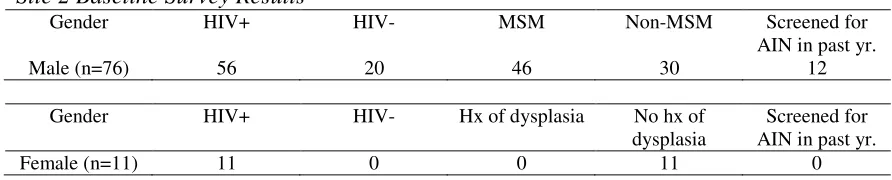
Analysis of the initial surveys from implementation site 2 showed there were 87
patients (11 female and 76 male) chosen by the providers (Table 2). Yet similar to site 1,
not all of the patients met the screening criteria targeting those most at risk for the
development of ASCC, MSM-LWH or women LWH and a history of cervical and/or
vulvar dysplasia. The surveys demonstrated that the female patients were chosen based
solely on HIV status; none of the selected female patients had a history of vulvar and/or
cervical dysplasia. For male patients, the pervasive selection criteria noted was MSM
status, with HIV having no impact on the decision to include a patient as one who would
benefit from AIN screening. The providers at site 2 chose 20 male patients, (26% of the
males), who were MSM but not infected with HIV. This data reconfirms that patient
selection for AIN screening remains a barrier noted in practice, because over screening
limits the cost effectiveness of any screening program.
Moreover, there were also low numbers of patients being identified as at-risk for
the development of ASCC taking place at site 2. Only 12 of the total 87 patients selected
information reiterates the fact that this office too has barriers to AIN screening that
extend beyond patient selection.
Table 2
Site 2 Baseline Survey Results
Gender HIV+ HIV- MSM Non-MSM Screened for AIN in past yr.
Male (n=76) 56 20 46 30 12
Gender HIV+ HIV- Hx of dysplasia No hx of dysplasia
Screened for AIN in past yr.
Female (n=11) 11 0 0 11 0
Additional barriers. At the conclusion of the baseline data collection, informal
conversations between the project director and the providers at both implementation sites
revealed that barriers to AIN screening exist in addition to those noted in the literature.
The literature highlights the point that patient selection remains the most substantial issue
however that was addressed in the educational forum. The providers noted some
personal barriers in their own practices that were standing in their way of increasing the
number of patients they screen for AIN.
The first additional barrier identified through these conversations was one of
follow-up, more specifically where to obtain the follow-up. Each of the providers was
fully informed of the fact that HRA was the next step for a patient with a positive screen,
however where and how to access the HRA services was a problem. To combat this
barrier, the educational forum included an algorithm currently in use by the Dysplasia
Clinic at the University of California San Francisco (UCSF) Cancer Center (Appendix G)
(Jay, 2011). All referrals for HRA could be made to the UCSF Dysplasia Clinic,
allowing every patient to receive treatment there because the health plan covering all
for HRA would be considered a referral for a higher level of treatment and thus coverage
would continue at the UCSF Dysplasia Clinic.
Another barrier noted in the baseline data was in obtaining reimbursement for the
office procedure. At both sites, all patients were covered by the same private insurance
plan, ensuring reimbursement for services rendered by the providers. Post
implementation of the Affordable Care Act in January 2014, all preventative care is
covered (H.R. 3590, 2009); however it is the responsibility of the primary care provider
to determine what is considered preventative for each patient. If the patient has been
identified as a high-risk patient but has not previously been screened, the code V76.49
can be used to bill for screening. The V76.49 billing code can also be used for
rescreening of the patient if the initial screening revealed normal tissue with no evidence
of dysplasia. If the patient has previously been screened and has documented
abnormalities, then the following ICD-9 code can be used for billing purposes: 796.70
(ICD9Data.com, 2013) (See Appendix I for full Gap Analysis).
Finalizing the implementation. In the summer of 2013 the project topic was
finalized and approval was obtained from the USF DNP Faculty, inclusive of IRB
exemption. Following this approval, authorization from both primary care clinics chosen
for implementation was obtained during September 2013. At the request of the clinics,
actual implementation of the project was delayed until after the start of 2014 in order to
avoid the holiday season during which hours at each site were changing and many of the
staff were away. Implementation began in February 2014 and continued through May
to plan and timeline were documented via the milestone reporting matrix (Appendix J).
See appendices K and L for detailed timeline and work breakdown structure respectively.
Methods of Evaluation
After extensive discussions with the DNP committee members throughout the
qualifying process, and also to stay in line with the IRB exemption granted, the decision
was made to focus on the intention of the providers to screen patients for AIN as the
measure of how successful the project was at overcoming barriers. The primary
providers also indicated a strong desire for little to no impact to the daily operations or
workflow of the clinics due to the busy nature of both sites. This led to the decision to
use a survey to collect the information regarding the baseline practices and any changes
on the part of the providers following the education on AIN screening. The MA issued
the surveys to the provider after the visit had concluded so as to have no impact on
existing standards of care or medical decision-making.
All of the participating providers cited existing knowledge at the outset of the
project, yet none screened patients in a consistent manner. This highlights the threats to
the project to have an intended change in practice and for these changes to persist
following the conclusion of the project. Currently, Sutter Health does not have any
providers that market themselves as HRA providers. While they do have an extensive
network of gynecological providers, who sometimes do perform HRA, there is no way to
identify those providers for the purposes of referrals. This has resulted in the need to
refer out of the healthcare system for follow-up, causing significant trepidation on the
Assessment of Change of Practice
The project was analyzed by comparing the baseline practices at each
implementation site to practices after the educational forum. These baseline practices
were evaluated to ascertain the providers’ ability to identify patients in need of AIN
screening and to identify those not screened, and the reasons they were not. Following
the educational forum with the providers, additional surveys were completed to determine
if the providers were now more successful in identifying patients who could benefit from
AIN screening (Appendix H). The follow-up surveys focused on provider intention to
screen each patient they selected for inclusion, and if there was no intention to screen, the
reason for not screening the patient. The secondary portion of the survey served to aid in
the identification of barriers that were not successfully overcome. The decision was
made to only consider intended rates of screening post-forum to ensure that the project
remained in line with the IRB exemption that was granted. However the actual numbers
of patients screened is unknown. This would have required specific patient data collected
from the medical records, and both sites were resistant to providing that data. Changes
were determined using the surveys provided to each primary care provider and completed
at the conclusion of each visit.
The surveys used to collect data after the educational forum were distributed to
each of the providers in the same fashion as the baseline surveys. In implementation site
1, surveys were attached to the after-visit summary of all patients already scheduled for
visits by the MA. At site 2, the surveys were affixed to each medical record of
Results
Program Evaluation/Outcomes
Project implementation went according to the methods identified in the original
project prospectus with one exception. After gathering the data on current screening
practices at each site, there was a delay in conducting the educational forum for each of
the providers. This delay resulted from the MD at site 2 requesting that the data to be
delivered in the forum also be given to each of the providers in printed form for future
reference (Appendix E). Development of the hard copy of the information along with
securing reproductions for each of the providers delayed the forum for approximately 1
month.
Aside from the slight change in the timeline referenced above, there was success
in meeting the objectives found in the project prospectus. The identified barriers, with
solutions, were presented to each of the MD, NP and PA providers, who all actively
participated in the educational forum. These barriers and solutions are as follows: patient
selection, MSM-LWH and female patients LWH who also have a history of cervical
and/or vulvar dysplasia; how to follow up on a positive screen, all patients can be referred
to the UCSF Dysplasia Clinic for HRA and subsequent targeted destruction as indicated;
and how to ensure proper billing and reimbursement, providers were given ICD-9 codes
for both initial screenings and follow up or rescreening.
Through the use of the post-forum surveys (Appendix H) completed at each site,
there was a noted improvement in patient selection, according the criteria of MSM-LWH
or women LWH and a history of either cervical or vulvar dysplasia. As previously noted,
the rates of screening for AIN in both sites were low, based on the assumption that the
patient as a potential AIN screening candidate. This stands in contrast to the fact that site
2 was actually over-selecting MSM patients without HIV. This highlights the fact that
inclusion of information on the most at-risk patients is imperative when seeking to
improve rates of AIN.
After each provider at site 1 had participated in the training, and had been
provided a hard copy of the most relevant data, the patients identified for AIN screening
did increase when compared to the number of patients selected pre-forum. To garner the
post-forum data, each provider was again asked to examine the patients already
scheduled, and if they met the criteria for AIN screening as noted in the provider packet,
to discuss the issue of AIN screening with the patient. This discussion was to investigate
if there were any barriers to screening on the part of the patients, which may not have
appeared in the literature, or during discussion with providers throughout the project.
Distribution of the follow-up surveys (Appendix H) was done in the manner referenced
above, in which the providers were issued a survey at the conclusion of each visit during
the 2-week post-forum data collection period.
The follow-up surveys demonstrated that 66% or 33/50 of the patients chosen for
inclusion by the providers at site 1 would have been screened at the conclusion of their
visit (Table 3). However, some patients chosen by the providers did not meet the
criteria. There were 3/4 female patients chosen for inclusion that did not meet criteria.
Two of these female patients were noted to be LWH, yet lacked any history of cervical
and/or vulvar dysplasia; and the other female patient who does have the necessary history
of cervical and/or vulvar dysplasia, but was not LWH. The males chosen by the
packet and also discussed during the educational forum. This finding indicates the
ongoing need to highlight the differences between men and women when seeking to
determine if they would benefit from AIN screening.
Table 3
Site 1 Post-forum Survey Results
Gender HIV+ HIV- MSM Non-MSM Would be screened
Would not be screened
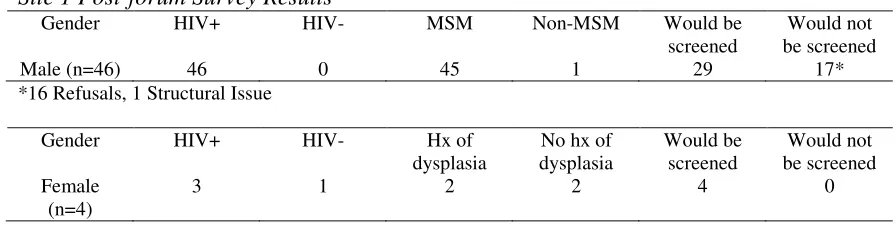
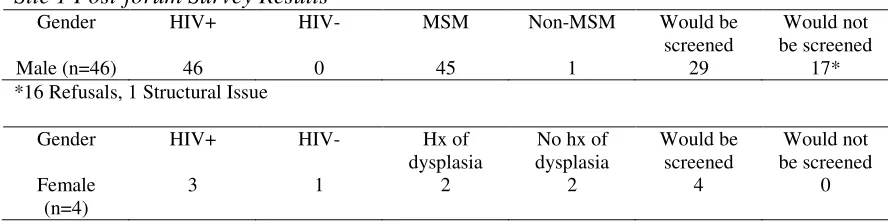
Male (n=46) 46 0 45 1 29 17*
*16 Refusals, 1 Structural Issue
Gender HIV+ HIV- Hx of dysplasia
No hx of dysplasia Would be screened Would not be screened Female (n=4)
3 1 2 2 4 0
As previously noted, only 33 out of the 50 surveys completed at site 1 were noted
to have an intention to screen for AIN, yet 94% or 47/50 would have met the criteria for
inclusion. Using the additional questions on the survey, it was noted that 16/50 of the
patients identified by the providers would refuse actual screening. This information was
obtained from each of the providers at the time of the visit through a discussion of AIN
screening with each patient. There was an additional patient who was selected by a
provider, but not included for intended screening due to a pending loss of insurance, cited
as a structural barrier by the provider (Table 3).
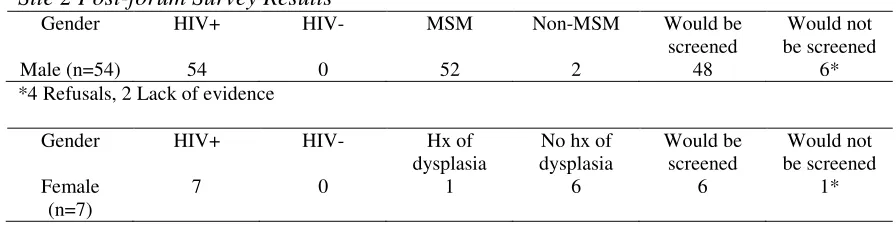
Review of the survey results from implementation site 2 provided similar results,
however for full analysis, it is important to review the data separately. The baseline data
collected during early implementation demonstrated higher rates of AIN screening, but
with varying criteria used for inclusion. Following the education provided to both the NP
and MD providers in the office, surveys were distributed for all patients by the MA staff.
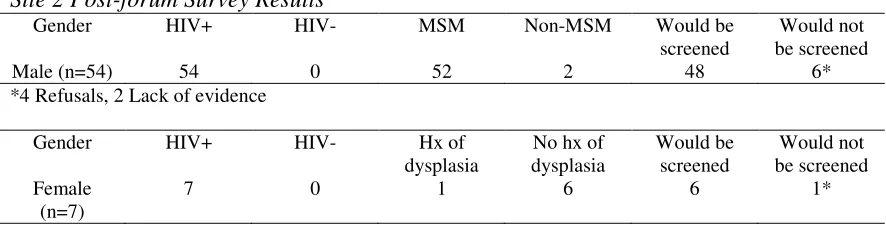
appointments to discuss the idea of AIN screening (Table 4). Of those 61 patients chosen
for inclusion, 6 females and 2 males did not meet the criteria for AIN screening. These
patients, while LWH, had none of the concomitant history. This information does show
an improvement in the ability of the providers to identify at-risk patients, but patients
were still over-selected based on HIV status alone.
Table 4
Site 2 Post-forum Survey Results
Gender HIV+ HIV- MSM Non-MSM Would be screened
Would not be screened
Male (n=54) 54 0 52 2 48 6*
*4 Refusals, 2 Lack of evidence
Gender HIV+ HIV- Hx of dysplasia
No hx of dysplasia Would be screened Would not be screened Female (n=7)
7 0 1 6 6 1*
*1 Refusal
Further examination of these surveys also revealed that site 2 had an improvement
in their ability to identify patients who stand to benefit from AIN screening, when
compared to the baseline patient selection. This improvement was greater than what was
noted in site 1. The surveys at site 2 showed that the providers intended to screen 89% or
54/61 of the selected patients at the conclusion of the visit. Of the 7 remaining patients,
whom the providers did not intend to screen, 5 (4 males and 1 female) stated they would
refuse screening. The remaining 2 male patients whom the provider did not intend to
screen were not included due to insufficient evidence supporting screening in this patient.
Important to note, these 2 patients also did not meet the criteria of MSM-LWH, as both
were LWH but have no history of MSM, supporting the provider’s assertion that the
evidence does not support screening this patient. It is unclear why the provider selected
The results were shared with the providers at both sites during an informal
meeting conducted at the conclusion of the project. This meeting also provided an
opportunity to gain insight to the perceptions of the providers on AIN screening in
general, as it is hypothesized that this had a great impact on shaping the patients
perceptions on participation in AIN screening.
As noted, the vast majority of research that has been conducted and published on
AIN screening methods, protocols for follow-up and determining the most at-risk groups
and more has come out of the work of a relatively small research team; and is credited in
both the NYDHAI and the VA guidelines. The knowledge that preceded the
implementation of this project allowed each of the providers to develop their own
opinions and biases regarding screening for AIN and the subsequent HRA required for
follow-up on positive screens. More specifically, the MD at implementation site 1 shared
a personal relationship with the two of the lead physicians who have generated much of
the AIN research that exists. During the last meeting to discuss the results of the project,
it was revealed that this relationship has led the MD at site 1 to develop the opinion that
some of the data being generated on the topic lacks the significance required for a change
in his practice.
In the post-implementation discussions with the providers, it was also noted that
the providers at site 2 discussed the idea of AIN screening with patients as a novel idea
that could have positive benefits on their health, while site 1 providers presented the idea
as a “project being conducted in the office”, thus having a possibly significant influence
on the perceived benefit on the part of the patient. The MD provider at site 2 was very
forward to incorporating into the office. This created a situation in which these providers
acted as sales agents for the idea of AIN screening. This is an imperative role for primary
care providers, to ensure their patients receive the care needed.
In contrast, when meeting with the providers at site 1 and their staff, it was clear
there was no intention of implementing an AIN screening program. The MD stated that
he was not convinced of the evidence showing patients have anything to gain from
screening. While he willingly participated in the project, his views on the topic were
quite set. The reluctance on the part of the MD provider at site 1 to accept the evidence
supporting AIN screening should have been better assessed during the unfreezing portion
of the project. The willingness to participate in the project was misinterpreted on the part
of the project manager as readiness to change, but later it became clear that was not the
case. More discussion on this is noted under the Limitations section. (See Tables 1-4 for
complete results.)
Discussion
Summary
Examination of the results demonstrates that there was success in changing the
practice of all of the providers who participated in the project, measured by their ability
to select or identify patients in need of AIN screening and also through providing an
educational forum, providing resources overcoming barriers to AIN screening. This
change was garnered through an evidence-based approach regarding whom to screen, and
through a set of strategies to overcome the identified barriers. However, the change in
the author. In spite of the fact that information on characteristics that place the patient in
the highest risk category was delivered to the providers during the educational forum and
in the provider packet, this proved to be the area still in need of the most improvement.
Each of the participating providers focused on the HIV status of the patient and did not
fully consider the required co requisites, MSM in males and a history of cervical or
vulvar dysplasia in women.
The results also show that preconceived ideas and opinions of the providers can
have a larger than anticipated effect on the rates of intended screenings as well as on the
patients’ perceptions of what they stand to gain from potential AIN screening. In the case
of this project, the providers who viewed AIN screening in a positive light prior to the
project were more inclined to present the issue to their patients also in a positive light.
The manner of presentation by the provider had an impact on the perception of how
useful or beneficial the screening was for the patient.
Evaluation of the Lewin theory as the guiding theory was also done, revealing that
the integral step of ‘unfreezing’ was not fully successful. This assumption was made
following the post-implementation meetings conducted with the providers. During these
interactions, it became clear that not enough attention was spent on readying the
providers for a change of practice as outlined in the Lewin model (1947). Should this
project be continued in each of the clinic sites, or at other sites, ensuring the providers’
readiness to change will be more carefully examined. The incomplete ‘unfreezing’ at the
outset of the project also threatened the sustainability of the project. As mentioned
previously, the project manager was unaware of the unwillingness of the providers at site
results were being delivered to the providers. This created a situation where there was
little that could be done to change the perceptions of the providers, or increase the
chances of a sustained practice change in site 1.
Relation to other evidence
Evidence regarding the benefits of screening is plentiful. Screening programs for
both CRC and cervical cancer have proven successful, as previously mentioned (National
Cancer Institute Age Adjusted SEER Incidence, n.d.; National Cancer Institute, n.d.).
This success has largely been credited to the development of national guidelines for
primary care providers, yet there are no nationally recognized guidelines for AIN
screening. The results of this project also mirror those found in another study where the
feasibility of an AIN screening program in an HIV clinic was tested (Rosa-Cunha et. al.,
2011). As in the case of this project and the Rosa-Cunha et. al. (2011) study, full
implementation of the AIN screening program could be done with minimal changes to
the existing primary care clinic.
Limitations of the project
Initially the implementation was met with few limitations. The clinics and
providers chosen for participation were eager to be involved, and there were sufficient
numbers of patients in each office that would benefit from AIN screening. Furthermore,
one of the leading clinics conducting research and treatment of AIN is located in San
Francisco, which was presumed to be a benefit. However, this is what became an
obstacle when seeking to fully overcome the barriers to the AIN screening process. The
location of the UCSF Dysplasia Clinic and the implementation sites not only proved to be
this project be replicated at future sites. The close proximity of the UCSF Dysplasia
Clinic allowed the MD providers at both sites 1 and 2 to become familiar with the AIN
screening process. However, the close proximity also allowed the providers to develop
professional relationships with the UCSF clinic staff regarding their work. At subsequent
geographical locations, the limitation would be the lack of follow-up for patients who are
found to have a positive screen, due to the sporadic supply of HRA providers. The lack
of HRA providers is certainly a well known barrier to AIN screening, but will require
more of a systems change as opposed to a practice change, as was the focus of this
project.
Moreover, there was no pilot done with the initial or post forum surveys. This
created gaps in the information gathered by during the project. Both the initial baseline
survey and the post forum survey lacked the ability to determine which of the providers
(MD, PA or NP) had seen the patient and completed the survey. With this information, a
determination could have been made as to how best to address the barriers that may exist
on an individual basis, thus enhancing the evaluation of this project. The surveys also
were only completed by the providers whom were selected by the providers, rather than
being completed on all patients seen at both sites. This limits the ability to evaluate the
total numbers of patients being chosen for inclusion, both before and after the educational
forum. However, because the target population of this project was MSM-LWH and
women LWH who also have a history of cervical and/or vulvar dysplasia, capturing this
information would neither add nor detract from the overall project.
Lastly, follow-up with HRA, biopsy and/or targeted destruction of dysplastic
individual provider at the implementation site that they were not interested in moving to
another healthcare delivery system. To overcome this limitation an Advanced Practice
Nurse could be employed to perform the HRA, biopsy and/or additional treatment as
indicated. Advanced Practice Nurses, with training, are ideal candidates to fill this gap in
both the Sutter Health system as well as other healthcare systems in the country that may
be limited in AIN screening due to the lack of follow-up care.
Interpretation
Upon evaluation of the change in practice, more patients were accurately selected
for AIN screening at both sites. This increase implies that many of the barriers were
successfully overcome. However, closer examination of the data demonstrates that if
additional IRB approval had been obtained, the project director could have reviewed
patient’s charts. This would allow for patients who were not selected by the providers for
AIN screening, but may still benefit, to be identified. With full information on all
patients seen during the project timeline, the noted change in practice may have been less
significant when compared to baseline practices at each site.
The personal bias of the providers was also determined to have played a larger
role than initially thought. In the future, a collaborative effort on the part of the UCSF
Dysplasia Clinic and any other primary care clinic could serve to address these
preconceived notions, and would be the recommendation for any further projects.
Implications for the future. This practice improvement project did however succeed in
raising awareness of AIN screening and did develop an educational process that could
easily be replicated for use in other settings, provided the access to HRA providers were