www.ijper.org
Insight into Concept and Progress on Pharmaceutical
Co-Crystals: An Overview
Venkata Deepthi Vemuri1,*, Srinivas Lankalapalli2
1Maharajah’s College of Pharmacy, Phool Baugh, Vizianagaram, Andhra Pradesh, INDIA.
2GITAM Institute of Pharmacy, GITAM (Deemed to be University), Visakhapatnam, Andhra Pradesh, INDIA.
ABSTRACT
Pharmaceutical co-crystals have conferred significant recognition in recent past as a new solid form by virtue their capability to modulate physicochemical properties of Active Pharmaceutical Ingredient (API). Nevertheless, pharmaceutical progress of co-crystals could be provocation, the requirement for high-throughput screening methods and the techniques capable of co-crystal production in industrial scale still hamper the co-crystal used by industries. In this review, well ordered overview of pharmaceutical co-crystal is provided, with focus on role of supramolecular chemistry, co-crystal design strategies, preparation methods, physicochemical property studies, mechanism of solubility enhancement, evaluation techniques. In the present commentary, the impact of choosing appropriate process design and formulation on translational challenges has been discussed. Eventually, a short outline of applications and marketed drug products of pharmaceutical co-crystal drug substance is also described.
Key words: Co-crystals, Crystal engineering, Physicochemical properties,
Co-crystallization, Translational challenges.
DOI: 10.5530/ijper.53.4s.147
Correspondence:
Mrs. Venkata Deepthi Vemuri,
Assistant Professor, Maha-rajah’s College of Pharmacy, Phool Baugh, Vizianaga-ram-535002, Andhra Pradesh, INDIA.
Phone: +91 9032292387 E-mail: deepthichowdary438@ gmail.com
Submission Date: 17-07-2019; Revision Date: 26-09-2019; Accepted Date: 12-10-2019 INTRODUCTION
The process of developing a new dosage form from a new chemical entity is a com-plex process. It involves in strategic and exploratory research in the selection and development of medical product. Whereas the molecule has to pass different stages of development to reach the required criteria. Incomplete information about its prop-erties and pharmaceutical manufacturing capabilities in advance to clinical trials may lead to complex and costly problems at the later stage.1 Considering these cases improv-ing the existimprov-ing molecules founds more
beneficial than the new molecule. Most of
the solid-state Active Pharmaceutical Ingre-dients (APIs) exist mainly in two morpho-logical structures crystalline or amorphous (Figure 1). Among these crystalline materi-als are more preferred for product devel-opment due to their high stability when compare to the amorphous forms (less stable and leads to re-crystallization over
time).2 Even though crystal forms are stable,
reproducible and easily purifiable than other
types of solids the major drawback is its low solubility. Amid all the biopharmaceutical properties, solubility remains as main issue for most of the API’s.3 Solubility and disso-lution rates are the most important consider-ations to determine the performance of the drug. Improvement in these aspects without change in the molecular structure is the most challenging aspect for successful develop-ment of new product. Currently, many strategies have been adopted for improving the solubility to attain the improvement in their absorption and bioavailability of the drugs, including milling techniques,4 hot melt extrusion,5 self-emulsification,6 solid-dispersion,7 inclusion-complex8 liposomal formulations,9 nanoparticles.10
Co-crystallization is one of the
alterna-tive ways to solve the problems confined
API. Over the last twenty years a number of
publica-tions have been shown the significant increase in the
use of co-crystal and their possible use in the formu-lation as an optimization strategy for solubility, dis-solution rate, physical stability and bioavailability of API’s.11 This is encouraged by the recent FDA
reclas-sification, from which co-crystals are considered as drug
polymorph rather a new API,12,13 including solvates to ease the regulation burden on manufacturers that work with them.12,13 Many of co-crystal strategies like solvent change techniques,14 Solution co-crystallization,15 ther-mal methods,16 ultrasound assisted,17 grinding meth-ods18 have been emerged.Previously, many of the case studies and reviews conducted in co-crystals reported, superiority of co-crystallization technology in com-parison to other strategies,19 improvements in manufac-turing of drug dosage forms,20 enhancements in drug properties by bottom-up approach,21 pharmaceutical co-crystallization techniques,22 translational develop-ment challenges,23 impact of co-crystals on drug phar-macokinetics,24 Co-crystallization of neutraceuticals,25 Vibrational spectroscopic investigations on co-crystal-lization.26 Improvement of physicochemical properties of co- crystallization have been well explored.27
Supra-molecular chemistry and crystal engineering
The scientific community had some disagreement with co-crystal definitions which were subjected in the past. European medicine agency defined co-crystal as a crys -talline homogeneous structure having two or more
components arranged in a crystal lattice with a defi
-nite stoichiometric ratio (EMA 2015). Co-crystals are
formed by intermolecular interactions such as halogen
bonding electrostatic interactions, π stacking, hydrogen
bonding and Vander walls forces which are non-cova-lent between API and the co-former.20,28 Figure 2 shows the schematic formation of co-crystal. Supramolecular synthons, homo-synthons and hetero-synthons29 refer to structural units within supramolecules which are formed by intermolecular interaction by known syn-thetic operations.30 A comparison between FDA and
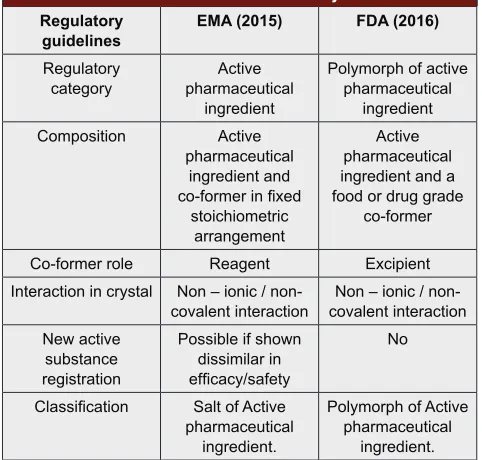
EMA guidelines of Pharmaceutical co-crystals was dis -cussed in Table 1.31
Crystal engineering involves breaking and forming non-covalent bonds, rearrangement of molecules within the crystal packing. In turn, it is effective in designing supra-molecular synthons32,33 and ultimately results in co-crys-tals formation, which may lead to the improvement of physicochemical properties of API without affecting its structure and functions. An acid group of carboxylic acids, alcohol groups and amide groups are the
com-mon functional groups involving in supra-molecular synthon formation by H-bonding.34,35 Co-crystal forma-tion is more favored by hetero-synthons than homo-synthons,36,37 The intermolecular interactions involved in co-crystal formulations should be non-ionic,34 with no proton transfer. If the proton transfer is completed
Figure 1: Schematic representation of solid forms classifica-tion.
Figure 2: Schematic representation of co-crystal formation.
Table 1: Comparison between FDA and EMA guide-lines of Pharmaceutical co-crystals.31
Regulatory
guidelines EMA (2015) FDA (2016) Regulatory
category pharmaceutical Active ingredient
Polymorph of active pharmaceutical
ingredient Composition Active
pharmaceutical ingredient and
co-former in fixed
stoichiometric arrangement
Active pharmaceutical ingredient and a food or drug grade
co-former
Co-former role Reagent Excipient
Interaction in crystal Non – ionic /
non-covalent interaction covalent interactionNon – ionic / non-New active
substance registration
Possible if shown dissimilar in
efficacy/safety
No
Classification Salt of Active pharmaceutical
ingredient.
Polymorph of Active pharmaceutical
it leads to salt formation.38 This proton transfer mainly depends upon the pKa values of the API and co-formers. According to FDA39 Δ pKa is considered as a threshold for distinguishing between co-crystals and salt. FDA also indicates, the formation of salt will hap-pen in the components having Δ pKa ≥ 1. If the com
-ponent having Δ pKa < 1 result in co-crystal formation.
In addition to FDA indications, others expressed “rule
of thumb’’ states Δ pKa > 2.7-3 units, formation of salt
is likely to happen than cocrystal.40
Fine-tuning of API properties by using crystal
engineer-ing would be beneficial to the pharmaceutical industry.
Co-crystals found to be better than salts, polymorphism, solvates and amorphous forms
Effect of co-crystals on physicochemical properties of API
Along with all other aspect’s investigations of physi-cochemical properties plays most important role in developing the new dosage form.41 These physico-chemical properties of the drugs can be adjusted with
an increased instability and efficiency of dosage form
by using co-crystallization techniques.42 Schultheiss and Newman gave a review based on these properties and some of the key physicochemical properties are melting point, solubility, stability dissolution bioavailability.43 Melting point
Melting point, as it is having a correlation with aqueous
solubility and vapour pressure44 used in purity
identi-fication and characterization. Melting point is one of
the key factors essential to characterize the polymorphs
of a compound (Monotropic or Enterotropic).45 Many of the researchers stated that the co-crystals provide
an excellent opportunity in modifying and fine-tuning
the physicochemical properties of the existing mol-ecules.43,21,46
A comparison melting point study was done by Staton
and Bak using 10 co-crystals with API AMG517 with
their respective co-formers, among these all the co-crys-tals have shown the melting point between the melting points of API and their corresponding co-formers.21 Linear correlation between the melting points of hexa-methylene bisacetamide co-crystals were reported with
five different even numbered aliphatic dicarboxylic acid
co-formers which are selected with similar structures and different melting points.46
Nate Schulthesis, 2009 conducted a survey on 50 cocrys-tal samples, the majority of them have shown the melt-ing point between that of the API and co-formers.43 Fleischman, 2003 carried out to investigate on the on four co-crystals with different crystal packing
arrange-ment but same heteromeric O-H…N hydrogen bond. These co-crystals had different melting points showing the impact of crystal packing arrangement on melting point.47
Stability
Stability is the most important parameters to be studied during the development of any new molecule the self-life of the molecule mainly depend upon the chemical and physical stabilities (ICHQ1A). The following are the aspects to be considered for stability testing.
Relative humidity (RH) stress
RH stress provides the information about the water content in co-crystals which leads to deterioration of molecules. This in turn helps in determining the best storage condition.48
Many of the literature concluded that the co-crystals are
stable to moisture under normal storage conditions.49-52 Dynamic vapour sorption and desorption experiments on co-crystals of Indomethacin saccharin (1:1) showed a very negligible amount of moisture was sorbed by co-crystals with no solid-state transformation.49 MC Namara conducted repeated sorption/desorption cycles
on co-crystals of glutaric acid and 2-(4-(4-choro-2-flur -phenoxy) phenyl) pyrimidine -4-caroxamide. The data revealed that the moisture uptake is less the 0.008% and the relative humidity was up to 95%.50 Bak A showed
that AMG517/sorbic acid co-crystals with minimum
moisture update 0.7% and with no solid-state transfor-mation with sorption/desorption cycle.27
Some of the literature supported with adequate physi-cal stability of co-crystals even in the long-term stability studies concerning for to RH.52 Trask conducted stud-ies with 6 caffeine co-crystals which were placed at 4 RH conditions (0, 43, 75 and 98% RH). These samples were analyzed after 1, 3, 7 days and 7 weeks. This study reveals using strong acid with caffeine produced the most stable co-crystal whereas weakest acid gave the least stable co-crystal.53
Thermal stress
This is the most important parameter used to determine physical and chemical stability.54,55 Chen prepared co-crystals of a monophosphate salt and phosphoric acid with were exposed to 60°C for 8-weeks and noticed with no degradation.56
Chemical stability
on the chemical stability of co-crystals. Chen, 2007, conducted stability studies of co-crystals of monophos-phate salt with phosphoric acid using 40°C/75% RH and 60°C/75% RH for 8 weeks and reported to have no detectable degradation.56 Another study was
con-ducted with co-crystals of 2-(4-(4-chloro-2-fluorphe -noxy) phenyl) pyrimidine-4-carbonxamide with glutaric acid using same conditions for 2 months and reported with no detectable degradants by HPLC impurity analy-sis.50 Another literature compared the chemical stability of carbamazepine (parent API) with 1:1 carbamaze-pine saccharin (co-crystals) using temperatures of 5°C, 40°C and 60°C at ambient humidity and elevated RH conditions of 25°C/60% RH and 40°C/75%RH for 2 months. Results revealed with no degradation at differ-ent temperatures and similar degradation with second condition.57 Based on these literatures we notice that the co-crystals may exhibit better chemical stability.
Solution Stability
Solution stability is defined as the ability of co-crystals
to stay in solution without converting into crystals.43 Solution stability along with solubility and dissolution studies play a very important role in understating the nature of co-crystals in releasing media. Trask 2006 along with RH studies, conducted a solution stability test for 2:1 caffeine/oxalic acid co-crystals by prepar-ing slurry with water at ambient temperature for two days and noticed that there is no change in its physical form indicating the stability of co-crystals. In another example the study involved in the screening of twenty carbamazepine co-crystals formed with 18 co-formers which were slurred with water for 20-48 hr. Among these, only seven co-crystals maintained their structure and remains are converted to carbamazepine dihydrate. The Author noted that the high aqueous solubility of co-formers has the chances of structural instability.58 Solution stability can be obtained by solubility and
intrinsic dissolution experiments in aqueous media. MC
Namara, 2006 conducted an intrinsic dissolution experi-ment on co-crystals of 2-[4-(4-Chloro-2Flourphenoxy)
Phenyl] Pyrimidine – 4 – Carboxamide with Glutaric
acid for 90 min at 37°C using water. Results showed that there is no major conversion to parent molecule, the remaining portion left in the apparatus showed the complete conversion to the parent molecule within 24 hrs under 37°C.50 Another literature conducted aque-ous solubility on 4 co-crystals of Fluoxetine Hcl with Benzoic acid, Fumaric acid and Succinic acid. Among these co-crystals Benzoic and Fumaric acids showed no change in its structure at the end of the experiment. But
Succinic acid co-crystals exhibited complete conversion to Fluoxetine Hydrochloride. In this study, the author reported that the Succinic acid is a conformer having highest solubility and it was co-former to dissociate.59 Solubility
Solubility is the thermodynamic equilibrium of solute between the liquid phase and solid phase.60,61 Pharma-ceutical co-crystallization is considered to be the most effective way of improving the solubility on which many of the researches have been reported.3,46,50,59 Ramenar compared three Itraconazol co-crystals with crystalline Itraconazol and reported with high solubility of co-crystals than crystalline form.62 Shiraki prepared
2 co-crystals, Exemestane/Maleic acid and megestrol
acetate/saccharin from organic solutions with different particle sizes. Both the co-crystals showed improvement in dissolution rates at the initial stage when compared to the respective original crystals. Fine particle co-crystals
of Megestrol acetate/saccharin showed supersaturated concentration of Megestrol acetate for about 6 folds more than MA within 15 min and 2 folds more within 4 hr. Co-crystals of Exemestane/Maleic acid transformed
to parent crystal within 1min in suspension. These co-crystals even larger particles have shown higher dis-solution rates63 Good and Redriguez-Hornedo, 2010 published a theoretical analysis for predicting the co-crystals solubility. Co-crystal eutectic constant (Keu) Plays a major role in the selection synthesis and for-mulation of co-crystals. Keu values were used to pre-dict the phase behavior, ionization and complexation.64 Co-crystallization approach for poorly soluble drugs like Carvedilol shown better bioavailability, solubility and dissolution in comparison to other strategies.19 A
NMR crystallographic study on niclosamide co-crystals,
reported the improvement of equilibrium solubility of 1:1 niclosamide – thiazole cocrystals 2.8 folds to that of pristine niclosamide.65
Mechanism involved in solubility enhancement
Solubility depends mainly on crystal lattice strength and
Spring and Parachute effect
Spring and Parachute phenomenon was explained by
Guzman, this concept improves the solubility of hydro -phobic drugs by using a supersaturation strategy. This mechanism involves in the origination of
supersatu-rated Metastable state and its maintenance.71 The weak Bonds (Hydrogen bonds) that connects the drug and the co-former in co-crystals72 are dissociated, which leads to the release of high water-soluble co-former from the crystal lattice of co-crystal to the biological medium. The Hydrophobic drug has been converted to supersaturation state which is having higher energy than its crystalline molecule called spring. This spring will precipitates to clusters immediately. The maintenance
of this super saturated stage for a sufficient period is beneficial for improving the solubility Figure 3. Using
some of the excipients or compounds which intervene with crystal growth may lead to inhibit the precipi-tate and maintain spring sprecipi-tate this referred to as para-chute. This state lasts for a long time in the dissolution medium showing high solubility. This stage transformer follows Ostwald’s Law of stages.63-74 Childs, 2013 pre-pared 1:1 Danazol/Vanillin co-crystals which results in
1.7 times rise in AUC with simple aqueous suspension.
Whereas these co-crystals have shown 10 times rise in
AUC when suspended in the aqueous phase containing TPGS and HCP as solubilizes and precipitate inhibitor
respectively.75 Intrinsic dissolution
Intrinsic dissolution indicates the rate of dissolution of a compound from constant particle size. Intrinsic dis-solution rate is one of the best indicators for the in vivo
performance of most of the co-crystals, which belongs to BCS class II drugs. Only limited numbers of liter-atures are available on intrinsic dissolution.50,59,63 M C Namara conducted intrinsic dissolution studies on glu-taric acid co-crystals of 2-[4-(4-Chloro-2Flourphenoxy) Phenyl] Pyrimidine – 4 – Carboxamide using water over 90 min. This study was reported to increase in dissolu-tion of co-crystals with 18 times than that of the par-ent molecule.50 Another study was conducted on three co-crystals of Fluoxetine HCl and different co-form-ers, 2:1 Fluoxetine HCl/Succinic acid co-crystals have shown a threefold increase of dissolution over parent molecule, 2 co-crystals which are made up of Benzoic acid and Fumaric acid showed reduced and same dis-solution rates respectively with the comparative parent molecule.59 Shiraki measured intrinsic dissolution on
2 co-crystals. 1:1 Exemestane/Maleic acid showed the
same dissolution rate as parent molecule whereas 1:1
Megestrol acetate/saccharin co-crystals showed a
3-4-fold increase in dissolution rate than the parent mol-ecule.63 More studies should be needed for the exact role of co-crystallisation on the intrinsic dissolution rate. The melting point of most co-crystals is resulting in the melting points between API and co-former. In most cases, stability was improved resisting hydrate forma-tion was shown in co-crystals. Solubility and dissolu-tion improvement for poorly soluble compounds were achieved by co-crystallization. It was shown that a wor-thy degree in bioavailability is possible with co-crystals. Formulation of co-crystals
Design strategy and co-former selection
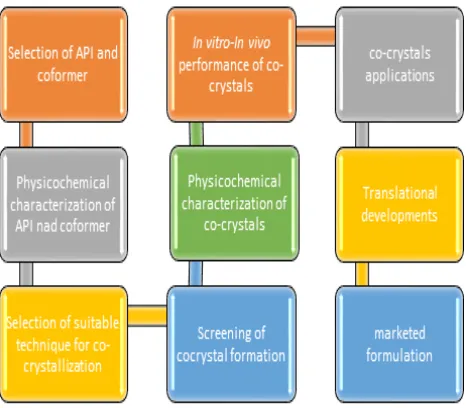
The design and preparation of pharmaceutical co-crys-tals is a complex and multistage process, represented schematically in Figure 4. Co-crystal designing can be
Figure 3: Spring and parachute effect to attain high solubility for insoluble drug. a) Low soluble crystalline form. b)
Amor-phous phase (spring form) which is short lived meta stable state shows high solubility but drops quickly to crystalline form. c) Spring with parachute effect maintained metastable
state for long time results in high soluble drug form.
done by empirical understanding of hydrogen-bonds pattern.76,77 The rules are (a) Crystal structure of a com-pound utilizes all the acidic hydrogens in the molecule for hydrogen bonding. (b) The availability of hydrogen bond donors leads to the utilization of good acceptors on hydrogen bonding. (c) Preferential formation of hydrogen bonds takes place between good donors and acceptors. N-H…O, N-H…Cl, N-H…H are some of the groups which can lead to the formation of hydrogen bonds. During designing of co-crystals, many worth-ful reference resources are containing empirical as well as theoretical resources such as CDS, HSP, Hydrogen bond theories and other empirical conclusions.
Cambridge structural database
Proper knowledge of intermolecular interactions is required for the synthesis of supramolecular synthons. Designing of synthons can be done by utilizing the information about hydrogen bond patterns of crystal lattice78 which can be done by CSD. Intermolecular interactions on crystals can be studied by using which provides the information for systematic analysis of a wide range of related structures which could not be done by other methods.79 CSD contains information about the functional groups that result in the formation of supramolecular synthons.80
Hansen solubility parameter
Prediction of co-crystal formation by using Hansen
solubility parameter was reported by Mohammad M
A.81 This concept was actually proposed by Hansen C
M for polymer solubility prediction in paints. HSP indi -cates that several individual forces compose the total energy of vaporization.82 The co-crystal formation can be predicted by calculating the difference in total solu-bility parameter (Δδt) for API and co-former. These Δδt values more than 10MP0.5 indicates fewer chances for
the co-crystal formation and less than 7MP0.5 indicates more co-crystal formation.80
Co-crystallization techniques
Co-crystallization technique, capable to amalgamate two or more molecules (API and conformer through non-covalent interaction and multiple API co-crystals through drug-drug interactions). Co-crystallization technique selection is the most important as the nature, properties and morphology of co-crystals formed were
influenced by this process.70,83 Co-crystallization
meth-ods based on the use of solvents, classified as
solvent-based and solvent-free techniques. Among these, solvent free techniques are gaining more importance due to the possibility of a green chemistry principle association.84 Several aspects like API and co-former, solubility,
stabil-ity, liabilstabil-ity, polymorphs, solvents, etc were taken into consideration while selecting co-crystallization method.
Method scalability should also be considered for appli -cations in the industry.85
Depending on the driving force, the co-crystallization
method can be classified as thermodynamic and kinetic
methods. Thermodynamic methods occur mainly in equilibrium conditions and take a large amount of time
to finish. Some of them are co-crystallization from melt -ing and slow solvent evaporation. For kinetic methods, occur in non-equilibrium conditions based on reaction duration and system energy. This gives rise to
meta-stable form, having higher gives free energy. Grinding, slurry sonication, supercritical fluid technology, spray drying is some of the techniques classified under kinetic
methods. Co-crystallization methods based on the use
of solvents classified as solvent-based and solvent-free
techniques.
Solvent based co-crystallization methods
Solvent-based methods are most commonly used due to the ability to monitoring the process and controlling the
properties of the final product. Solvent selection places
the most crucial step in these methods. As the solvent selected shows its impact on crystal size, shape, purity, polymorphic form and other co-crystal characteris-tics.86,87 Some of the literatures reported the importance of solvent selection in solvent-based co-crystallization method.88,89 Solvent evaporation, cooling co-crystalli-zation, reaction crystallico-crystalli-zation, anti-solvent addition, ultrasound-assisted co-crystallization are some of the examples comes under this method.
Solvent free co-crystallization methods
Solvent free co-crystallization methods are acquiring an interest in the industry and academia, due to the feasibil-ity of being kindred with green chemistry principles.79
These principles endorse efficient co-crystal production with less toxic bi-products. Mechano-chemical meth -ods, neat grinding, liquid assistant grinding, polymer assistant grinding, hot-melt extrusion, spray congeal-ing co-crystallization are some of the methods
classi-fied under solvent-free co-crystallization. Some of the
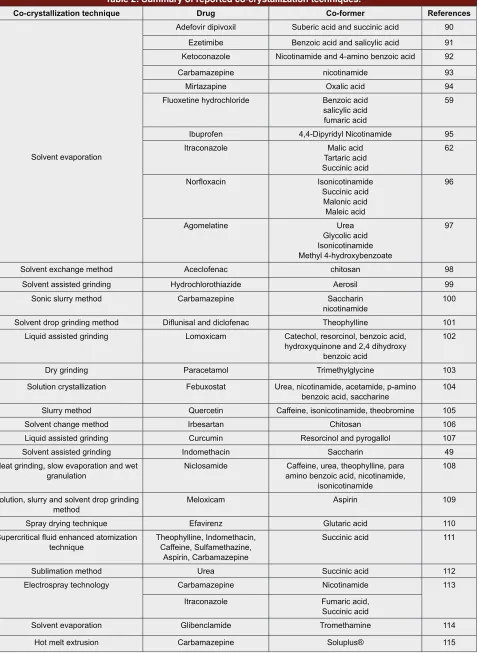
co-crystallization techniques reported were summarized in Table 2.90-115 Some of the latest international patents were summarized in Table 3.116-119
Table 2: Summary of reported co-crystallization techniques.
Co-crystallization technique Drug Co-former References
Solvent evaporation
Adefovir dipivoxil Suberic acid and succinic acid 90
Ezetimibe Benzoic acid and salicylic acid 91 Ketoconazole Nicotinamide and 4-amino benzoic acid 92
Carbamazepine nicotinamide 93
Mirtazapine Oxalic acid 94
Fluoxetine hydrochloride Benzoic acid
salicylic acid fumaric acid
59
Ibuprofen 4,4-Dipyridyl Nicotinamide 95
Itraconazole Malic acid
Tartaric acid Succinic acid
62
Norfloxacin Isonicotinamide
Succinic acid Malonic acid Maleic acid
96
Agomelatine Urea
Glycolic acid Isonicotinamide
Methyl 4-hydroxybenzoate
97
Solvent exchange method Aceclofenac chitosan 98
Solvent assisted grinding Hydrochlorothiazide Aerosil 99
Sonic slurry method Carbamazepine Saccharin
nicotinamide 100
Solvent drop grinding method Diflunisal and diclofenac Theophylline 101 Liquid assisted grinding Lomoxicam Catechol, resorcinol, benzoic acid,
hydroxyquinone and 2,4 dihydroxy
benzoic acid
102
Dry grinding Paracetamol Trimethylglycine 103
Solution crystallization Febuxostat Urea, nicotinamide, acetamide, p-amino
benzoic acid, saccharine 104 Slurry method Quercetin Caffeine, isonicotinamide, theobromine 105
Solvent change method Irbesartan Chitosan 106
Liquid assisted grinding Curcumin Resorcinol and pyrogallol 107
Solvent assisted grinding Indomethacin Saccharin 49
Neat grinding, slow evaporation and wet
granulation Niclosamide amino benzoic acid, nicotinamide, Caffeine, urea, theophylline, para isonicotinamide
108
Solution, slurry and solvent drop grinding
method Meloxicam Aspirin 109
Spray drying technique Efavirenz Glutaric acid 110
Supercritical fluid enhanced atomization
technique Theophylline, Indomethacin, Caffeine, Sulfamethazine, Aspirin, Carbamazepine
Succinic acid 111
Sublimation method Urea Succinic acid 112
Electrospray technology Carbamazepine Nicotinamide 113
Itraconazole Fumaric acid,
Succinic acid
Solvent evaporation Glibenclamide Tromethamine 114
of co-crystal components. Careful selection of methods
is important for a specific system.
Characterization and quality control
Recent researches aimed at improving the storage stabil-ity, processing and dissolution of the pure drug during the development of pharmaceutical formulations.120,121
New regulatory guidelines from the FDA and EMA
aimed at pharmaceutical co-crystal development, which should be facilitated with the requirements and approval procedures.122,123 Characterization and quality control of co-crystals were emphasized as important by these guidelines.
Screening of co-crystal formation
Liquid-assisted grinding has shown most attractive due to its short processing times, small sample sizes and a wide variety of applicable compounds.124 Its application to mixtures containing drug and possible formers results in systematic the screening of co-crystals.124 Thermal analysis and PXRD have been used during screening process for solids characterization.125 Faster detection of co-crystal formation can be done by Raman spectroscopy.126 Occurrence of new form at material interfaces can be shown by hot stage thermal microscopy.127 In-situ monitoring of co-crystal forma-tion can be predicted based on appropriate co-former’s selection and structural information.128,129
Structural characterization
Structure and physical properties determination are a critical step in understanding the quality of co-crystals developed.130,131 Several analytical techniques such as
Raman spectroscopy, thermal analysis, solid-state NMR,
X-ray diffractions, etc., are used for these estimations. Single-crystal XRD technique provides the detailed crystal structure which in turn helps as the theoretical basis for quality control of co-crystals. Powder XRD data provide the structural information of co-crystals.132 Some co-crystals like caffeine/glutaric acid133 and car-bamazepine/melonic acid134 results in multiple co-crys-tals or polymorphs based on preparation methods and formulation parameters. Some of the co-formers with
multiple functional groups results in the formation of multiple hydrogen bonds, which leads to varied stacking arrangement in the crystal lattice.135 The state of car-boxylic groups was evaluated by using FT-IR vibrational spectroscopy.136 Neutron diffraction provides the pre-cise information of proton transfer within multi-com-ponent co-crystal.136,137 Cross polarization magic angle spinning provides a more practical characterization which was a new data processing method associated
with solid-state NMR.138 X-ray photo electron spec-troscopy and Raman specspec-troscopy mixed with density functional theories of solid-state were also being used for characterizations.139 Yong Du, conducted a series of investigations on structural characterization of different co-crystals during their formation by using vibrational spectroscopy. These studies reported Raman and tera-hertz technique as a unique means for co-crystal con-formation and reaction dynamics during con-formation,140 FT-IR and FT-Raman could provide a theoretical and experimental standard to co-crystal characterization,141 Terahertz absorption and Raman scattering spectros-copy are able to identify the co-crystal structure and also pH-dependent co-crystallization effect,142 Terahertz time-domain spectroscopy and Raman spectroscopy could be able to identify molecular structural change of drug and also intermolecular hydrogen bonds interac-tions upon co-crystallization.143 Co-crystals which were prepared by various techniques may contain a difference in their physical state, composition and production-related impurities. Due to this complexity, the qual-ity maintenance of pharmaceutical co-crystal requires appropriate characterization methods.
Characterization of physicochemical properties Product quality mainly depends on the physical prop-erties of co-crystals can be known by multiple char-acterization methods.43 Melting temperature, thermal transition crystallinity, hydrate or solvate formation
information can be provided by Thermal Gravimetry (TG) and differential scanning calorimetry.135,144 Most of the co-crystal contains the melting point different from their co-former and API’s. Thermal scans using
Table 3: Latest international patents on cocrystals.
Date Compounds Assignee Patent no. Reference
9 Nov, 2017 dl – Proline and
Dapagliflozin pharma limitedAurobindo W02017191539A1 116
31Aug, 2017 Lorcaserin hydrochloride
and organic diacid Enantia, S. L W02017172811A1 117
PXRD or DSC-PXRD can identify physical changes caused during measurements. Chemical analysis of ther-mally altered compounds can be elucidated by HPLC, FT-IR and Raman. Solvate or hydrate characterization can be done by residual water measurement and ther-mal gravimetry.43,135 Co-crystal stability can be assessed by measuring crystallinity.145 Crystallinity of CBZ/Sac-charin and Indomethacin/SacCBZ/Sac-charin co-crystals can be provided by PXRD patterns and melting enthalpy.146 In vitro and in vivo performance of co-crystals
Solubility and dissolution profiles of low soluble API’s
are improved by co-crystal formation.147 The in vivo bioavailability of low soluble API’s is also improved in animal models.27,41 Shake - Flask method is mainly used for the evaluation of solubility of API at a given temperature in a given media.67,148 In vitro characteriza-tion are conducted by the measurements of intrinsic dissolution rates.149,150 Intrinsic dissolution rate is often a good parameter for predicting the in vivo performance of API.59 Animal studies will give the information about the behaviour of the formulation. It was proved that the high concentration in the main absorption region improves the bioavailability of low soluble API’s in many of co-crystal.27,50,151 This animal study data should be evaluated carefully for the relevance to humans.
Feeding conditions also influence the solubility and bio -availability of co-crystals formed.152
It is significant to mention that no single technique is sufficient to characterize completely the co-crystal
structure and properties. Various characterization tech-niques integration can help to characterize or elucidate the structure and properties of co-crystalline materi-als. Among all the techniques vibrational spectroscopic
techniques seem to be more beneficial for elucidation
and characterization.
Challenges involved in translational development of co-crystals
Any drug substance, for converting into the drug prod-uct consists of pre formulation studies, prototype
for-mulation, development of process, scale up and finally
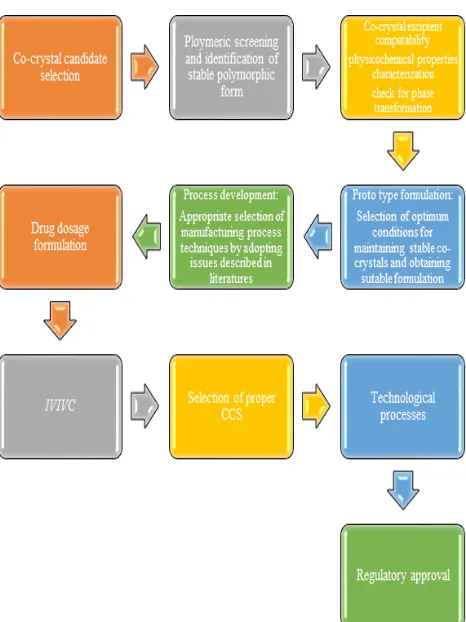
manufacturing of batches. The unique properties and structural features of co-crystals remain as challenging for developing them into drug product. These chal-lenges can be reduced by selecting suitable co-crystal for the development. Translational development of co-crystals is a complex process, represented schematically in Figure 5.
Excipient selection
Selecting of compatible excipient is an utmost impor-tant step of the pre-formulation activity. The overall
performance of the drug product mainly depends on the selected excipients.153 Alhalaweh, 2014 conducted studies on celecoxib-nicotinamide co-crystals with dif-ferent concentrations of SLS and polyvinyl pyrrolidone polymer, reported with the increase in bioavailability of formulation containing 1-10 % of SLS and polyvi-nyl pyrrolidone. The author reported the importance of use in suitable concentration of surfactant (SLS) or polymer (PVP), which in turn decreases the chance of phase transformation and increase solubility.154 Childs, 2013 prepared DNZ-VAN co-crystal. This formation
contains 1% D-α-tocopherol polyethylene glycol succi -nate as solubilizer and 2% Kluce LF pharma hydroxy propyl cellulose as crystallization inhibitor. This
for-mulation showed 10-fold increase of AUC (Area under
curve) when compared to parent DNZ. Whereas non-formulated DNZ co-crystals showed a modest increase
of 1.7 times higher AUC in comparison with parent
molecule.75 Some literatures reported the role of addi-tives on co-crystal performance.155-158 Maintenance of parachute condition (prevention of supersaturation triggered precipitation) of a drug is an important aspect for co-crystal-based products. This can be achieved by selecting a polymer based on their precipitation inhibi-tor capacity of co-crystal and drug.75,155-156 Selection
of suitable surfactant with optimal concentration will prevent the solution mediated transformation64,159 and maximum apparent solubility.75
Prototype formulation
The aim of formulation development is to investigate the impact of excipients on the performance, manufac-turability and safety of the product. Co-crystal eutectic constant Keu and identification of different parameter at
transition point, plays a major role in the selection and optimization of suitable excipients.64,154,160,161 Selection of optimal pH is a crucial parameter to gain maximum solubility.162 Normally a formulation contains diverse excipients and the effect of these excipients on prod-uct performance should be investigated by using sound statistical experiments. Constituting in vitro - in vivo cor-relation is the major challenging aspect in co-crystal product development. In vitro performance of the prod-uct may be hardly correlated with in vivo performance due to changes in the micro environment pH, presence of endogenous surfactants, Lipids etc. which may alter the solubility of the product. Cheney, 2009 conducted,
in vitro and in vivo studies of lamotrigine co-crystals with NCT. This formulation showed an enhanced dissolu-tion rate, whereas decreased oral bio availability in rats when compared to parent molecules.163 Establishing an appropriate formulation strategy will help in obtaining desired mechanical properties and also minimizes phase transformation of co-crystals during mechanical stress. Previous literatures stated that some of the co-crystals may undergo polymorphic phase transformation due to mechanical stress.164 Cushioning agents like carra-geenan’s, alginates, chitosan’s, polyethylene oxides and microcrystalline cellulose pellets may avoid the com-paction induced phase transformation by absorbing the mechanical shock in tablet formulation.165,166
Process development
Process development is aimed at identifying the critical process parameters for ensuring the quality of the prod-uct. The selection of equipment, in-process controls and manufacturing process depends on the material properties of co-crystals. Dissociation of Theophyl-line co-crystals with acidic co-formers like malonic, glu-taric or maleic acids will take place in the presence of water.53 Likewise, wet granulation and wet milling opera-tions may result in dissociation of co-crystals.167 So, the selection of alternative operations like dry granulation
and dry milling may be beneficial in these situations.
Anhydrous THP-Citric acid co-crystals were converted to co-crystal hydrates within 3 days when maintained in humidity conditions.168 This problem can be
recti-fied by maintaining low humidity during manufacturing.
Sodium naproxen -lactose-tetrahydrate co-crystals when heated from 60°C to 120°C, results in loss of water molecules from crystal lattice and transformed to co-amorphous form.169 Therefore, adoption of the issues described in the literature should be done while select-ing the manufacturselect-ing process.170 Zhou, 2016 reported the improved solubility and tabletability of Resveratrol co-crystals, these cocrystals also shown the non-hygro-scopic and phase stable even in high humid conditions, which makes them suitable for tablet formulation.171 Container closure systems (CCS)
The choice of selecting proper packing should be based on the nature of co-crystals and resistance against stressors. Optimized CCS can help in protecting the
product against moisture, light and oxygen. AMG517:
2-hydroxy caproic acid co-crystals showed slight hygro-scopic nature at 8% RH/25°C, during moisture absorp-tion studies.21 This problem can be rectified by adopting, humidity control, water-free process of manufacturing area and by protective packing. The selection of proper CCS may overcome some of the challenges regarding
the transitional development of co-crystals. More stud -ies should be required in this aspect.
Even though rational formulation, environment control, proper process development and selection of ccs may overcome the translational challenges of co-crystals, it is recommended to choose the most suitable co-crystal candidate for pre-formulation screening
Applications
The strategy of converting the idea of co-crystals into the application was already described in the translational development challenges of this paper.
Apixaban (AXP, trade name Eliquis®). Which could be used in various thromboembolic treatment after knee or hip replacement surgery,172,173 having poor solubility and low oral bioavailability. There is no improvement in oral bioavailability even increasing the dose more than 25mg, which is the goal for improving the solubil-ity.174,175 Chen and co-workers prepared APX: oxalic acid co-crystals. Which results in better solubility when com-pared with anhydrous APX form. The pharmacokinetic studies of APX-OXC co-crystals shoed 2.7 times larger
AUC0-24h.175
co-formers, the thermal stability and aqueous solubility were improved in both the cases.181 AD: Saccharine co-crystals maintained their stability throughout the stor-age conditions (1 month) at 60°C.182 These studies help in the implication of the co-crystallization approach to unstable drugs and can result in longer expiry dated preparations.
P-Hydroxyacetanilide (paracetamol PA) is the most popular API used as analgesic183,184 which exhibits poor compatibility and belongs to BCS Class-III.185 PA co-crystals formed with different co-formers PA- Phera-zine,186 PA-trimethyl glycine,187 PA-citric acid188 and others189 results in improved physiochemical, mechani-cal and pharmaceutimechani-cal properties.
Ethenzamide (2-etoxy benzamide, ET) is a commonly
used non-steroidal anti-inflammatory drug belongs to
BCS Class-II, whose water solubility is low and some of
the modifications may improve the property.190-192 Many of the literatures proved that the co-crystals of ET with different co-formers showed improvement in solubility and other physicochemical properties.193,194
Hexamethylene bis-acetamide A is an anticancer drug used in lung cancer treatment.195,196 Aakeroy prepared the co-crystals of Hexamethylene bis-acetamide A with a dicarboxylic acid. These co-crystals have the melting point in a range of 148°C-188°C whereas API melting point ranges between 181°C-182°C. Solubility studies showed improvement by a factor of 2.5 when compared to API.197
Isoniazid (INH) which is the first-generation
anti-tubercular drug198 has been reported with high solubil-ity, whereas chemical stability in tablets is very low.199
Many of the co-crystals such as INH: Fumaric acid,200 INH: caffeine acid,201 INH: Sebacic acid202 and many other co-formers are used for INH co-crystals such as Nicotinamide, succinic acid, vanilic acid, ferulic acid, etc
preparation of co-crystals act as potential drug modifi -cation for solid drug formulation.200
Formation of drug-drug pharmaceutical co-crystals results to overcome the problems related with a tradi-tional combination of drugs by modifying the prop-erties of both drugs.59,198,203 Telmisartan: Atenolol
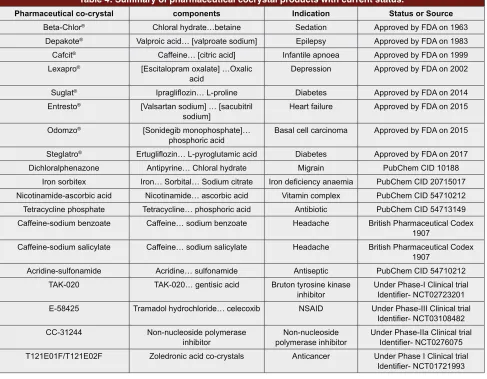
Table 4: Summary of pharmaceutical cocrystal products with current status.
Pharmaceutical co-crystal components Indication Status or Source Beta-Chlor® Chloral hydrate…betaine Sedation Approved by FDA on 1963
Depakote® Valproic acid… [valproate sodium] Epilepsy Approved by FDA on 1983 Cafcit® Caffeine… [citric acid] Infantile apnoea Approved by FDA on 1999
Lexapro® [Escitalopram oxalate] …Oxalic
acid Depression Approved by FDA on 2002
Suglat® Ipragliflozin… L-proline Diabetes Approved by FDA on 2014 Entresto® [Valsartan sodium] … [sacubitril
sodium] Heart failure Approved by FDA on 2015 Odomzo® [Sonidegib monophosphate]…
phosphoric acid Basal cell carcinoma Approved by FDA on 2015 Steglatro® Ertugliflozin… L-pyroglutamic acid Diabetes Approved by FDA on 2017 Dichloralphenazone Antipyrine… Chloral hydrate Migrain PubChem CID 10188
Iron sorbitex Iron… Sorbital… Sodium citrate Iron deficiency anaemia PubChem CID 20715017 Nicotinamide-ascorbic acid Nicotinamide… ascorbic acid Vitamin complex PubChem CID 54710212 Tetracycline phosphate Tetracycline… phosphoric acid Antibiotic PubChem CID 54713149 Caffeine-sodium benzoate Caffeine… sodium benzoate Headache British Pharmaceutical Codex
1907
Caffeine-sodium salicylate Caffeine… sodium salicylate Headache British Pharmaceutical Codex
1907
Acridine-sulfonamide Acridine… sulfonamide Antiseptic PubChem CID 54710212 TAK-020 TAK-020… gentisic acid Bruton tyrosine kinase
inhibitor Under Phase-I Clinical trial Identifier- NCT02723201
E-58425 Tramadol hydrochloride… celecoxib NSAID Under Phase-III Clinical trial
Identifier- NCT03108482
CC-31244 Non-nucleoside polymerase
inhibitor polymerase inhibitorNon-nucleoside Under Phase-IIa Clinical trial Identifier- NCT0276075
T121E01F/T121E02F Zoledronic acid co-crystals Anticancer Under Phase I Clinical trial
co-crystals204 proved that multidrug co-crystals could be a great replacement for standard therapy with more than one API. Almansa prepared tramadol hydrochlo-ride: celecoxib co-crystals which showed favourable
physicochemical and dissolution profiles.205 These co-crystals completed their phase-I and phase-II clinical studies whereas phase-III is going on.206
Commercial co-crystal formulations
Beta-Chlor® (chloral betaine), US patent described its formulation in 1962, as its aim was to mask the unpleas-ant taste of chloral207 but its co-crystal structure was revealed in 2016.193 Zaworot Ko described chloral betain as charge assisted diol–carboxylate heterodimer. These co-crystals showed increased thermal stability when compared to pure drug.208
Depakene® (Valproate semi sodium) Valproate showed full potential in the treatment and prevention of scis-sors.209 This is presently sold in 3 forms. Valproate: Val-proic acid (free acid, trade name Depakote®), sodium valproate (salt, trade name Epilim®) and semisodium Valproate (co-crystal, trade name Depakene®).210 Of all the several forms of valproate, the co-crystal formula-tion showed the superior physicochemical properties, mainly by decreasing the hygroscopicity which was found in other forms.211
Cafcit® (Caffeine citrate) According to British phar-maceutical codex 1907, caffeine citrate exhibits high stability in concentrated solution than pure alkaloid (pharmaceutical codex 1907). Karki, in his studies, revealed the co-crystal structure of caffeine citrate in 2007, which was previously known as complex.168 Lexapro® (Escitalopram oxalate) It is marketed as co-crystal which contains escitalopram oxalate salt and oxalic acid, where citalopram as hydrobromide salt, which leads to controversies regarding structural enan-tiomers.212 Harrison demonstrated the patentable co-crystal from this formulation213 recently, the Lanset reported, Escitalopram, vortioxetine is agomelatine are the most effectual antidepressants available.214 Some of the pharmaceutical co-crystal products were sum-marised in Table 4
Successful drug delivery may be possible with co-crys-tallization. The life time of API could be enhanced through co-crystallization, further drug-drug
co-crys-tals may be helpful to increase therapeutic efficacy by
combinational therapy. Inturn, co-crystallization also enhances the chance of tablatability, stability and physi-cochemical properties as discussed under previous sec-tions.
CONCLUSION
The requirement in drug properties modification is
the main reason for gaining extensive attention on co-crystals. The improvement in dissolution rate, bioavail-ability, solubility and other physicochemical properties has been reported frequently. Research should centre in actual industry problems, such as the scaleup method for industrial standards and high throughput screening
methods. Method selection is immensely important and
particular for each system. A great effort is required in order to apply co-crystallization in the pharmaceutical industry as a customary method to improve drug
prop-erties. Preclinical and clinical studies have confirmed a proof-of-concept on the benefit of co-crystals. How -ever, co-crystals may phase notable challenges in their translation to drug products. This includes co-former safety, polymorphism, lower than super saturation solu-bility, the behaviour of co-crystal in formulation and
difficulty in conducting an IVIVC. An increase in sci
-entific knowledge on crystal engineering and biophar -maceutical performance of co-crystals shall lead to the introduction of drug products containing co-crystals.
ACKNOWLEDGEMENT
The authors wish to thank Maharajah’s College of Phar
-macy, Vizianagaram and Gitam Institute of Phar-macy,
(Deemed to be university), Visakhapatnam for provid-ing their support and continuous encouragement durprovid-ing the preparation of this review paper.
CONFLICT OF INTEREST
The authors declare no conflicts of interest.
ABBREVIATIONS
API: Active pharmaceutical ingredient; EMA: Euro-pean medicine agency; FDA: Food Drug Administra-tion; RH: Relative humidity; HPLC: High performance liquid chromatography; Hcl: Hydrochloric acid; Keu: eutectic constant; TPGS: D-α-Tocopheryl polyeth -ylene glycol 1000 succinate; BCS:
Theophyl-line; CCS: Container closure systems; APX: Apixaban; OXC: Oxalic acid; AD: Adefovir dipivoxil; INH: Iso-niazid; IVIVC:In vivo – in vitro correlation.
REFERENCES
1. Chow K, Tong HHY, Lum S, Chow AHL. Engineering of pharmaceutical materials: An industrial perspective. J Pharm Sci. 2008;97(8):2855-77. 2. Yamamoto K, Kojima T, Karashima M, Ikeda Y. Pharmaceutical evaluation
and developability assessment of co-amorphouses of low soluble drugs and comparison to the co-crystals. Chem Pharm Bull. 2016;64(12):1739-46. 3. Blagden N, DeMatas M, Gavan PT, York P. Crystal engineering of active
pharmaceutical iingredients to improve solubility and dissolution rates. Adv Drug Del Rev. 2007;59(7):617-30.
4. Zhi HL, Asim KS, Paul WSH. Overview of milling techniques for improving the solubility of poorly water-soluble drugs. Asian J Pharm Sci. 2015;10(4):255-74.
5. Nannan G, Mengran G, Qiang F, Zhonggui H. Application of hot melt
extrusion to enhance the dissolution and oral bioavailability of oleanolic acid.
Asian J Pharm Sci. 2017;12(1):66-76.
6. Nitin PG, Panchaxari MD, Anand PG, Vinayak SM. Solubility Enhancement of Satranidazole Using Self Emulsified Drug Delivery Systems. IJPER.
2016;50(3):S68-75.
7. Kulthe VV, Chaudhari PD. Solubility Enhancement of Etoricoxib by Solid
Dispersions Prepared by Spray Drying Technique. IJPER. 2011;45(3):248-58.
8. Apichart A, Somchai S. Inclusion complexes between sildenafil citrate and cyclodextrins enhance drug solubility. Asian J Pharm Sci. 2016;11(1):104-5.
9. Srinivas L, Venkata SVKT, Sunil KN. Design and Development of Vancomycin Liposomes. IJPER. 2015;49(3):208-15.
10. Kanokporn B, Hirofumi T, Pornsak S. Development of pectin nanoparticles through mechanical homogenization for dissolution enhancement of itraconazole. Asian J Pharm Sci. 2016;11(3):365-75.
11. Schultheiss N, Newman A. Pharmaceutical cocrystals and their physicochemical properties. Cryst Growth Des. 2009;9(6):2950-67.
12. Douroumis SA, Ross A, Nokhodchi. Advanced methodologies for cocrystal synthesis. Adv Drug Deliv Rev. 2017;117:178-95.
13. Regulatory Classification of Pharmaceutical Co-Crystals Guidance for
Industry. FDA Guidance. 2018;1-7. https://www.fda.gov/downloads/drugs/ guidances/ucm281764.pdf.
14. Shete AS, Yadav AV, Murthy MS. Enhancement of Dissolution Rate of Irbesartan by Chitosan based Crystal Engineering Technique. IJPER. 2012;46(4):323-9.
15. Amol SS, Vishwajeet VK, Srinivasa MM, Adhikrao VY, Sfurti SS, Rajendra CD. Solid State Characterization and Tableting Studies of Ethanol Based
Cocrystals of Fenofibrate with Nicotinamide. IJPER. 2018;52(1):71-7.
16. Lu E, Rodriguez-Hornedo N, Suryanarayanan R. A rapid thermal method for cocrystal screening. Cryst Engcomm. 2008;10(6):665-8.
17. Aher S, Dhumal R, Mahadik K, Paradkar A, York P. Ultrasound assisted cocrystallization from solution (USSC) containing a non-congruently soluble cocrystal component pair: Caffeine/maleic acid. Eur J Pharm Sci. 2010;41(5):597-602.
18. Friscic T, Jones W. Recent advances in understanding the mechanism of cocrystal formation via grinding. Cryst Growth. 2009;9(3):1621-37. Miroshnyk I, Mirza S, Sandler N. Pharmaceutical co-crystals-an opportunity for drug
product enhancement. Expert Opin Drug Deliv 2009;6(4):333-41.
19. Fernandes GJ, Kumar L, Sharma K, Tunge R, Rathnanand M. A review on solubility enhancement of carvedilol – A BCS class II drug. J Pharm Innovation. 2018;13(3):197-212.
20. Miroshnyk I, Mirza S, Sandler N. Pharmaceutical co-crystals-an opportunity
for drug product enhancement. Expert Opin Drug Deliv. 2009;6(4):333-41.
21. Stanton MK, Bak A. Physicochemical properties of pharmaceutical cocrystals: A case study of ten AMG 517 co-crystals. Cryst Growth Des. 2008;8(10):3856-62.
22. Rodrigues M, Baptista B, Lopes JA, Mafalda CS. Pharmaceutical cocrystallization techniques: Advances and challenges. Int J Pharm. 2018;547(1-2):404-20.
23. Dnyaneshwar PK, Sandeep SZ, Arvind KB. Challenges in translational development of pharmaceutical cocrystals. J Pharm Sci. 2016;10(21):1-14. 24. Ning S, Miranda LP, David RW, Michael JZ. Impact of pharmaceutical
cocrystals: The effect on drug pharmacokinetics. Expert Opin Metab.
2014;10(9):1255-71.
25. Abhijeet SS, Anita RM, Simon EL. Recent review articles such as: Cocrystallization of Nutraceuticals. Crystal Growth Design. 2015;15(2):984-1009.
26. Yong D, Jiadan X. Investigation of polymorphism and cocrystallization of active pharmaceutical ingredients using vibrational spectroscopic techniques. Curr Pharm Des. 2016;22(32):4917-28.
27. Bak A, Gore A, Yanez E, Stanton M, Tufekcic S, Syed R, et al. The co-crystal
approach to improve the exposure of a water-insoluble compound: AMG 517
sorbic acid co-crystal characterization and pharmacokinetics. J Pharm Sci. 2008;97(9):3942-56.
28. Aakeroy CB, Fasulo ME, Desper J. Cocrystal or salt: Does it really matter?. Mol Pharm. 2007;4(3):317-22.
29. Hemamalini M, Loh WS, Quah CK, Fun HK. Investigation of supramolecular
synthons and structural characterisation of aminopyridine-carboxylic acid
derivatives. Chem Cent J. 2014;8:1-9.
30. Desiraju GR. Sipramolecular synthons in crystal engineering – a new organic synthesis. Angewandte Chemie-International Edition in English. 1995;34(21):2311-27.
31. Izutsu KI, Koide T, Takata N, Ikeda Y, Ono M, Inoue M, et al. Characterization and Quality Control of Pharmaceutical Cocrystals. Chem Pharm Bull. 2016;64(10):1421-30.
32. Almarsson O, Zaworotko MJ. Crystal engineering of the composition of pharmaceutical phases: Do pharmaceutical co-crystals represent a new path to improved medicines. Chem Commun. 2004;35(17):1889-96.
33. Khan M, Enkelmann V, Brunklaus G. Crystal engineering of pharmaceutical co-crystals: application of methylparaben as molecular hook. J Am Chem Soc. 2010;132(14):5254-63.
34. Karki S, Friscic T, Jones W. Control and interconversion of cocrystal stoichometry in grinding: stepwise mechanism for the formation of a hydrogen-bonded cocrystal. Crysteng Comm. 2009;11(3):470-81.
35. He GW, Jacob C, Guo LF, Chow PS, Tan RBH. Screening for cocrystallization tendency: The role of intermolecular interaction. J Phys Chem B. 2008;112(32):9890-5.
36. Bis JA, Vishweshwar P, Weyna D, Zaworotko MJ. Hierarchy of supramolecular
synthons: Persistent hydroxyl pyridine hydrogen bonds in cocrystals that
contain a cyano acceptor. Mol Pharmaceutics. 2007;4(3):401-16.
37. Vishweshwar P, McMahon JA, Bis JA, Zaworotko MA. Pharmaceutical cocrystals. J Pharm Sci. 2006;95:499-516.
38. Jones W, Motherwell WDS, Trask AV. Pharmaceutical co-crystals: An Emerging approach to physical property enhancement. MRS Bull. 2006;31(11):875-9.
39. Food and Drug Administration, F. Regulatory classification of Pharmaceutical
co-crystals guidance for industry. 2016.
40. Cerreia VP, Chierotti MR, Gobetto R. Pharmaceutical aspects of salt and cocrystal forms of APIs and characterization challenges. Adv Drug Deliv Rev. 2017;117:86-110.
41. Bryn SR, Pfeiffer RR, Stowell JG. Solid-State Chemistry of Drugs. 2nd ed. West Lafayette: IN. 1999.
42. Blagden N, Berry DJ, Parkin A, Javed H, Ibrahim A, Gavan PT, et al. Current directions in co-crystal growth. New J Chem. 2008;32(10):1659-72.
43. Schultheiss N, Newman A. Pharmaceutical cocrystals and their physicochemical properties. Cryst Growth Des. 2009;9(6):2950-67.
44. Abramowitz R, Yalkowsky SH. Melting Point, Boiling Point and Symmetry. Pharm Res. 1990;7(9):942-47.
45. Burger A, Ramberger R. On the polymorphism of pharmaceuticals and other molecular crystals. I. Mikrochim Acta. 1979;72(3-4):259-71.
47. Fleischman SG, Kuduva SS, McMahon JA, Moulton B, Bailey Walsh
RD, Rodrı´guez-Hornedo N. Crystal Engineering of the Composition of
Pharmaceutical Phases: Multiple-Component Crystalline Solids Involving Carbamazepine. J Cryst Growth Des. 2003;3(6):909-19.
48. Rolf H. The Physical Characterization of Hygroscopicity in Pharmaceutical Solids, In Polymorphism. Wiley-VCH: Weinheim. 2006;235-58.
49. Basavoju S, Bostrom D, Velaga SP. Indomethacin–Saccharin Cocrystal: Design, Synthesis and Preliminary Pharmaceutical Characterization. Pharm Res. 2008;25(3):530-41.
50. McNamara DP, Childs SL, Giordano J, Iarriccio A, Cassidy J, She MS. Use of a glutaric acid cocrystal to improve oral bioavailability of a low solubility API. Pharm Res. 2006;23(8):1888-97.
51. Padrela L, Rodrigues MA, Velaga SP, Fernandes AC, Matos HA, DeAzevedo
EG. Screening for pharmaceutical cocrystals using the supercritical fluid
enhanced atomization process. J Supercrit Fluids. 2010;53(1-3):156-64. 52. Pop M, Sieger P, Cains P. Example: API/ fumerate/ fumaric acid. W J Pharm
Sci. 2008;95:1820-34.
53. Trask AV, Motherwell S, Jones W. Pharmaceutical Cocrystallization: Engineering a Remedy for Caffeine Hydration. Cryst Growth Des. 2005;5(3):1013-21.
54. Oswald IDH, Allan DR, McGregor PA, Motherwell WDS, Parsons S, Pulham CR. The formation of paracetamol (acetaminophen) adducts with hydrogen-bond acceptors. Acta Crystallogr Sect B. 2002;58(Pt 6):1057-66.
55. Variankaval N, Wenslow R, Murry J, Hartman R, Helmy R, Kwong E. Preparation and Solid-State Characterization of Nonstoichiometric Cocrystals of a Phosphodiesterase-IV Inhibitor and l-TarTaric acid. Crystal Growth Des. 2006;6(3):690-700.
56. Chen AM, Ellison ME, Peresypkin A, Wenslow RM, Variankaval N, Savarin CG. Development of a pharmaceutical cocrystal of a monophosphate salt with phosphoric acid. Chem Commun. 2007;4(4):419-21.
57. Hickey M, Peterson M, Scoppettuolo L, Morrisette S, Vetter A, Guzmán H. Performance comparison of a co-crystal of carbamazepine with marketed product. European Journal of Pharmaceutics and Biopharmaceutics. 2007;67(1):112-9.
58. Childs SL, Rodriguez-Hornedo N, Reddy LS, Jayasankar A, Maheshwari C, McCausland L, et al. Screening strategies based on solubility and solution composition generate pharmaceutically acceptable cocrystals of carbamazepine. Cryst Eng Comm. 2008;10(7):856-64.
59. Childs SL, Chyall LJ, Dunlap JT, Smolenskaya VN, Stahly BC, Stahly GP. Crystal Engineering Approach to Forming Cocrystals of Amine Hydrochlorides
with Organic Acids. Molecular Complexes of Fluoxetine Hydrochloride with
Benzoic, Succinic and Fumaric Acids. J Am Chem Soc. 2004;126(41):13335-42.
60. Hildebrand JH. Solubility: The Chemical Catalog Company: New York. 1924;206.
61. Hildebrand JH, Scott RL. The solubility of Nonelectrolytes. 3rd ed. New York:
Reinhold publishing. 1950;113(2938):450-1.
62. Remenar JF, Morissette SL, Peterson ML. Crystal engineering of novel
co-crystals of a triazole drug with 1,4-dicarboxylic acids. J Am Chem Soc.
2003;125(28):8456-7.
63. Shiraki K, Takata N, Takano R. Dissolution improvement and the mechanism of the improvement from cocrystallization of poorly water-soluble compounds. Pharm. Res. 2008;25(11):2581-92.
64. Good DJ, Rodríguez-Hornedo N. Cocrystals eutectic constants and prediction of solubility behaviour. Cryst Growth Des. 2010;10(3):1028-32.
65. Luedeker D, Gossmann R, Langer K, Brunklaus G. Crystal engineering of pharmaceutical crystals: “NMR crystallography” of niclosamide co-crystals. Cryst Growth Des. 2016;16(6):3087-100.
66. Serajuddin ATM. Salt formation to improve drug solubility. Adv Drug Del Rev. 2007;59(7):603-16.
67. Good DJ, Rodríguez-Hornedo N. Solubility Advantage of Pharmaceutical Cocrystals. Cryst Growth Des. 2009;9(5):2252-64.
68. Liu R. Water-insoluble Drug Formulation. 2nd ed. Boca Raton: CRC Press.
2008.
69. Yalkowsky SH. Solubility and Solubilization in Aqueous Media. American
Chemical Society. New York: Oxford University Press: 1999. J Am Chem
Soc. 2000;122(40):9882.
70. Trask AV, Motherwell WDS, Jones W. Physical stability enhancement of theophylline via cocrystallization. Int J Pharm. 2006;320(1-2):114-23. 71. Guzmán HR, Tawa M, Zhang Z, Ratanabanangkoon P, Shaw P, Gardner
CR. Combined use of crystalline salt forms and precipitation inhibitors to
improve oral absorption of celecoxib from solid oral formulations. J Pharm
Sci. 2010;96(10):4215-27.
72. Friščić T, Jones W. Benefits of cocrystallisation in pharmaceutical materials
science: An update. J Pharm Pharmacol. 2010;62(11):1547-59.
73. Brouwers J, Brewster ME, Augustijns P. Supersaturating drug delivery systems: the answer to solubility-limited oral bioavailability?. J Pharm Sci. 2009;98(8):2549-72.
74. Babu NJ, Nangia A. Solubility advantage of amorphous drugs and pharmaceutical cocrystals. Cryst Growth Des. 2011;11(7):2662-79. 75. Childs SL, Kandi P, Lingireddy SR. Formulation of a Danazol cocrystal with
controlled supersaturation plays an essential role in improving bioavailability. Mol Pharm. 2013;10(8):3112-27.
76. Etter MC. Encoding and decoding hydrogen-bond patterns of oganic compounds. Acc Chem Res. 1990;95:4601-10.
77. Donohue J. The hydrogen bond in organic crystals. J Phys Chem. 1952;56(4):502-10. doi: 10.1021/j150496a023.
78. Rodrguez-Hornedo N, Nehm SJ, Jayasankar A. Cocrystals: Design, Properties and Formation Mechanisms: Encyclopedia of Pharmaceutical Technology. 4th ed. New York: Informa Healthcare. 2007;615-35.
79. Allen FH, Kennard O, Taylor R. Systematic analysis of structural data as a research technique in organic chemistry. Acc Chem Res. 1983;16(5):146-53. 80. Haynes DA, Chisholm JA, Jones W, Motherwell WS. Supramolecular
synthon competition in organic sulfonates: A CSD survey. Cryst Eng Comm. 2004;6(95):584-8.
81. Mohammad AM, Amjad A, Sitaram PV. Hansen solubility parameter as a tool to predict cocrystal formation. Int J Pharm. 2011;407(1-2):63-71.
82. Hansen CM. Hansen solubility parameters: A user’s handbook. 2nd Ed. Boca
Raton: CRC press. 2007;544.
83. Moradiya H, Islam MT, Woolam GR, Slipper IJ, Halsey S, Snowden MJ. Continuous co-crystallization for dissolution rate optimization of poorly water-soluble drug. Cryst Growth Des. 2014;14(1):189-98.
84. Sarkar A, Rohani S. Cocrystals of Acyclovir with promising physicochemical properties. J Pharm Sci. 2015;104(1):98-105.
85. Izutsu K, Koide T, Takata N, Ikeda Y, Ono M, Inoue M. Characterization and Quality control of pharmaceutical cocrystals. Chem Pharm Bull. 2016;23:2381-92.
86. Lange L, Heisel S, Sadowski G. Predicting the solubility of pharmaceutical
cocrystals in solvent/anti-solvent mixtures. Molecules. 2016;21(5):593-610.
87. Lee MJ, Wang LC, Kim MJ, Kim P, Song KH, Chun NH. Controlling the polymorphism of carbamazepine-saccharine cocrystals formed during antisolvent cocrystallization using kinetic parameters. Korean J Chem Eng. 2015;32(9):1910-7.
88. Holan J, Stepanek F, Billot P, Ridvan L. The construction, prediction and measurement of co-crystal ternary phase diagrams as a tool for solvent selection. Eur J Pharm Sci. 2014;63:124-31.
89. Sarraguca MC, Ribeiro PRS, DosSantos AO, Lopes JA. Batch statistical process monitoring approach to cocrystallization process. J Pharm Sci. 2015;104(12):4099-108.
90. Sungyup J, Jonghwi L, Won K. Structures and physical properties of the
cocrystals of adefovir dipivoxil with dicarboxylic acids. J Cryst Growth.
2013;373:59-63.
91. Snehal PM, Samina AJ, Poonam SK, Yogesh VP, Shashikant CD. Improvement in physicochemical properties of ezetimibe using a crystal engineering technique. Powder Technol. 2012;222:131-8.
92. Ali S, Abolghasem J. Physicochemical characterization of a new cocrystal of ketoconazole. Powder Technol. 2014;262:242-8.
93. Ning Q, Mingzhong L, Walkiria S, Nazneen M, Angela D, Gary T. Pharmaceutical cocrystals: An overview. Int J Pharm. 2011;419(1-2):1-11. 94. Anindita S, Sohrab R. Molecular salts and co-crystals of mirtazapine
with promising physicochemical properties. J Pharm Biomed Analysis. 2015;110:93-9.