Eutrema nanum
(Brassicaceae), a new species from
Chola Shan, Southwest China
Guoqian Hao1,2, Ihsan A. Al-Shehbaz3, Lei Zhang2,
Xinyi Guo2, Hao Bi2, Songbai Xu1, Jianquan Liu2
1 Biodiversity Institute of Mount Emei, Mount Emei Scenic Area Management Committee, Leshan 614000, Sichuan, P. R. China 2 Key Laboratory for Bio-Resources and Eco-Environment of Ministry of Education, Col-lege of Life Science, Sichuan University, Chengdu 610065, Sichuan, P. R. China 3 Missouri Botanical Garden, P.O. Box 299, St. Louis, MO 63166-0299, USA
Corresponding author:Jianquan Liu ([email protected])
Academic editor:K. Marhold | Received 29 May 2018 | Accepted 21 August 2018 | Published 17 September 2018
Citation: Hao G, Al-Shehbaz IA, Zhang L, Guo X, Bi H, Xu S, Liu J (2018) Eutrema nanum (Brassicaceae), a new species from Chola Shan, Southwest China. PhytoKeys 109: 17–25. https://doi.org/10.3897/phytokeys.109.27049
Abstract
Eutrema nanum, a new high-elevation (4500–4600 m) species from Chola Shan, Sichuan (Southwest Chi-na), is described and illustrated. It is similar morphologically to E. nepalense but is readily distinguished by having oblong to elliptic or obovate to spatulate (vs. suborbicular to broadly ovate) leaves, glabrous (vs. puberulent) sepals and ovate to oblong fruit 4–7 × 2–3 mm with flattened valves (vs. ovoid to subglobose fruit 2–3 × 1.8–2 mm with rounded valves). The genetic differences amongst E. nanum, E. nepalense and other close relatives are further confirmed by phylogenetic analyses using ITS and cpDNA sequence vari-ations. The new combination E. sinense is proposed.
Keywords
Cruciferae, Eutrema nanum, molecular phylogeny, Sichuan, Eutrema sinense
Introduction
The boundaries of Eutrema R.Br. (Brassicaceae or Cruciferae) have recently been expanded to include 38 species, several of which were previously placed in the six genera Taphrospermum C.A.Mey., Thellungiella O.E.Schulz, Neomartinella Pilg.,
Platycraspedum O.E.Schulz, Chalcanthus Boiss. and Pegaeophyton Hayek & Hand.-Mazz. (Al-Shehbaz and Warwick 2005; Hao et al. 2017a). The taxonomic knowledge http://phytokeys.pensoft.net
Copyright Guoqian Hao et al. This is an open access article distributed under the terms of the Creative Commons Attribution License (CC BY 4.0), which permits unrestricted use, distribution, and reproduction in any medium, provided the original author and source are credited.
of this genus is still incomplete because numerous collections from the high-elevation regions in Southwest China were often overlooked and many areas remain poorly explored. We reported two new species during recent field investigations and molecular analyses (Hao et al. 2016, 2017b). Here we report the third one, Eutrema nanum, found in Chola Shan at a high elevation of 4500–4600 m in Sichuan Province, Southwest China. This new species is morphlogically similar to E. nepalense (Al-Shehbaz, Kats Arai & H.Ohba) Al-Shehbaz, G.Q.Hao & J.Quan Liu but, as shown below, it is readily distinguished by several aspects of leaves and fruit. The phylogenetic studies on both species and their other relatives were also conducted herein and the results support the recognition of this novelty. In addition, one of six species which were used to determine the systematic position of E. nanum was found to need a taxonomic combination and a new name Eutrema sinense (Hemsl.) G.Q.Hao, J.Quan Liu & Al-Shehbaz is therefore proposed herein.
Material and methods
We examined morphological traits of Eutrema nanum and several relative species. We followed Hu et al. (2015) and Hao et al. (2017a) in examining the genetic differences between this novelty (two accessions) and the morphologically similar E. nepalense
(one accession). In order to determine the systematic position of E. nanum, we futher included six species (E. scapiflorum (Hook.f. & Thomson) Al-Shehbaz, G.Q.Hao & J.Quan Liu, E. sinense (Hemsl.) G.Q.Hao, J.Quan Liu & Al-Shehbaz, E. hookeri Al-Shehbaz & Warwick, E. fontanum (Maxim.) Al-Shehbaz & Warwick, E. verticillatum
(Jeffrey & W.W.Sm.) Al-Shehbaz & Warwick and E. deltoideum (Hook.f. & Thomson) O.E.Schulz) in our analyses. All six species were shown to be close relatives to E. nepa-lense in our previous study (Hao et al. 2017a) and two (E. scapiflorum and E. sinense) were previously placed in the genus Pegaeophyton. The related E. integrifolium Bunge (see Hao et al. 2017a) was selected as the outgroup. The collection information of the sampled species is listed in Table 1 and Figure 3 and the voucher specimens were de-posited in the Sichuan University Herbarium (SZ).
random-addition-sequence replicates per bootstrap replicate. ML analyses were performed with raxml-HPC -f a -s sequence. phy -n boot2 -m GTRGAMMA -x 1234 -# 1000 -n outname. The most suitable GTRGAMMA models were used and bootstrap analyses were esti-mated with 1000 replicates.
Taxonomy
Eutrema nanum G.Q.Hao, J.Quan Liu & Al-Shehbaz, sp. nov.
urn:lsid:ipni.org:names:60477015-2
小山嵛菜
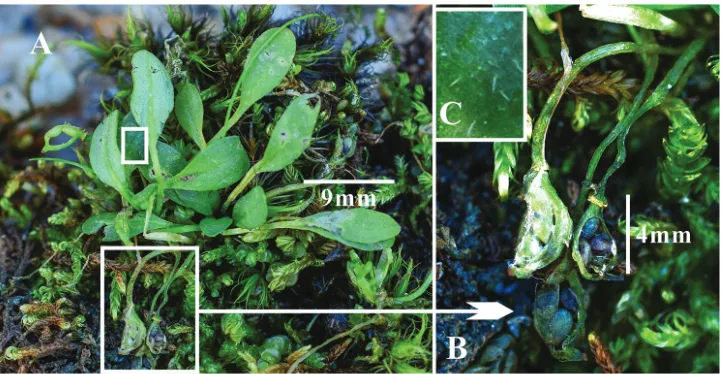
Type. China. Sichuan: Chola Shan, 31°55'32"N, 98°54'35"E, 4500 m elev., 16 Au-gust 2014, Liu & Hao 14091 (Holotype, SZ). Figures 1, 2.
Table 1. The sources of materials used for molecular analyses of Himalayan Eutrema (all vouchers at SZ).
Taxon Voucher Source Coordinate
E. nanum Liu & Hao 14091 Chola Shan, Sichuan, China 31°55'N, 98°54'E E. nanum Liu 17124 Chola Shan, Sichuan, China 31°55'N, 98°54E E. nepalense Long et al. 605 Sikkim, India 27°36'N, 88°12'E E. sinense Liu 13114 Biluo Snow Mountain, Yunnan, China 27°59'N, 98°47'E E. scapiflorum Liu & Hao 13074 Yarla Shampo Mountain, Tibet, China 28°51'N, 91°59E E. fontanum Liu & Hao 13144 Zhuodala Mountain, Sichuan, China 31°24'N, 99°56'E E. hookeri Liu 17108a Mila Mountain, Tibet, China 29°49'N, 92°90'E E. verticillatum Liu & Hao 14094 Maila Mountain, Sichuan, China 30°58'N, 98°58'E E. deltoideum Liu 13024 Lasa, Tibet, China 29°42'N, 91°09'E E. integrifolium Liu & Hao 13049 Tianshan Mountain, Xinjiang, China 43°12'N, 84°49'E
Figure 2. Holotype of Eutrema nanum.
Figure 3. Geographical distribution of the sampled populations of Eutrema nanum and related species.
obovate, spatulate, 6–10 × 3–4 mm, fleshy, glabrous or abaxially pubescent with trichomes, 0.3–0.6 mm long, base subattenuate, to cuneate, margin entire, apex obtuse to subrounded. Pedicels slender, 18–23 mm long at anthesis, not elongated in fruit, not persistent. Flowers 5–8 per plant; sepals ovate to oblong, 1–1.5 mm long; petals white, broadly obovate to spatulate, blade 2–3 ×1–2 mm, persistent to fruit maturity, claw-like base 0.5–1 mm long. Ovules 2–4 per ovary. Fruit latisep-tate, dehiscent, ovate to oblong, somewhat curved, 4–7 × 2–3 mm; valves nearly flat, extending along part of fruit length; gynophore 0.1–0.3 mm long; replum 0.3–0.4 mm wide; style 0.6–1 mm long. Seeds broadly ovate, brown, plump, 2–4 per fruit, 1.4–2 × 0.6–1 mm.
Eutrema nanum is morpholgically most similar to E. nepalense, from which it is readily distinguished by having oblong, elliptic, obovate to spatulate leaves, glabrous sepals and ovate to oblong larger fruit 4–7 × 2–3 mm with flattened, glabrous valves. In contrast, E. nepalense (https://www.gbif.org) has suborbicular to broadly ovate leaves, puberulent sepals and ovoid to subglobose smaller fruit 2–3 × 1.8–2 mm with rounded, puberulent valves. Eutrema nanum was only found with around 100 individuals along a stream in a valley about 2 kilometres from the Chola Shan peak, whereas E. nepalense
occurs across Himalyas Mountains in Bhtan, China, Nepal and India. Phenology. Flowering: June–August. Fruiting: August–September.
Distribution and habitat. Eutrema nanum is currently known only from Chola Shan, part of Hengduan Mountains in West Sichuan, China (Fig. 3). It grows under rocks by streams close to glaciers, damp or gravelly scree, wet sand at a very high eleva-tion of 4500–4600 m.
Paratype. China. Sichuan: Chola Shan, 31°55'32"N, 98°54'35"E, 4500 m elev.,
Eutrema sinense (Hemsl.) G.Q.Hao, J.Quan Liu & Al-Shehbaz, comb. nov. Based on Braya sinensis Hemsl., J. Linn. Soc., Bot. 30: 303. 1892.
urn:lsid:ipni.org:names:77190124-1
Syn.: Eutrema robustum (O.E.Schulz) Al-Shehbaz, G.Q.Hao & J.Quan Liu, Bot. J. Linn. Soc. 184: 219. 2017. Basionym: Pegaeophyton sinense var. robustum O.E.Schulz, Notizbl. Bot. Gart. Gerlin-Dahlem 9: 477. 1926.
The earliest available epithet of this taxon at the species rank is “sinensis” and it should have been been transferred to Eutrema by Hao et al. (2017a) instead of using the varietal epithet “robustum.”
Genetic differences between Eutrema nanum, E. nepalense and other relatives
Sequence data from Eutrema nanum and E. nepalense reveals that one nucleotide sub-stitution in ITS, two in rbcL, 18 in matK and eight substitutions and three indels in
psbA-trnH distinguish them very well (Table 2).
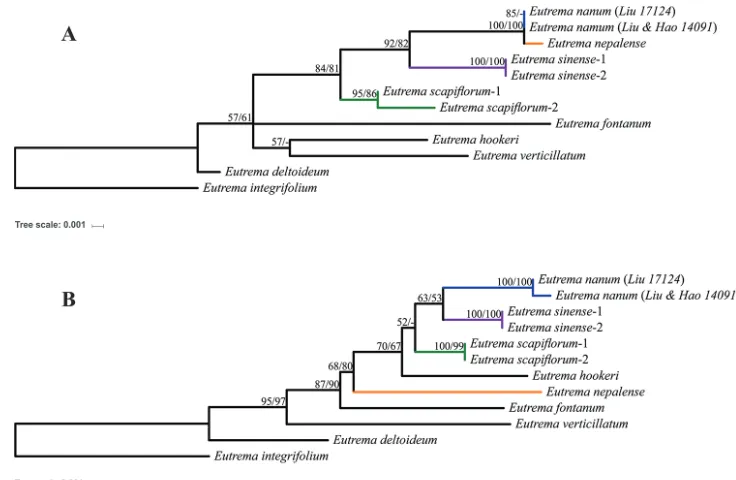
Based on sequence variations of ITS and cpDNAs (Table 3), phylogenetic analyses suggested that Eutrema nanum is mostly related to E. nepalense, E. sinense and E. scapi-florum. However, phylogenetic relationships of these four species are incongurent be-tween ITS and plastid DNA tree (Fig. 4). In the ML analyses of ITS sequence data,
E. nanum and E. nepalense formed a single cluster sister to E. sinense and together are sister to E. scapiflorum with high support values (>80%) (Fig. 4A). By contrast, in the ML analyses of cpDNAs sequences, the phylogenetic relationships were maintined between E. nanum and sister E. sinense and together as sister to E. scapiflorum, but
E. nepalense fell outside that relationship and was separated from them by E. hookeri
with medium support (>50%) (Fig. 4B). MP analyses produced almost the same tree topologies with similar bootstrap support values.
Table 2. Diagnosing sites of the aligned ITS and three cpDNA sequences between Eutrema nanum and E. nepalense.
Species ITS rbcL matK
508 82 337 165 276 333 342 391 449 483 495 497 549
Eutrema nanum C C T C T T T T T T C T T
Eutrema nepalense T A C T C G C A G C T C A
matK psbA-trnH
601 603 633 638 657 28 40 48 92 114 115 138- 212 228 235
Eutrema nanum C C T T G T C G - G C - 2 nt C C
Figure 4. The Maximum Likelihood tree based on analysis of ITS (A) and Three cpDNA regions (B). Numbers above branches are maximum likelihood bootstrap support values and maximum parsimony bootstrap support values. ‘-’ represents <50%.
Table 3. Tree statistics for analyses of the datasets.
Data set ITS* psbA-trnH rbcL matK Combined
cpDNA*
No. of sequences 30 30 30 30 30
Aligned length used in analyses 698 455 506 779 1786
No. of variable characters 141 58 17 66 169
No. of parsimony-informative characters 56 15 7 22 47
Tree length (steps) 78 70 10 71 195
Consistency (CI) 0.833333 0.900000 1.000000 0.873239 0.892308
Retention index (RI) 0.803030 0.708333 1.000000 0.790698 0.764045
Rescaled consistency index (RC) 0.669192 0.637500 1.000000 0.690468 0.681763 *gaps were coded and included.
Discussion
separated by a distance of at least 1200 air kilometres from the Chola Shan (Sichuan, SW China), where E. nanum is endemic (Fig. 3). Eutrema nanum is also closely related to E. sinense in the phylogenetic analyses of the cpDNA sequence variations, but both are easily distinguished from each other. Eutrema nanum is a small and weak herb with entire leaves (0.5–1.5 cm long) and small flowers (petals 2–3 mm long), whereas E. sin-ense is obviously stout with entire or toothed leaves (1.5–8 cm long) and distinctly larger flowers (petals 8–15 mm long) and fruit (10–20 mm long).
Pylogenetic relationships amongst E. nanum, E. nepalense and E. sinense are in-congruent between ITS and cpDNA trees. This incongruence may suggest possible hybridisations or incomplete lineage sorting during the rapid and recent species di-versifications (Soltis and Soltis 2000, 2009). However, it is not possible at present to determine which of these two factors had caused the incongruent phylogenies ob-served here. More analyses and molecular data, especially based on more individuals and genomic evidence, are needed to solve these phylogenetic inconsistences.
Acknowledgements
This research was supported by grants from the National Natural Science Foundation of China (31700164 and 31590821).
References
Al-Shehbaz IA, Warwick SI (2005) A synopsis of Eutrema (Brassicaceae). Harvard Papers in Botany 10(2): 129–135. https://doi.org/10.3100/1043-4534(2005)10[129:ASOEB]2.0.CO;2 Felsenstein J (1985) Confidence limits on phylogenies, an approach using the bootstrap.
Evolution; International Journal of Organic Evolution 39(4): 783–791. https://doi. org/10.1111/j.1558-5646.1985.tb00420.x
Hao GQ, Al-Shehbaz IA, Liang QL, Liu JQ (2016) Eutrema tianshanense (Brassicaceae), a new species from Tian Shan Mountains of central Asia. Phytotaxa 286(1): 23–31. https://doi.org/10.11646/phytotaxa.286.1.3
Hao GQ, Al-Shehbaz IA, Ahani H, Liang QL, Mao KS, Wang Q, Liu JQ (2017a) An in-tegrative study of evolutionary diversification of Eutrema (Eutremeae, Brassicaceae). Botanical Journal of the Linnean Society 184(2): 204–223. https://doi.org/10.1093/ botlinnean/box024
Hao GQ, Zhang CB, Al-Shehbaz IA, Guo XY, Bi H, Wang JY, Liu JQ (2017b) Eutrema gigan-teum (Brassicaceae), a new species from Sichuan, southwest China. PhytoKeys 82: 15–26. https://doi.org/10.3897/phytokeys.82.12329
Soltis PS, Soltis DE (2000) The role of genetic and genomic attributes in the success of polyploids. Proceedings of the National Academy of Sciences of the United States of America 97(13): 7051–7057. https://doi.org/10.1073/pnas.97.13.7051
Soltis PS, Soltis DE (2009) The role of hybridization in plant speciation. Annual Review of Plant Biology 60(1): 561–588. https://doi.org/10.1146/annurev.arplant.043008.092039 Stamatakis A (2006) RAxML-VI-HPC, maximum likelihood-based phylogenetic analyses with
thousands of taxa and mixed models. Bioinformatics (Oxford, England) 22(21): 2688–2690. https://doi.org/10.1093/bioinformatics/btl446
Swofford DL (2003) PAUP*, phylogenetic analyses using parsimony (*and other methods), Version 4. Sunderland, MA, USA, Sinauer Associates.
Thompson JD, Gibson TJ, Plewniak F, Jeanmougin F, Higgins DG (1997) The CLUSTAL_X windows interface, flexible strategies for multiple sequence alignment aided by quality analysis tools. Nucleic Acids Research 25(24): 4876–4882. https://doi.org/10.1093/nar/25.24.4876 Young ND, Healy J (2003) GapCoder automates the use of indel characters in phylogenetic