Vol.8 (2018) No. 5
ISSN: 2088-5334
Random Forest Weighting based Feature Selection for C4.5
Algorithm on Wart Treatment Selection Method
Handoyo Widi Nugroho
#, Teguh Bharata Adji
#, Noor Akhmad Setiawan
# #Department of Electrical Engineering and Information Technology, Universitas Gadjah Mada Yogyakarta, Indonesia
E-mail: [email protected], [email protected], [email protected]
Abstract— Research in the field of health, especially treatment of wart disease has been widely practiced. One of the research topics related to the treatment of wart disease is in order to provide the most appropriate treatment method recommendations. Doctors widely use treatment methods for the treatment of patients with wart disease that is the method of cryotherapy and immunotherapy. Previous research has been done on cryotherapy and immunotherapy datasets, which resulted in two different prediction methods, but the accuracy level has not been satisfactory. In this study, two datasets are combined to produce a single prediction method. The method uses the C4.5 algorithm combined with Random Forest Feature Weighting (C4.5+RFFW) used to select the relevant features to improve accuracy. Experimental results show that the proposed method can improve performance with accuracy and informedness are 87.22% and 71.24%, respectively. These results further facilitate physicians in determining treatment methods for patients with a single predictive method and better-predicted performance.
Keywords— C4.5; random forest; feature weighting; wart.
I. INTRODUCTION
Data mining techniques can be used to study and infer relationships between data. This analysis can find patterns that are not previously known to the database. The results of the analysis of the data are required in various fields, one of which is in the medical field [1]–[3], e.g., skin cancer detection, tumor detection, Malign Melanoma analysis [4], and others.
Research in the field of health, especially of skin disease to date is still possible to be developed [5]. This is indicated by not too much research that discusses this disease, especially research in the field of wart disease treatment. There are several treatment methods of wart disease, but doctors have not yet known the most effective treatment method for each patient [6].
Previous studies have been conducted on immunotherapy method using candida antigen and cryotherapy method using liquid nitrogen. Both of these treatment methods were selected for study because they were the best method [7]. The study was conducted on 180 plantar patients, and common warts refer to the dermatology clinic of Ghaem Hospital, Mashhad, Iran. This study looked at two treatment methods for plantar and common warts [8], namely: cryotherapy and immunotherapy methods using candida antigen. Both methods use a separate dataset that produces
two different rules. The rules were developed using rule-based fuzzy system [9]–[11]. A researcher optimized fuzzy variables using state-of-the-art Adaptive Network-based Fuzzy Inference System (ANFIS) [12]. The rules are combined with Information Gain-based classification algorithms and with Feature Selection. The process then proceeds with the Apriori algorithm to extract the rules and methods as Prior research (IGFS+Apriori+ANFIS). The results of the accuracy achieved by the study in predicting plantar and common wart treatments were 83.33% using immunotherapy treatment method and 80% using cryotherapy method. The research has succeeded in recommending choosing the best method for the treatment of wart disease. The rules generated by the study have also been able to reduce the time and cost of patient treatment. Nevertheless, the accuracy of the model proposed in previous studies is not good enough. Thus, there is still a chance to improve on the existing model.
One standard method of data mining in classification is the C4.5 algorithm [13]. The C4.5 algorithm is capable of handling nominal and numerical attributes, handling training data with missing attribute values, and improving computational efficiency [14].
lead to a decrease in accuracy [6]. Thus, the purpose of this study is to improve the accuracy of the C4.5 algorithm.
One way to achieve the aim is by performing features selection. Features selection is an essential step in the classification process because the selected features significantly affect the accuracy of the classification [15]. Classification of datasets that have many features requires a process to reduce non-essential features. The method used to reduce the features is Random Forest Feature Weighting. Hence, this research proposes the C4.5 algorithm combined with Random Forest Feature Weighting (RFFW) method to improve the accuracy of C4.5 Algorithm.
II. MATERIAL AND METHOD
A. Dataset
The study uses two datasets from the University of California at Irvine's (UCI) machine learning repository: cryotherapy and immunotherapy datasets [7]. Cryotherapy dataset consists of 90 records and each record consist of seven features: sex, age, and time, number of warts, type, area, and response to treatment. While immunotherapy dataset consists of 90 record and each record consists of eight features: sex, age, and time, number of warts, type, area, induration diameter, and response to treatment. Table I presents cryotherapy and immunotherapy datasets along with their feature names and descriptions.
TABLEI
CRYOTHERAPY AND IMMUNOTHERAPY DATASETS
Method Feature name Description
Cryotherapy 1. Result of treatment 1 or 0
2. Sex 47 Man
43 Woman
3. Age 15-67 (year)
4. Time 0-12 (month)
5. Number of warts 1-12
6. Type 1-Common (54)
2-Plantar (9) 3-Both (27)
7. Area 4-750 (mm2)
Immunotherapy 1. Result of treatment 1 or 0
2. Sex 41 Man
49 Woman
3. Age 15-56 (year)
4. Time 0-12 (month)
5. Number of warts 1-19
6. Type 1-Common (47)
2-Plantar (22) 3-Both (21)
7. Area 6-900 (mm2)
8. Induration diameter 5-70 (mm)
This study is intended to select the appropriate treatment methods based on the two datasets. Hence, both datasets are merged. The merging process is conducted by removing unequal features between the two datasets. The induration diameter feature on the immunotherapy dataset is removed because the induration diameter feature has a value below the RFFW weighting threshold. Thus, this feature is not a significant feature. Afterward, we categorize the merged
dataset into two labels, i.e. cryotherapy and immunotherapy as shown in Table II.
The merged records are derived from cryotherapy and immunotherapy datasets whose values of the result of treatment features are 1. The merged dataset has 119 records consisting of 59.66% for cryotherapy and 40.34% for immunotherapy. From the proportion of each class, it can be said that this merged dataset is balanced because the proportions of the two classes are not far apart from one another. The merged dataset can be seen in Table II.
TABLEII
THE COMBINATION BETWEEN CRYOTHERAPY AND IMMUNOTHERAPY DATASET
Number Feature name Description
1 Therapy (label) 1 (Cryo) or 2 (Immuno)
2 Sex 59 Man
60 Woman
3 Age 15-54 (year)
4 Time 0.25-11.75 (month)
5 Number of warts 1-19
6 Type 1-Common (54)
2-Plantar (9) 3-Both (27)
7 Area 4-900 (mm2)
In Table II, the merged dataset consists of 59 male patients and 60 female patients. The patients' ages are of at least 15 years and a maximum 54 years. The merged dataset is used to compare the performance of several classification methods. The first performance comparison is between the C4.5 algorithm and the proposed method (C4.5 + RFFW). The second performance comparison is between Prior research and C4.5 + RFFW.
B. Proposed Method
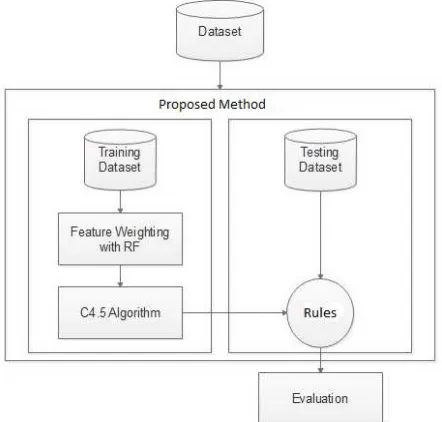
The proposed method in this research is classification method using C4.5 algorithm combined with Random Forest Feature Weighting method (C4.5+RFFW). The order of the classification method is shown in Fig. 1.
Fig. 1 describes the sequence of processes from the proposed research. The processes consist of dataset preparation, feature weighting, classification using C4.5 Algorithm, model generation, and testing. In the preparation stage, the dataset is divided into two parts: 90% for training and 10% for testing. The division of this dataset uses Cross Validation Techniques. The relevant features contained in the training dataset are determined by weighting techniques using Random Forest Feature Weighting (RFFW) method. This method has advantages, among others, can produce lower errors, provide good results in classification, can handle the training data in large numbers efficiently, effective to estimate the missing data, and can help select the relevant features using weighting features on classification process. The feature selection is made by giving weight to each feature. Features with weight values below the threshold would be removed. Features with weight values greater than the threshold are considered as relevant features [15], [16].
The result of determining the relevant features on the training dataset using RFFW method would be continued with the classification process using the C4.5 algorithm. C4.5 is an algorithm which is used to build a decision tree [17]. This method transforms extensive facts into a decision tree that are represented as rules [18]. The next process would be the evaluation of the generated rules using the testing dataset.
C. Evaluation
This research performs several evaluations to show the performance of each method. The performance evaluations include accuracy, sensitivity, specificity, Area Under Curve (AUC), f-measure and informedness.
The accuracy value shows the proximity of the measured result to the true value. This value describes how accurate the results of the classification process. The value of sensitivity is also called the true positive level that is measuring correctly the proportion of positive value identified. In contrast, specificity is also called the actual negative level, which measures correctly identifiable negative proportion [19]. Sometimes there is an imbalance between sensitivity and specificity, so a compromise (trade-off) is required. Power [20] introduced informedness as a compromise between sensitivity and specificity. Informedness evaluation is how information predicts a given condition.
Area Under the Curve (AUC) is a measure of the suitability of the method. The AUC represents the value of sensitivity and specificity with a boundary value of 0 to 1.
Furthermore, the results of this evaluation are categorized based on the value obtained from each measurement. Gorunescu [21] categorizes the classification results based on the AUC values as follows:
• 0.90 – 1.00 = excellent classification;
• 0.80 – 0.90 = good classification;
• 0.70 – 0.80 = fair classification;
• 0.60 – 0.70 = poor classification;
• 0.50 – 0.60 = failure.
This categorization would be used for other performance evaluations such as accuracy, sensitivity, specificity, f-measure, and informedness.
III.RESULTS AND DISCUSSION
In this study, the proposed method is C4.5 algorithm combined with Random Forest Feature Weighting (C4.5+RFFW) that would be compared to previous research using Information Gain-Based classification algorithm combined with Feature Selection and ANFIS. We refer to this proposed method as IGFS+Apriori+ANFIS.
This study conducts six experimental models. The first experiment is to evaluate the performance of C4.5 Algorithm and the second experiment is to measure the performance of the proposed method (C4.5+RFFW). Each experiment uses two datasets, i.e., cryotherapy dataset and immunotherapy dataset separately. While an experiment to measure performance comparisons between C4.5 and C4.5 + RFFW is a third experiment using cryotherapy and immunotherapy datasets. The fourth experiment used a combined dataset
(cryotherapy and immunotherapy). Furthermore, an
experiment to compare performance between C4.5 + RFFW and IGFS + Apriori + ANFIS is the fifth experiment using Cryotherapy and Immunotherapy datasets. While the sixth experiment using the merged dataset.
This experiment uses RapidMinner. This software is used to model every data processing experiment from the feature determination process, classification, to the evaluation stage. This experiment uses hardware having the following specifications: Intel Core i5, with 8 GB of RAM.
A. Classification Result Using C4.5 Algorithm
The experiment is classified cryotherapy datasets and immunotherapy using the C4.5 algorithm. The result of dataset classification can be seen in Table III.
TABLEIII
CLASSIFICATION RESULTS USING C4.5ALGORITHM
Evaluation Cryotherapy Immunotherapy
Accuracy 91.11 % 80.00 % Specificity 92.50 % 30.00 % Sensitivity 90.00 % 92.86 %
AUC 0.775 0.546
f-measure 91,54 % 40 % informedness 82.50 % 22.86 %
It can be explained from Table III that the classification results using the C4.5 algorithm on cryotherapy dataset achieves first classification (AUC = 0.90 – 1.00) for three measurements: accuracy, specificity, and f-measure. While immunotherapy dataset only achieves an excellent classification (AUC = 0.90 – 1.00) for sensitivity. The informedness measurement on immunotherapy dataset is categorized into failure (AUC = 0.50 – 0.60). The problem is caused by an imbalance value between specificity and sensitivity, i.e. 30.00 % and 92.86 % respectively.
Meanwhile, the measurement of informedness on cryotherapy dataset is categorized into proper classification (AUC = 0.80 - 0.90). This is because the value of specificity and sensitivity is quite balanced.
B. Classification Result Using C4.5+RFFW
In this experiment, the classification is performed using C4.5 + RFFW. The number of trees and the maximum weighting threshold of RFFW are 66, 0.11 for cryotherapy, 86, and 0.165 for immunotherapy datasets. Details of the experiment result can be seen in Table IV.
TABLEIV
CLASSIFICATION RESULTS USING C4.5+RFFW
Evaluation Cryotherapy Immunotherapy
Accuracy 93.33 % 86.67 % Specificity 98.00 % 95.71 % Sensitivity 88.50 % 50.00 %
AUC 0.617 0.636
F-measure 91.94 % 62.50 % Informedness 87.00 % 45.71 %
The classification results in Table IV show that the informedness measurement on immunotherapy dataset is minimal and thus cannot be categorized. The problem is caused by an imbalance value between specificity and sensitivity, i.e. 95.71 % and 50.00 % respectively. The measurement of informedness on cryotherapy dataset is categorized into good classification (AUC = 0.80 - 0.90).
Almost all measurements of cryotherapy dataset are superior to those of immunotherapy dataset, except for AUC measurement.
C. Comparison Between C4.5 and C4.5+RFFW on Cryotherapy and Immunotherapy Datasets
The experiment compares the classification results between C4.5 and C4.5 + RFFW. The datasets are similar to the previous classification experiment using C4.5 Algorithm (see Sub Section III.A), i.e. cryotherapy and immunotherapy datasets. The classification results can be seen in Table V.
TABLEV
COMPARISON BETWEEN C4.5 AND C4.5+RFFW
Evaluation
Cryotherapy Immunotherapy
C4.5 C4.5
+RFFW
C4.5 C4.5
+RFFW Accuracy 91.11 % 93.33 % 80.00 % 84.44 % Specificity 92.50 % 98.00 % 30.00 % 91.43 % Sensitivity 90.00 % 88.50 % 92.86 % 55.00 %
AUC 0.775 0.617 0.546 0.707
F-measure 91,54 % 91.94 % 40 % 61.11 % Informedness 82.50 % 87.00 % 22.86 % 46.43 %
It can be explained from Table V that each method has its advantages. Classification using C4.5+RFFW on cryotherapy dataset outperforms in four measurements, i.e. accuracy, specificity, f-measure, and informedness. The C4.5 win in two measurements, i.e. sensitivity and AUC.
Classification results using C4.5+RFFW on immunotherapy dataset outperforms in five measurements: accuracy, specificity, AUC, f-measure, and informedness. Tthe classification using C4.5 on immunotherapy dataset only outperforms in sensitivity measurements.
C4.5+RFFW is almost superior in all measurements using either cryotherapy dataset or immunotherapy dataset, except for the sensitivity measurements in both datasets and AUC
on cryotherapy dataset. Thus, it can be concluded that the performance of C4.5 + RFFW is superior to C4.5.
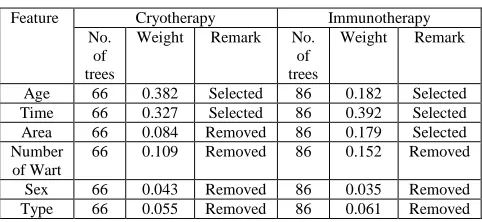
The superiority of the classification results using C4.5 + RFFW over C4.5 method is obtained from the selection process of the dataset’s relevant features. The result of feature weighting process is shown in Table VI.
TABLEVI
FEATURE CRYOTHERAPY AND IMMUNOTHERAPY DATASET
Feature Cryotherapy Immunotherapy No.
of trees
Weight Remark No. of trees
Weight Remark
Age 66 0.382 Selected 86 0.182 Selected Time 66 0.327 Selected 86 0.392 Selected Area 66 0.084 Removed 86 0.179 Selected Number
of Wart
66 0.109 Removed 86 0.152 Removed
Sex 66 0.043 Removed 86 0.035 Removed Type 66 0.055 Removed 86 0.061 Removed
Table VI explains the values of the weights for each feature such as age, time, and area, number of warts, sex, and type of both cryotherapy and immunotherapy datasets. For example, the weights of age feature of cryotherapy and immunotherapy datasets are 0.382 and 0.182, respectively. These weights are obtained using RFFW and are then selected/filtered using a maximum weighted threshold of RFFW, i.e. 0.11 for cryotherapy dataset and 0.165 for immunotherapy dataset. As a result, features with weights more than the threshold are selected and features with weights less than the threshold are removed. Hence, only two features among the six features available on cryotherapy dataset are selected, i.e., age and time. While only three features from immunotherapy dataset are selected, i.e., age, time and area.
D. Comparison Between C4.5 and C4.5+RFFW on Merged Dataset
The experiment compares the classification results using C4.5 and C4.5 + RFFW. The number of trees in C4.5 + RFFW classification is 8, and the maximum weighted threshold of RFFW is 0.13. The dataset used in this experiment is the merge of cryotherapy and immunotherapy datasets. The experiment results can be seen in Table VII.
TABLEVII
COMPARISON RESULTS MEASUREMENT BETWEEN C4.5 AND C4.5+RFFW ON THE MERGED DATASET
Evaluation C4.5 C4.5+RFFW
Accuracy 84.44 % 87.22 % Specificity 89.92 % 90.76 % Sensitivity 73.57 % 80.48 %
AUC 0.747 0.830
f-measure 73.88 % 79.85 % informedness 63.49 % 71.24 %
C4.5 achieves good classification (AUC = 0.80 – 0/90) for specificity measurement and fair classification (AUC = 0.70 – 0.80) for AUC measurement.
C4.5+RFFW is almost superior in all measurements, so it can be concluded that the performance of C4.5 + RFFW is better than C4.5. The superiority of C4.5 + RFFW is due to the process of selecting relevant features of the merged dataset.
E. Comparison Between IGFS+Apriori+ANFIS and C4.5+RFFW on Cryotherapy and Immunotherapy Datasets
This experiment is conducted to see the comparison of classification results between IGFS+Apriori+ANFIS and C4.5+RFFW. The datasets used in this research are cryotherapy and immunotherapy datasets. The classification results of this experiment can be shown in Table VIII.
TABLEVIII
COMPARISON BETWEEN IGFS+APRIORI+ANFIS AND C4.5+RFFW ON CRYOTHERAPY AND IMMUNOTHERAPY DATASET
Evaluation
Cryotherapy Immunotherapy
IGFS+ Apriori+
ANFIS [7]
C4.5 +RFFW
IGFS+ Apriori+
ANFIS [7]
C4.5 +RFFW
Accuracy 81.67 % 93.33 % 85.57 % 84.44 % specificity 74.00 % 98.50 % 97.22 % 91.43 % Sensitivity 84.50 % 88.50 % 42.50% 55.00 %
AUC 0.860 0.617 0.657 0.707
f-measure - 91.94 % - 61.11 %
informedness 58.50 % 87.00 % 39.72 % 46.43 %
Based on Table VIII, the result shows that the performance of C4.5+RFFW on cryotherapy dataset achieves first classification (AUC = 0.90 - 1.00) for three measurements: accuracy, sensitivity, and informedness. However, the classification using IGFS+Apriori+ANFIS only outperforms in AUC measurement. Therefore, the performance classification of C4.5+RFFW is superior compared to IGFS+Apriori+ANFIS on cryotherapy dataset. Classification results using C4.5 + RFFW in immunotherapy datasets is superior on sensitivity, AUC, and informedness measurements. The IGFS+Apriori+ANFIS is superior on accuracy and specificity measurements. Thus it can be concluded that the performance classification of C4.5+RFFW is relatively superior compared to IGFS+Apriori+ANFIS.
F. Comparison Between IGFS+Apriori+ANFIS and C4.5+RFFW on Merged Dataset
The experiment compares the classification results between IGFS + Apriori + ANFIS and C4.5 + RFFW. The dataset used in this experiment is the merge of cryotherapy and immunotherapy datasets. The category of the merged dataset are class 1 (cryotherapy) and class 2 (immunotherapy). This means that if a treatment record is categorized into class 1, then the record is in the cryotherapy dataset, also meaning that the patient is healthy (1). If a treatment record is categorized into class 2, then the record is in immunotherapy dataset that makes the patient healthy (1). Healthy (1) and sick (0) are values of the result of the
treatment feature. Note that the merged dataset has a proportion of 59.66% in class 1 and 40.34% in class 2 that shows the balance of the merged dataset. The comparison of classification results between IGFS + Apriori + ANFIS and C4.5 + RWWF can be seen in Table IX.
The result of Table IX explains that the classification results using IGFS + Apriori + ANFIS excel in sensitivity and AUC. While C4.5 + RFFW excel in accuracy, specificity, and informedness.
TABLEIX
COMPARISON RESULTS MEASUREMENT BETWEEN IGFS+APRIORI+ANFIS AND C4.5+RFFW ON THE MERGED DATASET
Evaluation IGFS+Apriori+ANFIS
[7]
C4.5+RFFW
Accuracy 81.67 % 87.22 %
Specificity 74.00 % 90.76 % Sensitivity 84.50 % 80.48 %
AUC 0.860 0.830
f-measure n/a 79.85 %
Informedness 58.50 % 71.24 %
Almost all measurements using C4.5 + RFFW achieve good classification (AUC = 0.80 - 0.90), even the specificity achieves excellent classification (AUC = 0.90 - 1.00). Whilst the specificity measurement using IGFS + Apriori + ANFIS reaches fair classification (AUC = 0.70 - 0.80).
Other classification results show that the measurement of informedness on IGFS + Apriori + ANFIS reaches the classification of failure (AUC = 0.50 - 0.60). Whilst the measurement of informedness on C4.5 + RFFW reaches fair classification (AUC = 0.70 - 0.80). The low informedness measurements on IGFS + Apriori + ANFIS are caused by an imbalance value between specificity and sensitivity.
Based on the classification results, the accuracy and informedness values of C4.5 + RFFW are greater than in previous research. Thus, it can be said that the proposed method (C4.5 + RFFW) outperforms previous research (IGFS + Apriori + ANFIS).
The high values of accuracy and informedness measurements using C4.5 + RFFW are also caused by the selection of the relevant features of the merged dataset. The feature weighting results using RFFW on the merged dataset can be seen in Table X.
TABLEX
MERGED DATASET FEATURE WITH NUMBER OF TREE=8
Feature Weight Remark
Age 0.294 Selected
Time 0.288 Selected
Area 0.175 Selected
Number of Warts 0.108 Removed
Type 0.059 Removed
Therapy 0.041 Removed
Sex 0.034 Removed
features having weights more than the threshold are selected and features having weights less than the threshold are removed. Hence, only three features among the seven features available on the merged dataset are selected, i.e., age, time, and area. In this study, feature weighting using RFFW selects consistent features for the merged dataset. This can be interpreted that feature weighting using RFFW on the combined dataset is effective. Merging dataset does not affect the classification performance so that this merger can be used in other studies.
IV.CONCLUSION
The method proposed in this research (C4.5+RFFW) classification consists of decision tree C4.5 algorithm combined with Random Forest Feature Weighting selection method. Random Forest Feature Weighting does the feature selection then the classification process is done using Algorithm C4.5.
Accuracy and informedness measurements from the previous methods (IGFS + Apriori + ANFIS) were 81.67 % and 58.50 %. While for C4.5 + RFFW is 87.22 % and 71.24 %. Thus, it can be concluded that the classification using C4.5 + RFFW method shows improved accuracy than the previous research methods (IGFS + Apriori + ANFIS).
C4.5 + RFFW has been able to classify merged datasets of cryotherapy and immunotherapy dataset, thus producing a model that can recommend physicians to determine the most appropriate method in the treatment of wart diseases.
In future work, feature selection methods can be used for improving classifier performance.
REFERENCES
[1] L. Verma, S. Srivastava, and P. C. Negi, “A Hybrid Data Mining Model to Predict Coronary Artery Disease Cases Using Non-Invasive Clinical Data,” J. Med. Syst., vol. 40, no. 7, 2016.
[2] C. S. Tucker, I. Behoora, H. B. Nembhard, M. Lewis, N. W. Sterling, and X. Huang, “Machine learning classification of medication adherence in patients with movement disorders using non-wearable sensors,” Comput. Biol. Med., vol. 66, pp. 120–134, 2015.
[3] N. Memarian, S. Kim, S. Dewar, J. Engel, and R. J. Staba, “Multimodal data and machine learning for surgery outcome prediction in complicated cases of mesial temporal lobe epilepsy,” Comput. Biol. Med., vol. 64, pp. 67–78, 2015.
[4] H. Mirzaalian, T. K. Lee, and G. Hamarneh, “Skin lesion tracking using structured graphical models,” Med. Image Anal., vol. 27, pp. 84–92, 2016.
[5] V. K. Shrivastava, N. D. Londhe, R. S. Sonawane, and J. S. Suri, “Exploring the color feature power for psoriasis risk stratification and classification: A data mining paradigm,” Comput. Biol. Med., vol. 65, pp. 54–68, 2015.
[6] D. M. Farid, L. Zhang, C. M. Rahman, M. A. Hossain, and R. Strachan, “Hybrid decision tree and naïve Bayes classifiers for multi-class multi-classification tasks,” Expert Syst. Appl., vol. 41, no. 4 PART 2, pp. 1937–1946, 2014.
[7] F. Khozeimeh, R. Alizadehsani, M. Roshanzamir, A. Khosravi, P. Layegh, and S. Nahavandi, “An expert system for selecting wart treatment method,” Comput. Biol. Med., vol. 81, no. August 2016, pp. 167–175, 2017.
[8] F. Khozeimeh et al., “Intralesional immunotherapy compared to cryotherapy in the treatment of warts,” Int. J. Dermatol., vol. 56, no. 4, pp. 474–478, 2017.
[9] C. Barbieri et al., “A new machine learning approach for predicting the response to anemia treatment in a large cohort of End Stage Renal Disease patients undergoing dialysis,” Comput. Biol. Med., vol. 61, pp. 56–61, 2015.
[10] A. J. Masino, R. W. Grundmeier, J. W. Pennington, J. A. Germiller, and E. Bryan Crenshaw, “Temporal bone radiology report classification using open source machine learning and natural langue processing libraries,” BMC Med. Inform. Decis. Mak., vol. 16, no. 1, pp. 1–10, 2016.
[11] J. Arevalo, F. A. González, R. Ramos-Pollán, J. L. Oliveira, and M. A. Guevara Lopez, “Representation learning for mammography mass lesion classification with convolutional neural networks,” Comput. Methods Programs Biomed., vol. 127, pp. 248–257, 2016.
[12] C. Bergmeir and M. Ben, “frbs : Fuzzy Rule-Based Systems for Classification,” J. Stat. Softw., vol. 65, no. 6, pp. 1–30, 2015. [13] A. Wijaya and A. Bisri, “Hybrid decision tree and logistic regression
classifier for email spam detection,” Proc. 2016 8th Int. Conf. Inf. Technol. Electr. Eng. Empower. Technol. Better Futur. ICITEE 2016, pp. 5–8, 2017.
[14] J. Ross, Q. Morgan, and K. Publishers, “Book Review : C4 . 5 : Programs for Machine Learning,” vol. 240, pp. 235–240, 1994. [15] J. Ali, R. Khan, N. Ahmad, and I. Maqsood, “Random forests and
decision trees,” IJCSI Int. J. Comput. Sci. Issues, vol. 9, no. 5, pp. 272–278, 2012.
[16] E. Vigneau, P. Courcoux, R. Symoneaux, L. Guérin, and A. Villière, “Random forests: A machine learning methodology to highlight the volatile organic compounds involved in olfactory perception,” Food Qual. Prefer., vol. 68, no. February, pp. 135–145, 2018.
[17] N. V. Chawla, “C4. 5 and imbalanced data sets: investigating the effect of sampling method, probabilistic estimate, and decision tree structure,” Proc. Int. Conf. Mach. Learn. Work. Learn. from Imbalanced Data Set II, 2003.
[18] H. K. Sok, M. P. L. Ooi, Y. C. Kuang, and S. Demidenko, “Multivariate alternating decision trees,” Pattern Recognit., vol. 50, pp. 195–209, 2016.
[19] J. R. Taylor, An Introduction to Error Analysis, Second. Clifornia: University Science Books, 1999.
[20] D. M. W. Powers, “Evaluation: From Precision, Recall and F-Measure To Roc, Informedness, Markedness & Correlation,” J. Mach. Learn. Technol., vol. 2, no. 1, pp. 37–63, 2011.