Early to lowermost Middle Triassic Foraminifera from the Locker Shale of Hampton-1 well,
Western Australia
M. APTHORPE
School of Earth & Geographical Sciences, The University of Western Australia, 35 Stirling Highway, Crawley WA 6009, Australia (e-mail: [email protected])
ABSTRACT– Marine smaller foraminifera from a 350 m thick, non-carbonate borehole succession are described from the upper Lower Triassic to lowermost Middle Triassic (Spathian–Lower Anisian) of offshore Western Australia. This is only the second foraminiferal fauna of this age described from the Southern Hemisphere and it differs from a coeval fauna previously described from the same area (Heath & Apthorpe, 1986). The new fauna contains some ‘Tethyan’ genera previously recorded from South China and the Alps, includingDuostomina, Krikoumbilica,Gsollbergella,Trocholina,Endothyraand Endothy-ranella. Other genera and species appear to persist from the Permian. Three species are described as new: Dentalina septacosta,Krikoumbilica compressaandTrocholina planoconvexa. The age of the fauna is based on palynological evidence, correlated with conodont dating.J. Micropalaeontol.22(1): 1–27, July 2003.
INTRODUCTION
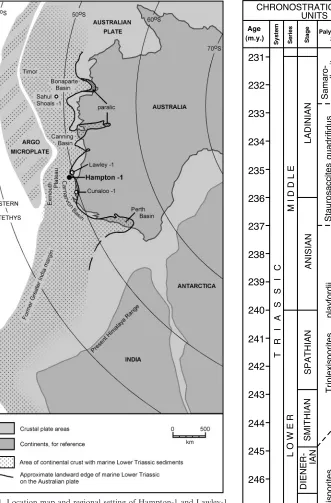
Marine microfaunas of Early and Middle Triassic age are poorly known in Australia, as marine sedimentation during the Triassic was largely confined to offshore areas on the northwestern margin of the continent. During the Early Triassic a shallow sea occupied areas along the western margin of Australia which subsequently developed into the Bonaparte, Canning, Carnarvon and Perth Basins (Fig. 1). Predominantly fine-grained clastic units deposited at this time include the Mt Goodwin Formation in the Bonaparte Basin, the brackish Blina Shale of the Canning Basin, the predominantly marine Locker Shale of the Carnarvon Basin and the marine Kockatea Shale of the Perth Basin.
This shallow Triassic sea occupied part of the continental shelf of Eastern Gondwana, on the southern margin of eastern Tethys (Ogg & von Rad, 1994). According to their recon-structions, the location studied here, within the later-formed Carnarvon Basin (Fig. 1), was at a temperate palaeolatitude of 50(S during the Early Triassic, warming to a palaeolatitude of 40(S during the Middle Triassic, as a result of plate movements. The area lies southeast of the Exmouth Plateau and at least 700 km southeast of the inferred margin of the deep Tethys Ocean (Ramsay & Exon, 1994), indicating the great width of the marginal sea at this time.
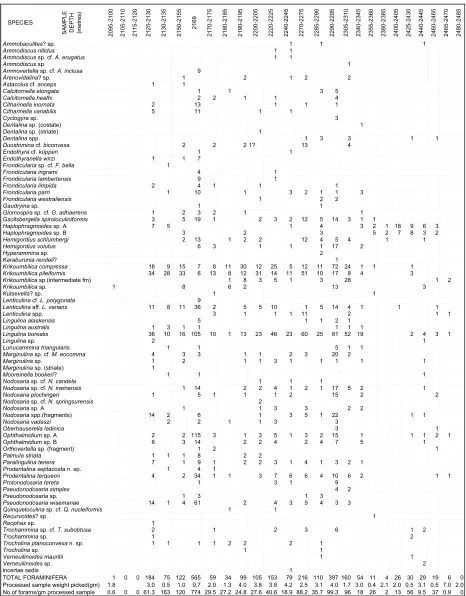
In the Carnarvon Basin, the Early Triassic transgression commenced with variable sands, shales and, near the base, two limestones (Fig. 2; Hocking et al., 1987; Gorter, 1994). The limestones have been given formation status, as the (basal) Sholl Formation, and the stratigraphically younger Cunaloo Formation, by Gorter (1994). The Lower to basal Middle Triassic marine succession is referred to as the Locker Shale (Parry, in Jones, 1967), although the lithology varies from shale, through siltstone, to fine sandstone in some wells.
The Locker Shale occurs only in the subsurface and has been studied in some petroleum exploration wells (McTavish, 1973; Gorter, 1994). Over much of the Carnarvon Basin this Lower to Middle Triassic marine succession has been deeply buried beneath thick Jurassic and Upper Triassic marine and fluvio-deltaic strata, and is beyond the reach of commercial explor-ation drilling. Along the eastern margin of the basin, however, the Lower to Middle Triassic is present at shallow to moderate
depths in a series of tilted fault blocks, some of which have been drilled by petroleum exploration wells. The foraminifera from the Hampton-1 well, drilled in 1974, are described here (BOC of Australia Ltd, 1974).
AGE AND CORRELATION OF THE STUDIED SUCCESSION
The overall age of the Locker Shale has been established from conodont studies (McTavish, 1973; Gorter, 1994) and palynol-ogy (Balme, 1969; Helby et al., 1987) in wells including Cunaloo-1 and Sahul Shoals-1 (Fig. 1). The age of both the top and base of the formation varies. The oldest dating is Dienerian (Neospathodus dieneri conodont zone) (Gorter, 1994, quoting McTavish, 1973). This is some 3.5 million years above the base of the Triassic, according to the time-scale of Haqet al. (1987, 1988). The youngest dating ascribed to most of the top of the Locker Shale is Anisian or, in some wells, Ladinian. The framework for the palynological zonations customarily used to date Australian Triassic sequences is outlined in Balme (1990). Whilst the two Lower Triassic palynological zones are fairly well constrained by isolated conodont dates, the Middle Triassic zones are not (see Fig. 2).
part of the Locker Shale in Hampton-1 is dated as the Staurosac-cites quadrifidus palynological zone, which is ascribed a late Anisian to Ladinian age, based on the presence of the dinoflagel-lateSahulidinium ottiiin its upper part (Helbyet al., 1987). Gorter (1994) placed the top of theT. playfordiizone and the base of the S. quadrifiduszone within a single seismo-stratigraphic sequence. Fig. 1.Location map and regional setting of Hampton-1 and Lawley-1 wells, marginal Australian basins, and Eastern Gondwana continental plates. Also shown are other key wells in the Triassic stratigraphy of Western Australia (see Gorter, 1994). Base map and palaeolatitudes for the Early Triassic from Ogg & von Rad (1994, fig. 3). Triassic coastline of Australia modified from BMR Palaeogeographic Group (1990). Note that the outline and extent of marine facies on the Argo Microplate are unknown.
The Hampton-1 well contains 460 m of Locker Shale, of which 365 m are foraminifera bearing. From the palynological and conodont evidence outlined above, it appears that the foraminiferal succession may span the Spathian and at least part of the early Anisian. The highest foraminiferal samples occur just below the apparently conformable contact between the playfordiiandquadrifiduszones.
MATERIAL EXAMINED
All of the 26 samples picked for foraminifera, with the exception of the sidewall core at 2169 m were, of necessity, ditch cuttings (see Fig. 3). The original quantities of sample processed are not recorded, but were probably approximately 15 g. The samples were processed by soaking in dilute hydrogen peroxide, then washing over a 63 µm sieve, which resulted in processed sample weights of 4–10 g. Variable quantities of processed samples were completely picked. By dividing the number of specimens recovered by the weight of sample picked, a rough estimate of sample yield has been obtained. The sample yield is diluted by interbedded sands between 2180 m and 2205 m, where onlyc. 25 specimens were found per gram of processed sediment picked. Richer intervals of calcareous shale and siltstone between 2125 m and 2155 m yielded 60 to 160 specimens per gram of washed residue. The sidewall core sample at 2169 m is a muddy fine-grained coquina of molluscan, algal and other fragments with common foraminifera, and the original weight of sample processed is recorded. It contains the maximum number of foraminifera found, 774 specimens per gram of residue, which equates to 380 foraminifera per gram within the original un-processed sediment. In contrast, the deepest samples between 2440 m and 2485 m are hard carbonaceous micaceous shales, yielding some molluscs and algal fragments, but few fora-minifera (<1 to 9 specimens per gram of processed sample residue). In part the low foraminiferal yields may be due to poor breakdown of the samples, but examination of many rock frag-ments suggests that the foraminiferal numbers are diluted by higher sedimentation rates and possibly unfavourable con-ditions. Interbedded thin white limestones at 2460–2465 m, with associated foraminifera, raise the yield slightly over this interval. In comparison with Cretaceous to Cenozoic assemblages in the region, the Triassic foraminiferal yield in Hampton-1 well is sparse to rare. The quality of ditch cuttings is, however, surpris-ingly good. Although the Triassic Locker Shale and Mungaroo Formations are overlain by Jurassic sediments and a thin Cretaceous interval, caving of fauna from these levels is virtually non-existent. The Locker Shale Triassic fauna varies in preser-vation type from sample to sample, and is always correlatable with the numerous variations in lithology, from calcareous claystone to sandy siltstone. From this it is thought that the sample depths given fairly accurately reflect the microfaunal succession. Some caving of coarser quartz sand from the over-lying Late Triassic Mungaroo Formation is present in most samples. However, this fluviatile formation does not contain foraminifera in Hampton-1.
THE FORAMINIFERAL SUCCESSION AND INTERPRETED PALAEOENVIRONMENTS
The succession has been subdivided into informal assemblages (Fig. 3). The highest assemblage between 2125 m and 2290 m
contains the greatest number of specimens and species. The lithologies vary from sample to sample, from shale to calcareous siltstone and silty sandstone. The richest sample is the sidewall core at 2169 m, a calcareous silty claystone with an abundance of thin-shelled ostracod fragments and other molluscs in layers parallel to the bedding. The foraminifera are less numerous, but still common. Specimen sizes, as throughout the succession, are relatively small, possibly reflecting the temperate sea tempera-tures. Many specimens (including those from the sidewall core at 2169 m) are broken, suggesting current activity or transpor-tation of specimens. The assemblage (here named thePalmula striata assemblage) is correlated with the abundant but Lingulina-dominated foraminiferal horizon in Lawley-1 well at 635.1 m. The latter is thought to be an estuarine or embayment assemblage, based on the total dominance (>90%) of one species, and the absence of foraminifera in samples above and below. Hockinget al. (1987, fig. 76) interpret the Early Triassic coastline to have been bounded by tidal flats and a series of barrier bars near river mouths, partly enclosing bays, based on sedimentological evidence in twelve wells. The Hampton-1 as-semblages are more poorly preserved and are lower in specimen numbers in comparison with the single assemblage at Lawley-1. They are interpreted to have been deposited on an open marine shelf, based on the relatively large number of species present. Other fossil groups present (echinoderm fragments, crinoid ossicles, tiny brachiopods, gastropods, ostracods, bivalve fragments and algal fragments) appear to confirm such an interpretation.
The second assemblage in Hampton-1 occurs between 2290 m and 2345 m. Samples are dominated either by Krikoumbilica spp., or byLingulina borealis. Other genera are fewer in number than above. The lithology consists of light grey shales, and fine calcareous sandstones, the latter rich in thin-shelled ostracods and ostracod fragments. In one sample some of the shale fragments are ferruginized. Either shallower marine water depths, or a more restricted marine circulation, is interpreted for this interval, based on the lower specimen numbers, and higher dominance of one species in these samples.
The third assemblage, between 2355 m and 2405 m, contains rare specimens of the siliceous agglutinated Haplophragmoides sp. A and sp. B as virtually the only species present. Some shale fragments are rich in mica and there is subordinate sandstone present. The interval is interpreted as a paralic environment, possibly with some influx of fresh water from local rivers, based on analogies with the Early Cretaceous of the Great Australian Basin (Haig, 1979a, 1980). Similar, even more impoverished assemblages were found in the well Lawley-1 (Fig. 3) where three shale cores between 894 m and 957 m contain assemblages of two species ofHaplophragmoides, plusAmmobaculites, with megaspores at 957 m. The Lawley-1 sequence is considerably sandier than Hampton-1, and some shale sidewall cores contain coarse-grained frosted quartz, suggestive of nearby beach or dune environments; whilst others are micaceous, and entirely barren of calcareous fossils. The environmental interpretation of Haplophragmoidesis further discussed below.
borealis, preserved in a more calcareous matrix. The interval is thought to consist of interbedded brackish paralic claystones, alternating with thin shallow-marine or estuarine limestones, as the well lies near the landward edge of marine Triassic deposition. Such lithological and faunal alternations may well have resulted from fluctuating salinity in a marine embayment, intermittently closed offfrom the open sea.
The interpretation of a paralic environment for assemblages consisting largely or entirely ofHaplophragmoides(with Ammo-baculitesin some samples) is not in agreement with the depiction of Haplophragmoides as a predominantly deep-water taxon, which is found in literature on the Jurassic (e.g. Gradstein, 1983, table 3). However, Nagy (1992, fig. 11) indicates its presence in low numbers in pro-delta environments in the Jurassic of the North Sea. Haplophragmoides is not a taxon that has been mentioned in previous studies of Triassic environments. This is probably because most Triassic studies have involved study of the foraminifera in low-latitude carbonate associations. The apparent migration of the genus into deeper water during the mid-Tertiary obscures its palaeoenvironmental significance in high-latitude Mesozoic assemblages. Amongst Mesozoic assem-blages, the following offer support for a shallow, cool-water, probably hyposaline interpretation for the very low diversity TriassicHaplophragmoidesassemblages seen in Hampton-1.
The siliceous-walledHaplophragmoidesis a common compo-nent of the Lower Cretaceous shallow epiconticompo-nental Ammoba-culites Association in Australia (Haig, 1979b, 1980). Haig interprets the controlling factors to include shallow, land-locked seas at palaeolatitudes higher than 30(N and S, with cool water temperatures and lower than normal salinities from freshwater influx, leading to dissolution of calcium carbonate. Haplophrag-moides is also a common genus (and sometimes the only foraminiferid present) in Upper Cretaceous faunas in the cold temperate Otway Basin, a narrow elongated rift basin with limited marine connections, in a wet climate, located at a palaeolatitude of 70(S (Taylor, 1964). In the Upper Cretaceous and Upper Albian of western Canada, Haplophragmoides is common to abundant in diverse agglutinated assemblages which are almost totally lacking in calcareous Foraminifera (Stelck & Koke, 1987). Water-depth interpretations of such assemblages have varied in detail between various authors (e.g., Wall, 1960; Stelck, 1975; Stelck & Koke, 1987; Stelck & Leckie, 1988, 1990; Stelck, 1991) with Haplophragmoides present in assemblages interpreted as ranging from littoral, to marine shelf less than 200 m deep. Common elements are the dominance of Haplo-phragmoidesin the shallowest facies (<20 m interpreted water depth), the cool temperate nature of the assemblages, the possible dissolution of any calcareous species originally present, due to lowered pH, and the suggestion of turbidity in the mud-dominated environment. Whereas the older papers listed above mention the present occurrence ofHaplophragmoidesin water depths greater than 200 m, the later papers avoid reference to such Recent analogues, and are more tentative in their suggestions of water depth, reflecting the difficulty of using modern distributions as a key to the Mesozoic.
PALAEOGEOGRAPHY
The foraminiferal assemblages described here from Hampton-1 well are diverse, comprising some 80 species, and they contain a
number of species and genera previously described from Tethyan areas. The previously described Lawley-1 assemblages (Heath & Apthorpe, 1986) are dominated (>90%) byLingulina borealis, described from Alaska. The differences between the faunal composition of the Lawley and Hampton assemblages suggest, not an age difference, nor a division into ‘Boreal’ and ‘Tethyan’ over a distance of some 50 km, but simply a facies difference between the wells, as mentioned in the previous section. Whereas the upper part of the Hampton section is believed to represent a marine shelf facies, Lawley contains a thin interval of extremely abundant foraminifera which is inter-preted to represent an estuarine or embayment environment, in the middle of an otherwise paralic or coastal sequence. The latter contains only the generaHaplophragmoidesand Ammoba-culites which occur sporadically, interspersed with barren samples containing indications of coastal environments, and sand intervals.
COMPARISON WITH ANISIAN ASSEMBLAGES FROM OTHER REGIONS
The Hampton-1 foraminiferal assemblages are mostly dissimilar in species and generic composition to assemblages of Anisian age reported in the literature from other regions of the world. The closest comparisons are with some assemblages from South China and Iran, and possibly with assemblages from Poland.
Kristan-Tollmann (1983) gives a comprehensive description of an Anisian fauna from the Leidapo Member of the Qingyan Formation of South China. The fauna is dominated by Duostominidae, including Diplotremina spp., Duostomina spp. and Variostoma sp. Of these, only Duostomina occurs in the Hampton assemblage, in very small numbers. Of the 63 species in the Leidapo assemblage, only five occur in the Hampton-1 assemblage of 80 species. The most common species in the Hampton-1 assemblage (Lingulina borealis and Krikoumbilica spp.) are not listed in the Leidapo assemblage (although Polytaxis? leidapoensis Kristan-Tollmann may possibly be a Krikoumbilica).
all species of Glomospira, are Tethyan in type, and entirely different from the Hampton-1 assemblages.
Oberhauser (1960) illustrated ten species, as part of a Ladinian assemblage from NE Iran which has some similarity with the Hampton-1 assemblages. Species in common include Dentalina ex. gr. subsiliqua (=Prodentalina terquemi of this paper),Lingulina aghdarbandi(=Lingulina alaskensis),Lingulina tenera, andLingulina iranica(?=Lingulina borealis). In the same paper, assemblages from the Ladinian of the Alps are illustrated. Similarities to the Hampton-1 assemblages are much less from this area; species in common include Lingulina klebelsbergi (=Lingulina borealis), Dentalina vadaszi (=Nodosaria vadaszi), andGlobigerina ladinica(=Oberhauserella ladinica).
In the ‘Sephardic’ realm of the Triassic Tethys in Israel, Benjamini (1984) reports on two Anisian foraminiferal assem-blages in a predominantly carbonate environment. Dominant genera areTolypamminaandGlomospira, with some nodosarids and Lingulina sp. Glomospira is present in low numbers in Hampton-1, and encrusting foraminifera are low in numbers. Details of other species present in the Israeli assemblages are insufficient for comparison.
In Poland, Styk (1975) described assemblages from the upper part of the Lower Triassic of Poland. The assemblages, of some 36 species, as in Hampton-1 consist of a wide range of genera including dominantly Nodosariidae, but with Lingulina and miliolids. Species in common with Hampton-1 include Pachy-phloides klebelsbergi (=Lingulina borealis) and Kollmannita cf. ladinica(=Oberhauserella ladinica).
SYSTEMATIC DESCRIPTIONS
The foraminifera are listed in the orders used in Loeblich & Tappan (1987), although reservations are expressed in the text as to the definition of some genera. If these doubts prove to be correct, a rearrangement of some genera within larger taxo-nomic groups (including suborders) may be necessary. Some taxonomic problems encountered here will require detailed thin section and SEM study of wall ultrastructure to resolve them. This has not been possible in the scope of the present study.
All illustrated and type specimens (except for one specimen) are deposited in the collections of the Western Australian Museum, Francis St, Perth, Western Australia, under the catalogue numbers WAM 02.320–WAM 02.402. The museum catalogue numbers are given in the plate captions, followed by the author’s original numbering in parentheses. Some specimens
photographed in transmitted light were lost after photography and, therefore, do not have museum numbers.
SuborderTextulariinaDelage & Hérouard, 1896 FamilyAmmodiscidaeReuss, 1862 GenusAmmovertellaCushman, 1928
Ammovertellasp. cf.inclusa(Cushman & Waters) 1927Psammophis inclususCushman & Waters: 148, pl. 26, fig. 12.
1958Ammovertellacf.inclusa(Cushman & Waters); Crespin: 72, pl. 18, fig. 5.
Remarks.Specimens of a finely agglutinated tubular form with a grey, siliceous-appearing cement are tentatively identified, following Crespin. The tubes, which are about 100 to 150 µm in diameter, are wound irregularly around themselves, or around a shell or other surface of attachment, and change direction abruptly. In places the tubes are slightly constricted. Length of specimens up to 0.7 mm.
GenusGlomospiraRzehak, 1885 Glomospirasp. cf.G.adhaerensParr, 1942
1942 Glomospira adhaerens Parr: 103, pl. 1, fig. 2 (fide Crespin).
1958Glomospira adhaerensParr; Crespin: 70, pl. 13, figs 6, 7. 1967Glomospira adhaerensParr; Ludbrook: 79, pl. 4, figs 1-4.
Remarks.The species was described from the Lower Permian of Western Australia and South Australia. It is found as a single specimen in Hampton-1 at 2125–2130 m.
FamilyHaplophragmoididaeMaync, 1952 GenusHaplophragmoidesCushman, 1910
Haplophragmoidessp. A (Pl. 1, figs 1, 5)
1986 Haplophragmoides wilgunyaensisCrespin, 1963: Heath & Apthorpe: 317, pl. 1, figs 1–2.
Remarks.The species present in Hampton-1 was believed to be the CretaceousHaplophragmoides wilgunyaensisCrespin. How-ever, D. Haig (pers. comm., 2000) states that the holotype ofH. wilgunyaensisis crushed, and partly evolute on one side. All the paratypes are partly evolute on one side. The present species is involute, with a shallow central umbilical depression, and
Explanation of Plate 1.
essentially symmetrical appearance on both sides. The margin is compressed. Many specimens are somewhat deformed. The same species also occurs in the Triassic of the Lawley-1 well (Heath & Apthorpe, 1986).
Palaeoecology. Haplophragmoides is virtually absent above 2340 m, but between that depth and 2465 m it is the dominant genus in the sparse foraminiferal assemblages. It reaches a peak of abundance between 2400 m and 2430 m. This dominance is believed to indicate a down-sequence change in the depositional environment, to paralic or delta-influenced conditions.
Haplophragmoidessp. B (Pl. 1, figs 2–3)
Remarks. A species of Haplophragmoides with a broader, more rounded periphery than H. sp. A, shallow sutures, and with more involute coiling, resulting in a very small or obscured umbilical depression. It occurs in association with H. sp. A.
GenusKutsevellaDain, 1978
Kutsevella? sp. (Pl. 1, fig. 4)
Remarks. A compressed, Haplophragmoides-like planispirally coiled specimen found at 2170–2175 m has a tapering, separated final chamber. It is similar to specimens ofKutsevella figured from the Jurassic by Nagy & Basov (1998). The aperture on the present specimen cannot be seen clearly, but it may be terminal or areal.
GenusTrochamminaParker & Jones, 1859
Trochamminasp. cf.T.subobtusaParr, 1942
1958 cf.Trochammina subobtusaParr, 1942; Crespin: 92, pl. 21, figs 5–6.
Remarks. Deformed specimens tentatively attributed to this Permian species occur sporadically in small numbers between 2125 m and 2360 m in Hampton-1.
GenusGaudryinad’Orbigny, 1839
Gaudryinasp. (Pl. 1, fig. 8)
Remarks. A single specimen 270 µm in length was found at 2169 m, and a second specimen at 2285–2290 m. The figured specimen has a fairly quadrate profile when viewed from the apertural end.
GenusVerneuilinoidesLoeblich & Tappan, 1949
Verneuilinoides mauritii(Terquem, 1866) (Pl. 1, fig. 7)
1866Verneuilina mauritiiTerquem: 448, pl. 18, fig. 18a–b (fide Ellis & Messina, 1940et seq.).
1988 Verneuilinoides mauritii (Terquem); Kristan-Tollmann: 248, fig. 1 (18–22).
Remarks.Two triserial specimens, 0.3–0.4 mm long, appear to correspond to this species. The wall is rough, and composed of abundant silt grains set in a small amount of matrix of unknown composition. The figured specimen is the best pre-served. The aperture has not been clearly seen. It may consist of a small arched opening on the basal suture of the last chamber.
The species was originally described from the Early Jurassic of France. Kristan-Tollmann (1988) figured drawings of speci-mens from the Late Triassic of Austria, the Carnian of Turkey and Timor, and the Rhaetian of Papua-New Guinea.
SuborderFusulininaWedekind, 1937 FamilyEndothyridaeBrady, 1884
GenusEndothyraPhillips, 1846
Endothyracf.küpperiOberhauser, 1960 (Pl. 1, figs 9–10)
1960Endothyra küpperiOberhauser: 16, tafel 3, figs 7a–c, 14a–c, 22.
Remarks. A single specimen of this enrolled, involute form was found at 2169 m, and a second, somewhat dubious specimen at 2240–2245 m. The figured specimen is flatter on one side than on the other, and has a slightly more truncate margin than Oberhauser’s species. The maximum diameter is about 120 µm.
Incertae sedis (Pl. 1, figs 11–12)
Remarks.A planoconvex specimen of a possible endothyrid was found at 2240–2245 m. No internal chamber arrangement could be seen. In the SEM the specimen appears to be composed of several coiled chambers. In the sample at 2169 m, very small specimens, composed of one to three chambers, may be of a similar form. These are possibly juveniles of an as yet unrecognized species.
GenusEndothyranellaGalloway & Harlton, 1930
Endothyranella wirzi(Koehn-Zaninetti, 1968) (Pl. 1, figs 13–17)
1968Ammobaculites wirziKoehn-Zaninetti:nomen nudum. 1969Ammobaculites wirziKoehn-Zaninetti: fig. 5, A–D, F–K. 1976 Endothyranella wirzi (Koehn-Zaninetti); Zaninetti: 129, pl. 4, figs 2–4, pl. 8, figs 26–30.
See Zaninetti (1976) for synonymy.
fig. 17), the aperture lacks a neck and is a larger opening with possible radiating slits. Further study of the species from additional specimens is required.
SuborderInvolutininaHohenegger & Piller, 1977 FamilyInvolutinidaeBütschli, 1880
GenusArenovidalinaHe, 1959
Arenovidalina? sp.
1983 ? ‘Arenovidalina chialingchiangensis’ Ho; Kristan-Tollmann: 296, Abb. 1, figs 10–12.
Remarks.Very rare small specimens are tentatively referred to this genus. Piller (1983) has indicated thatArenovidalina does not belong within the Involutinina. The specimens are externally similar to Anisian specimens figured by Kristan-Tollmann (1983) from China, but pending thin section study, no decision is possible as to the correct generic placement.
GenusTrocholinaPaalzow, 1922 Trocholina planoconvexasp. nov.
(Pl. 2, figs 1–7)
Derivation of name.Describing the shape.
Diagnosis.Small planoconvexTrocholinawith a low spire and a step-like profile on the spiral side.
Holotype. WAM 02.332 (W69-14), Hampton-1 well, 2240– 2245 m (ditch cutting sample): Pl. 2, figs 1–3.
Type level.Undifferentiated late Spathian to Anisian in age.
Figured paratype. WAM 02.333 (M80-4), Hampton-1 well, 2285–2290 m: Pl. 2, figs 4–7.
Unfigured paratypes.‘A’ (WAM 02.334) and ‘B’ (WAM 02.335) both from Hampton-1 well, 2180–2185 m; ‘C’ (WAM 02.336) from Hampton-1 well, 2170–2175 m.
Description. Test small (diameter 0.1–0.25 mm); calcareous; planoconvex. The low convex side consists of a spiral of six to seven whorls, defined by the step-like profile of this side of the test, which is clearly seen in the holotype and paratypes. Umbilical side of test flat, with an irregular, poorly defined umbilical depression. The entire umbilical side appears to be covered with irregular nodules, which are difficult to see due to the very small size of the specimens. The holotype is the best preserved of the eleven specimens found. The wall surface as seen in the SEM is finely and irregularly pitted (see Pl. 2, figs 5–7), but this may be a diagenetic effect. Broken areas of wall appear to be of heavily recrystallized calcite crystals aligned perpendicular to the surface (Pl. 2, fig. 4).
Comparison with other species.This small, low-spiredTrocholina differs fromT. permodiscoidesOberhauser (1964) andT. bicon-vexa Oberhauser (1957) by being planoconvex rather than slightly biconvex, and also by the ‘step-like’ definition of the whorls on the spiral side. FromT. ventroplanaOberhauser, the
new species differs in having a lower spire, and a nodular umbili-cal surface. FromT. plagiostomaTollmann & Kristan-Tollmann (as reproduced by Zaninetti, 1976),T. planoconvexan. sp. differs in having a slower rate of chamber expansion in the final whorl and in lacking the prominent growth lines figured onT. plagios-toma. Nodules cover the entire umbilical side of the holotype of T. planoconvexa, rather than being confined to the umbilical area only. However, in the figured paratype (Pl. 2, fig. 7) the nodular covering does not extend to the final part of the chamber.
Dimensions. Holotype WAM 02.332 (W69-14; from 2240– 2245 m; Pl. 2, figs 1–3): diameter 0.24 mm; height 0.11 mm. Figured paratype WAM 02.333 (M80-4; from 2285–2290 m; Pl. 2, figs 4–7), maximum diameter 0.29 mm; height 0.125 mm. Unfigured paratype ‘A’, WAM 02.334 from 2180–2185 m, diam-eter 0.25 mm; paratype ‘B’, WAM 02.335 from 2180–2185 m, diameter 0.18 mm; paratype ‘C’, WAM 02.336, from 2170– 2175 m, diameter 0.13 mm, heightc. 0.06 mm. ?Juvenile (from sidewall core at 2169 m), diameter 0.1 mm; three specimens from ditch cutting sample at 2240–2245 m, diameters all 0.22 mm.
Occurrence. Hampton-1 well, 2125–2130 m (ditch cutting) to 2169 m (sidewall core) to 2285–2290 m (ditch cutting sample); 11 specimens found; most very poorly preserved.
Trocholinasp. (Pl. 1, figs 22–24)
Dimensions.Diameter approximately 0.24 mm; height of spiral side 0.11 mm; height of umbilical side, approximately 0.06 mm.
Remarks. One specimen of a small Trocholina was found at 2285–2290 m (figured) and a second, similar specimen at 2190– 2195 m. The preservation of both is poor, with the edges of the figured specimen being broken. The spiral side is moderately high, and the surface essentially smooth, unlikeT.planoconvexa, above. The umbilical side is slightly convex. No other features are discernible in the SEM.
SuborderMiliolinaDelage & Hérouard, 1896 FamilyHemigordiopsidaeA. Nikitina, 1969
GenusHemigordiusSchubert, 1908
Hemigordius schlumbergi(Howchin, 1895)
1895Cornuspira schlumbergiHowchin, M.S. 1893: 195, pl. 10, figs 1–3 (fideCrespin, 1958).
1958 Hemigordius schlumbergi(Howchin); Crespin: 81, pl. 16, figs 7–9, pl. 31, figs 4–5.
Remarks. Small, non-descript and badly preserved specimens appear to be referable to this Permian species. Sparse in number; scattered through the section between 2150 m and 2445 m.
Hemigordius volutusPalmieri, 1985 (Pl. 2, figs 18–19)
1985Hemigordius volutusPalmieri, in Fosteret al.: 82, pl. 6, figs 10–14.
chambers appear to belong withinH. volutus, rather than within the more regularly coiled, more involuteH. schlumbergi. Both forms appear to be present in Hampton-1, but poor preservation of many specimens prevents definite assignment to one or other species in some cases.
FamilyCornuspirinaeSchultze, 1854 GenusCalcitornellaCushman & Waters, 1928
Calcitornella elongataCushman & Waters, 1928 (Pl. 1, fig. 18)
1958 Calcitornella elongata Cushman & Waters; Crespin: 82, pl. 17, figs 1–3.
Remarks. Specimens with an irregularly coiled tubular cal-careous test with a roughened exterior, coiled around a spine or other object, occur rarely from 2169 m to 2295 m in Hampton-1.
Calcitornella heathiCushman & Waters, 1928 (Pl. 1, figs 19–21)
1958 Calcitornella heathi Cushman & Waters; Crespin: 83, pl. 13, figs 8–11, pl. 19, fig. 11.
1985Calcitornella heathiCushman & Waters; Palmieri in Foster et al.: 80–81, pl. 5, fig. 14, pl. 6, figs 15–16.
Remarks.This is a medium-size, scale-like attached form, with a low domed free surface, a nodular thickened margin and an irregular coiled tubular chamber revealed on the broken attached surface. Occurs rarely from 2169 m to 2295 m in Hampton-1.
FamilyOphthalmidiidaeWiesner, 1920 GenusGsollbergellaZaninetti, 1979
Gsollbergella spiroloculiformisOraveczné Scheffer, 1968 (Pl. 2, figs 8–16, ?17)
1968 Agathammina spiroloculiformis Oraveczné Scheffer: 91, pl. 2, figs 1–5.
1969Agathamminoides gsollbergensisZaninetti: 699, fig. 1. 1976 Agathamminoides spiroloculiformis (Oraveczné Scheffer); Zaninetti: 147, pl. 5, figs 10–14, pl. 7, figs 1–2.
1979 Gsollbergella spiroloculiformis (Oraveczné Scheffer); Zaninetti: 73.
Remarks.Rare to moderately common in many samples down to 2360 m in Hampton-1. Variable, ovate outline, compressed, with broadly rounded margin. Chambers externally poorly defined due to preservation. Some specimens in transmitted light reveal a chamber arrangement identical to that figured by Zaninetti (1976, pl. 5, figs 10–14), with a globular proloculus, followed by chambers in a quinqueloculine arrangement, but with the separation between chambers poorly defined.
Zaninetti (1969) described this species as Agathamminoides gsollbergensis, the type species for her new genus Agathammi-noides. However, the nameAgathamminoides was preoccupied by the agglutinated genusAgathamminoidesVangerow, 1964. In 1979 Zaninetti, therefore, renamed her genusGsollbergella, with the type species gsollbergensis recognized as a synonym of Agathammina spiroloculiformisOraveczné Scheffer, 1968.
GenusKaraburuniaLanger, 1968
?Karaburunia rendeliLanger (Pl. 2, figs 20–21)
1968Karaburunia rendeliLanger: 591–592, pl. 1, figs 6–8.
Remarks. Only one specimen is doubtfully referred to this species. It is more compressed than Langer’s illustrated speci-mens, but has a similar aperture on a neck, which is partly broken off.K. rendeliwas described from the Anisian of Turkey.
GenusOphthalmidiumKübler & Zwingli, 1870
Ophthalmidiumsp. A (Pl. 2, figs 22–24)
Description.A small species with a round to slightly oval outline, flat parallel sides, sometimes slightly depressed central area and broadly rounded margin. Most specimens are poorly preserved and their chamber structure is obscure. One specimen (Pl. 2, fig. 22) in transmitted light shows a spherical initial chamber, followed by a tubular second chamber one whorl in length, followed by three chambers each half a whorl in length; later chambers are roughly half a whorl in length, but with only slight constriction or partitioning at the end of later chambers. The earlier chambers are widest at their initial end and taper slightly
Explanation of Plate 2.
towards the apertural end, forming a ‘milioline-looking’ early stage. The later chambers taper less, and form a more circular outline. The aperture is a simple opening at the end of the last chamber (Pl. 2, fig. 24). Wall calcareous, but the microstructure is unknown.
Remarks.The parallel sides and absence of secondary thicken-ing, plus the slightly tapering but poorly divided chambers, suggest that this species is best referred toOphthalmidiumrather thanEoophthalmidiumLanger orPraeophthalmidiumBurbach.
Ophthalmidiumsp. B (Pl. 2, figs 25–26)
1981 ?Ophthalmidiumsp. Goelet al.: pl. 1, fig. 8.
1986 Ophthalmidium orbiculare Burbach; Heath & Apthorpe: 317, pl. 1, figs 4–8.
non1983Ophthalmidium triadicum(Kristan); Kristan-Tollmann: abb. 2, figs 17–22, tafel 4, figs 1–2.
Remarks.An elongate Ophthalmidium, with a chamber coiling which appears to be more evolute than Eoophthalmidium Langer. The chamber surface appears to be pitted in Hampton-1 (Pl. 2, fig. 26), although this may be due to poor preservation. The specimens have a broader, less leaf-shaped outline than Ophthalmidium triadicum(Kristan) from the Anisian of South China (Kristan-Tollmann, 1983). They are not conspecific with Ophthalmidium orbiculareBurbach (J. Hohenegger, 1995, pers. comm.). Both forms of Ophthalmidium found in Hampton-1 require further study and thin sectioning.
GenusQuinqueloculinad’Orbigny, 1826
Quinqueloculinasp. cf.Q. nucleiformisKristan-Tollmann, 1964 (Pl. 2, fig. 27)
1964 cf. Quinqueloculina nucleiformis Kristan-Tollmann: 61, pl. 9, figs 9–11.
Remarks.Two specimens, from 2180–2185 m and 2220–2225 m, are similar to the Rhaetian speciesQuinqueloculina nucleiformis Kristan-Tollmann, 1964, but have chambers that are slightly less produced at the aperture.
SuborderLageninaDelage & Hérouard, 1896 FamilyIchthyolariidaeLoeblich & Tappan, 1986
GenusParalingulinaGerke, 1969
Paralingulina tenera(Bornemann, 1854) (Pl. 4, figs 12–13)
1854Lingulina teneraBornemann: 38:fideEllis & Messina, 1940 et seq.
1960 Frondicularia tenera tenera Bornemann; Oberhauser: 37, pl. 1, figs 47–51, pl. 6, fig. 9.
1964 Lingulina tenera concosta Kristan-Tollmann: 141, pl. 30, figs 8–12.
1979aLingulina teneraBornemann; Haig: 212, fig. 2, 1–2. 1981Geinitzinita tenera(Bornemann); Quilty: 10, pl. 2, figs 1–6, text-fig. 4.
1983 Lingulina tenera carinata (Nørvang); Kristan-Tollmann: 292, pl. 3, figs 9, 13.
1983Lingulina tenera substriata(Nørvang); Kristan-Tollmann: 292, pl. 3, fig. 12.
1984Lingulina tenera teneraBornemann; Strong: 29–30, pl. 5, figs 114–119, pl. 12, figs 243–248.
1986 Lingulina tenera Bornemann; Heath & Apthorpe: 332, pl. 8, figs 23–30.
1987 Paralingulina tenera (Bornemann); Loeblich & Tappan: 391, pl. 433, figs 3–4.
Remarks.This group occurs as rare specimens in most samples between 2125 m and 2345 m. The specimens display the same variation in ornament as seen in Lawley-1 well: ranging from specimens with two heavy longitudinal ribs outlining each lateral face, to specimens with the lateral ribs very faintly devel-oped. Preservation is very poor. The partial synonymy above emphasizes Triassic (Anisian) occurrences ofParalingulina tenera, which ranges at least from the Spathian (this paper) to the Pliensbachian, plus two Jurassic published records for the species in Papua-New Guinea and New Zealand. The geographi-cal distribution of the species in the Anisian to Rhaetian ranges from the Alps, through Iran, to Australia and South China. The numerous records of the species for the Early Jurassic are not given here.
Explanation of Plate 3.
GenusProdentalinaNorling, 1968 Prodentalina terquemi(d’Orbigny, 1850)
(Pl. 3, figs 1–3)
1850Dentalina terquemid’Orbigny; Ellis & Messina: 1940et seq. 1955 Dentalina terquemi d’Orbigny; Tappan: 66, pl. 23, figs 1–4.
1964 Dentalina terquemi d’Orbigny; Kristan-Tollmann: 96, pl. 15, figs 12–15, pl. 17, fig. 18.
1968 Prodentalina terquemi (d’Orbigny); Norling: 34, [fide Loeblich & Tappan, 1987].
1976 Dentalina terquemi d’Orbigny; Nicora & Premoli-Silva: 492, pl. 1, fig. 5.
1986 Dentalina terquemi d’Orbigny; Heath & Apthorpe: 319, pl. 1, figs 21–23.
1987 Prodentalina terquemi (d’Orbigny); Loeblich & Tappan: 391, pl. 434, figs 12–16.
Remarks.The species is abundant in the sample at 2169 m, and sparse but present in nearly all samples between 2125 m and 2345 m. Most specimens are broken. It is also moderately com-mon in Lawley-1 well (Heath & Apthorpe, 1986). Apart from the numerous records in the Jurassic, Triassic records include Kristan-Tollmann (1964), from the Norian–Rhaetian of Austria, and Nicora & Premoli-Silva (1976), from the Anisian of Greece.
Prodentalina septacostasp. nov. (Pl. 3, figs 4–10, 15)
1986Dentalinasp. Heath & Apthorpe: 319, pl. 1, figs 19–20.
Derivation of name.From the number of costae (usually seven) ornamenting the test.
Holotype.Plate 3 (figs 4–5) of the Geological Survey of Western Australia collection no. F46840 (W49-3): Lawley-1 well, sidewall core at 635.1 m.
Paratypes. Plate 3 (figs 6–7, 10) of the Western Australian Museum collection no. WAM 02.352 (M1-7) and Plate 3 (figs 8–9) (WAM 02.353 (M88-3)), both from Hampton-1 well, sidewall core at 2169 m.
Material.Six specimens: Lawley-1 well, sidewall core at 635.1 m, one specimen (holotype); Hampton-1 well, sidewall core at 2169 m, four specimens; and ditch cutting at 2130–2135 m, one specimen: all Spathian–Anisian in age.
Description. Test moderately large, robust, elongate, chamber arrangement uniserial, rectilinear as for Dentalina, slightly laterally compressed. In most specimens, large initial chamber with a blunt basal spine, followed by 4–(5?) chambers, wider than high. Sutures generally flush and chambers not inflated, except for the final chamber, which has a slightly depressed suture and is gently inflated. Aperture strongly eccentric, produced. Remnants of a radiate structure can be seen around the apertural opening, which is damaged in all specimens. Ornament consisting of seven or sometimes eight prominent thick raised costae, all but two extending from near the initial spine. The costae are almost parallel to the length of the test. They extend continuously over the first four chambers, and disappear near the base of the final chamber, which is smooth. They are evenly spaced around the test, so that usually four costae are visible from either side. On the paratype WAM 02.353 (M88-3; Pl. 3, figs 8–9), six costae occur on the earlier chambers, with an additional two short costae appearing on chamber no. 5, and dying out on chamber no. 6. This specimen has an extremely small initial chamber, followed by five chambers of expanding size. It appears to be a microspheric specimen. The wall structure of all specimens is thick and appears to be nonlamellar (see Pl. 3, fig. 10). The species has not been thin sectioned due to the low number of specimens.
Dimensions. Holotype F46840 (W49-3), length 420 µm, width approximately 120 µm, thickness approximately 110 µm. Para-type WAM 02.353 (M88-3), length c. 390 µm, width 120 µm, maximum thickness 95 µm.
Comparison with other species.Prodentalina septacostan. sp. is similar to Dentalina tenuistriata Terquem (after Kristan-Tollmann, 1964, pl. 14, figs 8–9), but in the present species the costae are thicker, parallel to the length of the test, and they disappear at the base of the final chamber.
Explanation of Plate 4.
Remarks.This species is not placed in the genusMarginulina d’Orbigny because no indication of any initial coiling has been seen on the six specimens found thus far. The assign-ment toProdentalinais tentative. Norling (1968) divided the genus Dentalina into three genera, on the basis of wall structure. Although this species has not been thin sectioned, due to the very small number of available specimens, the wall appears to be single-layered and nonlamellar when whole specimens are viewed in transmitted light. This suggests that this robust species should be placed within Norling’s genus Prodentalina. Loeblich & Tappan (1987, p. 391) state that the genus is unornamented. However, Norling in his description of the genus (1968, p. 34), only stated that the ‘species hitherto examined lack ornamen-tation’, which would not necessarily exclude ornamented species which in other characteristics fitted the generic diagnosis.
GenusProtonodosariaGerke, 1959
Protonodosaria tereta(Crespin, 1958) (Pl. 4, figs 1–2)
1958Nodosaria teretaCrespin: 99, pl. 26, figs 1–4, pl. 31, figs 9, 10, 12.
1985Protonodosaria tereta (Crespin); Palmieriin Fosteret al.: 82–83, pl. 7, figs 1–10.
1994Protonodosaria tereta (Crespin); Palmieri: 47, pl. 14, figs 10, 22, 26, pl. 15, fig. 15, pl. 26, figs 7a–b, pl. 30, fig. 4.
Remarks.Sparse occurrences of a small, smooth-walled nodosa-rid with thick sutures, chambers wider than high, and a slightly more inflated final chamber, are referred to Crespin’s Permian species.
FamilyGeinitzinidaeBozorgnia, 1973
(Following Palmieri (1994),Lunucamminais included in the SuborderLageninarather than in the SuborderFusulinina.)
GenusLunucamminaSpandel, 1898
Lunucammina triangularis(Chapman & Howchin, 1905) 1905Geinitzina triangularisChapman & Howchin: 16, pl. 2, figs 9–10.
1958 Geinitzina triangularis Chapman & Howchin; Crespin: 118–119, pl. 30, figs 8–11; pl. 31, fig. 7.
1985 Lunucammina triangularis Chapman & Howchin; Palmieri, in Fosteret al.: 83, pl. 8, figs 1–17.
1986Lunucammina cf.L. triangularis(Chapman & Howchin); Heath & Apthorpe: 332, pl. 8, figs 1–8.
1994 Lunucammina triangularis (Chapman & Howchin 1905); Palmieri: 38, pl. 12, fig. 1, pl. 16, figs 1–20.
Remarks. A few specimens occur in Hampton-1, mainly at 2290–2295 m. They fall within the range of variation illustrated by Palmieri (1994, pl. 16) from the Permian, and correspond to specimens previously recorded from the Triassic by Heath & Apthorpe (1986; see remarks therein).
?FamilyNodosariidaeEhrenberg, 1838
[Smooth-walled ‘Lingulina’ spp. are tentatively placed here; their generic placement is uncertain (see ‘Comparison with other species’, forLingulina borealis).]
GenusLingulinad’Orbigny, 1826
Lingulina alaskensisTappan, 1951 (Pl. 4, fig. 14)
1951aLingulina alaskensisTappan: 1, pl. 1, fig. 1a–b. 1951bLingulina alaskensisTappan: 13, pl. 4, figs 18–22. 1986 Pseudonodosariasp.; Heath & Apthorpe: 319, pl. 2, figs 21–23.
Remarks.Found as two specimens in Lawley-1 well, this smooth species with a quadrate profile also occurs as rare specimens in Hampton-1, where it is found spasmodically between 2169 m and 2310 m.
Lingulina borealisTappan, 1951 (Pl. 4, figs 6–9)
1951bLingulina borealisTappan: 13, pl. 4, figs 5–8, 14–17. 1960Lingulina klebelsbergiOberhauser: 34, pl. 4, figs 8–20, 22. 1986 Lingulina borealisTappan; Heath & Apthorpe: 329–331, pl. 9, figs 1–23.
Remarks.Lingulina borealisis the most common species present in the Hampton-1 section, apart from theKrikoumbilicagroup. It ranges from 2125 m to 2345 m, being mostly common (>20 specimens) in every sample; disappears over an interval of some 50 m; then recurs rarely from 2425 m to 2470 m.
Explanation of Plate 5.
Comparison with other species.The smooth-walled Triassic ‘Lin-gulina’ speciesL. borealisandL. alaskensisdo not fit readily into any of the Palaeozoic genera proposed by Sellier de Civrieux & Dessauvagie (1965).Pachyphloidesof these authors (tentatively included under Cryptoseptida by Loeblich & Tappan, 1987, p. 388) is superficially similar. However, Lingulina borealis differs from this genus in having a thin wall, apart from a single thickened median ridge. The aperture of Cryptoseptida (Loeblich & Tappan, 1987, p. 388) is described as a small oval opening, which is very different from the complex, variable slit-and-lips character of the aperture of Lingulina borealis described by Heath & Apthorpe (1986, pp. 329–331, pl. 9). From Frondina Sellier de Civrieux & Dessauvagie, 1965, Lingulina borealisdiffers in its higher arched chambers, and in its complex, produced aperture.Lingulina borealisdiffers from Ichthyolaria Wedekind, 1937, in being less compressed, and in having lower-arched, less chevron-shaped chambers; in comparison to the other genera, in its lipped, produced aperture. Pending a detailed study of the Australian fauna in thin section, and clarification of the differences between the previously described genera, there seems little point in trying to force ‘Lingulina’ borealisinto one of the above generic labels.
Lingulina australisHeath & Apthorpe, 1986
1986 Lingulina australis Heath & Apthorpe: 329, pl. 8, figs 9–20.
Remarks.This species occurs sporadically as single specimens in samples between 2125 m and 2345 m in Hampton-1. The speci-mens are poorly preserved, and the reader is referred to the original description and illustrations. The species should poss-ibly be referred toIchthyolaria, but requires thin section study to clarify its placement.
GenusFrondiculariaDefrance, 1826 Frondicularia ingramiHeath & Apthorpe, 1986 1986Frondicularia ingrami Heath & Apthorpe: 329, pl. 7, figs 18–26.
1994pars?Cryptoseptida caseyi (Crespin); Palmieri: 40, pl. 21, figs 13, 14, 16–20 only.
Remarks.Occurs in small numbers between 2169 m and 2225 m in Hampton-1. Better-preserved and more numerous specimens
occur in Lawley-1. As for theLingulinaspecies discussed above, the generic placement of this species requires further study.
Frondicularia limpidaCrespin, 1958
1958Frondicularia limpidaCrespin: 112–113, pl. 29, figs 1–2. 1986 Frondicularia limpida Crespin; Heath & Apthorpe: 325, pl. 7, figs 10–17.
1994 Ichthyolaria limpida(Crespin), part; Palmieri: 42, pl. 18, fig. 18, pl. 19, fig. 1, pl. 27, fig. 6, pl. 30, figs 16, 18, pl. 31, figs 20, 21.
Remarks. A smooth-walled, lanceolate species similar to F. ingrami. Found very rarely (as one or two specimens) in four samples from Hampton-1; much more common in Lawley-1. Other comments as for species above.
Frondicularia lambertensisHeath & Apthorpe, 1986 (Pl. 4, fig. 11)
1986Frondicularia lambertensisHeath & Apthorpe: 325, pl. 7, figs 3–9.
Remarks.Essentially only found in the sidewall core at 2169 m.
Frondicularia parriCrespin, 1945 (Pl. 4, figs 10, 15)
1945Frondicularia parriCrespin: 27, pl. 3, figs 9–11.
1958Frondicularia parriCrespin; Crespin: 113, pl. 29, figs 3–7. 1961Frondicularia subtilistriataGerke: pl. 53, fig. 2.
1986Frondicularia parriCrespin: Heath & Apthorpe, 323, pl. 6, figs 14–20, pl. 7, figs 1–2.
1994Howchinella parri(Crespin): Palmieri, 36, pl. 18, figs 14–15, 21, pl. 23, figs 9–10.
Frondicularia westraliensisHeath & Apthorpe, 1986 1986Frondicularia westraliensisHeath & Apthorpe: 323, pl. 6, figs 1–8.
Remarks.The three striate species ofFrondicularialisted above (F. lambertensis,F. parriandF. westraliensis) occur sporadically in the Hampton-1 section (see Fig. 4, distribution chart). The generic assignment of these species is questionable. Loeblich & Tappan (1987, p. 401) note that ‘Upper Paleozoic to Lower
Explanation of Plate 6.
Jurassic species previously included here [inFrondicularia] are referrable to genera of the Geinitzinidae and Ichthyolariidae’. On the basis of test shape, these species could be included in eitherIchthyolariaWedekind, or inFrondiculinitaGerke. On the basis of their variable radiate apertural shape, they could be included withinHowchinellaPalmieri, 1985.
Ichthyolaria is described as having a radial calcite wall, in-distinct primary lamination, with no secondary lamination (Loeblich & Tappan, 1987, pp. 389–390). Howchinella is de-scribed as having a double-layered wall with a thin inner organic layer and an outer calcite radial layer.Howchinellais described as being either without secondary lamination (as inIchthyolaria), or as having partial secondary lamination (Palmieri,inFosteret al., 1985, p. 83). Palmieri consideredHowchinella‘intermediate in the evolutionary trend linkingLunucamminatoIchthyolaria’. However, all three genera appear to co-exist in the Permian and Early to Middle Triassic. It is difficult to envisage why there should be a trend from an absence of secondary lamination (Lunucammina), through very variable degrees of secondary lamination (Howchinella), back to an absence of secondary lami-nation (Ichthyolaria). The alleged distinction between Ichthy-olariaandHowchinellaon the basis of wall structure does not appear to be borne out by thin sections figured by Palmieri (1994, pl. 27, figs 3–6), the structure of the wall appearing to be identical and without secondary lamination. Other thin sections (Palmieri, 1994, pl. 28, figs 4–5) show species ofHowchinellawith thick secondary lamination extending back over six to seven chambers of the test. Such differences suggest thatHowchinella requires subdivision, or that some of its species should be as-signed to other genera. A decision on where to place the present Triassic species will have to await not only a thin section study of those specimens, but also further study of the Permian species originally placed inFrondicularia, and now variously placed in IchthyolariaandHowchinellaby Palmieri (1994).
FamilyNodosariidaeEhrenberg, 1838 GenusDentalinaRisso, 1826
Dentalinasp. (Pl. 3, figs 16–17)
Remarks.A single broken, moderately large specimen was found at 2200–2205 m. The test consists of >3 chambers in an arcuate series. The sutures are oblique. The aperture is produced and radiate. The surface is ornamented with numerous longitudinal fine costae, which cross the sutures and reach almost to the aperture. Between the costae there appear to be rows of minute pits.
GenusNodosariaLamarck, 1812
Nodosariacf.irwinensisHowchin (Pl. 3, figs 11–14)
1895Nodosaria irwinensisHowchin: 196–197, pl. 10, figs 7–8. 1958 Nodosaria irwinensis Howchin; Crespin: 103, pl. 25, figs 4–8 only.
1985 part: Protonodosaria irwinensis (Howchin); Palmieri in Fosteret al.: 82, pl. 7, figs 16–18 only.
1978 ?Nodosaria liratellaTappan; Hohenegger: fig. 2, fig. 7. non 1951b Nodosaria liratella Tappan n. sp.: 11, pl. 3, figs 17–20.
Remarks.Very small, striateNodosariaoccur as fairly common but broken specimens in Hampton-1 between 2169 m and 2345 m. They have not been thin sectioned, and therefore their generic placement, based on wall structure, is uncertain. BothNodosaria andProtonodosariaare described by Loeblich & Tappan (1987) as having a smooth surface, unlike the present species, which may possibly belong withinPyramidulinaFornasini.
The specific identification of the Hampton-1 specimens is also uncertain. Nodosaria irwinensis Howchin was described from the Lower Permian of Australia. Crespin (1958, p. 103) stated that the many specimens she had examined from the type locality (Fossil Cliff, Irwin River) are unlike those figured by Howchin. She further com-mented on the variable morphology of this species, and said that many of the specimens from the type locality may represent a new species. Palmieri (inFosteret al., 1985) figured six specimens from the type locality, which he considered to be ‘average’ for the population. They vary as to the coarseness of the ribbing, the specimens shown in SEM photographs (his pl. 7, figs 14, 19) having thicker, more closely spaced ribs than the Hampton-1 specimens figured here, but the light photographs (his pl. 7, figs 16, 17) having a close resemblance to the Hampton specimens. Tappan (1951b) describedNodosaria liratella from the Late Triassic Shublik Formation of Alaska as having ‘about 10 low ribs’. The holotype has a more tapering test than the two figured paratypes. Hohenegger (1978) measured and figured ‘Nodosa-ria liratella’ from the Middle T‘Nodosa-riassic (Ladinian) of Aust‘Nodosa-ria. His specimens show 16–20 fine ribs, and in this respect are similar to the Hampton-1 specimens, which showc. 12–18 ribs, which extend all the way to the aperture. The Hampton-1 specimens taper more than Hohenegger’s specimens, but in this they resemble the holotype of Nodosaria liratella. It is possible that the Hampton-1 specimens represent a transitional form between the Permian Nodosaria irwinensisand the Ladinian ‘Nodosaria liratella’ of Hohenegger, but the differences, if any, between these forms appear to be very slight.
Nodosariasp. cf.N. springsurensisCrespin, 1945 (Pl. 3, figs 20–21)
1945Nodosaria springsurensisCrespin: 26, pl. 26, fig. 5. 1958 Nodosaria springsurensis Crespin; Crespin: 106, pl. 26, figs 11–12.
Remarks.A few specimens with fewer and coarser ribs than the species above, are tentatively ascribed toN.cf.springsurensis.
Nodosariasp. A (Pl. 3, figs 18–19)
Remarks.This species has been found only as occasional incom-plete specimens. The test of >3 chambers is almost parallel-sided. The ornament consists of c. 18–20 fine ribs extending from the suture and covering the lower half of each chamber. The ribs die out upwards and the upper half of each chamber is smooth. The aperture is a central, circular, non-radiate opening. The wall microstructure is unknown.
Nodosaria plochingeri(Oberhauser, 1960) (Pl. 3, figs 22, 24–26)
1960 Pseudoglandulina plochingeri Oberhauser: 27, pl. 1, figs 1–41.
1986 Nodosaria plochingeri (Oberhauser); Heath & Apthorpe: 317–318, pl. 1, figs 15–16.
Remarks.This species is much more prominent in Hampton-1 than in Lawley-1, occurring erratically, and sometimes in mod-erate numbers, from 2125 m to 2465 m. The specimens found vary from a pronounced flaring shape (Pl. 3, fig. 25) to parallel-sided forms (Pl. 3, fig. 24). The prominent irregular longitudinal ridges are as figured by Oberhauser (1960). In the SEM, some Hampton-1 specimens show a faint longitudinal striation on the surface between the ribs (Pl. 3, figs 24–25).
Nodosaria vadaszi(Oberhauser, 1960) (Pl. 3, fig. 23)
1960Dentalina vadasziOberhauser: 23, pl. 3, figs 11, 17, pl. 4, fig. 34.
1986Nodosaria vadaszi(Oberhauser); Heath & Apthorpe: 319, pl. 1, figs 17–18.
Remarks. Recorded as occasional specimens between 2130 m and 2295 m in Hampton-1.
GenusPseudonodosariaBoomgaart, 1949 Pseudonodosariasp.
(Pl. 4, figs 4–5)
Remarks.A few small globular specimens found between 2169 m and 2310 m are referred to this genus.
Pseudonodosaria wisemanaeHeath & Apthorpe, 1986 (Pl. 4, fig. 3)
1986Pseudonodosaria wisemanaeHeath & Apthorpe: 319–320, pl. 2, figs 1–20.
Remarks.This species is abundant in the sample at 2169 m, and occurs in small numbers from 2125 m to 2310 m. The specimens are poorly preserved in comparison to the well-preserved type material. The distinctive ornament of fine longitudinal furrows containing rows of perforations is visible on only some of the chambers, due to poor preservation.
FamilyVaginulinidaeReuss, 1860 GenusLenticulinaLamarck, 1804
Lenticulinasp. cf.L. polygonataFranke, 1936 (Pl. 5, figs 1–2)
?1936Lenticulina polygonataFranke: 118, pl. 12, fig.1.
1960Lenticulina polygonataFranke; Oberhauser: 20, pl. 2, figs 18–19, 27.
Remarks. Nine specimens of aLenticulinawith slightly com-pressed, polygonal outline, and 0.35 mm in maximum diameter, were found in Hampton-1. The chambers are moderately inflated, the sutures curved and depressed, the umbilicus deep, and the aperture slightly produced. There are
seven or eight chambers in the final whorl. These specimens appear to be similar in size and shape to specimens figured by Oberhauser (1960) from the Carnian of the Alps. He noted that his specimens were smaller than the Jurassic L. polygonata described by Franke, which has a maximum diameter of 0.75 mm. The Triassic form may be a separate sub-species.
Lenticulinaaff.varians(Bornemann, 1854) (Pl. 4, figs 16–17, 22–24)
1854Cristellaria variansBornemann: 41, pl. 4, figs 32–34. 1936Cristellaria(Lenticulina)variansBornemann; Franke: 112, pl. 11, figs 9–13.
1960Lenticulinaaff.varians(Bornemann); Oberhauser: 20, pl. 2, figs 3–6.
1986Lenticulina varians(Bornemann); Heath & Apthorpe: 321, pl. 5, fig. 13.
Remarks.Highly compressed and variable specimens of Lenti-culinaoccur in two intervals of the Hampton-1 sequence: 2169 m to 2225 m, and 2290 m to 2360 m. Most appear to fit withinL. varians. The more strongly uncoiled varieties appear to fall withinMarginulinaaff.vetusta(d’Orbigny) of Oberhauser (1960, pl. 2, figs 1, 2) or within Lenticulina(Vaginulinopsis) sp. A of Kristan-Tollmann (1964, pl. 26, figs 7, 9). The group has not been studied in detail in Hampton-1.
GenusPalmulaLea, 1833
Palmula striataHeath & Apthorpe, 1986 (Pl. 4, figs 25–26)
1986 Palmula striata Heath & Apthorpe: 321–323, pl. 2, figs 7–11.
Remarks.Occurs in small numbers as broken specimens between 2125 m and 2205 m in Hampton-1.
GenusMarginulinad’Orbigny, 1826
Marginulinasp. (Pl. 4, figs 20–21)
Remarks. A single broken specimen, moderately compressed, with an apparent small initial coil, and a surface ornamented with linear grooves on both sides of the test, was found at 2125–2130 m in Hampton-1.
Marginulinasp. cf.M. eocomma(Kristan-Tollmann) (Pl. 4, figs 18–19)
1983 Lenticulina eocomma Kristan-Tollmann; Kristan-Tollmann, abb. 3, figs 1, 11, pl. 3, fig. 1.
1986 Marginulina sp.; Heath & Apthorpe: 325, pl. 5, figs 14–15.
holes, approaching a cribrate condition. A specimen of very similar form found in Lawley-1 well had the final wall broken away, revealing a mould of a radiate aperture. The aperture on the figured Hampton-1 specimen (Pl. 4, fig. 18) may be an ‘overgrown’ radiate aperture.
This species differs from Lenticulina eocomma Kristan-Tollmann by having sutures which are not depressed but are flush with the surface. The initial coil may be better developed in the present species. The specimens may represent a new species but require further study.
GenusCitharinellaMarie, 1938 Citharinella inornataHeath & Apthorpe, 1986 1986 Citharinella inornata Heath & Apthorpe: 321, pl. 3, figs 1–3, pl. 4, figs 1–3.
Citharinella variabilisHeath & Apthorpe, 1986 1986Citharinella variabilis Heath & Apthorpe: 321, pl. 3, figs 4–6, pl. 4, figs 4–7, pl. 5, figs 1–6.
Remarks. A small number of both species of Citharinella, previously described from the Lawley-1 well, were found in Hampton-1. One of the Hampton-1 specimens shows a well-developed radiate aperture. Apart from this, the poorly pre-served specimens do not add any additional information to the previous record, and as both species have been extensively illustrated in Heath & Apthorpe (1986), they are not figured here.
SuborderRobertininaLoeblich & Tappan, 1984 FamilyDuostominidaeBrotzen, 1963 GenusDuostominaKristan-Tollmann, 1960 Duostominacf.biconvexaKristan-Tollmann, 1960
(Pl. 5, figs 3–9)
1960 Duostomina biconvexa Kristan-Tollmann: 68, pl. 17, figs 1–2, pl. 18, fig. 2.
Remarks.Specimens are small, and rare except at 2270–2275 m, where they are sparse. The double aperture described as a characteristic of this genus could not be seen with any certainty. Many specimens have a distinctive stellate chamber outline, but apart from this no features could be clearly discerned due to poor preservation.
FamilyOberhauserellidaeFuchs, 1970 GenusKrikoumbilicaHe, 1984
Krikoumbilica compressasp. nov. (Pl. 6, figs 10–18)
Derivation of name. From the Latin compressio, a pressing together, a compression; referring to the flattened spire and very compressed margin.
Diagnosis.A very compressed, low-spired species of Krikoum-bilicawith oblique, swept-back chambers.
Holotype. WAM 02.401 (W69-5), Hampton-1 well, 2240– 2245 m: Pl. 6, figs 15–17.
Paratypes. WAM 02.400 (W75-16), Hampton-1, 2290–2295 m: Pl. 6, figs 12–13; WAM 02.399 (W163-5), Hampton-1, 2290– 2295 m: Pl. 6, fig.11; WAM 02.398 (M89-3), Hampton-1, 2290– 2295 m: Pl. 6, figs 10, 14.
Repository of type specimens. Western Australian Museum, Francis St, Perth, Western Australia.
Material.262 specimens.
Age.Spathian to Anisian.
Description. Test planoconvex to concavo-convex, a very low, flattened trochospire. Outline oval to rounded, chambers very weakly lobulate. Periphery compressed to very narrowly rounded. Chambers arranged in two whorls; six to eight chambers in the final whorl, enlarging slowly; the last two chambers enlarging more rapidly to produce an ovate outline. The chambers on the spiral side are elongated backward in the direction of coiling. Sutures usually flush with surface; on the spiral side, straight to gently curved and directed obliquely backward; on the umbilical side, radial. Because of the diff er-ent shape of the chamber surface on the spiral and umbilical sides, the intercameral wall must be curved and slightly twisted (as is suggested by the shadowy spiral end of this wall seen in transmitted light in Pl. 6, fig. 18). The umbilical depression is shallow and of moderate width, occupying about a quarter of the diameter of the test; in most specimens it is filled with rock matrix. In those specimens with an open umbilicus, the cham-ber ends (folia) protrude into the umbilical hollow, making the margin of the umbilical area appear weakly lobulate, as in Oberhauserella. There are no indications of lobed or crenulate sutures on the umbilical side. Under the light microscope, no aperture of any kind is visible. SEM examination suggests the presence of a thin slit on the final chamber, terminating in a small rounded peripheral opening, but this could be an arte-fact of preservation. It is possible that the aperture is under-neath the final lobate folium in the umbilicus. The wall is calcareous; all specimens appear to be recrystallized; micro-structure is unknown. The wall originally may have been aragonitic, as the specimens are more recrystallized than other calcareous genera in the same samples. Some specimens retain a well-defined brown organic inner lining within the chambers, particularly the earlier chambers, but sometimes extending to the latest. In other specimens this lining does not appear to be preserved.
Dimensions.Holotype – WAM 02.401 (W69-5), maximum diam-eter 0.187 mm, thickness 0.055 mm; paratype – WAM 02.400 (W75-16), maximum diameter 0.210 mm, thicknessc. 0.055 mm; paratype – WAM 02.399 (W163-5), maximum diameter 0.23 mm; paratype – WAM 02.398 (M89-3), maximum diameter 0.187 mm, thickness 0.07 mm. Maximum diameter of specimens ranges from 0.130 mm to 0.230 mm.