LSA-AODV: A LINK STABILITY BASED ALGORITHM
USING FUZZY LOGIC FOR MULTI-HOP WIRELESS
MESH NETWORKS
Er.Pushpender Sarao
1Prof.(Dr.) Sohan Garg
21.Department of CSE , Shri Venkateshwara Uuniversity, Gajraula(UP), India 2. Department of CSE, C.C.S. University,Meerut (UP), India
SHIV SHAKTI
International Journal in Multidisciplinary and Academic Research (SSIJMAR)
Vol. 2, No. 6, November- December (ISSN 2278 – 5973)
Absract
Wireless mesh networks (WMNs) are cost-effective to provide coverage and broadband wireless connectivity for mobile users to get access to different services. To support QoS in routing for WMNs, the requirements include bandwidth, delay, delay-jitter and packet to loss ratio. One of the noticeable main problems in QoS routing in wireless mesh networks is to ensure that the established path for a connection does not break before the end of the data transmission. In this regards to reduce the broken routes, we have proposed a link stability based routing algorithm using fuzzy logic for WMNs. Using nodes position information and velocity information, source selects a reliable route for nodes mobility. Source evaluates link stability value (RSV) with fuzzy logic and it use RSV to select route with highest stability for the requiring source, destination pair.
I. INTRODUCTION
Wireless mesh network is self-organizing, self-healing , and multi-hop nature wireless network. In such a network, many routing problems comes out due to complexity in the network. One of the problems is that the established path for a connection request may break before the end of data transmission. An active path fails due to mobility when a pair of nodes forming a hop along the path move out of each other transmits range[5].Multi-hop wireless mesh networks are usually built on fixed stations and these stations are connected to each other using a mesh topology to form a multi-hop network. The performance of such a network depends upon the interaction among communicating entities in a given neighborhood. In WMNs, an important part of a routing scheme is the packet forwarding algorithm that chooses among neighboring nodes the one that is going to be used to forward the data packet.
Several routing protocols for wireless mesh networks have been proposed in recent years. But, most of the existing routing protocols, such as DSDV(Destination Sequenced Distance Vector), OLSR routing protocol, AODV, TORA, and DSR-are based on shortest-path routing scheme. These protocols have been designed based on minimum-hop count or shortest path routing scheme to determine the route . But these algorithms are not so robust for time-varying – radio –link cases. Most of the research work has been done such as ABR and SSA, to enhance the stability of the link in wireless mesh networks. The goal of this proposed research work is to find out such a routing stable path where chances of broken path is less. To obtain this target, source estimate route stability value (RSV) with fuzzy logic and it use RSV to select route with the highest stability for the requiring source , destination pair. Our proposed routing sheme, location information of the node and velocity information is used to find out the stability of the link between two adjacent nodes.
II.RELATED WORK
break to an upstream node and re-establishes a new route before a route break. In [3] Arash Dana et. al proposed a reliability routing algorithm based on fuzzy logic. The proposed scheme uses a RRAF (Reliable Routing Algorithm bsed on Fuzzy-logic) mechanism. In this proposed technique, reliability factor take different values based on fuzzy rules that dependent upon varied input values i.e. energy and trust values. Here, the output value is decided by a fuzzy system by taking two input values. In [4] Mamoun Hussein Mamoun et. al has proposed a technique based on a decision algorithm. In this work, the proposed algorithm weighs individual links as a path to
the necessary destination is being constructed if this link is deemed suitable by the fuzzy logic system it is added to the path and route construction continue. For route discovery purposes, a fuzzy logic based productive decision is used. In [5] Arash Dana et. al had proposed a fuzzy based stable routing algorithm. in this proposed work, the proposed algorithm SRA (Stable Routing Algorithm) source selects a stable route for nodes mobility by considering nodes position/velocity information. Also in this work, a new novel routing mechanism for route maintenance have been proposed. Here, source estimate route stability co-efficient(RSC) with fuzzy logic and it use RSC to select route with the highest stability for the requiring source, destination pair.
III.ROUTE STABILITY VALUE (RSV)
A.Description of node
In a wireless mesh network, the communication between two adjacent nodes needs the relative movement information of nodes. Generally speaking, the state of a node includes the position, the movement speed and the movement direction. The following are the attribute description of one node. Node: N
x( p, v ) Where x denotes the No. of one node, p denotes the position of Node
Figure 1: Node description
Δdx,y = Px – Py
Where Δd
x,y denotes the distance between node x and node y
ΔVx,y=( Vxcosα-Vycosβ)-(Vysinα-Vysinβ)
ΔVx,y means that if the velocity vectors of two nodes are similar in size and direction, the value
of Δv
x,y is equal zero. α denotes the angle between vi and the line connected from node x to node
y, β denotes the angle between v
yand the extended line connected from node x to node y. This
part means that if the direction of v
x and vy are face to face, the value of Δvx,y is positive ,
contrarily, if they are in opposite direction, the value Δv
x,y is negative.
B.Link Stability Value (LSV)
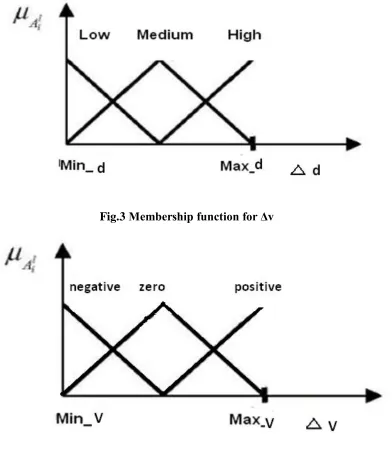
Fuzzy logic implements human experiences and preferences via membership functions and fuzzy rules. The fuzzy logic proposed to calculates the Link Stability Value (LSV) of each link between source and destination. The fuzzy logic uses two input variables and one output variable. The two input variables to be fuzzified are Δd and Δv of the neighbor nodes. The inputs are fuzzified, implicated, aggregated and defuzzified to get the crisp value of LSV as the output. The linguistic variables associated with the input variables are Low (L), medium (M) and high (H) for Δd and negative (N), zero (Z) and positive (P) for Δv.
Fig.3 Membership function for Δv
For the output variable, link stability index, six linguistic variables are used. They are, very low (VL), low (L), medium (M), average (A), high (H) and, very high (VH).
All membership functions are chosen to be triangular. The fuzzy conditional rules for the fuzzy stability are given as below:
Rule 1: If (Δd is Low) and (Δv is Negative) then the link stability is Medium.
Rule 2: If (Δd is Medium) and (Δv is Negative) then the link stability is Low.
Rule 3: If (Δd is High) and (Δv is Negative) then the link stability is Very Low.
Rule 4: If (Δd is Low) and (Δv is Zero) then the link stability is Very High.
Rule 5: If (Δd is Medium) and (Δv is Zero) then the link stability is High.
Rule 6: If (Δd is High) and (Δv is Zero) then the link stability is Average.
Rule 7: If (Δd is Low) and (Δv is Positive) then the link stability is Average.
Rule 8: If (Δd is Medium) and (Δv is Positive) then the link stability is Average.
Rule 9: If (Δd is High) and (Δv is Positive) then the link stability is High.
The LSV between each neighboring nodes can be computed using fuzzy logic. Here, we use
LSVx,y denote the LSV between node x and node y. Assume one communication route between
source and destination is made up of n intermitted nodes RSV
s,d = LSVs,1 * LSV1,2 * LSV2,3 * …
* LSV
n,d RSVs,d denotes the Rout Stability Coefficient of the whole route.
IV.ROUT DISCOVERY
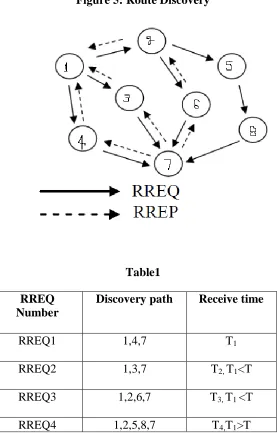
This process executes the path-finding algorithm to discover the stable route between source and distention. The source node initiates a route discovery process by broadcasting a Route Request (RREQ) message to all of its neighboring nodes. The RREQ packet here is similar to the RREQ in AODV protocol. Intermediate nodes receive RREQs and rebroadcast them. The destination node receives multiple RREQs within a time window, which starts from the first arrival RREQ .In this time window destination send Route Reply (RREP) per each received RREQ without delay. It creates RREP messages formatted similarly in AODV protocol for responding with the RREQs but includes a two newly field named node position and node velocity. Intermediate nodes add own position and velocity to RREP. Then the nodes forward the RREP toward the source node along the reverse route through which the selected RREQ passed. RREP packet, which contains the complete route topology information from source to destination, is sent back to the source node. The source node calculate RSV while receiving first RREP and start to transmit data packet from discovered path, by receiving next RREPs compares their RSVs with transmitted packet route RSV, in this comparing if source find route with higher RSV it will switch transmit packet path to stable path.
In figure – node 1 is as source and node 7 is as destination. Node 1 broadcast RREQ to find existing routes. Node 7 when received RREQ
1 sends RREP1 without delay. In table 1 shown
apparent route between source and destination, and also time difference between receiving RREQs and RREQ
Figure 5: Route Discovery
Table1
RREQ Number
Discovery path Receive time
RREQ1 1,4,7 T1
RREQ2 1,3,7 T2, T1<T
RREQ3 1,2,6,7 T3, T1 <T
RREQ4 1,2,5,8,7 T4,T1>T
It should be considered the received time of RREQ
4 (T4) is out of time window (T), so
Destination sends three RREPs to source. Source calculates RSV's after receiving RREPs. It is shown RSVs in table 2 .Source starts to transmit data packet from route 1 after receiving RREP
Table 2
RREP No. RSV
RREP1 0.59
RREP2 0.54
RREP3 0.74
V.PERFORMANCE EVALUATION:
A. Simulation Environment and Methodology:
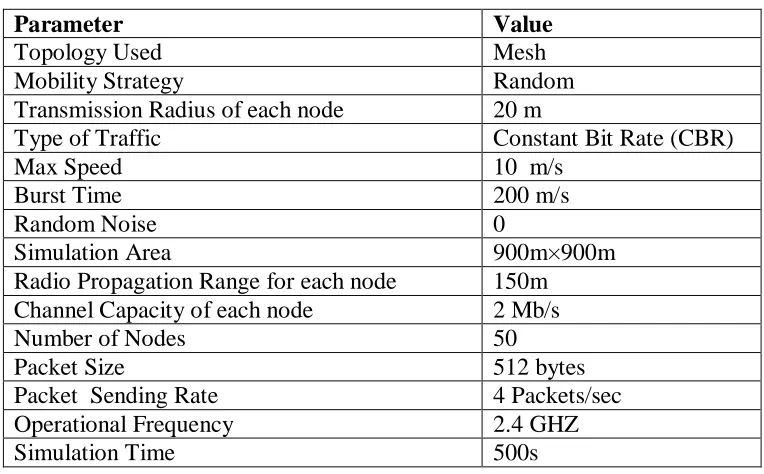
The proposed routing scheme has been implemented in a simulation environment using MATLAB 7.2. MATLAB 7.2 is a software package for high performance numerical computation and visualization. Its broad appeal lies in its interactive environment, which features hundreds of built-in functions for technical computation, graphics, and animation. MATLAB is a power computing system for handling the calculations involved in scientific and engineering problems. The table shows the various parameters and their associated values used for the simulation purposes. Here, continuous bit rate (CBR) type traffic is used for simulation environment.
Table 3: Simulation Parameters
Parameter Value
Topology Used Mesh
Mobility Strategy Random
Transmission Radius of each node 20 m
Type of Traffic Constant Bit Rate (CBR)
Max Speed 10 m/s
Burst Time 200 m/s
Random Noise 0
Simulation Area 900m×900m
Radio Propagation Range for each node 150m
Channel Capacity of each node 2 Mb/s
Number of Nodes 50
Packet Size 512 bytes
Packet Sending Rate 4 Packets/sec
Operational Frequency 2.4 GHZ
B. Performance Metrics:
The metrics used for the performance evaluation in an simulation environment are given as below:
PDR (Packet Delivery Ratio): Packet delivery ratio is the ratio between the number of packets originated by the “application layer” CBR sources and the number of packets received by the CBR sink at the final destination [5].
Throughput: It is the amount of digital data transmitted per unit time from the source to the destination. It is usually measured in bits per second [5].
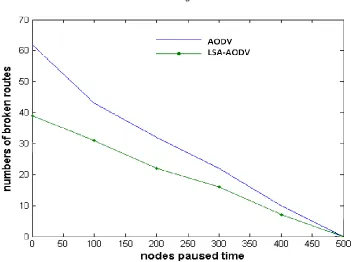
Route Stability: Route stability is a very important performance parameter for a routing protocol. Route stability can be measured in terms of number of route failures [5].
C. Simulation Results:
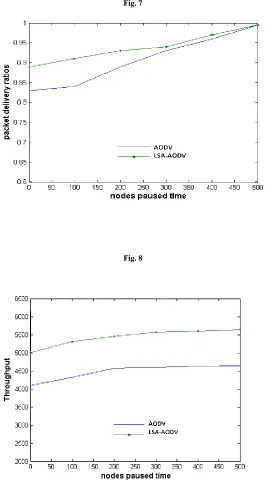
We will present below the simulated performance of the proposed LSA-AODV (link stability algorithm-AODV) in comparison with AODV.
Fig. 6
paused time and Y-axis is labeled with numbers of broken routes. Through changing the pause time, we can see that the broken number of LSA-AODV (link stability-AODV) decreases greatly compared to AODV.
Fig. 7
Fig. 8
VI.CONCLUSIONS AND FUTURE WORK:
Fuzzy logic is a suitable tool to be applied in the wireless mesh network routing decision purposes. The research work in the present paper is source select route by using certain metrics such as throughput, packet delivery ratio, and route stability. The results of simulation presents that the proposed routing scheme for WMNs can reduce the number of broken routes efficiently
and can enhance the route stability and network performance effectively. The results obtained by
simulation methods indicate that the LSA-AODV algorithm enhanced the performance and stability of wireless mesh networks dramatically. We believe that the proposed algorithm LSA-AODV can be further investigated based on other radio propagation models in order to design better adaptive technique for wireless mesh networks.
REFERENCES:
[1] http://www.cs.jhu.edu/~cs647/class-papers/Routing/p114-draves.pdf
[2] Ali Khasrozadeh, Abalfazle Akbari, Maryam Bagheri and Beikmahdavi, “ A New
Algorithm AODV Routing Protocol in Mobile ADHOC Networks”, Int. J Latest Trends Computing, vol-2 No3,September,2011,pp-457-464.
[3] Arash Dana,Golnoosh Ghalavand, Azadeh Ghalavand , and Fardad Farokhi , “A
Reliability routing algorithm for Mobile Ad-hoc Networks based on fuzzy logic”, IJCSI,vol.8,issue3,no.1, May,2011,pp. 128-133.
[4] Mamoun Hussein Mamoun, “Aproposed Route Selection Technique in DSR Routing
Protocol for MANET”, IJETIJENS vol:11 No:02,pp. 10-13,April,2011.
[5] Arash Dana, Mohamad Hadi Babaei, “A Fuzzy Based Stable Routing Algorithm for