Universal Design for Learning in an Online Teacher Education
Course: Enhancing Learners' Confidence to Teach Online
Ye He Associate Professor
Department of Teacher Education and Higher Education The University of North Carolina at Greensboro
Greensboro, NC 27402 USA [email protected]
Abstract
To prepare teacher candidates for the growing number of online learners they will encounter in their professional practice, it is important that they have the opportunity to experience quality online learning themselves. This paper reports a case study of an online teacher education course that was designed based on Universal Design for Learning (UDL) principles. Drawing from survey results and statistics collected through the online learning management system, 24 teacher candidates' online learning experiences were shared. The findings of this study illustrate the impact of the online course on teacher candidates' confidence and self-efficacy in learning in an online environment and potentially teaching online in the future. Teacher candidates' perceptions of the benefits and challenges for teaching and learning online are also discussed.
Keywords: Universal Design for Learning (UDL), online teacher education, confidence, self-efficacy
Introduction
As instructional technology continues to develop, more learners have access to a variety of online learning opportunities. According to a recent review of K-12 online learning policy and practice, as of late 2011 all 50 U.S. states and the District of Columbia offer online learning experiences to students in K-12 settings (Watson, Murin, Vashaw, Gemin, & Rapp, 2011). Students in Michigan, New Mexico, Alabama, and Idaho are required to complete an online learning experience before graduating from high school (Kennedy & Archambault, 2012). It is projected that by 2020, 50% of high school classes will be offered online (Christensen, Horn, & Johnson, 2011). As Hathaway and Norton (2012) pointed out, "The issue is no longer whether or not online learning is or should occur, but rather how it is implemented" (p. 146).
Archambault, 2012; Ko & Rossen, 2010). To better prepare future teachers for the growing number of online learners, it is important that teacher educators model good online instruction in teacher education courses. Teacher candidates need to be offered the opportunity to not only experience online learning themselves beyond an isolated instructional technology course, but to also reflect on their learning experiences to further their development as teachers (Compton, Davis, & Mackey, 2009; Kennedy & Archambault, 2012). Through the "apprenticeship of observation" (Lortie, 1975, p. 61) in an online environment, teacher candidates may be able to further develop their readiness for teaching online in the future (North American Council for Online Learning, 2008).
The purposes of this study, therefore, are to: (1) describe how teacher candidates engage in an online teacher education course; (2) explore the impact of this experience on teachers' confidence and self-efficacy in teaching and learning online; and (3) examine the impact of this experience on teachers' perceptions of the benefits and challenges of teaching and learning online.
Literature Review
The researcher reviewed literature regarding online course design and delivery in teacher education programs. The Universal Design for Learning (UDL) principles guided both the course design and delivery in this study (Rose & Meyer, 2002). Further, a review of recent studies examining the impact of online learning informed the research design and instrument used in this study.
Universal Design for Learning in Online Instruction
Universal design principles originated from architectural principles developed to ensure access to all structures (North Carolina State University, The Center for Universal Design, 1997). Building upon the same purpose to ensure access, educational researchers developed UDL principles in instructional design to ensure students' access not only to the learning environments, but to learning itself (Rose, Harbour, Johnston, Daley, & Abarbanell, 2006; Rose & Meyer, 2002).
Introduced by the Center for Applied Special Technology (CAST), the UDL framework and guidelines reflect theories and practices in education, developmental psychology, cognitive science, and cognitive neuroscience (Rose & Gravel, 2010). The three primary brain networks recognized by cognitive neuroscientists undergird the development of the specific UDL guidelines: (1) recognition networks – the "what" of learning, (2) strategic networks – the "how" of learning, and (3) affective networks – the "why" of learning (CAST, 2011; Rose & Gravel, 2010). Accordingly, UDL guidelines include: (1) providing multiple means of representation in terms of perception, language, expressions, symbols, and comprehension to support learning through recognition networks; (2) providing multiple means of action and expression including physical action, expression and communication, and executive function to support learning through strategic networks; and (3) providing multiple means of engagement including recruiting interest, sustaining effort and persistence, and self-regulation to support learning through affective networks (CAST, 2011). UDL principles highlight the importance of universal access in course design and delivery with an intentional effort to incorporate the use of new technologies that support learning.
In an effort to apply UDL principles in higher education settings, several institutions within the California State University system launched the Ensuring Access through Collaboration and Technology (EnACT) project with funding from the U.S. Department of Education's Office of Postsecondary Education. The team not only designed professional development materials for faculty who would like to learn and apply UDL principles but also shared UDL-based resources specifically for quality online learning and teaching. EnACT's rubric for online instruction offers specific guidelines for online course development based on UDL principles (California State University, 2012), specifying ways to ensure learner support and resources, online organization and design, online instructional design and delivery, assessment and evaluation of student learning, innovative teaching with technology, and faculty use of student feedback. Table 1 includes course development and delivery considerations that were integrated to address the above principles in this study.
Table 1. Online course design based on UDL rubric
Online Course Design Rubric Course Design Elements
Learner Support and Resources
• Links provided to multiple ways of accessing online technology support via phone, e-mail, and online chat
• Additional resources in text, audio, and video format included for each online course module
Online Organization and Design
• Consistent organization of all course modules by week
• All web pages are visually and functionally consistent throughout the course
• Technical requirements were specified and testing sessions for students to practice the use of various technology tools were offered
• Accessibility issues are addressed throughout the course (sight, mobility, hearing, and technical accessibility issues were considered)
Instructional Design and Delivery
• Multiple forms of interactions including synchronous sessions, asynchronous discussions, weekly e-mail announcements, student group collaborations, individual e-mails, and Skype sessions
• Course goals and learning objectives were clearly identified every week
• Learning activities were clearly aligned with course objectives • Course provides choices of multiple visual, textual, and auditory
activities to enhance student learning and accessibility
• Course projects promote students' critical thinking and problem-solving skills
Assessment and Evaluation of Student Learning
• Course offers multiple, ongoing self-assessments, peer-assessments, and project-based assessment tasks
• Learning objectives and course activities are closely aligned • Regular feedback about student performance was provided
through an online grade book, online discussions, and weekly e-mails.
Innovative Teaching with Technology
• Blackboard, e-mail, Google Docs, and Skype were used as tools to facilitate online communication and learning
• Learning objects were designed and integrated to support different learning styles
• Additional instructional technology tools such as LiveBinders, BookBuilder, Photo Story, VoiceThread, etc., were introduced to students and offered as options for them to use to complete course activities and assignments
Faculty Use of Student Feedback
• Feedback form was made available to students to offer ongoing feedback
Impact and Effectiveness of Online Learning
Even though research examining the impact of UDL-guided online courses is still scarce, with the growing development of online courses and research on the impact and effectiveness of online learning, more studies have been conducted to measure learner perceptions of their online learning experiences. There are a number of studies regarding learner confidence in navigating the online learning environment and self-efficacy in completing online learning tasks (Heirdsfield, Walker, Tambyah, & Beutel, 2011; Hung, Chou, Chen, & Own, 2010; Seok, DaCosta, Kinsell, & Tung, 2010; Žuvic-Butorac, Roncevic, Nemcanin, & Nebic, 2011).
Based on the review of recent studies measuring learners' readiness for online learning, Hung et al. (2010) constructed and validated an 18-item instrument examining five dimensions of readiness for online learning including: self-directed learning, learner control, motivation for learning, computer/Internet efficacy, and online communication efficacy. While items regarding self-directed learning (e.g., "I carry out my own study plan") and motivation for learning (e.g., "I am open to new ideas") may refer to more general learning strategies, items regarding computer/Internet self-efficacy (e.g., "I feel confident in performing the basic functions of Microsoft Office programs"), learner control (e.g., "I am not distracted by other online activities when learning online"), and online communication self-efficacy (e.g., "I feel confident in using online tools to effectively communicate with others") were directly related to online learning experiences. Similarly, Artino and McCoach (2008) also developed and finalized an 11-item scale on task value and learner online self-efficacy based on three studies. Five items included in the self-efficacy subscale addressed learners' confidence in understanding the content and communicating with others in an online learning environment.
Adapting items from surveys used in previous studies, in this study, a learner self-efficacy and confidence instrument was developed. The instrument not only contained items addressing learners' confidence with specific technology tools used in the course, and their self-efficacy of online learning in general, but also included items regarding their confidence in using technology tools for teaching. This approach to instrument development allowed the researcher to make the instrument more relevant to learners' experiences and to collect more targeted feedback.
Context
This study was conducted in a three-credit hour course for both undergraduate and graduate teacher candidates. This course was designed for teacher candidates who are currently teaching or interested in working with English learners. The main objectives for this course are to introduce the historical backgrounds of English-as-a-Second-Language (ESL) education policies and programs, discuss legal issues involving English learners and their families, engage in cross-cultural communication practices and reflections, and explore ideas for family and community involvement in working with English learners. Both asynchronous and synchronous interactions were integrated into the online course. Teacher candidates were expected to complete 11 online modules with ongoing assessments built in, participate in seven asynchronous online discussions, complete two multiple-choice assessments, and compile a list of resources in the form of LiveBinders. Synchronous discussions were optional and all synchronous sessions were recorded and archived.
In addition, all teacher candidates are expected to apply their understanding to authentic interaction with English learners and their families through the ABC’s project (Schmidt, 1999, 2001). In this project, teacher candidates write an autobiography describing their own cultural background, learning experiences, and their understanding of teachers' roles and responsibilities. Over the course of the semester, they interview and observe an English learner whose cultural background is different to their own, with specific emphasis on their cultural backgrounds and language learning experiences, and drawing comparisons between English and the learner's native language. Finally, they write up a biography of the learner with whom they work, then compare that biography with their autobiography and reflect on how their interaction with the learner has contributed to their development of cross-cultural competence (He, 2013; He & Cooper, 2009).
weekly basis, and a weekly announcement was sent to summarize the discussion from the previous week and provide an overview of topics to be covered in the coming week.
While this was not a teaching methods course, online teaching strategies were explicitly modeled and teacher candidates were engaged in reflections on their online learning experiences to inform their understandings of teaching in an online environment. Even though teacher candidates did not have the opportunity to engage in online teaching, the course offered an opportunity for them to observe online instruction and reflect on ways in which they may be able to integrate UDL principles and online teaching tools in their future classrooms.
Method
The general research question in this study was:
What is the impact of an online teacher education course on teacher candidates' perceptions of online instruction?
Three specific questions guided data collection and analysis:
1) How do teacher candidates participate in this online learning experience?
2) What is the impact of this experience on their confidence and self-efficacy in online learning and potentially teaching in an online environment in the future?
3) What is the impact of this experience on teacher candidates' perceptions of the benefits and challenges for teaching and learning online?
A total of 24 teacher candidates enrolled in the course, all of whom agreed to participate in the study. The majority of the class was graduate students (N = 22; 92%) and there were two international exchange students who were in their senior year. Seven participants were male (29%), and 17 were female (71%). Ten participants (42%) were enrolled in a graduate-level pre-service teacher education program that requires K-12 field experiences during the semester.
Quantitative data was collected from the Blackboard LMS itself through statistical tracking of how frequently students accessed all course content. This tracking allowed the instructor to monitor the amount of time and the time frame during which participants interacted with the course content. This information, accompanying participants' self-reported survey data, was used to depict the patterns of participation in the online course environment.
An online teaching and learning self-assessment in the form of a survey was administered at the start (pre-assessment) and end (post-assessment) of the course in order to examine participants' confidence in using technology in online teaching and learning settings and their self-efficacy in learning in an online environment. The survey contained 14 five-point Likert-scale items and four open-ended questions. The 14 Likert-scale items addressed three categories: (1) confidence in using technology in learning; (2) confidence in using technology in teaching; and (3) online learning self-efficacy. The open-ended questions asked about participants' likes and concerns about the online teaching and learning environment as teachers and as students. On the post-assessment, in addition to the same items from the pre-assessment, participants were asked to rank the importance of and their satisfaction with various course components including the Blackboard LMS, various online interaction forums, and projects. Based on the data collected in this study, the reliability (Cronbach's alpha) of the instrument was .95.
In addition to the pre/post self-assessment, participants were also provided the opportunity to offer ongoing feedback through a Google form that was embedded in the Blackboard course. At the end of the semester, participants were invited to respond to a final course evaluation that included both Likert-scale items and open-ended questions.
During the secondary-level analysis, the relationships among the categories, and the responses that were coded under multiple categories, were further explored to form the general themes including: (1) pacing and flexibility; (2) interaction with course content; (3) interaction with peers; (4) interaction between instructor and students; and (5) technology issues in this study.
Results
Online Learning Experiences
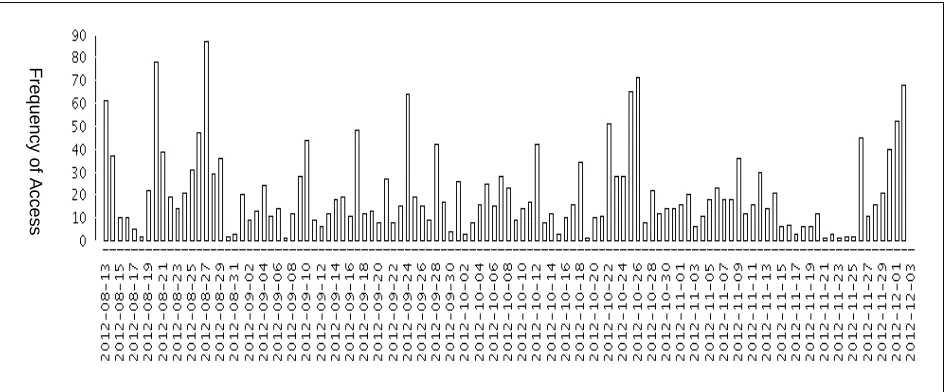
Both asynchronous and synchronous experiences were offered in this course. Participants' main interaction with the course content was through the online course modules that provided access to all recommended reading materials, websites, podcasts, webinars, and videos. The online course modules also included required learning materials and interactive activities. Although the course materials were organized by week and new materials were released every Monday, participants were encouraged to revisit previous course materials and maintain their own pace throughout the week. Based on the statistics tracking from Blackboard, it was evident that in this study, participants interacted with course content in an ongoing manner throughout the course. Figure 1 showed the pattern of participants' interaction with the course content posted under Course Documents for Class 1. The x-axis indicates the date when participants accessed the course content and the y-axis illustrates the frequency of access. This pattern was consistent for other content area documents as well.
Figure 1. Class 1 content statistics tracking
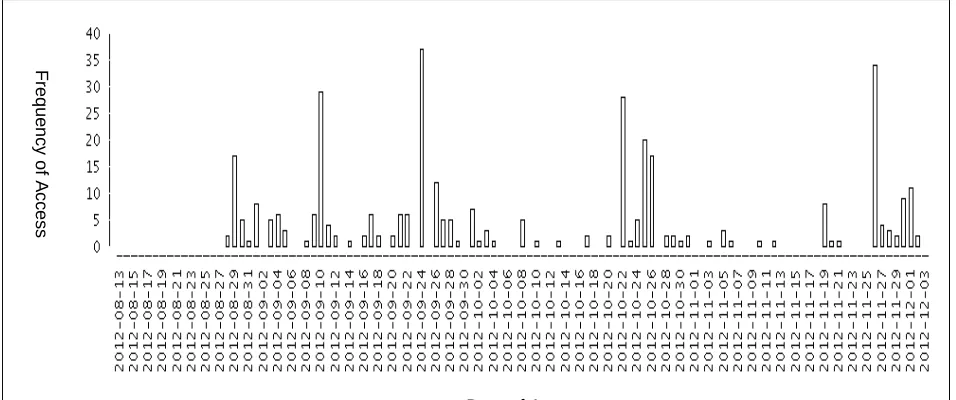
Synchronous online interactions offered opportunities for participants to interact directly with the instructor and with their peers. To accommodate participants' schedules, synchronous sessions were not required in this course. However, all sessions were recorded and archived for later access. On average, 16 out of 24 participants (67%) were present in each synchronous session. It was interesting to note that almost all participants, including those who were present at the synchronous sessions, accessed and viewed the archived recordings of these sessions. Figure 2 illustrates the number of hits of the archived second synchronous session over the course of the semester as an example. The x-axis indicates the dates when participants accessed the archived session and the y-axis the frequency. This pattern was also consistent for other archived synchronous sessions. Some participants accessed the recordings multiple times during one day and other participants accessed the recordings throughout the course of the semester rather than only during the week when a particular synchronous session was offered. In their feedback form, eight out of 14 participants (57%) mentioned the synchronous sessions as their favorite part of the course and commented that being able to review recorded synchronous sessions was an advantage of online learning.
Date of Access
F
reque
nc
y
of
A
c
c
es
Figure 2. Archived second synchronous session statistics tracking
At the end of the semester, participants were asked to rank the importance of the course components they experienced and their satisfaction with each component. As is shown in Table 2, "Instructor" was ranked as the most important component of the course. The LMS, weekly announcements, course modules, documents, and the required field experiences were also ranked as important by participants. While the LMS and weekly announcements provided clear organization for the course, the course modules and documents provided opportunities for learners to engage with the content. The required field experiences allowed participants to apply their learning in authentic interactions.
Table 2. Perceived importance of and satisfaction with course components
Course Component Importance Satisfaction
M SD M SD
Blackboard System 2.86 0.47 2.82 0.40
Announcement 2.86 0.47 2.86 0.35
Modules 2.86 0.47 2.91 0.29
Course Documents 2.82 0.50 2.86 0.40
TESOL News 2.23 0.53 2.59 0.50
Asynchronous Discussions 2.68 0.57 2.82 0.40 Synchronous Sessions 2.77 0.43 2.91 0.29 LiveBinders Project 2.77 0.53 2.82 0.40 Field Experiences 2.82 0.50 2.82 0.40
Group Work 2.41 0.67 2.59 0.59
Instructor 2.91 0.29 2.91 0.29
Note. N = 24. A 5-point Likert scale was used for the ratings, with 1 = Not Important or Not satisfied and 3 = Very important or Very satisfied.
Based on their experiences in this course, participants were most satisfied with the online course modules, the synchronous sessions, and the instructor. More specifically, participants appreciated the consistent organization of the course content and the prompt feedback offered by the instructor. In the final course evaluation, nine out of 15 participants (60%) commented that the promptness of feedback and responses to questions and concerns in multiple formats (e.g., e-mails, synchronous discussions, individual or group Skype meetings) facilitated their online learning experiences. For participants who were not as familiar with the online learning environment at the beginning of the course, they felt that they were "able to overcome any obstacles the online format might present" and felt that the course was delivered "in an effective and interesting way."
The TESOL News section was perceived as the least important and prompted the least satisfaction among the participants. Even though the RSS feed functioned well and was readily available,
Date of Access
F
reque
nc
y
of
A
c
c
es
participants reported that they often did not remember to check it and were not able to make full use of the materials it provided. While group work was not rated by participants as important as other components of the course, in the final evaluation, participants did comment on how they appreciated the "interactions and peer reviews incorporated that expanded learning for all," and felt the class "functioned like a learning community."
Confidence and Self-Efficacy in Teaching and Learning Online
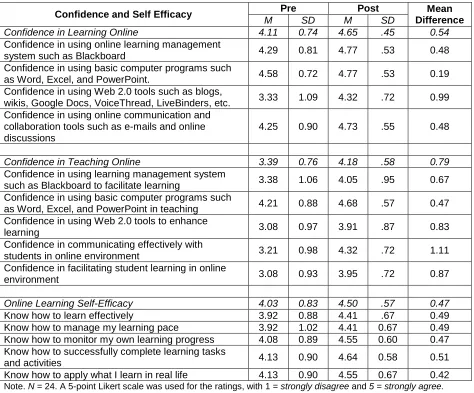
At the start and end of the course, participants completed self-assessments regarding their confidence and self-efficacy in teaching and learning in an online environment (see Table 3). Based on the pre-assessment, participants reported the highest ratings on their confidence in learning online, especially in terms of using basic computer programs such as Word, Excel, and PowerPoint. Not surprisingly, they reported the lowest confidence in teaching online, particularly concerning the use of Web 2.0 tools and facilitating student learning in an online environment. The average rating of participants' self-efficacy in online learning is also relatively high, especially in regard to completing online activities and tasks and being able to apply what they learn in real life.
Table 3. Confidence and self-efficacy in teaching and learning online – pre/post self-assessment
Confidence and Self Efficacy Pre Post Mean
Difference
M SD M SD
Confidence in Learning Online 4.11 0.74 4.65 .45 0.54
Confidence in using online learning management
system such as Blackboard 4.29 0.81 4.77 .53 0.48
Confidence in using basic computer programs such
as Word, Excel, and PowerPoint. 4.58 0.72 4.77 .53 0.19 Confidence in using Web 2.0 tools such as blogs,
wikis, Google Docs, VoiceThread, LiveBinders, etc. 3.33 1.09 4.32 .72 0.99 Confidence in using online communication and
collaboration tools such as e-mails and online discussions
4.25 0.90 4.73 .55 0.48
Confidence in Teaching Online 3.39 0.76 4.18 .58 0.79
Confidence in using learning management system
such as Blackboard to facilitate learning 3.38 1.06 4.05 .95 0.67 Confidence in using basic computer programs such
as Word, Excel, and PowerPoint in teaching 4.21 0.88 4.68 .57 0.47 Confidence in using Web 2.0 tools to enhance
learning 3.08 0.97 3.91 .87 0.83
Confidence in communicating effectively with
students in online environment 3.21 0.98 4.32 .72 1.11 Confidence in facilitating student learning in online
environment 3.08 0.93 3.95 .72 0.87
Online Learning Self-Efficacy 4.03 0.83 4.50 .57 0.47
Know how to learn effectively 3.92 0.88 4.41 .67 0.49 Know how to manage my learning pace 3.92 1.02 4.41 0.67 0.49 Know how to monitor my own learning progress 4.08 0.89 4.55 0.60 0.47 Know how to successfully complete learning tasks
and activities 4.13 0.90 4.64 0.58 0.51
Know how to apply what I learn in real life 4.13 0.90 4.55 0.67 0.42 Note. N = 24. A 5-point Likert scale was used for the ratings, with 1 = strongly disagree and 5 = strongly agree.
growth. The increase in the mean rating in participants' confidence in their ability to effectively communicate with students in an online environment was especially noticeable. Participants also demonstrated growth in their self-efficacy for online learning. Positive changes were observed on all items in this subscale.
Overall, it was evident from participants' pre and post self-assessments that they not only enhanced their online learning self-efficacy and confidence in learning online through taking the online course, but also developed their confidence in their ability to teach online. The use of LMSs, basic computer programs, and Web 2.0 tools were modeled throughout the course and the participants were also required to use some more advanced features in basic computer programs such as narration in PowerPoint, collaborative tools such as Google Docs and LiveBinders, and basic Blackboard tools such as synchronous Collaborate sessions, asynchronous discussions, and group collaboration tools. Additional tools and resources such as BookBuilder, Photo Story, and VoiceThread were recommended as choices participants could select to complete assignments and projects. As one participant commented in the final evaluation: "I really liked the various examples of technology that were suggested as a means of doing different course assignments." The modeling, resources, and choices of the use of various online teaching and learning tools provided differentiated support for learners with different levels of readiness in using instructional technology in their own learning and served as models of how they can teach in online environments as well.
Benefits of Online Teaching and Learning
Participants reflected on the benefits of both learning online and teaching online before and after the course. Pacing and flexibility were reported by most of the participants as benefits for both teaching and learning online. At the end of the semester, more participants commented on interactions with course content as an additional benefit of learning online. From the teaching perspective, several participants recognized the advantages of the use of technology in teaching and reported that teaching quality can be enhanced through online instructor–student interactions and student–student interactions.
• Benefits of learning online. The majority of the participants in this study (20 out of 24, or 83%) referred to pacing and flexibility as the key benefit of learning online. Specifically, at the beginning of the semester, participants commented that online learning offers a more "flexible schedule," easy access, and reduced time and cost for travel than was typically required for F2F classes.
At the end of the semester, the same number of participants commented on pacing and flexibility as the main benefits for online learning. The online learning experiences they had allowed them to discuss more specifically what they appreciated as an online learner: "I can determine how much time I need to spend on each class component to ensure I understand it better. I also like that I can go back to previous modules to retrieve information."
Related to the comment on flexibility and pacing, at the end of the semester, four participants (17%) specifically referred to their interaction with the learning content as the benefit. One participant, for example, mentioned that: "It [the online format] allows me to use my laptop and online resources more frequently." Similarly, another participant said that: "I liked the variety of materials and modes of communication that we were able to utilize."
• Benefits of teaching online. From their perspectives as teachers, nine participants (38%) referred to pacing and flexibility as the benefit of online teaching at the beginning of the semester. These comments tend to also be associated with flexible schedule and cost. Several participants (five out of 24, or 21%) commented on the interaction between the instructor and students as a strength of the online teaching format, especially for students who typically do not feel comfortable speaking up in class. As one participant described, "Teacher can know more about their students because the online class makes the timid student have the courage to express their thoughts and ideas."
While only five participants (21%) commented that interaction between the instructor and student and interaction among peers were benefits of online teaching, it was observed that when participants referred back to the specific learning activities they experienced: "It is easier for the teacher knowing the feedback of every student when using the synchronous learning program (e.g., teacher can ask every student questions and knowing the result very quickly and accurately)." Finally, four participants (17%) stated that the availability of technology was a benefit of the online teaching format. They were pleased to learn that "there are many instructional technology tools available to deliver audio and visual lectures." One participant commented that he/she felt the online learning experience provided him/her with invaluable preparation "for the future by using technology in a creative and effective manner."
Concerns about Teaching and Learning Online
Participants also reflected on their concerns about teaching and learning online before and after taking the course. The major concerns regarding learning that online participants expressed prior to taking the course included the lack of interactions with the instructor, the lack of interactions among peers, and the potential technology issues that may interfere with learning. From a teaching perspective, participants expressed concerns in terms of instructor–student relationships, immediate feedback, and assessment and accountability. After taking the course, fewer participants expressed these concerns, but they still commented on the benefits of F2F interactions with the instructor that were missing in the online course and the potential technology issues they may experience in the future. Instead of being worried about not being able to use technology to deliver the content, they became more concerned about ways to best differentiate instruction for learners with different needs using appropriate technology tools.
• Concerns about learning online. As online learners, most participants (14 out of 24, or 58%) expressed concerns regarding interactions with peers at the beginning of the semester. Participants tended to refer back to their experiences in F2F classrooms and commented on how they "enjoy being in a classroom with other students," and that "the interaction and discussion is an important component." In addition to interactions in the classroom settings, some participants also expressed concerns about establishing long-term relationships with their peers. For example, one participant commented: "It's hard to make friends and get to know colleagues without seeing them in person." Two participants specifically mentioned their concerns with not being able to see the non-verbal behaviors of their peers and therefore cannot "gauge their reactions or their reception to my responses." Another participant commented, "I wonder if the collaboration with peers is actually feasible." After taking the online course, interaction with peers remained the concern expressed by most of the participants. Nine out of 24 participants (38%) still expressed that they "miss the face to face contact of a classroom."
In addition to interaction with peers, interaction between teacher and students and technology issues were concerns expressed by seven participants at the beginning of the course (28%). Similar concerns regarding the lack of F2F meeting opportunities and seeing non-verbal feedback were expressed regarding the interaction between the teacher and students. In terms of technology, several participants admitted that they may not be as familiar with the use of online LMSs or instructional technology tools. As one participant put it: "I have much to learn about the online learning process. I am concerned that I will not understand how to use online programs required for this class." Three participants who identified technology as one of their major concerns were actually very confident in their technology skills. They were more concerned about technology issues beyond individual control:
"I only have concerns about online learning when my technology fails to work. I am confident in my ability to navigate online sites and the computer itself. However, my concern arises when I don't know how to readily fix problems, such as wireless connection or other random glitches."
the comments were general and hypothetical, such as "there is always the possibility of a technical crash which could prove disastrous." Only one participant actually referred to specific technology difficulties: "Technology glitches are my biggest concern. For example, I uploaded a PP [PowerPoint] presentation with audio, but the uploaded file did not play the audio. This is frustrating."
• Concerns about teaching online. Participants also commented on their concerns for online teaching from their perspective as teachers. Not surprisingly, interaction between the teacher and the students was the major concern expressed by most of the participants (13 out of 24, or 54%). Participants expressed concerns regarding the lack of immediate feedback from their students to adjust and modify their instruction. For example, one participant commented:
"I think the biggest concern about online learning from a teacher's perspective would be gaging how challenging the activities and assessments are. Especially with younger students, but with all students in general, it is easier to tell if a student is frustrated or bored with an activity if you are in the room with that student."
Several participants were also concerned about the assessment and accountability in general. One participant commented that: "It might be a little hard to check up the students' learning." Another participant worried that "identity of students who attend the class might be one thing that is hard to detect."
The lack of opportunity to get to know students and to establish relationships with students was another aspect of the concern:
"I would be concerned about not being able to build a strong rapport with my students because I wouldn't see them or interact with them face-to-face. I wouldn't want my instruction to suffer because I didn't 'know' my students."
Participants (eight out of 24, or 33%) also expressed concerns regarding technology from the teacher's perspective at the beginning of the course. While the majority of these participants commented on their lack of familiarity with online teaching, one participant commented on concerns that they would need to address technology issues as part of the course content:
"I am worried that rather than teaching content or language, a greater part of my actual instruction time will be diverted to teaching others how to use technology, and because I learned technology by figuring it out for myself, I am unsure what teaching the use of such things looks like."
After taking the online course, five participants (21%) expressed similar concerns in terms of instructor–student relationships, immediate feedback, and assessment and accountability. In terms of concerns regarding technology, it was interesting to note that although six participants expressed concerns (25%), only one of them stated a lack of familiarity with technology as the concern. The rest of the participants expressed their concerns with learning ways to differentiate and support learners who may have various backgrounds in technology. For example, one participant commented: "I would say that the most difficult aspect of online learning from a teacher's perspective is the differences in computer skills that students have as a result of their backgrounds." Another participant stated:
"I think I might be concerned that some student may be neglected by their peers, which may happen unintentionally; but it is possible. Also I would be concerned about the technical problems that some student might encounter and try to think of alternative plans in such cases."
Discussion and Conclusion
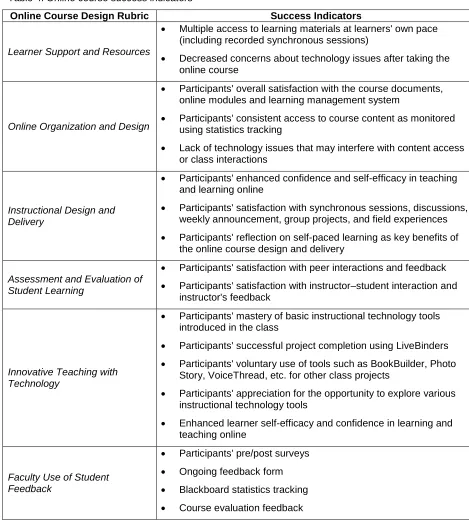
In addition to confirming the findings from previous studies in terms of key components in online learning, the findings from this study offered additional insights regarding applying the UDL principles in online teacher education courses. Building upon the findings in this study, Table 4 summarizes the success indicators of the use of UDL principles in the online course design based on the EnACT rubric.
Table 4. Online course success indicators
Online Course Design Rubric Success Indicators
Learner Support and Resources
• Multiple access to learning materials at learners' own pace (including recorded synchronous sessions)
• Decreased concerns about technology issues after taking the online course
Online Organization and Design
• Participants' overall satisfaction with the course documents, online modules and learning management system
• Participants' consistent access to course content as monitored using statistics tracking
• Lack of technology issues that may interfere with content access or class interactions
Instructional Design and Delivery
• Participants' enhanced confidence and self-efficacy in teaching and learning online
• Participants' satisfaction with synchronous sessions, discussions, weekly announcement, group projects, and field experiences • Participants' reflection on self-paced learning as key benefits of
the online course design and delivery
Assessment and Evaluation of Student Learning
• Participants' satisfaction with peer interactions and feedback • Participants' satisfaction with instructor–student interaction and
instructor's feedback
Innovative Teaching with Technology
• Participants' mastery of basic instructional technology tools introduced in the class
• Participants' successful project completion using LiveBinders • Participants' voluntary use of tools such as BookBuilder, Photo
Story, VoiceThread, etc. for other class projects
• Participants' appreciation for the opportunity to explore various instructional technology tools
• Enhanced learner self-efficacy and confidence in learning and teaching online
Faculty Use of Student Feedback
• Participants' pre/post surveys • Ongoing feedback form • Blackboard statistics tracking • Course evaluation feedback
al., 2011). While consistent online course organization can be achieved during course design, instructor presence and prompt feedback are essential elements in course delivery that all higher education faculty, including teacher educators, need to learn more about. Behaviors such as frequency of interaction, formats of interactions, responsiveness, and even tone impact how students perceive instructors' social and cognitive presence (Lowenthal, 2009; Russo & Campbell, 2004). Offering teacher educators professional development on these topics would enhance the quality of online course delivery and allow teacher educators to be more cognizant in reflecting on their own online teaching behaviors in addition to sharing these experiences explicitly with teacher candidates.
Further, participants in this study illustrated that availability of ongoing opportunities to interact with content, especially the recorded synchronous sessions, opportunities to explore the use of various technology tools, and an environment that allowed for self-paced learning are unique features and benefits of online learning. These benefits may encourage more teachers and teacher educators to integrate online components in F2F courses to offer more differentiation for learners coming from different cultural and linguistic backgrounds, or with different learning styles or learning preferences. Choices pertaining to class engagement and participation in various online formats could also enrich the classroom environment and maximize opportunities for teaching and learning in general.
It was encouraging to note that participants reported enhanced confidence and self-efficacy in both learning and teaching online after taking this course. This finding supports the need for all teacher candidates to have the opportunity to experience online learning during their teacher education program (Compton et al., 2009; Kennedy & Archambault, 2012). In addition to the self-reported survey, participants' more detailed and specific descriptions of the benefits and concerns regarding online learning also indicated the importance of intentional reflection being integrated as part of their online learning experiences. Based on findings from this study, participants' online learning experiences not only allowed them to see what learning opportunities are possible in an online learning environment but also challenged them to question what pedagogical methods they need to be aware of as teachers to support learners with different levels of technology readiness in their future teaching.
Finally, the process of conducting the research on the effectiveness and impact of the online course and design itself may offer other teacher educators ideas for collecting ongoing feedback from learners for online course development and improvement. In addition to the use of course evaluation, in this study, pre/post surveys, ongoing feedback from participants, and the statistics tracking from the LMS offered the instructor multiple sources for data to obtain teacher candidates' feedback in online learning. Promoting such assessment and feedback efforts at the institutional level could further extend our understanding of online instruction and offer learners more opportunities to contribute to the improvement of online course offerings.
Limitations and Future Research
As Kennedy and Archambault (2012) pointed out, to be truly prepared to teach the increasing number of online learners, teacher candidates need to develop specific dispositions, knowledge, and skills about online teaching by having opportunities to experience guided online teaching experiences. Modeling sound pedagogical practices to teach online through the "apprenticeship of observation" (Lortie, 1975, p. 61) and examining the effectiveness and impact of such courses are initial steps in preparing effective teachers who are confident and capable of using online pedagogy. Teacher educators may need to consider designing more teacher education courses, especially methods courses, where online teaching pedagogy can be modeled and guided teaching opportunities can be provided. At the same time, research studies examining these innovative practices also need to be more widely disseminated to reach a wide audience of teacher educators and practicing teachers.
References
Anderson, D. L., Standerford, N. S., & Imdieke, S. (2010). A self-study on building community in the online classroom. Networks, 12(2). Retrieved from http://journals.library.wisc.edu/index.php/ networks/article/download/261/392
Artino, A. R., & McCoach, D. B. (2008). Development and initial validation of the online learning value and self-efficacy scale. Journal of Educational Computing Research, 38(3), 279-303.
doi:10.2190/EC.38.3.c
Bandura, A. (1977). Self-efficacy: Toward a unifying theory of behavioral change. Psychological Review, 84(2), 191-215. doi:10.1037/0033-295X.84.2.191
California State University. (2012). Quality Online Learning & Teaching. Retrieved from http://enact.sonoma.edu/content.php?pid=218878&sid=2552680
Center for Applied Special Technology. (2011). Universal Design for Learning Guidelines version 2.0. Wakefield, MA: Author. Retrieved from http://www.udlcenter.org/aboutudl/udlguidelines
Christensen, C. M., Horn, M. B., & Johnson, C. W. (2011). Disrupting class: How disruptive innovation will change the way the world learns (Updated and expanded new ed.) New York, NY: McGraw-Hill.
Compton, L. K. L., Davis, N. E., & Mackey, J. (2009). Field experience in virtual schools – to be there virtually. Journal of Technology and Teacher Education, 17(4), 459-477. Available from EdITLib Digital Library. (28316)
Grabinger, R., Aplin, C., & Ponnappa-Brenner, G. (2008). Supporting learners with cognitive impairments in online environments. TechTrends, 52(1), 63-69. doi:10.1007/s11528-008-0114-4 Hathaway, D., & Norton, P. (2012). An exploratory study comparing two modes of preparation for online
teaching. Journal of Digital Learning in Teacher Education, 28(4), 146-152. doi:10.1080/21532974.2012.10784695
He, Y. (2013). Developing teachers' cultural competence: Application of appreciative inquiry in ESL teacher education. Teacher Development, 17(1), 55-71. doi:10.1080/13664530.2012.753944 He, Y., & Cooper, J. E. (2009). The ABCs for pre-service teacher cultural competency development.
Teaching Education, 20(3), 305-322. doi:10.1080/10476210902943256
Heirdsfield, A., Walker, S., Tambyah, M., & Beutel, D. (2011). Blackboard as an online learning environment: What do teacher education students and staff think? Australian Journal of Teacher Education, 36(7). doi:10.14221/ajte.2011v36n7.4
Hodges, C. B., & Cowan, S. F. (2012). Preservice teachers' views of instructor presence in online courses. Journal of Digital Learning in Teacher Education, 28(4), 139-145.
doi:10.1080/21532974.2012.10784694
Hung, M.-L., Chou, C., Chen, C.-H., & Own, Z.-Y. (2010). Learner readiness for online learning: Scale development and student perceptions. Computers & Education, 55(3), 1080-1090.
doi:10.1016/j.compedu.2010.05.004
Kennedy, K., & Archambault, L. (2012). Offering preservice teachers field experiences in K-12 online learning: A national survey of teacher education programs. Journal of Teacher Education, 63(3), 185-200. doi:10.1177/0022487111433651
Ko, S., & Rossen, S. (2010). Teaching online: A practical guide (3rd ed.). New York, NY: Routledge.
Ku, H.-Y., Akarasriworn, C., Glassmeyer, D. M., Mendoza, B., & Rice, L. A. (2011). Teaching an online graduate mathematics education course for in-service mathematics teachers. Quarterly Review of Distance Education, 12(2), 135-147.
Lortie, D. C. (1975). Schoolteacher: A sociological study. Chicago, IL: University of Chicago Press.
Lowenthal, P. R. (2009). Social presence. In P. L. Rogers, G. A. Berg, J. V. Boettcher, C. Howard, L. Justice, & K. D. Schenk (Eds.), Encyclopedia of distance and online learning (2nd ed., pp. 1900-1906). Hershey, PA: Information Science Reference. doi:10.4018/978-1-60566-198-8.ch280 North American Council for Online Learning. (2008). National Standards for Quality Online Teaching.
Vienna, VA: Author. Retrieved from December 30, 2008, from http://www.inacol.org/resources/ nationalstandards/NACOL%20Standards%20Quality%20Online%20Teaching.pdf (archived at https://web.archive.org/web/20081230080309/http://www.inacol.org/resources/nationalstandards/NA COL%20Standards%20Quality%20Online%20Teaching.pdf)
North Carolina State University, The Center for Universal Design. (1997). The principles of universal design. Raleigh, NC: Author. Retrieved from http://www.ncsu.edu/ncsu/design/cud/about_ud/ udprinciplestext.htm
Project Tomorrow. (2011). The new 3 E's of education: Enabled, engaged, empowered. How today's educators are advancing a new vision for teaching and learning. Irvine, CA: Author. Retrieved from http://www.tomorrow.org/speakup/pdfs/SU10_3EofEducation_Educators.pdf
Rose, D. H., & Gravel, J. W. (2010). Universal design for learning. In P. Peterson, E. Baker, & B. McGaw (Eds.). International encyclopedia of education (3rd ed., pp. 119-124). Oxford, UK: Elsevier. doi:10.1016/B978-0-08-044894-7.00719-3
Rose, D. H., Harbour, W. S., Johnston, C. S., Daley, S. G., & Abarbanell, L. (2006). Universal design for learning in postsecondary education: Reflections on principles and their application. Journal of Postsecondary Education and Disability, 19(2), 135-151. Retrieved from https://www.ahead.org/ uploads/docs/jped/journals/JPEDVol19No2.doc
Rose, D. H., & Meyer, A. (2002). Teaching every student in the digital age: Universal design for learning. Alexandria, VA: Association for Supervision and Curriculum Development.
Russo, T. C., & Campbell, S. W. (2004). Perceptions of mediated presence in an asynchronous online course: Interplay of communication behaviors and medium. Distance Education, 25(2), 215-232. doi:10.1080/0158791042000262139
Sapp, W. (2009). Universal design: Online educational media for students with disabilities. Journal of Visual Impairment and Blindness, 103(8), 495-500.
Schmidt, P. R. (1999). Know thyself and understand others. Language Arts, 76(4), 332-340.
Schmidt, P. R. (2001). The power to empower: Creating home/school relationships with the ABC's of cultural understanding and communication. In P. R. Schmidt & P. Mosenthal (Eds.),
Reconceptualizing literacy in the new age of multiculturalism and pluralism (pp. 389-443). Greenwich, CT: Information Age.
Seok, S., DaCosta, B., Kinsell, C., & Tung, C. K. (2010). Comparison of instructors' and students' perceptions of the effectiveness of online courses. Quarterly Review of Distance Education, 11(1), 25-36.
Simoncelli, A., & Hinson, J. M. (2008). College students' with learning disabilities personal reactions to online learning. Journal of College Reading and Learning, 38(2), 49-62.
Vygotsky, L. S. (1978). Mind in society: The development of higher psychological processes. Cambridge, MA: Harvard University Press.
Žuvic-Butorac, M., Roncevic, N., Nemcanin, D., & Nebic, Z. (2011). Blended e-learning in higher education: Research on students' perspective. Issues in Informing Science and Information Technology, 8, 409-429. Retrieved from http://www.iisit.org/Vol8/IISITv8p409-429Zuvic247.pdf
This work is published under a Creative Commons Attribution-Non-Commercial-Share-Alike License