This is an Open Access document downloaded from ORCA, Cardiff University's institutional
repository: http://orca.cf.ac.uk/114941/
This is the author’s version of a work that was submitted to / accepted for publication.
Citation for final published version:
Bittencourt, Luiz Fernando, Immich, Roger, Sakellariou, Rizos, Fonseca, Nelson, Madeira,
Edmundo, Curado, Marilia, Villas, Leandro, daSilva, Luiz, Lee, Craig and Rana, Omer F. 2018. The
Internet of Things, fog and cloud continuum: Integration and challenges. Internet of Things 3-4 , pp.
134-155. 10.1016/j.iot.2018.09.005 file
Publishers page: https://doi.org/10.1016/j.iot.2018.09.005 <https://doi.org/10.1016/j.iot.2018.09.005>
Please note:
Changes made as a result of publishing processes such as copy-editing, formatting and page
numbers may not be reflected in this version. For the definitive version of this publication, please
refer to the published source. You are advised to consult the publisher’s version if you wish to cite
this paper.
This version is being made available in accordance with publisher policies. See
http://orca.cf.ac.uk/policies.html for usage policies. Copyright and moral rights for publications
made available in ORCA are retained by the copyright holders.
Manuscript Details
Manuscript number IOT_2018_63
Title The Internet of Things, Fog and Cloud Continuum: Integration and Challenges
Short title IoT-Fog-Cloud Continuum: Integration and Challeges
Article type Review Article
Abstract
The Internet of Things needs for computing power and storage are expected to remain on the rise in the next decade. Consequently, the amount of data generated by devices at the edge of the network will also grow. While cloud computing has been an established and effective way of acquiring computation and storage as a service to many applications, it may not be suitable to handle the myriad of data from IoT devices and fulfill largely heterogeneous application requirements. Fog computing has been developed to lie between IoT and the cloud, providing a hierarchy of computing power that can collect, aggregate, and process data from/to IoT devices. Combining fog and cloud may reduce data transfers and communication bottlenecks to the cloud and also contribute to reduced latencies, as fog computing resources exist closer to the edge. This paper examines this IoT-Fog-Cloud ecosystem and provides a literature review from different facets of it: how it can be organized, how management is being addressed, and how applications can benefit from it. Lastly, we present challenging issues yet to be addressed in IoT-Fog-Cloud infrastructures.
Keywords Internet of Things; Fog Computing; Edge Computing; Cloud Computing
Corresponding Author Luiz Fernando Bittencourt
Corresponding Author's
Institution University of Campinas
Order of Authors Luiz Fernando Bittencourt, Roger Immich, Rizos Sakellariou, Nelson Fonseca, Edmundo Madeira, Marilia Curado, Leandro Villas, Luiz daSilva, Craig Lee, Omer Rana
Submission Files Included in this PDF
File Name [File Type]
FogIoT-main.pdf [Manuscript (without Author Details)]
To view all the submission files, including those not included in the PDF, click on the manuscript title on your EVISE Homepage, then click 'Download zip file'.
The Internet of Things, Fog and Cloud Continuum:
Integration and Challenges
Abstract
The Internet of Things needs for computing power and storage are expected to remain on the rise in the next decade. Consequently, the amount of data generated by devices at the edge of the network will also grow. While cloud computing has been an established and effective way of acquiring computation and storage as a service to many applications, it may not be suitable to handle the myriad of data from IoT devices and fulfill largely heterogeneous application requirements. Fog computing has been developed to lie between IoT and the cloud, providing a hierarchy of computing power that can collect, aggregate, and process data from/to IoT devices. Combining fog and cloud may reduce data transfers and communication bottlenecks to the cloud and also contribute to reduced latencies, as fog computing resources exist closer to the edge. This paper examines this IoT-Fog-Cloud ecosystem and provides a literature review from different facets of it: how it can be organized, how management is be-ing addressed, and how applications can benefit from it. Lastly, we present challenging issues yet to be addressed in IoT-Fog-Cloud infrastructures. Keywords: Internet of Things (IoT), Fog Computing, Edge Computing,, Cloud Computing
1. Introduction
Electronic devices have been expanding their ability to generate data, re-sulting in the accumulation of a wide variety of information ranging from mea-surements of natural phenomena to human-related behavior. With the expected expansion of the Internet of Things (IoT) [1], it is predicted that in the future
virtually all objects will be in some way connected. Along with the connection ofeverything to the Internet comes the need for transferring, storing, and pro-cessing unprecedented amounts of data, laying down a path for many years of research related to such IoT requirements.
Cloud computing has evolved and became an easy-to-use platform for
ap-10
plications in general to store and process data. IoT devices frequently rely on cloud computing to store and process data, producing information and knowl-edge as a result. On the one hand, the wide adoption of cloud computing is a consequence of a fast time-to-market for many types of applications due to the paradigm’s flexibility and reduced or null initial capital expenditures. On
15
the other hand, this same wide adoption has exposed some limitations of the paradigm in fulfilling all requirements of some classes of applications, such as real-time, low latency, and mobile applications. The centralized cloud data cen-ters are often physically and/or logically distant from the cloud client, implying communication and data transfers to traverse multiple hops, which introduces
20
delays and consumes network bandwidth of edge and core networks [2]. The widespread adoption of cloud computing, combined with the ever in-creasing ability of edge devices to run heterogeneous applications that generate and consume all kinds of data from a variety of sources, requires novel dis-tributed computing infrastructures that can cope with such heterogeneous
ap-25
plication requirements. Computing infrastructures that enact applications at edge devices have started to appear in recent years [3, 4], improving aspects such as response time and reducing bandwidth use. Combining the ability of running smaller, localized applications at the edge with the high-capacity from the cloud, fog computing has emerged as an paradigm that can support
het-30
erogeneous requirements of small and large applications through multiple layers of a computational infrastructure that combines resources from the edge of the network as well as from the cloud [5].
In this paper, we aim at identifying and reviewing the main aspects and challenges that make the combination of fog computing and cloud
comput-35
We discuss aspects from the infrastructure (processing, networking, protocols, and infrastructure for 5G support) to applications (smart cities, urban com-puting, and industry 4.0), passing through the management complexity of the distributed IoT-fog-cloud system (services, resource allocation and
optimiza-40
tion, energy consumption, data management and locality, devices federation and trust, and business and service models).
In the next section we introduce concepts and definitions for Internet of Things (IoT), cloud computing, and fog computing. In Section 3 we review the literature on the aforementioned infrastructure, management, and applications
45
aspects. Section 4 discusses several challenges related to these aspects, and Section 5 presents concluding remarks.
2. IoT, Fog, and Cloud: Basic Definitions
This section introduces the terminology and concepts related to the three components of the IoT-Fog-Cloud ecosystem.
50
2.1. Internet of Things
Several predictions about the Internet of Things have been put forward in the literature. If one consensus exists about IoT, it is about the number of connected devices: dozens of billions of “things will be connected in a few years from now [1, 6]. Such devices can include virtually any object with embedded
55
microcontroller and communication capabilities (e.g., in a generalized manner, a set of sensors and/or actuators).
This unprecedented number of devices results in an unprecedented amount of data to be transmitted and processed. More than that, IoT connected de-vices are highly heterogeneous at many levels: data communication protocols,
60
energy requirements, computing capacity, mobility, and so on. Therefore, IoT devices management, throughout the data communication and processing stack, becomes intrinsically challenging.
Raw data generated by the Internet of Things as a whole may not be directly useful. Such extraordinarily large data sets require significant processing and
knowledge extraction capabilities to provide some insightful information. IoT applications are aimed at realizing this task: transform gathered data into actual information knowledge. Although a myriad of new applications is enabled by IoT, this is also a source of increased heterogeneity: different applications also have different requirements, which should be fulfilled by the computing system
70
amalgamating IoT devices with their applications. In the next sections, we present two computing paradigms that can be utilized together to fulfill the heterogeneous requirements associated with IoT applications: cloud and fog computing.
2.2. Cloud computing
75
Cloud computing has achieved a mature state in the past decade, turning into a widely adopted computing paradigm for many applications, due to its dynamic characteristics such as elasticity and pay-per-use. To be able to provide these characteristics, virtualization is one of the management pillars for cloud providers. Virtual machines and containers allow providers to share slices of
80
their computing resources, usually deployed in large data centers, among users, resulting in a logically isolated system for each tenant.
On-demand computing is offered by cloud providers based on three canonical models, namely Infrastructure as a Service (IaaS), Platform as a Service (PaaS), and Software as a Service (SaaS) [7]. IaaS offers computing infrastructure as a
85
service, where the user can remotely access and manage computing power; PaaS offers a platform for software development along with the necessary libraries and databases to deploy and run applications, and SaaS offers the software itself relying on the cloud providers infrastructure to offload computing and/or data. A variety of cloud service levels has surfaced, resulting in the Everything as a
90
Service (XaaS) concept [8].
Cloud providers can also be classified according to their deployment model: public, private, hybrid and community clouds. Public clouds are those open to the public, usually charged on a pay-per-use basis for anyone with an Internet connection. Private clouds are restricted to a set of predefined users (e.g.,
from a company or university). Hybrid clouds are a composition of public and private cloud resources, often composed to fulfill the dynamic demand and avoid upfront investment for peak demand [9]. The community clouds [10], resembling the virtual organizations from grid computing[11], are a composition of private clouds in order to share resources.
100
Cloud services are offered based on a Service Level Agreement (SLA), which establishes what is offered and how the user should be charged to use the cloud service. Common examples are pay-per-use models where charging takes place by time unit (e.g., virtual machines in a per hour basis), by amount of data (e.g., data transfers off the provider or amount of data stored), or by number
105
of requests (e.g., the number of times a specific function/method was called in the programming model of a SaaS provider).
The above characteristics result in properties that make the cloud attractive for clients, as for example on-demand provisioning/deprovisioning, elasticity, ubiquitous access, lower upfront investments with reduced capital expenditures
110
in exchange for operational expenditures, and faster time to market. Through-out this paper, we discuss how clouds can fulfill part of the application require-ments within the IoT landscape. We also discuss how fog computing, defined in the next section, can be combined with the cloud to provide an infrastructure that fulfills a wide range of requirements for IoT applications.
115
2.3. Fog Computing
Computing capacity at the edge increased with the hardware evolution of personal devices. The combination of higher computing capacity with the con-comitant evolution of edge networks leveraged distributed computing paradigms that propose the utilization of edge devices to run applications and store data.
120
The hardware evolution also allowed devices to shrink in size, resulting in mobile devices that have enough computing and battery capacity to run applications with reasonable complexity and quality of service (QoS).
The aggregation of edge devices into a distributed system infrastructure has different names in the literature, also showing different characteristics and
cuses. For example, the European Telecommunications Standards Institute (ETSI) recently changed the name of Mobile Edge Computing to Multi-access edge com-puting, while keeping the same MEC acronym [12]. This change is an effort to provide a more flexible framework which goes beyond the new cellular operator’s requirements. The primary goal is still the same, that is, to provide cloud-like
130
features close to the subscribers at the edge of the network, however, it now includes all other wired and wireless communication technologies. Because of that, a broad range of new designs can be implemented at, for example, IoT and Vehicle-to-everything (V2X) networks.
Fog computing brings together the edge devices and the cloud, as well as
135
introduces a hierarchy of computing capacity (fog nodes, cloudlets or micro data centers) between the edge and the cloud [13]. This capacity can be scattered at access points, routing devices in the network, the network core, and so on. It is expected that the higher in the network hierarchy a fog node (cloudlet or micro data center) is, the larger its computing capacity since it should provide
140
capacity for a larger set of users downwards the hierarchy. Moreover, the lower in the hierarchy a device is, the closer to the edge it is, thus presenting lower communication delays to edge devices (e.g., end-user devices, IoT sensors and actuators, vehicles, drones, and so on).
The computing hierarchy in the fog infrastructure can offer a wider range
145
of service levels, supporting applications that cannot be supported by cloud computing alone. A fog infrastructure is able to handle applications with a variety of QoS requirements, as applications can run at a hierarchy level that provides adequate processing capacity and meets latency requirements. Another consequence of the use of processing closer to the edge is to reduce (aggregate)
150
bandwidth use in the network along the path between edge and cloud.
3. Literature review
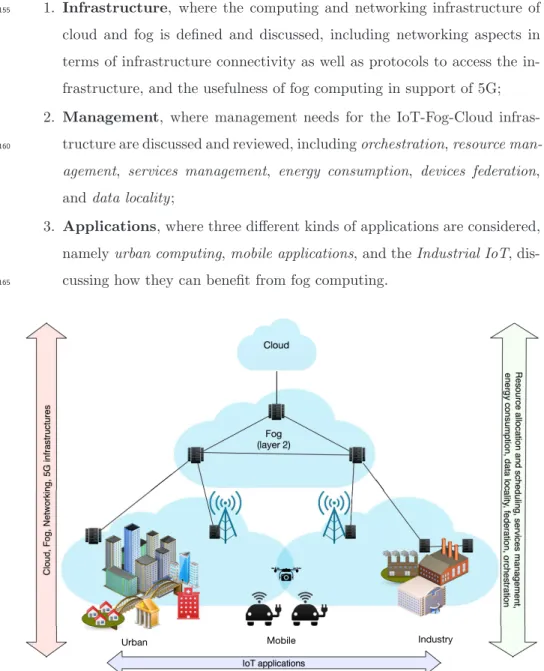
In this section we discuss and review three different facets of the IoT-Fog-Cloud hierarchy, as illustrated in Figure 1:
1. Infrastructure, where the computing and networking infrastructure of
155
cloud and fog is defined and discussed, including networking aspects in terms of infrastructure connectivity as well as protocols to access the in-frastructure, and the usefulness of fog computing in support of 5G; 2. Management, where management needs for the IoT-Fog-Cloud
infras-tructure are discussed and reviewed, includingorchestration,resource
man-160
agement, services management, energy consumption, devices federation, anddata locality;
3. Applications, where three different kinds of applications are considered, namelyurban computing,mobile applications, and theIndustrial IoT, dis-cussing how they can benefit from fog computing.
165 Mobile Industry C lo u d , F o g , N e tw o rki n g , 5 G i n fra st ru ct u re s R e so u rce a llo ca tio n a n d sch e d u lin g , se rvi ce s ma n a g e me n t, e n e rg y co n su mp tio n , d a ta lo ca lit y, fe d e ra tio n , o rch e st ra tio n IoT applications Cloud Fog (layer 2) Urban
Figure 1: Illustrative overview, within the IoT-Fog-Cloud infrastructure, of topics covered in this paper.
3.1. Infrastructure 3.1.1. Cloud and Fog
The infrastructure discussed in this paper is a composition of fog and cloud to support IoT applications, therefore constituting a three-tiered infrastructure. While IoT devices are concentrated at the edge of the network, fog devices are
170
distributed from the IoT device’s access point through the network core. The cloud is further away from the IoT sensors/actuators, requiring requests from the edge to traverse the public Internet to access cloud computing resources. As the fog infrastructure can be itself composed of different levels [13], the mid-layer of the IoT-Fog-Cloud infrastructure can offer a variety of levels of
175
quality of service [14]. Applications that have different requirements can be deployed and run on any device in this infrastructure composition, depending on their requirements. Moreover, application components can be distributed among devices at different levels of the fog depending on the application needs (e.g., latency, computing capacity, data locality).
180
Cloud computing services are based on centralized data centers, where com-puting capacity is offered over the virtualization of comcom-puting clusters deployed in buildings specially designed to host them. Hosts in the data center are often connected through Ethernet; different topologies for this interconnect are avail-able in the literature [15, 16]. Cloud users are usually not aware or concerned
185
about details of the data center network topology, even though this can have an impact on the application’s behavior. As the infrastructure management and control are provider’s duties, how this infrastructure impacts application should be reflected in the Service Level Agreement (SLA) established between providers and users.
190
Cloud data centers are large facilities deployed in a limited number of lo-cations due to special infrastructure requirements, such as space, power, and cooling, as well as due to the need for qualified workforce and the associated management costs. On the other hand, cloud users are scattered worldwide, and consequently many users are not geographically close to cloud data centers
of their preferred cloud provider. In the same way, IoT devices are scattered and may also be distant from the cloud; thus, the fog computing infrastructure can be closer to those devices to bring computing capacity with lower response time.
The fog infrastructure can be organized in a hierarchy among the edge
de-200
vices (IoT, mobile smart devices, etc) and the cloud data centers. The distri-bution (e.g., density or number of levels) of this hierarchy can vary from place to place, but the first level is expected to be located one hop away from the edge (user or device): at the access point (e.g., WiFi or cell phone antennas) or immediately above it. This would be the first (closest) offloading option for
205
devices at the edge, providing lower latencies even though with limited com-puting capacity. This single level of processing can be combined with the cloud to provide the necessary computing power for applications with heterogeneous requirements [17], but other fog levels may be added to enhance computing capacity closer to the edge and allow data processing/transit between devices
210
connected to different or distant access points. The multi-tier deployment of fog nodes may depend on the use case. The number of tiers of a fog system is determined by different factors, such as the characteristics of the workload to be processed, available capacities of processing nodes, number of sensors and actuators, and latency requirements. The workload on fog nodes is generally
215
related to the processing of latency-constrained jobs. The cloud can process heavy workloads and perform long-term storage of data.
It is common to designate the aforementioned hierarchy of computing capac-ity asfog nodes [18],cloudlets [19] ormicro data centers [20, 21]. Conceptually, the higher in the hierarchy a cloudlet is, the larger its processing/storage
capac-220
ity is, since it is expected to support more devices in the tree downwards the edge. On the other hand, cloudlets that are higher in the hierarchy are also ex-pected to present longer network delays to the edge. Therefore, the hierarchical composition of micro data centers (or cloudlets) along with the cloud provides a range of computing capacity at different geographical (and logical) distances
225
3.1.2. Networking and Fog Hierarchy
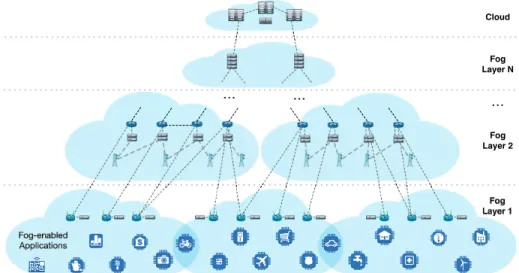
The connectivity between several tiers in the fog/cloud hierarchy can be possible thanks to several network technologies, including wired and wireless ones. Figure 2 illustrates this fog/cloud hierarchy connectivity.
230 Fog-enabled Applications … … Fog Layer 2 Fog Layer 1 Fog Layer N … Cloud
Figure 2: IoT-Fog-Cloud connectivity.
The functional unit of a fog computing system, i.e., the fog node, can be either a logical or a physical entity, embedding computing, storage, and also networking capabilities. Diverse devices can act as fog nodes, including net-working devices: routers, switches, wireless access points. Along with other fog nodes (e.g., video surveillance cameras and traditional servers) networking
235
devices can also enable the processing of tasks closer to data sources, providing increased performance and security critical to health, military, or emergency applications.
Data in IoT-Fog-Cloud infrastructures must traverse one or more tiers, con-nected by a fog network. The decision on how to connect different nodes depends
240
on a specific technological scenario. For example, a fog node used to process raw data from sensors will typically employ wireless connections, while a fog in a factory employed to monitor manufacturing processes is likely to use wired
connections.
The connection to the cloud is made by the Internet. It typically employs
245
optical links belonging to an Internet Service Provider that will connect fog nodes to the Internet while interconnection between different fog nodes are likely to be made by Ethernet-like protocols. Moreover, the network topology connecting different fog nodes will depend on how communication channels are placed a given area, and thus different topologies and network technologies to
250
connect fog nodes at the same or different layers can co-exist.
Wireless links may typically connect IoT devices to the fog since these devices often have only wireless interfaces. Wireless connections can also be employed in fog-to-fog or fog-to-cloud interconnections depending on the available infras-tructure. Cellular technologies (3G, 4G, 5G) are expected to be used in fog
255
computing systems. For example, an architecture for fog computing, named Telcofog, has been designed to integrate fog nodes in 5G networks [22]. In this architecture, a fog node can be created in an edge network and accessed by end-users using 5G connections.
Wireless LAN (WLAN) networks are also useful in the deployment of fog
260
nodes. Due to their limited range, they can be used in fog nodes for small build-ings or campus [23, 24]. Other wireless technologies for device-to-fog communi-cation include Wireless Personal Area Networks (Bluetooth, ZigBee, Infrared) and Near Field Communication. Moreover, multi-hop wireless transmissions to route data between sensors/actuators and the fog have also been proposed in
265
the literature [25].
3.1.3. Data collection and Protocols at the Edge
At the lowest level of an IoT network, it is expected to have hundreds or even more elements associated with each fog node. These elements may be sensors, actuators, or control nodes, which can range from relatively dumb devices, with
270
major processing capability constraints, to well-equipped nodes that can easily handle the full stack network protocols [26].
implement. Because of that, it is not possible to address this issue with an one-fits-all approach. To make matters worse, scenarios where fog and edge
275
computing best fit are those where data needs to be collected, analyzed, and acted upon within a few milliseconds. In the light of the above, the network protocols should accommodate the requirements of such communication pat-terns by providing the flexibility, scalability, and availability needed. This holds especially true for delay-sensitive applications.
280
Another important aspect in the IoT-Fog-Cloud hierarchy is that the com-munication technologies are going to be responsible to connect heterogeneous devices so that they can enable new smart services. The physical objects will be bridged together at the edge of the network to provide intelligent decision making capabilities by talking to each other, sharing information, and
coordi-285
nating decisions without human intervention. It is important to notice that a considerable amount of IoT nodes are power-constrained and need to operate in noisy or lossy communication links. Placing an excerpt of the intelligence at the fog level helps to reduce some of these device-related complexity constraints.
The most fitted network connectivity model may widely range depending on
290
the nodes location, purpose, and specifications [27]. Nodes may be connected through a wired network, for example, on a factory floor or other highly noisy environment. This connection is also a good option for static nodes that require very high throughput. One example of a communication protocol, in this case, is the Ethernet [28], with either copper or fiber links. On the other hand,
295
nodes with mobility or deployed at places without a pre-existing infrastructure can use wireless networks. Examples of communication protocols in the latter case are Wi-Fi [29], Bluetooth low energy [30], Z-wave [31], IEEE 802.15.4 (WirelessHART, ZigBee, ISA100.11a, MiWi) [32], just to name a few.
Another important advance in communications protocol technology is the
300
IPv6 over Low-Power Wireless Area Networks (6LoWPAN) standard [33]. This technology contemplates an adaptation layer between the network and link lay-ers to adjust the size of the packets, which are smaller in the IEEE 802.15.4 standard. In addition, it also implements several header compression techniques
to handle resource-limited devices. Moreover, the IPv6 allows having a much
305
larger address space and also the capability of establishing a direct external communication link between the devices without the need for a coordinator or a gateway to translate the messages [34].
Taking everything into consideration, having the sensors, actuators, and control nodes close together at the fog level brings several advantages. However,
310
several of them may not be capable of communicating directly with a fog node. Because of that, protocol abstraction layers are needed to logically connect all these elements as well as data collection and aggregation to consolidate the data. The main goal of data collection and aggregation is to use a centralized approach to gather all the data in an effective manner, which provides several
315
benefits [35]. First of all, because IoT elements are close to the edge nodes, the fog can act as the first front of access control and encryption as well as provide isolation and contextual integrity. Besides, it can also protect privacy-sensitive data [36, 37], by not allowing it to leave the edge. In addition, sensors often generate a huge volume of raw data in burst mode, i.e., there are peaks of data
320
transmission that fluctuate over time. By collecting this data and aggregating the results it is possible to reduce (if not eliminate) redundancy, which leads to a decrease in network communication cost [38]. This can also have a positive impact on the network lifespan, improve the energy consumption [39], prevent traffic bottlenecks, as well as enhance data accuracy by removing outliers and
325
misreadings [40].
Another advantage of this technique is to provide data locality. This means that it is possible to give context to the data and handle it where it makes the most sense. This allows making the decision process more efficient as it helps to act as soon as the raw data is converted into some meaningful context; further
330
information can be found in section 3.2.4. 3.1.4. An Infrastructure to Support 5G
Current developments in 5G are characterized by the orchestration of net-work resources to meet a wide range of services, broadly classified into three
categories: enhanced mobile broadband (eMBB), ultra-reliable and low-latency
335
communications (URLL), and massive machine-type communications (mMTC). While a fog/cloud computing hierarchy plays a role in all three, IoT services are generally considered under the mMTC heading. The idea is that a 5G operator will be able to slice the network, provisioning each slice to meet the very diverse needs of the three types of service, in terms of latency, reliability, throughput,
340
scalability, and mobility support. A slice, in this context, can be thought of as a virtual network, whose resources are provisioned for a particular service or class of service and isolated from other slices that share the same physical infrastruc-ture. They are expected to be one of the key resources in 5G networks [41], by providing a holistic end-to-end virtual network for a given user, so-called
345
tenants. This means that the physical mobile network will have its resources partitioned and customized according to the system needs [42]. The outcome is a more flexible, reliable, scalable, and secure network. Using these technologies, in many situations, the networks will be able to reconfigure slices within seconds to quickly respond to local demands, such as an unexpected gathering of people
350
or to prioritize emergency systems. On the other hand, it is also possible to program a long-term lease, for example, to an electrical utility company to ac-commodate its smart grid components such as meters, sensors, controllers, and other IoT devices. A short-term lease is also feasible, for example, when a public venue or a concert promoter wants to have a dedicated slice for a weekend-long
355
festival and optimize it for streaming high-quality video and music data. While it is possible to envision a network slice to support a particular IoT service throughout the fog hierarchy, it is the ability to combine and process vast amounts of data in the cloud, originating from multiple IoT services through the fog, and to apply machine learning techniques to those data, that opens
360
up potentially revolutionary progress in a myriad of fields, from healthcare to precision agriculture.
Edge devices in IoT are often resource-constrained in energy storage and processing capabilities. The combination of cloud and fog computing pro-vides some relief to these limitations, meeting requirements of 5G such as
distributed real-time processing and runtime adaptability [43]. As the fog com-puting paradigm emerges, the development of 5G architectures with fog support started to appear. For example, fog radio access network (F-RAN) was proposed to combine communications and computing operations for 5G [44].
One of the intrinsic challenges then becomes how to achieve the low latency
370
requirements of real-time IoT services. Recent work suggests the adoption of a hybrid fog/cloud solution in order to support latency-sensitive IoT services [45, 46]. The impact of the lack of processing power on the delay performance of an IoT service that relies on voice and gesture commands from the end-user to control a set of lights in a smart home or office has already been demonstrated
375
[47].
3.2. IoT and Fog Management
3.2.1. Resource Allocation and Optimization
Resource allocation has been a challenging problem in distributed systems and, as novel infrastructures appear, new variables must be considered. Data
380
about application requirements and infrastructure characteristics are taken as input to optimize an objective function in order to map applications to the resources available in the infrastructure. A scheduler is the entity responsible for running an optimization model that takes those data as input and generates an application schedule into resources as an output trying to maximize or minimize
385
a single objective or a set of (conflicting or not) objectives.
As the scheduling problem is NP-Complete in general [48], many different techniques to model and solve it have been proposed in the literature [49]. Notwithstanding, with the emergence of IoT, a plethora of devices and ap-plications have been suggested, bringing the heterogeneity in both application
390
requirements and infrastructure characteristics to unprecedented levels. The scheduling literature in distributed systems shows that scheduling models and optimization techniques are sensitive to applications and infrastructure charac-teristics [50]. Therefore, when heterogeneity becomes the norm, as it is in IoT, schedulers should be able to adapt to different scenarios, or multiple
ulers should coexist to handle optimization models with different characteristics and/or objectives.
Currently, IoT applications commonly rely on cloud computing to process and store data. Resource allocation in cloud computing can be seen from two different perspectives: (i) allocation of resources within the cloud provider’s data
400
center; and (ii) allocation of applications to services offered by cloud providers. Perspective (i) is often referred to as a VM placement problem, which is an optimization problem that aims at distributing virtual machines in a data cen-ter [51, 52]. Objective functions common for the VM placement problem are to maximize the utilization of the data center, minimize network traffic, and
405
minimize energy consumption [53, 51, 52]. Perspective (ii), often referred to asapplication scheduling, is concerned with matching application requirements with services by taking into account application requirements and service level agreements from cloud providers. Common objectives in application scheduling are minimization of the execution time [54] and minimization of costs [9], as
410
cloud computing services charge on a pay-per-use basis.
Fog computing is expected to fulfill requirements that cloud data centers are not able to, but yet rely on the cloud when such requirements do not exist or are not mandatory. In this sense, with fog models and architectures under dis-cussion in the literature, research on schedulers that take fog infrastructures as
415
input has been carried out in the last few years [55, 2]. One of the main questions that arise is how to distribute heterogeneous data, jobs, and services throughout the fog/cloud hierarchy in a way that application requirements are met and in-frastructure utilization is efficient, avoiding bottlenecks as the resources closer to the edge in the fog infrastructure are constrained. In the IoT landscape,
420
requirements such as latency can play an important role in the scheduler de-cision making, thus being a determinant of where applications should run [5]. Moreover, the combination of heterogeneous applications with mobility has also been the focus of attention lately [2], as dynamic demands on edge nodes call for dynamic approaches to redistribute the load in the fog/cloud hierarchy.
3.2.2. Serverless Computing
The new computing systems that are being proposed have to be able to handle a myriad of heterogeneous devices, which can often have different com-putational capabilities. Furthermore, there is a varying network, data commu-nications bandwidth, and latency available closer to a data center compared to
430
the network edge. Understanding which services should execute on a cloud data center and which on the edge devices remains a challenge.
The serverless perspective focuses on the provision of computational func-tions, with limited resource requirements, that can be deployed closer to user devices such as AWS Lambda, Google Cloud functions, and Microsoft Azure
435
functions. In these systems, the functions are triggered based on user-defined events. In the AWS case, it can use of a number of other AWS services, such as DynamoDB and S3, just to cite a couple. AWS lambda involves hosting such functions using Amazon CloudFront, which means that it will be used by a data center in close proximity to the data source. A key benefit in adopting these
440
approaches involves rapid deployment of lambda functions as well as the limited resource needs for executing them. This approach has received significant trac-tion for real-time data streams processing. By doing that, a data feed can be shared and distributed for processing across multiple functions through AWS Kinesis. The serverless approach also modifies the traditional public cloud
sys-445
tems approach, from batch-oriented processing to a close to real-time processing of data.
Serverless computing is expected to grow across the IoT-Fog-Edge-Cloud systems as an extension of current cloud-based implementations to support IoT applications. In this direction, EdgeScale [56] aims to implement a serverless
450
computation model that enables scalable and persistent storage services to be scattered through a data center hierarchy, thus compatible with the fog com-puting architecture. The focus of EdgeScale is to enable automatic application state movement through the hierarchy considering that applications can run at different levels depending on user needs and current network status.
In the same direction, the Osmotic Computing (OC) [57] focus has been on developing microservices which can be migrated from cloud data centers through the fog/edge driven by performance and/or security constraints. The OC model specifically focuses on creatingmigratable hosting environments for microservices that can be moved dynamically, taking account of device specific
460
characteristics of edge resources. It suggests the use of frameworks such as JaJa, Fabric8, and PXE for hosting container-based deployment of microservices to support latency-sensitive applications. It also suggests the use of a serverless style of processing, however, the processing functions are deployed using mi-gratable containers. Many serverless capabilities currently available also rely
465
on vendor specific solutions (e.g., AWS lambda), which are hard to generalize across vendors. On the other hand, the OC perspective is vendor-neutral, re-lying on identifying a function hosting approach that can be shared between different vendors.
3.2.3. Energy Consumption
470
There are two key aspects to be considered when discussing energy consump-tion in relaconsump-tion to IoT-Fog-Cloud computing. On one hand there is a plethora of studies that argue for the benefits that IoT can bring in reducing energy con-sumption in various settings [58, 59, 60, 61]. Some of these benefits in terms of energy are also discussed later in the section on Urban Computing. On the other
475
hand, however, there are strong indications that, on their own, IoT-Fog-Cloud technologies may lead to additional pressures in energy consumption. Clearly, a full evaluation would need to weigh costs and benefits: a small increase in IoT or cloud energy costs may be offset by significantly higher savings in the domains where these technologies are applied. To the best of our knowledge there has
480
been no such holistic assessment in the literature but it may take some time until comprehensive studies in this respect may be produced.
Pressures in energy consumption can be addressed at primarily three levels: (i) hardware and infrastructures in general; (ii) systems software; (iii) data management. In terms of hardware and infrastructures it is useful to distinguish
between work to produce energy-efficient chips or devices and work at a level that considers infrastructures built with multiple such chips or devices. The former consists of various energy-efficient architectural features that may include techniques for voltage scaling or cooling [62, 63, 64, 65, 66]. The latter includes the large body of work aiming at minimizing the energy cost of running
large-490
scale infrastructures, data centers in particular [67, 68, 69, 70].
A number of researchers have focused on systems software issues, partic-ularly resource management. As IoT-Fog-Cloud platforms typically consist of multiple and heterogeneous resources, efficient use of such resources can make a significant impact on energy. In fact, energy has often become a key
consid-495
eration in a variety of mapping and resource allocation techniques [71, 72, 52], with some work focusing on resource management for specific applications or services [73, 74, 75, 76]. Somewhat orthogonally, the energy consumption im-pact of different programming languages has been assessed in [77]. It is expected that this line of research will intensify in the broader IoT-Fog-Cloud context.
500
Significant energy savings could be obtained by carefully managing the large size of data that IoT-Fog-Cloud applications may potentially generate. Differ-ent approaches may include: (i) algorithms for energy-aware data transfer [78]; (ii) algorithms that trade computation with communication, as in [79], possibly using strict energy consumption objectives to balance this trade-off; or (iii)
al-505
gorithms that limit the amount of data that could potentially be produced and transmitted through network links using some sort of satisfaction criterion [80], which may also include energy consumption thresholds that should not be ex-ceeded. Overall, handling data in an economical manner and avoiding costly communication as much as possible in the IoT-Fog-Cloud continuum (see next
510
section) may lead to significant energy savings. 3.2.4. Data Management and Locality
In recent years, there has been a considerable increase in the creation and consumption of data, which has reached unprecedented rates. As a result, data management and locality have been gaining significant attention lately.
These concepts have been researched in different contexts in cluster, parallel and distributed computing in the past. However, they had not been adopted to geo-distributed data centers such as Cloud-Fog-Edge computing, until re-cently [81, 82, 83]. In principle, the two concepts refer to the capability of organizing and maintaining data-related processes, which include acquiring,
pro-520
cessing, distributing, storing, protecting, and validating information.
Data management involves the design and deployment of policies, architec-tures, and procedures allowing the accurate management of the full data lifecy-cle. It broadly relates to two generic strategies, the placement strategy and the access strategy [84]. The first one defines where and how the data should be
525
distributed. This includes defining how many copies should be made and what the best nodes are to store these copies. The second one prescribes how the read and write operations are going to be handled by the system. This strategy has to take into account consistency among the distributed copies and how each copy is going to be accessed through the network.
530
Data locality is related to the capability of moving the computation close to where the actual data is being created or acquired, rather than transferring large amounts of data to a centralized computational resource [85]. This concept goes against pushing all the indiscriminate raw data directly to the cloud. This is based on the fact that it is cheaper, in terms of network resources, and more
535
efficient to move and execute a computational application near to the data it operates on. This is one of the main premises of the fog computing: to have a decentralized system with resources close to the end-users [86]. This is especially true if the data to be analyzed is considerably large. In doing that, it is possible to reduce the core network congestion and decrease the latency, as well as to
540
improve the overall throughput of the system [87].
Nowadays, data-intensive applications are increasingly relying on geographi-cally distributed resources to store and process information. Several frameworks have been proposed to make an efficient use of large computational clusters pro-viding massive data processing capabilities. The MapReduce framework [88],
545
This means that the jobs are divided into several tasks and then dispatched to the node which has the data to be processed. Doing this reduces the network overhead by avoiding unnecessary data movement and improves the individual job feedback time within a cluster, as well as decreases the latency [89, 90].
550
In fog computing, data locality issues have been addressed more recently, indicating that data storage at the edges in a fog can improve response time and reduce network traffic [91]. Another positive aspect of data locality in fog computing is the enhancement of security- and privacy-related issues [92]. By operating locally, it is possible to have an accurate knowledge of the gateways
555
and easily implement authentication and authorization features. At the same time, because the data and the processing nodes are close to each other, the information does not need to be moved around, thus facilitating privacy [93]. 3.2.5. Orchestration in Fog for IoT
As mentioned earlier, the fog can be organized in multiple layers and spread
560
throughout different entities creating a highly dynamic, large-scale, heteroge-neous and complex scenario. Within this ecosystem new challenges arise in terms of dynamic resource management and orchestration functions. These challenges are being addressed in different ways in the literature, as described in this section.
565
The main objective of orchestration functions comprises the dynamic man-agement of resources considering applications requirements and the related workloads characteristics, which, in many cases include a transient operational behaviour. Fog resources are manifold involving basic sensors, CPU and mem-ory components, virtual machines and virtual network functions, as well as
570
network and applications services and micro-services. The role of fog orches-tration is thus to guarantee the proper functioning of all these resources while guaranteeing security and an adequate application performance level.
To achieve its objectives, a fog orchestrator must perform the following func-tions [94]:
575
to decide which applications should be executed where and when [95, 96]. To fulfill this goal a range of information must be considered, such as applications requirements, resource availability and mobility patterns, as discussed in Sections 3.2.1 and 3.3.2. In the edge, the orchestrator should
580
also make the scheduler aware of the need for migration of tasks and data.
• Discovery and allocation – To support scheduling, it is of utmost
impor-tance that the orchestrator has updated information about the resources and devices in the fog [2]. In addition, resource allocation must be per-formed according to optimization criteria that suit applications
require-585
ments. Multiple trade-offs arise in this context due to the complexity of the functions involved; the updated information provided by the orches-trator drives the scheduling algorithm towards the optimization function. Several fog orchestrators have been proposed in the literature with different objectives, such as reducing latency, improving resilience, ensuring security and
590
privacy, among many others, as summarized next.
GA-Par (Genetic Algorithm Parallel) has been conceived to manage IoT application composition using a genetic algorithm [86]. The main application requirements considered were security and network QoS. Although this work provides insights towards orchestration, it presents scalability issues
highlight-595
ing the challenges associated with dynamic adaptations within fog-based IoT orchestration.
The ECHO middleware platform provides orchestration capabilities for data flow composition over distributed resources, including edge, fog and cloud [97]. In addition, ECHO also supports task migration, which is fundamental to adapt
600
to the dynamicity of these systems. However, the proposed approach has a centralized nature which limits its applicability in large-scale systems as well as its resilience.
Overcoming the well-known limitations of centralized approaches, CF-Cloud Orch (Cloud Fog Orchestration) proposes a distributed solution for cloud
orches-605
The main management functions supported include security, scheduling and load balancing. Although the proposed architecture aims to be scalable, the paper does not present results to support such an objective.
A new trend to address the challenges of fog environments combines
or-610
chestration with choreography [99]. This hybrid approach resorts to service orchestration for resource management between the fog and the cloud and ser-vice choreography for resource management between the IoT deser-vices and the fog. On one hand, with the orchestration approach it is possible to have a global view of the environment and to efficiently use and manage the fog/cloud
615
resources. On the other hand, a finer view of the choreography supports more efficient localized decisions.
In addition to the related work presented above, there are several initia-tives for the standardization of management and orchestration functions in fog environments. The European Telecommunications Standards Institute (ETSI)
620
has ongoing efforts in the Mobile Edge Computing (MEC 1
), and NFV Man-agement and Orchestration (MANO2
) technical committees. In addition, the OpenFog Consortium has designed an architecture for fog computing which has been adopted by IEEE [13]. Two fog orchestration architectures that closely fol-low the activities of these standardization bodies have been proposed within the
625
context of 5G networks [100, 101]. While the first paper is still at architecture level, the second paper has been assessed in a smart cities scenario comprising autonomous fog node management, data analysis and decision making function-alities.
3.2.6. Applying Federation Concepts in Fog and IoT Environments
630
The Internet of Things and the notion of fog computing is the natural evolu-tion of interconnectedness that is part of this integrated fabric that is touching every aspect of academia, industry, government and culture. This
intercon-1
https://www.etsi.org/technologies-clusters/technologies/multi-access-edge-computing 2
nectedness is being driven by the need to collaborate, i.e., to share data and resources. In more established computing environments, this has led to the
de-635
velopment of networked communications, the World Wide Web, and all manner of social media.
As pervasive as the technologies are, there has still been a need to manage shared resources in a more intelligent, comprehensive manner that is less ad hoc. This has given rise to the concept of federation. In short, a federation is
640
a security and collaboration context wherein participants from different organi-zations and administrative domains can jointly define, agree upon, and enforce joint resource discovery and access policies [102]. It is clear that fog computing environments and IoT devices will ultimately need some type of federation to manage how different sets of data producers and data consumers can collaborate
645
and share data.
Just as one example, consider a smart electric vehicle on a road trip. Will the vehicle owner authorize a local power company to monitor the geographic location and current charge of the vehicle to (a) direct the vehicle to an appro-priate charging station when it needs to recharge, and (b) ensure that sufficient
650
electrical power is available at the charging station at a given cost? This one example includes multiple aspects of policy, authorization, trust and also mo-bility. The vehicle owner may have authorized their “home” power company to monitor charge, but another entity may have to be authorized to monitor location and share this information with the power company. The home power
655
company may have to delegate the responsibility for re-charging to the “local” power company wherever the vehicle actually happens to be. This local power company may have to report the charging cost to the home company such that the vehicle owner can be billed appropriately. All of this needs to be securely managed such that the vehicle owner can manage their privacy as desired, and
660
that electrical power production and consumption is efficiently managed and fairly paid for. In general, federations can provide the virtual context wherein such policy agreements can be made and enforced.
articu-lated in the NIST Cloud Computing Technology Roadmap [103] asRequirement
665
5: Frameworks to Support Federated Community Clouds. The concept of using federation to manage collaboration, however, is not cloud-specific. Over the last fifteen years or so, a tremendous amount of work has been done to support different aspects of federations, and for different specific use cases. Systems such as InCommon [104] and eduGAIN [105] were developed to enable
meta-670
data about Identity Providers and Service Providers to be exchanged among participating organizations. The Interoperable Global Trust Federation [106] was formed to develop trust criteria and enable IdPs to be trusted among par-ticipating organizations. Globus Auth [107] was developed whereby IdPs and SPs can be managed with more structure, and a user’s Globus Auth credentials
675
can be delegated to a third-party SP to act on behalf of the user. There are many more examples, but a more complete review is outside the scope of this paper.
While certainly important and widely used, these systems were also devel-oped in anad hocmanner. Different deployment and governance mechanisms
680
are static and “baked-in” to their designs and operation. While standards, such as SAML, OpenID, OAuth, and OpenID Connect, are used for their specific purposes, the federation capabilities themselves are not built to any standards. To address this issue, NIST and the IEEE formed a Joint Federated Cloud Working Group [108]. The NIST goal is to clearly define thefederation design
685
spacein a Reference Architecture that identifies the major actors involved in general federations and how they can and must interact. (See [109] for more de-tails.) Areas of desirable,federation-specificstandards would be taken through the international process by the IEEE.
Clearly the vast majority of work done in federation has been done in
es-690
tablished computing environments. The question at hand ishow well can these unifying, federation concepts being developed by NIST be applied in fog com-puting environments and IoT devices? IoT devices will be numerous, highly distributed, and typically operated in resource-constrained environment. The termfog computingwas coined to denote computing resources that are “closer
to the ground”. As such, fog computing is commonly described as having a three-tier model of cloud resources, fog nodes, and IoT edge devices [87, 110].
All of these computing resources and devices will exist in inherently dis-tributed environments and could have different owners. Owners will typically want to manage how their data is produced, how it is collected, how it is
con-700
sumed, and by whom. As such, these resources, devices and data will be man-aged in differentadministrative domains. However, as much as any other or-ganization in a connected world, IoT device and data owners may have strong motivations to collaborate and share data with other organizations.
The core goal of the NIST/IEEE Joint WG is to clearly define how the
705
sharing of resources and data can be done across administrative domains in a general, standardizable way. The key concept is the ability to establish and man-agevirtualized administrative domains that may span multiple organizational administrative domains. Such virtualized domains arefederations.
The draft NIST Cloud Federation Reference Architecture [109] is based on
710
the notion of a Federation Manager (FM). This FM is capable of a specific set of fundamental capabilities to support federations. However, FMs can be deployed singly or large groups in a wide range of deployment and governance models. The choice of deployment and governance model can be driven by the requirements of the application domain. These models are described by the
715
following properties:
• Deployment/Scale Properties
– Internal vs. External FMs.
– Centralized vs. Distributed FMs.
– Simple vs. Large/Arbitrary Communication Topologies.
720
– Homogeneous vs. Heterogeneous Deployments.
• Governance Properties
– Implicit vs. Explicit Trust Relationships.
– Federated Identity.
725
– Roles/Attributes.
– Federated Resource Management:
∗ Discovery.
∗ Discovery Policies. ∗ Access Policies.
730
– New Federation Member Vetting/On-Boarding.
– Accounting/Auditing.
– Federation Discovery.
It should be clear that federation deployments can range from very sim-ple, single FM deployments, to global-scale, hightly distributed deployments.
735
Likewise, the governance properties may be greatly simplified. In some cases, the need may just not exist. For example, simple federation deployment may not need to have a general federation discovery mechanism. When federations become more common and widely deployed, however, having such a discovery service would be very useful. Simple, small-scale federations may also have no
740
need for accounting and auditing. Federations could also operate using out-of-band methods for agreeing on identity credentials, roles/attributes, resource discovery, and resource access policies. As federations become larger and involve more amounts of significant resources, then more formal methods for addressing these governance requirements will need to be in place.
745
These deployment and governance properties will take on additional dimen-sions when considering fog and IoT environments. In a three-tier model, IoT devices will typically be designed for minimal power requirements. As such, they will typically not have any extra capacity for hosting the federation properties itemized above. Fog nodes could host these functions, depending on their actual
750
capacity. Fog nodes could possibly run their own, internal FM, but could also simply act as a client to an external FM that is hosted in a fully functional data center. If a fog node is only managing a small number of IoT device types, then it may be possible that roles/attributes and resource discovery/access policies
can be statically defined out-of-band. In any case, scale will certainly be an
755
issue. A fog node will have a finite capacity that will define how many IoT devices it can manage and how it can manage the sharing of data with external data consumers.
3.2.7. Trust Models to Support Federation in Fog and IoT Environments The fundamental requirement for all of these deployment and governance
760
properties, however, is having a trust relationship among the administrative domains, i.e., federations. Once trust is established, the governance mechanisms can be put in place. Hence, how federations can be managed in fog and IoT environments will depend on how trust can be managed. This leads us to our central question: What are the possible ways of managing trust, and how well
765
would they work in fog and IoT environments? We review here a number of ways of looking at this issue.
Implicit Trust. For completeness we note that informal federations can be formed usingimplicit trust. That is to say, if two or more organizations already have a working relationship, an implicit trust relationship already exists. Based
770
on such implicit trust, these organizations can easily configure their Federation Managers to interact with each other, and support useful collaborations. An example of this is the OpenStack Keystone OS-FEDERATION API extensions [111]. The administrator of a Keystone deployment can configure their Keystone to trust another Keystone either as an IdP or SP.
775
Trusted Identity Providers. More formal federations rely on trusted Identity Providers. The Interoperable Global Trust Federation (IGTF) was created to facilitate this reliance on a global scale [106]. IGTF defines a mini-mum set of requirements and recommendations for the operation of Public Key Infrastructure (PKI) Certificate Authorities. IGTF maintains a set of
authenti-780
cation profilesconcerning things like attribute assertions and attribute release. Once an IdP demonstrates that it complies to IGTF requirements, then other organizations will trust the certificates signed by that IdP.
CILo-gon. InCommon [104] maintains a metadata catalog of IdPs and SPs that were
785
vetted when added to the catalog. Globus Auth [107] can rely on InCommon and other IdPs to managelinked identities. CILogon [112] (which lives within the InCommon ecosystem) can rely on 80+ different IdPs when providing feder-ated PKI certificates to users based on their home identity. Organizations such as XSEDE, OSG, and LIGO all rely on CILogon certificates to make data and
790
services available to their users, based on CILogon certificate attributes. The G´EANT Trusted Certificate Service (TCS) performs a similar function, but within the realm of G´EANT services [113]. TCS runs the Trusted Aca-demic CA Repository (TACAR), which hosts the PKI trust anchors needed for G´EANT services such as eduroam, eduGAIN and perfSONAR. We note that
795
IGTF has accredited most of the CA root certificates hosted by TACAR.
Blockchain. A Blockchain is a replicated ledger that uses cryptographic techniques and consensus algorithms to build trustworthy systems in an other-wise trustless world [114]. A blockchain is simply, as the name implies, a chain of blocks, or data structures. Each block contains a cryptographic link to the
800
previous block. Each block consists of a header and content. The header con-tains a link to the previous block, a time stamp, and a Merkle hash value. The Merkle hash value is cryptographically linked to the entire contents of the tree. The blockchain “magic” happens in how new blocks are added to the chains, i.e., how a consensus algorithm is used to establish agreement among
partici-805
pants for adding a new block. Proof of Work is the most common consensus mechanism used in blockchain implementations. This proof of work in early blockchain implementations required blockchain miners to experimentally de-termine which cryptographic nonce makes the hash of its current header fit the current target. Proof of Stake gives advantage to those miners that have a
810
larger stake in the blockchain ecosystem. The Practical Byzantine Fault Tol-erance (PBFT) algorithm provides a lower latency mechanism where arriving messages are signed, and if enough identical messages are received, then con-sensus is achieved. Other concon-sensus algorithms are possible that all have their pros and cons with regards to cost, throughput and scalability.
Named Data Networks. Named Data Networks (NDNs) or Information-Centric Networks (ICNs) represents not only a different way of managing com-munication, but also trust. Rather than managing communication based on fixed machine addresses, i.e., IP addresses, all communication is based on a hi-erarchical name space. The NDN concept was, in fact, developed to address IoT
820
requirements with billions of diverse devices with relatively small data messages, yet in massive volumes in a resource-constrained environments [115].
In NDNs, anInterest packetare issued for a given name path that are routed among NDN Forwarders. When the named data is found, a Data packet is returned. A key design principle of NDNs is that all data packets are encrypted.
825
Rather than relying on a secure channel or session, NDNs encrypt all packets and manage the key distribution such that only entitled users can decrypt the appropriate data packets. Attribute-based encryption approaches can be used whereby the keys used to encrypt and decrypt a ciphertext are derived from the data access policy [116, 117].
830
A method of automating the decision about which keys can sign which data and how signature verification can be done is discussed in [118]. This process is facilitated by the use of trust schemas which are defined by a set of trust rules. Within the name space, each trust rule defines a relationship between the name of the data and its signing keys. This could be through a shared prefix,
835
shared suffix, or common name elements at specific positions. We note that trust schemas must nonetheless reference one or more trust anchors that are pre-authenticated using out-of-band mechanisms.
Aside from federations based on implicit trust, we note that all of the other trust mechanisms rely on cryptographic methods of some sort. While implicit
840
trust relationships may be feasible for some applications, in general, stronger trust and security mechanisms will have to be used. For completeness, we can considerreputation systems[119], but these must also rely on establishing iden-tity of one type or another. It is claimed that reputations can be established even for anonymous parties as long as they can be recognized from one
action to the next. Nonetheless, reputation systems only provide was can be calledsoft securitywhich will be insufficient for most fog and IoT domains.
Hence, in general, most federations will employ cryptographic methods to establish identity and trust. This implies that applying federation techniques to managing fog and IoT devices will require a sufficient degree of computing
850
resources to support cryptographic or consensus operations. It is reasonable to assume that fog nodes will be capable of this, while IoT devices themselves will not be. This implies that security between the fog nodes and the IoT de-vices must be secured at the hardware communication level. On the fog node, however, a number of different trust mechanisms could be employed that, in
855
turn, enable a number of federation governance models. This does, however, raise some fundamental questions: How lightweight can cryptographic methods be made such that federation mechanisms can be moved further “down the stack” to less powerful and capable fog nodes, and closer to the IoT devices themselves? Likewise, since different deployment and governance models can be applied to
860
different federation instances,can more lightweight models be devised that min-imize the need for cryptographic operations? These are outstanding issues for using federations to manage fog and IoT environments.
3.3. Applications 3.3.1. Urban Computing
865
Urban computing is the process of acquiring, integrating and analyzing a large volume of heterogeneous data produced by various sources in urban spaces; for instance, sensors, vehicles and human beings to tackle various problems that cities face such as air pollution, public safety, urban mobility, lack of water and increased energy consumption. Thus, one of the main objectives of that area is to
870
help improve the quality of life of people living in large urban environments [120]. In this context, fog computing is expected to help in data processing and storage for knowledge extraction to solve long- and short-term urban-related problems. According to the United Nations, nowadays, 55% of the world’s population live in urban areas, a proportion that is expected to increase to 68% by 2050.
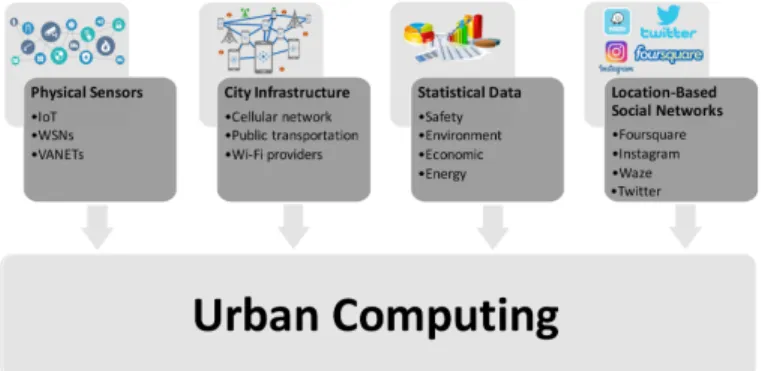
Consequently, there is an enormous pressure on providing the proper infrastruc-ture to large cities, such as transport, housing, water, and energy. To understand and partly tackle these issues, urban computing combines various data sources such as those coming from the Internet of Things (IoT) devices [121]; statis-tical data about cities and its population; and data from location-based social
880
networks (LBSN) [122, 123, 124]. As fog computing provides a scattered set of fog nodes throughout the urban environment, real-time identification of issues can be supported. For example, urban surveillance can be supported by fog computing to automate and improve public safety, supporting requirements of real-time information processing and decision making [125].
885
Urban computing aims to understand the aspects of the urban phenomena and also provide estimates about the future of cities. It is an interdisciplinary area, and in the context of computer science, urban computing intersects with sensor networks, computer networks, vehicles networks, social networks, dis-tributed systems, and artificial intelligence. As urban computing is fairly
com-890
prehensive, a possible way of classifying research efforts in this area is through the data considered. Figure 3 illustrates the main data sources used by studies in the area of urban computing. Most typical urban data sources can utilize fog nodes to process and transfer data between them or to the cloud for long-term storage or further processing.
895