Volume 2, Special Issue 1 MEPCON 2015 Available online at www.ijiere.com
International Journal of Innovative and Emerging
Research in Engineering
e-ISSN: 2394 - 3343 p-ISSN: 2394 - 5494
The Emissions Analysis of Diesel Engine Using
GarciniaIndica and Rice Bran Oil Based Methyl Esters as
Fuels with an ANN Approach
M H Attal
a, A M Mahalle
ba Asst. Professor at Department of Mechanical Engineering, SCOE, Pune, India, [email protected] . bAsso.Professor, General Engineering Department, LIT,Nagpur, [email protected]
ABSTRACT:
On the face of the upcoming energy crisis and increasing pollution, lot of efforts are being carried out throughout the world to find out environment friendly as well as cost-effective fuels as an alternative to petroleum derived fuels. Indian economy is mainly dependent on agriculture and the country satisfies almost all petroleum demand through imports. The evaluation of Fatty acid methyl esters also called as biodiesels derived from edible as well as non-edible vegetable oils alternative engine fuels is of great importance. The scope of the present study is to initially analyze the performance and emission characteristics of multi-cylinder diesel engine using GarciniaIndica (kokum) oil and Rice bran oil methyl esters as fuels. The later part of this study deals with development of an Artificial Neural Network (ANN) model of the diesel engine as a tool for accurately predicting its performance and emissions when operating on aforementioned biodiesels as fuels. In this paper study & usability of GarciniaIndica (kokum) oil was examined and presented.
Keywords:Garcinia Indica oil methyl esters; Rice bran oil methyl esters, Artificial Neural Network
I. INTRODUCTION
Fossile fuels are one of the major sources of energy in the world today. Their popularity can be accounted to their easy usability, availability and cost effectiveness. The alarming increase in worldwide demand of these fuels having limited reserves is of great concern owing to rapid depletion of the reserves. A developing country like India depends mainly on imported fuels due to lack of fossil fuel reserves and it has a great impact on economy. Also the combustion of fossil fuels in internal combustion engines emits various harmful emissions like carbon dioxide (CO2), carbon monoxide (CO) nitrogen oxide (NOX) unburned HCs etc which have detrimental effect on entire environment.
The above reasons urge search for alternative fuels that are inexpensive, abundant and environmentally friendly which can be used in existing engines without any or with minor modifications. Country like India having vast vegetation and land availability, bio-diesel has come up as a promising alternative fuel. In recent years, lots of research has been done to investigate use of tranesterified edible as well as non edible vegetable oils such as Sunflower, Peanut, Olive, Soya bean, Rapeseed, Pongamiapinnata ,Cottonseed, Jathropa, etc as alternate fuel for diesel engine.
II. LITERATURE REVIEW
A.E. Atabani et.al. [1] have laid emphasis on various aspects associated to non-edible oil feedstocks like Jatrophacurcas, Calophylluminaphyllum, Pongamiapinnata, Madhucaindica, Sterculiafeotida, Rubberseed etc. for the biodiesel production. Lin Lin et.al. [2] reported successful production of biodiesel by transesterification of crude rice bran oil (RBO). Anand Kumar Pandey and M R Nandgaonkar [3] investigated the effects of use of Karanja oil methyl ester biodiesel on performance, emission and wear of 118kW, six cylinders, diesel engine in comparison with the petroleum based diesel. Their study affirmed 35% lower wear of metal parts when engine was operated with biodiesel as compared to petroleum diesel along with decrease in CO and UHC emissions.
Volume 2, Special Issue 1 MEPCON 2015 toolbox available in MATLAB platform made prediction with MSE (Mean Square Error) error obtained as 0.0004. Yusuf Çay et.al. [5] investigated the use of ANN (artificial neural network) modelling to predict brake specific fuel consumption (BSFC) and air-fuel ratio (AFR) along with exhaust emissions that are carbon monoxide (CO) and un-burnt hydrocarbon (HC) of a spark ignition engine operating on methanol and gasoline. The values obtained using ANN model were within acceptable error limits (±5%). Jatinder Kumar et.al. [6] have proposed Artificial Neural Network (ANN) approach as an potential tool for estimation of properties of diesel-biodiesel blends as against tedious and time consuming experimental work .
The present work investigates the suitability of Kokum and rice bran oil biodiesel as an alternate fuel and application of Artificial Neural Network as a tool for predicting the values of output parameters of a diesel engine using the same as biodiesel with some input parameters.
III. ENGINE SETUP
Figure 1 shows the schematic representation of diesel engine testing facility available for studying the engine performance and emission characteristics. The research engine used in the present study is three cylinders naturally aspirated diesel engine.
Fig.1 : Engine Setup
The engine was loaded by hydraulic (water brake) dynamometer. The value of exhaust gas temperature is measured using K type thermocouple during the experiments. Engine speed was measured with an optical speed sensor. The values of engine speed and exhaust gas temperature could be observed at the display panel.
A special fuel system was designed so as to run the engine on diesel fuel as well as the biodiesel and its blends such that the fuel consumption could be measured
IV. FUEL PROPERTIES
Before applying for a use as a commercial fuel, the prepared biodiesel must be analyzed using sophisticated analytical equipment to ensure it meets ASTM specifications. The instruments for testing of various properties are made available at the laboratory facility of IBDC, Baramati. Some of the properties of the tested biodiesel are given in table 2.
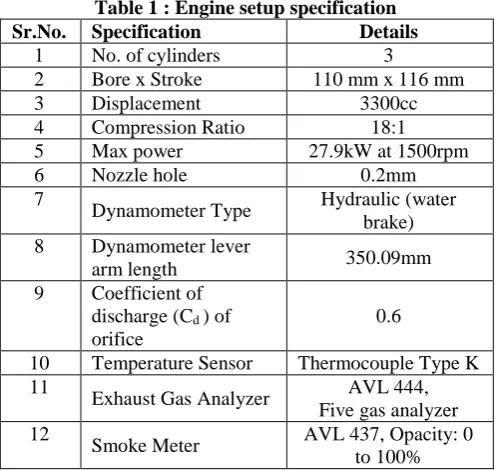
Table 1 : Engine setup specification
Sr.No. Specification Details
1 No. of cylinders 3
2 Bore x Stroke 110 mm x 116 mm
3 Displacement 3300cc
4 Compression Ratio 18:1
5 Max power 27.9kW at 1500rpm
6 Nozzle hole 0.2mm
7
Dynamometer Type Hydraulic (water brake) 8 Dynamometer lever
arm length 350.09mm
9 Coefficient of discharge (Cd ) of orifice
0.6
10 Temperature Sensor Thermocouple Type K 11
Exhaust Gas Analyzer AVL 444, Five gas analyzer
Volume 2, Special Issue 1 MEPCON 2015
Table 2 : Properties of Diesel, Kokum Oil Biodiesel (KB100) and Rice-Bran Oil Biodiesel (RB100) Test
Description
Reference Limit
B0 KB100 RB100
Density 850-900 830 862 880
Acid Number
- - 0.3 0.031
Calorific Value
34-45 42.50 39.12 35.60
Viscosity 3-6 2.44 5.80 5.56
Cloud Point - 2 12 7
Flash point - 75 135 170
Cetane No. 41-55 51 52.8 52.9
V. RESULTS AND DISCUSSIONS
The results obtained from the experiments conducted for the thermal performance evaluation and emission characteristics and the performance of the neural network developed for modeling of the engine are summarized in this chapter. The performance emission characteristics of diesel engines operating on diesel oil blended with 20%, 40%, 60%, 80% and 100% on volume basis is analyzed and compared with that of engine operating on pure diesel at various brake power of 0, 5.4, 10.79, 16.19 and 21.58 kW at constant speed of 1500 rpm.
Average Emissions Impact
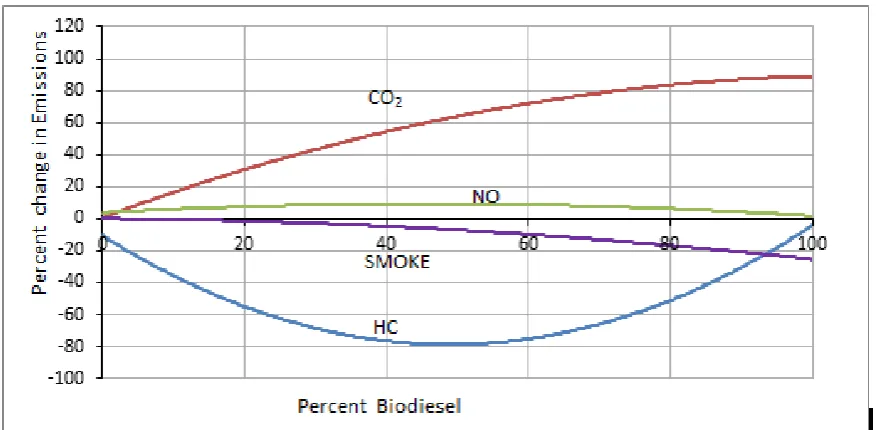
Figure 2 represents comprehensive emission impact of use of Kokum Biodiesel on the diesel engine. This investigation made use of statistical regression analysis to correlate the concentration of biodiesel in conventional diesel fuel with changes in pollutants by fitting a polynomial curve to approximate the actual emission characteristics. The graphs suggest that with the increase in concentration of biodiesel in the blends there is rise in emission of CO2 up to 60% when Kokum Biodiesel are used respectively while with the use of biodiesels there is increase in NO emissions by 8-10%.
Fig.2 : Average Emissions Impact of Kokum Biodiesel on Diesel Engine
The CO2 released during combustion gets offset by the same being sequestered while growing the feed stock. It could be also observed that with the increase in concentration of biodiesel in the blends there is 80 to 90 % decrease in un-burnt HC emissions along with 25% reduction in emission of smoke. Thus the emissions from the diesel engine operating on biodiesel are low as compared to those from engine operating on petroleum diesel except for slight increase in NOx emission making it greener fuel.
Predictions
Volume 2, Special Issue 1 MEPCON 2015 Both show that the ANN models developed for making predictions have an acceptable error and hence can be used for obtaining the output parameters for given inputs.
Figures 3 to 6 represent the comparison of experimental values Of BTE and emissions of NO, Smoke and HC respectively with values of the same mentioned parameters as predicted by ANN model.
Fig.3 : Comparisons of Experimental Values of BTE with Values Predicted by ANN Model
Fig.4 : Comparisons of Experimental Values of NO Emission With Values Predicted by ANN
Model
Fig.5 : Comparisons of Experimental Values of Smoke Opacity with Values Predicted By ANN
Model
Fig.6 : Comparisons of Experimental Values of HC Emission with Values Predicted By ANN
Model
It can be observed that the predictions made by ANN are quite closer to that of actual values. Thus the artificial neural network offers the advantage of being fast, accurate and reliable in predicting results, especially when theoretical and mathematical methods fail.
VI Conclusions
The results of thermal performance were found to be very comparable for KB20.The maximum brake thermal efficiency obtained using Diesel was 33.85%. By adding 20% of Kokum oil methyl ester it was noticed that brake thermal efficiency reduced by 4 to 5%. From emissions point of view, as compared to all blends the NOx emission was comparable to that of engine operating on diesel when the same was operated on KB80 respectively. Use of KB80 shows maximum rise in NOx emission by 19%.Also as compared to all blends smoke emission was least in case KB40 at almost all the loads. At maximum load use of KB40 resulted in decrease in smoke emission by 18.2%. Thus it could be concluded thatKokum oil biodiesel could be used as an alternative fuel for diesel engine without any modification.
REFERENCES
[1] Anand Kumar Pandey and M R Nandgaonkar, “Experimental Investigation of the Effect of Esterified Karanja Oil Biodiesel on Performance, Emission and Engine Wear of a Military 160hp Turbocharged CIDI Engine” Proceedings of the World Congress on Engineering 2011 Vol III, July 6 - 8, 2011, London, U.K
[2] A.M. Liaquat, “Application of blend fuels in a diesel engine” 2nd International Conference on Advances in Energy Engineering (ICAEE 2011), Energy Procedia 14 (2011).
[3] AnantBhaskarGarg et.al, “Artificial Neural Networks based Methodologies for Optimization of Engine Operations”, International Journal of Scientific & Engineering Research, Volume 3, Issue 5, May-2012. [4] A.E. Atabaniet.al, “Non-edible vegetable oils: A critical evaluation of oil extraction, fatty acid compositions,
biodiesel production, characteristics, engine performance and emissions production”,Renewable and Sustainable Energy Reviews 18 (2013).
Volume 2, Special Issue 1 MEPCON 2015 [6] Bobade S.N. and Khyade V.B., “Preparation of Methyl Ester (Biodiesel) from Karanja (PongamiaPinnata)
Oil”,Research Journal of Chemical Sciences Vol. 2(8), 43-50, August (2012).
[7] CenkSayin et.al, “Performance and exhaust emissions of a gasoline engine using artificial neural network”, Elsevier (2006).
[8] G. VenkataSubbaiah, “Rice Bran Oil Biodiesel as an Additive in Diesel- Ethanol Blends for Diesel Engines”,International journal of research and reviews (IJRRAS) June 2010.
[9] Jatinder Kumar and Ajay Bansal, “Application of Artificial Neural Network to Predict Properties of Diesel – Biodiesel Blends”, Kathmandu University Journal of Science, Engineering and Technology, vol. 6, no. ii, November, 2010, pp 98-103.
[10] JasanpreetSingha et.al, “Rice Bran Oil Biodiesel as an Alternative in Single Cylinder CI Engine with DI Ethyl Ether Blends”,International Journal of Emerging Science and Engineering (IJESE) ISSN: 2319–6378, Volume-1, Issue-12, October 2013.
[11] Lin Lin et.al, “Biodiesel production from crude rice bran oil and properties as fuel” Applied Energy 86 (2009) 681–688.