Deconstructing Students’ Attitude to Learning:
A Case Study in IT Education
Jocelyn Armarego
Murdoch University, Perth, Australia
[email protected]
Abstract
Decreasing enrolment in IT programs suggests it is important to understand how students learn a discipline in order to support student success. This paper describes a study to examine student attitude to learning in the IT discipline of Engineering (ie Software Engineering). The Ap-proaches to Study Inventory was applied to successive cohorts of students. The results describe a level of orientation (meaning or reproduction) for each participant and the cohort as a whole. However, examination of the subscales of the ASI indicate that the level of coherence in study approach exhibited by individual students is somewhat masked in their overall ASI result. Student reflective comments support the interpretations made of the subscale scores. The results suggest such a deconstruction enables teachers to assist students to know themselves as learners, thus raising their metalearning awareness, which, in turn has the potential to enhance student success.
Keywords: learning styles, ICT education, software engineering, approaches to learning, Ap-proaches to Study Inventory.
Introduction
Practitioner studies suggest there is an increasing need for IT professionals – although Zwieg et al. (2006) suggest stability in the short term, other predictions indicate a shortfall over the period 2005 plus (e.g. in the Australian context (Australia, 2002, 2006; Bolger, 2000)), a shortfall that will become critical as baby-boomers approach retirement. In addition, tertiary education in IT related disciplines (Information Systems (IS), Computer Science (CS), Software Engineering (SE)) report a disturbing downward trend in student enrolments (Davidson, 2005). Practitioners studies suggest an issue is that formal education does not model the needs of industry (Lee, 2004; Trauth, Farwell, & Lee, 1993) – attrition of students who have enrolled, but do not complete may be partially due to this disconnect, as well as to the quality of their classroom experience (Astin, 1993).
This paper examines student attitudes to learning as an approach to addressing this issue – Lucas and Meyer (2004) conclude that, once educators know more about their students, they can support
them in developing a better awareness and understanding of themselves as learners. Given current concerns about student performance in higher education generally, and their success as practitio-ners, investigation of factors that affect learning, in order to enhance that ex-perience, is important.
Background
Students bring a complex assortment of beliefs, past experiences, and expectations to a learning situation, which influence the approach to learning they take. In turn, this approach to learning affects the quality of their learning outcomes. Their future learning intentions and behaviours will also reflect this (Prosser & Trigwell, 1999).
There is a need, therefore to identify aspects of the learners’ conceptions of learning and ap-proaches to it so that appropriate support can be provided. Early work in the UK and Australia (e.g. Biggs, 1970; Entwistle, Thompson & Wilson, 1974) identified motivation and personality as of prime importance, with the later addition of information processing (Craik & Lockhart, 1972) and intention factors (Marton & Saljo, 1976) (i.e. rote versus meaningful, deep versus surface) to the web of interrelationships. The approach to learning that a student takes is very sensitive to the context in which learning is done, with a demonstrated correlation between more advanced con-ceptions (e.g. abstraction of meaning and understanding of reality (van Rossum & Schenk, 1984)) and a deep approach to learning. This conception to a large extent determines the student’s expec-tation of what the learning process and teaching entail.
There is a general consensus that a deep approach to learning is desirable in higher education. There is also research evidence to support an association between deep approaches and enhanced learning outcomes: students using a deep approach appear more able to demonstrate their under-standing, develop their conceptions of material and report greater development of generic skills (see Wilson and Fowler, 2005, for a discussion of the relevant studies). Therefore, while the achievement of high quality learning is important in all graduates, it has an increased relevance where the context of practice is continually changing and the professions are continuously devel-oping. The IT disciplines are a prime example of these characteristics (Garlan, Gluch, &
Tomayko, 1997).
Research Approach
Procedure and Context
The focus of the study was on students progressing through the IT-related discipline of Engineer-ing (Software EngineerEngineer-ing) at Murdoch University. Over successive semesters these students were involved in a long-term study of learning behaviour: they responded to specific inventories, provided qualitative feedback in School- and University-based surveys and reported on their learning through reflective journals included as part of the deliverables of specific units (courses). This feedback was used to drive changes in the learning environment, in order to achieve align-ment between professional practice, (formal) discipline learning and learner characteristics. In this paper the focus is on the Approaches to Study Inventory (ASI) (Entwistle & Ramsden, 1983) as an indicator of student learning. The particular interest is to examine student attitude to the learning environment provided in the units that make up their discipline content. These units were based on non-traditional models of learning and therefore challenged the students’ expecta-tions of an engineering learning environment. Specifically, approaches based on authentic, con-structivist models were the basis of student learning of Software Engineering, in order to align with characteristics of professional practice in the discipline: problems are complex and ill-structured, requiring creativity and opportunism in addressing them. Higher order learning is seen as essential to enable the skills to be acquired to deal with these characteristics (Scott & Wilson, 2002; Turley & Bieman, 1995).
engineer-ing body (Engineers Australia) date only from the mid-1990s, with US programs dated later). While there is a long educational history in both engineering education (with many studies report-ing on student attitude to learnreport-ing (a prime example is the work undertaken by Felder. Felder & Spurlin, 2005, and Felder & Brent, 2005, which includes a concise summary of this work) and IT education (Lee, 1999; Lee, Trauth, & Farwell, 1995; Scott & Wilson, 2002) the learning of IT as a profession within an Engineering ethos is not well reported. In particular, the alignment be-tween the discipline and the learning environment (and consequently student attitude to the envi-ronment provided) has not been much investigated.
Instruments
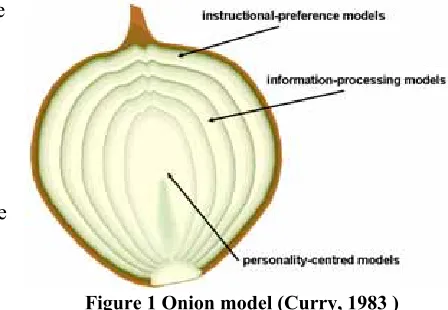
A variety of self-reporting questionnaires have resulted from interest in different aspects of student learning behaviour, and from the un-derlying requirement to demonstrate effec-tiveness and efficiency in teaching. In general these apply similar formats and psychometric principles, usually based on Likert scales. Curry (1983)’s onion model (see Figure 1) originally described three layers: a central core made up of personality-centred models spe-cifically related to how learners prefer to ac-quire and integrate information (such as the LSI described below); a stratum of
in-formation-processing models to examine a learners intellectual approach to assimilation of new information, based on the approaches to studying literature (such as ASI, also described below) and an outer layer of instructional-preference models relating to external factors such as physio-logical and environmental stimuli associated with learning activities. These layers assist in the choice of over 70 models reported in the literature (Coffield, Moseley, Hall, & Ecclestone, 2004).
Personality-centred models
These serve as an indicator of how an individual interacts with and responds to the learning envi-ronment. The study of learning style involves the investigation of individual differences: people perceive and gain knowledge differently, they form ideas and think differently, and they act dif-ferently. The value of investigating personality-centred learning models is two-fold: to help teachers design a balanced approach that addresses the learning needs of all of their students by attempting to provide variation in teaching style and to provide individual students with both an understanding of the learning implications of their style and strategies to address their strengths and weaknesses.
The Learning Style Inventory (LSI) (Kolb, 1984) addresses this aspect of learner profile. While detailed discussion of the learning styles is available in the numerous works of Kolb (e.g. 1995), in summary this is a simple test to measure an individual’s intrinsic learning style or predisposi-tion in any given learning situapredisposi-tion. It looks at four stages of the learning process: concrete ex-perience (CE), reflective observation (RO), abstract conceptualisation (AC), and active experi-mentation (AE). The user’s learning style can be identified as one of four archetypes:
• Accomodator : (concrete, active) What if? people
• Diverger : (concrete, reflective) Why or why not? people
• Assimilator : (abstract, reflective) What? people
• Converger : (abstract, active) How? people.
Information processing models
Despite a wide variety of methodologies and descriptive terms, a clear consensus has emerged that students approach learning with either a surface or a deep orientation, originally identified by Marton & Saljo (1976). Those with a surface orientation tend to take an approach characterised as instrumental, reproductive and minimalist, relying on rote memorisation and mechanical formula substitution, making little or no effort to understand the material being taught. Those with a deep orientation tend to adopt a meaningful approach, characterised as striving for meaning and under-standing, probing and questioning and exploring the limits of applicability of new material. These orientations are complemented by motives and strategies that are dependant on a specific learning context.
While personality-centred models are considered a relatively stable indicator of how an individual interacts with and responds to the learning environment, information-processing models capture students’ responses and adaptations to learning contexts. As well as being determined, to some extent, by past experience, the choice of approach is also influenced by student perception of the nature of the unit they are studying, so that students may be inclined to approach their learning in one of several ways. The work of Entwistle and Ramsden (1983) confirms this, while that of Ramsden (1988) adds that the manifestation of deep and surface learning is also dependent on the discipline of study.
There is a general consensus that a deep approach to learning is desirable in higher education. There is also research evidence to support an association between deep approaches and enhanced learning outcomes: students using a deep approach appear more able to demonstrate their under-standing, develop their conceptions of material and report greater development of generic skills. However, it is also shown that students of either orientation prefer teaching methods that encour-age those approaches to learning (Entwistle, Hanley, & Hounsell, 1979; Entwistle & Tait, 1990). The value of investigating information-processing learning models is therefore to provide justifi-cation for educators seeking to influence students towards deeper approaches to learning. The Approaches to Study Inventory (ASI), by Entwistle and Ramsden (1983), was developed to address a range of concepts, including motivation and study methods. It describes four study ori-entations, and is one of the most widely used questionnaires on student learning in higher educa-tion. In its most commonly used version, the ASI contains 64 items in 16 scales, however, a shortened version (32-item) of this instrument has been confirmed by Richardson’s (1990) work to possess adequate internal consistency and test – retest reliability. This focuses on two of the four orientations (see Table 1):
Table 1 ASI Scales for Reproduction and Meaning Orientation (Richardson, 1990) Scale Meaning
Meaning Orientation
Deep Approach Interrelating Ideas Use of Evidence
Comprehension Learning
DA RI UE CL
active questioning in learning relating to other parts of the course relating evidence to conclusions
readiness to map out subject area and think divergently
Reproduction Orientation
Surface Approach Syllabus-boundness Improvidence Fear of Failure
SA SB IP FF
preoccupation with memorisation relying on staff to define learning tasks overcautious reliance on details
• a meaning orientation (MO) indicates an intention to understand for oneself – compre-hension learning, relating ideas, and using evidence, being all motivated by interest in the ideas presented. This orientation is characterised by a holistic style and intrinsic mo-tivation
• a reproducing orientation (RO) indicates the use of a surface approach, with an empha-sis on rote memorising, and a narrow syllabus-bound attitude, associated with both ex-trinsic motivation and fear of failure.
Instructional-preference models
Instructional-preference models of learning style relate to external factors such as physiological and environmental stimuli associated with learning activities. Although in this study no formal instrument was applied to this layer, components of other instruments were seen to address some of the aspects of affective and habitat preferences noted below. Dunn and Dunn (1978) identify five dimensions that mark various preferences:
• environmental preferences regarding sound, light, temperature, and class design
• emotional preferences addressing motivation, persistence, responsibility and structure
• sociological preferences for private, pair, peer, team, adult or varied learning relations
• psychological preference related to perception, intake, time, and mobility
• psychological preferences based on analytic mode, hemisphericity, and action.
It can be seen that many sociological and psychological elements of these categories overlap with other layers of Curry’s model and the instruments used in this study.
Collecting Data and Interpreting Results
As noted previously, data on student learning were collected over successive semesters, using a variety of instruments. Some of these were included as components of the learning environment (e.g. reflective questions directly posed, journals and activity logs maintained and commented on by the students themselves), others were additional and possibly voluntary (e.g. School- and Uni-versity-based surveys of learning). In particular, instruments which identified the ‘coherence’ of student approach to the learning environment were applied, examined and compared to the results of data collected through qualitative instruments.
The results of this examination show that student preconceptions predispose them to view learn-ing in a discipline in a certain way, and may lead to the adoption of less than coherent learnlearn-ing processes. This comparison of individual student results shows that finer granularity provided by subscale mapping enables teachers (and learners) to isolate specific issues individual students face within their learning environment. The instrument then becomes a component of the ‘pas-toral care’ of students – it enables teachers to address specific issues individual students face dur-ing their learndur-ing, and to support them to raise their metalearndur-ing awareness.
Learning Styles
Table 2 provides a comparison between first year students attending a regional campus of Mur-doch University over the period 1999-2003. As can be seen, there is a weighting towards the characteristics of theorists (Assimilators) (which features a preference for abstract conceptualisa-tion and reflective observaconceptualisa-tion, with a forté in the basic sciences) in our CS/IT students. Our En-gineering students, however, lean towards pragmatists (Convergers) who revel in active experi-mentation (labs, fieldwork) with a tendency to narrow technical interests (Kolb, 1984).
Table 2 Kolb Learning Style Inventory 1999-2003 cumulative results (percentages) Eng 1st Year CS/IT 1st Year Eng 4th Year
Accomodator 8 5 3
Diverger 18 12 7
Assimilator 33 56 38
Converger 41 27 52
This leaning appears to grow stronger as student engineers progress through their program of study (either through transformation, or attrition), so that the Converger characteristic, to seek “single, correct answers or solutions to a question or problem” (Kolb, 1995) becomes the domi-nant learning style. Although studies with computing students have consistently shown that ab-stract learners (such as indicated by our CS/IT students above) are more effective in learning computing skills (see Kolb & Kolb, 2005, 2006, for published studies to this effect), neither Con-vergers nor Assimilators exhibit strengths in design and innovation (requiring a divergent ap-proach) nor business management (requiring accomodative skills). Yet practitioners suggest these are crucial in the IT disciplines (Holt & Solomon, 1996). In addition, the Converger approach to learning is considered the antithesis to the development of the generic learning skills (Boyce, Williams, Kelly, & Yee, 2001) required for professional practice in a changing discipline.
Approaches to Study
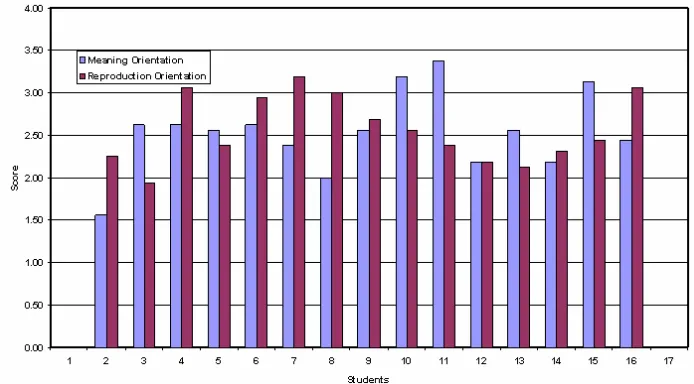
The shortened version of the ASI was administered to the student cohort, at the completion of the initial mandatory unit in Software Engineering in 2003. This had been offered, for the first time, in a PBL (Problem-based Learning) environment, developed to more closely map to discipline characteristics. The results are as indicated in Figure 2 (note that some students declined to com-plete the survey).
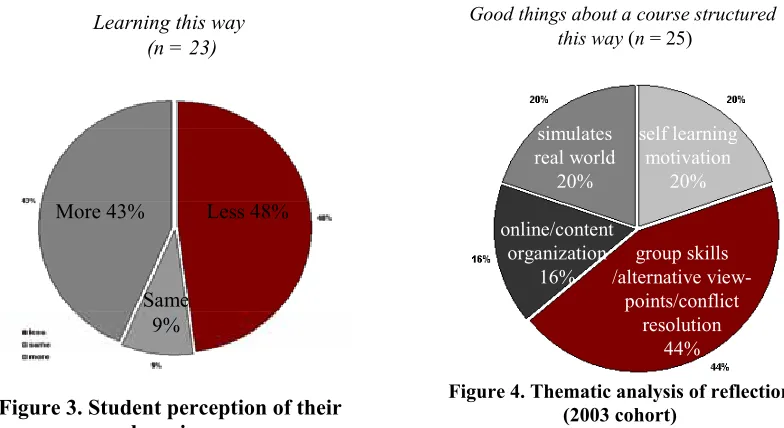
This post-hoc ASI showed that students were very much sitting on the fence between learning for meaning (MO) (mean 2.53, standard deviation 0.43) and learning for reproduction (RO) (mean 2.56, standard deviation 0.41). Asked, as part of a reflective component of an assessment item, whether they perceived they had learnt more or less from the PBL approach, the students’ ‘fence-sitting’ was confirmed (see Figure 3). Further alignment can be discerned between the tenor of comments made in the reflective assessment component and results of the ASI. Among other questions, students were asked to reflect on what is good/bad about a unit structured this way. Figure 4 shows the results. While some students could appreciate the authentic nature of the envi-ronment (like [professional] practice), the learning envienvi-ronment did not sit well with many stu-dents (intimidating learning style; sudden change in study style). However, the group-work was almost always viewed positively (project+ team improve individual learning/group lottery). In effect, supporting the work of Entwistle and Tait (1990, 1995) meaning-oriented students were more likely to see their learning environment in positive terms while reproduction orientation was associated with the view that the learning environment was difficult. These results were also sup-ported by a later study by Tynjälä, Salminen, Sutela, Nuutinen, & Pitkänen, (2005), which indi-cates that students’ conceptions of the characteristics of their learning environments were related to their study orientations and strategies.
A further theme that emerged referred to the level of work perceived by students (far too much content to read; too much workload leading to no marks). Drew (2001) discovered that a heavy workload tends to affect the depth at which students studied, while Chambers (1992) found that a ‘reasonable’ workload is a precondition of good studying and deep learning. More recently Cope & Staehr (2005) confirmed that perception of workload appeared to be a key to encouraging the use of deep learning approaches, while surface learning have been associated with perceptions of too high a workload. Student comments on this aspect suggested the motivation to deep learning could be enhanced through an understanding of individual student attitude.
The ASI results therefore indicated at least as strong a bias to surface learning as there was to deep learning in the student cohort. From the teacher’s perspective, this confirmed that students seem to need greater preparation in order to tackle a different learning model (e.g. a better under-standing of the PBL process), even when it modelled their chosen discipline more closely, as well as support structures (examples, guidelines) so that they have a clear indication of the appropri-ateness of their learning. This would appear to be borne out by results of the ASI undertaken by a %
Good things about a course structured this way(n= 25)
simulates real world 20% self learning motivation 20% online/content organization 16% group skills /alternative view-points/conflict resolution 44%
Good things about a course structured this way(n= 25)
simulates real world 20% self learning motivation 20% online/content organization 16% group skills /alternative view-points/conflict resolution 44%
Good things about a course structured this way(n= 25)
simulates real world 20% self learning motivation 20% online/content organization 16% group skills /alternative view-points/conflict resolution 44%
Figure 4. Thematic analysis of reflection (2003 cohort)
Learning this way (n = 23)
Less 48%
Same 9% More 43%
Learning this way (n = 23) Learning this way
(n = 23)
Less 48%
Same 9% More 43%
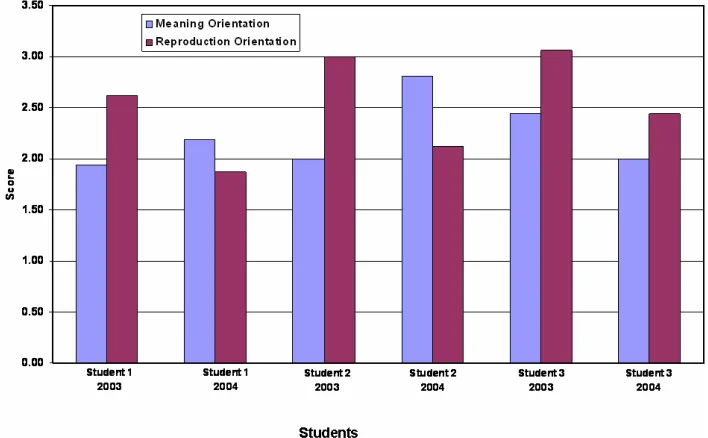
few of the same students after an additional semester of a similar learning environment (see Fig-ure 5): they did exhibit a greater leaning towards meaning although many other factors (including increasing student maturity) are at play.
It has been suggested that a limitation of instruments such as the ASI is the focus on relating con-ceptions of learning to other broad aspects of learning, rather than to the specific learning activi-ties in which students engage. Some researchers (e.g. Meyer, 1991), therefore, suggest what is needed is some indication of the relationship between the subscales components of the instru-ment. The value of this is to represent student attitude as a personal ‘profile’ of learning that is contextualised – a student will approach study for each unit differently, depending on the de-mands placed on them by the learning environment, their previous experience and personal stance at the time, and is not ‘innate’.
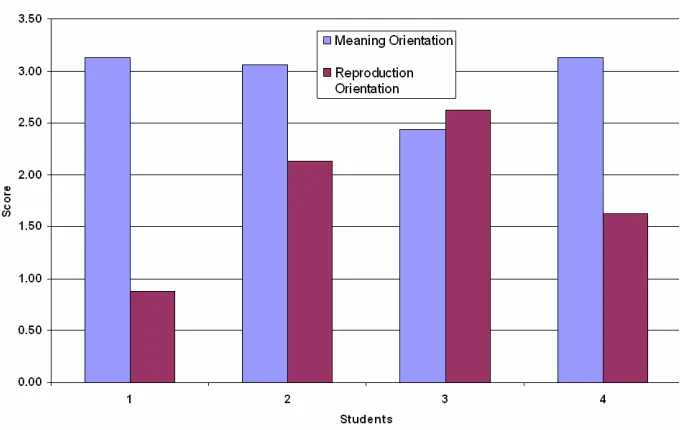
Figure 5. ASI results for selected students - 2003 and 2004
Research undertaken in Finland (e.g. Lindblom-Ylänne, 2004) has shown that coherent or disso-nant study orchestration is developed through interaction between these all components (study orientation, factors such as learning experiences and regulatory skills, and the learning environ-ment). A high level of dissonance indicated, in that study, an individual student’s study habit problems and lack of metacognitive skills to evaluate study practices and quality of learning. This high dissonance is characterised by the inclusion of elements from both the surface (consisting of scales measuring a reproduction-directed approach to learning) and deep (consisting of scales measuring a meaning-directed approach to learning scales). Slightly dissonant study orchestra-tions are characterised by elements from either a deep or surface profile, but also contained theo-retically atypical combinations of subscale scores.
Figure 6. ASI Results for selected students (2005 cohort)
Student 1 would be classed as strongly coherent in Lindblom-Ylänne’s (2004) terminology – high score for MO with commensurate low score for RO. Student 4 also shows coherence (though less strong), while Student 2 exhibits as somewhat dissonant and Student 3 as strongly dissonant. Ex-amining the subscale scores reveals some issues the students bring to the learning environment. As a benchmark, Table 3 provides the mean for this group, for each of the ASI subscales.
Table 3. Mean scores for ASI subscales
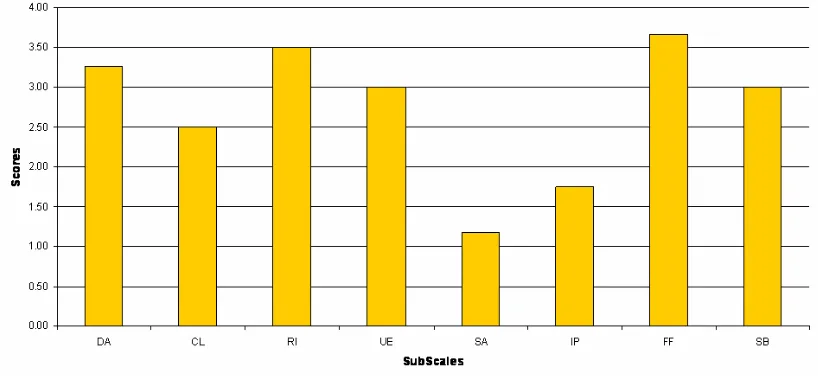
Figure 7 ASI breakdown - Student 1
As noted, Student 1 (see Figure 7) is strongly coherent – although some reliance on memorisation (SA) and teacher direction (SB) is exhibited, there are no real conflicts in the subscale scores. Meaning Orientation mean
scores DA 3.31 CL 2.00 RI 3.44 UE 3.00 Overall mean2.94
Reproduction Orientation
Reflective comments confirm the student came to the unit with some anxiety and lack of confi-dence – not convinced the material undertaken in earlier units had been learnt – it was easier to recall than I thought. Over this final semester, the student gained confidence in the level of profi-ciency (more confident with working within the java environment, acting as manager of project, back on schedule, completed implementation report. Personally enjoying the Java coding in real world application. Been helping group members with their Java coding).
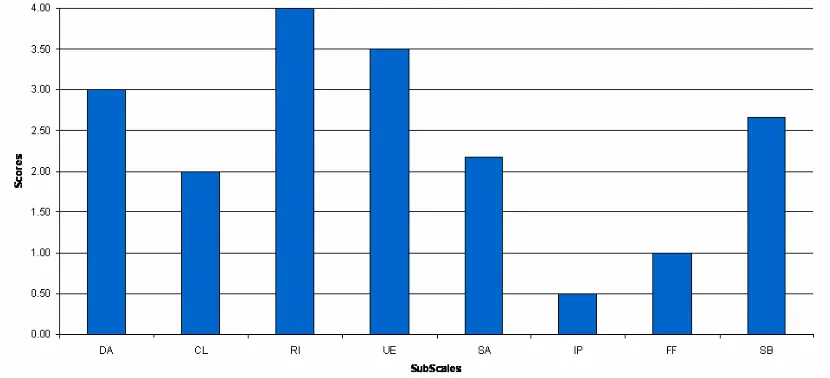
Student 2 is somewhat dissonant (see Figure 8). The ASI suggests that, although the student is bent on understanding and working out the material in the unit (Even though I did some reading, it has not really understood yet), there is a tendency to fall back on reproducing when that under-standing is reduced, and to focus on detail (IP) in order to achieve underunder-standing (I could not work out how those architecture styles in text books are used in actual systems. Personally it took some time to play around with the sequence diagrams and make sense how the system works). In this case, both teacher-direction (SB) and concern about academic outcomes (FF) are culturally based, and in direct conflict with the high scores for meaning. From the teacher perspective, this insight to the student’s behaviour has increased impact given the multicultural composition of our student cohorts.
Figure 8 ASI breakdown - Student 2
Figure 9. ASI breakdown - Student 3
Although the ASI result for Student 4 (see Figure 10) indicates an orientation towards reproduc-tion below the mean, closer examinareproduc-tion highlight some contrasting subscales. These indicate a didactic/reproductive belief about learning and teaching, so that the student may consequently struggle with tasks that demand more than memorisation (SA) and teacher-direction (SB). This student’s reflective comments indicated a feeling of being under pressure, needing to catch up and feeling guilty about not helping other members more.
Figure 10. ASI breakdown - Student 4
Discussion
particu-larly true of learning styles diagnostics studies, which are generally undertaken only once or twice across a program of study.
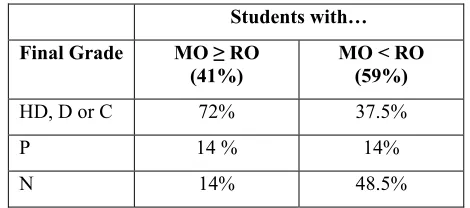
Table 4 Final Grades mapped to Study Orientation (2003 cohort)
Students with…
Final Grade MO ≥ RO (41%)
MO < RO (59%)
HD, D or C 72% 37.5%
P 14 % 14%
N 14% 48.5%
The results of the ASI showed that while a correlation between a high(er) score for Meaning Ori-entation and final result did exist, it was not very strong – of the 88% of students who completed the ASI, 41% showed same or higher MO to RO. Of these, 72% achieved either a H(igh) D(istin-ction), D(istinD(istin-ction), or a C(redit), while 14% achieved each of a P(ass) or a fail (N). Students in this latter category exhibited equal orientation to meaning and reproduction (e.g. MO 2.65, RO 2.38). All other students who failed exhibited much higher ROs to MOs (between 0.43 and 0.81 difference). Of the students who indicated higher ROs, 62.5% achieved a P(ass) or lower. Table 4 provides a summary of this data. Since the assessment components for this unit included a final exam, it should be noted, perhaps as a caveat, that learning for understanding is less reliably as-sessed than memory learning and learning that achieves some form of creativity (one of the aims of the unit) will be quite radically different for different students (Elton, 2000).
Deconstructing the ASI results provides valuable information of student approaches to learning, and the issues they may face in addressing a learning context. If one of the goals of the learning environment is to increase deep and/or decrease surface approaches to learning, as a mechanism for engaging students with the learning, and ultimately to support their success in a discipline, it is important to address these issues specifically. In particular, the coherence of each student’s ap-proach may be considered an indicator of mixed messages (Norton, Owens, & Clark, 2004) pro-vided within the learning environment, so that students do not have a clear indication of the ap-propriateness of their learning. According to Elton (2000), such conflict leads to student schizo-phrenia. The results of such a study therefore have strong impact in the area of unit review and development, both in order to ensure students are made aware of the appropriateness (or other-wise) of both their learning and their ‘fit’ for the discipline they are studying. This increased awareness goes some way to addressing the issue of student attrition from IT programs.
From the teaching perspective, deconstructing student attitudes to their learning informed signifi-cant changes to the environment provided for the Software Engineering program (Armarego, 2007), and flowed on to change the learning environment for all engineering programs at this university (Armarego & Fowler, 2005). From the learning perspective, students were provided with increased scaffolding and strategies to address their learning dissonances.
Conclusion
As we learn more about how students learn, and what they need to learn in order to practice as competent professionals in their chosen discipline, we move further from traditional teaching and closer to the concept of learning as a reflection on professional practice. Such a small study does not allow conclusions to be drawn, except in very general terms. Students appear to be receiving mixed messages regarding the importance of deep versus surface approaches to learning, and ap-pear ready to hedge their bets. However, once teachers know more about their students, they can support them in developing a better awareness and understanding of themselves as learners (Lucas & Meyer, 2004). Given current concerns about student performance in higher education, and their success as practitioners, the question of how to help students raise their metalearning awareness should be of keen interest.
References
Armarego, J. (2007). Beyond PBL: Preparing graduates for professional practice. Paper presented at the
CSEET2007: 20th Conference on Software Engineering Education & Training, Dublin. Armarego, J., & Fowler, L. (2005). Orienting students to studio learning.Proceedings of the 2005
ASEE/AaeE 4th Global Colloquium on Engineering Education, Sydney.
Astin, A. W. (1993). What matters in college: Four critical years revisited. San Francisco: Jossey-Bass. Australia. (2002). Employability skills for the future. Canberra: Dept of Education, Science and Training. Australia. (2006). Building Australian ICT skills: Report of the ICT skills foresighting working group.
Can-berra: Dept of Communications, Information Technology and the Arts.
Biggs, J. B. (1970). Faculty pattern in study behaviour. Australian Journal of Psychology, 22, 161–174. Bolger, C. (2000). How to fill the upcoming ICT skills gap? APESMA Professional Update, 10(9). Boyce, G., Williams, S., Kelly, A., & Yee, H. (2001). Fostering deep and elaborative learning and generic
(soft) skill development: The strategic use of case studies in accounting education. Accounting Educa-tion: An International Journal, 10(1), 37–60.
Chambers, E. (1992). Workload and the quality of student learning. Studies in Higher Education, 17(2), 141–154.
Coffield, F. J., Moseley, D. V., Hall, E., & Ecclestone, K. (2004). Learning styles for post 16 learners: What do we know? London: University of Newcastle upon Tyne, Learning and Skills Research Centre. Cope, C., & Staehr, L. (2005). Improving students learning approaches through intervention in an
informa-tion systems learning environment. Studies in Higher Education, 30(2), 181–197.
Craik, F. I. M., & Lockhart, R. S. (1972). Levels of processing: A framework for memory research. Journal of Verbal Learning and Verbal Behaviour, 671-684.
Curry, L. (1983). An organisation of learning style theory and constructs. In L. Curry (Ed.), Learning Style in Continuing Education. Halifax: Dalhousie University.
Davidson, P. (2005). The next ICT skills shortage. Information Age.
Drew, S. (2001). Perceptions of what helps learn and develop in education. Teaching in Higher Education, 6(3), 309–331.
Dunn, R., & K, D. (1978). Teaching students through their individual learning styles: A practical ap-proach. Reston, VA: Reston Publishing.
Elton, L. (2000). Matching teaching methods to learning processes: Dangers of doing the wrong thing righter. Paper presented at the 2nd Annual Conference of the Learning in Law Initiative.
Entwistle, N. J., Hanley, M., & Hounsell, D. (1979). Identifying distinctive approaches to studying. Higher Education, 8, 365-380.
Entwistle, N. J., & Tait, H. (1990). Approaches to learning, Evaluations of teaching, and preferences for contrasting academic environments. Higher Education, 19, 169-194.
Entwistle, N. J., Thompson, J. B., & Wilson, J. D. (1974). Motivation and study methods. Higher Educa-tion, 3, 379–396.
Felder, G. M., & Spurlin, J. (2005). Applications, reliability and validity of the Index of Learning Styles.
International Journal of Engineering Education, 21(1), 1-3-112.
Felder, R. M., & Brent, R. (2005). Understanding student differences. Journal of Engineering Education, 94(1), 57-72.
Garlan, D., Gluch, D. P., & Tomayko, J. E. (1997). Agents of change: Educating future leaders in software engineering. IEEE Computer, 30(11), 59-65.
Holt, J., & Solomon, F. (1996). Engineering education - the way ahead. Australasian Journal of Engineer-ing Education, 7(1), 1-22, 83-98.
Kolb, A., & Kolb, D. A. (2005). Experiential learning theory bibliography: 1971-2005: Experience Based Learning Systems.
Kolb, A., & Kolb, D. A. (2006). Experiential learning theory bibliography: Recent research 2005-2005: Experience Based Learning Systems.
Kolb, D. A. (1984). Experiential learning experience as the source of learning and development. Prentice-Hall.
Kolb, D. A. (1995). Learning style inventory: Technical specifications. Boston: McBer & Company. Lee, D. M. S. (1999). Knowledge/skill requirements and professional development of IS/IT workers: A
summary of empirical findings from two studies. In Panel on Workforce Needs in Information Tech-nology, Computer Science and Telecommunications Board, National Academy of Sciences. Milwaukee (WI).
Lee, D. M. S. (2004). Organizational entry and transition from academic study: Examining a critical step in the professional development of young IS workers. In M. Igbaria & C. Shayo (Eds.), Strategies for Managing IS/IT Personnel (pp. 113-141). Hershey, PA: Idea Group.
Lee, D. M. S., Trauth, E. M., & Farwell, D. (1995). Critical skills and knowledge requirements of IS pro-fessionals: A joint academic/industry investigation. MIS Quarterly, 19(3), 313-340.
Lindblom-Ylänne, S. (2004). Raising students’ awareness of their approaches to study. Innovations in Edu-cation and Teaching International, 41(4), 405-421.
Lucas, U., & Meyer, J. H. F. (2004). Supporting student awareness: Understanding student preconceptions of their subject matter within introductory courses. Innovations in Education and Teaching Interna-tional, 41(4), 459–471.
Marton, F., & Saljo, R. (1976). On qualitative differences in learning I - Outcomes and processes. British Journal of Educational Psychology, 46, 4-11.
Meyer, J. H. F. (1991). Study orchestration: The manifestation, interpretation and consequences of contex-tualised approaches to studying. Higher Education, 22, 297–316.
Mills, J., Ayre, M., Hands, D., & Carden, P. (2005). Learning about learning styles: Can this improve engi-neering education? MountainRise, 2(1).
Norton, L. S., Owens, T., & Clark, L. (2004). Analysing metalearning in first-year undergraduates through their reflective discussions and writing. Innovations in Education and TeachingInternational Journal of Engineering Education, 41(4), 423–441.
Ramsden, P. (1988). Studying learning: improving teaching. In P. Ramsden (Ed.), Improving Learning: New perspectives (pp. 13–31). London: Kogan Page.
Richardson, J. T. E. (1990). Reliability and replicability of the Approaches to Studying questionnaire. Stud-ies in Higher Education, 15, 155-168.
Scott, G., & Wilson, D. (2002). Tracking and profiling successful IT graduates: An exploratory study. Pro-ceedings of the 13th Australasian Conference on Information Systems.
Trauth, E. M., Farwell, D., & Lee, D. M. S. (1993). The IS expectation gap: Industry expectation versus academic preparation. MIS Quarterly, 17, 293-307.
Turley, R. T., & Bieman, J. M. (1995). Competencies of exceptional and non-exceptional software engi-neers. Journal of Systems and Software, 28(1), 19-38.
Tynjälä, P., Salminen, R., Sutela, T., Nuutinen, A., & Pitkänen, S. (2005). Factors related to study success in engineering education. European Journal of Engineering Education, 30(2), 221-231.
van Rossum, E. J., & Schenk, S. M. (1984). The relationship between learning conception, study strategy and learning outcome. British Journal of Educational Psychology, 54, 73–83.
Wilson, K., & Fowler, J. (2005). Assessing the impact of learning environments on students’ approaches to learning: Comparing conventional and action learning designs. Assessment & Evaluation in Higher Education, 30(1), 87–101.
Zwieg, P., Kaiser, K. M., Beath, C. M., Gallagher, K. P., Goles, T., & Howland, J. (2006). The information technology workforce: Trends and implications 2005-2008. MIS Quarterly Executive, 5(2), 101-108.