Nat. Hazards Earth Syst. Sci., 16, 1449–1463, 2016 www.nat-hazards-earth-syst-sci.net/16/1449/2016/ doi:10.5194/nhess-16-1449-2016
© Author(s) 2016. CC Attribution 3.0 License.
An approach using multi-factor combination
to evaluate high rocky slope safety
Huaizhi Su1,2, Meng Yang2,3, and Zhiping Wen4
1State Key Laboratory of Hydrology-Water Resources and Hydraulic Engineering, Hohai University, Nanjing 210098, China 2College of Water Conservancy and Hydropower Engineering, Hohai University, Nanjing 210098, China
3National Engineering Research Center of Water Resources Efficient Utilization and Engineering Safety, Nanjing, 210098, China
4Department of Computer Engineering, Nanjing Institute of Technology, Nanjing 211167, China
Correspondence to:Huaizhi Su ([email protected])
Received: 5 December 2015 – Published in Nat. Hazards Earth Syst. Sci. Discuss.: 23 February 2016 Revised: 25 April 2016 – Accepted: 1 June 2016 – Published: 17 June 2016
Abstract.A high rocky slope is an open complex giant sys-tem for which there is contradiction among different influ-encing factors and coexistence of qualitative and quantitative information. This study presents a comprehensive intelligent evaluation method of high rocky slope safety through an in-tegrated analytic hierarchy process, extension matter element model and entropy weight to assess the safety behavior of the high rocky slope. The proposed intelligent evaluation in-tegrates subjective judgments derived from the analytic hier-archy process with the extension matter model and entropy weight into a multiple indexes dynamic safety evaluation ap-proach. A combined subjective and objective comprehensive evaluation process, a more objective study, through avoid-ing subjective effects on the weights, and a qualitative safety assessment and quantitative safety amount are presented in the proposed method. The detailed computational procedures were also provided to illustrate the integration process of the above methods. Safety analysis of one high rocky slope is conducted to illustrate that this approach can adequately han-dle the inherent imprecision and contradiction of the human decision-making process and provide the flexibility and ro-bustness needed for the decision maker to better monitor the safety status of a high rocky slope. This study was the first application of the proposed integrated evaluation method in the safety assessment of a high rocky slope. The study also indicated that it can also be applied to other similar prob-lems.
1 Introduction
Nowadays, human beings are facing many serious environ-mental and natural geological disasters, accompanying the massive construction of important projects (Su et al., 2013a). More and more high and steep rocky slopes are forming and are threatening people’s lives and property and the safety of whole projects. This slope safety behavior needs to be ur-gently analyzed. From an engineering point of view, a high rocky slope is a complex open system and the factors affect-ing its stability are varyaffect-ing and capricious, in that they have strongly chaotic characteristics. The complexity and uncer-tainty of these factors leads to contradiction among differ-ent factors and the coexistence of qualitative and quantitative information, which may seriously affect the safety assess-ment of slopes. Therefore, it is very difficult, but important, to carry out a safety assessment of high rocky slopes.
presents a fundamental approach to mathematically express human beings’ inference and interpretation. The prevailing side of the proposed method in solving the multiple criteria decision-making problem is its capability of more objective and intelligent assessment in mathematical form, combining detected influencing factors without the need of human in-volvement and interference.
Much research mainly focuses on one specific aspect of slopes’ safety and lacks the identification of the whole se-curity of high rocky slopes (Malkawi et al., 2000; Prsilva et al., 2008). Although there are many evaluation methods, the amount of research and number of applications are still few and superficial. Traditional methods always tend to cause contradictions among affecting factors and the coincidence of qualitative and quantitative information, resulting in un-certainty.
In recent years, we have seen the development of the finite element analysis, the fuzzy mathematic method and the ar-tificial neural network method. They all conduct the assess-ment through combining qualitative and quantitative infor-mation, and the factors concerned basically do not change (Su et al., 2013b). For rocky slope safety evaluation, some advanced methods, such as geographic information systems and ground-based radar, have been attempted for slope safety evaluation and warning (Dai and Lee, 2002; Bozzano et al., 2010; Casagli et al., 2010). However, existing interpretation methods typically applied one single index (e.g., surface de-formation or rainfall) as a predictor and hence revealed only one aspect of slope performance (Ermini et al., 2005). In the paper, a method is introduced though multiple monitoring in-dexes and influencing parameters.
For the past 1 year of research from 2014 to 2015, analysis methods mainly focused on the Bayesian network, finite ele-ment analysis, genetic algorithms, artificial neural networks, digital elevation models, statistics methods, evolutionary ap-proach, etc. (Abdalla et al., 2015; Jamsawang et al., 2015; Fuchs et al., 2014; Bahsan et al., 2014; Peng et al., 2014; Garg and Tai, 2014; Ji et al., 2015). The disadvantages of present rocky slope safety evaluation method include that it is focused on one or certain factor, local safety analysis, single qualitative evaluation, single quantitative calculation, changeable results, more subjective analysis and so on. A holistic assessment of the slope safety state might not be achieved. Besides, a large portion of monitoring data is of-ten not utilized in these methods.
The geological conditions of high rocky slopes are change-able and the outer environment also changes with time. The evaluation methods and theories still have large limitations and defects which need to be further developed (Pantelidis, 2011). Slope safety evaluation using multiple sources of monitoring information is more reasonable, and it is the topic of the present research. For present studies, a complete eval-uation analysis, combining subjective and objective factors and presenting a qualitative evaluation conclusion and quan-titative evaluation amount, is desired. An integrated approach
is proposed, avoiding the aforementioned disadvantages and enhancing present research which lacks high rocky slope safety evaluation.
The objective of this study is to propose a methodology for identifying and delineating high rocky slope safety using an integrated analytic hierarchy process (AHP)–matter element analysis (MEA)–entropy weight method (EWM). Firstly, previously related research is reviewed systematically. Sec-ondly, the multiple criteria decision-making (MCDM) pro-cess of high rocky slope safety evaluation is computerized and an MCDM evaluation system of three layers, four crite-ria and 15 subcritecrite-ria is built by the AHP. Thirdly, MEA is used to determine the factor importance sequence to avoid subjective judgment as much as possible, and the sutra field, controlled field and the matrices of the matter element are set up from each layer. The importance ranking of each fac-tor is finally determined based on the single index corre-lation, comprehensive correlation and grade variable eigen-value. The initial weight follows with the multiple compari-son and judgment principle and matrix. A second correction with the EWM is conducted to reduce the decision maker’s subjectivity on the largest level to improve the scientific na-ture and accuracy of the evaluation indexes. Lastly, an ex-ample of one slope is presented to illustrate the proposed methodology.
2 Literature review
H. Z. Su et al.: An approach using multi-factor combination to evaluate high rocky slope safety 1451
Olson (2001), Belton and Stewart (2002), Hashemkhani et al. (2013) and Figueira et al. (2005).
In addition, a fundamental problem of MCDM is the derivation of the weight for a set of activities according to im-portance. Thus, scaling numbers from 1 to 9 were introduced to the weights of the elements in each level of the hierarchy with respect to an element of the next higher level in MCDM (Saaty, 1977). Weights based on a subjective approach re-flect subjective judgements from one person, and objective weights obtained by mathematical methods are based on the analysis of the initial data. Both of them are not perfect and an integrated approach could be most appropriate for deter-mining the weights of the attributes. Therefore, a subjective and objective integrated approach was introduced to deter-mine attribute weights in multiple attribute decision-making problems (Ma et al., 1999). As the quantitative criteria were precisely defined, the developed quantitative multiple criteria decision-making method can be successfully applied (Usti-novichius et al., 2007). In terms of qualitative and quanti-tative criteria, decision-making techniques were applied, in-cluding Technique for Order of Preference by Similarity to Ideal Solution, Simple Additive Weighting and mixed meth-ods, as well as AHP and entropy methmeth-ods, for defining the importance of weights of the attributes (Karami and Johans-son, 2014).
2.2 Analytic hierarchy process (AHP)
According to advantages of applied techniques, it is expected that the AHP method can provide closer results to real deci-sions made (Saaty, 2003). Saaty’s AHP is a popular MCDM technique and is widely used. Thus, the AHP method is firstly chosen as the basic analysis approach in this paper. The AHP was proposed by Thomas L. Saaty (Saaty, 1972, 1986, 1988, 1994; Shannon, 1948; Vaidya and Kumar, 2006) and reflects the natural behavior of human thinking. Its major innovation is the introduction of pairwise comparisons. The pairwise comparison technique represents a theoretically founded ap-proach to compute weights, representing the relative impor-tance of criteria. Therefore, AHP has been considered as a very useful tool for dealing with complex MCDM problems by the international scientific community.
In civil engineering, especially for the situations with in-complete or ambiguous data due to great inherent uncertainty in construction projects, a risk assessment model using AHP was developed (Abdul-Rahman et al., 2013). Li et al. (2013) analyzed the inconsistent comparison matrix in AHP and proposed a way to improve comparison matrix consistency by using a sorting and ranking methodology. To manage crises in the reconstruction of the damaged areas, the AHP method for weighing the important criteria and a novel com-plex proportional assessment of alternatives with gray rela-tions for evaluating the alternatives were successfully applied (Bitarafan et al., 2012). Li and Zou (2011) proposed a fuzzy AHP method to deal with the public–private partnerships in
infrastructure projects. Eshtehardian et al. (2013) applied the analytical network process and AHP methods to select appro-priate construction suppliers and civil engineering compa-nies, and achieved a satisfied result. An AHP-based MCDM approach was presented for pedestrian zone selection in the absence of quantitative data (Sayyadi and Awasthi, 2013). However, the models considered present some difficulties for application and are far from being perfect, therefore requir-ing further analysis (Triantaphyllou, 2000).
2.3 Matter element analysis (MEA)
Based on previous reviews and summaries, the AHP is proven to be a well-known decision support tool used for complex MCDM problems by providing a multi-level hier-archical structure. However, it is also indicated that it is dif-ficult for a single mathematical method to complete the final decision-making process because of some drawbacks of the AHP. Thus, this paper adopts an integrated method to evalu-ate high rocky slope safety.
During the AHP process, the index importance rule is in-fluenced seriously by artificial disturbance and it is diffi-cult to establish a reasonable and precise index importance sequence. The incompatibility problem is very evident. To solve these problems, the matter element analysis (MEA) method based on extension theory is introduced and primar-ily used to study the problem of incompatibility (Cai, 1983). Matter element analysis is a new theory to find out the reg-ular patterns of incompatibility problems. It can better reflect the variation characteristics of the objects of analysis and aid in qualitative analysis and quantitative calculation. Extenics theory differs from the fuzziness concept described in fuzzy mathematics and certain concepts from classical mathemat-ics. It concentrates on the changeability of the research ob-jects and further describes the pros and cons from the qualita-tive level to the quantitaqualita-tive level. It can be used for solving multiple parameters evaluation problem by formalizing the problem and establishing the corresponding matter element.
This paper is based on the matter element concept, com-bining the evaluation objects, indexes and index values, and the extension nature of the matter element is used to assess the whole safety of the high rocky slope.
2.4 Entropy weight method (EWM)
However, the safety evaluation weight of the slope founded on the AHP-extension matter model might be subjective, which might affect the objective analysis about its safety. In addition, for the integrated AHP and MEA, a minor fac-tor can have a great influence on the ranking of the alterna-tives. Hence, the entropy approach is introduced for deter-mining the objective weight (Ustinovichius, 2001). AHP de-pends on experts to different extents, and therefore contains strong subjectivity. Slight weight differences can dramati-cally change the order of the alternative preference. Conse-quently, the appropriate weight for each criterion in MCDM is critical to achieve a precise qualitative evaluation and quantitative safety amount. An objective weight correction method is an important guarantee.
As we all know, entropy is the one of the most important concepts in social science, physics and information theory. The entropy weight method (EWM) is used to determine the weights of influence indexes as a better way of avoiding sub-jective influence. EWM can be quantified and simulated to represent the objective information contained in an MCDM system and the subjective information possessed by a deci-sion maker. In the literature of information theory, the con-cept of entropy, was firstly introduced by Shannon (1948). Shannon’s entropy served as a useful method for evaluat-ing data structures and patterns. Then, EWM was introduced in determination of criteria weights for MCDM problems (Shemshadi et al, 2011; Ye, 2010; Kildiene et al, 2011). Ge et al. (2013) established a fuzzy optimization model based on EWM to select a typical flood hydrograph in the design flood, and this model was relatively better at designing flood com-putation compared with the traditional typical flood hydro-graph. European country management capabilities within the construction sector in the time of crisis were investigated, ap-plying a proposed method determined via the entropy method (Susinskas et al., 2011). Assessment and selection of appro-priate solutions for occupational safety were classified as an MCDM problem, and EWM was used to determine the rela-tive significance of evaluation criteria (Dejus and Antuchevi-ciene, 2013).
2.5 Integrated method
A single method effect is weak for the solution of MCDM problem and may be dangerously inaccurate for complex de-cision problems. An integrated approach brings a compre-hensive and objective result based on previous reviews. Thus, the integrated approach is an effective evaluation method. AHP and EWM are often used to implement the safety
eval-uation of hydraulic or civil engineering (Kok et al., 2009; Rahman et al., 2013). Tavana and Hatami-Marbini (2011) developed an MCDM framework based on AHP and EWM for the human spaceflight mission planning. For the selection of the best material for the tool holder used in hard milling, Caliskan et al. (2013) applied the AHP and EWM to confirm criteria weighting so that a new decision model was devel-oped. For the pursuing the goal of selecting the best trans-portation investment project portfolio, a fuzzy assessment approach was presented by utilizing the concept of entropy and fuzzy AHP (Ozkir and Demirel, 2012).
This paper adopts an AHP–MEA–EWM integrated method to assess the safety of high rocky slopes. It sets up the comprehensive multi-layer and multi-objective safety evalu-ation model for high rocky slopes from the aspects of ge-ological condition, engineering condition, external environ-ment and internal and external monitoring behavior. AHP is firstly used to construct a multi-layer and multi-index MCDM framework. Then, the importance ranking of all in-fluential factors of high rocky slopes is determined based on the single index correlative degree, comprehensive cor-relative degree and grade variable eigenvalue of the mat-ter element matrix. The initial weight is obtained based on the above analyses, and a second correction with the en-tropy weight method is made. Finally, the quantitative safety amount and qualitative safety level are determined by over-lapping application of integrated methods and recursive cal-culation from the criteria level to the goal level.
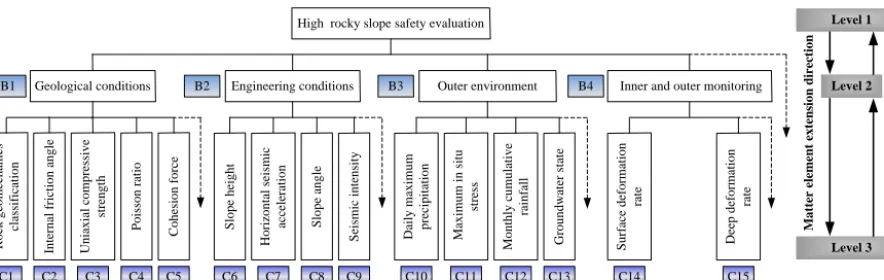
3 Multi-level and multi-index evaluation system of high rocky slope safety
H. Z. Su et al.: An approach using multi-factor combination to evaluate high rocky slope safety 1453
Level 1
Level 3 Level 2 High rocky slope safety evaluation
Geological conditions Engineering conditions Outer environment Inner and outer monitoring
In te rn al f ri ct io n a n g le U n ia x ia l co m p re ss iv e st re n g th P o is so n r at io C o h es io n f o rc e S lo p e h ei g h t H o ri zo n ta l se is m ic ac ce le ra ti o n S lo p e an g le S ei sm ic i n te n si ty D ai ly m ax im u m p re ci p it at io n M ax im u m i n s it u st re ss M o n th ly c u m u la ti v e ra in fa ll G ro u n d w at er s ta te S u rf ac e d ef o rm at io n ra te D ee p d ef o rm at io n ra te R o ck g eo m ec h an ic s cl as si fi ca ti o n C o m p re h en si v e ev a lu a ti o n d ir ec ti o n B1 C15 M a tt er e le m en t ex te n si o n d ir ec ti o n
B2 B3 B4
C14 C13 C12 C11 C10 C9 C8 C7 C6 C5 C4 C3 C2 C1
Figure 1.Safety evaluation hierarchy of high rocky slopes.
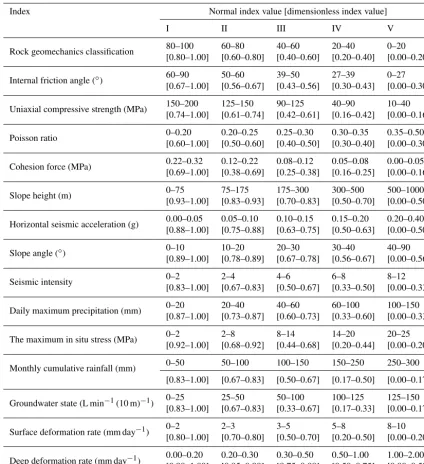
According to the specification and national standard of the water conservancy and hydropower slope engineering about the rocky slope safety classification and existing re-search results on the ranking standard, the differences of dif-ferent areas and difdif-ferent projects are comprehensively con-sidered (Wu and Chen, 2009; Zhao et al., 2011). Combined with numbers of engineering cases, the safety grade of high rocky slope can be divided into five levels shown in Table 1; I means very stable, II means stable, III means basically sta-ble, IV means unstable and V means extremely unstable.
In order to eliminate the shortcomings of incommensu-rability brought by the dimension and dimensional unit for evaluation index values under different factors, the dimen-sionless method is used to process the evaluation indexes on different grade levels. For indexes such as the cohesion force, the larger the value, the better the tendency.
c0ij= cij−cimax/ (cimax−cimin) (1) For indexes such as slope height, the smaller the value, the better the tendency.
c0ij= cimax−cij
/ (cimax−cimin) , (2) wherecimaxandciminare the maximum and minimum indi-cators at different levels of one indicator.cij andc0ij are the
initial index value and the final result calculated by a self-developed algorithm of range method under one indicator level. The dimensionless result is shown in Table 1.
4 The proposed integrated method evaluating high rocky slope safety
4.1 The identification of evaluation indexes’ importance on high rocky slopes
Comprehensive stability evaluation in terms of high rocky slopes is based on the extensibility of the matter element for stability evaluation. Its core is to determine the extension do-main, and the matter element transformation of factors is the
implementation means in the extension domain. For exten-ics, the matter element is the logic cell. The stability of high rocky slope is called eventN. The feature of high rocky slope stability is calledC, including the geological conditions, the engineering conditions, the external environment and the in-ternal and exin-ternal monitoring behavior. The eigenvalue of each factor in the every level is called the magnitudeV. The ordered tripleR= {N,C,V}is known as the most basically described element, also named the matter element. Introduc-tion of the matter element provides a viable tool for solving the formalization of stability comprehensive evaluation ques-tions of high rocky slopes.
Extension evaluation will be established including every level based on the matter element extensibility. Sutra field, controlled field and the matrices of matter element for ap-praising will be set up from each layer. The importance rank-ing of each factor is finally determined in the correspondrank-ing level basing on the single index correlation, the comprehen-sive correlation and the grade variable eigenvalue. Through this, it can avoid subjective judgments as far as possible and provide an important basis for the improved AHP.
(1) Matter element
For the evaluation level of the matter element, evaluation eventN0k corresponds to composition elements of the
eval-uation level. The indexes composing evaleval-uation levels corre-spond to matter element featureCi includingC1,C2, . . . ,Cn
and the index value is called the matter element feature of the magnitudeV0ik=< a0ik,b0ik>.R0k=(N0k,Ci,V0ik) is the
Table 1.Value rank of evaluation index under different grades.
Index Normal index value [dimensionless index value]
I II III IV V
Rock geomechanics classification 80–100 60–80 40–60 20–40 0–20
[0.80–1.00] [0.60–0.80] [0.40–0.60] [0.20–0.40] [0.00–0.20]
Internal friction angle (◦) 60–90 50–60 39–50 27–39 0–27
[0.67–1.00] [0.56–0.67] [0.43–0.56] [0.30–0.43] [0.00–0.30]
Uniaxial compressive strength (MPa) 150–200 125–150 90–125 40–90 10–40
[0.74–1.00] [0.61–0.74] [0.42–0.61] [0.16–0.42] [0.00–0.16]
Poisson ratio 0–0.20 0.20–0.25 0.25–0.30 0.30–0.35 0.35–0.50
[0.60–1.00] [0.50–0.60] [0.40–0.50] [0.30–0.40] [0.00–0.30]
Cohesion force (MPa) 0.22–0.32 0.12–0.22 0.08–0.12 0.05–0.08 0.00–0.05
[0.69–1.00] [0.38–0.69] [0.25–0.38] [0.16–0.25] [0.00–0.16]
Slope height (m) 0–75 75–175 175–300 300–500 500–1000
[0.93–1.00] [0.83–0.93] [0.70–0.83] [0.50–0.70] [0.00–0.50]
Horizontal seismic acceleration (g) 0.00–0.05 0.05–0.10 0.10–0.15 0.15–0.20 0.20–0.40
[0.88–1.00] [0.75–0.88] [0.63–0.75] [0.50–0.63] [0.00–0.50]
Slope angle (◦) 0–10 10–20 20–30 30–40 40–90
[0.89–1.00] [0.78–0.89] [0.67–0.78] [0.56–0.67] [0.00–0.56]
Seismic intensity 0–2 2–4 4–6 6–8 8–12
[0.83–1.00] [0.67–0.83] [0.50–0.67] [0.33–0.50] [0.00–0.33]
Daily maximum precipitation (mm) 0–20 20–40 40–60 60–100 100–150
[0.87–1.00] [0.73–0.87] [0.60–0.73] [0.33–0.60] [0.00–0.33]
The maximum in situ stress (MPa) 0–2 2–8 8–14 14–20 20–25
[0.92–1.00] [0.68–0.92] [0.44–0.68] [0.20–0.44] [0.00–0.20]
Monthly cumulative rainfall (mm) 0–50 50–100 100–150 150–250 250–300
[0.83–1.00] [0.67–0.83] [0.50–0.67] [0.17–0.50] [0.00–0.17]
Groundwater state (L min−1(10 m)−1) 0–25 25–50 50–100 100–125 125–150
[0.83–1.00] [0.67–0.83] [0.33–0.67] [0.17–0.33] [0.00–0.17]
Surface deformation rate (mm day−1) 0–2 2–3 3–5 5–8 8–10
[0.80–1.00] [0.70–0.80] [0.50–0.70] [0.20–0.50] [0.00–0.20]
Deep deformation rate (mm day−1) 0.00–0.20 0.20–0.30 0.30–0.50 0.50–1.00 1.00–2.00
[0.90–1.00] [0.85–0.90] [0.75–0.80] [0.50–0.75] [0.00–0.50]
R0k=(N0k, Ci, V0ik)=
N0k C1 V01k
C2 V02k
C3 V03k
.. . Cn V0nk
=
N0k C1 < a01k, b01k>
C2 < a02k, b02k>
C3 < a03k, b03k>
.. .
Cn < a0nk, b0nk>
. (3)
Its controlled field can be expressed as
Rp= P , Ci, Vpi=
P C1 Vp1 C2 Vp2 C2 Vp3
.. . Cn Vpn
=
P C1 < ap1, bp1> C2 < ap2, bp2> C2 < ap3, bp3>
.. .
Cn < apn, bpn>
H. Z. Su et al.: An approach using multi-factor combination to evaluate high rocky slope safety 1455
whereRp means controlled field matter element;P means
the composition of evaluation level elements and Vpi=<
api, bpi> means the maximum magnitude range of the
controlled field matter element and< a0ik,b0ik>⊂< api,
bpi>, (i=1, 2, . . . ,n).
Furthermore, the matrices of matter element for appraising can be expressed as
Rt=(Nt, Ct, Vt)=
Nm C1 d1 C2 d2 C2 d3
.. . Cn dn
, (5)
where Rt means the matter element of high rocky slope
safety to be evaluated;Ntmeans elements of evaluation level
to be evaluated;Ctmeans evaluating planning index of
evalu-ation level elements;Vt=di (i=1, 2 . . . n) means the actual
value ofCm.
(2) Correlation function determination
Based on the extenics theory, the calculation results of simple correlation function of evaluation indexes play an important role in determining the weight coefficient. The expression is
Kt(Vm)=
2(dm−a0mt)
b0mt−a0mt
dm<
a0mt+b0mt
2 2(b0mt−dm)
b0mt−a0mt
dm≥
a0mt+b0mt
2
. (6)
The expression of elementary correlation function is
Kt(Vm)=
ρ dm, V0mt ρ dm, Vpm−ρ dm, V0mt
ρ dm, Vpt−ρ dm, V0mt6=0
−ρ dm, V0mt−1 ρ dm, Vpt−ρ dm, V0mt=0
,
(7) where
ρ (dm, V0mt)=
dm−
1
2(a0mt+b0mt)
−1
2(b0mt−a0mt)
=
a0mt−dm, dm<
1
2(a0mt+b0mt) dm−b0mt, dm≥
1
2(a0mt+b0mt) (8)
ρ dm, Vpm=
dm−
1
2 apm+bpm
−1
2 bpm−apm
=
apm−dm, dm<
1
2 apm+bpm
dm−bpm, dm≥
1
2 apm+bpm
. (9)
In the above correlation function formula,Kt(Vm)expresses
the simple correlation function value for thetth classification grade ofdm, which represents themth (m=1, 2, . . . ,n)
in-dicator in the evaluating planning matter element. a0mt and
b0mt represent the minimum and maximum values of the
in-dex grades respectively.ρ(dm,V0mt)andρ(dm,Vpm)
repre-sent the interval distance between evaluating planning index value and< a0ik,b0ik>,< api,bpi>respectively.
(3) Importance ranking of each factor in the same index level
The evaluation index maximum correlation function value Kmmax and the associated stability grade tmKmax (m=1, 2, . . . , n) are calculated via simple or elementary dependent function. The matrix is composed as follows: T = {t1Kmax, t2Kmax, . . ., tnKmax}. (10) Then, the maximum grade oft grade matrix can be deter-mined as
T0= {max(T )} =t10t, t20Kmax, . . ., txK0 max , (11) wherexrepresents thexth indicator in the maximumtgrade in the index level, and the maximum value does not exceedn. txK0 maxrepresents the grade value of thexth indicator in the maximumtgrade matrix.
In the maximum grade matrixt, the indexx, correspond-ing to the maximum grade value is the most important fac-tor in the index level followed by the index corresponding to the second maximum value. The rest can be deduced by analogy. In this way, the index sequence of importance at the maximum grade can be determined.
Then, the second largest grade is considered, building the second largest grade matrix and determining the sequence importance of every factor based on the similar process above. At last, the importance sequence of different factors in every indicator layer can finally be determined.
4.2 Weight determination of evaluation indexes on high rocky slope
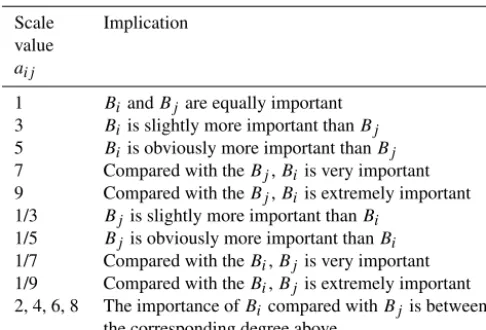
According to the scale of multiple comparison and judgment principle, A. L. Satty applied fuzzy mathematics theory to establish multiple comparison scale system (Table 2) (Xu, 2013; Chowdary et al., 2013). Considering the factor impor-tance sequence identification in the index level, a compar-ative judgment matrix of the adjacent upper level is finally established. The judgment matrix is solved by a square root method, and the consistency check is carried out. Then, the factor weight vector of the index level is determined. The in-dex weight is the maximized objective correction based on a comprehensive weight-determining method of the combi-nation of subjective and objective factors of multi-factor en-tropy weight model. Ultimately the weighted value is deter-mined.
(1) Construct judgment matrix
evalu-Table 2.Standard table of multiple comparison.
Scale Implication
value aij
1 BiandBjare equally important
3 Biis slightly more important thanBj
5 Biis obviously more important thanBj
7 Compared with theBj,Biis very important
9 Compared with theBj,Biis extremely important
1/3 Bjis slightly more important thanBi
1/5 Bjis obviously more important thanBi
1/7 Compared with theBi,Bjis very important
1/9 Compared with theBi,Bjis extremely important
2, 4, 6, 8 The importance ofBi compared withBj is between
the corresponding degree above
ation system are arranged hierarchically by nature, including namely the establishment of the overall goal level, criteria level and subcriteria level.
The judgment matrix is the basic information of the AHP. It is also the basis of calculations of the relative importance and level of single sequencing. The method takes a factor of upper level as the criterion and builds a multiple comparison judgment matrix based on the above conclusions about the factor importance sequence and the standard table of multiple comparison in Table 2. The results are listed in Table 3. Every factor of the judging matrix satisfies the following relations: bij=1/bj i, bjj=1(i, j=1,2. . . n). (12)
(2) Calculate the eigenvalue and eigenvectors
MW=λmaxW, W and λmax represent the eigenvector and
eigenvalue of the judgment matrix. The square root method is applied while it is a generally approximated solution.
The productEi (i=1, 2 . . . ,n) of every row element can
be calculated by multiplying the elements in the judgment matrixMby row:
Ei= n
Y
j=1
bij. (13)
Calculate thenth root ofEi of each row (nis the order of
matrix) as follows: Ei=
n √
Ei. (14)
TakeEi into regularization processing as follows:
E0i=Ei/ n
X
k=1
Ek, (15)
whereE0i is called the weight vector of the matrix.
Table 3.Judgment matrix of evaluation system for high slope safety.
A B1 B2 . . . Bj . . . Bn
B1 1 b12 . . . b1j . . . b1n
B2 b21 1 . . . b2j . . . b2n
. .
. ... ... ... ... ... ...
Bi bi1 bi2 . . . bij . . . bin
. .
. ... ... ... ... ...
Bn bn1 bn2 . . . bnj . . . 1
Table 4.Different order values of RI.
The order Consistency The order Consistency
of judgment index RI of judgment index RI
matrix middle matrix
1 0.00 8 1.41
2 0.00 9 1.45
3 0.58 10 1.49
4 0.90 11 1.52
5 1.12 12 1.54
6 1.24 13 1.56
7 1.32 14 1.58
Estimate the maximum characteristic value of judgment matrix as follows:
λmax=
n
X
k=1
(ME0)k/ nEk0
. (16)
The consistency check index, CI, is introduced to make the result more consistent with the actual situation. The consis-tency check formula is as follows:
CR=CI/RI, (17)
where CI=(λmax−n)/(n−1). The mean random consis-tency index, RI, is different along with the change of the matrix order. The result is shown in Table 4. The judgment matrix is introduced. When CR<0.1, the consistency of the judgment matrix is acceptable. Otherwise, it needs to adjust the judgment matrix until the consistency test meets the re-quirements. Especially when CR<0.01, the consistency of the matrix is a satisfactory result. When CR=0, it is a com-plete consistency check.
(3) Determine and correct the weight vector
H. Z. Su et al.: An approach using multi-factor combination to evaluate high rocky slope safety 1457
Standard literature
Result analysis
Experiment research
Engineering analogy
Index level
Evaluation index
Value range
Dimensionless scope
Geological conditions
Engineering specifications
External environment
Internal and external monitoring
Slope indicator evaluation Object slope evaluation
Object evaluation index Index value
Simple correlation
Primary correlation
Importance ranking Classical field
matter element
Controlled field matter element
Evaluated matter element
Consistency check
Entropy correcting weights
Extension relativity Judgment
matrix
Weight vector
Stable grade Levels variable
characteristic value Evaluation result
Figure 2.Evaluation flowchart of high rocky slope safety.
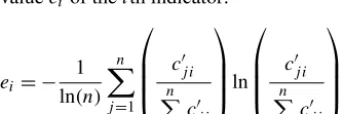
up the multi-objective decision entropy weight model from which we can learn how decision makers influence the index weight. Then, the weight indicator of AHP by the entropy weight method is corrected to make the index weight vector more reasonable and accurate. The factor importance ranking method built by the entropy weight method and the matter element extension theory reduces the subjective judgment as a maximization level, making the results more accurate and objective.
The following formula is adopted to determine the entropy valueei of theith indicator:
ei= −
1 ln(n)
n
X
j=1
c0j i
n
P
j=1 c0j i
ln
c0j i
n
P
j=1 c0j i
, (18)
wherenis the slope judgment matrix order.cij0 is the slope impact factor index value which has experienced the range treatment.
The difference coefficientgi of theith indicator is
calcu-lated as follows:
gi =(1−ei) / n− n
X
i=1 ei
!
, (19)
where 0≤gi≤1.
The information weight valuewiis determined as follows:
wi =gi/ n
X
i=1
gi. (20)
The index weightki of AHP is corrected bywi, and
eventu-ally the synthesis weightsi is determined as follows:
si =wiki/ n
X
i=1
wiki. (21)
4.3 High rocky slope safety state determination
With the help of single factor correlation function valueKt(Vm)and the weight vectors, the extension
corre-lationKt(O)of the evaluation planning slopeO about the
grade oftcan be confirmed:
Kt(O)= n
X
i=1
siKt(Vi) , (22)
where
n
P
i=1
si=1,nis the matrix dimension.
With extension relativity, the safety state of the high rocky slope can eventually be obtained, namely as follows: Kt(O)= {k11(O), k22(O), . . . kt i(O) . . . kss(O)}, (23)
wheret is the standard grade;iis the element numbering of the vectorKt(O)at the gradet, and the elements’ maximum
value in this vector is recorded as
kit0(O)=max({k11(O), k22(O), . . . kt i(O) . . . kss(O)}) . (24)
The stability grade of high slope ist0. The calculation for-mula for the eigenvalue of classification grade of the evalua-tion planning index can be expressed as follows:
kt(O)=
[kt(O)−min(Kt(O))]
[max(Kt(O))−min(Kt(O))]
, (25)
where t0=
s
X
t=1
t kt(O)/ s
X
t=1
kt(O). (26)
5 Case study
Integrating the aforementioned principles and methods, the calculation procedure for the evaluation of high rocky slope has been compiled in this section. This procedure is designed with the consideration of achieving the real-time dynamic evaluation and internal and external monitoring timeliness. The AHP–MEA–EWM is adopted during the calculation. One high rocky slope in China is used as a typical research project analyzed under the multi-factor evaluation system, as shown in Table 5.
The height of the unique high rocky slope is more than 700 m and the width is 50–290 m for an area of 115 000 m2. Larger deformations of the surface and inner rocks are caused by challenging geological conditions in complex internal and external environments, such as rainfall and groundwa-ter. The largest cumulative deformation velocity could reach 3.5 mm day−1. At present, the maximum cumulative dis-placement amount is about 1500 mm for 1 year. Therefore, the present rocky slope is unstable and its safety needs to be analyzed urgently by integrating multiple methods.
5.1 Influencing index importance analysis
On the basis of the ideas explained above, the matter element extension matrix of the index level should be first constructed to determine the element importance ranking. Then simple correlation function values and elementary dependent func-tion values can be calculated through establishing its sutra field, controlled field and the matrices of matter element for appraising. In order to identify the index importance rank-ing, the improved AHP is used to construct the judgment ma-trix and the initial weight vector is calculated after a consis-tency inspection. Finally, the EWM based on multi-objective decision-making is a means of secondary revision of the ini-tial weight vector to build the extension relativity. The final safety state is determined for the high rocky slope, and the di-mensionless parameters in this project are shown in Table 5. This article takes the index evaluation system under ge-ological conditions (B1) criteria in Fig. 1 as an example of carrying out detailed analysis. Other indexes can also be analyzed through a similar analysis process. For the stabil-ity classification, the sutra field (R01–R05), the controlled field (Rp) and the evaluating planning matter element (R0)
are respectively shown as follows:
R01=
N01 C1 <0.80, 1.00> C2 <0.67, 1.00> C3 <0.74, 1.00> C4 <0.60, 1.00> C5 <0.69, 1.00>
, R02=
N02 C1 <0.60, 0.80> C2 <0.56, 0.67> C3 <0.61, 0.74> C4 <0.50, 0.60> C5 <0.38, 0.69>
, R03=
N03 C1 <0.40, 0.60> C2 <0.43, 0.56> C3 <0.42, 0.61> C4 <0.40, 0.50> C5 <0.25, 0.38>
,
R04=
N04 C1 <0.20, 0.40> C2 <0.30, 0.43> C3 <0.16, 0.42> C4 <0.30, 0.40> C5 <0.16, 0.25>
, R05=
N05 C1 <0.00, 0.20> C2 <0.00, 0.30> C3 <0.00, 0.16> C4 <0.00, 0.30> C5 <0.00, 0.16>
,
Rp=
P C1 <0.00,1.00> C2 <0.00,1.00> C3 <0.00,1.00> C4 <0.00,1.00> C5 <0.00,1.00>
,
R0=
N0 C10.30 C2 0.21 C3 0.53 C4 0.30 C5 0.25 . (27)
According to Eqs. (6) and (7), the simple correlation function and elementary correlation function values ofR01are deter-mined by calculating the correlation procedure developed in this paper. The calculation results are listed in Tables 6 and 7. The result of importance ranking of different factors ac-cording to the above methods isC2,C4,C1,C5,C3. Based on the same method, the results of the order of importance of other indexes in Level 3 areC8,C6,C9,C7;C11,C13,C10, C12,C15,C14. According to the order of importance and Ta-ble 2, the judgment matrix ofB1−Cis shown in Table 8.
RB1−C=
1 1/3 3 1/2 2
3 1 5 2 4
1/3 1/5 1 1/4 1/2
2 1/2 4 1 3
1/2 1/4 2 1/3 1
H. Z. Su et al.: An approach using multi-factor combination to evaluate high rocky slope safety 1459
Table 5.Safety evaluation index value of high rocky slopes.
Level 2 Level 3 Values Dimensionless
values
Geological conditions B1
Rock geomechanics classification (RMR) 30.00 0.30
Internal friction angle (◦) 19.30 0.21
Uniaxial compressive strength (MPa) 110.00 0.53
Poisson ratio 0.35 0.30
Cohesive force (MPa) 0.08 0.25
Engineering conditions B2
Slope height (m) 750.00 0.25
Horizontal seismic acceleration (g) 0.07 0.83
Slope angle (◦) 43.00 0.52
Seismic intensity 5.00 0.58
External environment B3
Daily maximum precipitation (mm) 54.60 0.64
Maximum in situ stress (MPa) 23.50 0.06
Monthly cumulative rainfall (mm) 68.40 0.77
Groundwater state (L min−1(10 m)−1) 75.00 0.50
Internal and external monitoring B4 Surface deformation rate (mm day
−1) 9.90 0.010
Deep deformation rate (mm day−1) 1.63 0.19
Table 6.Index level results of correlation function under geological conditions criteria for grade I.
Evaluated Classic field Controlled field Evaluated Elementary Simple
index interval interval matter dependent correlation
element function function
C1 <0.80,1.00> <0.00,1.00> 0.30 −0.63 −5.00
C2 <0.67,1.00> <0.00,1.00> 0.21 −0.69 −2.79
C3 <0.74,1.00> <0.00,1.00> 0.53 −0.31 −1.62
C4 <0.60,1.00> <0.00,1.00> 0.30 −0.50 −1.50
C5 <0.69,1.00> <0.00,1.00> 0.25 −0.64 −2.84
Table 7. The results of elementary dependent function for every grade.
Index I II III IV V
C1 −0.63 −0.50 −0.25 0.50 −0.25
C2 −0.69 −0.63 −0.51 −0.30 0.75
C3 −0.31 −0.15 0.21 −0.19 −0.44
C4 −0.50 −0.40 −0.25 0.00 0.00
C5 −0.64 −0.34 0.00 0.00 −0.26
Based on the procedure of calculating weights and eigen-values developed in this paper, the obtained weight result is 0.16, 0.42, 0.06, 0.26, 0.10, with 5.07 as its eigenvalue. The consistency test (CR=0.015<0.1) shows that the judg-ment matrix has a satisfactory consistency which shows that the judgment matrix and the weight are reliable. Based on the weight amendment procedure, the result of corrected weight vector is 0.18, 0.55, 0.044, 0.14, 0.083. According to Eqs. (22)–(26) and the program developed in this paper, the extension relativity of each level is calculated (−0.63,−0.53,
Table 8.Standard table of multiple comparison ofB1–C.
B C1 C2 C3 C4 C5
C1 1 1/3 3 1/2 2
C2 3 1 5 2 4
C3 1/3 1/5 1 1/4 1/2
C4 2 1/2 4 1 3
C5 1/2 1/4 2 1/3 1
−0.35,−0.083, 0.33), and the eigenvalue of the classification grade is 4.25.
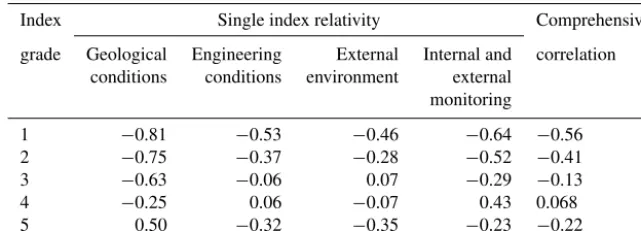
Table 9.Evaluation results of criteria level (Level 2).
Index Single index relativity Comprehensive
grade Geological Engineering External Internal and correlation
conditions conditions environment external
monitoring
1 −0.81 −0.53 −0.46 −0.64 −0.56
2 −0.75 −0.37 −0.28 −0.52 −0.41
3 −0.63 −0.06 0.07 −0.29 −0.13
4 −0.25 0.06 −0.07 0.43 0.068
5 0.50 −0.32 −0.35 −0.23 −0.22
eigenvalue of the classification grade is 3.11.B3−Cis with its weight vector results in 0.16, 0.48, 0.88, 0.27, and the eigenvalue is 4.00, with a satisfactory result in the consis-tency test (CR=0.0034<0.01) and the weight vector after amendment is 0.17, 0.47, 0.091, 0.27. The extension rela-tivity in each level is−0.63,−0.50,−0.27,−0.46,−0.69, and the eigenvalue of the classification grade is 2.85.B4−C, with its weight vector result of 0.25, 0.75, eigenvalue of 1.99 and matrix order of 2, shows a satisfactory consistency. The extension relativity in each level is −0.84, −0.83, −0.81,
−0.70,−0.86, and the eigenvalue of the classification grade is 3.57.
5.2 Final safety evaluation
The analysis program of evaluation system is built on the theory of the integrated AHP–MEA–EWM. For the evalua-tion system of the overall goal level (Level 1), the analysis steps and ideas are consistent with the criteria level (Level 2) and the classification eigenvalue of the criteria level (Level 2) constructed above is 0, 1; 1, 2; 2, 3; 3, 4; 4, 5. Based on the ideas calculated in this article, the results of the single-index relation degree, integrated incidence degree and grade vari-able eigenvalue for safety evaluation of high rocky slope are shown in Table 9.
Based on the above methods, the importance order is B3, B4, B2, B1. The initial value of the weight is 0.10, 0.16, 0.47, 0.28, the value of the weight after amendment is 0.11, 0.18, 0.44, 0.27 and the classification eigenvalue is 3.75. The safety state of grade slope is IV, which is fully consistent with the present situation of the high rocky slope under an un-stable state with larger and more unun-stable deformation. It is worth noting that the results of multivariate analysis demon-strate a warning of its precarious state. Based on the results of its internal and external monitoring, this safety evaluation system has provided an important theoretical basis for mak-ing rational decisions usmak-ing a procedural algorithm to assess the security status of the slope in a timely and dynamic man-ner.
6 Conclusions
An integrated analytic hierarchy process–matter element analysis–entropy weight method for solving the multiple cri-teria decision-making problem has been proposed and ap-plied in the comprehensive safety assessment of high rocky slope. The proposed method integrates the analytic hier-archy process method, matter element theory, and the en-tropy weight method within a safety assessment framework. The specific multivariate computational procedures were provided to illustrate the integration process of the above methods. Its evaluation process involves factor input, self-evaluation, dynamic assessment and real-time grade stan-dards’ output, etc. The comprehensive assessment results demonstrate that the level eigenvalue of the high rocky slope is 3.75, and its security status IV is fully consistent with the actual situation. Decision makers can conduct flexible and variable response programs for the high rocky slope. This study is the first application of the proposed method in the safety assessment of high rocky slopes.
H. Z. Su et al.: An approach using multi-factor combination to evaluate high rocky slope safety 1461
The proposed MCDM approach integrates subjective judgments derived from the AHP with MEA and EWM into an intelligent, preferable and subjective and objective and multiple criteria approach. The structured approach pre-sented in this study has some obvious attractive features. (1) It is comprehensive and flexible; the approach combines a comprehensive method covering the AHP, MEA and EWM technique concerning multiple factors, multiple criteria and multiple layers. The number of the all kinds of factors is not limited and this method is flexible for extension. (2) It is structured and analytical; the miscellaneous factors are stratified into a hierarchy to simplify information input and provide a clear framework for the decision maker for such complex problems. The proposed method helps the decision maker decompose a complex problem into manageable steps. (3) It is qualitative and quantitative; the comprehensive ap-proach presents a qualitative evaluation analysis and a quan-titative evaluation amount, which can be established for the decision maker to obtain a more precise decision. (4)It is subjective and objective; the subjective evaluation of a finite number of decision alternatives is allowed as the generic na-ture of the proposed approach of this paper allows a finite number of influencing factors. The objective influencing fac-tors’ importance of multiple layers can be obtained by MEA and an objective weight can be achieved by integrating the AHP and EWM. (5) It is computational and intelligent; the proposed method is a mathematical and computational model which can be widely applicable to the MCDM problem.
For future research, it can be conducted in the following directions. (1) The proposed method could be developed in the future based on fuzzy theory for imprecise, ambiguous or unknown data. (2) A more objective evaluation guide-line could be introduced to amend the subjective judgment of the AHP. (3) The proposed method could be applied to other MCDM problems, especially for the safety evaluation of other fields. (4) The matter element theory could be more widely applied in solving MCDM problems by integrating other methods.
Acknowledgements. This research has been partially supported by the National Natural Science Foundation of China (SN: 51579083, 41323001, 51139001, 51479054), the Jiangsu Natural Science Foundation (SN: BK2012036), the Doctoral Program of Higher Education of China (SN: 20130094110010), the Open Foundation of State Key Laboratory of Hydrology-Water Resources and Hydraulic Engineering (SN: 20145027612), the Fundamental Research Funds for the Central Universities (SN: 2015B25414) and a project funded by the Priority Academic Program Development of Jiangsu Higher Education Institutions (SN: 3014-SYS1401).
Edited by: O. Katz
Reviewed by: three anonymous referees
References
Abdalla, J. A., Attom, M. F., and Hawileh, R.: Prediction of mini-mum factor of safety against slope failure in clayey soils using ar-tificial neural network, Environ. Earth Sci., 73, 5463–5477, 2015. Abdul-Rahman, H., Wang, C., and Lee, Y. L.: Design and pilot run of fuzzy synthetic model (FSM) for risk evaluation civil engi-neering, J. Civ. Eng. Manage., 19, 217–238, 2013.
Bahsan, E., Liao, H. J., and Ching, J.: Statistics for the calculated safety factors of undrained failure slopes, Eng. Geol., 172, 85– 94, 2014.
Belton, V. and Stewart, T. J.: Multiple attributes decision analysis: An integrated approach, Kluwer Academic, Dordrecht, 2002. Bitarafan, M., Hashemkhani Zolfani, S., Arefi, S. L., and
Zavad-skas, E. K: Evaluating the construction methods of cold-formed steel structures in reconstructing the areas damaged in natu-ral crises, using the methods AHP and COPRAS-G, Arch. Civ. Mech. Eng., 12, 360–367, 2012.
Bozzano, F., Mazzanti, P., Prestininzi, A., and Scarascia Mugnozza, G.: Research and development of advanced technologies for landslide hazard analysis in Italy, Landslides, 7, 381–385, 2010. Cai, W.: The extension set and non-compatible problem, J. Scient.
Exp., 3, 83–97, 1983.
Caliskan, H., Kursuncu, B., Kurbanoglu, C., and Güven, S. H.: Ma-terial selection for the tool holder working under hard milling conditions using different multi criteria decision making meth-ods, Mater. Design, 45, 473–479, 2013.
Casagli, N., Catani, F., Del Ventisette, C., and Luzi, G.: Monitoring, prediction, and early warning using ground-based radar interfer-ometry, Landslides, 7, 291–301, 2010.
Cheng, K.: Application of matter-element analysis theory for blast-ing classification of rock, J. Wuhan Univers. Technol., 16, 51–53, 2001.
Chowdary, V. M., Chakraborthy, D., and Jeyaram, A.: Multi-criteria decision making approach for watershed prioritization using an-alytic hierarchy process technique and GIS, Water Resour. Man-age., 27, 3555–3571, 2013.
Dai, F. C. and Lee, C. F.: Landslide characteristics and slope insta-bility modeling using GIS, Lantau Island, Hong Kong, Geomor-phology, 42, 213–228, 2002.
Dejus, T. and Antucheviciene, J.: Assessment of health and safety solutions at a construction site, J. Civ. Eng. Manage., 19, 728– 737, 2013.
Ermini, L., Catani, F., and Casagli, N: Artificial neural networks applied to landslide susceptibility assessment, Geomorphology, 66, 327–343, 2005.
Eshtehardian, E., Ghodousi, P., and Bejanpour, A: Using ANP and AHP for the supplier selection in the construction and civil en-gineering companies; Case study of Iranian company, KSCE J. Civ. Eng., 17, 262–270, 2013.
Feng, L. and Hong, W.: Application of matter-element analysis in weather forecasting, Meteorol. Appl., 21, 398–402, 2014. Figueira, J., Greco, S., and Ehrgott, M.: Multiple attributes decision
analysis: State of the art surveys, Springer, New York, 2005. Fuchs, M., Torizin, J., and Kuehn, F.: The effect of DEM resolution
on the computation of the factor of safety using an infinite slope model, Geomorphology, 224, 16–26, 2014.
Ge, H., Huang, Z. P., and Wang, Y.: Application of fuzzy optimiza-tion model based on entropy weight in typical flood hydrograph selection, J. Hydrol. Eng., 18, 1400–1407, 2013.
Ginevicius, R.: A new determining method for the criteria weights in multicriteria evaluation, Int. J. Inf. Technol. Decis. Mak., 10, 1067–1095, 2011.
Hashemkhani Z. S., Aghdaie, M. H., Derakhti, A., Zavadskas, E. K., and Morshed Varzandeh, M. H.: Decision making on business issues with foresight perspective; an application of new hybrid MCDM model in shopping mall locating, Exp. Syst. Appl., 40, 7111–7121, 2013.
Hwang, C. L. and Yoon, K.: Multiple attributes decision making methods and applications, Springer-Verlag, New York, 1981. Jamsawang, P., Voottipruex, P., and Boathong, P.:
Three-dimensional numerical investigation on lateral movement and factor of safety of slopes stabilized with deep cement mixing col-umn rows, Eng. Geol., 188, 159–167, 2015.
Ji, Y., Huang, G. H., and Sun, W.: Risk assessment of hydropower stations through an integrated fuzzy entropy-weight multiple cri-teria decision making method: A case study of the Xiangxi River, Exp. Syst. Appl., 42, 5380–5389, 2015.
Karami, A. and Johansson, R.: Utilization of multi attribute decision making techniques to integrate automatic and manual ranking of options, J. Inf. Sci. Eng., 30, 519–534, 2014.
Kersuliene, V., Zavadskas, E. K., and Turskis, Z.: Selection of ratio-nal dispute resolution method by applying new step-wise weight assessment ratio analysis (SWARA), J. Business Econ. Manage., 11, 243–258, 2010.
Kildiene, S., Kaklauskas, A., and Zavadskas, E. K.: COPRAS based comparative analysis of the European country management ca-pabilities within the construction sector in the time of crisis, J. Business Econ. Manage., 12, 417–434, 2011.
Kok, J. L. D., Kofalk, S., Berlekamp, J., and Hahn, B.: From design to application of a decision-support system for integrated river-basin management, Water resources management, 23, 1781– 1811, 2009.
Larichev, O. I. and Olson, D. L.: Multiple attributes analysis in strategic siting problems, Kluwer Academic Publishers, Boston, 2001.
Li, F., Phoon, K., Du, X., and Zhang, M.: Improved AHP method and its application in risk identification, J. Construct. Eng. Man-age., 139, 312–320, 2013.
Li, J. and Zou, P. X. W.: Fuzzy AHP-based risk assessment method-ology for PPP Projects, J. Construct. Eng. Manage., 137, 1205– 1209, 2011.
Li, M. G., Zhang, Z. Q., and Bai, R. Q.: Matter-Element Model for evaluating the financial security, Pakistan J. Stat., 30, 779–790, 2014.
Ma, J., Fan, Z. P., and Huang, L. H.: A subjective and objective in-tegrated approach to determining attribute weights, Eur. J. Oper. Res., 112, 397–404, 1999.
Malkawi, A. I. H., Hassan, W. F., and Abdulla, F. A.: Uncertainty and reliability analysis applied to slope stability, Struct. Safety, 22, 161–187, 2000.
Ozkir, V. and Demirel, T.: A fuzzy assessment framework to select among transportation investment projects in Turkey, Exp. Syst. Appl., 39, 74–80, 2012.
Pantelidis, L.: A critical review of highway slope instability risk as-sessment systems, Bull. Eng. Geol. Environ., 70, 395–400, 2011.
Peng, M., Li, X. Y., and Li, D. Q.: Slope safety evaluation by inte-grating multi-source monitoring information, Struct. Safety, 49, 65–74, 2014.
Prsilva, F., Lambe, T. W., and Marr, W. A.: Probability and risk of slope failure, J. Geotech. Geoenvironm. Eng., 134, 1691–1699, 2008.
Rahman, M. A., Rusteberg, B., Uddin, M. S., Lutz, A., Saada, M. A., and Sauter, M.: An integrated study of spatial multicrite-ria analysis and mathematical modelling for managed aquifer recharge site suitability mapping and site ranking at Northern Gaza coastal aquifer, J. Environ. Manage., 124, 25–39, 2013. Saaty, T. L.: Operations Research: Some Contributions to
Mathe-matics: Applied mathematics gets a new surge of life from tech-niques of operations research, Science, 178, 1061–1070, 1972. Saaty, T .L.: A scaling method for priorities in hierarchical
struc-tures, J. Math. Psyhol., 15, 234–281, 1977.
Saaty, T. L.: Decision making for leaders: The analytic hierarchy process for decisions in complex environments, RWS Publica-tions, Pittsburg, 1986.
Saaty, T. L.: Multicriteria decision making: The analytic hierarchy process, RWS Publications, Pittsburg, 1988.
Saaty, T. L.: Fundamentals of decision making and priority theory with AHP, RWS Publications, Pittsburg, 1994.
Saaty, T. L.: Decision-making with the AHP: Why is the principal eigenvector necessary, Eur. J. Oper. Res., 145, 85–91, 2003. Sayyadi, G. and Awasthi, A.: AHP-based approach for location
planning of pedestrian zones: application in Montreal, Canada, J. Transport. Eng., 139, 239–246, 2013.
Shannon, C. E.: A mathematical theory of communication, Bell Syst. Tech. J., 27, 379–423, 1948.
Shemshadi, A., Shirazi, H., Toreihi, M., and Terokh, M. J.: A fuzzy VIKOR method for supplier selection based on entropy mea-sure for objective weighting, Exp. Syst. Appl., 38, 12160–12167, 2011.
Su, H. Z., Hu, J., and Wen, Z. P.: Optimization of reinforcement strategies for dangerous dams considering time-average system failure probability and benefit–cost ratio using a life quality in-dex, Nat. Hazards, 65, 799–817, 2013a.
Su, H. Z., Qin, P., and Qin, Z.: A method for evaluating sea dike safety, Water Resour. Manage., 27, 5157-5170, 2013b.
Susinskas, S., Zavadskas, E. K., and Turskis, Z.: Multiple crite-ria assessment of pile-columns alternatives, Balt. J. Road Bridge Eng., 6, 145–152, 2011.
Tang, J., Wang, C., and Lin, N. F.: Application of matter-element model in soil nutrient evaluation of ecological fragile region, Chin. Geogr. Sci., 19, 168–176, 2009.
Tavana, M. and Hatami-Marbini, A.: A group AHP-TOPSIS frame-work for human spaceflight mission planning at NASA, Exp. Syst. Appl., 38, 13588–13603, 2011.
Triantaphyllou, E.: Multi-attributes decision making methods: A comparative study, Kluwer Academic Publishers, Boston, 2000. Ustinovichius, L.: Determining integrated weights of attributes, J.
Civ. Eng. Manage., 7, 321–326, 2001.
Ustinovichius, L., Zavadskas, E. K., and Podvezko, V.: Application of a quantitative multiple criteria decision making (MCDM-1) approach to the analysis of investments in construction, Control Cybernet., 36, 251–268, 2007.
H. Z. Su et al.: An approach using multi-factor combination to evaluate high rocky slope safety 1463
Wang, C., Wu, A., and Lu, H.: Predicting rock burst tendency based on fuzzy matter-element model, Int. J. Rock Mech. Min. Sci., 75, 224–232, 2015.
Wu, C. H. and Chen, S. C.: Determining landslide susceptibility in Central Taiwan from rainfall and six site factors using the analyt-ical hierarchy process method, Geomorphology, 112, 190–204, 2009.
Xu, J. C.: Analytic hierarchy process for assessing factors influ-encing the stability of soil slopes reinforced with piles, Environ. Earth Sci., 70, 1507–1514, 2013.
Ye, J.: Multicriteria fuzzy decision-making method using entropy weights-based correlation coefficients of interval-valued intu-itionistic fuzzy sets, Appl. Math. Model., 34, 3864–3870, 2010.
Zhao, Y. K., Liu, H. D., and Li, Q. A.: Slope stability analysis of lower reaches’ dikes of Yellow River under flood immersion and water level rapid drawdown, Rock Soil Mech., 32, 1495–1499, 2011.