217
Copyright © 2011-15. Vandana Publications. All Rights Reserved.
Volume-5, Issue-2, April-2015
International Journal of Engineering and Management Research
Page Number: 217-226
Hall Current Effect on Unsteady MHD Convective Flow of Viscoelastic,
Reacting and Radiating Fluid through Porous Medium in a Vertical
Channel
B. P. Garg1, K. D. Singh2, Neeraj Kumar3 1
Research Supervisor, Punjab Technical University, Jalandhar, INDIA
2
Professor of Mathematics, Wexlow, Lower Kaithu, Shimla, INDIA 3
Research Scholar, Punjab Technical University, Jalandhar, Punjab, INDIA
ABSTRACT
An analysis of an unsteady MHD convective flow of a viscoelastic, incompressible and electrically conducting fluid through porous medium in a vertical channel in the presence of chemical reaction is carried out. A magnetic field of uniform strength is applied in the direction normal to the planes of the plates. The Hall currents have been taken into account. The temperature and species concentration of either of the channel plates at 𝒛𝒛∗= ±𝒅𝒅
𝟐𝟐 varies periodically with time.
The temperature difference of the channel plates is high enough to cause heat radiation. A closed form solution of MHD flow is obtained analytically. The effects of different parameters on the flow are discussed with the help of graphs.
Keywords---- Hall current, viscoelastic, MHD, periodic, reacting, radiating, convective flow.
I.
INTRODUCTION
Convective flows in a porous medium have received much attention in recent time due to its wide applications in geothermal and oil reservoir engineering as well as other geophysical and astrophysical studies. Moreover, considerable interest has been shown in reacting and radiation interaction with convection for heat transfer in fluids. This is due to the significant role of thermal radiation in the surface heat transfer when convection heat transfer is small, particularly in free convection problems involving absorbing-emitting fluids. Theoretical and experimental works on MHD flow with thermal diffusion and chemical reaction have been done extensively in various areas such as liquid metal cooling of nuclear reactions, electromagnetic casting of metals and sustain plasma confinement for controlled thermo nuclear fusion. The effects of transversely applied magnetic field on the flow of an electrically conducting viscous fluid have been discussed widely owing to their astrophysics, geophysical and engineering applications. Hakiem [1] investgated hydromagnetic oscillatory flow on free convection radiation through porous medium with constant suction velocity. Raptis and Perdikis [2] studied an unsteady flow
through a highly porous medium in the presence of radiation. Makinde and Mhone [3] have analyzed the heat transfer to MHD oscillatory flow in a channel filled with porous medium. Alagoa, et al. [4] studied radiative and free convective effects of a MHD flow through a porous medium between infinite parallel plates with time-dependent suction. Seth et al. [5] investigated an unsteady MHD convective flow within a parallel plate rotating channel with thermal source/sink in a porous medium under slip boundary conditions.
In majority of hydromagnetic flows the Hall
218
Copyright © 2011-15. Vandana Publications. All Rights Reserved.
along a porous flat plate with mass transfer. Singh and Reena Pathak [10] presented an analysis of an oscillatory rotating MHD Poiseuille flow with injection/suction and Hall currents. Singh and Rakesh Kumar [11] investigated of Hall current and rotation effects together on free convection MHD flow in a porous channel. Hall currents and surface temperature oscillation effects on natural convection magnetohydrodynamic heat-generating flow have been considered by Takhar and Ram [12]. Singh and Kumar [13] investigate fluctuating heat and mass transfer on unsteady MHD free convection flow of radiating and reacting fluid past a vertical porous plate in slip-flow regime. Chand et al. [14] analyzed Hall effect on radiating and chemically reacting MHD oscillatory flow in a rotating porous vertical channel in slip flow regime. Effects of thermal diffusion and chemical reaction on MHD flow of dusty viscoelastic fluid have been analyzed by Prakash et al. [15]. Devika et al. [16] analyzed MHD oscillatory flow of a visco-elastic fluid in a porous channel with chemical reaction. Ahmed and Sinha [17] investigated effect of chemical reaction on transient MHD flow past an impulsively started vertical plate with ramped temperature and concentration. Reddy et al. [18] discussed MHD heat and mass transfer flow of a viscoelastic fluid past an impulsively started infinite vertical plate with chemical reaction.
The aim of the present study is to analyze the effects Hall currents on MHD convective flow through porous medium in a vertical channel in the presence of radiation and chemical reaction when the temperature and the species concentration varies periodically with time. The channel is filled with the highly porous medium. A magnetic field of uniform strength is applied perpendicular to the planes of the plates. Exact solutions of the partial differential equations are obtained and the effects of different flow parameters on the flow and temperature are discussed with the aid of graphs.
II.
BASIC EQUATIONS
The equations governing the unsteady convective flow of a visco-elastic, incompressible, and electrically conducting fluid through porous medium in the presence of Hall current are:
Equation of Continuity:
𝑑𝑑𝑑𝑑𝑑𝑑𝑉𝑉�⃗= 0 , (1)
Momentum Equation: 𝜌𝜌 �𝜕𝜕𝑉𝑉��⃗
𝜕𝜕𝑡𝑡∗+�𝑉𝑉�⃗ ∙ ∇�𝑉𝑉�⃗�=
∇.∃ − 𝜇𝜇𝐾𝐾𝑉𝑉��⃗∗+𝑗𝑗⃗×𝐵𝐵�⃗+ +𝐹𝐹⃗, (2)
Energy Equation: 𝜌𝜌𝑐𝑐𝑝𝑝�𝜕𝜕𝑇𝑇∗
𝜕𝜕𝑡𝑡∗+
𝑉𝑉.∇𝑇𝑇∗=𝑘𝑘∇2𝑇𝑇∗−∇q∗ ,(3)
Mass diffusion equation:
𝜕𝜕𝐶𝐶∗
𝜕𝜕𝑡𝑡∗+�𝑉𝑉�⃗.∇�𝐶𝐶∗=𝐷𝐷∇2𝐶𝐶∗− 𝐾𝐾𝑟𝑟(𝐶𝐶∗− 𝐶𝐶1), (4)
Kirchhoff’s First Law: 𝑑𝑑𝑑𝑑𝑑𝑑𝑗𝑗⃗= 0 (5)
General Ohm's Law:
𝑗𝑗⃗+𝜔𝜔𝑒𝑒𝜏𝜏𝑒𝑒
𝐵𝐵0 �𝑗𝑗⃗×𝐵𝐵�⃗�=𝜎𝜎 �𝐸𝐸�⃗+𝑉𝑉�⃗×𝐵𝐵�⃗+
1
𝑒𝑒𝜂𝜂𝑒𝑒∇𝑝𝑝𝑒𝑒� (6)
Gauss's Law of Magnetism:
𝑑𝑑𝑑𝑑𝑑𝑑𝐵𝐵�⃗= 0 , (7)
where 𝑉𝑉�⃗ is the velocity vector, p is the pressure, ρ is the density, 𝐵𝐵�⃗ is the magnetic induction vector, 𝑗𝑗⃗ is the current
density, μ is the coefficient of viscosity, t*
is the time, g is the acceleration due to gravity, K* is the permeability of the porous medium, cp is the specific heat at constant pressure, T* is the temperature, k is the thermal conductivity, q* is the heat radiation, C* is the species concentration, D is the molecular diffusivity and Kr is the chemical reaction, σ is the electrical conductivity, e is the
electron charge, ωe is the electron frequency, τe is the electron collision time, pe is the electron pressure, 𝐸𝐸�⃗ is the
electric field and ηe is the number density of electron. On the right hand side of equation (2) the last term 𝐹𝐹⃗=𝑔𝑔𝑔𝑔(𝑇𝑇∗− 𝑇𝑇1) +𝑔𝑔𝑔𝑔∗(𝐶𝐶∗− 𝐶𝐶1) accounts for the force due to buoyancy and the second last term is the Lorentz force due to magnetic field 𝐵𝐵�⃗ and is given by
𝐽𝐽⃗×𝐵𝐵�⃗=𝜎𝜎�𝑉𝑉�⃗×𝐵𝐵�⃗�×𝐵𝐵�⃗ . (8)
In the first term on the R. H. S. of equation (2), ∃ is the Cauchy stress tensor and the constitutive equation derived by Coleman and Noll [19] for an incompressible homogeneous fluid of second order is
∃=−𝑝𝑝∗𝐼𝐼+𝜇𝜇
1𝐴𝐴1+𝜇𝜇2𝐴𝐴2+𝜇𝜇3𝐴𝐴12. (9)
Here −𝑝𝑝∗𝐼𝐼 is the interdeterminate part of the stress due to constraint of incompressibility, 𝜇𝜇1, 𝜇𝜇2 and 𝜇𝜇3 are the material constants describing viscosity, elasticity and cross-viscosity respectively. The kinematic 𝐴𝐴1 and 𝐴𝐴2 are the Rivelen Ericson constants defined as
𝐴𝐴1= (∇𝑉𝑉�) + (∇𝑉𝑉�)𝑇𝑇,
𝐴𝐴2=𝑑𝑑𝐴𝐴𝑑𝑑𝑡𝑡1+(∇𝑉𝑉�)𝑇𝑇𝐴𝐴1+𝐴𝐴1(∇𝑉𝑉�),
where ∇ denotes the gradient operator and d/dt the material time derivative. According to Markovitz and Coleman [20] the material constants𝜇𝜇1, 𝜇𝜇3 are taken as positive and 𝜇𝜇2 as negative.
219
Copyright © 2011-15. Vandana Publications. All Rights Reserved.
III.
FORMULATION OF THE
PROBLEM
Consider an oscillatory MHD convective flow of a viscoelastic, incompressible and electrically conducting fluid through a porous medium in a vertical channel. The insulated plates of the channel are at distance 'd' apart. The
𝑥𝑥∗- axis is oriented vertically upwards along the centreline
of the channel. The 𝑧𝑧∗-axis taken perpendicular to the planes of the plates and a strong transverse magnetic field of uniform strength 𝐵𝐵0 is applied along this axis. Hall current due to the applied magnetic field have been taken into account. The non-uniform temperature of the plate at
𝑧𝑧∗= +𝑑𝑑
2 and the species concentration at the plate
𝑧𝑧∗=−𝑑𝑑
2 are respectively assumed to be varying periodically with time. The equation of Continuity (1) for non-porous plates of the channel integrates to 𝑤𝑤∗= 0. where 𝑉𝑉�⃗= (𝑢𝑢∗,𝑑𝑑∗,𝑤𝑤∗) represents the velocity components in the directions (𝑥𝑥∗,𝑦𝑦∗,𝑧𝑧∗) respectively. The plates of the channel being considered infinite so all the physical quantities except the pressure are functions of z* and t* only. The physical configuration of the problem is shown in Figure1.
X*
Fig.1. Physical configuration of the physical problem.
A strong transverse magnetic field of uniform strength 𝐵𝐵0 is applied along the Z
*
If �𝑗𝑗𝑥𝑥∗,𝑗𝑗𝑦𝑦∗, 𝑗𝑗𝑧𝑧∗� are the components of electric current density 𝑗𝑗⃗. The equation of conservation of electric charge (5) gives𝑗𝑗𝑧𝑧∗=𝑐𝑐𝑐𝑐𝑐𝑐𝑐𝑐𝑡𝑡𝑐𝑐𝑐𝑐𝑡𝑡. For non-conducting plates
𝑗𝑗𝑧𝑧∗= 0 at the plates and hence zero everywhere in the fluid.
Under the usual assumptions that the electron pressure (for a weakly ionized gas), the thermoelectric pressure, ion slip and the external electric field arising due to polarization of charges is negligible. It is assumed that no applied and
polarization voltage exists. This corresponds to the case where no energy is being added or extracted from the fluid by electrical means (Meyer [21]) i.e., electrical field𝐸𝐸�⃗= 0. Therefore, equation (6) takes the form:
𝑗𝑗⃗+𝜔𝜔𝑒𝑒𝜏𝜏𝑒𝑒
𝐵𝐵0 �𝑗𝑗⃗×𝐵𝐵�⃗�=𝜎𝜎�𝑉𝑉�⃗×𝐵𝐵�⃗� . (10)
After using equation 𝑗𝑗𝑧𝑧∗= 0, equation (10) in component form becomes
𝑗𝑗𝑥𝑥∗+𝜔𝜔𝑒𝑒𝜏𝜏𝑒𝑒𝑗𝑗𝑦𝑦∗ =𝜎𝜎𝐵𝐵0𝑑𝑑∗ , (11)
𝑗𝑗𝑦𝑦∗− 𝜔𝜔𝑒𝑒𝜏𝜏𝑒𝑒𝑗𝑗𝑥𝑥∗=−𝜎𝜎𝐵𝐵0𝑢𝑢∗ . (12)
Solving (11) and (12) for 𝑗𝑗𝑥𝑥∗ and 𝑗𝑗𝑦𝑦∗ , we get
𝑗𝑗𝑥𝑥∗=(1+𝜎𝜎𝐵𝐵0
𝐻𝐻2)(𝐻𝐻𝑢𝑢∗+𝑑𝑑∗) and 𝑗𝑗𝑦𝑦∗=(1+𝜎𝜎𝐵𝐵0
𝐻𝐻2)(𝐻𝐻𝑑𝑑∗− 𝑢𝑢∗)
where 𝐻𝐻=𝜔𝜔𝑒𝑒𝜏𝜏𝑒𝑒 is the Hall parameter.
Using the velocity and the magnetic field distribution as stated above the magnetohydrodynamic (MHD) flow of a viscoelastic fluid is governed by the following Cartesian equations:
𝜕𝜕𝑢𝑢∗ 𝜕𝜕𝑡𝑡∗ =−
1
𝜌𝜌 𝜕𝜕𝑝𝑝∗ 𝜕𝜕𝑥𝑥∗+𝜗𝜗1
𝜕𝜕2𝑢𝑢∗ 𝜕𝜕𝑧𝑧∗2+𝜗𝜗2
𝜕𝜕3𝑢𝑢∗ 𝜕𝜕𝑧𝑧∗2𝜕𝜕𝑡𝑡∗+
𝜎𝜎𝐵𝐵02(𝐻𝐻𝑑𝑑∗−𝑢𝑢∗)
𝜌𝜌(1+𝐻𝐻²) −
𝜗𝜗1𝑢𝑢∗
𝐾𝐾∗ +
𝑔𝑔𝑔𝑔(𝑇𝑇∗− 𝑇𝑇
1) +𝑔𝑔𝑔𝑔∗(𝐶𝐶∗− 𝐶𝐶1), (13)
𝜕𝜕𝑑𝑑∗
𝜕𝜕𝑡𝑡∗=−1𝜌𝜌𝜕𝜕𝑝𝑝 ∗
𝜕𝜕𝑦𝑦∗+𝜗𝜗1𝜕𝜕
2𝑑𝑑∗
𝜕𝜕𝑧𝑧∗2+𝜗𝜗2 𝜕𝜕
3𝑑𝑑∗
𝜕𝜕𝑧𝑧∗2𝜕𝜕𝑡𝑡∗−𝜎𝜎𝐵𝐵0 2(𝐻𝐻𝑢𝑢∗+𝑑𝑑∗)
𝜌𝜌(1+𝐻𝐻²) −
𝜗𝜗1𝑢𝑢∗
𝐾𝐾∗ , (14)
0 =−𝜌𝜌1𝜕𝜕𝑝𝑝𝜕𝜕𝑧𝑧∗∗ , (15)
𝜕𝜕𝑇𝑇∗
𝜕𝜕𝑡𝑡∗=
𝑘𝑘 𝜌𝜌𝑐𝑐𝑝𝑝
𝜕𝜕2𝑇𝑇∗
𝜕𝜕𝑧𝑧∗2−
1
𝜌𝜌𝑐𝑐𝑝𝑝
𝜕𝜕𝜕𝜕
𝜕𝜕𝑧𝑧∗ , (16)
𝜕𝜕𝐶𝐶∗ 𝜕𝜕𝑡𝑡∗ =𝐷𝐷𝜕𝜕
2𝐶𝐶∗
𝜕𝜕𝑧𝑧∗2 − 𝐾𝐾𝑟𝑟(𝐶𝐶∗− 𝐶𝐶1), (17)
where β is the coefficient of volume expansion, β
-axis. So equation (7) for the magnetic field 𝐵𝐵�⃗=�𝐵𝐵𝑥𝑥∗,𝐵𝐵𝑦𝑦∗,𝐵𝐵𝑧𝑧∗� gives𝐵𝐵𝑧𝑧∗=
𝐵𝐵0(𝑐𝑐𝑐𝑐𝑐𝑐𝑐𝑐𝑡𝑡𝑐𝑐𝑐𝑐𝑡𝑡).
* is the volumetric coefficient of expansion with concentration, 𝜗𝜗1 is the kinematic viscosity, 𝜗𝜗2 is the viscoelasticity. The boundary conditions for the problem are
𝑧𝑧∗=−𝑑𝑑
2: 𝑢𝑢∗=𝑑𝑑∗= 0, 𝑇𝑇∗=𝑇𝑇1,𝐶𝐶∗=𝐶𝐶1+
(𝐶𝐶2− 𝐶𝐶1) cos𝜔𝜔∗𝑡𝑡∗ , (18)
𝑧𝑧∗=𝑑𝑑
2: 𝑢𝑢∗=𝑑𝑑∗= 0, 𝑇𝑇∗=
𝑇𝑇1+ (𝑇𝑇2− 𝑇𝑇1) cos𝜔𝜔∗𝑡𝑡∗,𝐶𝐶∗=𝐶𝐶1 , (19)
220
Copyright © 2011-15. Vandana Publications. All Rights Reserved.
𝜕𝜕𝜕𝜕∗
𝜕𝜕𝑧𝑧∗= 4𝑐𝑐∗𝜎𝜎∗(𝑇𝑇∗4− 𝑇𝑇14), (20)
for the case of an optically thin gray gas. Here a* is the means absorption coefficient and 𝜎𝜎∗ is Stefan- Boltzmann constant. We assume that the temperature differences within the flow are sufficiently small such that T*4 may be expressed as a linear function of the temperature. This is accomplished by expanding T*4 in a Taylor series about T1
𝐾𝐾=𝐾𝐾𝑑𝑑2∗ is the permeability of the porous medium,
and neglecting higher order terms, thus
𝑇𝑇∗4≅4𝑇𝑇
1∗3𝑇𝑇∗−3𝑇𝑇14. (21)
Substituting (21) into (20) and simplifying, we obtain
𝜕𝜕𝜕𝜕∗
𝜕𝜕𝑧𝑧∗= 16𝑐𝑐∗𝜎𝜎∗𝑇𝑇13(𝑇𝑇∗− 𝑇𝑇1). (22)
After the substitution of equation (22) into the energy equation (16) for the heat due to radiation, we get
𝜕𝜕𝑇𝑇∗
𝜕𝜕𝑡𝑡∗=
𝑘𝑘 𝜌𝜌𝑐𝑐𝑝𝑝
𝜕𝜕2𝑇𝑇∗
𝜕𝜕𝑧𝑧∗2−
16𝑐𝑐∗𝜎𝜎∗𝑇𝑇13(𝑇𝑇∗−𝑇𝑇1)
𝜌𝜌𝑐𝑐𝑝𝑝 , (23)
Equation (15) shows the constancy of the hydrodynamic pressure along the axis perpendicular to the plates. Introducing the following non-dimensional quantities into equations (13), (14), (23) and (17)
𝑥𝑥=𝑥𝑥𝑑𝑑∗, 𝑦𝑦=𝑦𝑦𝑑𝑑∗ ,𝑧𝑧=𝑧𝑧𝑑𝑑∗ 𝑡𝑡=𝜔𝜔∗𝑡𝑡∗,𝑢𝑢=𝑢𝑢∗ 𝑈𝑈 , 𝑑𝑑=
𝑑𝑑∗
𝑈𝑈, 𝜃𝜃= 𝑇𝑇∗−𝑇𝑇1
𝑇𝑇2−𝑇𝑇1,𝐶𝐶=
𝐶𝐶∗−𝐶𝐶1
𝐶𝐶2−𝐶𝐶1 ,𝜔𝜔=
𝜔𝜔∗𝑑𝑑2
𝜗𝜗1 ,𝑝𝑝=
𝑑𝑑𝑝𝑝∗
𝜌𝜌𝜗𝜗1𝑈𝑈, (24)
we get
𝜔𝜔𝜕𝜕𝑢𝑢𝜕𝜕𝑡𝑡 =−𝜕𝜕𝑝𝑝𝜕𝜕𝑥𝑥 +𝜕𝜕𝜕𝜕𝑧𝑧2𝑢𝑢2+𝛾𝛾𝜔𝜔 𝜕𝜕 3𝑢𝑢
𝜕𝜕𝑧𝑧2𝜕𝜕𝑡𝑡+𝑀𝑀 2(𝐻𝐻𝑑𝑑−𝑢𝑢)
(1+𝐻𝐻2) − 𝐾𝐾−1𝑢𝑢+
𝐺𝐺𝑟𝑟𝜃𝜃+𝐺𝐺𝐺𝐺𝐶𝐶 , (25)
𝜔𝜔𝜕𝜕𝑑𝑑𝜕𝜕𝑡𝑡 =−𝜕𝜕𝑝𝑝𝜕𝜕𝑦𝑦+𝜕𝜕𝜕𝜕𝑧𝑧2𝑑𝑑2+𝛾𝛾𝜔𝜔
𝜕𝜕3𝑑𝑑
𝜕𝜕𝑧𝑧2𝜕𝜕𝑡𝑡−
𝑀𝑀2(𝐻𝐻𝑑𝑑−𝑢𝑢)
(1+𝐻𝐻2) − 𝐾𝐾−1𝑑𝑑 ,
(26)
𝜔𝜔𝜔𝜔𝑟𝑟𝜕𝜕𝜃𝜃𝜕𝜕𝑡𝑡 =𝜕𝜕𝜕𝜕𝑧𝑧2𝜃𝜃2− 𝑁𝑁2𝜃𝜃 , (27)
𝜔𝜔𝜔𝜔𝑐𝑐𝜕𝜕𝐶𝐶𝜕𝜕𝑡𝑡 =𝜕𝜕𝜕𝜕𝑧𝑧2𝐶𝐶2− 𝐾𝐾𝑟𝑟𝜔𝜔𝑐𝑐𝐶𝐶 , (28)
where U is the mean axial velocity, ‘*’ represents the dimensional physical quantities,
𝛾𝛾=𝜐𝜐2
𝑑𝑑2 is the visco-elastic parameter,
𝐺𝐺𝑟𝑟=𝑔𝑔𝑔𝑔 𝑑𝑑2(𝑇𝑇2−𝑇𝑇1)
𝜗𝜗1𝑈𝑈 is the Grashof number,
𝐺𝐺𝐺𝐺=𝑔𝑔𝑔𝑔∗𝑑𝑑2(𝐶𝐶2−𝐶𝐶1)
𝜗𝜗1𝑈𝑈 is the modified Grashof number,
𝑀𝑀=𝐵𝐵0𝑑𝑑�𝜌𝜌 𝜗𝜗𝜎𝜎1 is the Hartmann number,
𝐻𝐻=𝜔𝜔𝑒𝑒𝜏𝜏𝑒𝑒 is the Hall parameter,
𝜔𝜔𝑟𝑟=𝜌𝜌𝜗𝜗1𝑐𝑐𝑝𝑝
𝑘𝑘 is the Prandtl number,
𝑁𝑁= 4𝑑𝑑�𝑐𝑐∗𝜎𝜎∗𝑇𝑇13
𝑘𝑘 is the radiation parameter,
𝜔𝜔𝑐𝑐=𝜗𝜗1
𝐷𝐷 is the Schmidt number,
𝐾𝐾𝑟𝑟 =𝐾𝐾𝑟𝑟
∗𝑑𝑑2
𝜗𝜗1 is the chemical reaction parameter.
The boundary conditions in the dimensionless form become
𝑧𝑧=−1
2: 𝑢𝑢=𝑑𝑑= 0,𝜃𝜃= 0,𝐶𝐶= cos𝑡𝑡, (29)
𝑧𝑧=1
2: 𝑢𝑢=𝑑𝑑= 0, 𝜃𝜃= cos𝑡𝑡,𝐶𝐶= 0. (30)
We shall assume now that the fluid flows under the influence of pressure gradient varying periodically with time in the X*-axis only is of the form
−𝜕𝜕𝑝𝑝𝜕𝜕𝑥𝑥 =𝐴𝐴𝑐𝑐𝑐𝑐𝑐𝑐𝑡𝑡 and −𝜕𝜕𝑝𝑝𝜕𝜕𝑦𝑦 = 0 , (31) where A is a constant.
IV. SOLUTION OF THE PROBLEM
Now combine equations (25) and (26) into single equation by introducing a complex function F = u + iv, we get
𝜔𝜔𝜕𝜕𝐹𝐹𝜕𝜕𝑡𝑡 + 2𝑑𝑑𝑖𝑖𝐹𝐹=𝐴𝐴𝑐𝑐𝑐𝑐𝑐𝑐𝑡𝑡+𝜕𝜕𝜕𝜕𝑧𝑧2𝐹𝐹2+𝛾𝛾𝜔𝜔
𝜕𝜕3𝐹𝐹 𝜕𝜕𝑧𝑧2𝜕𝜕𝑡𝑡−
𝑀𝑀2(1+𝑑𝑑𝐻𝐻)
(1+𝐻𝐻2) 𝐹𝐹 −
𝐾𝐾−1𝐹𝐹+𝐺𝐺𝑟𝑟𝜃𝜃+𝐺𝐺𝐺𝐺𝐶𝐶. (32)
In order to solve the problem it is convenient to adopt complex notations and assume the solution of the problem as
𝐹𝐹(𝑧𝑧,𝑡𝑡) =𝐹𝐹0(𝑧𝑧)𝑒𝑒𝑑𝑑𝑡𝑡,𝜃𝜃(𝑧𝑧,𝑡𝑡) =𝜃𝜃0(𝑧𝑧)𝑒𝑒𝑑𝑑𝑡𝑡, 𝐶𝐶(𝑧𝑧,𝑡𝑡) =
𝐶𝐶0(𝑧𝑧)𝑒𝑒𝑑𝑑𝑡𝑡 − 𝜕𝜕𝑦𝑦𝜕𝜕𝑥𝑥 =𝐴𝐴𝑒𝑒𝑑𝑑𝑡𝑡. (33)
with corresponding boundary conditions (29) and (30) in complex notations as
𝑧𝑧=−1
2: 𝐹𝐹= 0, 𝜃𝜃= 0,𝐶𝐶=𝑒𝑒𝑑𝑑𝑡𝑡, (34)
𝑧𝑧=1
2: 𝐹𝐹= 0, 𝜃𝜃=𝑒𝑒𝑑𝑑𝑡𝑡,𝐶𝐶= 0. (35)
Substituting expressions (33) in equations (32), (27) and (28), we get
𝑐𝑐2𝑑𝑑2𝐹𝐹0
𝑑𝑑𝑧𝑧2 − 𝐺𝐺2𝐹𝐹0=−𝐴𝐴 − 𝐺𝐺𝑟𝑟𝜃𝜃0− 𝐺𝐺𝐺𝐺𝐶𝐶0,(36
𝑑𝑑2𝜃𝜃0
𝑑𝑑𝑧𝑧2 − 𝑐𝑐2𝜃𝜃0= 0, (37)
𝑑𝑑2𝐶𝐶0
𝑑𝑑𝑧𝑧2 − 𝑙𝑙2𝜃𝜃0= 0 , (38)
where 𝑐𝑐=�1 +𝑑𝑑𝜔𝜔𝛾𝛾 , 𝑙𝑙=�𝜔𝜔𝑐𝑐(𝐾𝐾𝑟𝑟+𝑑𝑑𝜔𝜔), 𝐺𝐺=
221
Copyright © 2011-15. Vandana Publications. All Rights Reserved.
The transformed boundary conditions reduce to
𝑧𝑧=−1
2: 𝐹𝐹0= 0, 𝜃𝜃0= 0,𝐶𝐶0= 1, (39)
𝑧𝑧=1
2: 𝐹𝐹0= 0, 𝜃𝜃0= 1,𝐶𝐶0= 0. (40)
The ordinary differential equations (36), (37) and (38) are solved under the boundary conditions (39) and (40) for the velocity, temperature and species concentration fields. The solution of the problem is obtained as
The primary velocity is given by the real part of complex function F (z, t). From the velocity field we can now obtain the skin-
friction
𝜏𝜏
𝐿𝐿at
the left plate in terms of its amplitude and phase angle asV.
RESULTS AND DISCUSSION
The problem of unsteady MHD convective flow through the porous medium bounded by two infinite vertical plates is analyzed. The temperature and the species concentration both vary periodically in time. The Hall current have been taken into account due to the transverse application of the magnetic field. Numerical calculations have been carried out to study the effects of viscoelastic
222
Copyright © 2011-15. Vandana Publications. All Rights Reserved.
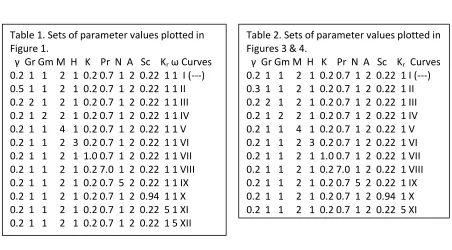
The variations of primary velocity profiles u(y, z, t) under the influence of different parameters against z i.e., over the channel width are shown graphically in Figure 2. The values of various parameters listed in Table 1 represent different curves in Figure 2. In order to study the effect of each of the parameter every curve is compared with the dotted curve I (---). The velocity profiles remain parabolic in the channel. Comparison of curves III, IV, VI and VII with the dotted curve I (---) reveals that the primary velocity increases with the increase of Grashof number Gr, modified Grashof number Gm, Hall parameter H and the permeability of porous the medium parameter K. Physically it means that the buoyancy force due to thermal diffusion and molecular diffusion enhance the flow velocity. At the same time as expected physically also that the resistance posed by the porous matrix reduces with increasing permeability of the porous medium which consequently leads to the gain in the velocity.
Similarly, the comparison of curves II, V, VIII, IX, X, XI and XII with the dotted curve I (---) show that the primary velocity decreases with increasing viscoelastic
parameter γ, Hartmann number M, Prandtl number Pr, radiation parameter N, Schmidt number Sc, Chemical reaction parameter Kr
The amplitude |𝐹𝐹| of the skin-friction on the left plate (y = -0.5) is plotted in Figure 3 against the frequency of oscillations. The values of various parameters listed in Table 2 represent different curves in this Figure. It is quite evident that the amplitude of the skin friction goes
on decreasing with increasing frequency of oscillations ω.
In order to study the effect of each parameter every curve is compared with the dotted curve I (---). Comparison of curves III, IV, VI and VII with the dotted curve I (---) shows that the amplitude increases with the increase of Grashof number Gr, modified Grashof number Gm, Hall parameter H and the permeability of porous the medium parameter K. Similarly comparing curves II, V, VIII, IX, X and XI with the dotted curve I (---) show that the amplitude |𝐹𝐹| decreases with increasing viscoelastic
parameter γ, Hartmann number M, Prandtl number Pr, radiation parameter N, Schmidt number Sc and chemical reaction parameter Kr.
and the frequency of oscillation ω. The decrease of velocity due M is because of the reason that effects of a transverse magnetic field on an electrically conducting fluid gives rise to a resistive type force (called Lorentz force) similar to drag force and upon increasing the values of M increases the drag force which has tendency to slow down the motion of the fluid. The decreases with the increase of Prandtl number Pr is due to the fact that increasing Prandtl number means (Prandtl number being the ratio of the viscous to the thermal diffusion) the dominance of the viscous over the thermal diffusion. Thus, the fluid flow is resisted because of this predominance property of the viscous fluid which leads to the decrease in velocity. To be more realistic the two values of the Prandtl number chosen represent air (Pr=0.7) and water (Pr=7) the most commonly found fluids on earth. As expected the flow velocity is less in water (Pr=7) than in air (Pr=0.7).
The effects of the variations of different flow parameters on the phase angle 𝜑𝜑of the skin-friction 𝜏𝜏𝐿𝐿 are illustrated in Figure 4. The values of various parameters listed in Table 2 represent different curves in Figure 4. It is obvious from this figure that there is always a phase lag because the values of 𝜑𝜑 plotted against 𝜔𝜔 are negative throughout. This lag in the phase goes on increasing further as the frequency of oscillations 𝜔𝜔 increases. In order to know the effect of each of the flow parameter every curve in the figure is compared with the basic dotted curve I (---). By the comparison of curves VIII, IX and XI with the dotted curve I (---) we find that the lag in phase angle decreases with the increase of Prandtl number Pr, radiation parameter N and reaction parameter Kr. However, by the increase of viscoelastic parameter γ, Grashof number Gr, modified Grashof number Gm, Hartmann number M, Hall parameter H, porous medium permeability parameter K and Schmidt number Sc the lag in phase angle increases as is observed by the comparison of curves II, III, IV, V, VI, VII and X.
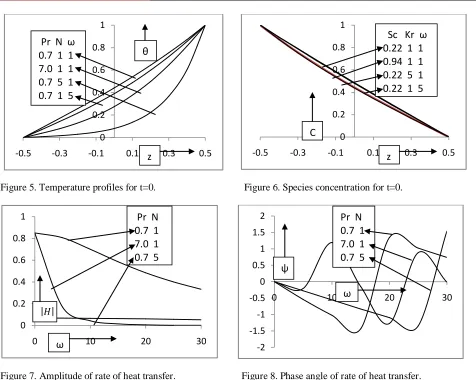
The temperature profiles are shown in Figure 5. It is quite clear from this figure that the temperature decreases with the increase of each of the parameters involved i.e., Prandtl number Pr, radiation parameter N
and the frequency of oscillations ω. Similarly, the species
concentration also decreases with either of the Schmidt number Sc, reaction parameter Kr and the frequency of
oscillations ω as is depicted in Figure 6. The amplitude |𝐻𝐻| and the phase angle of the Nusselt number are presented in Figures 7 and 8 respectively. Figure 7 reveals that |𝐻𝐻| decreases sharply with the increase of Prandtl number or
radiation parameter as frequency ω increases. For larger
radiation the amplitude remains almost constant with
increasing frequency of oscillations ω. The phase angle ψ
of rate of heat transfer shown in figure 8 oscillates between
phase lag and phase lead as ω increases. The wave length
due to the increase of Prandtl number Pr and the radiation parameter N increases and decreases respectively. The amplitude |𝐶𝐶|and phase angle ζ of the Sherwood number are shown in Figures 9 and 10. The amplitude |𝐶𝐶| decreases with the increase of Schmidt number Sc and reaction parameter Kr. However, the phase angle ζ increases with Sc but decreases with Kr
The problem of oscillatory MHD convection flow through the porous medium bounded by two infinite vertical porous plates is analyzed. An exact solutions of the governing equations in the presence of chemical reaction are obtained. Following conclusions of the study are made:
.
VI.
CONCLUSIONS
223
Copyright © 2011-15. Vandana Publications. All Rights Reserved.
the primary velocity increases with the increase of Grashof number Gr, modified Grashof number Gm, Hall parameter H and the permeability of porous the medium parameter K.
The primary velocity decreases with increasing viscoelastic parameter γ, Hartmann number M, Prandtl number Pr, radiation parameter N, Schmidt number Sc, Chemical reaction parameter Kr
The amplitude increases with the increase of Grashof number Gr, modified Grashof number Gm, Hall parameter H and the permeability of porous the medium parameter K.
and the frequency
of oscillation ω.
The amplitude |𝐹𝐹| decreases with increasing viscoelastic parameter γ, Hartmann number M, Prandtl number Pr, radiation parameter N, Schmidt number Sc and chemical reaction parameter Kr.
The increasing frequency of oscillations ω leads to the
decrease of the amplitude of skin friction while to an increase in the phase lag.
The temperature and the concentration both decrease with the increase of the parameters involved.
The amplitude of Nu decreases with Prandtl number Pr or radiation N.
The phase angle of Nu oscillates between phase lag and phase lead.
The amplitude |𝐶𝐶| decreases with the increase of Schmidt number Sc and reaction parameter Kr
However, the phase angle ζ increases with Sc but
decreases with K
.
r
REFERENCES
[1] Hakiem E. I. M. A., (1991) “MHD oscillatory flow on free convection radiation through porous medium with constant suction velocity”, J Magnetism and Magnetic Materials, 220, pp. 271-276.
[2] Raptis A. and Perdikis C. P., (2004) “Unsteady flow through a highly porous medium in the presence of radiation”, Transport in Porous Medium, 57, pp. 171-179. [3] Makinde O. D. and Mhone P. Y., (2005) “Heat transfer to MHD oscillatory flow in a channel filled with porous medium”, Rom. Journ. Phys., 50, pp. 931-938.
[4] Alagoa K. D., Tay G., and Abbey T. M., (1999) “Radiative and free convective effects of a MHD flow through a porous medium between infinite parallel plates with time-dependent suction”, Astrophysics and Space Science, 260, pp. 455-468.
.
[5] Seth G. S., Nandkeolyar R., and Ansari Md. S., (2010) “Unsteady MHD convective flow within a parallel plate rotating channel with thermal source/sink in a porous
medium under slip boundary conditions”, Int. J. of Engg., Sci. and Tech., 11, pp. 1-16.
[6] Reddy N. B. and Bathaiah D., (1982) “Hall effects on MHD Couette flow through a porous straight channel”, Def. Sci. J., 32, pp. 313-326.
[7] Jana R. N. and Dutta N., (1980) “Hall effects on MHD Couette flow in a rotating system”, Czech. J. Phys., 30, pp. 659-667.
[8] Attia H. A., (1998) “Hall current effects on velocity and temperature fields of an unsteady Hartmann flow”, Can. J. Phys., 76, pp. 739.
[9] Hossain M. A. and Rashid R. I. M. I., (1987) “Hall effect on hydromagnetic free convection flow along a porous flat plate with mass transfer”, J. Phys. Soc. Japan, 56, pp. 97-104.
[10] Singh K. D. and Pathak R., (2010) “An analysis of an oscillatory rotating MHD Poiseuille flow with injection/suction and Hall currents”, Proc. Indian Natn. Sci. Acad., 76, pp. 201-207.
[11] Singh K. D. and Kumar R., (2009) “Combined effects of Hall current and rotation on free convection MHD flow in a porous channel”, Indian J. Pure & Appl. Phys., 47, pp. 617-623.
[12] Takhar H. S. and Ram P. C., (1991) “Free convection in hydromagnetic flows of a viscous heat-generating fluid with wall temperature oscillation and Hall currents”, Astrophysics and Space Science, 183, pp. 193-198, [13] Singh K. D. and Kumar R., (2011) “Fluctuating heat and mass transfer on unsteady MHD free convection flow of radiating and reacting fluid past a vertical porous plate in slip-flow regime”, Journal of Applied Fluid Mechanics, 4, pp. 101-106.
[14] Chand K., Singh K. D., and Kumar S., (2012) “Hall effect on radiating and chemically reacting MHD oscillatory flow in a rotating porous vertical channel in slip flow regime”, Advances in Applied Sciences Research, 3, pp. 2424-2437.
[15] Prakash Om, Kumar D., and Dwivedi V. K., (2010) “Effects of thermal diffusion and chemical reaction on MHD flow of dusty visco-elastic (Walter’s liquid Model-B) fluid”, J. Elecromagnetic Analysis & applications, 2, pp. 581-587.
[16] Devika B., Satya Narayana P.V., and Venkataramana S., (2013) “MHD oscillatory flow of a visco elastic fluid in a porous channel with chemical reaction”, International Journal of Engineering Science Invention, 2, pp. 26-35. [17] Nazibuddin A. and Sujan S., (2013) “Investigated effect of chemical reaction on transient MHD flow past an impulsively started vertical plate with ramped temperature and concentration”, Journal of Energy, Heat and Mass Transfer, 35, pp. 253-273.
224
Copyright © 2011-15. Vandana Publications. All Rights Reserved.
Research in Science, Engineering and Technology, 2, pp. 973-981.
Table 2. Sets of parameter values plotted in Figures 3 & 4.
γ Gr Gm M H K Pr N A Sc Kr Curves
0.2 1 1 2 1 0.2 0.7 1 2 0.22 1 I (---) 0.3 1 1 2 1 0.2 0.7 1 2 0.22 1 II 0.2 2 1 2 1 0.2 0.7 1 2 0.22 1 III 0.2 1 2 2 1 0.2 0.7 1 2 0.22 1 IV 0.2 1 1 4 1 0.2 0.7 1 2 0.22 1 V 0.2 1 1 2 3 0.2 0.7 1 2 0.22 1 VI 0.2 1 1 2 1 1.0 0.7 1 2 0.22 1 VII 0.2 1 1 2 1 0.2 7.0 1 2 0.22 1 VIII 0.2 1 1 2 1 0.2 0.7 5 2 0.22 1 IX 0.2 1 1 2 1 0.2 0.7 1 2 0.94 1 X 0.2 1 1 2 1 0.2 0.7 1 2 0.22 5 XI Table 1. Sets of parameter values plotted in
Figure 1.
γ Gr Gm M H K Pr N A Sc Krω Curves
226
Copyright © 2011-15. Vandana Publications. All Rights Reserved.
Figure 5. Temperature profiles for t=0. Figure 6. Species concentration for t=0.
Figure 7. Amplitude of rate of heat transfer. Figure 8. Phase angle of rate of heat transfer.
Figure 9. Amplitude of Sherwood number. Figure 10. Phase angle of Sherwood number.
0 0.2 0.4 0.6 0.8 1
-0.5 -0.3 -0.1 0.1 0.3 0.5
0 0.2 0.4 0.6 0.8 1
-0.5 -0.3 -0.1 0.1 0.3 0.5
0 0.2 0.4 0.6 0.8 1
0 10 20 30 -1.5-2
-1 -0.5 0 0.5 1 1.5 2
0 10 20 30
0 1 2 3 4 5 6
0 10 20 30
0 0.2 0.4 0.6 0.8 1
0 10 20 30
z Pr N ω
0.7 1 1 7.0 1 1 0.7 5 1 0.7 1 5
θ
Sc Kr ω
0.22 1 1 0.94 1 1 0.22 5 1 0.22 1 5
C
z
Pr N 0.7 1 7.0 1 0.7 5
ω
|𝐻𝐻|
Pr N 0.7 1 7.0 1 0.7 5
ω ψ
Sc Kr 0.22 1 0.94 1 0.22 5
ω
|𝐶𝐶| Sc Kr 0.22 1
0.94 1 0.22 5