147
Copyright © 2018. IJEMR. All Rights Reserved.
Volume-8, Issue-3, June 2018
International Journal of Engineering and Management Research
Page Number: 147-152
DOI: doi.org/10.31033/ijemr.8.3.19
Analysis of Al 6061-TiO2 -CNT Metal Matrix Composites Produced by
Stir Casting Process
Shashank Dewangan1, Dr. S. K. Ganguly2 and Dr. R. Banchhor3
1
M.Tech Scholar, Department of Mechanical Engineering, Bhilai Institute of Technology, Durg, INDIA
2Professor & Head of Department, Department of Mechanical Engineering, Bhilai Institute of Technology, Durg, INDIA 3Associate Professor, Department of Mechanical Engineering, Bhilai Institute of Technology, Durg, INDIA
ABSTRACT
Aluminium Hybrid Composites are the new groupof metal matrix composites (MMCs) due to their attractive properties like high ductility, high conductivity, light weight and high strength to weight ratio and is a response to the dynamic ever-increasing demand of these super material in the field of aircrafts and marines. Carbon Nanotube (CNTs) are also known for their high strength and stiffness and their low density which when combined together makes CNTs an ideal reinforcement. This work briefly reviews the research revelation of an Aluminium (Al-6061) based hybrid metal matrix composite reinforced with CNTs and TiO2. The Hybrid Aluminium Metal Matrix Composites (AMMCs) is prepared with various CNTs weight percentages (0, 0.5, 1 and 1.5 wt. %) and keeping TiO2 weight percentage fixed to 1%.Stir Casting (SC) is focused in general to successfully fabricate the MMCs. The discussion of this work revolves around tensile test, hardness test, and Scanning Electron Microscope (SEM) of the MMC. The mechanical properties of the fabricated MMCs materials like tensile strength, hardness and impact strength is found by using these experimental methods. It has been observed that the tensile strength of the MMCs increases in the presence of TiO2 and CNTs and increases even more with the increase in the weight fraction of CNTs. Same results have been obtained for hardness and impact strength where there is an increase in them in the presence of TiO2 and CNT and their value increases even further with increase in weight fraction of CNTs.
Keywords-- Metal Matrix Composites, Titanium Dioxide, Al 6061, Stir Casting, Hardness Test, SEM Test. Tensile Test
I. INTRODUCTION
In today’s world of rapidly developing technology, scientists and engineers are creating new materials which are stronger and lightweight that can be used in various industries to enhance their efficiency and production. A composite material is combination of at least two materials, which combine to offer properties greater to those of the distinct constituents. The many component materials and different processes that can be used make composites extremely versatile and efficient. They typically result in lighter, stronger, more durable solutions compared to traditional materials. MMCs are a perfect example of new metals which were created to enhance properties of parent materials. They are metals or alloy reinforced with particles or fibers of some different metal or material.
148
Copyright © 2018. IJEMR. All Rights Reserved.
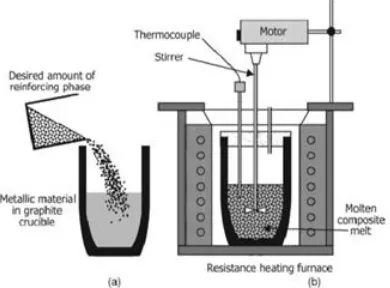
Figure 1- Composition of CompositesStir casting method is generally employed for fabrication of particulate reinforced metal matrix composite (PMMC). It is a primary procedure of composite production whereby the reinforcement ingredient material is incorporated into the molten metal by stirring. The stir casting of MMCs involves producing a melt of the selected matrix material followed by the introduction of a reinforcement material into the melt before adding the reinforcement material the melt should be subjected to degasing by a suitable medium, because the molten metal reacts with atmospheric oxides and experiences oxidation by degrading the properties of the base material.
Figure 2- Schematic of stir casting set-up
To date, uniform dispersion of CNTs in a solution or a composite matrix remains a challenge, due to the strong van der Waals binding energies associated with the CNT aggregates. Ultrasonication is a very effective method of dispersion and deagglomeration of CNTs, as ultrasonic waves of high-intensity ultrasound generate cavitation in liquids. Ultrasonication of CNTs in solvents such as ethanol is a common technique for dispersing samples for electron microscopy. One way to improve the dispersion of nanotubes is to shorten the nanotubes. The shorter tubes are less likely to entangle and arrange into aggregates.
Figure 3- Schematic of Ultrasonication of CNTs
A SEM is a kind of electron microscope that generate images of a specimen by scanning the surface with a concentrated beam of electrons. The electrons act together with atoms in the specimen, creating numerous signals that comprise information about the specimen surface microstructure and composition. The electron beam is scanned in a raster scanpattern, and the beam's position is joined with the detected signal to generate an image. SEM can attain resolution superior than 1 nm. Specimens can be observed in high vacuum in conventional SEM, or in low vacuum or wet conditions in variable pressure or environmental SEM, and at a wide range of cryogenic or elevated temperatures with specialized instruments.
149
Copyright © 2018. IJEMR. All Rights Reserved.
II. LITERATURE REVIEW
Rutile is a mineral composed predominantly of titanium dioxide (TiO2). Rutile, a common natural form of TiO2, is readily available, inexpensive and holds substantial wear resistance, mechanical and thermal properties [1].
Ramesh et al reinforced Al 6061 alloy with TiO2 and achieved significant enhancement in wear resistance and hardness characteristics [2].
Tromans et al confirmed that rutile possesses superior physical and engineering properties. Comprehensive survey on various literatures revealed that no detailed findings are available for powder metallurgy (P/M) processed Al−SiC−TiO2 (rutile) hybrid composites. P/M is widely adapted for achieving uniform distribution of reinforcing phase within the matrix and to produce near net shaped components [3-4].
Metal matrix composites (MMCs) possess significantly improved properties including high specific strength, specific modulus, damping capacity and good wear resistance compared to the unreinforced alloys. Aluminium alloys are used in many engineering applications due to their light weight and high strength characteristics [5].
Zhou and coworkers fabricated aluminium composites reinforced with CNTs through pressure less infiltration of aluminium into CNTs–Mg–Al preformed in N2 atmosphere at 800˚C. They found that CNTs were well dispersed and embedded in the Al matrix, the friction coefficient of the composite decreased with increasing the volume fraction of CNTs, and the wear rate of the composite decreased steadily with the increase of CNTs content (from 0 to 20 vol. %) [6].
Kuzumaki et al said CNTs were synthesized using arc discharge. The purity of CNT used was reported to be about 60% by volume which, compared to CNT produced nowadays, is considered low. They mixed 5 and 10% volume of CNT with pure Al and stirred the mix in ethanol for half an hour in order to disperse CNT. The mix was then dried and packed in an Al case. The case was preheated and compressed in a steel die, then hot extrusion was performed at 773 K. Several characterization techniques were performed, but the significant results came from the tensile strength and elongation percentage tests versus annealing time [7].
Hansang Kwon et al discussed functionally graded carbon nanotubes (CNT) and nano Silicon carbide (nSiC) reinforced aluminium (Al) matrix composite materials were fully densified by a simple ball milling and hot-pressing processes. The nSiC was used as a physical mixing agent to increase dispersity of the CNT in the Al particles. It was observed that the CNT was better dispersed in the Al particles with an nSiC mixing agent compared to without it used [8]
Subrata Kumar Ghosh & Partha Saha discovered that crack density and wear performance of SiC particulate (SiCp) reinforced Al-based metal matrix composite (Al-MMC) fabricated by direct metal laser sintering (DMLS) process have been studied. Mainly, size and volume fraction of SiCp have been varied to analyse the crack and wear behavior ofthe composite. The study has suggested that crack density increases significantly after 15 volume percentage (vol. %) of SiCp [9].
Deuis R.L et al., investigated Aluminium-silicon alloys and aluminium based metal matrix composites have found application in the manufacture of various automotive engine components such as cylinder blocks, pistons and piston insert rings where adhesive wear (or dry sliding wear) is a predominant process. For adhesive wear, the influence of applied load, sliding speed, wearing surface hardness, reinforcement fracture toughness and morphology are critical parameters in relation to the wear regime encountered by the material. In this review contemporary wear theories, issues related to counter face wear, and wear mechanisms are discussed [10].
Hybrid composites are those composites which have a combination of two or more reinforcements. The behavior of hybrid composites is a weighed sum of the individual components in which there is a more favourable balance between the inherent advantages and disadvantages [11].
III. OBJECTIVE
1. To prepare the specimen by employing stir casting method.
2. After fabrication prepare the specimen for mechanical testing’s as per the ASTM standards with good surface integrity by employing EDM. 3. To analyse the mechanical properties, perform
tensile tests and Rockwell Hardness tests on specimen.
4. Further microstructure characterisation of the composite performed by using SEM.
IV.
EXPERIMENT PROCEDURE &
TESTING
A. Stir Casting
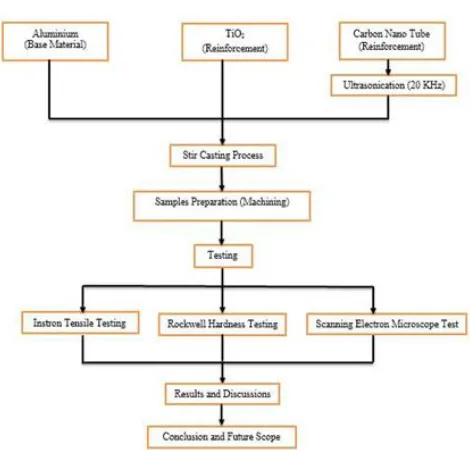
Stir casting is used for the preparation of the MMCs. Overall, following four samples of metal matrix composite are fabricated using stir casting:
1) Al + 1 % TiO2
150
Copyright © 2018. IJEMR. All Rights Reserved.
Throughout the whole process, the personconducting the experiment wears all the protective gears for his safety. For the remaining samples, 900gm Al 6061 billets are placed in the furnace to melt and the specified weight percentage of CNT and TiO2 powder for the respective samples are preheated to a temperature of 250°C followed by the same steps mentioned for the fabrication of the first sample. After getting the uniform finish the plates were cut using wire EDM. Wire EDM was used for cutting the specimens for tensile test. To evaluate the properties of composite and also for validation purpose, we choose ASTM standard for tensile test.
Testing of the samples
After the samples are machined, they undergo hardness test, tensile test and SEM. After the completion of each test for all the samples, the results are noted.
B. Tensile Test
Tensile test was performed on the INSTRON machine. All the four samples were tested for maximum tensile strength. Before starting the test, the dimensions of all the samples were measured using digital vernier caliper.
C. Rockwell Hardness Test
The samples were cut as per the ASTM standards and were polished by using sand paper. After making the surface smooth, the sample was tested on Rockwell testing machine. All the readings were obtained from digital screen available on the machine. Three reading were taken for each sample to get the average Rockwell hardness of the sample. The following Figures show the Rockwell hardness testing machine used.
D. SEM Test
The surfaces of all the samples on which the test was supposed to be performed were polished properly. After the polishingwas done, the polished surface of each sample was cleaned with acetone to remove any dust particles or impurities which were present on the surface as
their presence would have affected the accuracy of the results. Once the polished surfaces were cleaned properly with acetone, carbon SEM tape (a type of adherent) was applied on the surface opposite to the polished surface of each sample to prevent them from moving or shaking during the test.
V. RESULT
The results obtained for all samples after the completion of the tensile test are explained below in graph:
Figure 6 - Stress vs. Strain graph for all the samples
The maximum tensile stress got for the sample 1 77.289 MPa. The maximum tensile stress obtained for the sample 2 was perceived to be 123.142 MPa which shows significant increment in the tensile strength when compared to the first sample which only has TiO2 as reinforcement. The maximum tensile strength for third sample is 128.083 MPa. The maximum tensile strength for the sample 4 was 152.368 MPa. So, Form the graph we know that the maximum tensile strength of the sample increase by increasing the CNT % in it. The elongation of samples at maximum stress were also affected by addition of CNT. The values can be observed in the following table-
151
Copyright © 2018. IJEMR. All Rights Reserved.
The following results were obtained after thehardness test. Above results show that using TiO2 as reinforcement in Al6061 increases the hardness. It is also observed that when Al6061 is reinforced with 1% of TiO2 and 0.5% of CNT, the hardness value increases even further. By increasing the composition of CNT in the samples, it is observed that the value of hardness increases. Therefore, it can be concluded that the value of hardness depends upon the reinforcement i.e. CNT and TiO2 and also on their weight percentages as it can be seen that the hardness of the samples increased in the presence on TiO2 and CNT and with the increase in the weight percentage of CNT.
Table 2 -Results for Rockwell Hardness Test
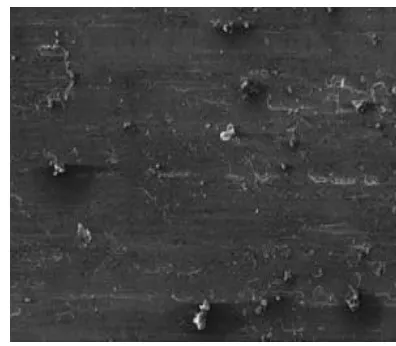
Following are the images produced for all the 4 samples using SEM test-
1. Al + 1% TiO2
Figure 7 - SEM image of Sample 1
2. Al + 1% TiO2+ 0.5% CNT
Figure 8 - SEM image of Sample 2
3. Al + 1% TiO2+ 1% CNT
Figure 9- SEM image of Sample 3
4. Al + 1% TiO2+ 1.5% CNT
152
Copyright © 2018. IJEMR. All Rights Reserved.
VI.
CONCLUSION
The dispersion of CNT powder in the fabricated samples was enhanced significantly through sonication process as visible in the SEM images.
The tensile test results show that the addition of TiO2 and CNT as reinforcement slightly improves
the tensile strength of the Al based metal matrix. When the samples undergo elongation in linear manner, the CNT and TiO2 incorporated as
reinforcement in the samples break and resist the development of tensile stress slightly.
The Rockwell hardness test results show that the hardness of the sample increases with increase in the weight percentage of CNT as reinforcement in the sample.
The SEM image shows uniform distribution of the TiO2 and CNT in AMCs which shows
increase in tensile strength and hardness test results.
REFERENCES
[1] Arora, R., Kumar, S., Singh, G., & Pandey, O. P. (2015). Influence of particle size and temperature on the wear properties of rutile-reinforced aluminium metal matrix composite. Journal of Composite Materials, 49(7), 843-852.
[2] Ramesh, C. S., Khan, A. A., Ravikumar, N., & Savanprabhu, P. (2005). Prediction of wear coefficient of Al6061–TiO2 composites. Wear, 259(1-6), 602-608. [3] Inderjeet Singh, Ravinder Singh, Gagandeep Singh Sandhu, & Farman Khan. (2017). Tensile strength and microhardness behavior of friction stir welded joints of magnesium AZ31B-O alloy. International Journal of Engineering and Management Research, 7(2), 328-332. [4] Tromans, D.& Meech, J. A. (2004). Fracture toughness and surface energies of covalent minerals: theoretical estimates. Minerals Engineering, 17(1), 1-15.
[5] Saheb, N., Laoui, T., Daud, A. R., Harun, M., Radiman, S., & Yahaya, R. (2001). Influence of Ti addition on wear properties of Al–Si eutectic alloys. Wear, 249(8), 656-662.
[6] Zhou, S. M., Zhang, X. B., Ding, Z. P., Min, C. Y., Xu, G. L., & Zhu, W. M. (2007). Fabrication and tribiological properties of carbon nanotubes reinforced Al composites
prepared by pressure less infiltration
technique. Composites Part A: Applied Science and Manufacturing, 38(2), 301-306.
[7] Ravinder Singh, Gagandeep Singh Sandhu, Ramandeep Singh Deorda, & Inderjeet Singh. (2016). Effect of single pass and double pass on friction stir welded aluminium alloy 6063 using square tool pin profile. International Journal of Engineering and Management Research, 6(3), 491-499.
[8] Kwon, H., Estili, M., Takagi, K., Miyazaki, T., & Kawasaki, A. (2009). Combination of hot extrusion and spark plasma sintering for producing carbon nanotube reinforced aluminium matrix composites. Carbon, 47(3), 570-577.
[9] Ghosh, S. K., & Saha, P. (2011). Crack and wear behavior of SiC particulate reinforced aluminium based metal matrix composite fabricated by direct metal laser sintering process. Materials & Design, 32(1), 139-145. [10] Deuis, R. L., Subramanian, C., & Yellup, J. M. (1997). Dry sliding wear of aluminium composites—A review. Composites Science and Technology, 57(4), 415-435.