46
Copyright © 2011-15. Vandana Publications. All Rights Reserved.
Volume-5, Issue-3, June-2015
International Journal of Engineering and Management Research
Page Number: 46-50
A Study on Performance of Banking Services in View of Customer
Relationship Management
R.S. Devi1, A. Rama2, S. Banumathi3 1
Assistant Professor, Department of Commerce (CA), ANJA College, Sivkasi, INDIA 2,3
Reader, Department of commerce, VVV College for women, Virudhunagar, INDIA
ABSTRACT
Banks have been rapt by broadening international economy and market competitiveness that initiated the remarkable change of banking industry in the past two decades. Application of customer relationship management in banks to improve services has been increased all over the world. These banking innovations have served in managing the logistics and other activities involved in serving customers, nevertheless it has also affected the supplier-customer relationship in other ways. For instance supplier-customers’ doubts clarification through teleworking has resulted in less personal contact between bank interface personnel and customers. Banking service in a way is more related to personal relationship in order to gain trust and loyalty among customers. In the present study despite having advancement in technology and adoption of CRM in banking, did it help in improving or not, that has been studied by the analysis of performance of banks on the following underpinnings, such as branch expansion, deposits incurred, target achievement in advances and credit to deposit ratio in the chosen region with the well-established two public sector banks during the specific study period. The study has been done by primarily collecting the data with the banks and its further analysed using linear regression model.
Keywords— Banking, CRM, Growth rate, Public sector bank, Trend coefficients.
I.
INTRODUCTION
Customer relationship management (CRM), in general, is operationally termed as a management focuses of acquiring customers by understanding and fulfilling their requirements through quality service [1]. In addition it also attracts new customers and withstands existing customers through specific marketing strategies [2]. This process involves a total commitment on the part of the entire organization in evolving and implementing the
relationship strategies that would be rewarding to all concerned. In transactional approach, which is used to be before 1990s, customers view of decision making was give less significance, perhaps very little attention is paid to customer oriented services and customer commitment [3]. Growing concern of major banks of various countries to bank servicing through technologically advanced channels, in addition the development of virtual banks and financial institutes have caused tremendous competition changes from transactional approach to modern approach from the late 1990s [4]. In deed the nationalized banks are left with no option to withstand the market pressure due to raising costs, meeting customers’ demand which is exponentially enhancing due to information technology impact. Thus to maintain profitability and to withstand market pressure, the banks are invested on new, innovative servicing channels, such as CRM implementation, relationship management strategies as a consequence, flexible banking, virtual banking and electronic banking have been in place to meet the customers demand in more effective manner [5].
47
Copyright © 2011-15. Vandana Publications. All Rights Reserved.
eventually be converted into better market share and profit;however this merit is obviously earned only by means of philosophical commitment to service piggybacked by diligent attention to the customers want and need [9]. Banking industries are not only selling their products and services, like manufacturing and other service industries. In other words, banks are selling their industries reputation with every customer relationship. The best customer relationship needs the marketer to develop custom efforts to craft, produce and develop a good quality package mix so as to maintain and enhance the relationship unharmed.
Thus in the present research work, banking industries performance have been studied in one of the industrialized, agriculture and business based region in the southern part of Tamil Nadu, called Virudhunagar district. In this case widely accepted and more popular banks that serves to the community for years have been taken into account. As it is pretty evident to withstand in the market and continuously serve better in the market in addition to make profit to the concern, any banking industries in this era is completely developed with technology and their customer relationship strategies are installed in place. Yet it is always wise to revisit on their implementation strategies by measuring its performance periodically that will be helpful to revitalize and to ensure on their pathway or else the strategies could be modified to suit specific requirement and to stay healthy in the market. For which, the performance of banking has been studied in the
banking perspective by choosing the following
underpinnings such as branch expansion, target and advances in achievement, various deposits incurred and credit to deposit ratio.
II.
METHODOLOGY
Source data
The Virudhunagar district has been chosen for the study of banking services in the present work. It is one of the districts in Tamil Nadu state, situated southern part of the state. It consist eleven taluks and has an area surfing 4270.3 square kilometres [10]. The district is served by a network of banking giving an average of 15680 persons per branch during the study period, 2000-2007. These branches are located across the districts comprising nearly eleven public sector banks during the study period. For this study, several banks were approached, of which, two major banking industries were consented to carry this research work that can be named it as public sector bank 1 (PSB1) and public sector bank 2 (PSB2). The sources of data have been collected from the chosen banking industry with the proper questionnaire constructed through literature survey and through brainstorming exercise carried out with the field experts. In addition, the annual reports of the respective banks have been observed to collect the relevant data during the period of study.
Mathematical Model
The raw data are first used to estimate the trend that it follows; which are then used to determine the trend coefficients that could basically form as a dependent variable ‘Y’ is a function of independent variable ‘f(x)’ and a constant ‘a’, which is shown in Eq. 1. In this Eq. 1., The ‘a’ and ‘b’ are the trend coefficients, the ‘a’ further can be determined by taking .
(1) Then, through the regression analysis the certainty of best fit is found, finally the compound growth rate (CGR) is calculated using the obtained data that follows to be:
(2)
Where, ‘nf‘ is the end value in the study period, ‘ni‘ is the initial value of the study period and ‘n’ is the number of samples or study period. In addition, the statistical significance of the data on a particular variable is ensured through, ‘to’- test statistic, and accordingly this analysis is portrayed for the other necessary variables that the banks under study had encountered through CRM strategies in reaching the customer effectively and efficiently. The value of ‘to’ can be determined as follows [11]
(3)
Where, ‘to‘ is the computed value from the sample, ‘n’ is the sample size and ‘r2’ is the regression coefficient. If ‘|to|’>tα/2, n-2, the correlation between ‘Y’ and ‘X’ is significant or, equivalently, the regression model is significant. The tα/2, n-2 can be determined from
the t-table for 0.005 and ‘n-2’ is the degrees of freedom, in the present study it is 5, therefore the table value of ‘t’ is 4.032. If the condition meets then it can be ensured that 99.9% trend coefficients of the sample data are statistically significant
.
III.
RESULTS AND DISCUSSION
48
Copyright © 2011-15. Vandana Publications. All Rights Reserved.
Figure 1: Relationship between branch expansions andstudy period
Table 1
Trend and growth of branches in the study period Bank
s
Trend Coefficients
R2 to ItoI>t CG R
α/2, n-2
a b
PSB1 2.458 2
0.093 4
0.927 4
7.148 2
Significan t
9.91
PSB2 2.790 4
0.053 2
0.823 8
4.324 4
Significan t
5.06
Branch Expansion: The Fig. 1 reveals that there is a consistent improvement in branch expansion for both the public sector banks over the period of study, yet PSB2 is always superseded over PSB1 almost for all the years. Therefore, it can be said that there exist steady trend, besides, PSB2 had higher in branch establishment than PSB1. Further it can be understood that PSB1 shows higher fluctuation in opening branches than PSB2, as it is estimated that PSB1 nearly 18% is away from its mean as compared to PSB2 which is just 11% away from its mean value. The trend and growth for branch expansions has been constructed in Table 1 along with its regression coefficient. It is ensured that the trend coefficients for both the banks are statistically significant at 0.005% level. Further, it is noticed from Table 1 that PSB1 and PSB2 shown respectively 0.0934 and 0.0532 amount or rate of growth on average annually during the study period. In Table 1, the value for R2 represents the regression coefficient that reveals the certainty of best fit, for instance PSB1 is of 92.74% best fit. The CGR means as compound growth rate, which is of nearly 10 for PSB1 that indicates they have comparatively raised more branches from their existence during the study period.
Figure 2: Various deposits secured during study period
Table 2
Trend and growth of various deposits during study period Ban
ks Deposits Coefficients Trend R t
2 o ItoI>t CG
R
α/ 2, n-2
a b
PSB 1
CD 7.0433 0.3342 0.9260 8.7198
Signific ant
39. 68 SD 8.1931 0.1813 0.8199 5.3217 19.87
FD 8.3029 0.1610 0.9426 9.9780 17.47
PSB 2
CD 7.3039 0.3091 0.93 8.3356 32.22
SD 8.4632 0.1484 0.92 7.6387 16.12
FD 8.4755 0.1549 0.98 17.7609 16.76
49
Copyright © 2011-15. Vandana Publications. All Rights Reserved.
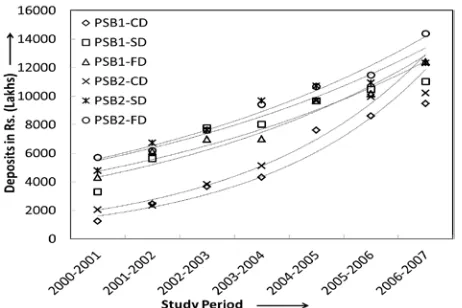
rate provided for FD in general more or less similar. It isalso interesting to note from Table 2 is that sample data and obtained trend coefficients are statistically significant for all the deposits irrespective of banks. To further note that the growth rate for CD for both the banks are far better and in particular PSB1 is showing increased rate as compared to PSB2. A similar observation can be seen it for SD and FD of PSB1 as compared to PSB2, this indicates that PSB1 taking better initiative to reach customer through their CRM techniques in the recent years.
Figure 3: Relationship between targets achieved in advances and study period
Target & Achievement in Advances: Another milestone of digging the performance of bank industries as overall is the achievement of banks in credit, thus the total percentage of achievement in advance as set from the target by both the banks have been studied and is plotted in Fig. 3. Target achievement in percentage is basically the ratio of target achieved to target set in advances for the every financial year that is undertaken during the study period for both the banks. It is better revealed from Fig. 3., is that almost although both the banks start from same figure (that is in the year 2000-2001) but gradually the performance of PSB2 in achievement of advances is appreciable as it increase bit faster and consistent during the rest of study period. Indeed, the PSB1 performance is also appreciable and close competitive till 2003-2004 but later it is falling down. In other words there exists some fluctuation in achieving the target for PSB1. It is carefully observed from the source data that PSB2 shows fluctuation in target setting however not in achieving the target on the other hand PSB1 shows fluctuation in target achieving but not in target setting. This underpinning or variable reveal that customers trust or the banks quality of service and ability of solving potential problems by the banks are the major factor, in addition to the effective way of marketing their products to the customer in today’s competitive environment. But looking at the fact, it can be concluded that both banks are performing equally well to their target in securing advances through their best CRM practices.
Figure 4: Credit to deposit ratio over the study period
Credit to Deposit Ratio: The credit to deposit (C/D) ratio is another important factor to measure the functioning of the banks as overall in regards to their CRM adoption to reach customer. It is shown in Fig. 4., this reveals that there is a gradual increase of C/D ratio for PSB2 over the study period. Eventually it confirms that the customers has got more trust with this bank and indirectly refer to their best quality of service. On the other hand C/D ratio is highly fluctuating for PSB1 over the study period. In general the C/D ratio for PSB1 is decreasing over the time despite both the banks persist almost from the same starting point during 2000-2001. This indicates that perhaps the PSB1 needs to concentrate more on to their quality of service that should reach the customer in still better way.
IV.
LIMITATIONS AND FUTURE
RESEARCH
50
Copyright © 2011-15. Vandana Publications. All Rights Reserved.
performance of banking service such as ATM expansion inthe region, phone banking facility, tele-banking facility, Internet banking facility and so on. Thus, in multi corner this can be studied and better understanding on the implementation of the banking strategies and selling their products in better manner and retain the true long standing customers shall be achieved.
V.
IMPLICATIONS AND
CONCLUSIONS
This research has a number of implications on the performance of the banks, implementation of CRM strategies, and quality of service and so on. In particular, the banks and in general, any service organizations, show importance on finding and sustaining the loyal customers; for which, the service organizations will be after conquering the customers’ trust and constructing the healthy bondage with customers. Thus it is important to upgrade with the technology as well as to know the industries periodic performance to withstand and to grow in the competitive environment. The study will alarm the concerned banking industry to make adjustments to customers’ needs, be flexible and innovative in providing services, be flexible in serving customers, and also offer personalized services, since these are the strategies that directly link to create trust and quality service.
The present study had investigated the performance of banking industry in view of their CRM activities, for which four different parameters have been chosen to carry out the study in two different major public sector banks. The results revealed that both the banks are most popular in the region and conquered vast majority of trust and quality in their service among customers. However the study is just concentrated in the view of banking industry perspective, leaving customers view for future studies revealed that both the banks expanded their branch every year gradually and consistently. Nevertheless PSB2 had superseded over PSB1 irrespective of the study period under concerned. Similarly, all the deposits offered by both the banks shows an increasing trend over the period, of which current deposit shows highest compound growth rate and the fixed deposit takes lowest annual growth rate, whilst the saving deposit takes in between position. The target and advances in achievement by both the banks shows almost similar trend and in deed is increasing gradually over the period. However the credit to deposit ratio found gradually and continuously increasing under the study period for PSB2, which is otherwise for PSB1, despite both had started from almost at the same C/D level in the initial year of study. Overall the PSB1 performance is bit less than the PSB2, however the growth rate in each underpinning for PSB1 is appreciable; this indicates the PSB1 is in way of revitalizing on their CRM and other technological implemental strategies.
REFERENCES
[1] M.P. Gupta, Learnings from Customer Relationship Management (CRM) Implementation in a Bank, Global Business Review, 3(1): 99-122, 2002.
[2] R.N. Bolton and C.O. Tarasi, Managing Customer Relationships, in N.K. Malhotra (ed.), Review of Marketing Research, Emerald, 3-38, 2007.
[3] M. Paulin, R.J. Ferguson and M. Payaud, Effectiveness of Relational and Transactional Cultures in Commercial Banking: Putting Client-Value into the Competing Values Model, International Journal of Bank Marketing, 18(7): 328-337, 2000.
[4] U. Yavas and M.M. Yasin, Enhancing Organizational Performance in Banks: A Systematic Approach, Journal of Services Marketing, 15(6): 444-453, 2001.
[5] C. Jayawardhena and P. Foley, Changes in the Banking Sector – The Case of Internet Banking in the UK, Internet Research, 10(1): 19-31, 2000.
[6] T. Bohling, D. Bowman, S. LaVelle, V. Mittal, D. Narayandas, G. Ramani and R. Varadarajan, CRM Implementation Effectiveness Issues and Insights, Journal of Service Research, 9(2): 184-194, 2006.
[7] K.A. Gyampah, ERP implementation factors: A comparison of managerial and end‐user perspectives, Business Process Management Journal, 10(2): 171-183, 2004.
[8] J.O. Chan, Toward a Unified View of Customer Relationship Management, The Journal of American Academy of Business, 6(1): 32-38, 2005.
[9] M. Zineldin and T. Bredenlow, Performance Measurement and Management Control: Quality, Productivity and Strategic Positioning, - A Case Study of a Swedish Bank, Managerial Auditing Journal, 9(16): 484-499, 2001.
[10] Available in TN website:
http://virudhunagar.tn.nic.in/, 2005.