Design and development of a multi-crop manual seed drill
Tumpa Rani Sarker, Murshed Alam, Md. Rostom Ali
*, Chayan Kumer Saha,
Md. Ashraful Haque
(Department of Farm Power and Machinery, Bangladesh Agricultural University, Mymensingh-2202, Bangladesh)
Abstract: A machine which can sow seeds of paddy, wheat, black gram, mung bean, lentil, mustard, and radish in rows was designed and developed at the department of Farm Power and Machinery, Bangladesh Agricultural University. The machine consisted of two wheels, two drums with a number of peripheral openings in seven rows, two furrow openers, two furrow closers and a handle. There is a provision to change the openings of drum for different types of seed and row spacing for sowing seeds. The average seed rate was found as 88 kg ha-1, 122 kg ha-1, 33 kg ha-1, 50 kg ha-1, 32 kg ha-1, 3.8 kg ha-1, and 7.2 kg ha-1 for paddy, wheat, black gram, mung bean, lentil, radish, and mustard, respectively at normal walking speed. A relation was found between seed rates and filling condition of drums. Since the seed rates were not uniform with the change of filling conditions of drums by seeds, agitators were designed and fixed with the shaft to get the better seed rate at different filling conditions. It was found that the best filling conditions of drum to get the uniform seed rate were 0.9-2 kg, 0.25-1.7 kg, 0.8-2 kg, 1.4-2.2 kg, 0.9-2 kg, 1-1.21 kg and 1-2 kg for paddy, wheat, black gram, mung bean, radish, mustard, and lentil, respectively whereas the best operational speed of the machine was found as 2-4 km h-1. The average effective field capacities of the machine at a speed of 2.58 km h-1 were 0.17 ha h-1 (width 80 cm), and 0.24 ha h-1 (width 120 cm), which had the field efficiencies of 82.22% and 78.6%, respectively. The estimated cost of the machine was USD 68.54 only. The weight of the whole machine was only 14 kg and required a pulling force of only 103 N which made it to operate at ease by a man or a woman in the field. Overall, the performance of the multi-crop seed drill machine was found satisfactory.
Keywords: crops, seed-drill, seed rate, field capacity
Citation: Sarker, T. R., M. Alam, M. R. Ali, C. K. Saha, and M. A. Haque. 2019. Design and development of a multi-crop manual seed drill. Agricultural Engineering International: CIGR Journal, 21(3): 51–60.
1 Introduction
Agriculture is the dominant economic activity in Bangladesh and regarded as the lifeline of the economy of Bangladesh. Its role is vital in income generation, employment and poverty alleviation in the rural areas for improving the livelihood of majority people. As the demand of food production is increasing as well as the area of cultivation is decreasing day by day, to meet up the food demand, food production are increasing by growing more crops per unit area of land. Besides many advantages, the contribution of agricultural machinery in enhancing the productivity and profitability of agriculture is well known.
Received date: 2018-09-20 Accepted date: 2019-02-12
*Corresponding author: Md. Rostom Ali, Professor, Department of Farm Power and Machinery, Bangladesh Agricultural University, Mymensingh-2202, Bangladesh. Email: [email protected]; Phone: +88091-67401-6-68219; Fax: +88091-61510.
A mechanized way of seed sowing rather than manual broadcasting saves time, seeds and cost of the cultivation. Seed sowing machine sows seed with proper quantity, distance, depth and in a short period of time which also increases sowing efficiency and reduces losses of seed and also reduces the labor requirement to a large scale. In Bangladesh, labor requirement is high for land preparation, sowing seeds, transplanting and weeding crop. Transplanting method usually is practiced for paddy and it involves huge labors with long process. Human stress and drudgery are also involved in transplanting operation Transplanting method required about 400-450 man-h ha-1 (Islam et al., 2000) and increased the rice production (Sarker, 2004). Seed drill machines are being used in Bangladesh but very limited in scale. The farmers of Bangladesh still practice their old broadcasting methods of
pulses and oil seeds are usually line sowing crops and it contributes to higher yield and involves less cost. The line sowing by mechanical means provides uniform placement of seeds at proper depth with proper spacing, which saves time and cost of intercultural operation. It also ensures better germination, more emergences of seeds and helps to achieve more plants population. Limited numbers of seed drill are available for those crops. However, due to the high cost of individual machine, farmers of Bangladesh are reluctant in using machine. Alam et al. (2006) designed and developed a drum seeder using locally available materials. Bangladesh Agricultural Research Institute (BARI) developed a power tiller operated inclined multi crop planter for maize, wheat, soybean, groundnut and pulses available for a cost of US$ 200 (Ahmmed et al., 2004). A single row manually operated seeder (Shamma,
2014) is available to sow maize, wheat, black gram & groundnut by changing the seed metering device. There are some other multi-crop seeders which are power tiller operated. A seed drill which is suitable for multi-crop seed sowing as well as cost effective is needed by small farmers. Therefore, this research was conducted with a view to design and develop a ‘multi-crop seed drill’ by which paddy, wheat, mung bean, black gram, lentil, mustard, and radish could be sown by changing the seed opening plate depending on the seed size and row to row distance.
2 Methodology
2.1 Physical properties of seeds
Paddy, wheat, mung bean, black gram, lentil, mustard, and radish seeds were used in the experiment. As it is a multi-crop seed drill machine, different types of seeds
were tried to sow only by changing the seed opening plate because the size of seeds are different. The weight of seed was determined (Table 2) by weighing 10 samples of 100 grains by an electronic balance.Since the shapes of seeds were irregular and sizes were too small, it was difficult to measure these attributes by slide calipers or other instruments. Therefore, the sizes of seeds were measured by Image J software. In that case, a numbers of seed were scanned in scanner and black and white image was stored in the computer. During scanning a known scale was always maintained to get actual data from Image-J. After that the size was determined using Image J software. The
maximum and minimum dimensions of seeds were recorded and maximum dimension with shape of the seed was considered to design the opening for dropping seed.
2.2 Design and development of drum type metering
device and hoppers
In Bangladesh, there is no available seed machine
made of local materials. In the study, the machine can be used for seeding different types of seeds. In Bangladeshi market, people are usually familiar with seed drill which is only operated for seeding rice, some are for maize and blackgram. The hopper and metering device of the machine was designed as drum type in which two drums were made of polyvinyl chloride (PVC) pipe and driving shaft was passed through the center of the drum. The length and diameter of each drum were 350 mm and 150 mm, respectively. Right side drum had an opening of 90 mm×60 mm whereas left side drum had 70 mm and 60 mm for filling the drum with seeds because the left drum contained four series of holes. There were a number of peripheral holes drilled in different spacing on the drum to drop the seed by gravitational force. Among them one drum (left one) contained four series of holes and another drum (right one) had three series of holes to adjust the row to row distance of seeds. The diameter of hole was the highest diameter of the experimental seeds. Different views of drums are presented in Figure 1 while the stretch out figure of the drum and photographic view of drum is shown in Figure 2. The maximum capacity of each drum was 6.2×10⁻³ m3. These hoppers can move either side because it was fixed over the shaft with metal plate placing between the hoppers as separators.
2.3 Adjustment of opening hole and row-row
distance for different seeds
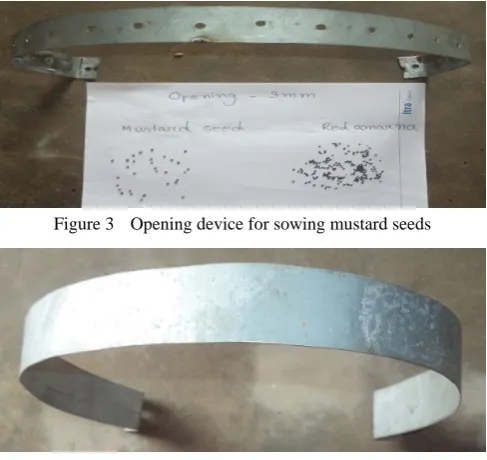
Figure 4 shows the opening for mustard seeds. This opening was made according to the seed dimensions and it is different for different crop seeds. A metal band without hole (Figure 4) was made to close a series of hole which was not needed during sowing a specific seed. Figure 5 and Figure 6 show the adjustment of distance between row
to row for different seeds.
Figure 1 Different partial views of drum
Figure 2 Stretch out view and photographic view of the drum
Figure 3 Opening device for sowing mustard seeds
Figure 4 Metal band without hole which is used to close the opening of the drum
Figure 5 Adjustment of drums and holes for row to row distance of 20 cm for paddy and wheat
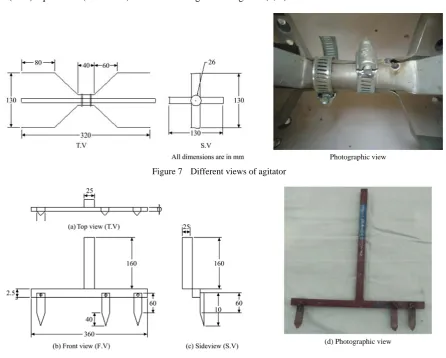
and attached to the shaft with a clip. Design and photographic view of agitator are shown in Figure 7.
Furrow opener was designed and experimented several times to get the suitable design which required less force to pull the machine. The optimum design was obtained by trial and error method. Each drum required two furrows.
Furrow opener was made of a simple 2.5 cm of each side mild steel (M.S) square bar (BHN 126) with 24 cm length
attached to a M.S bar of 2.5 cm square with 36 cm length horizontally. Opener was joined with that horizontal bar by screw and the depth of furrow could be controlled by adjusting this screw. The bar was cut tapered at a point such that the end of the bar was sharp enough to cut the soil structure and the tapered length of the cutting edge was
4 cm. Different views of the furrow opener are shown in Figure 8(a, b).
Photographic view
Figure 7 Different views of agitator
(d) Photographic view
Figure 8 Different views of furrow opener
The above furrow opener required more force to pull
and found troublesome during operation. That is why it
was needed to redesign the furrow opener as shown in Figure 9(b).
Furrow closer is a covering device which covers
the seed and makes the soil level. It was made by a
2.5 cm each side of square bar in T-shape which could level the furrowed soil easily. The height of the closer was
24 cm and it was welded with 36 cm bar horizontally.
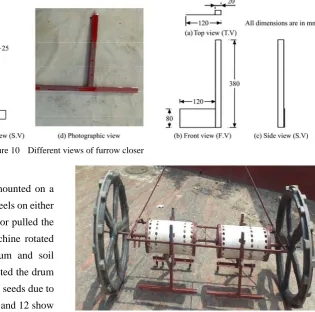
Different views of the furrow closer are shown in Figure 10(a).
Figure 10 Different views of furrow closer
2.4 Principle of the drum seeder
The seed was deposited in two drums mounted on a shaft which was supported by two ground wheels on either side and pulled by a handle. When an operator pulled the machine, the forward movement of the machine rotated the driving wheels (clearance between drum and soil surface is 180 mm), which consequently rotated the drum hoppers attached to the shaft and dropped the seeds due to gravity force in rows on the field. Figures 11 and 12 show
the details of the complete seed drill. Figure 11 Photographic view of seed drill
2.5 Laboratory experiment of the machine
The weight of the machine was measured by a spring balance at the workshop. Before starting the test of the seed drill machine in the laboratory, the numbers of revolutions of wheel for 1/100 hectare were determined using the following equation (1) (Karim et al., 2014):
10000 100 N
x n πd
=
× × × (1)
where, N = numbers of revolutions of wheel; x = row spacing in meters; n = numbers of rows of the seeder; d = diameter of the wheel in meters.
Then, two third portion of the drum was filled with an experimental seeds. The drums were rotated N times by turning the wheels with hand. The amount of seed fallen from each drum for the N turns was collected and weighed. The times of turning was also recorded with a stopwatch. The seed rate was determined using the following equation (2):
10000 3.14
A C
D W N
× =
× × × (2)
where, C = Seed rate, kg ha-1; A = Weight of seed collected during N turns of the wheel, kg; D = Diameter of wheel, m; W = Width of seeder, m.
2.6 Distribution pattern of seeds
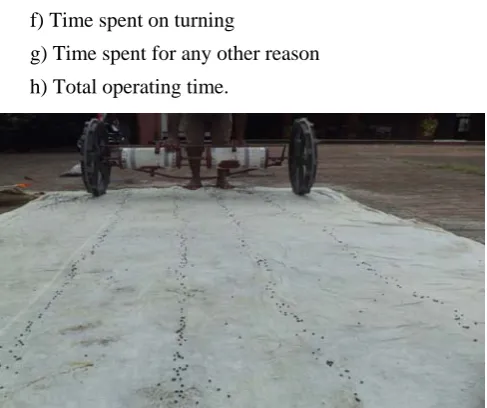
It was quite difficult to determine the distributions of seeds in soil. To avoid this problem the machine was run on a wet white cloth (Figure 13) at normal walking speed. To minimize the bouncing of seeds, the cloth was spread over with wet sand. A measuring tape was used to measure the distance between seed to seed and row to row and a stopwatch was used to record the time of travel. Then the average seed spacing and evenness of spacing were calculated using the following equation (3) (Karim et al., 2014). The distribution pattern of seed over wet sand is shown in Figure 13. The plot 22 m×3.6 m size was selected for direct seeding. The distribution pattern of seed over white cloth and wet land are shown in Figures 13 and 14.
Evenness of spacing
Average seed spacing Standard deviation of seed spacing Average seed spacing
=
−
(3)
The following measurements were also made during field experiments:
a) Number of passes
b) Number of rotation of wheel per pass c) Row spacing
d) Time spent to cover a pass e) Pulling force and angle f) Time spent on turning
g) Time spent for any other reason h) Total operating time.
Figure 13 Observation of the distribution pattern of seeds in rows
Figure 14 Distribution patterns of wheat seeds on wet sand Seeds were directly sown in dry land by multi-crop seed drill except for paddy, where BR 11 variety seed were immersed into water in a pot for 24 hours. Then the seeds were removed from water and kept in a basket for 48 hours. After germination, the seeds were kept in a shade for two hours and tried to separate seeds from each other. After that sprouted seeds were sown in the field.
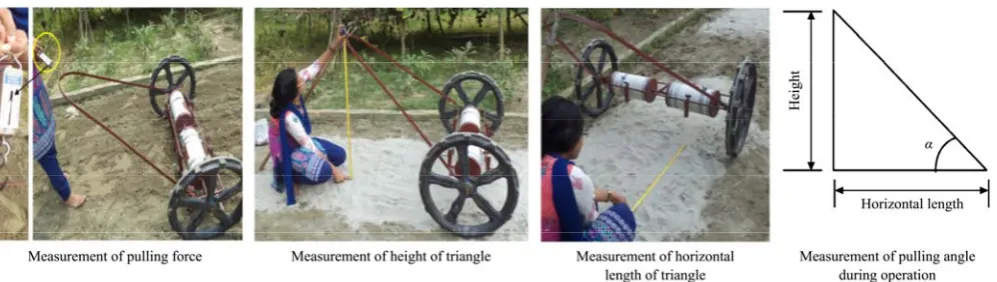
The force requirement of operation was determined in the field using a spring balance (capacity 30 kg). One end of the spring balance was held by the hand while the other end was fixed to the handle and one person pulled the seed drill machine as shown in Figure 15. The operation was recorded by a camera (5X Zoom, 14.1 mega pixel, Sony) in video mode. The video was played by KM player and captured the slides of video to find the force in various time and pulling force was read out from the captured video.
Figure 15 Pulling force measurement The height and horizontal length of pulling handle
were measured by a tape to calculate the pulling angle. Then the drawbar power was calculated by using the following equation (5) (Hunt, 1995).
3.6 DS
dbp= (5)
where, dbp = Drawbar power, kW; D = Draft, kN; S = Speed, m s-1. In additon to this, field capacity and field efficiency of the machine were determined according to the procedure mentioned Barger etal. (1978).
3 Results and discussions
The heighest dimension of each type of seed was used to design the opening of metering device for that type of
seeds. Descriptive statistics of the dimensions of each type of seed including the heighest dimension were determined and are shown in Table 1 and weight in Table 2. The size varied between 6.91-8.94 mm, 7.62 to 9.14 mm, 1.21- 3.35 mm, 4.77-6.43 mm, 5.2-7.49 mm, 4.06-5.33 mm, and 3.81-4.75 mm for paddy, wheat, mustard, mungbean, black gram, lentil, and raddish, respectively. The means of the size of each types of seeds were 7.97 mm, 7.05 mm, 2.32 mm, 5.43 mm, 6.80 mm, 4.69 mm, and 4.21 mm with standard deviation of 0.68 mm, 0.70 mm, 0.20 mm, 0.42 mm, 0.60 mm, 0.39 mm, and 0.34 mm for paddy, wheat, mustard, mungbean, black gram, lentil, and raddish, respectively. The average weights of 100 seed of each crop were found as 2.07 gm, 3.07 gm, 0.98 gm, 1.30 gm, 1.98 gm, 1.93 gm and 2.14 gm for paddy, wheat, mustard, mungbean, black gram, lentil, and raddish, respectively.
Cumulative (%) of different classes of size of seeds were determined to get a clear picture of size distribution. Suitable size of opening should be that about 90% seeds can be dropped through. To determine this, cumulative
percentage of seeds were plotted against seed sizes (Figure 16).
Table 1 Descriptive statistics of size of different seeds
Statistical
Parameter Paddy Wheat Mustard Mungbean Black
gram Lentil Radish
Mean 7.97 7.05 2.32 5.43 6.80 4.69 4.21
Standard deviation 0.68 0.70 0.20 0.42 0.60 0.39 0.34
Largest (1) 8.94 9.14 3.05 6.43 7.49 5.33 4.75
Smallest (1) 6.91 7.62 1.21 4.77 5.20 4.06 3.81
Table 2 Seed weight (g) of different seeds
Parameter Paddy Wheat Mustard Mungbean Black gram Lentil Radish
Mean 2.07 3.07 0.98 1.30 1.98 1.93 2.14
Standard
deviation 0.092 0.31 0.16 0.24 0.14 0.27 0.22
From the above figure, it was observed that seed size of paddy varied from 6.5-9 mm. Here for paddy, above
90% seeds were observed at size of 8.5-9 mm. So the suitable size of opening for paddy was selected as 9 mm. In case of wheat, the optimum opening size was taken as
9 mm because 9 mm maximum seed size was found. To make the opening more effective, this size was selected. Seed size of black gram varied from 5.2-7.5 mm. Most of
the black gram seeds were found at size of 7 mm. So the size of opening for blackgram was selected as 7 mm. On
the other hand, for lentil and radish, about 90% seeds fell within the size of 5 mm. Therefore, the size of opening for these seeds were selected as 5 mm. For mung bean, above
95% seed were found at size of 6 mm. So the suitable size of opening for mung bean was chosen as 6 mm. In case of mustard, the suitable opening was taken as 3 mm because
3 mm maximum seed size was found. Seed rates found experimentally by the seed drill in case of paddy, wheat, black gram, mung bean, lentil, raddish, and mustard are
Figure 16 Cumulative percentages of seeds with respect to size
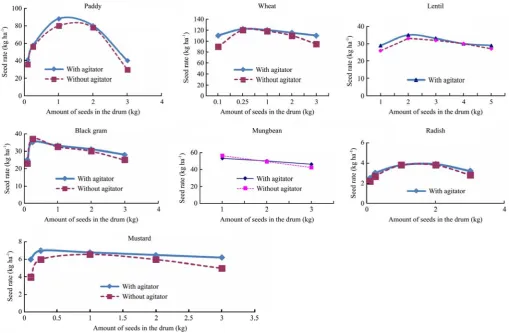
Figure 17 Graphical representation of comparative performance of seed rates (kg ha-1)
It was observed that the seed rate varied with the recommended seed rate and rpm of ground wheels, seed opening, seed size and shape and non-uniformity of
operator speed caused this variation. Skidding was also a reason for variation in optimum seed rate. Besides some of the seeds were trapped between the seed hopper and the opening.
3.1 Effect of forward speed on seeding rate
The wheel was rotated with 75% filling of the drum at different speeds on a white cloth. The seed rate was calculated at different speeds (Figure 18). A relation was found between forward speed of the seeder and seeding rate.
reached a peak, after that it started to decrease. The appropriate seed rate was found at speed 2-4 km h-1 as the standard seed rates of different crops were collected from BARI (2014) as shown in Table 3. From the Figure 18, it was observed that the best operational speed of the machine was 2-4 km h-1.
Figure 18 Variation of seeding rate with operating speed
Table 3 Recommended seed rate
Seed rate, kg ha-1 Crop
Minimum Maximum Recommended
Paddy 80 100 90
Wheat 120 130 125
Black gram 30 35 32.5 Mung bean 40 45 42.5
Lentil 30 35 32.5
Raddish 2.5 3 2.75
Mustard 7 8 7.5
3.2 Effect of amount of seed in the drum on seeding rate
The drums were filled with different seeds in different percentage of its capacity (100%, 75%, 50%, and 25% of its full capacity) to determine the effect of amount of seed in the drum on seeding rate. A strong relation was found between seed rate and weight of seeds in the drum as shown in Figure 19. Paddy showed a little bit different result from others, it might be due to its density.
Figure 19 Effect of amount of seeds in drum on seeding rate The maximum seed rate was recorded when the drum
was filled of its one-third capacity (2.1×10⁻³ m3) and the lowest seed rate was obtained when the drum was filled of its full capacity. This result indicated that the seeding rate increased with the decrease of seeds in the drum. Figure 19 shows that the seeding rate decreased both with the full load condition as well as nearly empty condition
density of those seeds was very small.
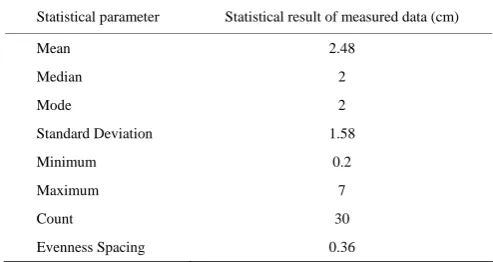
From the distribution pattern of seeds, spacing between seeds were measured and is shown in Table 4 for wheat seeds.
Table 4 Descriptive statistics of the seed spacing for wheat seed
Statistical parameter Statistical result of measured data (cm)
Mean 2.48
Median 2
Mode 2
Standard Deviation 1.58
Minimum 0.2
Maximum 7
Count 30
Evenness Spacing 0.36
Seed drill gives more uniform spacing in row. As it is not a precision planter, it is important to avoid seed bouncing in seed furrow to avoid gaps and thick patches in a row because uneven plant spacing both effect grain size and yield severely. So evenness spacing was calculated for all types of seed used.
4 Conclusions
The design of the multi-crop seed drill machine was successfully completed at the workshop, which can be easily operated. It required small amount of pulling force of 10.5 kg and consequently a drawbar power of 0.046 kW at a forward speed of 2.58 km h-1. The effective field capacity of the machine for crop A (paddy, wheat) was 0.17 ha h-1 and for crop B (black gram, mung bean, lentil, radish, mustard) was 0.24 ha h-1 at a speed of 2.58 km h-1 yielding field efficiencies of 82.25% and 78.6%,
respectively. The cost of the machine was only USD 68.65, which is within the buying capacity of the farmers of Bangladesh. So, /it can be concluded that the machine could be successfully introduced in Bangladesh.
References
Ahmmed, S., K. C. Roy, M. N. Amin, M. A. Wohab, and M. A. Matin. 2004. Design and development of a power tiller operated inclined plate multi-crop planter. Journal of the
Institutions of Engineers Bangladesh, 31(1): 89–96.
Alam, M., R. Ali, M. A. Rabbani, and A. B. M. M. H. Khan. 2006. Design and development of a drum seeder. Progressive.
Agriculture, 17(2): 203–212.
Barger, E. L., B. Roy, and R. A. Kepner. 1978. Principles of Farm
Machinery. 3rd ed. USA: the University of Michigan. BARI (Bangladesh Agricultural Research Institute). 2014. Krishi
Projukti Hand Book. 6th ed. Gazipur: BARI.
Hunt, D. 1995. Farm Power and Machinery Management. 9th ed. Ames: Iowa State University Press.
Islam, S., M. A. M. Soom, M. A. Baqui, D. Ahmad, and M. B. Daud. 2000. A comparative study on the crop establishment technologies for paddy in Bangladesh: transplanting vs. wet seeding. Agricultural Mechanization in Asia, Africa and Latin America, 31(4): 41–46.
Karim, M. F, M. Alam, M. R. Ali, and O. Kozan. 2014. Design and development of a drum seeder with urea supergranule application for rural farmers in Bangladesh. Agricultural
Engineering International: CIGR Journal, 17(3): 61–71. Sarker, S. 2004. Evaluation of the profitability of direct seeder over
manual transplanting of rice. M.S. thesis, Department of farm power and machinery, Bangladesh Agricultural University. Shamma. 2014. Design & development of multi-crop seeder.