Design patterns for container-based distributed systems
Brendan Burns
David Oppenheimer
1
Introduction
In the late 1980s and early 1990s, object-oriented pro-gramming revolutionized software development, popu-larizing the approach of building of applications as col-lections of modular components. Today we are seeing a similar revolution in distributed system development, with the increasing popularity of microservice archi-tectures built from containerized software components. Containers [15] [22] [1] [2] are particularly well-suited as the fundamental “object” in distributed systems by virtue of the walls they erect at the container bound-ary. As this architectural style matures, we are seeing the emergence of design patterns, much as we did for object-oriented programs, and for the same reason – thinking in terms of objects (or containers) abstracts away the low-level details of code, eventually revealing higher-low-level patterns that are common to a variety of applications and algorithms.
This paper describes three types of design patterns that we have observed emerging in container-based dis-tributed systems: single-container patterns for container management, single-node patterns of closely cooperat-ing containers, and multi-node patterns for distributed algorithms. Like object-oriented patterns before them, these patterns for distributed computation encode best practices, simplify development, and make the systems where they are used more reliable.
2
Distributed system design patterns
After object-oriented programming had been used for some years, design patterns emerged and were docu-mented [3]. These patterns codified and regularized gen-eral approaches to solving particular common program-ming problems. This codification further improved the general state of the art in programming because it made it easier for less experienced programmers to produce well-engineered code, and led to the development of reusable
libraries that made code more reliable and faster to de-velop.
The state-of-the-art in distributed system engineering today looks significantly more like the world of early 1980s programming than it does the world of object-oriented development. Yet it’s clear from the success of the MapReduce pattern [4] in bringing the power of “Big Data” programming to a broad set of fields and de-velopers, that putting in place the right set of patterns can dramatically improve the quality, speed, and acces-sibility of distributed system programming. But even the success of MapReduce is largely limited to a single pro-gramming language, insofar as the Apache Hadoop [5] ecosystem is primarily written in and for Java. Develop-ing a truly comprehensive suite of patterns for distributed system design requires a very generic, language-neutral vehicle to represent the atoms of the system.
3
Single-container management patterns
The container provides a natural boundary for defining an interface, much like the object boundary. Contain-ers can expose not only application-specific functional-ity, but also hooks for management systems, via this in-terface.
The traditional container management interface is ex-tremely limited. A container effectively exports three verbs: run(), pause(), and stop(). Though this interface is useful, a richer interface can provide even more util-ity to system developers and operators. And given the ubiquitous support for HTTP web servers in nearly every modern programming language and widespread support for data formats like JSON, it is easy to define an HTTP-based management API that can be “implemented” by having the container host a web server at specific end-points, in addition to its main functionality.
In the “upward” direction the container can ex-pose a rich set of application information, including application-specific monitoring metrics (QPS, applica-tion health, etc.), profiling informaapplica-tion of interest to de-velopers (threads, stack, lock contention, network mes-sage statistics, etc.), component configuration informa-tion, and component logs. As a concrete example of this, Kubernetes [6], Aurora [7], Marathon [8], and other con-tainer management systems allow users to define health checks via specified HTTP endpoints (e.g. “/health”). Standardized support for other elements of the “upward” API we have described is more rare.
In the “downward” direction, the container interface provides a natural place to define a lifecycle that makes it easier to write software components that are controlled by a management system. For example, a cluster man-agement system will typically assign “priorities” to tasks, with high-priority tasks guaranteed to run even when the cluster is oversubscribed. This guarantee is enforced by evicting already-running lower-priority tasks, that will then have to wait until resources become available. Evic-tion can be implemented by simply killing the lower-priority task, but this puts an undue burden on the de-veloper to respond to arbitrary death anywhere in their code. If instead, a formal lifecycle is defined between application and management system, then the applica-tion components become more manageable, since they conform to a defined contract, and the development of the system becomes easier, since the developer can rely on the contract. For example, Kubernetes uses a “grace-ful deletion” feature of Docker that warns a container, via the SIGTERM signal, that it is going to be termi-nated, an application-defined amount of time before it is sent the SIGKILL signal. This allows the application to terminate cleanly by finishing in-flight operations, flush-ing state to disk, etc. One can imagine extendflush-ing such a
mechanism to provide support for state serialization and recovery that makes state management significantly eas-ier for stateful distributed systems.
As a concrete example of a more complex lifecycle, consider the Android Activity model [9], which features a series of callbacks (e.g. onCreate(), onStart(), on-Stop(), ...) and a formally defined state machine for how the system triggers these callbacks. Without this formal lifecycle, robust, reliable Android applications would be significantly harder to develop. In the context of container-based systems, this generalizes to application-defined hooks that are invoked when a container is cre-ated, when it is started, just before termination, etc. An-other example of a “downward” API that a container might support is “replicate yourself” (to scale up the ser-vice).
4
Single-node, multi-container application
patterns
Beyond the interface of a single container, we also see design patterns emerging that span containers. We have previously identified several such patterns [10]. These single-node patterns consist of symbiotic containers that are co-scheduled onto a single host machine. Container management system support for co-scheduling multiple containers as an atomic unit, an abstraction Kubernetes calls “Pods” and Nomad [11] calls “task groups,” is thus a required feature for enabling the patterns we describe in this section.
4.1
Sidecar pattern
The first and most common pattern for multi-container deployments is the sidecar pattern. Sidecars extend and enhance the main container. For example, the main con-tainer might be a web server, and it might be paired with a “logsaver” sidecar container that collects the web server’s logs from local disk and streams them to a clus-ter storage system. Figure 1 shows an example of the sidecar pattern. Another common example is a web server that serves from local disk content that is pop-ulated by a sidecar container that periodically synchro-nizes the content from a git repository, content manage-ment system, or other data source. Both of these exam-ples are common at Google. Sidecars are possible be-cause containers on the same machine can share a local disk volume.
Figure 1: An example of a sidecar container augmenting an application with log saving.
[15] can be configured so that it provides consistent low-latency responses to queries, while the logsaver container is configured to scavenge spare CPU cycles when the web server is not busy. Second, the container is the unit ofpackaging, so separating serving and log saving into different containers makes it easy to divide responsibil-ity for their development between two separate program-ming teams, and allows them to be tested independently as well as together. Third, the container is the unit of
reuse, so sidecar containers can be paired with numer-ous different “main” containers (e.g. a log saver con-tainer could be used with any component that produces logs). Fourth, the container provides afailure contain-ment boundary, making it possible for the overall sys-tem to degrade gracefully (for example, the web server can continue serving even if the log saver has failed). Lastly, the container is the unit of deployment, which allows each piece of functionality to be upgraded and, when necessary, rolled back, independently. (Though it should be noted that this last benefit also comes with a downside – the test matrix for the overall system must consider all of the container version combinations that might be seen in production, which can be large since sets of containers generally can’t be upgraded atomically. Of course while a monolithic application doesn’t have this issue, componentized systems are easier to test in some regards, since they are built from smaller units that can be independently tested.) Note that these five bene-fits apply to all of the container patterns we describe in the remainder of this paper.
4.2
Ambassador pattern
The next pattern that we have observed is the ambassador pattern. Ambassador containers proxy communication to and from a main container. For example, a developer might pair an application that is speaking the memcache protocol with a twemproxy ambassador. The application believes that it is simply talking to a single memcache on localhost, but in reality twemproxy is sharding the re-quests across a distributed installation of multiple
mem-Figure 2: An example of the ambassador pattern applied to proxying to different memcache shards.
cache nodes elsewhere in the cluster. This container pat-tern simplifies the programmer’s life in three ways: they only have to think and program in terms of their appli-cation connecting to a single server on localhost, they can test their application standalone by running a real memcache instance on their local machine instead of the ambassador, and they can reuse the twemproxy ambas-sador with other applications that might even be coded in different languages. Ambassadors are possible because containers on the same machine share the same localhost network interface. An example of this pattern is shown in Figure 2.
4.3
Adapter pattern
Figure 3: An example of the adapter pattern applied to normalizing the monitoring interface.
5
Multi-node application patterns
Moving beyond cooperating containers on a single ma-chine, modular containers make it easier to build coor-dinated multi-node distributed applications. We describe three of these distributed system patterns next. Like the patterns in the previous section, these also require system support for the Pod abstraction.
5.1
Leader election pattern
One of the most common problems in distributed sys-tems is leader election (e.g. [20]). While replication is commonly used to share load among multiple identical instances of a component, another, more complex use of replication is in applications that need to distinguish one replica from a set as the “leader.” The other replicas are available to quickly take the place of the leader if it fails. A system may even run multiple leader elections in par-allel, for example to determine the leader of each of mul-tiple shards. There are numerous libraries for perform-ing leader election. They are generally complicated to understand and use correctly, and additionally, they are limited by being implemented in a particular program-ming language. An alternative to linking a leader tion library into the application is to use a leader elec-tion container. A set of leader-elecelec-tion containers, each one co-scheduled with an instance of the application that requires leader election, can perform election amongst themselves, and they can present a simplified HTTP API over localhost to each application container that requires leader election (e.g. becomeLeader, renewLeadership, etc.). These leader election containers can be built once, by experts in this complicated area, and then the subse-quent simplified interface can be re-used by application developers regardless of their choice of implementation language. This represents the best of abstraction and en-capsulation in software engineering.
5.2
Work queue pattern
Although work queues, like leader election, are a well-studied subject with many frameworks implementing them, they too are an example of a distributed system
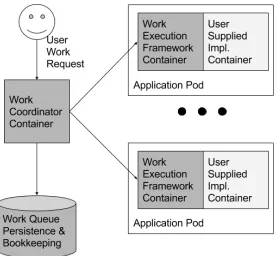
Figure 4: An illustration of the generic work queue. Reusable framework containers are shown in dark gray, while developer containers are shown in light gray.
pattern that can benefit from container-oriented architec-tures. In previous systems, the framework limited pro-grams to a single language environment (e.g. Celery for Python [13]), or the distribution of work and binary were exercises left to the implementer (e.g. Condor [21]). The availability of containers that implement the run() and mount() interfaces makes it fairly straightforward to im-plement a generic work queue framework that can take arbitrary processing code packaged as a container, and arbitrary data, and build a complete work queue system. The developer only has to build a container that can take an input data file on the filesystem, and transform it to an output file; this container would become one stage of the work queue. All of the other work involved in develop-ing a complete work queue can be handled by the generic work queue framework that can be reused whenever such a system is needed. The manner in which a user’s code integrates into this shared work queue framework is il-lustrated in Figure 4.
5.3
Scatter/gather pattern
Figure 5: An illustration of the scatter/gather pattern. A reusable root container (dark gray) implements client in-teractions and request fan-out to developer-supplied leaf containers and to a developer-supplied container respon-sible for merging the results (all in light gray).
implement a specific interface. In particular, to imple-ment a scatter/gather system, a user is required to sup-ply two containers. First, the container that implements the leaf node computation; this container performs the partial computation and returns the corresponding result. The second container is the merge container; this tainer takes the aggregated output of all of the leaf con-tainers, and groups them into a single response. It is easy to see how a user can implement a scatter/gather system of arbitrary depth (including parents, in addition to roots, if necessary) simply by providing containers that imple-ment these relatively simple interfaces. Such a system is illustrated in Figure 5.
6
Related work
Service-oriented architectures (SOA) [16] pre-date, and share a number of characteristics with, container-based distributed systems. For example, both emphasize reusable components with well-defined interfaces that communicate over a network. On the other hand, com-ponents in SOA systems tend to be larger-grain and more loosely-coupled than the multi-container patterns we have described. Additionally, components in SOA of-ten implement business activities, while the components we have focused on here are more akin to generic li-braries that make it easier to build distributed systems. The term “microservice” has recently emerged to de-scribe the types of components we have discussed in this paper.
The concept of standardized management interfaces to networked components dates back at least to SNMP [19]. SNMP focuses primarily on managing hardware com-ponents, and no standard has yet emerged for managing microservice/container-based systems. This has not
pre-vented the development of numerous container manage-ment systems, including Aurora [7], ECS [17], Docker Swarm [18], Kubernetes [6], Marathon [8], and Nomad [11].
All of the distributed algorithms we mentioned in Sec-tion 5 have a long history. One can find a number of leader election implementations in Github, though they appear to be structured as libraries rather than stan-dalone components. There are a number of popular work queue implementations, including Celery [13] and Ama-zon SQS [14]. Scatter-gather has been identified as an Enterprise Integration Pattern [12].
7
Conclusion
Much as object-oriented programming led to the emer-gence and codification of object-oriented “design pat-terns,” we see container architectures leading to design patterns for container-based distributed systems. In this paper we identified three types of patterns we have seen emerging: single-container patterns for system manage-ment, single-node patterns of closely-cooperating con-tainers, and multi-node patterns for distributed algo-rithms. In all cases, containers provide many of the same benefits as objects in object-oriented systems, such as making it easy to divide implementation among multiple teams and to reuse components in new contexts. In ad-dition, they provide some benefits unique to distributed systems, such as enabling components to be upgraded in-dependently, to be written in a mixture of languages, and for the system a whole to degrade gracefully. We believe that the set of container patterns will only grow, and that in the coming years they will revolutionize distributed systems programming much as object-oriented program-ming did in earlier decades, in this case by enabling a standardization and regularization of distributed system development.
8
Acknowledgements
Ideas don’t simply appear in our heads from a vaccum. The work in this paper has been influenced heavily by conversations with Brian Grant, Tim Hockin, Joe Beda and Craig McLuckie.
References
[1] Docker Engine http://www.docker.com
[2] rkt: a security-minded standards-based container en-gine https://coreos.com/rkt/
Reusable Object-Oriented Software, Addison-Wesley, Massachusetts, 1994.
[4] Jeffrey Dean, Sanjay Ghemawat, MapReduce: Sim-plified Data Processing on Large Clusters, Sixth Symposium on Operating System Design and Imple-mentation, San Francisco, CA 2004.
[5] Apache Hadoop, http://hadoop.apache.org
[6] Kubernetes, http://kubernetes.io
[7] Apache Aurora, https://aurora.apache.org.
[8] Marathon: A cluster-wide init and control system for services, https://mesosphere.github.io/marathon/
[9] Managing the Activity Lifecycle, http://developer.android.com/training/basics/activity-lifecycle/index.html
[10] Brendan Burns, The Distributed System ToolKit: Patterns for Composite Containers, http://blog.kubernetes.io/2015/06/the-distributed-system-toolkit-patterns.html
[11] Nomad by Hashicorp, https://www.nomadproject.io/
[12] Gregor Hohpe, Enterprise Integration Patterns, Addison-Wesley, Massachusetts, 2004.
[13] Celery: Distributed Task Queue, http://www.celeryproject.org/
[14] Amazon Simple Queue Service, https://aws.amazon.com/sqs/
[15] https://www.kernel.org/doc/Documentation/cgroup-v1/cgroups.txt
[16] Service Oriented Architecture,
https://en.wikipedia.org/wiki/Service-oriented architecture
[17] Amazon EC2 Container Service, https://aws.amazon.com/ecs/
[18] Docker Swarm https://docker.com/swarm
[19] J. Case, M. Fedor, M. Schoffstall, J. Davin, A Simple Network Management Protocol (SNMP), https://www.ietf.org/rfc/rfc1157.txt, 1990.
[20] R. G. Gallager, P. A. Humblet, P. M. Spira, A distributed algorithm for minimum-weight spanning trees, ACM Transactions on Programming Lan-guages and Systems, January, 1983.
[21] M.J. Litzkow, M. Livny, M. W. Mutka, Condor: a hunter of idle workstations, IEEE Distributed Com-puting Systems, 1988.