The Impact of Unconventional Monetary Policy on Firm Financing
Constraints: Evidence from the Maturity Extension Program
N
ATHANF
OLEY-F
ISHER,
R
ODNEYR
AMCHARAN,
ANDE
DISONY
U1Federal Reserve Board Federal Reserve Board Federal Reserve Bank of Philadelphia
December, 2014
This paper investigates the impact of unconventional monetary policy on firm
financing constraints. It focuses on the Federal Reserve’s Maturity Extension
Program (MEP) which was intended to lower longer term rates and flatten the
yield curve by reducing the supply of long-term government debt. Consistent with
those models that emphasize bond market segmentation and firms’ sticky
borrowing preferences, we find evidence that around the MEP’s announcement,
stock prices rose most sharply for those firms that traditionally relied on longer
term debt. We also find that these firms issued more long-term debt during the
MEP, “filling the gap” created by the Fed’s asset purchases. There is also
evidence of “reach for yield” behavior among some institutional investors, as the
demand for longer duration riskier debt also rose during the MEP, reducing the
cost of external finance for some financial firms. We also find that
non-financial firms more dependent on longer term debt increased investment during
1
the MEP. Unconventional monetary policy may thus have helped to relax financing
constraints for some firms after the financial crisis.
In response to the financial crisis and the weak economy, the federal funds rate has been at the
zero lower bound (ZLB) since December 2008. To help overcome the ZLB constraint and stimulate
economic activity, the Federal Reserve and other central banks have undertaken a number of almost
unprecedented actions, including a series of large scale asset purchases (LSAPs) or quantitative easing.
LSAPs are in part designed to work around the ZLB constraint and stimulate the economy by directly
buying assets, such as US Treasury bonds and mortgage backed securities (MBS) in order offset the
disruptions in private sector intermediation, and the resulting binding financing constraints on firms and
households (Cahill et al. (2013), Gertler and Karadi (2011), Krishnamurthy and Vissing-Jorgensen (2011),
and Shleifer and Vishny (2011)).2
The effectiveness of LSAPs in lowering longer term yields and overcoming the ZLB depends in
part on how these policies might shape investors’ expectations regarding the central bank’s intentions
over the path of short-term interest rates (Eggertsson and Woodford (2006), Gagnon et al. (2011),
Swanson and Williams (forthcoming) and Wright (2012)). Their effectiveness in reducing the cost of
external finance more broadly in the economy might also depend on the degree to which asset markets are
segmented and the extent to which capital market imperfections might impose limits to arbitrage
(Krishnamurthy and Vissing-Jorgensen (2013), Vayanos and Vila (2009)). For example, if some firms
have a sticky preference for borrowing at specific maturities and there are limits to arbitrage—the
preferred debt habitat theory—then attempts to reduce longer term rates would be expected to be
especially beneficial to those firms that prefer to borrow longer term maturity debt or have the financial
flexibility to adjust the maturity of the debt issuances.
2
In contrast, if arbitrageurs operate freely at different maturities along the yield curve, then any
policy induced reduction in longer term yields might be evanescent, having little longer term impact on
firm financing constraints and real outcomes. Even if longer term rates were to decline, firms might not
invest in the current environment not because of the cost of external finance, but because of uncertainty
over demand or even economic policy (Bloom (2009)). More fundamentally, economic growth in the post
crisis economy might be shaped by the pace of reallocation across geography and industries, as the supply
side of the economy adjusts to new sources of demand (King (2013)). Therefore, some have observed that
unconventional policies after a financial crisis might have little real impact, and could potentially fuel
asset price bubbles and future instability (Rajan (2013), Stein (2014)). Unfortunately, while there is now
substantial literature documenting the announcement effects of these policies on a range of asset prices,
little is known about the longer run impact of these policies on firm behavior and real outcomes.
This paper develops a number of empirical tests to understand better the real effects of
unconventional monetary policy. We focus on the Federal Reserve’s explicit attempt to flatten the yield
curve through the maturity extension program (MEP), which was announced on September 21, 2011. The
MEP committed the Federal Reserve to sell about $400 billion in shorter-term Treasury securities and use
the proceeds to buy longer-term Treasury securities (Swanson (2013)). The program was extended in June
2012 through December 2012, for an additional $267 billion. By reducing the supply of longer term
Treasury securities on the market, the MEP aimed to lower interest rates on longer-term Treasury
securities, and to indirectly lower the cost of credit for households and firms, especially among those
firms that traditionally rely on longer term debt.
Consistent with those models that emphasize bond market segmentation and limits to arbitrage,
these results suggest that the MEP might have helped to relax credit constraints for firms, leading to
increased investment (Greenwood, Hanson and Stein (2010), Vayanos and Vila (2009)). We first
document that consistent with the preferred habitat theory, and the forward guidance provided by the
Federal Reserve, abnormal stock returns on the day after the MEP’s announcement rose sharply for those
non-financial firms that traditionally relied on longer term debt finance. A one standard deviation increase
in the long term debt ratio of a firm is associated with 0.21 percentage higher abnormal return, which is
about 50% in annualized terms. We show that these results are robust to most plausible controls and are
largely without precedent.
Using a difference-in-difference methodology, we also find that those firms with a greater
preference for relying on longer term debt may have issued relatively more longer term debt during the
higher long-term debt ratio is associated with about a 6% faster growth in the stock of long-term debt
during the MEP’s implementation. As a falsification test, the coefficient estimate for the growth in
short-term debt is not statistically significant, giving us some confidence that the effect of the MEP program
operates through longer term borrowing. And consistent with these “gap” filling theories of debt, we also
find evidence that firms with more financial flexibility might have more easily adjusted their financing
plans in order to take advantage of the MEP.
Beyond influencing “gap filling” bond issuances by non-financial firms, low nominal interest
rates, and the expectation that low rates might persist, can also create incentives for certain types of
creditors to take added risk in an effort to reach for yield, affecting risk premia and the demand for longer
dated high yielding debt (Morris and Shin (2014), Borio and Zhu (2012), and Hanson and Stein (2012,
2013)). That is, a monetary policy shock such as the MEP might be associated with changes in the risk
premium over and above any change in the actuarially fair long term interest rate implied by the
expectations theory of the yield curve.
We test this monetary policy channel using the insurance industry and the capital regulations that
govern the industry (Becker and Ivashina (2014)). Insurers are the main buyers of corporate debt in the
United States, holding about 60 percent of all corporate bonds. And like banks, insurance companies are
subject to risk-adjusted capital requirements on their investments. These requirements are based on the
bond rating of the investment, and increase exponentially as the credit quality worsens. For bonds rated
AAA through A-, an insurer holds the same amount of equity capital, but this capital requirement rises
sharply for bonds below the A- threshold.
Exploiting this regulatory discontinuity, our difference-in-difference tests show that during the
period of the MEP’s implementation, for this subsample of bonds, a one standard deviation increase in
long term debt dependence is associated with a 26 percent drop in the risk premium. For other bond
ratings, the impact on the risk premia is insignificant. This suggests that the demand for higher yielding
debt among income investors, like insurers, that also economized on regulatory capital requirements, may
have risen sharply during the MEP, allowing non-financial firms to “fill the gap” at this credit grade far
more cheaply during the MEP than otherwise. Indeed, applying our difference-in-difference methodology
to regulatory filings data, we confirm that insurers significantly increased their holdings of A- debt from
these types of borrowers during the MEP.
We next investigate whether the MEP had any real effects on firm activities. Using a similar
difference-in-difference approach, we find that firms more dependent on longer term debt may have been
able to take advantage of the more benign financing conditions to increase investment during the MEP
Taken together, these results suggest that by relaxing financing constraints for some types of
firms, the MEP might have positively affected economic activity. These results also show that in addition
to allowing the corporate sector to “fill the gap” created by government purchases, LSAPs can induce
“search for yield” behavior among some types of investors, affecting bond market risk premia. The
remainder of the paper is structured as follows: Section II describes the maturity extension program.
Section III provides a summary of data used in the paper. Section IV presents empirical results using firm
and bond level data. Section V concludes.
II. The Maturity Extension Program and the Basic Hypotheses
The Federal Reserve announced the Maturity Extension Program (MEP) at 2:30pm on September
21, 2011 in its FOMC statement. The Federal Reserve announced that it would sell or redeem a total of
$400 billion of shorter-term Treasury securities and use the proceeds to buy longer-term Treasury
securities, thereby extending the average maturity of the securities in the Federal Reserve’s portfolio.
With the short term interest rate near the zero lower bound, the program’s intention was to lower long
term interest rates, and ultimately, the cost of longer term credit for households and firms.3 The
September 2011 announcement indicated a program end date of June 2012. But in June 2012, the MEP
was renewed, with the Fed announcing plans to swap another $200 billion in short-term Treasuries for
longer maturity debt. The MEP was officially discontinued at the end of 2012.
While standard arguments predict that arbitrageurs are likely to integrate bond markets of
different maturities and render policies like the MEP ineffective, models that emphasize bond market
segmentation and limited arbitrage suggest that the MEP might affect the term spread and the pattern of
corporate debt issuances (Greenwood, Hanson and Stein (2010), Vayanos and Vila (2009)). If
arbitrageurs are risk averse, and a firm’s maturity borrowing preference is relatively inelastic in the short
run, perhaps because firms wish to match the maturities of their assets and liabilities, then targeted
policies like the MEP can flatten the yield curve. A key implication of these theories then is that those
firms with a “preferred habitat” or preference for longer term liabilities, or those able to adjust easily the
maturity structure of their borrowings, are likely to benefit the most from the MEP’s attempt to reduce the
relative cost of longer term external finance.
3
(http://www.federalreserve.gov/monetarypolicy/maturityextensionprogram-faqs.htm).
But unconventional policies like the MEP can also affect the demand for debt and the risk premia
that these types of firms might face. The expectation that low rates might persist can induce certain types
of creditors to take added risk in an effort to reach for yield, reducing risk premia (Guerrieri and Kondor
(2012), Hanson and Stein (2013), Stein (2013)). Investors, for example, with a focus on current income
and a need to hold longer term assets in order to match the duration of their liabilities, such as life
insurance firms, could rebalance their portfolios in favor of both more duration and credit risk when
longer term interest rates are expected to remain low for an extended period (Stein (2013)). 4 In this case,
bond market risk premia are likely to decline especially for those firms that issue longer term debt.
A number of papers have already used event studies to document the impact of the MEP’s
immediate announcement on bond yields, but under the logic of limited arbitrage and segmentation, the
policy’s economic significance could have extended well beyond what event studies might reveal. Table 1
shows the maturity structure of NY Fed purchases of Treasuries under the MEP. The bottom panel of the
table also shows the stock of outstanding Treasuries at various maturities at end of 2011. For bonds of
duration roughly 8 years or longer, projected MEP purchases equal about 18 percent of the outstanding
stock Treasuries in 2011. The MEP may have thus created a sizeable “gap” to be filled by longer maturity
corporate debt issuances. The guidance associated with the MEP also intimated the possibility of even
more aggressive action in the future, potentially amplifying the actual impact of the policy. 5
Motivated by these ideas of limited arbitrage and segmentation at various points in the yield
curve, we construct a number of tests to measure the MEP’s impact. First, we use a basic event study
framework to examine the stock price reaction of firms to the MEP’s announcement. According to the
preferred habitat theory, if market participants absorbed the forward guidance associated with the MEP,
and believed in segmentation and limits to arbitrage, then we should expect to see the stock prices of
firms with a higher dependence on long term debt reacting more positively to the MEP’s announcement.
After all, because the MEP would be expected to relax financing constraints primarily for these types of
firms, they would now be better able to take advantage of growth opportunities.
Second, if indeed the MEP disproportionately reduced the cost of external finance for these firms,
we should see an increase in their debt issuances at the extensive margin during the program’s
implementation relative to other types of firms. We use a difference-in-difference framework to test these
predictions. We also focus on constructing tests to gauge the impact of the MEP on search for yield
4 Morris and Shin (2014) develop a variation of this idea in the case of asset managers, noting that herding behavior can lead to a collapse in the
risk premium after a central bank signals low future rates.
5 The June 2012 FOMC statement announcing the continuation of the MEP also noted that: “The Committee is prepared to take further action as
behavior among the natural buyers of long dated debt, and study its impact on bond market risk premia.
Finally, we develop a battery of tests motivated by the idea that if the MEP did relax financing constraints
disproportionately for those firms better able to fill the “gap” in longer term debt, then these firms might
more readily expand investment during the program relative to other types of firms.
The MEP provides an especially useful context in which to investigate the effects of
unconventional monetary policy on real economic outcomes. First, the relative calm around the MEP’s
announcement makes it somewhat easier to avoid conflating the effects of the MEP with wider
developments in financial markets. Previous attempts at quantitative easing, such as QE 1, were
announced and implemented in 2008 during the financial crisis—a period when financial markets were
significantly dislocated and the economy rapidly slowing. This makes it an especially difficult period for
statistical inference. Panic selling and fire sales in asset markets, as well as general uncertainty in the
wider economy all likely occurred around the same time as these unconventional monetary policy
announcements.
Second, the MEP’s precise focus on the term spread also makes it easier to interpret the evidence.
Movements in the term spread generally reflect broader factors, such as expected business cycle
movements or consumption smoothing motives, that might also shape firm behavior (Estrella and
Hardouvells (1991), Wheelock and Wohar (2009)). And distinguishing the direct impact of the term
spread on firm behavior and asset prices from these broader factors can be difficult. To be sure, the
Federal Reserve’s MEP announcement could have been motivated by an anticipation of future weakness
in those sectors more dependent on longer term credit. But this anticipatory bias is likely to lead to
under-estimates of the MEP’s impact on asset prices and outcomes for these types of firms.
That said, while our efforts to identify better the MEP’s impact are aided by the policy’s precise
focus on the term spread, its clear implementation period, along with the relative calm surrounding its
announcement, a firm’s debt maturity structure can be driven by a number of other factors that could also
shape how the firm might respond to the MEP (Diamond (1991), Flannery (1986), Hart and Moore (1994),
more recent theoretical work by Crouzet (2014) and the evidence in Rauh and Sufi (2010)). Therefore, in
many of our specifications, we control for a large number of firm and industry level observables, such as
the balance sheet structure of the firm, and exploit discontinuities in capital regulation among some of the
natural buyers of this type of debt in order to help address any biases that might arise from unobserved
III. Data
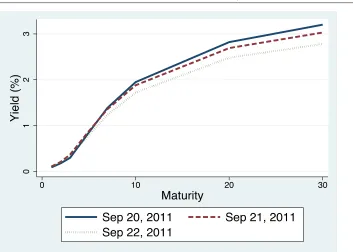
To help visualize the MEP’s potential impact on bond prices, panel (a) of Figure 1 plots the daily
yields of 30-year and one-year treasury bonds around the announcement of MEP. The solid line is the
yield on the 30-year treasury and the dashed line is the one year yield. We can see that the 30-year yield
started to drop when the MEP was announced on Sept 21, 2011, but the more significant drop occurred on
Sept 22, 2011. Consistent with the economic magnitudes in Table 1, the drop of 25 basis points on Sept
22 alone was a two standard deviation change, and the 30-year yield dropped by 42 basis points over the
two day period. Panel (b) plots the shift in the yield curve over the two days after the announcement of
the MEP. The solid line is the yield curve of treasury bonds on Sept 20, 2011. The dashed and dotted lines
are the yield curves for Sept 21 and Sept 22, 2011, respectively. The yield curve of treasury bonds tilted
downwards, consistent with the intention of the MEP.6
To understand the impact of the MEP on asset prices and firm behavior, we rely on Compustat
and CRSP. We use information from Compustat to compute a firm's long term debt dependence ratio and
to obtain various firm characteristics as control variables at an annual frequency. Throughout, financial
firms (SIC 6000 - 6999) are excluded from the sample. To measure a firm's dependence on long term debt,
we compute the share of long term debt out of total debt on a firm's balance sheet, averaged over periods
before 2007. Unfortunately, balance sheet information only distinguishes between debt with a maturity of
one year or shorter. Following Greenwood, Hanson and Stein (2010), we define long term debt as debt
with a maturity at issuance longer than one year.
Because the debt maturity structure of a firm might be driven by the nature of its assets and the
industry in which it operates, we include a large number of firm level controls in order to limit the
potential for biased estimates. These controls include: Market capitalization, the product of the total
number of outstanding common shares and the closing stock price at fiscal year end; total assets; the book
to market ratio is included to differentiate between growth and value firms defined as the ratio of book
value of equity over market capitalization. We include two measures of firm profitability: net income
growth is the log growth rate of a firm’s net income; the return on assets is net income divided by total
6
assets; we also include operating income before depreciation normalized by lagged total assets. We also
have two measures to control for firms' investment opportunity: average Q, and following Gorodnichenko
and Weber (2013), a firm’s capital expenditures divided by its net sales. A firm's average Q is the sum of
market capitalization and total assets minus book equity, normalized by lagged total assets. We also have
a measure of short-term financing need: The difference between account receivables and payables,
normalized by lagged total sales. A measure of capital intensity is also added as a control variable in the
regression.
Finally, long term debt dependence might simply proxy for a firm’s dependence on external
finance, so we include the four variable Kaplan-Zingales score (1997). And as before, to limit any
spurious associations induced by the crisis, we take the historical average of all the control variables
through 2007. For robustness, we also try taking the average of the control variables through to Sept 21,
2011, or just use the last available observation before 2007. All variables are winsorized at the 1% level to
eliminate outliers. Table 2 reports summary statistics and shows how long term debt dependence is
correlated with a number of other firm balance sheet characteristics. The Appendix describes variable
construction in more detail.
IV. Main Results
IV.A. The MEP, Long Term Debt Dependence and Stock Returns
We begin with the most basic test. If market participants expected the MEP to relax financing
constraints primarily for those firms that traditionally rely on longer maturity debt, allowing them to
capitalize better on growth opportunities, then abnormal stock returns obtained around the MEP
announcement date should be positively correlated with a firm’s long term debt dependence ratio. In
contrast, if market participants perceived that investors would quickly arbitrage away the MEP’s attempt
to reduce longer term yields relative to shorter term debt, leaving little impact on firm financing
constraints, then there should be no statistically significant relationship between abnormal returns and a
firm’s traditional debt maturity profile.
Analogously, long term yields began falling in the summer of 2011, driven in part by
developments in Europe, and well ahead of the MEP’s announcement. And if market participants believed
that these broader macro trends would likely account for most of the movements in yields and firms’
financing costs, then the MEP’s announcement would be expected to again have little impact on the
whether the MEP’s announcement and the associated forward guidance differentially impacted
expectations of firm profitability.
Column 1 of Table 3 shows the results of a simple OLS regression of abnormal returns of firms
on September 22, 2011 on firms' long term debt dependence. Abnormal stock returns are obtained from a
standard one factor model (MacKinlay (1997)), and long term debt dependence is defined as the ratio of
debt with a maturity greater than one year to total debt; for each firm, this ratio is averaged through the
history of the firm up through Dec 31, 2006. We exclude the post 2006 period to avoid the potential
endogenous responses of firms to the financial crisis and to the various program implemented afterward.
Standard errors are clustered at the 3-digit SIC level.
Consistent with the preferred habitat hypothesis, the coefficient estimate is positive and
statistically significant. A one standard deviation increase in the long term debt ratio of a firm is
associated with 0.21 percentage higher abnormal return, which is about 50% in annualized term. To
distinguish these results from purely sectoral effects, where some sectors are more affected by the
announcement of the MEP than others, we include sector (SIC 3-digit) fixed effects in the regression in
Column 2. The coefficient estimate is even bigger after controlling for sector fixed effects.
Firm level unobserved heterogeneity that is correlated with long term debt dependence could help
explain these positive associations. For example, the stock price reaction to changes in the term spread
might vary depending on the size of the firm or its relative growth “potential”. And since the capital
structure of a firm is closely related to the nature of its assets and the industry in which the firm operates,
it is plausible that these results could be driven by unobserved balance sheet factors.
To control for the size and growth potential of a firm, we compute the historical average of
market cap and book-to-market ratio of firms. As before, the average is taken through the whole history
of firms up until Dec 31, 2006. Column 3 of Table 3 shows that the results are very similar, suggesting
that the MEP might have had an impact on the value of the firm through the cost of long term debt rather
than purely through size and or the growth potential of the firm.
We now include a veritable kitchen sink of firm level observables to gauge the robustness of these results.
Column 4 controls for firm leverage; the impact of leverage on abnormal returns is positive and
statistically, but the coefficient on long term debt dependence remains significant. In addition to leverage,
we add the total assets of a firm to measure better firm size. Column 5 also includes various measures of
profitability, the firm “investment opportunities”, dependence on external financing, short term financing,
In reacting to the MEP’s announcement, market participants may have been influenced by more
recent firm level information than those observed pre-2007. As an additional robustness exercise, we use
the last available observation of the control variables before Sept 21, 2011 in Column 6, instead of the
historical average. And in Column 7 the historical averages for all variables are computed using
observations before the announcement of the MEP; we thus include the financial crisis. Across these
various specifications, the impact of long term debt dependence on abnormal returns the day after the
MEP announcement remains positive and significant.
We have seen that the relationship between long term debt dependence and abnormal stock
returns is robust to most firm level controls, but one competing explanation is that these firms are just
more sensitive to monetary shocks more generally. As shown by Kuttner (2001); Bernanke and Kuttner
(2005); Gürkaynak et al. (2005), among others, stock prices react to unexpected monetary shocks. And to
some extent, the MEP is an unexpected monetary shock, as measured by the changes in the prices of the
federal fund futures. If our measure of long term debt dependence captures the sensitivity of firms'
response to monetary shock, these results could merely be a consequence of the differential effects of an
unexpected monetary shock to short term interest rates on firm value.
This interpretation is belied by the fact that the magnitude of the unexpected shock on the federal
funds rate is small (about 0.8 basis points) and this shock occurred on Sept 21, 2011, rather than on Sept
22, 2011—the day the yield curve flattened the most. But to address more directly this concern, we
include a control variable called “Monetary Shock Sensitivity” in the regression. Following
Gorodnichenko and Weber (2013), this monetary shock sensitivity variable is the slope coefficient
estimates from firm-by-firm regressions of stock returns on unexpected monetary shocks over the period
between 1980 and 2010. These slope coefficients capture the sensitivity of a particular firm's stock return
to unexpected monetary shocks. The results of the regression with the inclusion of this extra control
variable are reported in Column 8. The coefficient for the long term debt dependence remains large and
statistically significant.
Alternative Dates
While it seems unlikely that the results in Table 3 are driven by latent firm level factors, they
might be driven by events other than the MEP. In this section then, we consider a number of additional
tests to check whether the relationship between long term dependence and abnormal returns is unique to
22 Sept, 2011 or also appear around dates unrelated to the MEP. Using the baseline specification in
column 8 of Table 3 we first plot the long term debt dependence coefficient estimate for a 10-day window
day in that window and the shaded area indicates the 95% confidence interval. The coefficient is
statistically significant only on Sept 22, 2011 at the 5% level. This gives us some confidence that the
MEP affects firms on the day when the yield curve flattens the most, and that these results are not driven
by other events around the same time period.
In addition to the placebo test above, we also report the regression results for a 10-day window
around some other dates. The first set of these dates correspond to the period around the MEP’s
announcement, namely around Sept 22, but for three different years proximate to our event: 2009, 2010,
and 2012. The second set of dates are the two announcement dates for different Large-Scale Asset
Purchase programs (also called Quantitative Easting): Nov 3, 2010 (QE2), and Sept 13, 2012 (QE3). The
reason that we exclude the announcement date of QE1 is that QE1 was announced in 2008 during the
financial crisis. Since the computation of the abnormal returns in our analysis are predicted residuals of a
one-factor model using historical data one year in advance, the residuals are not reliably predicted during
extreme market turbulence, and we exclude 2008 from the placebo test here.
Table 4 shows the results of these various placebo tests. In Panel A of Table 4, we run the same
regression for the 10-day windows around the same time of year in 2009, 2010, and 2012. The exact date
is either Sept 20, 21, or 22, depending on weekends. No coefficient estimates are statistically significant
at the 5% level. In Panel B, we include the announcement dates of QE2 and QE3 in addition to the results
from before for the MEP. Out of all these dates, only the coefficient estimate for Sept 22, 2011 is
statistically significant at the 1% level. There are two coefficient estimates that are marginally significant
at the 5% level. The coefficient estimate is marginally significant on Nov 2, 2010, one day before the
announcement of QE2. The coefficient is also significant on Sept 6, 2012, five and six days before the
announcement of QE3. The result may not be related to the announcement of QE3, however. On Sept 6,
2012, the European Central Bank announced their unlimited bond buying program and this might have a
similar effect as the MEP. These placebo tests thus suggest that the timing of the long term debt
dependence coefficient likely reflects the Federal Reserve's implementation of the MEP.
IV.B. External Finance
We have seen evidence that upon the MEP’s announcement, firm value increased
disproportionately among those firms more dependent on longer term debt. A determined skeptic might
nonetheless argue that the change in firm value reflects latent news that also coincided with the MEP’s
announcement, and does not reflect the causal impact of the policy. But if these results are driven by the
MEP’s announcement, it still remains possible that despite controlling for a large number of possible
even if these results do causally reflect the impact of the MEP’s announcement on equity prices, the
evidence is silent thus far on whether in fact the MEP did relax firm financing constraints in practice for
those more dependent on longer term debt. We also know nothing about whether these asset price
movements anticipated any change in investment decisions. In this subsection then, we develop additional
tests to understand better the mechanisms underlying these results.
These tests center on the idea that if the MEP affected the cost of longer term external finance,
then firms more reliant on this type of finance would be more likely to issue debt during the MEP relative
to other periods. That is, to the extent that corporate bonds are close substitutes for longer term Treasuries,
the “gap filling” hypothesis would predict that when Fed purchases reduce the supply of long-term
Treasuries, firms, especially those with a preference for longer term debt, will increase the supply of
longer dated corporate bonds.
In addition, low nominal interest rates, and the expectation that low rates might persist, can also
create incentives for certain types of creditors to take added risk in an effort to reach for yield, affecting
risk premia and the supply of credit (Adrian and Shin (2010), Borio and Zhu (2012), and Hanson and
Stein (2012, 2013)). Thus, a monetary policy shock such as the MEP might be associated with changes in
the risk premium over and above any change in the actuarially fair long term interest rate implied by the
expectations theory of the yield curve.
Investors, for example, with a focus on current income and a need to hold longer term assets in
order to match the duration of their liabilities, such as life insurance firms, could rebalance their bond
portfolios in favor of both more duration and credit risk when longer term interest rates are expected to
remain low for an extended period (Greenwood and Hanson (2013), and Stein (2013)). Using a global
games framework, Morris and Shin (2014) develop a variation of this idea in the case of asset managers,
noting that after a central bank signals low future rates, herding behavior can lead to a collapse in the risk
premium.
To investigate the MEP’s potential impact on the cost and availability of external finance, we first
focus on the extensive margin. The basic test uses a difference-in-difference estimation strategy to
examine whether the stock of longer duration debt rose faster during the MEP’s implementation at firms
with a preference for this kind of debt. The data are observed annually from 2007-2013, and the
dependent variable in column 1 of Table 5A is the growth in the stock of long term debt—debt with
maturity over one year—observed for the panel of firms. We create a dummy variable to capture the
implementation of the MEP program; it equals one if a firm-year observation falls between Jan 1, 2012
and Dec 31, 2012, and zero otherwise.7
7
The key variable of interest is the interaction between this dummy variable and a firm’s long term
debt dependence: if the MEP disproportionately increased credit usage for firms more reliant on longer
term debt, then we would expect this coefficient to be positive. As always, we use the historical average
before 2007 in order to avoid any potential endogenous firm responses to LSAPs and the crisis. To
control for heterogeneity in the cross-section of firms, we include the historical averages of the same
variables as in column 8 of Table 3, all interacted with the MEP indicator variable; we also allow these
variables to vary linearly over time in the panel.
We find evidence consistent with the preferred habitat hypothesis. The point estimate in column 1
of Table 5A suggests that a one standard deviation higher long-term debt ratio is associated with about a 7%
faster growth in the stock of long-term debt during the MEP’s implementation. As a falsification test, in
column 2, the coefficient estimate for the growth in short-term debt is not statistically significant, giving
us some confidence that the effect of the MEP program operates through longer term borrowing. All this
suggests that those firms that traditionally rely on longer term financing may have more easily been able
to fill the “gap” in longer dated securities created by the MEP.
Another test to help determine the MEP’s impact on external finance centers on the idea that
firms with more financial flexibility might also more easily be able to adjust their financing plans in order
to take advantage of the MEP (Greenwood, Hanson, and Stein (2010), Kaplan and Zingales (1997)). For
example, firms that rely more on longer term debt, and score lower on the Kaplan-Zingales measure of
financing constraints—less financially constrained firms—should be able to make use of their relatively
greater financial flexibility in order to increase more rapidly their longer term borrowings during the MEP
relative to firms with less flexibility.
Columns 3 and 4 implement this test, estimating the baseline specification in column 1 for those
firms in the bottom quartile of the index (column 3), and for those firms above the 25th percentile (column
4). The differences are stark. Among the more financially constrained firms (column 4), the point estimate
is small and insignificant. It implies that a one standard deviation increase in long term debt dependence
is associated with about a 4 percentage point increase in the long term debt growth rate (p-value=0.21).
But for those firms in the top quartile of flexibility, a similar increase in long term debt dependence is
associated with about a 13 percentage point increase in the long term debt growth rate during the MEP.
towards the end of 2011 and expired at the end of 2012. It might take some time for the firms to adjust their
As a robustness exercise, Table 5B repeats this test for some of the sub-components of the
Kaplan-Zingles index. We split the sample by cash flow to assets, cash balances to assets, Tobin’s Q, and
market capitalization—again all measured pre 2007. In three of the four cases, firms with greater financial
flexibility appear significantly more able to fill the maturity “gap” created by the MEP. Splitting the
sample by market capitalization reveals similar point estimates across the two sub-samples, but here the
point estimate is not statistically significant for those firms with less financial flexibility (columns 7-8).
Changes in a stock variable can imperfectly measure the response of firms at the extensive
margin, and we now use data on corporate bond issuances from the Mergent FISD database to measure
better the connection between the MEP and the use of external finance. The database covers most
corporate bond issuances, recording information about the issuer, offering date, maturity, and issuance
amount. We use this information to study whether firms that are more reliant on longer term debt are
more likely to issue debt during the MEP. We measure the extensive margin by aggregating the issuance
data up to the firm-calendar year level, merging the FISD data with the Compustat file by CUSIP and
company names. This merge results in a match of 2,517 firm-years, and it allows us to test whether the
MEP is associated with a change in the probability of a firm issuing a corporate bond.
In column 1 of Table 6, the dependent variable equals 1 if a firm issued a bond of any maturity in
the calendar year and 0 otherwise. As before, the key variable of interest is the interaction between the
MEP implementation period indicator variable—equals 1 for calendar year 2012 and 0 otherwise—and a
firm’s long term debt dependence, as measured up through 2007; year effects are the only other controls,
and the sample period is 2007-2013. The evidence continues to suggest that the MEP affected credit
usage on the extensive margin, especially for those firms more reliant on longer term debt. In this most
parsimonious specification, the point estimate in column 1 suggests that moving from a firm at the 25th to
75th percentile of long term debt dependence is associated with a 0.02 increase in the probability of a debt
issuance in 2012; the unconditional probability of a debt issuance is 0.31 over the sample period.
A firm’s past decision to issue debt could potentially bias these estimates and column 2 includes
the one year lag in the issuance decision as a control variable. The results remain unchanged in this
autoregressive specification. Column 3 controls for time invariant firm unobservables using firm fixed
effects, while column 4 retains firm fixed effects and interacts the full suite of standard firm level controls
with the MEP indicator variable in order to gauge further the robustness of these results; these controls
are linearly absorbed in the firm fixed effects. The evidence continues to suggest that firms more reliant
on longer term debt were more likely to issue debt during the MEP. Finally, column 5 focuses on the
more financially flexible firms—those in the bottom quartile of the Kaplan-Zingales index; column 6
more flexible firms with a greater dependence on longer term debt may have more easily filled the MEP
induced “gap”.
Risk and credit spreads
Using the Mergent FISD database, Table 7 now studies credit spreads. For those firms that issued
debt during the sample period, we compute the risk premium associated with each issuance: the spread
between the bond’s offering yield and the corresponding Treasury yield of the same duration. From
column 1, there is evidence that during the MEP, bond risk premia declined disproportionately for those
firms that traditionally relied on longer term debt. During the program’s implementation, a one standard
deviation increase in long term debt dependence is associated with a 6.2 percent drop in the risk premium.
We use the same suite of firm controls from column 4 of Table 6 along with key bond characteristics such
as the maturity, rating and size of the bond; these enter both linearly and are also interacted with the MEP
indicator variable. All this suggests that the MEP might have also affected the supply of credit.
Insurers and the capital regulations that govern the industry provide an especially helpful context
in which to investigate further this potential supply channel. Insurers are the dominant buyers of corporate
bonds among institutional investors, holding about 60 percent of all corporate bonds. And there is already
evidence that the industry as whole might engage in reach for yield behavior, potentially shaping bond
market risk premia (Becker, Ivashina, and School (2013), Becker and Ivashina (2014)). Our empirical
test builds on the idea that like banks, insurance companies are subject to risk-adjusted capital
requirements on their investments. These requirements are coordinated through the National Association
of Insurance Commissioners (NAIC), are based on the bond rating of the investment, and increase
exponentially as the credit quality worsens. For bonds in NAIC Category 1, those rated AAA through A-,
the insurer has to have $0.30 of equity capital for each $100 invested in Category 1 bonds. But for
Category 2 bonds, those rated BBB+ to BBB-, the capital requirement triples.
Our empirical tests exploit this discontinuity in the regulatory capital requirement between
Category 1 and Category 2 bonds. Among Category 1 bonds, those rated A- potentially afford the highest
yield for the same capital requirement. Therefore, if the MEP and the associated forward guidance on
efforts to push down longer term rates induced greater “search for yield” among insurers, then we should
expect to see a steeper drop in the risk premia for those bonds rated A- during the MEP relative to other
Category 1 bonds. Moreover, since insurers, especially life insurers, have an inherent preference for
longer duration bonds and thus a greater familiarity with those industries and firms that issue longer
duration bonds, the effect of the MEP on the risk premia associated with A- bonds should also be larger
for those bonds issued by these types of firms.
Column 2 restricts the sample to only those bond issuances rated A-. The economic magnitude
dependence is associated with a 26 percent drop in the risk premium—an effect about four times as large
as the full sample. Moreover, the impact of the MEP on bond risk premia issued by firms dependent on
longer term debt is primarily concentrated at the A- regulatory discontinuity. Column 3 restricts the
sample to all Category 1 bonds, while column 4 focuses on Category 2 bonds; for these broader samples,
the MEP interaction term is significantly smaller and less precisely estimated.
Finally, we use regulatory data from the Schedule D filings of insurers to help determine whether
indeed these results are driven by insurers’ demand for longer duration higher yielding corporate debt. If
insurers are the main source of demand, then the collapse in the risk premium should also be associated
with an increase in the relative quantity of these debt held by insurers. Using these regulatory filings, we
compute the fraction of each bond owned by insurers at the end of the year in which it was issued. This
information is available for 18 of the largest insurers in the US, and is likely representative of the industry
holdings. From column 4, which restricts the sample to A- bonds, we see that during the MEP’s
implementation, a one standard deviation increase in long term debt dependence is associated with a 0.27
percentage point increase in the fraction of insurers that hold a given A- bond.
IV.C. Investment
We have seen that the MEP’s impact on the yield curve may have shaped the cost and availability
of credit disproportionately for those firms with a preference for longer maturity borrowing. We now
offer some suggestive evidence that the MEP might have also affected investment decisions at these firms.
Using the 2012 cross-section of firms, we regress property, plant and equipment (PEE) growth on the
change on long term debt, along with a number of firm level controls in Table 8A of column 1. The
evidence suggests that those firms which accumulated faster longer term debt in 2012 also had faster
investment growth in 2012. A one standard deviation increase in long term debt growth in 2012 is
associated with a 0.22 standard deviation increase in PEE growth. Also, the remaining columns of Table 8
show that this basic association between long term debt growth and investment in 2012 is the largest in
the sample period, suggesting that the policy might have affected the basic relationship between credit
and investment. To be sure, the OLS estimates in Table 8A are likely biased, as contemporaneous
unobserved growth opportunities will likely shape both a firm’s debt usage and its investment decisions.
To make further progress, we build on the previous evidence and instrument a firm’s long term
debt usage in 2012 with its historic long term debt dependence, computed before 2007. We have already
shown that the heterogeneity in long term debt dependence across firms may have shaped the impact of
the MEP on credit availability in the cross-section of firms. That is, there is a strong first stage
reliance on longer term debt, computed up through 2006, is unlikely to be related to current expectations
of future growth opportunities in 2012, especially when conditioning on a variety of other firm level
observables.
Thus, instrumenting debt usage in 2012 with long term debt dependence is likely to produce
estimates that are less likely to reflect unobserved growth opportunities. From column 1 of Table 8B, the
IV estimate for 2012 is larger than the corresponding OLS estimate, suggesting that a one standard
deviation increase in long term borrowing in 2012 is associated with a 0.72 standard deviation in PEE
growth. Interestingly, for the other years in the sample, the IV results reveal no significant relationship
between long term debt usage and investment, suggesting that these results may not reflect a mechanical
relationship between investment and debt growth. Instead, the IV estimates might help measure the
impact of the MEP’s relaxation of credit conditions on firm decisions.8
V. Conclusion
Despite the large literature focused on the impact of unconventional monetary policy on asset
prices, little is known about whether these programs are effective in stimulating real economic activity or
the underlying mechanisms through which they might work. The current paper fills this gap by examining
the impact of the maturity extension program on firms. Consistent with the Fed’s forward guidance, and
those theories that emphasize limits to arbitrage in the bond market and a preferred habit for debt among
some firms, we first document that abnormal returns around the MEP’s announcement were higher
among firms more dependent on longer term.
Also, consistent with those theories that emphasize the role of the non-financial sector as macro
liquidity providers that absorb government supply shocks, we also find that firms that traditionally rely
more on longer term debt had a much faster growth in long-term borrowing and investment during the
MEP’s implementation. The MEP might have also affected the demand for corporate debt, as credit
spreads fell disproportionately for firms issuing longer term riskier debt. We also find that investment
rose relatively faster at those firms able to issue debt during the MEP. All this suggests that LSAPs might
have helped to relax financing constraints at firms, possibly stimulating economic activity.
8
Figures and Tables
FIGURE 1A.TREASURY YIELDS AROUND THE MEP
Figure 1 shows the 30-year and 1-year treasury yields around the MEP announcement date.
FIGURE 1B.THE YIELD CURVE,CIRCA THE MEP
Figure 2 shows the treasury yield curve around the MEP announcement date.
TABLE 2.THE MEPBOND BUYING PROGRAM
Weights used in the purchase of the Treasury securities during the
MEP bond buying program
6‐8 years 8‐10 years 10‐20
years
20‐30
years
TIPS
6‐30 years
32% 32% 4% 29% 3%
Outstanding Stock of Treasuries, 2011 ($billion)
5‐7 years 7‐10 years >=10
years
1,136 1,053 1,017
Sources: NY Fed (http://www.newyorkfed.org/markets/opolicy/operating_policy_120620.html)
US Treasury: http://www.treasury.gov/resource-center/data-chart-center/quarterly-refunding/Documents/Nov%202013%20QR%20-%20TBAC%20Discussion%20Charts%20%28Final%29.pdf
TABLE 2.SUMMARY STATISTICS
Variable Description No.
Obs. MEAN SD 5% 25% 50% 75% 95%
Corr. with 'ls'
ls Long-term Debt Share 3304 0.82 0.25 0.23 0.74 0.92 1.00 1.00 N.A.
mktcap Market Capitalization
(billions) 2570 1.58 4.24 0.02 0.11 0.35 1.08 6.49 0.01
b2m Book to Market Ratio 2569 0.56 0.39 0.11 0.29 0.49 0.75 1.24 -0.02
td Total Debts (normalized
by total assets) 2719 0.36 0.96 0.000 0.003 0.03 0.22 2.00 0.09
ldebt
Long-term Debts (normalized by total
assets)
2637 0.27 0.28 0.00 0.07 0.20 0.37 0.80 0.25
at Total Assets 2723 1.16 2.85 0.01 0.05 0.22 0.80 5.72 0.06
nig Net Income Growth 2607 0.19 0.35 -0.32 0.06 0.14 0.30 0.81 0.01
roa Return on Assets 2453 0.00 0.09 -0.18 -0.018 0.03 0.05 0.07 0.04
ni2a Income over assets 2640 -0.03 0.80 -0.85 0.06 0.15 0.21 0.37 0.09
Q Average Q 2548 6.35 16.08 1.18 1.58 2.44 4.83 18.08 -0.09
i2s Investment Opportunity 2679 0.40 1.59 0.01 0.03 0.06 0.15 1.19 0.01
kz4 Kaplan-Zingales Score 2634 -0.05 4.64 -3.98 0.01 0.82 1.47 2.45 0.05
rp2s Short-term Financial
Constraint 2674 -0.13 1.18 -0.44 0.00 0.07 0.13 0.24 0.02
d2a Capital Intensity 2640 0.06 0.05 0.02 0.03 0.05 0.07 0.14 0.04
This table reports the number of observation, mean, standard deviation, and, various percentiles of all the independent variables in the event study regressions. All variables are averages of firm level characteristics over time before 2007. Variables are winsorized at the 1% level to reduce the effects of outliers. The last column of the table reports the correlation coefficient between the Long-term debt dependent ratio and all other control variables.
TABLE 4.ALTEERNATIVE DATES
TABLE 5A.THE CHANGE IN LONG-TERM DEBT AND THE MEP
(1) (2) (3) (4)
VARIABLES long term debt short term debt Kaplan-Zingales Index<25th percentile
Kaplan-Zingales Index>=25th percentile long term debt
dependence*MEP 0.29** 0.42 0.53** 0.18
(2.33) (1.56) (2.23) (1.17)
Observations 15,919 5,823 3,931 11,988
R-squared 0.303 0.285 0.321 0.303
The dependent variable in columns 1, 3-4 is the growth in long term debt outstanding. In column 2, the dependent variable is the growth in short term debt. Numbers in parentheses are t-statistics. Standard errors are clustered by firms and years. *** p<0.01, ** p<0.05, * p<0.1. The MEP indicator variable equals 1 if the year is 2012 and 0 otherwise. The sample period is 2007-2013, and all specifications include firm fixed effects, and all the time invariant firm observables in column 8 of Table 3 interacted with the MEP indicator variable. All time invariant variables are observed pre-2007. These variables also enter linearly as time varying controls. The Kaplan-Zingales (1997) index is a measure of financial flexibility: higher values suggest less financial flexibility. Variables are winsorized at the 1% level.
TABLE 5B.THE CHANGE IN LONG-TERM DEBT, THE MEP AND FINANCIAL FLEXIBILITY
(1) High (2) Low (3) High (4) Low (5) High (6) Low (7) High (8) Low
VARIABLES Cash balances Cashflow Tobin’s Q Market Capitalization
long term debt
dependence*MEP 0.34** 0.21 0.38** 0.19 0.38** 0.10 0.34** 0.067
(2.21) (1.02) (2.55) (0.75) (2.55) (0.47) (2.18) (0.29)
Observations 11,951 39,68 11,955 3,964 11,959 3,960 11,950 3,969
R-squared 0.308 0.338 0.299 0.362 0.290 0.392 0.356 0.392
The dependent variable is the growth in long term debt outstanding. Numbers in parentheses are t-statistics. Standard errors are clustered by firms and years. *** p<0.01, ** p<0.05, * p<0.1. All specifications include the same controls as in Table 5B. “High” denotes values above the 25th percentile—the more financially flexible firms—and “Low” denotes values below the 25th percentile--
the less financially flexible firms. Columns 1 and 2 split the sample by cash balances to assets; columns 2 and 3 by cash flow to assets; columns 5 and 6 by Tobin’s Q and columns 7 and 8 by market capitalization, all observed pre-2007.
TABLE 6.DID A FIRM ISSUE DEBT?
(1) (2) (3) (4) (5) (6)
VARIABLES No Controls AR(1) Firm Fixed Effects Firm Controls Kaplan-Zingales Index<25th percentile Kaplan-Zingales Index>=25th percentile
long term debt
dependence*MEP 0.050*** 0.049*** 0.045*** 0.035** 0.046* 0.025
(3.32) (3.40) (4.72) (2.17) (1.81) (1.14)
Observations 35771 29152 35771 21190 5228 15962
R-squared 0.013 0.163 0.469 0.503 0.520 0.499
The dependent variable equals 1 if a firm issued debt in the calendar year and 0 otherwise. Numbers in parentheses are t-statistics. Standard errors clustered at the firm level for columns (1) and (2) and are clustered at firm and year levels for the other columns. *** p<0.01, ** p<0.05, * p<0.1. All specifications include year effects. Column 2 include a first order autoregressive term. Column 3 includes firm fixed effects. Column 4 includes all the time invariant firm observables in column 8 of Table 3 interacted with the MEP indicator variable. Columns 5 and 6 estimate the specification in column 4 using subsamples based on the Kaplan-Zingales index. The Kaplan-Zingales (1997) index is a measure of financial flexibility: higher values suggest less financial flexibility.
TABLE 7.INTENSIVE MARGIN:SPREADS
Spreads Fraction of bond
held by insurers (1) (2) (3) (4) (5)
VARIABLES full sample A- Category 1 Category 2 A-
long term debt dependence*MEP -0.485** -2.025* -0.433 -0.474 0.839*
(0.193) (1.023) (0.280) (0.578) (0.387)
Observations 2,597 258 1,005 891 289
R-squared 0.862 0.800 0.779 0.792 0.36
The dependent variable is the log spread between a bond and the corresponding Treasury of the same maturity in columns 1-4. Standard errors in parentheses are clustered at the firm level. *** p<0.01, ** p<0.05, * p<0.1. All specifications include firm fixed effects; the time invariant firm observables in column 8 of Table 3 interacted with the MEP indicator variable; as well as the log of the principal issued; log maturity and the bond credit rating; these bond level variables are also interacted with the MEP. The dependent variable in column 5 is the fraction of a bond held by an insurer.
TABLE 8A.THE MEP,EXTERNAL FINANCE AND FIRM INVESTMENT,OLSESTIMATES
(1) (2) (3) (4) (5) (6) (7)
VARIABLES 2012 2007 2008 2009 2010 2011 2013
change in long term debt 0.127*** 0.118*** 0.0986*** 0.0989*** 0.0794*** 0.0925*** 0.116***
(0.0143) (0.0170) (0.0126) (0.0134) (0.0134) (0.0154) (0.0127)
Observations 2,709 3,186 2,977 2,729 2,613 2,757 2,209
R-squared 0.219 0.225 0.167 0.205 0.195 0.226 0.228
For the cross-section of firms in 2012, column 1 regresses the change in plant and equipment expenditures in 2012 on the change in long term debt in 2012, along with the cross-section controls from column 1 of Table 5A (all observed in 2012). The remaining columns repeat this specification for the cross-section of firms observed in 2007 through 2013. Standard errors, in parenthesis, are clustered by sector, *** p<0.01, ** p<0.05, * p<0.1.
TABLE 8B.THE MEP,EXTERNAL FINANCE AND FIRM INVESTMENT,IVESTIMATES
(1) (2) (3) (4) (5) (6) (7)
VARIABLES 2012 2007 2008 2009 2010 2011 2013
change in long term debt
0.423** 0.140 1.199 0.176 -0.838 1.503 0.152
(0.189) (0.159) (1.263) (0.244) (2.300) (5.430) (0.306)
Observations 2,281 3,186 2,900 2,605 2,412 2,442 1,847
For the cross-section of firms in 2012, column 1 regresses the change in plant and equipment expenditures in 2012 on the change in long term debt in 2012, along with the cross-section controls from column 1 of Table 5A (all observed in 2012). The remaining columns repeat this specification for the cross-section of firms observed in 2007 through 2013. In all cases, the contemporaneous change in long term debt is instrumented by long term debt dependence, computed before 2007. Standard errors, in parenthesis, are clustered by sector, *** p<0.01, ** p<0.05, * p<0.1.
References
Adrian, T., & Shin, H. S. (2010). The Changing Nature of Financial Intermediation and the Financial Crisis of 2007–2009. Annual Review of Economics, 2(1), 603-618.
Bernanke, B. S., & Kuttner, K. N. (2005). What Explains the Stock Market's Reaction to Federal Reserve Policy? Journal of Finance, 60(3), 1221-1257.
Becker, Bo and Victora Ivashina, "Reaching for Yield in the Bond Market", Journal of Finance, forthcoming
Benmelech, Ephraim, Ralf Meisenzahl and Rodney Ramcharan, "The Real Effects of Liquidity During the Financial Crisis: Evidence from Automobiles, 2014. Available at
http://papers.ssrn.com/sol3/papers.cfm?abstract_id=2511181
Bloom, N. (2009). The Impact of Uncertainty Shocks. Econometrica, 77(3), 623-685.
Borio, C., & Zhu, H. (2012). Capital regulation, risk-taking and monetary policy: A missing link in the transmission mechanism? Journal of Financial Stability, 8(4), 236-251.
Cahill, M. E., D'Amico, S., Li, C., & Sears, J. S. (2013). Duration risk versus local supply channel in Treasury yields: evidence from the Federal Reserve's asset purchase announcements. Finance and Economics Discussion Series, Board of Governors of the Federal Reserve System (U.S.).
Chodorow-Reich, G. (2014). Effects of Unconventional Monetary Policy on Financial Institutions. Tech. rep., Harvard University.
Diamond, D. W. (1991). Debt Maturity Structure and Liquidity Risk. The Quarterly Journal of Economics, 106(3), 709-37.
Dimaggio, Marco, Amir Kermani and Rodney Ramcharan, "Monetary Policy Pass Through: Household Consumption and Voluntary Deleveraging". 2014. Available at
http://papers.ssrn.com/sol3/papers.cfm?abstract_id=2489793
Eggertsson, G. B., & Woodford, M. (2006). Optimal Monetary and Fiscal Policy in a Liquidity Trap. In {NBER International Seminar on Macroeconomics 2004} (pp. 75-144). National Bureau of Economic Research, Inc.
Estrella, A., & Hardouvelis, G. A. (1991). The Term Structure as a Predictor of Real Economic Activity. Journal of Finance, 46(2), 555-76.
Flannery, M. J. (1986). Asymmetric Information and Risky Debt Maturity Choice. Journal of Finance, 41(1), 19-37.
Gertler, M., & Karadi, P. (2011). A model of unconventional monetary policy. Journal of Monetary Economics, 58(1), 17-34.
Gertler, M., & Karadi, P. (2013). QE 1 vs. 2 vs. 3. . . : A Framework for Analyzing Large-Scale Asset Purchases as a Monetary Policy Tool. International Journal of Central Banking, 9(1), 5-53.
Gorodnichenko, Y., & Weber, M. (2013). Are Sticky Prices Costly? Evidence From The Stock Market. NBER Working Papers, National Bureau of Economic Research, Inc.
Greenwood, R., & Hanson, S. G. (2013). Issuer Quality and Corporate Bond Returns. Review of Financial Studies, 26(6), 1483-1525.
Greenwood, R., Hanson, S., & Stein, J. C. (2010). A Gap-Filling Theory of Corporate Debt Maturity Choice. Journal of Finance, 65(3), 993-1028.
Guerrieri, V., & Kondor, P. (2012). Fund Managers, Career Concerns, and Asset Price Volatility. American Economic Review, 102(5), 1986-2017.
Gürkaynak, R. S., Sack, B., & Swanson, E. (2005). Do Actions Speak Louder Than Words? The Response of Asset Prices to Monetary Policy Actions and Statements. International Journal of Central Banking, 1(1).
Hanson, S. G., & Stein, J. C. Monetary policy and long-term real rates. forthcoming, Journal of Financial Economics.
Hart, O., & Moore, J. (1994). A Theory of Debt Based on the Inalienability of Human Capital. The Quarterly Journal of Economics, 109(4), 841-79.
Kaplan, S. N., & Zingales, L. (1997). Do Investment-Cash Flow Sensitivities Provide Useful Measures of Financing Constraints. The Quarterly Journal of Economics, 112(1), 169-215.
King, Mervyn, 2013,
“Monetary policy: many targets, many instruments. Where do we stand?
”remarks given by the Governor of the Bank of England at the IMF Conference on
‘
Rethinking Macro Policy II: First Steps and Early Lessons
’.
Krishnamurthy, A., & Vissing-Jorgensen, A. (2011). The Effects of Quantitative Easing on Interest Rates: Channels and Implications for Policy. Brookings Papers on Economic Activity, 43(2 (Fall)), 215-287.
Krishnamurthy, A., & Vissing-Jorgensen, A. (2013). The ins and outs of LSAPs. Proceedings.
Kuttner, K. N. (2001). Monetary policy surprises and interest rates: Evidence from the Fed funds futures market. Journal of Monetary Economics, 47(3), 523-544.
Morris, S., & Shin, H. S. (2012). Contagious Adverse Selection. American Economic Journal: Macroeconomics, 4(1), 1-21.
Ramcharan, R., den Heuvel, S. V., & Verani, S. (forthcoming). From Wall Street to main street: the impact of the financial crisis on consumer credit supply. Journal of Finance(2013-10).
Rajan, Raghuram, "A step in the dark: unconvential monetary policy after the crisis", Andrew Crockett Memoral Lecture, 2013.
Rauh, J. D., & Sufi, A. (2010). Capital Structure and Debt Structure. Review of Financial Studies, 23(12), 4242-4280.
Shleifer, A., & Vishny, R. (2011). Fire Sales in Finance and Macroeconomics. Journal of Economic Perspectives, 25(1), 29-48.
Swanson, E. T., & Williams, J. C. (forthcoming). Measuring the effect of the zero lower bound on yields and exchange rates. American Economic Review.
Vayanos, D., & Vila, J.-L. (2009). A Preferred-Habitat Model of the Term Structure of Interest Rates. Working Paper, National Bureau of Economic Research.
Wheelock, D. C., & Wohar, M. E. (2009). Can the term spread predict output growth and recessions? a survey of the literature. Review(Sep), 419-440.
Wright, J. H. (2012). What does Monetary Policy do to Long-term Interest Rates at the Zero Lower Bound? The Economic Journal, 122(564), F447--F466.
Appendix -Data Description
The firm level data comes from Compustat. Variables of firms’ financial statement variables are
downloaded for U.S. firms at an annual frequency for all years that are available. Financial firms with SIC code between 6000 and 6999 are dropped.
A couple of size variables are controlled for in the model. All variables are at an annual frequency. Total assets are obtained directly from Compustat (at). Market capitalization is the product of closing stock price on financial year end (prcc_f) and total amount of outstanding common shares of the firm (csho). Sizes of debts are controlled for by total long-term debts and total debts, both normalized by lagged total assets (at). Book to Market ratio is the ratio of book equity (ceq) over market capitalization. We have a few measures of firms' profitability: (1) net income growth nig is the log growth rate of firms net income (item ni); (2) return on assets roa is net income divided by the sum of market capitalization and total liabilities (item NI divided by the sum of marketcap and lt); (3) i2a is computed by dividing operating income before depreciation (item OIBDP) normalized by lagged total assets.
Two measures are used to control for firms' investment opportunity: average Q and investment
opportunity i2s. A firm's average Q is the sum of market capitalization and total assets minus book equity and all normalized by lagged total assets. Investment opportunity is defined to be capital expenditure (item CAPX) divided by net sales (item SALE) of firms. This variable is similarly defined as in Gorodnichenko and Weber (2013). Capital intensity (d2a) is the ratio of depreciation (dp) over lagged total assets (at).
We have variables to measure a firm's dependence on short term financing and external financing and. Short term financing need (rp2s) is calculated first by taking the difference between receivables (rect) and payables (ap), and then by the dividing this difference by total sales (sale). To measure dependence on external financing, a four variable Kaplan-Zingales score is computed using the following equation
4 1.002 39.368 1.315 3.139
Cash flow (item oancf), dividends (sum of items dvc and dvp) and cash (item ch) are all normalized by lagged total assets. The term leverage is the total liabilities (sum of items lt and dlc) divided by lagged total assets (sum of items lt, dlc and seq).
And as before, to limit any spurious associations induced by the crisis, we take the historical average of all the control variables through 2007. For robustness, we also try taking the average of the control variables through to Sept 21, 2011, or just use the last available observation before 2007. All variables are winsorized at the 1% level to reduce the impact of outliers.
In the sections of evaluating the effect of MEP on firm activities, we have other firm level variables at an annual frequency. Growth in long-term debts and in short-term debts are log growth rates of long-term debts and short-term debts, respectively. Growth in properties, plants, and equipment, a measure of net investment, is computed as the log growth rate of the item ppent in Compustat.
Abnormal returns