International Doctorate School in Information and Communication Technologies
DIT - University of Trento
Provenance in Open Data Entity-Centric
Aggregation
Moaz Mohammed Reyad Abdelhamid Abdelnaby
Advisor:
Prof. Fausto Giunchiglia
Universit`a degli Studi di Trento
An increasing number of web services these days require combining data from several data providers into an aggregated database. Usually this aggregation is based on the linked data approach. On the other hand, the entity-centric model is a promising data model that outperforms the
linked data approach because it solves the lack of explicit semantics and the semantic heterogeneity problems. However, current open data which is available on the web as raw datasets can not be used in the entity-centric
model before processing them with an import process to extract the data elements and insert them correctly in the aggregated entity-centric database. It is essential to certify the quality of these imported data elements, especially the background knowledge part which acts as input to semantic computations,
because the quality of this part affects directly the quality of the web services which are built on top of it. Furthermore, the aggregation of entities and their attribute values from different sources raises three problems:
the need to trace the source of each element, the need to trace the links between entities which can be considered equivalent and the need to handle possible conflicts between different values when they are imported from various data sources. In this thesis, we introduce a new model to certify
the quality of a back ground knowledge base which separates linguistic and language independent elements. We also present a pipeline to import entities from open data repositories to add the missing implicit semantics
choose a strategy for handling possible conflicts between these values; and
how to keep the links between identical entities which represent the same real world entity.
Keywords
I would like to express my sincere gratitude to my advisor Prof. Fausto Giunchiglia for his valuable guidance, support and constructive comments
throughout the journey toward my PhD.
I would also like to thank all the members of the Knowdive group at the University of Trento. I can not list all the names of the current and
previous researchers, software developers and administrators of the group who contributed to my work and knowledge.
1 Introduction 1
1.1 The Context . . . 1
1.2 The Problem . . . 2
1.3 The Solution . . . 3
1.4 Innovative Aspects . . . 4
1.5 Structure of the Thesis . . . 5
2 State of the Art 7 2.1 ETL Tools . . . 7
2.2 Provenance . . . 10
2.3 Patents . . . 15
3 Knowledge Base Provenance 17 3.1 The Problem . . . 17
3.2 UKC Elements . . . 19
3.3 References . . . 22
3.3.1 Modeling Users and Resources . . . 24
3.4 Provenance . . . 29
3.4.1 Knowledge import scenarios . . . 31
3.5 Web API . . . 33
3.5.1 Data Model . . . 34
3.7 Use Cases . . . 36
3.7.1 Provenance for English Vocabulary . . . 36
3.7.2 Provenance for Chinese Vocabulary . . . 38
3.7.3 Provenance for Mongolian Vocabulary . . . 40
3.8 Conclusions . . . 41
4 Entity Base 43 4.1 Introduction to the entity base . . . 43
4.1.1 The semantic interface . . . 47
4.2 Problem . . . 48
4.3 Import Pipeline . . . 49
4.3.1 Catalog Importing Workflow . . . 51
4.3.2 The preliminary steps . . . 52
4.3.3 The tool steps . . . 54
4.3.4 Running Modalities . . . 77
4.4 Summary . . . 78
5 Entity Base Provenance 81 5.1 Motivation . . . 81
5.2 Problem . . . 84
5.2.1 CKAN Repositories and DCAT vocabulary . . . 86
5.2.2 Import process aspects . . . 87
5.3 Our approach . . . 88
5.3.1 Authority . . . 89
5.3.2 Provenance and Evidence . . . 92
5.4 Source Tracing Module . . . 108
5.5 User Interface . . . 111
5.5.1 Authority management . . . 111
5.6.1 Authority Rules Specification Scenarios . . . 116
5.6.2 Import Scenarios . . . 116
5.6.3 Query Scenarios . . . 121
5.7 Summary . . . 122
6 Conclusion 123 6.1 Thesis Summary . . . 123
6.2 Future Work . . . 123
2.2 A list of knowledge extraction systems . . . 10
2.1 A list of ETL tools . . . 11
3.1 Entity attributes . . . 24
3.2 Required provenance for each import scenario . . . 33
3.3 List of web services for knowledge base provenance . . . . 35
3.4 Required provenance for importing UKC 1.0 . . . 37
3.5 KB Elements imported from English WordNet . . . 38
3.6 KB Elements in Chinese importing experiment . . . 39
4.1 Short description of the semantifying pipeline tool steps . . 60
4.2 Columns and rows for an example dataset resource . . . . 62
4.3 Example correspondence given by Semantic Matching . . . 66
4.4 An example for structure validation . . . 69
4.5 An example for format validation . . . 70
4.6 Example for Entity Disambiguation . . . 71
4.7 Example for NLP of natural language attributes . . . 72
4.8 Cases of identity disambiguation . . . 74
4.9 An example for ID Disambiguation . . . 76
4.10 An example for conflict resolution while merging two entities 76 4.11 Combining the pipeline running modes . . . 78
5.1 Examples for authority rules . . . 92
2.1 Possible Conflict Handling Strategies from [53] . . . 12
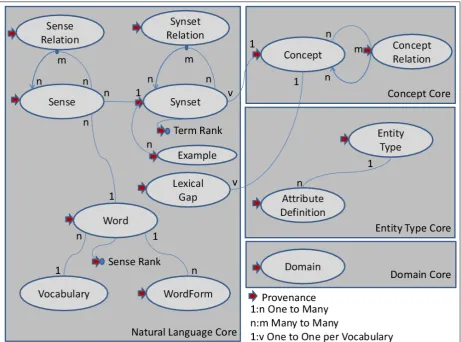
3.1 Knowledge Base Elements . . . 19
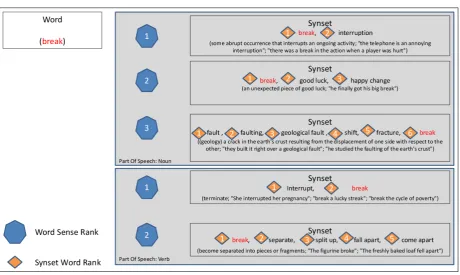
3.2 An example for word sense ranks and synset word ranks . 21 3.3 Provenance graph for the knowledge base . . . 31
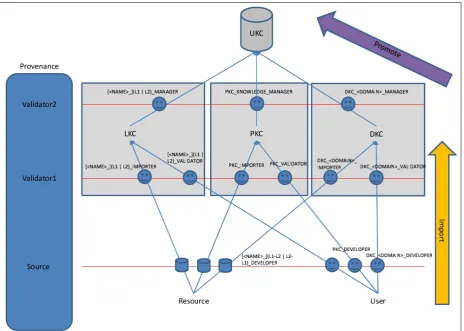
3.4 UKC importing scenarios . . . 32
3.5 UML for Knowledge Base Provenance Web API Model . . 34
3.6 Basic visualization for knowledge base provenance . . . 36
3.7 importing English WordNet for UKC 1.0 . . . 37
4.1 Logical separation of elements in our entity-centric model . 44 4.2 Workflow of dataset resources selection and editing . . . . 51
4.3 Overview of the import pipeline steps . . . 55
4.4 Step 1: Selection . . . 61
4.5 Step 2: Attribute Alignment . . . 63
4.6 Step 3: Attribute Value Validation . . . 68
4.7 Step 4: Attribute Value Disambiguation . . . 70
4.8 Step 5: Entity Alignment . . . 73
4.9 Exporting, Publishing and Visualization steps . . . 77
5.1 A motivation example: importing from two sources . . . . 83
5.2 Overview of the import process scenario . . . 85
CKAN . . . 87
5.5 Extending the import process with source tracing module . 89 5.6 Authority Scopes. (a) Entity type (b) Attribute Definition (c) Entity Set (d) Attribute Value . . . 90
5.7 Reference types . . . 94
5.8 Catalog, Dataset and Distribution etypes . . . 102
5.9 Provenance graph for the entity base . . . 106
5.10 Authority Management Expert Console UI . . . 112
5.11 Authority Management End User Console UI . . . 114
Introduction
1.1
The Context
Recently an increasing number of open data catalogs appear on the Web [54]. These catalogs contain data that represents real world entities and
their attributes. Data can be imported from several catalogs to build web services. The acceptance of these web services has several quality requirements. One of these requirements is the certification of data quality.
Data can be seen as the food of the web. Restaurants that offer high quality food may offer to the customers some facts about the source of their ingredients as a sign of quality and to gain their trust. For the web, data is the food which is continuously produced and consumed by web
services and users. Effective tracing for the sources of data on the web plays a major role in the acceptance of the services built on top of it.
Web services in future will be based on linked data and linked entities. We refer to real world objects that are of enough importance to be given a name as entities. Examples for entities are Italy and Barack Obama. There are different types of entities, such as Locations and Persons. Italy is an entity of typeLocationand Barack Obama is an entity of typePerson. The aggregation of data in our approach is entity-centric, i.e. it imports
which stores entities is called the entity base and the database which stores the language which describes them is called the knowledge base. In logic
terms, the entity base can be seen as a store of ABox elements and the knowledge base is the store of natural language vocabularies and the TBox elements.
The importing of data into the knowledge base and entity base must produce data elements which are of enough quality to enable the web ser-vices. Examples of quality aspects for the knowledge base include manual
translation of vocabularies and expert validation; and for the entity base they include consistent attribute values without conflicts and correct link-ing between internal and external entities. To certify the quality of the
imported elements, it can be useful to trace the provenance of each ele-ment. Users can see this information to appreciate the quality of the data and therefore the quality of the service built on it. This is similar to a customer that appreciates a high quality restaurant by knowing that its
food ingredients are matching his standards.
1.2
The Problem
The main problem of this thesis is to increase the quality of aggregated
entity stores. Data quality can have many aspects and this problem fo-cuses only on those which we think are more relevant to the entity-centric aggregation. The problem can be divided into four major pieces of work:
the quality certification of knowledge base elements, the semantic hetero-geneity and the lack of explicit semantics while aggregating entities, the tracing of entity base elements with attribute values conflict avoidance and entity linking.
The first and the most important problem is the quality certification of
linguistic and domain information. These knowledge base elements are used for several high level services such as natural language processing and
semantic matching. If these elements suffer from low quality characteris-tics, such as linguistic polysemy, then the overall quality of the services, such as the semantic matching, will be significantly reduced. This reduces also the acceptability of the whole system.
Second, the quality of the data in open data repositories is not high enough due to two reasons: the lack of explicit semantics and the
seman-tic heterogeneity. Lack of explicit semanseman-tics is the absence of the implicit semantics that the dataset developer had in his mind while creating the dataset. If this semantics is not made explicit in the dataset itself, auto-mated reasoning by machines will be hindered. Semantic heterogeneity
ap-pears when a dataset is developed for a specific purpose with assumptions that may not exist when the dataset is used in another public scenario.
Third, the attribute values may come from different data sources and it is important to trace the source of each attribute and to choose a strategy to handle possible conflicts. Data sources are not equal and some sources
have more authority than others. A link should be provided between any pair of entities which represent the same real world entity.
1.3
The Solution
Our proposed solution is also composed of four parts which are in parallel
with the division of the problem that was given in the previous section. The three parts are: the provenance of knowledge base elements, the definition of the entity import pipeline and the provenance of entity base elements.
For the knowledge base provenance, we propose a data model which is based on two main elements: the reference and the provenance. A
as entities. Provenance is used to record the source and two validators of each knowledge base element. We define also the mapping of the fields of
the provenance model for each import scenario.
For the entity import, we propose a semantifying pipeline based on an entity-centric approach to enrich datasets with special focus on those datasets which originate from open data catalogs. When entities are
im-ported, the pipeline uses a natural language processing service to enrich the text attribute values with linguistic annotations; and it uses an identity management service to assign unique identifiers to the entities. These two
steps fix the absence of explicit semantics and helps in resolving semantic heterogeneity. The semantifying pipeline is built on a data cleaning tool, and its steps are divided into preliminary steps and tool steps. We describe the semantifying pipeline steps and show some user interface mock-ups for
the tool steps. The required programming interface for the pipeline is also defined.
For the entity base, we propose a source tracing module that extends any existing entity-centric import process. The source tracing module
con-tains three tools: authority, provenance and evidence. Authority provides rules for overriding attribute values, provenance specifies the source of an attribute value and evidence links an entity with same external entities.
These three tools enable the source tracing services in the import process.
1.4
Innovative Aspects
This solution is innovative because it adds the following contributions:
• The knowledge base provenance is the first known model to capture
the provenance of the language and language-independent concepts. The available provenance systems store entity-level provenance and
and conceptual elements is a unique feature of our knowledge base provenance.
• The import pipeline which we use for entity-aggregation is balanced
between the two extremes of current data aggregation approaches. The first approach is the Extract, Transform, Load (ETL) which is
used in data warehouses and the second approach is the knowledge extraction which is used with formal knowledge systems.
• The entity base provenance handles both the provenance and the data
fusion problems using authority rules in one combined model unlike other available solutions. Its definition of evidence is also different from the current ’same-as’ links.
1.5
Structure of the Thesis
This thesis consists of the following chapters:
Chapter 2 presents a survey for the state-of-the-art in three research
directions that are relevant to this thesis. The first section of this chapter surveys the ETL and knowledge aggregation methods and systems, the second section surveys the different approaches to handle the provenance
problem. It also includes a short survey for industrial patents related to provenance.
Chapter 3 introduces the knowledge base and shows how provenance can be used to trace the source of knowledge base elements. The proposed
knowledge base provenance module uses external references to users and datasets. It allows two validators to check the elements before they are finally accepted.
Chapter 4 introduces the entity base and the import pipeline that
values. These entities are imported by a pipeline which takes as input an external source. The pipeline creates or updates the entities and their
attribute values.
Chapter 5 builds on the previous chapter by showing three source tracing tools: provenance, evidence and authority. We introduced these tools in the solution section above.
State of the Art
This chapter contains a survey for the state-of-the-art in three research
directions that are relevant to this thesis. In the first section, we present some ETL and knowledge aggregation methods and systems. The second section surveys the different approaches to handle the provenance problem. The chapter concludes with a short survey for patents from industry to
show examples of available solutions to provenance.
2.1
ETL Tools
Importing tools can be roughly classified into general ETL systems and knowledge extraction systems. The knowledge extraction systems are more
strict in the target format. The target is usually a logic system that allows some form of reasoning even if it is not implemented in the system itself. On the other hand, there is no explicit logical reasoning in generic ETL
systems but they usually allow high level searching with languages like SQL.
Table 2.1 shows the description and license information for some avail-able software for ETL. While Tavail-able 2.2 contains a list of tools used in
Name Description CSV2RDF4LOD
[3]
A tool that produces an RDF encoding of data
available in Comma Separated Values (CSV). D2R Server [4] A tool for publishing relational databases on the
Semantic Web.
Data Master [5] A Protege plug-in for importing schema structure and data from relational databases into Protege Krextor [9] An extensible XSLT-based framework for
extract-ing RDF from XML.
MapOnto [11] A research project aiming at discovering seman-tic mappings between different data models, e.g, database schemas, conceptual schemas, and
on-tologies. Mapping
Mas-ter [12]
A Protege-OWL plugin that can be used to trans-form the content of spreadsheets into OWL on-tologies.
ODEMapster [14]
A NeOn plugin that provides users a Graph-ical User Interface that allows to create, exe-cute, or query mappings between ontologies and databases.
OKKAM Refine extension [15]
An Open Refine extension to upload data into the OKKAM Entity Name System.
Poolparty
Ex-tractor [22]
A platform that provides precise text mining
al-gorithms based on semantic knowledge models. R2R [23] A framework to allow searching the Web for
map-pings to reconcile vocabularies
RDF Refine [27] An Open Refine extension that reconciles against
RDBToOnto RDBToOnto allows to automatically gener-ate fine-tuned OWL ontologies from relational databases.
RDF 123 [26] An application and web service for converting data in simple spreadsheets to an RDF graph. RDOTE [28] A framework for transporting data residing in
RDB into the Semantic Web.
Relational.OWL [29]
Relational.OWL is a technique to automatically extract the semantics of virtually any relational databases and transform this information auto-matically into RDF/OWL
T2LD[32] An automatic framework for extracting, inter-preting and representing tables as Linked Data The RDF Data
Cube Vocabu-lary [36]
A vocabulary that allows publishing
multi-dimensional data on the web in such a way that it can be linked to related data sets and concepts. TopBraid
Com-poser [37]
A modeling environment for developing Seman-tic Web ontologies and building semanSeman-tic
appli-cations.
Triplify [38] A small plugin for Web applications, which re-veals the semantic structures encoded in
rela-tional databases by making database content available as RDF, JSON or Linked Data.
Virtuoso’s RDF Views [40]
A tool for mapping relational data into RDF and allow the RDF representation of the relational
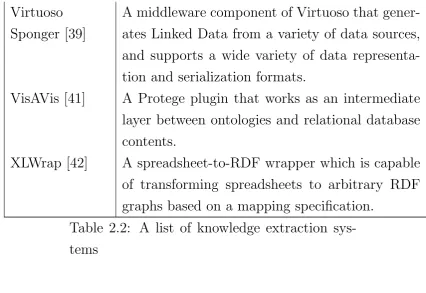
Virtuoso Sponger [39]
A middleware component of Virtuoso that gener-ates Linked Data from a variety of data sources, and supports a wide variety of data
representa-tion and serializarepresenta-tion formats.
VisAVis [41] A Protege plugin that works as an intermediate layer between ontologies and relational database contents.
XLWrap [42] A spreadsheet-to-RDF wrapper which is capable of transforming spreadsheets to arbitrary RDF graphs based on a mapping specification.
Table 2.2: A list of knowledge extraction sys-tems
2.2
Provenance
The current approach to combine datasets from different sources is to use linked data[51]. Linked data systems face two major challenges that de-termine their survival[71]. These challenges are: tracing the source of data and tracing the identity of resources across datasets. The tracing of the
source of data becomes critical when many datasets are imported from different data providers. A simple query to know the source of a piece of the combined data can take weeks of investigation without a suitable
mechanism to describe how the combined dataset is built. The tracing of identity is the second challenge. It appears because some web resources can be treated as equivalent in some contexts. Most of the time the equiva-lence is expressed using the owl:sameAs predicate. These equivalence links
provide the core linking feature of linked data.
scribe the datasets, such as the Vocabulary of Interlinked Datasets (VoID)1. This vocabulary provides a model, a vocabulary of predicates and a
mech-anism for distributing dataset descriptions. The vocabulary captures data locations, structure and statistics. It also includes the notion of linkset
to express the mapping between instances in different datasets. These linksets are separated from the dataset, so they can be used or updated
independently from the dataset itself.
One major problem in data aggregation is the data fusion. There are three known classes of strategies in the literature for data fusion: conflict
avoidance, conflict ignoring and conflict resolution (See Figure 2.1). In conflict ignoring strategies, two attribute values which are in conflict may be created in the aggregated data base which may lead to inconsistency. In conflict resolution strategies, the conflict between two or more attribute
values is resolved by taking their average for instance.
Figure 2.1: Possible Conflict Handling Strategies from [53]
Finally, as a part of our state-of-the-art survey for the latest advances in provenance, we present a summary of the provenance week 2014. The
provenance week is a combined event of two conferences IPAW 2014 and TAPP 2014.
• Initial workshops
The first workshop presented the PROV standard with recipes and tools. The tools include provenance translator that converts between
different serializations formats such as PROV-N and PROV-XML, provenance validator that checks the provenance against PROV con-strains, provenance store and provenance online editor. Finally a hands on session was given about ProvStore and Git2Prov tools.
Then a session on new scenarios of provenance presented four
applica-tions in the domains of scientific research, cloud computing, geospatial data and climate research: [59] is a tool for gathering of provenance information about the datasets used in research papers. [44] under-stands the behavior of Google Cloud from its one month log data. [65]
describes user requirements for modeling geospatial provenance. [86] defines a formal provenance representation for global climate change data.
Four more applications were presented in the next session: [91] studies
query generation for PROV-O data. [76] shows how to use provenance for online decision making with a crowd sourcing scenario. [74] is an application-independent methodology for analyzing data based on the network metrics of provenance graphs for the assessment of data
quality in an automated manner. [78] uses provenance to optimize the parallel execution of scientific workflows.
• IPAW
The workshop discussed these topics: standardization, application,
architecture, security and reproducibility.
In the standardization discussion, two papers were presented: PROV Abs [79], a tool for interactive experimentation with policies and ab-stractions for sharing sensitive provenance data. PROV Gen [61]
and of arbitrary size. Synthetic provenance graphs are useful for test-ing and experimenttest-ing.
In the application discussion, three applications were presented: [77] is an application for Prov PingBack to interconnect provenance records
that would traditionally sit in isolation, [75] proposes a generic and application-independent approach to interpret provenance of data to make online decisions and [67] collects compile-time and run-time
provenance for benchmarking systems.
In the architecture discussion, three papers were presented:
noWork-flow [80] is a tool that transparently captures provenance of scripts and enables reproducibility, LabelFlow [46] uses domain-specific labels with workflow provenance as a platform for data artifacts labelling; and [84] proposes software provenance to be included as part of
soft-ware packages.
In the security discussion, three papers were presented: [56] is a sur-vey for security in seven provenance systems, [45] proposes a policy control framework for integrating and developing services that gener-ate and use provenance. [63] provides security controls for protecting
provenance information.
Finally in the reproducibility discussion, three papers were presented: [85] is an approach to capturing data provenance based on taint track-ing. [89] generates electronic notebook documentation from multi-environment workflows by using provenance represented in the W3C
PROV model. [58] describes a provenance computation technique that uses the structure of workflow specifications to pre-compute the access paths of all dependent data items prior to workflow execution.
• Demos and Posters
query service with PingBack following Provenance Access and Query (PROV-AQ) standard. [50] presented a system that shows
infor-mation about Internet of Things devices to users. [73] was about Prov-O-Viz1, an online web-based visualization for provenance given in PROV-O. Finally [57] presented PBase, a provenance repository that supports search with ranking capability.
Several problems where discussed in the poster session. These prob-lems include using provenance in query answering by limiting the
sources that can be used to answer a query, making provenance inter-operable, adding provenance to an RDF store, tracing provenance of software development as a quality factor, abstracting provenance to hide private details.
Two provenance stores were presented, one provides a Web graphical user interface for visualizing provenance graphs, while the other is a public repository that allows user and applications to publish their
provenance on the web. Another two solutions extended the PROV-DM and PROV-O standards to allow provenance of sensor web and social computing respectively.
Few posters presented the use of provenance in several domains: med-ical, weather, agriculture, geospatial and taxonomy alignment scenar-ios. Other posters discussed engineering choices for provenance. One
engineering solution was proposing to use aspect-oriented program-ming to seamlessly integrate provenance.
2.3
Patents
The patent archives include several approaches for treating the prove-nance problem. For instance, the University Of Southern California
multi-ple, related workflows [90]. Researchers from the University Of Utah Research Foundation proposed provenance management system for
pre-existing applications[62]. IBM corporation shows a system to use and en-force provenance constrains which calculates provenance based on data or meta-data changes and determines whether the calculated provenance vio-lates the constraints[87]. Microsoft corporation used provenance in health
care domain[88]. Other researches produces a system to visualize nance to improve search query[48]. It can be easily noted that these prove-nance tracing approaches are either too generic and they are not tailored
Knowledge Base Provenance
The knowledge base (KB) is a database for background knowledge. The background knowledge must satisfy some quality requirements before it can
be used by semantic services. In this chapter we present how we certify the quality of the knowledge in the KB.
First we present the quality certification problem, then we list the
ele-ments of the KB and how they are imported or created. Next we present our proposed data model which is based on two main elements: the ref-erence and the provenance. A references is used to refer to external users
or resources which are represented as entities, therefore we show also the definition of user and resource entities with the reference model. Prove-nance is used to record the source and the validators of the KB element, therefore we show also the mapping of the provenance fields for each
im-port scenario with the provenance model. Then we show the Web API model and services for KB provenance. Finally, we present few use cases that were treated with the proposed model.
3.1
The Problem
The background knowledge is required to build semantic services [68]. The
ground knowledge behind it. If the quality of the knowledge is low, the semantic services which are built over it will fail to deliver the required
results. For instance, if the background knowledge suffers from high poly-semy (one natural language word that has more than one meaning), it will be less useful for the natural language processing and semantic services [43].
Data quality is generally defined as ”fitness for use”. The KB is used in
the context of semantic services, hence the fitness here can be specified as correctness, completeness and duplication-free. Correctness of the knowl-edge base is the right definition of each KB element and its relations with other elements. Completeness of the knowledge base is the coverage of the
elements in one language and the coverage of all the languages required for the specific application. Duplication-free is the avoidance of repeated elements in the knowledge base, such as duplicated concepts in the concept graph or duplicated meaning for one word.
With this definition of data quality, it can be noted that the quality
of knowledge base is set at the elements creation time. This is because the creation of a KB element causes either an increase or a decrease of the knowledge base quality. For instance, creating a correct example for a synset increases the quality, while creating a wrong translation for a word
decreases the quality. Since the elements creation time is when the quality is changed, the quality can be certified by tracing the sources and users who participated in the creation of the KB element.
Although several approaches for provenance exist in the literature as presented in Chapter 2, they either discussed the problem of provenance at
the instance or the schema levels. There is no existing solution that fulfills the need for provenance at the language and conceptual level, therefore we developed this novel provenance model as a quality certification tool for
Figure 3.1: Knowledge Base Elements
3.2
UKC Elements
The universal knowledge core (UKC) is a central background knowledge database which stores several types of elements. These elements are called knowledge base (KB) elements and some of them are traced by provenance.
The KB elements are classified into four groups: Natural Language Core,
Concept Core, Entity Type Core and Domain Core. Figure 3.1 shows the
KB elements and their inter-relations. It also show that provenance can be assigned to:
at-tributes and relations allowed.
2. Attribute Definition: the name and data type of the attribute.
3. Concept: a formal notion denoting a Class, an Attribute Name
(in-cluding Relation names) or an Attribute Value.
4. Concept Relation: a connection between related concepts.
5. Domain: a set of entity types and a subset of their attributes which determine the terminology of the domain.
6. Lexical Gap: a concept that cannot be lexicalized in the language.
7. Word: represents a word that belongs to a specific vocabulary.
8. Wordform: represents a derived form of a given word.
9. Sense: represents a word sense, basically defining the link between a word and a synset this word belongs to.
10. Synset: a group of words with same sense, i.e. which are synonyms in a language.
11. Sense Relation: a connection between related senses.
12. Synset Relation: a connection between related synsets.
13. Synset Example: an example attached to a specific synset
14. Word Sense Rank: the word sense rank of the word sense (used to
order the senses of a word)
15. Synset Word Rank: the concept word rank of the word sense (used to
Figure 3.2: An example for word sense ranks and synset word ranks
The last two items, namely word sense rank and synset word rank, are not KB elements. They are two ranks associated with KB elements as
shown in Figure 3.2. This figure shows an example for the natural language
word break. Since this word can be a noun or a verb, it has a group of
synsets for each part of speech. In each part of speech group, the synsets
are ordered with the Word Sense Rank which is shown in hexagons. In each synset, the senses are ordered with the Synset Word Rank which is shown in squares.
The word sense rank is associated with a word and a part of speech for this word. The synset word rank is associated with a synset. The provenance is specified for the whole rank and not for a single entry in the
3.3
References
A reference is data structure used to provide external references. There
are three reference types:
1. UserReference. Refers to a user who participated in the import and his editorial role.
2. ResourceReference. Refers to an external resource.
3. ResourcePartReference. Refers to a part of an external resource. (e.g. a row in a table)
Listing 3.1: Reference BNF for KB Provenance R e f e r e n c e : : = User
| R e s o u r c e
| R e s o u r c e P a r t
User : : = I d
, E d i t o r i a l R o l e
E d i t o r i a l R o l e : : = S t r i n g
R e s o u r c e : : = I d
, {R e s o u r c e P a r t}∗
R e s o u r c e P a r t : : = I d e n t i f i e r , URI
Name : : = S t r i n g Value : : = S t r i n g
URI : : = S t r i n g
I d : : = Long
Where:
• Reference: is an external reference to a user, a resource or a resource
part.
• User: is a reference to a user with the editorial role assigned to this
user. The user is represented as an entity with a set of attributes
defined in Section 3.3.1.
• Resource: is a reference to an external resource. The resource is
represented as an entity with a set of attributes defined in Section 3.3.1.
• ResourcePart: is a reference to a part in an external resource.
• Identifier: is the identifier of the part in the external resource.
• Name: is the name of the identifier of the resource part. [e.g., synset offset]
• Value: is the value of the identifier of the resource part. [e.g., n#00145679]
• URI: is the universal resource identifier of the resource part. [e.g.
wordnet/2.1/dict/data.noun]
• Id: is the internal identifier of a resource or an entity in an entity
base. More information on the resource and user entities are given in the Section 3.3.1.
The editorial role depends on the importing scenario. In the UKC 1.0 first-time bootstrapping scenario, there are two predefined editorial roles
UKC1.0 IMPORTER and UKC1.0 VALIDATOR. In the language devel-opment scenario, the editorial role encodes the name of the LKC (NAME), the source language (L1) and the target language (L2). The possible edi-torial roles for the LKC follow this regular expression:
[< NAME > ] ( L1 | L2 ) (IMPORTER | MANAGER)
[< NAME > ] ( L1−L2 | L2−L1 ) (DEVELOPER | VALIDATOR)
The first optional part [NAME ] which has the LKC name is added after copying (promoting) the knowledge base element and its provenance from
the LKC to the UKC.
3.3.1 Modeling Users and Resources
We present here the minimal set of attributes for modeling user and re-source entities. The general attributes of an Entity are given in Table
3.1. These attributes are inherited by both the user and resource enti-ties. In this table (and also in the next tables) The first column shows the attribute, the second column shows the data type and the third column
shows the reference dataset which gave the definition of the attribute. The
<P >symbol beside a data type means that the corresponding attribute is permanent (i.e. it is not constrained with a time validity, but it is always valid).
Attribute Data type Reference Dataset Name NLString []
Class Concept <P>
SURL String<P > UKC system itself
Table 3.1: Entity attributes
• Category: personal
Attribute Data type Reference Dataset
Name NLString [] Person herself Class Concept UKC system itself
Gender ENUM( MALE, FEMALE ) <P> person herself
birth Bate Date <P> Person herself Email String Person herself
Relation Entity type Reference Dataset
Country of
citizenship Country Person herself Country
where hiving now
Country Person herself
City where
living now City Person herself Photo String Person herself
• Category: biography
Attribute Data type Reference Dataset
Degree ENUM( PhD, MASTERS, BACHELOR, HIGH SCHOOL, NONE
) [] <P>
Person herself (Note that with
array symbol we mean that a person ctn select more than one degree)
Work Boolean Person herself
• Category: user
Attribute Data type Reference Dataset Login name String Person herself
Password String Person herself Joining
date Date Person herself Leaving
date Date Person herself
Relation Entity type Reference Dataset
RecommenderPerson <P> UKC existing user (possibly
suggested by person herself)
• Category: expertise
Attribute Data type Reference
Dataset Language
profi-ciency
<Language,
Level> [] Person herself
• Level
ENUM( A1,
A2, B1, B2, C1,
C2 )
person herself
Relation Entity type Reference dataset Language Language Person herself
• 2. Resource
Attribute Data type Reference Dataset Name NLString [] Entity importer herself
Class Concept
<P> Entity importer herself
description SString
<P> Entity importer herself
License String Entity importer herself
Note NLString
<P> Entity importer herself
Version String <P> Entity importer herself
Release String <P> Entity importer herself Date of
publication Date <P> Entity importer herself
Relation Entity type Reference Dataset Owner
Person and/or
Organization
Entity importer herself
• Category: resource identity
Attribute Data type Reference Dataset Homepage
URL String Entity importer herself Resource
URL String Entity importer herself
Attribute Structured
type Reference Dataset
KiDF URL KiDF URL Entity importer herself
• Structured types
KiDF URL
Atbritute Data type Reference dataset Name NLString [] Entity importer herself Description SString Entity importer herself
Note NLString Entity importer herself
3.4
Provenance
After defining the references, we present the definition of the provenance in the figure below.
Listing 3.2: Provenance BNF Provenance : : = P r o v e n a n c e I D
, {KB ID , Note}∗
, S o u r c e
[ , V a l i d a t o r 1 ]
[ , V a l i d a t o r 2 ]
[ , ProvenanceNote ] P r o v e n a n c e I D : : = Long
KB ID : : = Long
Note : : = S t r i n g ProvenanceNote : : = S t r i n g S o u r c e : : = R e f e r e n c e V a l i d a t o r 1 : : = User
V a l i d a t o r 2 : : = User
Where:
• Provenance: is a representation of the source, the first validator and
the second validator that participated in the creation of (zero or more) knowledge base elements.
• Provenance ID: is a unique identifier for the KB Provenance which is
generated and managed by the provenance framework.
• KB ID: is the unique identifier of the knowledge base element to which
the provenance is related. It is generated and managed internally by
• Source: is a reference to an external source as defined in Listing 3.1.
It can be a resource or a user. See Table 3.2 for the content of this
field in each import scenario.
• Validator1: is a reference to an external user defined in Listing 3.1.
The user is either the importer who imported from the source or the language validator who validated an element from the source. See
Table 3.2 for the content of this field in each import scenario.
• Validator2: is a reference to an external user who performed the final
validation on the imported element as defined in Listing 3.1. See Table 3.2 for the content of this field in each import scenario.
• Note: is a string that is used to record user notes on the knowledge
base element.
• ProvenanceNote: is a string that is used to record user notes on the
provenance. This note is written only by validator2.
This provenance model implements a provenance graph (see Figure 3.3) between the knowledge base elements and their external sources. All
ob-jects of the provenance graph in this figure are presented before except ProvenanceElement. This object is introduced to allow the provenance graph to be implemented as a separate database without changing the
Figure 3.3: Provenance graph for the knowledge base
3.4.1 Knowledge import scenarios
Provenance is used to trace the KB elements at their creation time. The KB elements are created in the universal knowledge core (UKC) through import scenarios, such as importing from an external dataset or developing
a translation of a vocabulary by an expert user. In addition to the UKC, there are three other types of knowledge cores which are involved in the import scenarios. These are the Peer Knowledge Core (PKC), Language Knowledge Core (LKC) and Domain Knowledge Core (DKC).
The PKC is a knowledge core which runs on a peer to provide services that support an application. The LKC is a special PKC used to develop
languages; and the DKC is a special PKC used to develop domains. Each LKC has a name, a source language and a target language. In all import scenarios, elements are not created directly in the UKC. They are first
imported in an intermediate knowledge base (PKC, LKC or DKC) then promoted to the UKC. The import scenarios are shown in Figure 3.4.
The import operation is different from other operations that transfer KB elements between knowledge cores. In the import operation, the elements are created from an external source (a user or a resource), while in transfer
LKC, DKC or UKC. No change is required in provenance when copying an element within the system between the knowledge cores; except that after
copying an element into the UKC from an intermediate knowledge base (such as a LKC), the name of the intermediate knowledge base should be added to the provenance.
Provenance is specified only in the first time creation from an exter-nal source. This operation is called Importing operation. Provenance is
not required when elements are copied from PKC, LKC or DKC into the UKC. This operation is called Promotion operation and it just copies the provenance of the element and adds the intermediate knowledge base when
necessary.
Table 3.2 shows how the fields of the provenance are filled in each import scenario.
Import Scenario Required Provenance
Source Intermediate KB Source Validator1 Validator2
Resource
LKC RESOURCE [<NAME>](L1|L2) IMPORTER [<NAME>](L1|L2) MANAGER PKC RESOURCE PKC IMPORTER PKC KNOWLEDGE MANAGER DKC RESOURCE DKC<DOMAIN>IMPORTER DKC<DOMAIN>MANAGER
User
LKC [<NAME>](L1-L2|L2-L1) DEVELOPER [<NAME>](L1|L2) VALIDATOR [<NAME>](L1|L2) MANAGER PKC PKC DEVELOPER PKC VALIDATOR PKC KNOWLEDGE MANAGER DKC DKC<DOMAIN>DEVELOPER DKC<DOMAIN>VALIDATOR DKC<DOMAIN>MANAGER
Table 3.2: Required provenance for each import scenario
3.5
Web API
We implemented a web API for provenance to make it more usable for web scenarios. This was necessary because the main applications for our provenance are web-based. The web API is divided into a model and a list
of services. We used JSON as the serialization format of the model and we followed REST principles in designing the services. In this section, we present the data model and the services of the Web API component for
3.5.1 Data Model
The data model of the knowledge base provenance web API has three classes as shown in 3.5. The classes are KBReference which represents
both the user and resource references; KBProvenance which represents the provenance tuple with the source, validator1, validator2 and the prove-nance note; and finally KBElementProvenance which provides the link
between the provenance and the knowledge base element that is identified with the element ID (and the part of speech in the case of word sense ranks).
Figure 3.5: UML for Knowledge Base Provenance Web API Model
3.5.2 Services
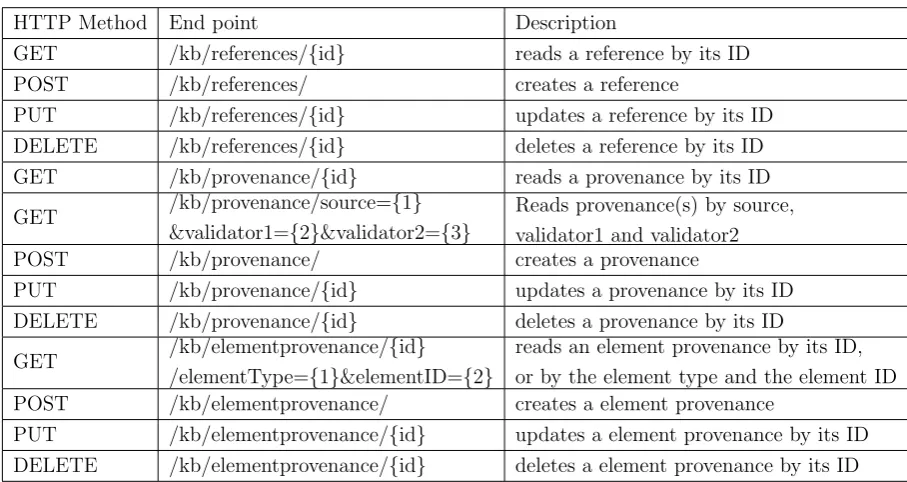
A list of web services is developed for accessing the provenance Web data model. The service list is shown in Table 3.3. The first column shows the HTTP method, the second column shows the end point and the third column shows the description of this end point. The services provide read
and write operations for the model objects. The read operations include searching such as finding a provenance by one or more of its fields (source, validator1 or validator2). The services are designed following the REST
HTTP Method End point Description
GET /kb/references/{id} reads a reference by its ID
POST /kb/references/ creates a reference
PUT /kb/references/{id} updates a reference by its ID DELETE /kb/references/{id} deletes a reference by its ID GET /kb/provenance/{id} reads a provenance by its ID
GET /kb/provenance/source={1} &validator1={2}&validator2={3}
Reads provenance(s) by source, validator1 and validator2
POST /kb/provenance/ creates a provenance
PUT /kb/provenance/{id} updates a provenance by its ID DELETE /kb/provenance/{id} deletes a provenance by its ID
GET /kb/elementprovenance/{id}
/elementType={1}&elementID={2}
reads an element provenance by its ID, or by the element type and the element ID POST /kb/elementprovenance/ creates a element provenance
PUT /kb/elementprovenance/{id} updates a element provenance by its ID
DELETE /kb/elementprovenance/{id} deletes a element provenance by its ID
Table 3.3: List of web services for knowledge base provenance
3.6
User Interface
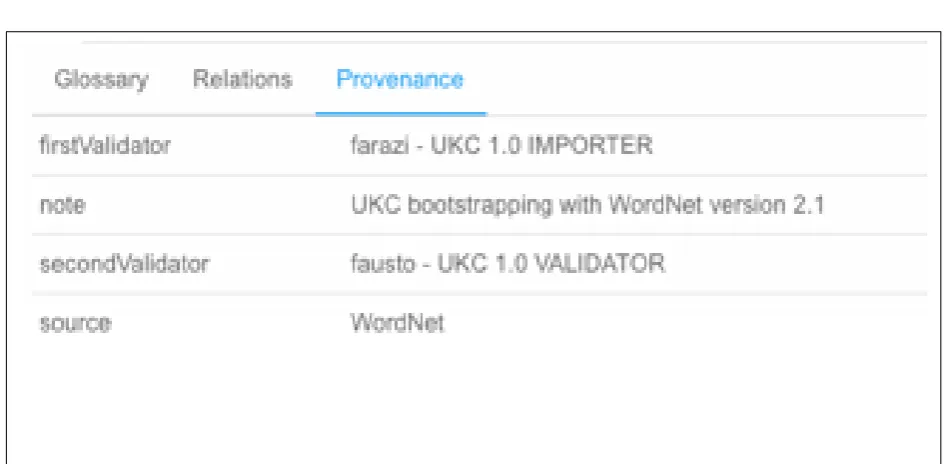
The knowledge base provenance can be visualized within the knowledge
base element user interface. As shown in Figure 3.6, this basic user interface shows the source, validator1, validator2 and a note for an element. More complex user interface can be developed to query the provenance and the
Figure 3.6: Basic visualization for knowledge base provenance
3.7
Use Cases
The knowledge base provenance was validated with few use cases from the Universal Knowledge Core project. This section presents three use cases which used the proposed provenance successfully to ensure high quality for the knowledge elements. The three cases are for importing the English,
Chinese and Mongolian vocabularies. English is a basic language for the background knowledge due to its global use. Chinese is the most spoken language and it is one of the most used languages on the Web. Mongolian
is not widely used as English and Chinese, therefore it provides a different and interesting use case.
3.7.1 Provenance for English Vocabulary
In addition to the six scenarios which were presented in Figure 3.4, there is
This scenario is presented in Figure 3.7. For this scenario, we added the following user roles: UKC VALIDATOR and KNOWLEDGE IMPORTER
to the definition of reference in Figure 3.1.
Figure 3.7: importing English WordNet for UKC 1.0
Import Scenario Required Provenance
Source Intermediate KB Source Validator1 Validator2 Resource PKC Resource (WordNet) UKC1.0 IMPORTER UKC1.0 VADILATOR
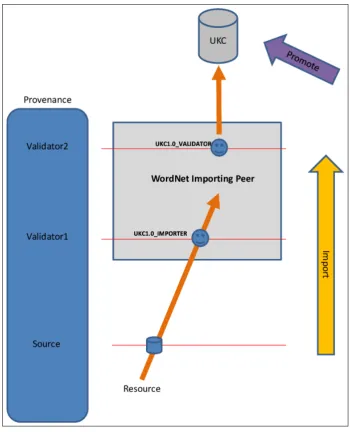
As shown in Figure 3.7, the English vocabulary was imported on a special importing peer which we called here WordNet Importing Peer. The
source of this import is the WordNet, the validator1 is the importer in the role of UKC1.0 IMPORTER and the validator2 is the UKC validator in the role of UKC1.0 VALIDATOR. This information is presented again in Table 3.4.
This use case is important because English is a basic language for the universal knowledge core due to its universal use. It is used as a source
language in many translating scenarios. English WordNet is also the first and the most developed linguistic resource for the semantic web. Similar linguistic resources for other languages (i.e. other WordNets) follow the same data structures and sometimes they reuse the same identifiers for
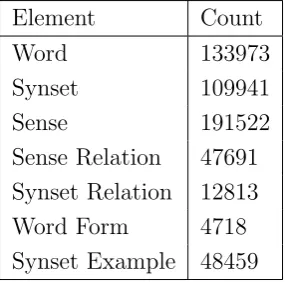
common elements. The list of elements that are imported from the English WordNet are given in Table 3.5.
Element Count
Word 133973
Synset 109941
Sense 191522
Sense Relation 47691 Synset Relation 12813 Word Form 4718 Synset Example 48459
Table 3.5: KB Elements imported from English WordNet
3.7.2 Provenance for Chinese Vocabulary
The development of Chinese language in the Language Knowledge Core (LKC) is done firstly by translating the space domain from English to Chi-nese in order to study the mapping between English and ChiChi-nese synsets
Space domain is translated from English to Chinese. The space domain[69] is a set of knowledge base elements (concepts, words, synsets and their
rela-tions) which are used to describe locations in space. Examples for concepts that can be found in space domain are: City and Mountain.
The Chinese WordNet (simplified version) is a linguistic resource for Chinese language that was developed by Southeast University of China.
It contains translations for the Chinese words of synsets, but, it is out of Chinese glosses. However, it aligned with English glosses which came from English WordNet. I.e. it reuses the same identifiers from the original
English WordNet for synsets, therefore it was straightforward to link the imported synsets from Chinese WordNet with the corresponding concepts in the universal knowledge core.
The result of the Chinese language development is shown in Table 3.6.
The table shows the KB element in the first column, the number of im-ported elements in the second column and the source of the element in the third column. These elements are now ready to be used in Chinese
semantic web applications. With each imported knowledge element, the provenance is added to record who is the importer, the translator and the validator.
Element Count Source
Word 89780 Chinese Wordnet Synset 96636 Chinese Wordnet Sense 119959 Chinese Wordnet Lexical Gap 21 Translator
Word Sense Rank 119959
-Synset Word Rank 119959 Chinese Wordnet
3.7.3 Provenance for Mongolian Vocabulary
The last use case that we present here is an experiment of ontology lo-calization [47]. The experiment was done on about 1000 English concepts
which were originally developed in English and later they are translated into Mongolian. The concepts were taken from space ontology. This use case is interesting because there was no available resources to use as a
back-ground knowledge for the Mongolian language. Starting from the concepts which are developed for English language, it was possible to build a Mon-golian resource for the space domain. A manual approach was used in this Mongolian ontology localization for translation and validation. The
ap-proach has two phases which required provenance: the concept translation and the concept addition.
In concept translation phase, the language translator may develop a word, a synset, a lexical gap or a concept. For each element created, a new provenance will be generated with the source referring to the translator. If
a language validator confirms an already developed element in this phase, then the provenance of that element is updated by linking validator1 to the instance of the UserReference which corresponds to the user name with the role of the language validator that is LKC Validator. As soon as the UKC
validator confirms a validated element, the provenance of that element is updated with the instantiation of the attribute validator2 referring to the name and role of the validator (i.e., UKC Validator) of the given context.
This marks the element as completely validated and accepted.
In the concept addition phase, the language translator may create a new
concept and its related lexical components such as synset, word, etc. in the target language and optionally in the source language. In this case the provenance source for each of the objects will be instantiated with
LKC English validator evaluates the source language synset provided by the language translator, the provenance validator1 is instantiated with her
LKC Validator role. If it happens that the LKC English validator trans-lates back the new concept into the source language, in this case the source is filled in with her role as LKC Developer and the validator1 is left unin-stantiated. Similarly to the concept translation, a UKC validator checks
the correctness of the concept addition and she becomes validator2 with the corresponding role.
3.8
Conclusions
In this chapter, we presented the problem of quality certification for a back
ground knowledge base in semantic web scenarios. The knowledge base el-ements are imported from external sources which can be users or resources. Two expert validators check the elements before they are finally accepted.
We developed a model for tracing the provenance of this importing and validation process. The model has been used successfully in few projects.
Our experiments show that tracing the creation provenance guarantees a good level of quality for the whole knowledge base. This in turn increases
the usability of the semantic services built on top of the knowledge base. The provenance solution that we presented in this chapter can be used as a tool for enforcing and tracing quality for any similar back ground knowledge.
Entity Base
4.1
Introduction to the entity base
The aggregation approach that we follow is entity-centric. It is rooted in the DERA methodology[68] which captures knowledge with four facets: Domains, Entities, Relations and Attributes. The canonical and universal
entity base is Entitypedia1. The unique features of the entity base are (1) the separation between the natural language and formal language; (2) the separation between the instances, the types and the concepts in the formal
language part.
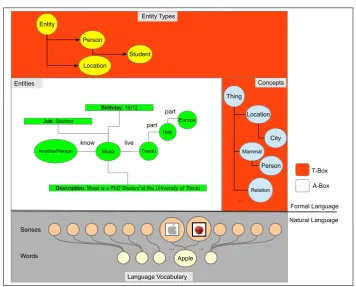
Figure 4.1: Logical separation of elements in our entity-centric model
Figure 4.1 shows a high-level view of the entity-centric model. It divides the elements in two parts: natural language part and formal language part.
The formal language part is also divided into two parts: the A-Box and the T-Box. The A-Box part is the entities part and the T-Box part is divided between the Concepts and Entity Types. The result of this division is four parts:
• The natural language part is the language vocabulary which is used
to describe natural language words and their meaning (sense). A natural language word may refer to more than one meaning (e.g. the
shown English word Apple can refer to the fruit or to the computer company), one meaning can be denoted by different words or one word can have exactly one meaning. The vocabulary part stores more
as shown in Chapter 3.
• The concept part is a graph of concepts where the links between the
concepts are concept relations. Concepts are natural language inde-pendent.
• The entity types part is a type hierarchy with a list of attribute
def-initions for each type. This part acts like the schema for the entities part.
• The entities part is the instances part where entity types and attribute
definitions can be instantiated.
The four parts are connected together with links which are not shown
in Figure 4.1 to avoid confusion.
The entities part (i.e. the A-Box) is stored in the entity base while the other three parts (i.e. the T-Box and the natural language vocabulary) are
stored in the knowledge base. This logical separation allows the system to make the hidden semantic information explicit which enables many services such as entity search with semantics. It also has other benefits such as the multi-language feature.
We refer to real life objects that are of enough importance to be given a name as entities. Examples for entities areItaly andBarack Obama. There are different types of entities, such as Locations and Persons. Italy is an
entity that has a type of Location and Barack Obama is an entity that has a type of Person. The type of entity gives the list of definitions for the attributes that can be assigned to an entity of this type. Location entities may have the attribute Area which holds the value of the total area of the
location, and Person entities may have the attributeBirthdate which holds the date of the birth for this person.
The entity-centric approach is not limited to physical entities like
intellectual and digital objects. Books and movies are two examples of intellectual entities; Computer files and digital pictures are two examples
of digital entities.
The type of entity gives the list of attribute definitions that can be assigned to an entity of this type. Location entities may have the attribute Area which holds the value of the total area of the location, and Person entities may have the attribute Birthdate which holds the date of the birth
for this person. The values of the attribute definitions for a specific entity are called attribute values. An attribute definition can be single-valued (e.g. the birthdate attribute of a person), or it can be multi-valued (e.g.
the email attribute of a person).
An entity is defined as:
Listing 4.1: Entity BNF E n t i t y : : = < {EntityName}+ ,
{AttributeName ,
A t t r i b u t e V a l u e}∗ >
Where:
• EntityName is the name of the entity. An entity can have one or more
names.
• AttributeName is the name of an attribute which is associated with
the entity type of this entity.
• AttributeValue is a value of an attribute which is defined by the
At-tributeName.
For example, an EntityName can be Barak Obama; and an Attribute-Value can be August 4, 1961 which is the value of the birthdate attribute
An entity base supports the following operations on entities and their attributes:
• CreateEntity(Entity e): creates a new entity in the entity base.
• CreateAttributeValue(AttribueDefinition ad, AttribueValue av):
cre-ates a new attribute value for an attribute definition in the entity
base.
• UpdateAttributeValue(AttribueDefinition ad, AttribueValue av):
up-dates an existing attribute value in the entity base.
• GetEntityIdentifier(Entity e): returns the unique identifier of an
en-tity in the enen-tity base or null if the enen-tity does not exist.
• ReadAttributeValue(AttribueDefinition ad): reads the attribute value
for the attribute definition ad.
• IsMultiValuedAttribue(AttribueDefinition ad): returns true if the given
attribute definition is a multi-valued attribute.
4.1.1 The semantic interface
We present here a summary for the semantic services which are exposed
by the knowledge base and entity base. The semantic services are accessed through programming interfaces. These interfaces allow the service to have different implementations.
The semantic services are:
1. Semantic Matching service is used to perform schema matching.
2. Entity Type service is used to perform read entity types or to add
3. Knowledge service is used to access vocabularies to search for natural language words.
4. NLP service is used to provide natural language processing services
such as word sense disambiguation, entity disambiguation and named entity recognition.
5. Entity service is used for CRUD on entities and attributes. Operations that can be performed with the entity service were defined in the previous section.
6. Identity service is used for creating unique identifiers for new entities.
7. Search service is used to find entities that match a given query.
4.2
Problem
Creating a new catalog for open data requires preparing data for public use if the data was not prepared from the design and the implementation for this public scenario. While it could be easy for human users to understand or guess the semantics behind the data, automatic reasoning by machines
will be hindered by two problems known as lack of explicit semantics and semantic heterogeneity.
I. Lack of explicit semantics is the absence of the semantics that the
dataset developer had in his mind while creating the dataset. This im-plicit semantics gives the meaning of the vocabularies and values used in the dataset. When the dataset is published in a catalog without this se-mantics made explicit with the dataset, automatic reasoning by machines
will be hard. Better services can be enabled by resolving the lack of explicit semantics[83].
For instance, let us assume a government dataset that contains data
author that Trento is the city in North Italy. It is possible that another location in the world may have the same name, for instance Trento in the
province of Agusan del Sur, Philippines. It is clear which city is referred to in the data only when the semantics are made explicit by assigning a unique identifier to the Trento city which is in North Italy and link the city with that identifier.
II. Semantic heterogeneity refers to differences or similarities in the meaning of local data[72]. Other kinds of heterogeneity are structural
(schema), syntactic (format) heterogeneity [66]. Heterogeneity is caused by autonomously designed and developed datasets. This heterogeneity makes it harder to link data from different sources together and complicates the
development of services.
For instance, let us assume again a government dataset that contains
data about the city of Trento and another dataset from a public knowledge base like Wikipedia about Trento. Each dataset represents the same city of Trento with different schema, with different format and with different meaning than the other dataset. The government dataset may have the
attribute inhabitants that holds the number of people living in the city in thousands, while the Wikipedia dataset may have the attribute Population that holds the number of people living in the city not in the format of
thousands.
4.3
Import Pipeline
The entity base stores entities from external datasets by importing them.
This section presents the import pipeline which semantifies the datasets and extracts entities from them. The pipeline is composed of steps that are divided into preliminary and tool steps. The preliminary steps are
4.3.1 Catalog Importing Workflow
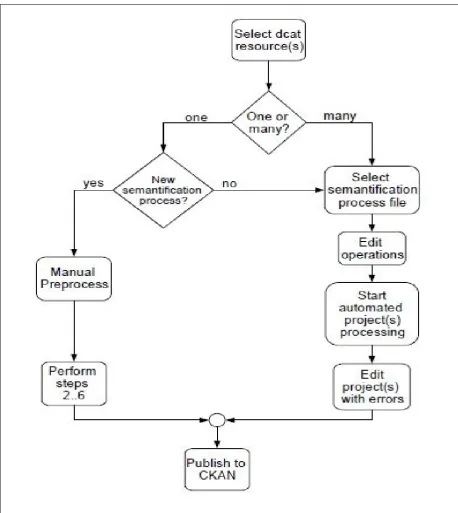
The pipeline has a high level workflow which uses preliminary steps and tool steps. This high level catalog workflow is used to select the resources
and decide if the semantification will run in automatic or in manual mode. The high level semantification workflow is shown in Figure 4.2. The manual preprocess block corresponds to the preliminary steps and theperform steps
block corresponds to the pipeline steps. In this section we present the high
level semantification workflow. Prepocessing steps are introduces in next section and pipeline steps are given in Section 4.3.3. The pipeline can run in manual or automatic modes. The modalities of running the pipeline are
discussed in Section 4.3.4.
The catalog importing workflow takes a catalog as input and checks for each resource in the catalog if the semantification process has been done
before or if it is the first time to semantify the resource.
• If this is the first time to semantify the resource, then we execute both
the preliminary and the pipeline steps manually. After the execution is done, a semantification process file is created. This file stores
infor-mation about the decisions made while performing the semantification process.
• If this is not the first time to semantify the resource, then we use
the semantification process file from a previous run to automate the processing.
4.3.2 The preliminary steps
Before using the tool steps of the semantifying pipeline, some data and
services should be prepared to provide the required functions to the tool steps of the semantifying pipeline. This section lists the steps that install and prepare the data and services. We call these steps the preliminary
steps. The preliminary steps are done by experts who understand both the entity-centric model and the domain of the data. These steps are:
1. Installing the Peer Knowledge Core (PKC). The PKC is a software
platform that has two parts: The Knowledge Base (KB) for storing knowledge elements such as words and concepts, and the Entity Base (EB) for storing entity elements such as entity types and attribute values.
2. Import natural language and concepts from Universal Knowledge Core (UKC). The UKC is a universal data set that can be imported into
a Peer to provide knowledge elements. Natural language elements in the UKC are disambiguated to provide better semantic services.
3. Import the Entity Types (etypes) from the UKC. Initial entity types are imported from a global Entity Base such as Entitypedia into the Peer. This allows the pipeline user to reuse the existing entity types
and their defined attributes.
4. Insert new knowledge elements. The natural language which is
im-ported in step 2 from UKC may not contain all the words or concepts needed to semantify the datasets of a catalog. Experts will be able to add new elements to the local Peer knowledge base after analyzing
the domain of the catalog.
5. Redefine the etypes. The imported etypes from UKC in step 3 can
be extended or changed according to the specific data which will be processed later by the tool steps. Experts will analyze the data and modify the etypes as needed.
6. Redefine the identifying sets. New identifying sets can be created for new or existing etypes. And existing identifying sets can be also
7. Enrich the UKC. The new and updated knowledge elements, etypes and identifying sets in steps 4, 5 and 6 can be promoted to the KB of
the universal knowledge core (UKC). The UKC managers will check the elements and approve them before they are inserted into the UKC. These steps are described in terms of our specific implementation, but they can be generalized to other similar systems. For instance, natural
language words can be imported from WordNET2 and entity types can be imported from Freebase3 .
4.3.3 The tool steps
The tools steps are composed of eight steps. The tools steps start by aselect
of a dataset and then processes it by attribute alignment andattribute value
validation. Then the data passes through two core steps: attribute value
disambiguation and entity alignment. The attribute value disambiguation
step connects the data with unique identifiers for disambiguation and the entity alignment step resolves the conflicts between matched entities with different attribute values. The output is exported and published as a clean and semantically enriched version of the original dataset. This output can
be visualized to the pipeline users if needed. The tools steps of the pipeline are shown in Figure 4.3.
Figure 4.3: Overview of the import pipeline steps
Entities are at the center of the pipeline processing. They are stored in one or more entity bases. These entity bases are not part of the pipeline and
the tool steps of the pipeline communicates with them through a program-ming interface. The programprogram-ming interface calls the entity base services as presented in Section 4.1.1.
The eight tool steps are executed in sequence. Each step takes an input and produces an output. The input to the tool steps is an initial URL for a catalog that uses a DCAT vocabulary . The DCAT vocabulary allows
dataset. The resource can be for example a file to download or a SPARQL endpoint. The output of the tool steps is a semantically enriched version
of the original dataset. The short description of the tool steps is given in Table 4.1.
N Step Name Description
1 Selection Starting from an initial URL for a catalog that uses the DCAT vocabulary, we select a dataset from a list of datasets retrieved from the catalog and read it. We
assume that the data is representable in a tabular form.
2 Attribute Alignment
We select a target type of entity, and then given the list of columns of the input dataset, we match them automatically with the list of attributes in the target type of entity. This will give the correspondence between
the input columns and the output attributes.
The user will then validate