Available Online At www.ijpret.com
INTERNATIONAL JOURNAL OF PURE AND
APPLIED RESEARCH IN ENGINEERING AND
TECHNOLOGY
A PATH FOR HORIZING YOUR INNOVATIVE WORK
MOBILE DATA STREAM MINING: ADAPTATION STRATEGIES WITH AOG
RAHUL WASULE, R.A. FADNAVIS
1. M.Tech, Department of Information Technology, Yeshwantrao Chavan College of Engineering, Nagpur.
2. Asst. Prof. , Department of Information Technology, Yeshwantrao Chavan College of Engineering, Nagpur.
Accepted Date:
27/02/2013
Publish Date:
01/04/2013
Keywords
Mobile Data
AOG
Corresponding Author
Mr. Rahul Wasule
Abstract
This paper presents an overview of the current state-of-the-
art in mobile data stream mining and its applications. The
paper presents the strategies and techniques for adaptation
that are essential in order to perform real-time, continuous
data mining on mobile devices. We present an overview of
adaptation strategies for data stream mining and in particular
for Resource-Aware Adaptation with Algorithm Output
Granularity. Finally, we discuss the key challenges and future
Available Online At www.ijpret.com
INTRODUCTION
Mobile devices are increasingly becoming
the central computing and communication
device in people’s lives. Devices today are
equipped with a growing number of
sophisticated embedded sensors such as an
accelerometer, digital compass, gyroscope,
GPS, microphone, light intensity sensor, and
camera. [1]This creates the opportunity to
develop applications that leverage on the
sensing capability of these mobile devices,
as well as data from other sensors such as
bio/body sensors. Data from mobile
users/devices is becoming increasingly
important for numerous applications
including urban modeling, transportation,
and more recently for mobile
crowd-sensing for citizen journalism and real-time
traffic routing. While significant efforts are
being focused towards the analysis of
mobile user data, a key challenge that
needs to be addressed in order to realize
the full-potential of mobile user analytics is
to address the scalability issues of real-time
data collection. By scalability, we refer to
both the challenges of data transmission
from a large number of users, as well as the
issues of energy consumed on individual
devices as a result of that transmission.
Mobile data stream mining is a key
technology for real-time analysis of data
streams generated on-board the phone
itself, for both data generated by sensors
on the phone and/or in close proximity to
the phone. The significant advantages that
mobile data stream mining provides over
traditional strategies for leveraging the
phone as a “transmission device” for sensor
data, are as follows: reduce the amount of
data transmitted from the phone to
servers/the cloud, as well as reduce the
energy/battery usage on the phone due to
transmission of sensor data. Mobile data
stream mining is particularly significant for
applications that need real-time analysis of
continuous data streams such as such as
mobile crowd sensing, mobile activity
recognition, intelligent transportation
systems, mobile healthcare, and so on.
Mobile data stream mining techniques
typically focus on adapting data stream
mining algorithms to be operational in the
Available Online At www.ijpret.com In addition to such adaptation techniques
for mobile data stream mining, numerous
“light-weight” mining algorithms for varies
types of analysis such as clustering,
classification, concept drift detection,
change detection, and frequent items
analysis have been developed.
A.ADAPTATION STRATEGIES FOR
ENABLING MOBILE DATA STREAM
MINING
There has been much work on
developing adaptation strategies for data
stream mining algorithms that vary the
accuracy levels according to available
computational resource levels and incoming
data rates. Adaptation strategies have been
shown to significantly enhance the
longevity of continuous real-time
processing of data mining in mobile
environments. Adaptation can enable, if not
guarantee, the continuity, cost-efficiency
and consistency of a mobile/ubiquitous
data stream mining application.
As discussed in even efficient data stream
mining algorithms such as Very Fast
K-Means (VFKM) can cause device crashes on
mobile devices when used without
awareness to context such as variations in
data rates and computational resource
availability. Thus, there are primarily three
different adaptation strategies that have
been proposed for mobile data stream
mining:
Situation-Aware Adaptation: With
situation-aware adaptation, the focus of
adaptation is with respect to the
application’s accuracy requirements
changing based on the occurring situations.
When the current situation warrants for
less frequent monitoring/analysis, the
algorithm accuracy can be moderately
decreased to preserve resources.[1] On the
other hand, in critical situations where
there is a need for closer monitoring, it is
important to increase the accuracy even if
the resource availability is scarce. By
situations we mean real-life situations such
‘fire threat’, ‘heat-stroke’, ‘driving’ and
many others. There are certain situations in
which applications do not need high
accuracy (e.g. ‘healthy’ situation). When
such situations occur, data mining
algorithm settings can be adjusted to
produce results with the low accuracy and
Available Online At www.ijpret.com hand, when critical situations (e.g. ‘fire
threat’) occur, the application requires a
higher level of accuracy and the settings of
the mining algorithm can be adjusted to
achieve this according to the need.
Situation-aware adaptation is typically
driven by leveraging context-aware and
situation-aware engines customized for
specific mobile data mining applications.
mHealth (also written as m-health or
mobile health) is a term used for the
practice of medicine and public health,
supported by mobile devices. The term is
most commonly used in reference to using
mobile communication devices, such as
mobile phones, tablet computers and PDAs,
for health services and information, but also
to affect emotional states. The mHealth
field has emerged as a sub-segment of
eHealth,
A Scenario
John has had a heart attack and is released
from hospital but there are concerns that
he might be susceptible to another heart
attack and is also experiencing blood
pressure fluctuations. Constant monitoring
of his vital signs could help him to reduce
his anxiety, decrease the need for routine
visits to medical facilities, and also detect
early warning features of a possible
impending event. He has a smart phone
with SAAP installed on it and is willing to
wear biosensors to measure his vital signs.
The data is wirelessly sent to his mobile
where SAAP detects any changes not only in
his vital signs but in any contextual
information that is related to the
application (e.g. the battery level of the
mobile phone). SAAP uses this information
to reason about situations in real-time and
according to inferred situations, it performs
intelligent and cost -efficient analysis of
data. When fluctuations of vital signs are
within a specified acceptable threshold,
there is no need for frequent measurement
and use of resources can be reduced and
moderated. However, when these
fluctuations are over the threshold, this
situation warrants a closer monitoring by
the system and more frequent
measurements. This type of adaptation
requires factoring in both available
resources and criticality of health situations.
According to the analyst firm Berg Insight,
Available Online At www.ijpret.com using a home monitoring service based on
equipment with integrated connectivity at
the end of 2012. The figure does not include
patients that use monitoring devices
connected to a PC or mobile phone. It only
includes systems that rely on monitors with
integrated connectivity or systems that use
monitoring hubs with integrated cellular or
fixed-line modems. Berg Insight forecasts
that the number of home monitoring
systems with integrated communication
capabilities will grow at a compound annual
growth rate (CAGR) of 26.9 percent
between 2011 and 2017 reaching 9.4
million connections globally by the end of
the forecast period. The number of these
devices that have integrated cellular
connectivity increased from 0.73 million in
2011 to about 1.03 million in 2012, and is
projected to grow at a CAGR of 46.3 percent
to 7.10 million in 2017.
Resource-Aware Adaptation:
The key focus of the adaptation strategies
has been to factor in varying levels of
computational resources on the mobile
device and use this as a continuous control
parameter to adapt the behavior of the
stream mining algorithms that are
operational on the mobile device. Generic
granularity-based adaptation techniques
that can be used with any data stream
mining technique running on a
resource-constrained device have been developed.
This approach facilitates adaptation of data
stream mining algorithms to varying data
rates based on available computational
resources in mobile devices by innovative
strategies to perform knowledge
integration, controlling the rate of learning
and varying the accuracy levels of the
discovered patterns. The granularity-based
adaptation approach has three different
variations. AOG (Algorithm Output
Granularity) provides adaptability by
adjusting the algorithm output rate (e.g. the
number of clusters) according to the
availability of memory, the remaining time
to fill the available memory and the data
stream rate. AOG uses a time threshold that
is the time required to generate the results
before any incremental integration
according to some accuracy measure. AIG
(Algorithm Input Granularity) is a process
that adapts the data rates feeding into the
Available Online At www.ijpret.com by using the methods of sampling, load
shedding and synopsis. When the battery
charge becomes critical, the adaptation
process changes the sampling rate to reflect
the current data rate according to the
previous consumption pattern in the most
recent time frame. APG (Algorithm
Processing Granularity) performs
adaptation of the processing settings of the
algorithm with respect to the CPU usage.
For example, in a a stream clustering
analysis, it uses a novel approach termed
Randomization Assignment. When the
algorithm needs to make the micro-cluster
assignment for a new data point, this
method enables examining only a fraction
of the current micro-clusters using the
randomization factor. If the randomization
factor is equal to 1, all micro-clusters need
to be examined. However if the usage
pattern of CPU increases this factor will be
decreased; thereby reducing the number of
micro-clusters examined and consequently
the CPU consumption.
Mining data streams for mobile and
embedded applications faces a major
problem represented in the high rate of the
streaming input with regard to the available
computational resources. Common
resources are battery charge, remaining
memory, CPU utilization, communication
buffer or bandwidth. The algorithm
granularity setting that is responsible for
adjusting mining algorithm parameters
according to resource availability.
Hybrid Adaptation:
Hybrid adaptation strategies aim to
integrate resource-aware strategies and
situation-aware strategies to control the
adaptation process
B. ALGORITHMS FOR MOBILE DATA
STREAM MINING
Mobile data stream mining algorithms
typically aim to perform the same data
stream mining on-board a mobile device. In
general, these algorithms are typically
one-pass techniques that leverage sliding
windows since they operate over streaming
data. There are two strategies for
development of mobile data stream mining
algorithms. Basically, as explained a mobile
data stream mining algorithm operates with
variability of performance according to
Available Online At www.ijpret.com This variable performance is typically
effected by specifying an upper and lower
bound for accuracy levels that are
acceptable. Thus, there are two ways in
which algorithms are developed according
to this principal. Firstly, the algorithms
themselves are developed as light-weight
techniques that have in-built strategies for
adaptation such as
• Clusterers
o Light-Weight Clustering
o RA-Cluster and DRA-Cluster
• Change Detection
o CHANGE-DETECT
• Classifiers
o Light-Weight Class (LWC)
• Frequent Items and Associations
o LWF (Light-Weight Frequent Items)
o HiCoRE (Highly Correlated
Energy-Efficient Rules)
Alternatively, the algorithms are general
stream mining techniques that can be
treated as a “black-box” (i.e. no
modifications to the internal processing),
but adaptation is leveraged by identifying
an algorithm’s potential control parameters
We have proposed to adapt the mining
algorithm output according to resource
availability and data stream rate. We have
termed this approach as Algorithm Output
Granularity (AOG) Based on AOG, we have
developed data stream mining algorithms
for clustering classification frequent items
and change detection and classification This
paper discusses the theoretical framework
of AOG. The generalization of the approach
using the Probably Approximately Correct
(PAC) machine learning model is also
discussed as a basis for theoretically
applying AOG to other stream mining
techniques. The choice of PAC learning is
based on its acceptance as the fundamental
machine learning model.
C. ALGORITHM OUTPUT GRANULARITY
AOG operates using three factors to enable
the adaptation of the mining algorithm to
Available Online At www.ijpret.com 1. The rate of the incoming data stream is
the first factor.
2. The rate of the algorithm output
represents the second one.
3. From these two, an estimated time
duration to fill the available memory
according to the logged history of data rate
and algorithm output rate is calculated. This
represents the last factor.
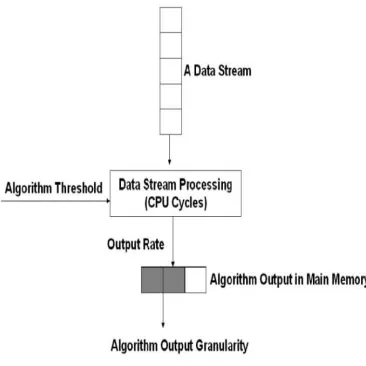
These three factors are used to
adjust what we call the algorithm threshold.
This threshold can control the output rate
of the algorithm according to the mining
technique. Fig. 1 shows how the algorithm
threshold can control the output rate of a
mining algorithm according to the three
factors that AOG operates on. The data
arrives sequentially and its rate is
calculated.
The algorithm runs with an initial
threshold value, and the rate of the output
is observed. The threshold is adjusted
periodically to conserve the available
memory according to the relationship
among the three factors.
Figure 1: Algorithm Output Granularity
Approach
AOG is a three-stage, resource-aware
threshold-based data stream mining
approach. The process of mining data
streams using AOG starts with a mining
phase. In this step, the algorithm threshold
that can control the algorithm output rate is
determined as an initial value set by the
user of the system (or preset to a default
initial value). In this stage, there are three
variations in using this threshold according
Available Online At www.ijpret.com
• Clustering: the threshold is used to
specify the minimum distance between
the cluster center and the data stream
record.
• Classification: in addition to using the
threshold in specifying the distance, the
class label is checked. If the class label
of the stored records and the new
item/record that are close (within the
accepted distance) is the same, the
weight of the stored item is increased
and stored along with the weighted
average of the other attributes,
otherwise the weight is decreased and
the new record is ignored.
• Frequent patterns: the threshold is used
to determine the number of counters
for the frequent items.
The second stage in the AOG approach is
the adaptation phase. In this phase, the
threshold value is adjusted to cope with the
data rate of the incoming stream, the
available memory, and time constraints to
fill the available memory with resultant
knowledge structures.
The third and final stage in AOG approach is
the knowledge integration phase. This stage
represents the merging of produced results
when the computational device is running
out of memory. In clustering, we use the
merging of clusters that are within short
proximity. The merging of class
representatives is used in classification.
Releasing the least frequent items from
memory is our strategy for frequent pattern
mining. This integration allows the
continuity of the data mining process.
Otherwise the computational device would
run out of memory even with adapting the
algorithm threshold to its highest possible
value that results in the lowest possible
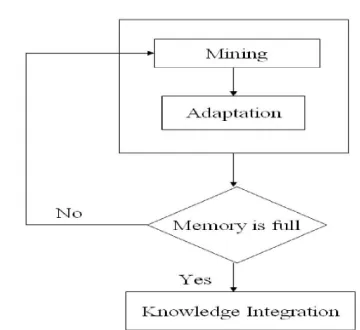
generation of knowledge structures. Fig. 2
shows a flowchart of AOG- mining process.
It shows the sequence of the three stages of
AOG.
Available Online At www.ijpret.com
D.CONCLUSIONS AND FUTURE
DIRECTIONS
With the significant interest in mobile users
and applications, driven by the ever
increasing sophistication and capabilities of
today’s mobile device, mobile data mining
is emerging as a key technology. This paper
gives an overview of the current
state-of-the-art in terms of algorithms, adaptation
strategies, and applications for mobile data
stream mining. There are many key areas
for future work including developing new
application case studies that leverage
mobile data mining such as in the network
gaming area, as well as to develop activity
recognition technologies that turn the
phone to your “personal protection” device,
as well as large scale gathering of data
through mobile devices to sense urban
phenomena and events. Furthermore, there
is always need for more sophisticated
analysis and visualization techniques.
Finally, a key challenge is to take the next
step from analysis to providing real-time
decision making for mobile users.
E. REFERENCES
1. Shonali Krishnaswamy, Joao Gam,
Mohamed Medhat Gaber “Mobile Data
Strem Mining: From Algorithms to
Applications” 2012 IEEE 13th International
Conference on Mobile Data Management
2. Pari Delir Haghighi, Arkady Zaslavsky,
Shonali Krishnaswamy, Mohamed Medhat
Gaber “Mobile Data Mining for Intelligent
Healthcare Support” Proceedings of the
42nd Hawaii International Conference on
System Sciences - 2009
3. Joao˜ Bartolo´ Gomes ErnesMna
Menasalvas and Pedro A. C.
“Situation-Aware Data Stream Mining Service for
Ubiquitous Applications” Eleventh
International Conference on Mobile Data
Management
4. Mohamed Medhat Gaber “Foundations
of Adaptive Data Stream Mining for Mobile
and Embedded Applications” Proceedings
of the 2008 IEEE,
CIBEC'08978-1-4244-2695-9/08/$25.00 ©2008 IEEE
5. Salim F.D., Loke, S. W., Rakotonirainy, A.,
Srinivasan, B.,Krishnaswamy, S., 2007,
Available Online At www.ijpret.com collision detection at road intersections,
Proc of the 2007 IEEE Intelligent
Transportation Systems Conference, USA,
pp. 16.
6. Brett Gillick, Hasnain AlTaiar, Shonali
Krishnaswamy, Jonathan Liono, Nicholas
Nicoloudis, Abhijat Sinha, Arkady B.
Zaslavsky, Mohamed Medhat Gaber:
Clutter-Adaptive Visualization for Mobile
Data Mining. ICDM Demo Paper 2010: