6759 STABILITY INDICATING RP-HPLC METHOD DEVELOPMENT AND VALIDATION
FOR ESTIMATION OF APALUTAMIDE IN BULK AND ITS DOSAGE FORMS
R. Kiranjyothi*1, M. Balakrishnan2, K. B. Chandrasekhar3
1Department of Pharmaceutical Analysis and Quality Assurance, Research scholar, Jawaharlal
Nehru technological university, Ananthapuramu-515002, A.P, India.
2Department of Pharmacognosy, Sri Seshachala College of Pharmacy, Puttur-517583, Tirupathi,
A.P, India.
3Department of Chemistry, Jawaharlal Nehru technological university,-Ananthapuramu-515002,
A.P, India.
*Corresponding author E-mail: [email protected]
ARTICLE INFO ABSTRACT
Key Words
Apalutamide; RP-HPLC; Stability indicating; Validation
A Stability-indicating reverse phase-high performance liquid
chromatographic (RP-HPLC) method was developed and validated for the determination of Apalutamide in tablet dosage form using C18
column phenomenix (250mm*4.6mm,5µm) with a mobilephase consisting of Methanol:2Mm Sodium Phosphate buffer pH 9.5(Adjusted with dil. NaOH)(25:75v/v).The mobilephase was sonicated for 10 minutes and filtered through a 0.45 µm membrane filter at a flow rate of 1ml/min. The detection was carried out at 272nm and retention time of apalutamide was found to be
3.273min.Method validation was Performed and Linearity was observed from50-150%. Apalutamide was subjected to stress
conditions including acidic,alkaline, oxidative, photolysis,and thermal degradation and results showed that it was more sensitive towards Basic degradation.
INTRODUCTION
Apalutamide chemically known as4-[7-[6-cyano-5-(trifluoromethyl) pyridin-3-yl]-8-oxo-6-sulfanylidene-5,7-diazaspiro[3.4] octan-5-yl]-2-fluoro-N-methylbenzamide.
Apalutamide, is a non steroidal antiandrogen (NSAA) medication which is used in the treatment of prostate cancer. It is specifically indicated for use in conjunction with
castration in the treatment of non
metastatic (NM-CRPC).Apalutamide is a potent androgen receptor (AR) antagonist that selectively binds to the ligand binding domain
of AR and blocks AR nuclear translocation . It has been used for studying the treatment of Prostate Cancer, Hepatic impairment, Prostatic Neoplasms, Castration-Resistant Prostate Cancer, and Prostatic Neoplasms. Exerting an antitumour action, Apalutamide blocks the effect of androgens that promote tumour growth. It targets the AR ligand-bindingdomain and prevents AR nuclear translocation, DNA binding, and transcription of AR gene targets in prostate tumours. It is used for the treatment of patients with
non-Journal of Global Trends in Pharmaceutical Sciences
6760
metastatic prostate cancer that is resistant to treatment with hormone therapy(castration-resistant). It is available as oral tablets. Apalutamide is the first FDA-approved treatment for non-metastatic, castration-resistant prostate cancer. Extensive Literature reveals that there are no works reported on Apalutamide. So our Present work includes stability studies including Method
Development and Validation of Apalutamide.
2. MATERIALS AND METHODS
2.1 Chemicals and reagents: The reagents used in this work were Methanol, HCL, NaOH (AR), and Hydrogen peroxide (3%) (AR), which were procured from, Merck India. Distilled water (HPLC) grade was obtained from Merck, Ltd; Mumbai.
2.2 Equipment: The instrument used in this study were electronic balance,sonicator,hot air oven,andDigital,pHmeter,HPLC(Shimadzu)wa s monitored and integrated using empower Software. Syringe system Additionally syringe[Hamiliton(Rheodye-20µL)]and
syringe filter were used.
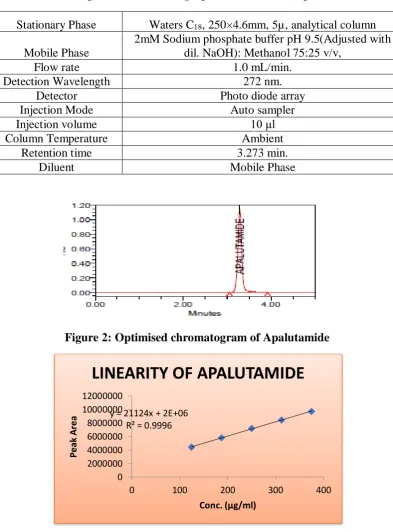
2.3 Chromatographic conditions: A number of HPLC systems were investigated to optimize the separation of apalutamide .HPLC system was composed of an prominence solvent delivery module,a manual rheodyne injector . With a 20µL fixed loop and an SPD-20A prominence UV- visible detector. Seperation was performed on a phenomenix C18 Column (250mm*4.6mm i.d; 5µ𝑚) phemomenex, Torrance at a ambient temperature.The mobile phase consisits of Methanol:2Mm Sodium Phosphate bufferpH 9.5(Adjusted with dil. NaOH)(25:75v/v). The Mobile phase was sonicated for 10 min and filtered through a 0.45µm membrane filter.The Mobilephase flow rate was maintained at 1ml/min and eluents were monitored .The samples were injected using a 20µL fixed loop.All determinations were performed at ambient temperature for a run time of 10 min.
2.4 Method development
2.4.1 Selection and preparation of mobilephase: Various mobilephase containing Methanol ,water in different ratios were tried with different ratios .Good symmetrical peak was found with the mobile phase comprising
Methanol: Water in the ratio 25:75(v/v)(pH was adjusted to 9.5 with dil.NaOH. Mobile phase was prepared by mixing 250 mL of HPLC grade methanol with 750 ml of water and the pH was adjusted to 9.5 with dilute sodium hydroxide. Mobile phase was sonicated for 10 min and filtered through a 0.45µm membrane filter.
2.4.2 Preparation of standard stock solution
The standard stock solutions of 1000µg/ml of the drug were prepared by dissolving 50mg of the pure drug in the mobile phase in a 50ml volumetric flask and the volume was made up to the mark. Resulting solutions were further diluted with Mobile phase to obtain a final concentration of100µg/ml and stored under refrigeration.
2.4.3 Preparation of calibration curve
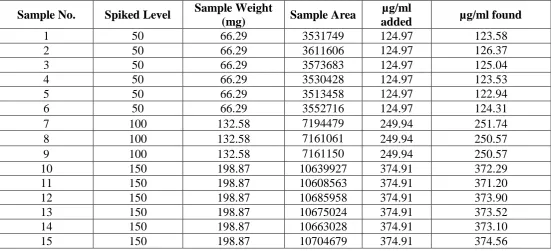
Aliquots of standard stock solutions were put in a 10ml volumetric flask and diluted up to the mark with mobilephase .In such a way ,the final concentration of the drug were in the range of 50-150 µg/ml.Triplicate injections of 20µL were made and analysed by chromatograph under the conditions as described above.Evaluation of the drugwas performed and peak areas were recorded .Calibration curves were constructed by plotting the peak area on y-axis against respective concentration of the drug on x-axis.The calibration curve was evaluated by its coefficient of determination(R2).
6761
2.5.1 Linearity: A stock solution of Apalutamide of 1000 µg/mL was prepared with mobile phase.From it variousWorking standard solutions were prepared in the range of 50 to 150 µg/mL and injected into HPLC. It was shown that the selected drug had linearity in the range of 50-150 µg/mL.The calibration plot was generated by replicate analysis (n=9) at all concentration levels and the linear relationships was evaluated using the least square methpd within Microsoft program.
2.5.2. Accuracy
The Accuracy of the method was carried out using one set of different standard addition methods at different concentration levels, 50%, 100%, 150% and then comparing the difference between the spiked value (theatrical value) and actual found value.
2.5.3. Precision: The Precision of the method was ascertained from the peak area obtained by actual determination of six replicates of a fixed amount of the drug (50 µg/mL).The precision of the assay was also determined in terms of intra- and inter day variation in the peak areas of a set of drug solutions on three different days..The intra day and inter day variation in the peak area of the drug solution was calculated in terms of relative standard deviation.(RSD)
2-5.4 Robustness: Robustness of the proposed method for Apalutamide was carried out by the slight variation in flow rates ,pH and mobilephase ratio. The percentage recovery and RSD were notes for Apalutamide.
2.5.5 Ruggedness: The test solutions were prepared as per test method and injected under variable conditions.Ruggedness of the method was studied by different analysts.
2.5.6 Detection limits and quantification limit
The limit of detection and limit of quantification were established based on the calibration curve parameters. According to the formula
LOD=3.3*S.D/slope
LOQ=10*S.D/slope
3. Forced degradation studies: The specificity of the method can be demonstrated through forced degradation studies conducted on the sample using Acid, Alkaline, Oxidative, Thermal studies, Photolytic and Ultraviolet Degradations. The sample was exposed to these conditions and the main peak was studied for the peak purity thus indicating that the method effectively separates the degradation products from pure active ingredients.
3.3.1- Degradation in acidic condition: Acid degradation of apalutamide was performed using 0.1N HCL.132.58 micrograms of the Apalutamide was weighed accurately and transferred into a 10 ml clean volumetric flask. The content of volumetric flask was dissolved in 5 ml of 0.1N HCL.then the volumetric flask was heated on a water bath at 65°c for 4 hours. Neutralize the sample with 0.1N NaOH and injected into HPLC system.
3.3.2. Degradation in Basic condition: Alkaline degradation was performed using 0.01M NaOH.132.58 micrograms of the Apalutamide was weighed accurately and transferred into a 10 ml clean volumetric flask. The content of volumetric flask was dissolved in 3 ml of 05N NaOH .then the volumetric flask was kept aside for 6 hours. Neutralize the sample with05N HCL and injected into HPLC system.
3.3.3 Oxidative degradation:
Alkaline degradation was performed using 0.01M NaOH132.58 micrograms of the Apalutamide was weighed accurately and transferred into a 10 ml clean volumetric flask. The content of volumetric flask was dissolved in 5ml of 3% H2O2.Then the volumetric flask was Kept aside for 1 day. and injected into HPLC system.
3.3.4 Photolytic degradation
6762
under direct sunlight for degradation.At different time intervals,10mg of sample was taken out .From it a stock solution of 1000µg/mL was prepared.Then it was sonicated for 5 min and diluted to obtain a working solution of 50 µg/mL in the mobilephase.it was then filtered through a 0.22µm filter and injected into the HPLC for analysis. The obtained chromatogram was observed for any degradation occurred during time
3.3.5.UV-degradation:
For UV degradation 100mg of the apalutamide was weighed accurately and transferred into a clean petridish .then the petridish was placed under a uv chamber 30cm at distance from the uv lamp After 3 hr the uv lamp was switched off and 10mg of sample was taken out .From it stock solution of 1000µg/mL was prepared.Then it was sonicated for 5 min and diluted to obtain a working solution of 50 µg/mLin the mobilephase.it was then filtered through a 0.22µm filter.
3.3.6 Thermal degradation:
Thermal degradation was performed by placing apalutamide in the incubator at 40°c.samples were drawn at different time intervals.132.58 weighed amount of sample was added to 5 ml of HPLC grade Methanol and heat at 80°C and sonicated for 5 min and injected into HPLC system.
4. DISCUSSION
In this RP-HPLC method the Linearity was within the range of 50-150µg/ml.The method was successfully validated in the optimized Conditions and the validation parameters were within the limits. In this chromatographic method , the LOD AND LOQ of Apalutmide was found to be 0.000023mg/ml,0.000076mg/ml. In the present study Apalutamide was subjected to
stability studies under different conditions as per ICH guidelines.From acidic hydrolysis degradation peaks are observed at0.53 min and 3.023min along with the drug peak .The peak area showed that 9.18% of degradation occurred when the drug was kept in 0.1N HCL at 65°C for 4 hours.From alkaline degradation .Degradation peaks are observed at 3.023min along with the drug peak .The peak area showed that 11.60% of degradation occurred when the drug was kept in 0.5NaOH and kept aside for 4 hours. From Photolytic degradation Degradation peaks are observed at 2.52,2.62,4.32min along with the drug peak.The peak area showed that 7.73% of degradation occurred when the drug was exposed to sunlight and kept aside for 4 hours .From Oxidative degradation.Degradation peaks are observed at 2.52.4.1min along with the drug peak .The peak area showed that 10.80% of degradation occurred when the drug was treated with 3%H2O2 and kept aside for 1 day.From Thermal degradation Degradation peaks are observed at 2.52, 4.1min along with the drug peak .The peak area showed that 10.80% of degradation occurred when the drug was treated with 3%H2O2 and kept aside for 1 day.
5. CONCLUSION
6763
Figure 1:Chemical structure of Apalutamide
Table 1: Optimized chromatographic conditions of Apalutamide
Stationary Phase Waters C18, 250×4.6mm, 5µ, analytical column
Mobile Phase
2mM Sodium phosphate buffer pH 9.5(Adjusted with dil. NaOH): Methanol 75:25 v/v,
Flow rate 1.0 mL/min.
Detection Wavelength 272 nm.
Detector Photo diode array
Injection Mode Auto sampler
Injection volume 10 μl
Column Temperature Ambient
Retention time 3.273 min.
Diluent Mobile Phase
Figure 2: Optimised chromatogram of Apalutamide
Figure 3: Linearity of Apalutamide
y = 21124x + 2E+06 R² = 0.9996
0 2000000 4000000 6000000 8000000 10000000 12000000
0 100 200 300 400
P
ea
k
A
rea
Conc. (µg/ml)
6764
Table 2: Linearity studies of Apalutamide
Level Conc (µg/ml) Peak Area
LINEARITY50% 125 4442136
LINEARITY75% 187.5 5796681
LINEARITY100% 250 7189562
LINEARITY125% 312.5 8436630
LINEARITY150% 375 9723328
Table 3: Accuracy of apalutamide
Sample No. Spiked Level Sample Weight
(mg) Sample Area
µg/ml
added µg/ml found
1 50 66.29 3531749 124.97 123.58
2 50 66.29 3611606 124.97 126.37
3 50 66.29 3573683 124.97 125.04
4 50 66.29 3530428 124.97 123.53
5 50 66.29 3513458 124.97 122.94
6 50 66.29 3552716 124.97 124.31
7 100 132.58 7194479 249.94 251.74
8 100 132.58 7161061 249.94 250.57
9 100 132.58 7161150 249.94 250.57
10 150 198.87 10639927 374.91 372.29
11 150 198.87 10608563 374.91 371.20
12 150 198.87 10685958 374.91 373.90
13 150 198.87 10675024 374.91 373.52
14 150 198.87 10663028 374.91 373.10
15 150 198.87 10704679 374.91 374.56
Table 4: System suitability
S. No STD Area Theoritical Plates Tailing Factor RT
1 7289022 6839 1.00 3.282
2 7216189 6755 1.00 3.283
3 7154002 6616 0.99 3.276
4 7092252 6499 1.00 3.282
5 6972842 6576 0.99 3.278
Avg 7144861 6657 1.00 3.28
SD 120739 137.78 0.01 0.0030
6765
Table 5: System precision
S. No Sample Weight Sample Area % Assay
1 132.58 7122699 99.69
2 132.58 7142606 99.97
3 132.58 7118974 99.64
4 132.58 7176367 100.44
5 132.58 7165881 100.30
6 132.58 7132006 99.82
Average Assay: 99.98
STD 0.33
% RSD 0.33
Table 6: Method precision
S. No Sample Weight Sample Area % Assay
1 132.58 7165874 100.30
2 132.58 7186524 100.59
3 132.58 7198745 100.76
4 132.58 7175896 100.44
5 132.58 7174524 100.42
6 132.58 6974965 100.42
Avarage Assay: 100.49
STD 0.16
% RSD 0.16
Table 7: Results of LOD and LOQ
LOD 0.000023 mg/ml
LOQ 0.000076 mg/ml
The LOD AND LOQ of apalutamide were determined to be 0.000023mg/ml,0.000076mg/ml
Table 8: Results of robustness studies
S.No Condition Peak area % Assay
1 0.8 ml/min 7108459 99.49
2 1 ml/min 7156845 100.17
3 1.2 ml/min 7157652 100.18
4 30 °C 7125339 99.73
5 35°C 7156845 100.17
6 40 °C 7142750 99.97
6766
Acid studies Base studies
Figure 4: Acid degradation of Apalutamide
Figure 5: Base degradation of Apalutamide Photolytic studies Thermal studies
Fig 6: Photolytic degradation of Apalutamide
Fig 7: Thermal degradation of Apalutamide
Oxidative studies
Fig 8: Oxidative degradation of Apalutamide
Table 9: Result of Forced degradation studies
Nature of the Sample
Sample
Weight Sample Area % Assay % of Degradation
Acid 132.58 6489022 90.82 9.18
Base 132.58 6316189 88.40 11.60
UV 132.58 6354002 88.93 11.07
Heat 132.58 6592252 92.27 7.73
6767
REFERENCES:
1. ICH guidelines.Q1A (R2); Stability Testing of New Drug Substances and products (revision 2) International conference on harmonization .Availablefrom:http://www.fda.gov/do wnloads/regulatoryinformation/guidan ce/ucm128204.pdf).20
2. Kats, Forced degradation studies: Regulatory considerations and Implementation. Biopharm Int.18(2005)1-7.
3. Szepsi, Selection of high performance liquid chromatographic methods in pharmaceutical analysis .III. Method validation
,J.Chromatogr.464(1989)265-278
4. Carr, J Practical approach to method validation in pharmaceutical analysis J.Pharm.Biomed.Anal.86(1990)613-618
5. Jenke,Chromatographic method validation ;a review of common practices and procedures
II,J.Liq.Chromatogr.19(1996),737-757
6. Bakshi, Development of validated stability indicating assay method – criticalreviews,J.Pharm,Biomed.Anal, 28(6)(2002)1011-1040.
7. Synder.J.L.Glajch,J.J. Kirkland, Practical HPLC Method
Development,seconded.,Wiley,Newyo rk,1997.
8. Singh, Z. Rehman, Current trends in forced degradation study for
pharmaceutical product development .J.Pharm Educ.Res.3(1),(2012)54-63.
9. Ashutoshkar: Pharmaceutical drug analysis, published by new age international (p) Ltd,(2001).
10.Ravisankar, Analytical method Development, Indian Journal of Research in Pharmacy and
Biotechnology, 2 (3), 2014,1183-1195.
11.Ravi Sankar. Text book of pharmaceutical analysis. 3rd ed. Tirunelveli: Rx Publications; 2001.
12.Kasture AV, Mahadik KR, Wadodker SG, More HN. Instrumental methods of Pharmaceutical analysis,2(14), 2006,1-30.
13.H.H. Williard, L.L.Merit, F.A. Dean and F.A. Settle, Instrumental Methods of Analysis, ed-7th, CBS Publishers andDistributers,NewDelhi,1(156),1986 , 622-628.
14.Sharma, High performance liquid chromatography, Instrumental Methods of Chemical Analysis. 13th ed. Meerut: Goel Publisher House; 2000.1-7.
15.Chatwal, Anand, High performance Liquid chromatography, Instrumental Methods of Chemicals Analysis. 1st ed. Mumbai: Himalaya Publishing House; 2000,184..
16.Chromatographic techniques (online): https://en.wikipedia.org/wiki/Chromat ographyHPLCdetectors(online):http:// www.pharmatutor.org/articles/details- on-various-detectors-used-in-high- performance-liquid-chromatography-in-compare-to-sensitivity.
17.Snyder,JJKirkland, JI Glajch, Practical HPLC Method Development. A Wiley-Interscience Publication, 2 (21), 1997 ,685-713
18.Christopher RileyM,Thomas Rosanske W. Development and validation of analytical methods. 1st ed. United States of America. Elsevier science, 1996.
19.International Conference on Harmonization (ICH) Guidelines Q2 (R1), ICH Guidelines: Validation of analytical procedures: Text and methodology Geneva, 2005.
20. International Conference on